X./2.: The short intervention
In the course of the processing of the chapter the student gets acquainted with the field of application and the methods of short intervention
X./2.1. Theoretical bases of short intervention
In Hungary it is a characteristic general phenomenon that alcoholics and other addicts get to be treated only after severe internal organic complications (e.g. cirrhosis, pancreatitis) or neuropsychiatric diseases (e.g. alcoholic dementia, delirium tremens) have already developed, or the consumer gets confronted with the legal consequences of illegal drug consumption. And even in a such a case it is a frequent occurrence that the treatment only aims the existent internal organic, traumatological or other problem, and no intervention regarding substance abuse happens. Short Intervention technique has been developed by the WHO for the assessment and treatment of problematic alcohol consumption. Problematic drinkers constitute a greater proportion of the population than alcoholics do.
The characteristics of the problematic/risk drinkers are the following: 1. Consuming a bigger amount of alcohol on a daily basis or drinking occasionally but recurrently until intoxicated
2. Alcohol consumption causes physical and/or mental problems
3. Alcohol consumption causes workplace, domestic and relationship problems. 4. With a certain proportion of problem drinkers an alcohol addiction evolves further on.
What are the questions we use for assessing drinking habits?
The aim of Short Intervention is the screening of risk- and problemc drinkers , and arousing motivation to change. Through the employment of the method the alcohol consumption of risk- and problem drinkers can be reduced, moreover, the method is suitable for motivating alcoholics to sign up for addictological treatment. Since its 1980 introduction, the efficiency of the method has been proved in many countries by several large sample analyses (Moyer 2002).
X./2.2. Screening
According to the recommendation of WHO, the first step of the method is the taking of a test that assesses drinking habits (Alcohol Use Disorders Identification Test, AUDIT). The test is comprised of 10 questions by the help of which it can be promptly
ascertained which risk-group our patient belongs to. The test can be taken in an interview as well as in a self-completion questionnaire form (Babor 2001).
List the four risk zones.
Figure 1.: Test gauging drinking habits
According to the recommendation of WHO, based on the test we may separate the different drinkers needing different therapeutic interventions according to the following. It is important to know that point limits are not normative, they may change from country to country and from individual to individual, thus at the classification the actual clinical picture has to be considered as well.
Table 2.: Recommended interventions in the case of problem drinking
X./2.3. The measure of risk drinking
According to the recommendation of WHO, the upper limit of safe alcohol consumption is maximum two drinks a day with two alcohol free days a week. Naturally, these data may be slightly modified by the type of the alcoholic beverage, the eating habits, the sex and body weight of the patient, but the limit may not rise significantly.
By a “drink” we mean the following:
one glass (330 ml) 5 % alc/vol beer, OR one pony (40 ml) 40 % alc/vol hard liquor OR one glass (150 ml) 12 % alc/vol wine
For women during the period of pregnancy as well for hepatopaths and patients taking certain medications they recommend complete abstinence.
X./2.4. Education for low-risk drinkers
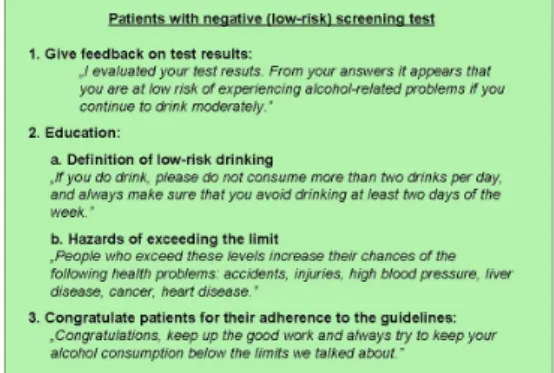
What should low-risk drinkers be educated about?
For those patients, who belong to the group of low-risk drinkers (scored less than 8 points in the AUDIT test), education about alcohol consumption is useful for preventive reasons.
X./2.5. Simple counselling for those belonging to risk zone II
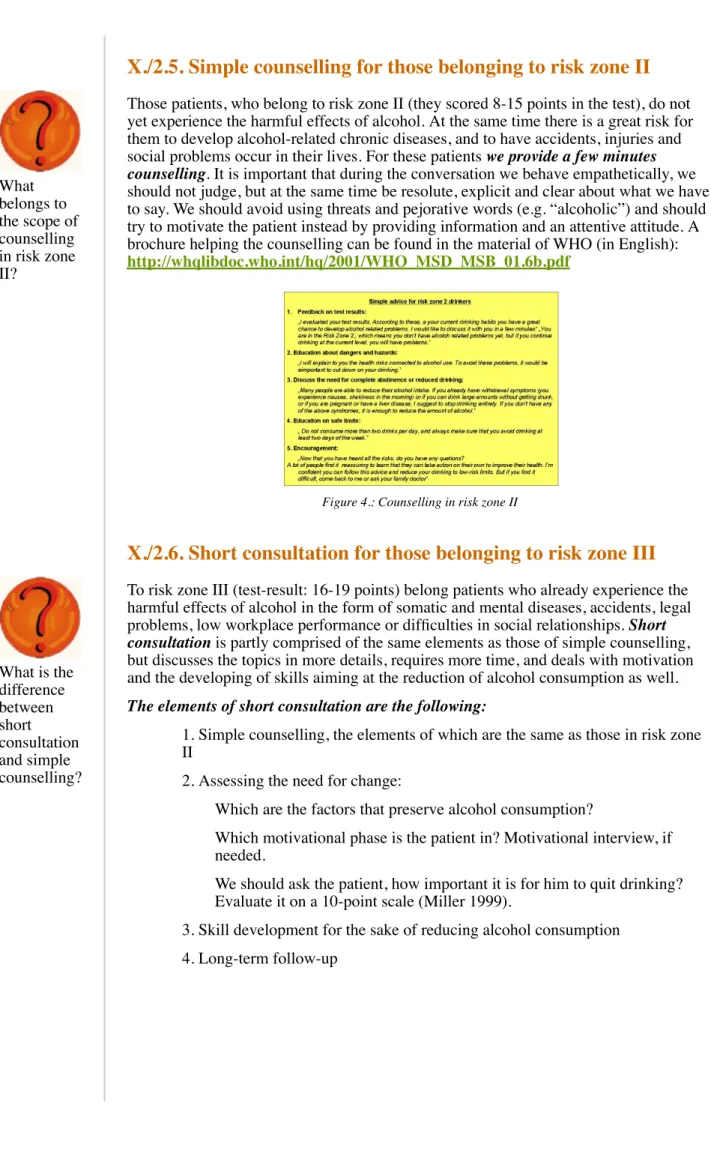
What belongs to the scope of counselling in risk zone II?
Those patients, who belong to risk zone II (they scored 8-15 points in the test), do not yet experience the harmful effects of alcohol. At the same time there is a great risk for them to develop alcohol-related chronic diseases, and to have accidents, injuries and social problems occur in their lives. For these patients we provide a few minutes counselling. It is important that during the conversation we behave empathetically, we should not judge, but at the same time be resolute, explicit and clear about what we have to say. We should avoid using threats and pejorative words (e.g. “alcoholic”) and should try to motivate the patient instead by providing information and an attentive attitude. A brochure helping the counselling can be found in the material of WHO (in English):
http://whqlibdoc.who.int/hq/2001/WHO_MSD_MSB_01.6b.pdf
Figure 4.: Counselling in risk zone II
X./2.6. Short consultation for those belonging to risk zone III
What is the difference between short consultation and simple counselling?
To risk zone III (test-result: 16-19 points) belong patients who already experience the harmful effects of alcohol in the form of somatic and mental diseases, accidents, legal problems, low workplace performance or difficulties in social relationships. Short consultation is partly comprised of the same elements as those of simple counselling, but discusses the topics in more details, requires more time, and deals with motivation and the developing of skills aiming at the reduction of alcohol consumption as well. The elements of short consultation are the following:
1. Simple counselling, the elements of which are the same as those in risk zone II
2. Assessing the need for change:
Which are the factors that preserve alcohol consumption?
Which motivational phase is the patient in? Motivational interview, if needed.
We should ask the patient, how important it is for him to quit drinking? Evaluate it on a 10-point scale (Miller 1999).
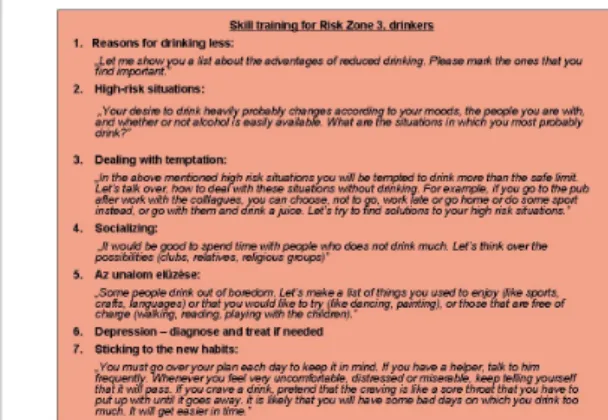
3. Skill development for the sake of reducing alcohol consumption 4. Long-term follow-up
Figure 5.: Skill development in risk zone III Figure 6.: A list about the advantages of reduced alcohol consumption
For skill development a self-help brochure can be found in the material of WHO (in English). http://whqlibdoc.who.int/hq/2001/WHO_MSD_MSB_01.6b.pdf
X/2.7. Risk zone IV: further direction
Who do we direct to addictology care?
Those patients who scored more than 20 points in the test need further examination and specialist treatment. Short intervention does not substitute for this. It is important to further direct these patients to the adequate places. For this purpose we should always have a list at hand of the helping places of our locality, such as:
Addictological, psychiatric care-centres
Addictological, psychiatric and toxicological wards Rehabilitational wards, homes
Anonym Alcoholics (http://www.anonimalkoholistak.hu) Other civil society organizations specialized for alcohol addicts
The result of the test is reported back to the patient in like manner as earlier. We should inform the patient that his alcohol consumption by far exceeds the secure limit, the drawbacks of this can already be experienced, and the possibility of an alcohol addiction cannot be excluded. We emphasize that this is a serious health problem, which requires further examination and treatment. We should explain to the patient that there is a causal relation between his current problems (e.g. somatic symptoms, sleep disorder,
workplace worries, etc.) and his alcohol consumption. We should give a detailed explanation to the patient what awaits him at the place we are sending him for further treatment, what treatment possibilities exist, which entails what, how much time do they take, and what they require from the patient. We should encourage him and stimulate him, and tell him that alcohol addiction is in many cases treatable, and it is still not late to utilize treatment.
X/2.8. Summary
The method of Short Intervention has been developed by the WHO for the assessment and treatment of problematic alcohol consumption, though similar methods have since been employed in other fields (drug addiction, movement-deficient lifestyle) as well. The education of low-risk alcohol consumers is useful for preventive reasons. Those consumers who have not yet experienced the harmful effects of alcohol, but their alcohol consumption has already exceeded the secure measure, are provided with simple
counselling, wheresubsequent to making test-results known, patients are familiarized with the long-term effects of alcohol. Consumers already experiencing the harmful effects of alcohol require – besides the above – short consultation, in the course of which skills are taught to them for the sake of changing their drinking habits. Alcohol
addicts are further directed to a specialized outdoor patient department or a hospital ward.
Literature
Babor TF, Higgins-Biddle JC. Brief intervention for hazardous and harmful drinking. A manual for use in primary care. http://whqlibdoc.who.int/hq/2001
/WHO_MSD_MSB_01.6b.pdf
Babor TF, Higgins-Biddle JC, Saunders JC, Monteiro MG. The Alcohol Use Disorders Identification Test. Guidelines for use in primary care.
http://whqlibdoc.who.int/hq/2001/who_msd_msb_01.6a.pdf
Miller WR. Enhancing motivation for change in substance abuse treatment. U.S. Department of Health and Human Services, SAMHSA/CSAT, Rockville, 1999. Moyer A, Finney JW, Swearingen CE, Vergun P. Brief interventions for alcohol problems: a meta-analytic review of controlled investigations in treatment-seeking and non-treatment-seeking populations. Addiction 2002 Mar;97(3):279-92.