IOP Conference Series: Earth and Environmental Science
PAPER • OPEN ACCESS
Research on the Development of Chinese and Foreign Denture
Technology
To cite this article: Lijuan Chen and Yifan Zhao 2021 IOP Conf. Ser.: Earth Environ. Sci. 632 032062
View the article online for updates and enhancements.
2020 Asia Conference on Geological Research and Environmental Technology IOP Conf. Series: Earth and Environmental Science632 (2021) 032062
IOP Publishing doi:10.1088/1755-1315/632/3/032062
Research on the Development of Chinese and Foreign Denture
Technology
Lijuan Chen1, * and Yifan Zhao2
1School of foreign language, Wuhan University of Technology, Wuhan, China 2School of Management, Wuhan University of Technology, Wuhan, China
*Corresponding author email: [email protected]
Abstract. Dentures are often referred to as "dentures". Just like the "prosthetic leg" and "prosthetic limb" are called "prosthetic limb", it is a general term for the restoration made after the missing of some or all teeth of the upper and lower jaw teeth in medicine. In recent years, with the improvement of living standards and the abundance of material life, more and more people will choose to install dentures after missing teeth, and denture technology has also developed rapidly. This article is in recent years. A brief investigation and research was carried out on the development of science and technology.
Keywords: Denture, technological development. 1. Introduction
60%-70% of the world's denture processing business is in China, and most of them are occupied by large denture companies. The United States is the main place of sale, and the industry is gradually moving out of low-cost areas. According to Hyundai Dental's 2017 annual report, the North American market generated approximately HK$687 million in revenue, an increase of approximately HK$410 million from 2016. This regional market accounted for approximately 31.5% of the Group's total revenue, while in 2016 it accounted for approximately 16.9%. Europe is also the main sales place of dentures. This trend shows that the potential of foreign markets is the same as that of the domestic market. The competition in the foreign denture market is not a price competition, but a competition in enterprise R&D capabilities and a patent competition. Means a lot of profits and opportunities, so large denture processing plants have invested in foreign markets.
2. Domestic Denture Technology 2.1. R&D model
At present, the existing denture processing technology innovation is currently divided into three stages. The progress of my country's denture technology research and development is shown in the figure:
2020 Asia Conference on Geological Research and Environmental Technology IOP Conf. Series: Earth and Environmental Science632 (2021) 032062
IOP Publishing doi:10.1088/1755-1315/632/3/032062
2
Figure 1. The stage of my country's denture technology.
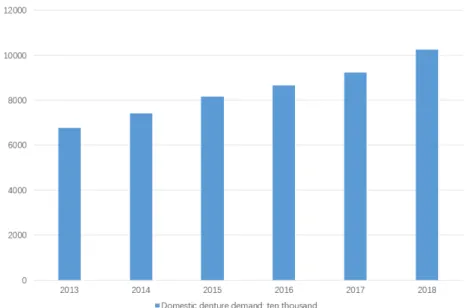
Although the new denture manufacturing technology can be put into use and bring benefits, it is still in the development stage, and the demand for dentures has grown rapidly in recent years (Figure 2), so domestic denture companies are stepping up their technology research.
Figure 2. Changes in domestic denture demand. 2.2. Domestic technology status
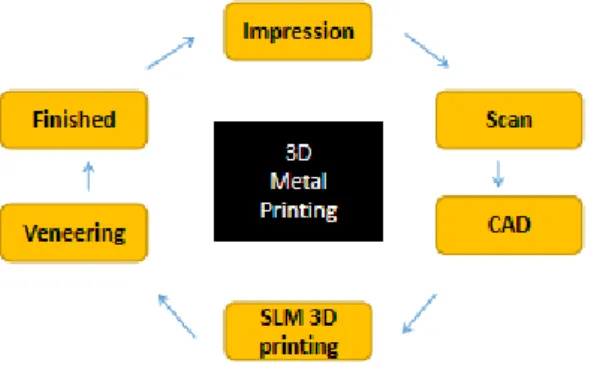
As a new technology, denture 3D printing is different from the traditional manual manufacturing and CNC processing methods (Figure 3).
Figure 3. Traditional manual manufacturing and CNC processing methods.
The existing metal 3D printing technology of dentures in China is optimized and innovated on the basis of CNC processing technology. After the oral cavity model, the production of metal crowns is all
2020 Asia Conference on Geological Research and Environmental Technology IOP Conf. Series: Earth and Environmental Science632 (2021) 032062
IOP Publishing doi:10.1088/1755-1315/632/3/032062
done by digital technology (Figure 4), but there is still a difference between the two. According to the data and cases of Xi'an Platinum Technology, when machining a metal crown, CNC machine tools need to use a tool to mill the metal crown on a metal blank. The average price of a metal plate used for CNC technology cutting is about 1200 yuan, which can cut 30-40 units, the processing time is 5-6 hours, and the cost of each unit of material is about 30 yuan.
Figure 4. 3D printing technology.
3D printed metal crowns are manufactured by selective laser melting (SLM) metal 3D printing equipment. Each unit cost only 5-7 yuan. From this perspective, the advantages of metal 3D printing technology in dental crown production cost and efficiency are more prominent. Digital dental technology, including CNC processing technology and 3D printing technology, is becoming the mainstream technology for denture processing.
3. European and American Denture Technology 3.1. Development
The United States is the world's largest producer and consumer of oral devices. Its imported medical devices include dental restorations and materials. In the United States, 40% of dental restorations are imported.
The current situation in the American denture industry is not optimistic: the cost of imported equipment is cheaper than domestic equipment, so the increase in tariffs will not have much impact; many dental equipment companies in the United States are in during the closing tide, the functions of dental technicians will gradually be replaced by machines.
3.2. Common techniques
3.2.1. SLA manufacturing process. In the manufacturing process, SLA and SLS processes are commonly used in American denture production. The former is a three-dimensional denture model made of photo-curable resin. The latter produces three-dimensional denture models for metal sintering. In the process of making digital dentures using SLA technology, the factors to be clarified are as follows (Figure 5).
Because SLA mainly uses laser as the light source of illumination, it has good accuracy, giving it manufacturing precision that cannot be achieved by traditional processes.
2020 Asia Conference on Geological Research and Environmental Technology IOP Conf. Series: Earth and Environmental Science632 (2021) 032062
IOP Publishing doi:10.1088/1755-1315/632/3/032062
4
Figure 5. SLA process parameters.
The first is the layer thickness setting. The refractive properties of different light-curing resins are different, and the laser power is also attenuated. Therefore, it is necessary to set a reasonable layer thickness to achieve the best printing effect. If the layer thickness is set, the laser will not hit the bottom of the base layer during the irradiation process. This leads to surface curing and the bottom layer has not yet cured, which in turn leads to printing failure. If the layer thickness is set too small, the absorbed laser energy is too high. Within a predetermined time, complete curing shrinkage early. As a result, the surrounding area shrinks further, forming irregular curing and causing printing failure.
Laser power is also an important factor. The laser itself will decay with time. If the power is too high, the corresponding irradiation point will rapidly cure and shrink, causing synchronous curing around; if the power is too low, the irradiation has not been completed, that is, it moves to the next position, and the printed layer collapses.
The printing speed includes the speed at which the light source moves and the speed at which the base moves. During the printing process, the movement was too slow, which caused the abutment to move to another layer, and the curing was not completed. The other is the movement of the base. If the base moves too fast, it will cause the layer to be printed and moved to the next layer. If the base moves too slowly, it will cause printing offset.
The flow rate of the material itself requires a certain amount of time for the material to flow to a predetermined location during the ascent of the abutment. If the flow rate of the material is too slow, the material in the vacuum area cannot be cured, which may cause printing failure
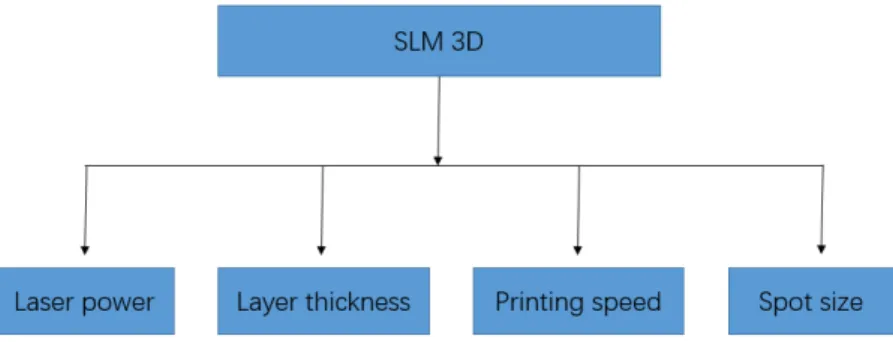
3.2.2. SLM manufacturing process. In the process of making digital dentures using SLM technology, the factors to be clear are as follows (Figure 6).
Figure 6. SLM process parameters.
During the SLM printing process, the surface of the particles was irregularly shaped during the laser sintering process. Irradiation of laser light on the surface of metal particles will cause diffuse reflection. It is required that the laser power can maintain a certain intensity. The laser power is too low to melt the particles to form spheroidization, resulting in insufficient printing intensity; the laser power is too high, irradiating multiple layers, the particles repeatedly melt to form over-burning phenomenon. Unable to produce the wrong layer according to the expected requirements, resulting in
2020 Asia Conference on Geological Research and Environmental Technology IOP Conf. Series: Earth and Environmental Science632 (2021) 032062
IOP Publishing doi:10.1088/1755-1315/632/3/032062
printing failure. The setting of the layer thickness depends on the reasonable laser power and the average particle diameter.
The layer thickness is set too small, and the average particle diameter is greater than the layer thickness. Each time the particle size of the powder is greater than the layer thickness, the set value cannot be reached and printing fails. If the layer thickness is set too large, the machine laser cannot melt the bottom particles and cause incomplete melting. In the post-printing process, spheroidization is formed, resulting in shrinkage holes and shrinkage, which leads to a decline in mechanical properties or even substandard.
The spot size refers to the size of the irradiated area formed by laser irradiation on the surface of the powder layer. The smaller the light spot, the more concentrated the power and the higher the energy density, resulting in overburning.
Scanning pitch refers to the overlap rate between two scans. The higher the lap rate, the melting occurs repeatedly, increasing the density. However, the surface roughness increases accordingly, whereas the strength decreases slightly.
4. The situation of dentures in the domestic market
In Europe and the United States, about 80% of the dentures come from 3D printing. China has also imported 3D printing equipment in recent years. For example, Tang Bao founded Nanjing Qianzhi Intelligent Technology Co., Ltd. in 2014. The goal is to completely replace imported equipment and realize the “intellectual manufacturing in China” in denture processing.
In fact, the substitution of domestic equipment for imports is not easy and requires a difficult R&D process. Tang Bao said that 3D printers cover many fields such as software, machinery, materials, and laser technology. For example, he told reporters that dual lasers meant a significant increase in speed for 3D printers, and for R&D it was necessary to redesign complex control algorithms. "Compared with single lasers, the design difficulty is not an order of magnitude."
According to the preliminary prediction of the Prospective Industry Research Institute, my country's 3D printing market will reach USD 2.25 billion in 2020 and around USD 8 billion in 2022. Tang Bao told reporters that the application of 3D technology is very extensive. Start-up companies must first find a segment with a huge market demand, and secondly invest their energy in deep cultivation. "To achieve a certain stage, there are no international advanced products that can imitate and learn, we must rely on ourselves to break through." Tang Bao said that in the tide of the reconstruction of China's dental industry, domestic 3D printing companies are expected to step out of the new path of leading the world.
5. Summary
According to the research on the development of denture technology in China and foreign countries, the current development of denture technology at home and abroad is still in a relatively balanced state. It is in a period of traditional technology transition to 3D printing technology. You can master 3D denture printing technology first. The most advanced denture manufacturing technology.
References
[1] Juang LH, Wu MN. Fall Down Detection Under Smart Home System [J]. J Med Syst, 2015, 39 (10): 107.
[2] van Noort R.The future of dental devices is digital [J]. Dental Materials, 2012, 28 (1): 3-12. [3] Dental applications [J]. Dental Abstracts, 2012, 57 (6): 301-303.