Many businesses do not have a clear conception of what business processes exist in their firms, how they work, or how much they cost. In a recent survey by Forrester and IBM, 38% of business executives said they had no real-time visibility into their firm's business processes. Surely this is an understatement. In contrast, nearly all businesses have fairly good measures of revenue, customers, employees, payroll, profits, assets and liabilities. All these accounting measures of a business are required by external authorities as accounting reporting requirements. Almost all business executives in a firm can tell you how much revenues are up or down, is head count up or down, and whether liabilities have increased along with assets. Very few executives can tell you if their business processes have improved, in what sense, and by how much. Business executives are very results oriented: the bottom line is how much money they make. How the money gets made is, well, often less well understood. This requires a process orientation.
1.0 What is Business Process Management
Business Process Management is a methodology, a set of tools and systems, and a management philosophy or approach to business. Let's start with the basic definition of a business process. A business process is a set of activities that transform inputs into outputs, utilize capital and labor, and require time to complete. Buffers represent time delays in the process where products or information are held until the next activi-ty is ready to receive them. Next let's think about how to measure a business process. Generally, business processes are measured in terms of their cost, time to complete or cycle, quality, efficiency and flexibility. Figure 1 illustrates a generic business process.
Business Process Management (BPM) is an approach to business which aims to continuously improve business processes. In this sense it shares a great deal with total quality management which seeks to improve the quality of business processes by decreasing error and rejection rates, improving customer satisfaction, and reducing costs. However, business process management is a bit broader, concerned with quality, but expanding beyond that to include efficiency, cost, benefits to the firm.
BPM uses a variety of tools and methodologies to understand existing processes, design new processes, and optimize those processes. BPM is never concluded because continuous improvement requires continual change.
2.0 The Business Process Management Development Model
There are a number of stages in the business process management management model:
C h a p t e r 3
A c h i e v i n g C o m p e t i t i v e A d v a n t a g e w i t h
I n f o r m a t i o n S y s t e m s
• Identify processes for change • Analyze existing process • Design new processes • Model new processes • Implement new processes • Optimize new processes • Continuous Measurement
Let's examine each of these stages in the BPM model.
Identify processes for change.This may seem obvious but deciding what to improve in a business can be a daunting task, and choosing a process to improve is influenced by many factors. First, any sizable business has thousands of processes. Rationally, one would like to identify all processes in the firm, and rank order them on various criteria such as cost-benefit: how much does each process contribute to profits and how much does it cost. Those processes which have a poor cost-benefit ratio would be candidates for BPM. This rational approach is not very useful if only because the cost of identifying all the business processes is prohibitive, and linking each to a portion of profits virtually impossible.
One method is to rely on a business scorecard approach in which senior executives decide the criteria of business performance that are important to them based on their experience and understanding of the business. A small number (generally less than ten) of performance criteria are identified such as customer satisfaction surveys, sales activity, revenues, market penetration, employee head count, stock price, costs of sup-plies, and other factors. These are continuously measured by existing systems and executives use a dashboard to monitor these performance criteria in real time. Once these measured criteria are understood, BPM managers can focus on the specific busi-ness processes involved in producing each outcome or result. For instance, if an
exec-utive learns that costs of supplies are accelerating faster than normal, he or she can ask BPM managers to examine the supply chain process more closely.
A different less formal method is also used. I call this the pain reduction method which is a variation of the "squeaky wheel" approach. Sometimes particular business processes are troublesome and produce negative results that obviously hurt the busi-ness. A poor Web site may turnoff customers; a loading dock may be the source of many accidents; some process might be far more costly than the same process devel-oped by competitors; the number of employees in a transaction processing unit or call center may be expanding faster than sales, suggesting a problem worthy of further investigation. Briefly, some processes are well-known in the firm as not being very good or effective. These become candidates for further analysis.
Analyze existing processes. Once a candidate process is identified for improve-ment, the next step is to analyze the process and determine how much resources in terms of time and costs are expended by the process. Once this is understood, the results can be compared to historical data, or to a similar process used by competitors. Here is where consulting firms are very valuable. Finding out your competitor's cost structure is very difficult. It can be "guesstimated" using a variety of legal techniques. Former employees of your competitors can provide information. Consulting firms who have worked throughout the industry are a major source of benchmark data.
Design new processes. Once the existing process is mapped and measured in terms of time and cost, the next step is to try to improve the process by designing a new one. Generally, alternative processes are suggested by competitors or consultants based on "best industry practice." Firms should be able to at least achieve best practice used in their industry, and copy other firms. Several candidate new processes can be devel-oped, and each modeled in terms of the time and cost of using each of the processes and then choosing the most cost effective.
Model new processes. Once the new process is chosen, it's still a theoretical process that needs more refinement. The new process can be physically modeled and then "run" and compared to the old process. For instance, firms can set up model offices using new processes and experiment with them to devise the best combinations of labor, technology, and equipment. Firms can experiment with new Web sites. Alternatively, processes can be refined and modeled with a computer program. The point of this exercise is to devise a theoretically optimal set of arrangements for the new process.
Optimize new processes. Once the new process has been implemented, and employees trained and accustomed to working with the new process, BPM managers ideally continue to experiment with improvements. Many improvements will be rec-ommended by employees who actually work in the process. Any process can always be improved, and here's where the continuous improvement goal of BPM really comes into its own.
Implement new processes. Once the new process is thoroughly modeled and understood at the theoretical and experimental level, it's time to roll it out into the field. Most firms adopt a phased roll-out of new processes, starting with business units most likely to adopt the new process, or where support among employees might be strongest. At this stage, problems are usually uncovered and addressed. Very few the-oretical models capture all the nuances of a process, or the difficulties of dealing with
people who may like the old process better than the new one.
Continuous Measurement. Once designed and implemented, and optimized, busi-ness processes need to be continually measured. Why? Processes can deteriorate over time as field employees can fall back on old methods. Processes should improve over time as employees go up the learning curve and become more familiar and polished in the new system. Continuous measurement may also be demanded by senior manage-ment.
BPM is not without its difficulties. Executives report that the largest single barrier to BPM is organizational culture. Employees are set in their ways, do not like to
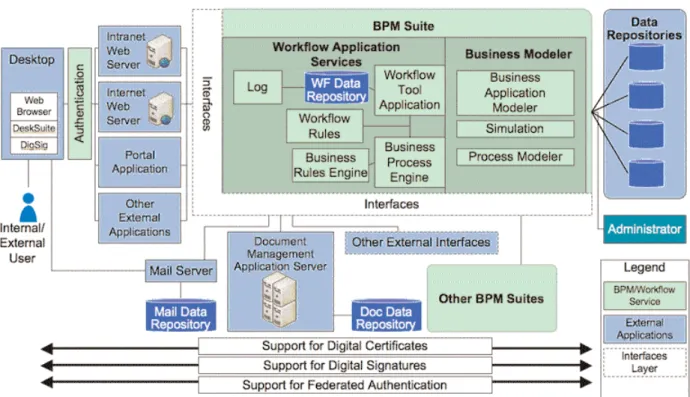
FIGURE 2 BPM SYSTEM REQUIREMENTS
When properly implemented, a BPM approach to management involves business process tools, a service oriented architecture (SOA), and new activities in the firm. Source: National Institutes of Health, 2009.
change, and do not like unfamiliar routines. New business processes can be both more efficient than old ones, but also less flexible and more difficult to adapt to change. The costs of measuring existing processes, designing new ones, experimenting, implement-ing, optimizing and measuring can be very expensive. The existing information sys-tems in a firm may not be capable of providing the information required to measure old or new business processes. In other words, a major system investment may be required to implement BPM.
3.0 BPM Software: the Technology Connection
Implementing a BPM approach in any but the smallest of firms will require invest-ments in new systems and technologies. The complexity of the task is quite high. Many software firms produce BPM suites of software to enable BPM. Figure 2 pro-vides a conceptual graphic that illustrates some of the systems required by BPM.
Let's take a closer look at the BPM graphic. At its heart is a BPM suite of software tools that can capture business rules (for existing and new systems), design workflows and processes, model business processes, simulate processes, and provide continuous measurement. On the left side of the graphic are a set of services that allow managers to gain access to the system. On the right side of the diagram are a set of databases and applications which can supply information to the BPM suite, and store informa-tion.
As you can see from this diagram, BPM requires a fully modernized IT infrastruc-ture based on a service oriented architecinfrastruc-ture (SOA) in order to receive data from exist-ing systems. Without this, the results of BPM cannot be measured against perform-ance criteria and targets established by senior management. For this reason, most large firms rely on their primary enterprise systems vendors to provide the BPM suite. The largest vendors are IBM, SAP, and Oracle. There are many hundreds of other ven-dors which aim at middle market and smaller firms.
References
Armistead, Colin; Jean-Philip Pritchard; and Simon Machin. "Strategic Business Process Management for Organisational Effectiveness." ScienceDirect, June 1999.
Forrester Consulting, "Enabling Dynamic Business Processes With BPM and SOA." Survey conducted for IBM, 2008.
Leymann, F.; D. Roller, and M.-T. Schmidt. "Web services and business process management." IBM White Paper, 2001.
National Institutes of Health, "Workflow/Business Process Management (BPM) Service Pattern,"
http://enterprisearchitecture.nih.gov/ArchLib/AT/TA/WorkflowServicePattern.htm, 2009.
Oracle Corporation. "Business Process Management in the Finance Sector." White Paper, 2008.