NARC:
NARC:
Network
Network
-
-
Attached Reconfigurable Computing for
Attached Reconfigurable Computing for
High
High
-
-
performance, Network
performance, Network
-
-
based Applications
based Applications
Chris Conger, Ian Troxel, Daniel Espinosa,
Vikas Aggarwal, and Alan D. George
High-performance Computing and Simulation (HCS) Research Lab
Department of Electrical and Computer Engineering
Outline
Introduction
NARC Board Architecture, Protocols
Case Study Applications
Experimental Setup
Results and Analysis
Pitfalls and Lessons Learned
Conclusions
Introduction
Network-Attached Reconfigurable Computer (NARC) Project
Inspiration:
network-attached storage
(NAS) devices
Core concept:
investigate challenges
and
alternatives for enabling direct network access
and control over reconfigurable (RC) devices
Method:
prototype
hardware interface and
software infrastructure,
demonstrate proof of
concept
for benefits of network-attached RC
resources
Motivations for NARC project include (but
not limited to) applications such as:
Network-accessible processing resources
Generic network RC resource, viable alternative to server and supercomputer solutions
Power and cost savings over server-based FPGA cards are key benefits
No server neededto host RC device
Infrastructure provided for robust operation and interfacing with users
Performance increase over existing RC solutions is not a primary goal of this approach
Network monitoring and packet analysis
Easy attachment; unobtrusive, fast traffic gathering and processing
Network intrusion and attack detection, performance monitoring, active traffic injection
Direct network connection of FPGA can enable wire-speed processing of network traffic
Aircraft and advanced munitions systems
Standard Ethernet interface eases addition and integration of RC devices in aircraft and munitions systems
Envisioned Applications
Aerospace & military applications
Modular, low-power design lends itself well to
military craft and munitions deployment
FPGAs providing high-performance radar, sonar,
and other computational capabilities
Scientific field operations
Quickly provide first-level estimations for
scientific field operations for geologists, biologists, etc.
Field-deployable covert operations
Completely wireless device enabled through battery, WLAN Passive network monitoring applications
Active network traffic injection
Distributed computing
Cost-effective, RC-enabled clusters or cluster resources Cluster NARC devices at a fraction of cost, power, cooling
Cost-effective intelligent sensor networks
Use FPGAs in close conjunction with sensors to provide pre-processing
functions before network transmission
High-performance network technologies
Fast Ethernet may be replaced by any network technology Gig-E, Infiniband, RapidIO, proprietary communication protocols
NARC Board Architecture: Hardware
ARM9 network control with FPGA processing power (see Figure 1)
Prototype design consists of two boards, connected via cable:
Network interface board (ARM9 processor + peripherals)
Xilinx development board(s) (FPGA)
Network interface peripherals include
:
Layer-2 network connection (hardware PHY+MAC)
External memory,
SDRAM
and
Flash
Serial port (debug communication link)
FPGA control and data lines
NARC hardware specifications
:
ARM-core microcontroller
, 1.8V core, 3.3V peripheral
32-bit RISC, 5-stage pipeline, in-order execution 16KB data cache, 16KB instruction cache
Core clock speed 180MHz, peripheral clock 60MHz On-chip Ethernet MAC layer with DMA
External memory, 3.3V
32MB SDRAM, 32-bit data bus
2MB Flash, 16-bit data bus
Port available for additional 16-bit SRAM devices
Ethernet transceiver
, 3.3V
DM9161 PHY layer transceiver 100Mbps, full duplex capable RMII interface to MAC
NARC Board Architecture: Software
ARM processor runs Linux kernel 2.4.19 Provides TCP(UDP)/IP stack, resource management, threaded
execution, Berkeley Socketsinterface for applications
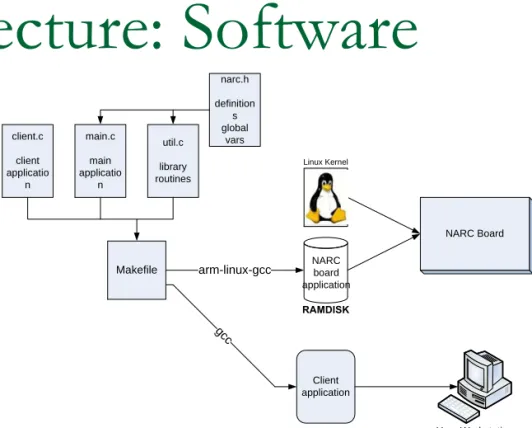
Configured and compiled with drivers specifically for our board Applications written in C, compiled using GCC compiler for
ARM (see Figure 2)
NARC API: Low-level driver function library for basic services
Initialize and configure on-chip peripherals of ARM-core processor
Configure FPGA (SelectMAPprotocol)
Transfer data to/from FPGA, manipulate control lines Monitor and initiate network traffic
NARC protocol for job exchange (from remote workstation)
NARC board application and client application must follow standard
rules and proceduresfor responding to requests from a user
User appends a small header onto data (if any) containing info.
about request before sending over network (see Figure 3)
Bootstrap software in on-board Flash, automatically loads and executes on power-up
Configures clocks, memory controllers, I/O pins, etc
Contacts tftp serverrunning on network, downloads Linux and
ramdisk
Boot Linux, automatically execute NARC board software contained in ramdisk
Optional serial interface through HyperTerminal for debugging/development
Figure 3 –Request header field definitions Figure 2 –Software development process
main.c main applicatio n util.c library routines narc.h definition s global vars Makefile arm-linux-gcc RAMDISK NARC Board Linux Kernel Client application ` User Workstation gc c NARC board application client.c client applicatio n
NARC Board Architecture: FPGA Interface
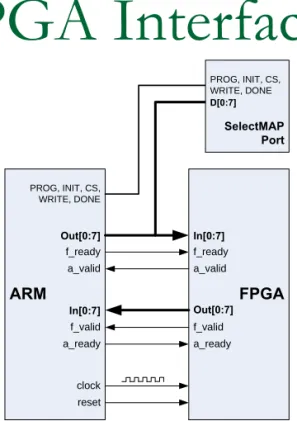
Data communicated to/from FPGA by means of
unidirectional data paths
8-bit input port, 8-bit output port, 8 control lines (Figure 4)
Control lines manage data transfer, also drive configuration signals Data transferred one byte at a time, full duplexcommunication possible Control lines include following signals:
Clock– software-generated signal to clock data on data ports
Reset– reset signal for interface logic in FPGA
Ready– signal indicating device is ready to accept another byte of data
Valid– signal indicating device has placed valid data on port
SelectMAP– all signals necessary to drive SelectMAP configuration
Figure 4 –FPGA interface signal diagram
ARM FPGA Out[0:7] In[0:7] Out[0:7] In[0:7] a_valid f_ready a_valid f_ready a_ready f_valid f_valid a_ready clock reset SelectMAP Port D[0:7] PROG, INIT, CS, WRITE, DONE PROG, INIT, CS, WRITE, DONE
FPGA configuration through SelectMAP protocol
Fastest configuration option for Xilinx FPGAs, protocol emulated using GPIO pins of ARM
NARC board
enables remote configuration
and management of FPGA
User submits configuration request (RTYPE = 01), along with bitfile and function descriptor Function descriptor is ASCII string, formatted list of functions with associated RTYPEdefinition ARM halts and configures FPGA, stores descriptor in dedicated RAM buffer for user queries
All FPGA designs must restrict use of all SelectMAP pins after configuration
Some signals are shared between SelectMAP port and FPGA-ARM link Once configured, SelectMAP pins must remain tri-stated and unused
Results and Analysis: Raw Performance
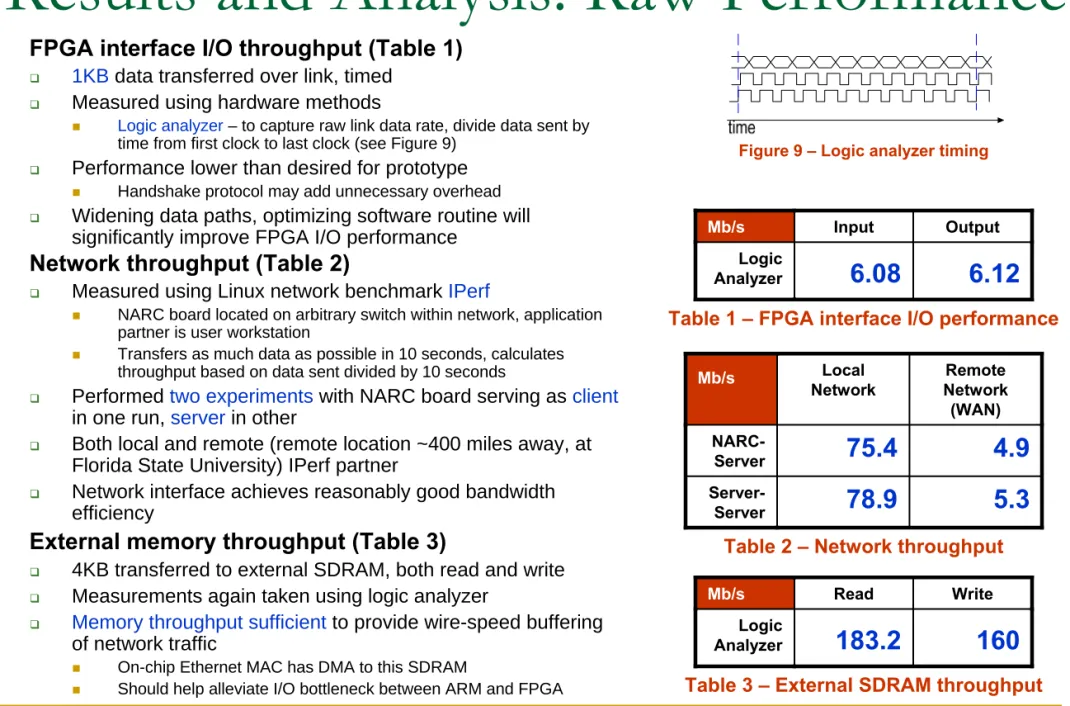
FPGA interface I/O throughput (Table 1)
1KBdata transferred over link, timed Measured using hardware methods
Logic analyzer– to capture raw link data rate, divide data sent by time from first clock to last clock (see Figure 9)
Performance lower than desired for prototype
Handshake protocol may add unnecessary overhead
Widening data paths, optimizing software routine will
significantly improve FPGA I/O performance
Network throughput (Table 2)
Measured using Linux network benchmark IPerf
NARC board located on arbitrary switch within network, application partner is user workstation
Transfers as much data as possible in 10 seconds, calculates throughput based on data sent divided by 10 seconds
Performed two experimentswith NARC board serving as client
in one run, serverin other
Both local and remote (remote location ~400 miles away, at
Florida State University) IPerf partner
Network interface achieves reasonably good bandwidth
efficiency
External memory throughput (Table 3)
4KB transferred to external SDRAM, both read and write Measurements again taken using logic analyzer
Memory throughput sufficientto provide wire-speed buffering
of network traffic
On-chip Ethernet MAC has DMA to this SDRAM
Should help alleviate I/O bottleneck between ARM and FPGA
Mb/s Input Output Logic Analyzer
6.08
6.12
Mb/s Local Network Remote Network (WAN) NARC-Server75.4
4.9
Server-Server78.9
5.3
Figure 9 –Logic analyzer timing
Table 1 – FPGA interface I/O performance
Table 2 –Network throughput
Mb/s Read Write
Logic
Analyzer
183.2
160
Results and Analysis: Raw Performance
Reconfiguration speed
Includes time to transfer bitfile over network, plus time to configure device (transfer
bitfile from ARM to FPGA), plus time to receive acknowledgement
Our design currently completes a user-initiated reconfiguration request with a
1.2MB
bitfile in 2.35
sec
Area/resource usage of minimal wrapper for Virtex-II Pro FPGA
Stats on resource requirements for a minimal design to provide required link
control and data transfer in an application wrapper are presented below:
Design implemented on older
Virtex-II Pro FPGA
Numbers to right indicate
requirements for wrapper
only
,
un-used resources available
for use in user applications
Extremely
small footprint!
Footprint will be even smaller
on larger FPGA
Device utilization summary:
---Selected Device : 2vp20ff1152-5
Number of Slices: 143 out of 9280 1% Number of Slice Flip Flops: 120 out of 18560 0% Number of 4 input LUTs: 238 out of 18560 1% Number of bonded IOBs: 24 out of 564 4% Number of BRAMs: 8 out of 88 9% Number of GCLKs: 1 out of 16 6%
Case Study Applications
Clustered RC Devices: N-Queens
HPC application demonstrating NARC board’s role as generic compute resource
Application characterized by
minimal communication
,
heavy computation
within FPGA
NARC version of N-Queens adapted from previously implemented application for
PCI-based Celoxica RC1000 board housed in a conventional server
N-Queens algorithm is a part of the DoD high-performance computing benchmark suite and
representative of select military and intelligence processing algorithms
Exercises functionality of various developed mechanisms and protocols for job
submission, data transfer, etc. on NARC
User specifies a single parameter
N
, upon
completion the algorithm returns total number
of possible solutions
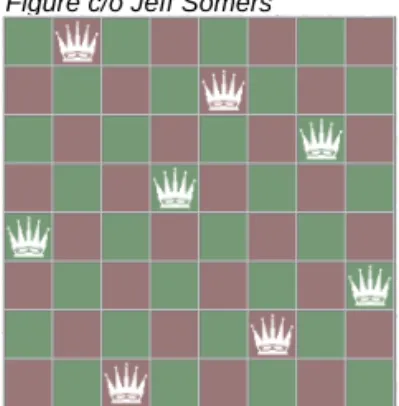
Purpose of algorithm is to determine how many
possible arrangements of
N
queens there are on
an
N
×
N
chess board, such that no queen may
attack another (see Figure 5)
Results are presented from both NARC-based execution and RC1000-based
execution for comparison
Figure c/o Jeff Somers
Case Study Applications
Network processing: Bloom Filter
This application performs passive packet analysis through use
of a classification algorithm known as a Bloom Filter
Application characterized by constant, bursty communication patterns
Most communication is Rxover network, transmission toFPGA
Filter may be programmedor queried
NARC device copies all received network frames to memory,
ARM parses TCP/IP header and sends it to Bloom Filter for classification
User can send programming requests, which include a header and string to be programmed into Filter
User can also send result collection requests, which causes a formatted results packet to be sent back to the user
Otherwise, application constantly runs, querying each header against the current Bloom Filter and recording match/header pair information
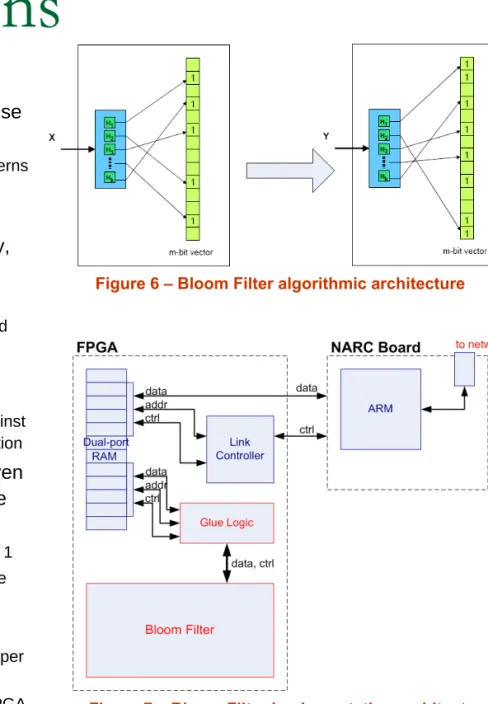
Bloom Filter works by using multiple hash functions on a given
bit string, each hash function rendering indices of a separate bit vector (see Figure 6)
To program, hash inputted string and set resulting bit positions as 1
To query, hash inputted string, if all resulting bit positions are 1 the string matches
Implemented on Virtex-II Pro FPGA
Uses slightly larger, but ultimately more effective application wrapper (see Figure 7)
Larger FPGA selected to demonstrate interoperability with any FPGA
Figure 6 –Bloom Filter algorithmic architecture
Experimental Setup
N-Queens: Clustered RC devices
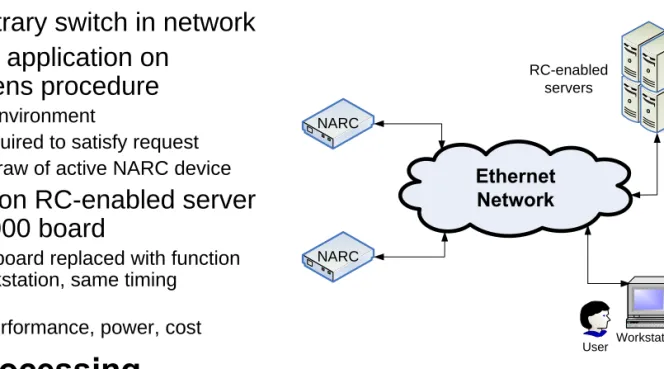
NARC device located on arbitrary switch in network
User interfaces through client application on
workstation, requests N-Queens procedure
Figure 8 illustrates experimental environment
Client application records time required to satisfy request
Power supply measures current draw of active NARC device
N-Queens also implemented on RC-enabled server
equipped with Celoxica RC1000 board
Client-side function call to NARC board replaced with function
call to RC1000 board in local workstation, same timing measurement
Comparison offered in terms of performance, power, cost Workstation NARC Ethernet Network User RC-enabled servers NARC
Figure 8 –Experimental environment
Bloom Filter: Network processing
Same experimental setup as N-Queens case study
Software on ARM co-processor captures all Ethernet frames
Only packet headers (TCP/IP) are passed to FPGA
Data continuously sent to FPGA as packets arrive over network
By attaching NARC device to switch, limited packets can be captured
Only broadcast packets and packets destined for the NARC device can be seen
Results and Analysis: N-Queens Case Study
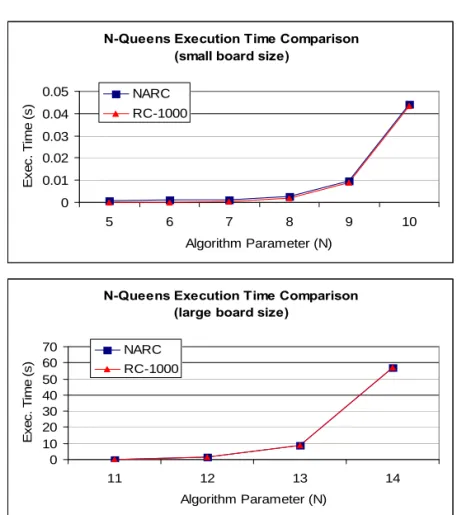
First, consider an execution time comparison
between our NARC board and a PCI-based
RC card (see Figure 10a and 10b)
Both FPGA designs clocked at 50MHz
Performance difference is minimal between devices
Being able to match performance of PCI-based card
is a
resounding success!
Power consumption and cost of NARC devices
drastically lower than that of server with RC card combos
Multiple users may share NARC device, PCI-based
cards somewhat fixed in an individual server
Power consumption calculated using following
method
Three regulated power supplies exist in complete
NARC device (network interface + FPGA board): 5V, 3.3V, 2.5V
Current draw from each supply was measured Power consumption is calculated as sum of V×I
products of all three supplies
N-Queens Execution Time Comparison (small board size)
0 0.01 0.02 0.03 0.04 0.05 5 6 7 8 9 10 Algorithm Parameter (N) E x e c . T ime ( s ) NARC RC-1000
Figure 10 –Performance comparison between NARC board and PCI-based RC card on server
N-Queens Execution Time Comparison (large board size)
0 10 20 30 40 50 60 70 11 12 13 14 Algorithm Parameter (N) E x e c . T im e (s ) NARCRC-1000
Results and Analysis: N-Queens Case Study
Figure 11 summarizes the performance
ratio of N-Queens between both NARC
and RC-1000 platforms
Consider Table 4 for a summary of cost
and power statistics
Unit price shown excluding cost of FPGA
FPGA costs offset when compared to
another device
Price shown includes PCB fabrication,
component costs
Approximate power consumption
drastically less than server + RC-card
combo
Power consumption of server varies
depending on particular hardware
Typical servers operate off of
200-400W power supplies
See Figure 12 for example of approximate
power consumption calculation
NARC Board Cost per unit
(prototype)
$175.00
Approx. Power
Consumption
3.28 W
Table 4 –Price and power figures for NARC device
Figure 12 –Power consumption calculation
P = (5V)(I5) + (3.3V)(I33) + (2.5V)(I25)
I5≈0.2A ; I33≈0.49A ; I25 ≈0.27A
P = (5)(.2) + (3.3)(.49) + (2.5)(.27)
= 3.28W
NARC / RC-1000 Performance Ratio
0 5 10 15 20 25 5 6 7 8 9 10 11 12 13 14 Algorithm Parameter (N) Ra ti o RATIO Equivalency
Results and Analysis: Bloom Filter
Passive, continuous network traffic analysis
Wrapper design was slightly larger than previous minimal wrapper used with N-Queens
Still small footprint on chip, majority of FPGA remains for application
Maximum wrapper clock frequency 183 MHz, should not limit application clock if in same clock domain
Packets received over network link are parsed by ARM, with TCP/IP header saved in buffer
Headers sent one-at-a-time as
query requests
to Bloom Filter (FPGA), when query finishes
another header will be de-queued if available
User may query NARC device at any time for results update, program new pattern
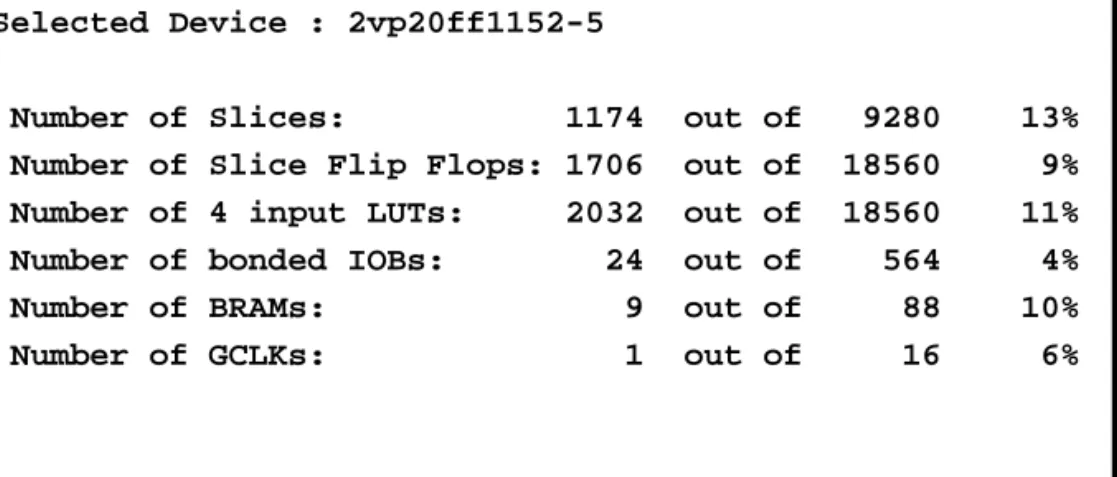
Device utilization summary:
---Selected Device : 2vp20ff1152-5
Number of Slices: 1174 out of 9280 13% Number of Slice Flip Flops: 1706 out of 18560 9% Number of 4 input LUTs: 2032 out of 18560 11% Number of bonded IOBs: 24 out of 564 4% Number of BRAMs: 9 out of 88 10% Number of GCLKs: 1 out of 16 6%
Figure 13 –Device utilization statistics for Bloom Filter design
Figure 13 shows resource usage for
Virtex-II Pro FPGA
Maximum clock frequency of 113MHz
Not affected by wrapper constraint
Significantly faster computation speed
than FPGA-ARM link communication speed
FPGA-side buffer will not fill up,
headers are processed before next
header transmitted to FPGA
ARM-side buffer may fill up under
heavy traffic loads
Pitfalls and Lessons Learned
FPGA I/O throughput capacity remains persistent problem
One motivation for designing custom hardware is to remove typical PCI
bottleneck and provide wire-speed network connectivity for FPGA
Under-provisioned data path between FPGA and network interface restricts
performance benefits for our prototype design
Luckily, this problem may be solved through a variety of approaches
Wider data paths (16-bit, 32-bit) double or quadruple throughput, at expense of
higher pin count
Use of higher-performance co-processor capable of faster I/O switching frequencies
Optimized data transfer protocol
Having co-processor in addition to FPGA to handle network
interface is vital to success of our approach
Required in order to permit initial remote configuration of FPGA, as well as
additional reconfigurations upon user request
Offloading network stack, basic request handling, and other maintenance-type
tasks from FPGA saves significant amount of valuable slices for user designs
Drastically
eases interfacing with user application on networked workstation
Active co-processor for FPGA applications, e.g. parsing network packets as in
Conclusions
A novel approach to providing FPGAs with standalone network connectivity has
been prototyped and successfully demonstrated
Investigated issues critical to providing remote management of standalone NARC resources
Proposed and demonstrated solutions to discovered challenges
Performed pair of case studies with two distinct, representative applications for a NARC device
Network-attached RC devices offer potential benefits for a variety of applications
Impressive cost and power savings over server-based RC processing
Independent NARC devices may be shared by multiple users without moving
Tightly coupled network interface enables FPGA to be used directly in path of network traffic for
real-time analysis and monitoring
Two issues that are proving to be a challenge to our approach include:
Data latency in FPGA communication
Software infrastructure required to achieve a robust standalone RC unit
While prototype design achieves relatively good performance in some areas, and
limited performance in others, this is acceptable for concept demonstration
Fairly complex board design; architecture and software enhancements in development
As proof of “NARC” concept, important goal of project was achieved in demonstration of an
Future Work
Expansion of network processing capabilities
Further development of packet filtering application
More specific and practical activity or behavior sought from network traffic
Analyze streaming packets at or near wire-speed rates
Expansion of Ethernet link to 2-port hub
Permit transparent insertion of device into network path
Provide easier access to all packets in switched IP network
Merging FPGA with ARM co-processor and network interface
into one device
Ultimate vision for NARC device
Will restrict number of different FPGAs which may be supported, according to
chosen FPGA socket/footprint for board
Increased difficulty in PCB design
Expansion to Gig-E, other network technologies
Fast Ethernet targeted for prototyping effort, concept demonstration
True high-performance device should support Gigabit Ethernet
Other potential technologies include (but not limited to) InfiniBand, RapidIO
Further development of management infrastructure