Original Research Article
Study of correlation between gestational age and new-born foot length
and chest circumference
Aayush Gupta, Gunjan Kela Mehrotra*, Swati Mulye
INTRODUCTION
Globally, in 2015, 1 million children died on first day of their life. The neonatal mortality rate is declining less rapidly than the mortality rate for children between 1 month and 5 years of age. Thus, contribution of the neonatal mortality to the under-five deaths is increasing. Usually as average income of a country increases, it leads to decline in child mortality yet some countries in the fast lane for global economic growth such as India have been in the slower lane for child mortality reduction. Thus, economic growth can help but does not guarantee improved child survival, and a country’s income need not
hinder the progress.1,2 In India, Madhya Pradesh is one of
the four states (others being Uttar Pradesh, Bihar and Rajasthan) with NMR of more than 35 per 1000 live births accounting for 55% of all neonatal deaths, contributing about 15 % of global neonatal deaths.3,4
About three-fourths of total neonatal deaths occur in the first week of life with the first 24 hours accounting for more than one-third (36.9%) of the deaths that occur in the entire neonatal period.5 Of all the causes of neonatal
mortality, prematurity is the leading cause of death accounting for nearly 35% of neonatal deaths with 70 % of these occurring in first week of life.2
ABSTRACT
Background: Globally, in 2015, 1 million children died on first day of their life. The neonatal mortality rate is declining less rapidly than the mortality rate for children between 1month and 5 years of age. Thus, contribution of the neonatal mortality to the under-five deaths is increasing. Usually as average income of a country increases, it leads to decline in child mortality yet some countries in the fast lane for global economic growth such as India have been in the slower lane for child mortality reduction.
Methods: This study was conducted at Sri Aurobindo Medical College and PG Institute, Indore from October 2015 to March 2017 for period of 18 months. Total of 800 live new-borns were included in this study by simple random technique. The statistical analysis of data was done using SPSS for Windows (Version 20.0) software. The correlation of gestational age with new-born foot length and new-born chest circumference was analysed by applying correlation and regression analysis.
Results: Foot length is significantly correlated with both gestational age and birth weight with p value of < 0.05 and highly positive correlation coefficient. Chest circumference is significantly correlated with both gestational age and birth weight with p value of < 0.05 and highly positive correlation coefficient.
Conclusions: This study tried to identify anthropometric parameter (foot length and chest circumference) which allows for rapid evaluation of the infant for gestational age and provide at risk infants with timely care.
Keywords: Chest circumference, Gestational age
Department ofPaediatrics, SAMC and PGI, Indore, Madhya Pradesh, India
Received: 02 June 2018
Accepted: 07 July 2018
*Correspondence:
Dr. Gunjan Kela Mehrotra, E-mail: [email protected]
Copyright: © the author(s), publisher and licensee Medip Academy. This is an open-access article distributed under the terms of the Creative Commons Attribution Non-Commercial License, which permits unrestricted non-commercial use, distribution, and reproduction in any medium, provided the original work is properly cited.
Nearly 30% of all neonates are born with a low birth weight in India accounting for 42% of the global burden which is largest for any country. As per many community-based studies, low birth weight infants are at 11-13 times increased risk of dying than normal birth weight infants. About 80% of total neonatal deaths occur among low birth weight/preterm neonates.4
The third National Family Health Survey, India (NFHS-3) has reported that less than 40% of mothers received postnatal care from any health personnel within 48 hours of delivery. Because of operational difficulties in field in India and other similar settings, postnatal care within 48 hours of birth though important is not generally being widely carried out.6
As prematurity is leading cause of neonatal death, early accurate estimation of gestational age is important for early identification of infants in need of specialised care. Thus, estimation of accurate gestational age at birth and identification and prompt care of preterm/premature babies provides us with an opportunity to not only reduce neonatal mortality but also under-five mortality rate. Birth weight and gestational age as calculated from last menstrual period have traditionally been used as strong indicators of prematurity and neonatal death.
But lack of trained staff and resources such as weighing machines as well as non-reliability of gestational age as calculated from last menstrual period warrants development of new simple, cost effective, reliable, easy to use and uniform method for estimation of gestational age. There are many difficulties which presents at various levels of health care system such as lack of trained and qualified staff, unaffordability, logistical problems, timely access to health centre as well as home-birth and all these problems get compounded in rural setup.
All above problems warrant the need for an alternative measurement which can predict birth weight and gestational age. These alternative measurements should not only be reliable but should also have a good correlation with both birth weight and gestational age in new-born.Foot length as well as chest circumference has been studied in past for their correlation with gestational age as well as birth weight. These both can be measured with simple and easily available equipment ‘measuring tape’ and does not require any special training for use.
With the present study, we aim to find a correlation between foot length and chest circumference with gestational age as well as establishing which one of the two is better correlated with gestational age.
METHODS
This study was conducted at Sri Aurobindo Medical College and PG Institute, Indore from October 2015 to March 2017 for period of 18 months. Total of 800 live
new-borns were included in this study by simple random technique.
Inclusion criteria
All new-born aged less than 72 hours.
Exclusion criteria
• Gross congenital abnormalities
• Sick new-borns
• New-borns aged more than 72 hours.
Instruments used
• Digital weighing scale
• Flexible, non-stretchable measuring tape
• Steel measuring scale
• Infantometer.
Figure 1: Measurement of foot length.
Method
Gestational age was estimated using modified New Ballard Score (45). It includes neuromuscular maturity based on posture, square window sign, arm recoil, popliteal angle, scarf sign and heel to ear. Physical maturity based on skin, lanugo, plantar surface, breast bud, eye/ear and genitals (male/female). For the purpose of statistical analysis, single gestational age was noted using New Ballard Score by taking the gestational age which was closer to the actual score. Foot length was measured using steel scale and was measured from posterior most prominence of foot to the tip of the great toe or second toes (whichever is longer) after straightening of the right foot by using gentle pressure. The length of foot was documented in centimetres. Weight of the baby was measured using electronic weighing scale after undressing the baby completely. This scale offered an accuracy of ±5 grams.
Figure 3: Measurement of chest circumference.
Chest circumference was measured using flexible, non-stretchable measuring tape at level of nipples after completely exposing new-born chest. Chest circumference was documented in centimetres. All the new-borns were grouped into preterm, term and post-term categories:
• Babies less than 37 completed week of gestation were counted in the preterm group
• Babies more than or equal to 42 completed weeks of gestation were counted in the post-term age group
• All other babies were included in term age group.
All the three groups of babies were further categorized into small for gestational age (SGA), appropriate for gestational age (AGA) and large for gestational age (LGA) groups. This classification was done by using Lubchenco intrauterine growth curve.7
Statistical analysis
The statistical analysis of data was done using SPSS for Windows (Version 20.0) software. The correlation of
gestational age with new-born foot length and new-born chest circumference was analysed by applying correlation and regression analysis. Correlation coefficient (r) values and R square (r2) values were derived for all the groups
studied. Scatter diagram was plotted to demonstrate the correlation. Regression equation was derived to predict gestational age from new-born foot length and new-born chest circumference. Preterm LGA, Term LGA and Post-term (SGA, AGA and LGA) groups were not analysed due to statistically insignificant sample size.
RESULTS
This study is a hospital based cross sectional study done at Sri Aurobindo Medical College and Post-graduate Institute, Indore from October 2015 to March 2017.
Figure 4: Distribution according to birth weight and gender.
Out of total 800 new-borns included in this study, 54.3% were males and 45.7% were females (Male predominance). 43% were LBW, 53.8% were of birth weight between 2.5-3.5 kg and 3.2% were of weight above 3.5 kg.
Figure 5: Distribution according to gestational age and intra uterine growth.
190
226
19 154
204
7 0
50 100 150 200 250
<2.5 2.5-3.5 >3.5
Male Female
432
75
7 226
48
0
11 1 0
0 100 200 300 400 500
AGA SGA LGA
Of total 800 newborns included in this study, 83.6% were AGA, 15.5% were SGA and 7% were LGA. 54% were term AGA, 9.4% were term SGA and 0.9% were term LGA. Preterm AGA and preterm SGA were 28.2% and 6% respectively. Only 1.4% was post-term AGA. No new-borns were present in preterm LGA and post-term LGA. Maximum new-borns were term AGA.
Figure 6: Distribution of mean gestational age for different groups of new-borns.
Out of 800 new-borns, range of gestational age is 28-42 weeks with mean gestational age of 37.47 weeks. Maximum number of new-borns was in Term AGA with no new-borns in Preterm SGA and Post-term LGA.
Table 1: Distribution of foot length for different group of new-borns.
Maturity No. of Subject
Mean FL (cm) SD
95% Confidence interval for Mean
Lower Upper
Preterm
AGA 226 6.87 0.673 6.78 6.96
Preterm
SGA 48 6.23 0.592 6.06 6.40
Term
AGA 432 7.70 0.230 7.59 7.82
Term
SGA 75 7.07 0.622 6.92 7.21
Term
LGA 7 8.71 0.488 8.26 9.17
Post-term
AGA 11 8.18 0.405 7.91 8.45
Post-term
SGA 1 7.00 0.00 7.00 7.00
Out of total of 800 new-borns in this study, mean foot length of 7.39 cm with range of 4.5 cm to 9 cm. Preterm AGA and SGA had mean foot length of 6.87 cm and 6.23 cm respectively.
Term AGA, SGA and LGA had mean foot length of 7.7 cm, 7.07 cm and 8.71 cm respectively. Post-term AGA and SGA had mean foot length of 8.18 cm and 7 cm respectively.
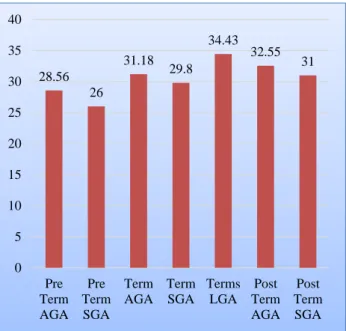
Figure 7: Distribution of mean of chest circumference for different group of new-borns.
Out of 800 new-borns in this study, mean chest circumference of 30.5 cm with range of 18.7 cm to 39.2 cm. Preterm AGA and SGA had mean chest circumference of 28.56 cm and 26 cm respectively. Term AGA, SGA and LGA had mean chest circumference of 31.18 cm, 29.8 cm and 34.43 cm respectively. Post-term AGA and SGA had mean chest circumference of 32.55 cm and 31 cm respectively.
Table 2: Correlation between foot length and other variable for Preterm AGA.
Anthropometric variables No. of Subjects Co- relation (r)
(r2)
p-value
Gestational age
(weeks) 226 0.740 0.547 .0001
Birth weight (kg) 226 0.783 0.613 .000
Foot length is significantly correlated with both gestational age and birth weight with p value of < 0.05 and highly positive correlation coefficient.
Table 3: Correlation between chest circumference and other variable for preterm AGA.
Anthropometric Variables No. of Subjects Co-relation (r)
(r2)
p-value
Gestational age
(weeks) 226 0.714 0.509 .0001
Birth weight (kg) 226 0.742 0.550 .000
34.7 34.08
38.89 38.83 39.71
Chest circumference is significantly correlated with both gestational age and birth weight with p value of < 0.05 and highly positive correlation coefficient.
Table 4: Correlation between foot length and other variable for Preterm SGA.
Anthropometric Variables
No. of Subjects
Co-relation (r)
r2
p-value
Gestational age
(weeks) 48 0.676 0.456 .0001
Birth weight (kg) 48 0.670 0.448 .000
Foot length is significantly correlated with both gestational age and birth weight with p value of < 0.05 and highly positive correlation coefficient.
Table 5: Correlation between chest circumference and other variable for preterm SGA.
Anthropometric Variables
No. of Subjects
Co-relation (r)
r2
p-value
Gestational age
(weeks) 48 0.675 0.455 .0001
Birth weight (kg) 48 0.666 0.443 .000
Chest circumference is significantly correlated with both gestational age and birth weight with p value of < 0.05 and highly positive correlation coefficient.
Table 6: Correlation between chest circumference and other variable for term AGA.
Anthropometric Variables
No. of Subjects
Co- relation (r)
r2
p-value
Gestational age
(weeks) 432 0.181 0.032 .00015
Birth weight (kg) 432 0.312 0.097 .000
Table 7: Correlation between foot length and other variable for term SGA.
Anthropometric Variables
No. of Subjects
Co-relation (r)
r2
p-value
Gestational age
(weeks) 75 0.393 0.154 0.0003
Birth weight (kg) 75 0.660 0.435 0.00
Table 8: Correlation between chest circumference and other variable for term SGA.
Anthropometric Variables
No. of Subjects
Correlation
(r) r
2
p-value Gestational age
(weeks) 75 .272 0.073 .018
Birth weight (kg) 75 .500 0.250 0.00
Table 9: Regression equation for gestational age calculation from foot length or chest circumference.
Maturity Variable Regression Equation
Gestational
age Foot length GA=30.242+0.985[FL] Gestational
age
Chest
circumference GA=17.903+0.651[CC]
Chest circumference is significantly correlated with both gestational age and birth weight with p value of <0.05 and highly positive correlation coefficient.
Foot length is significantly correlated with birth weight with p value of < 0.05 and highly positive correlation coefficient but is not correlated with gestational age.
Figure 8: Normal distribution curve of foot length.
Chest circumference is significantly correlated with both gestational age and birth weight with p value of < 0.05 and highly positive correlation coefficient.
Statistical analysis could not be done in preterm LGA, term LGA and post-term (SGA, AGA and LGA) due to statistically insignificant sample size.
DISCUSSION
About three-fourths of total neonatal deaths occur in the first week of life with the first 24 hours accounting for more than one-third (36.9%) of the deaths that occur in the entire neonatal period.5 Of all the causes of neonatal
mortality, prematurity is the leading cause of death accounting for nearly 35% of neonatal deaths with 70 % of these occurring in first week of life.2 Thus, early
identification of premature and low birth weight new-born is an important prerequisite for reduction of neonatal mortality rate and under-five mortality rate.
This study was done to find a correlation between gestational age and anthropometric measures such as foot length and chest circumference so that they can be used as proxy for estimation of gestational age. It aims to provide a simple measure that can be measured with commonly available measuring tape and without need to any specialised training to identify and manage at risk new-borns. This study was done over period of 18 months in which 800 hundred new-borns were selected by simple random technique and were examined within 72 hours of birth.
Male to female ratio
In present study, 54.3% were males as compared to 45.7% females. It is comparable to study done by Ashish KC et al which showed 53.1% males and 46.9% females.8
In study done by Singhal S et al 56.5% were males and 43.5% were females.9
Description of birth weight
In our study, 43% of total new-born were of low birth weight (<2.5 kg) which is comparable to study done by Mukherjee et al in 2013 which showed prevalence of 51% of LBW new-born.10 Mean birth weight in our study
is 2.52 kg which is comparable to mean birth weight of 2.679 kg in study by Hugue et al but is less as compared to other studies done such as by Chandrashekhar T Sreeramareddy et al and Sajjadian et al which had mean by 3.029 kg and 3.195 kg respectively.11-13
Distribution based on gestational age
In this study, 64.3% were term new-born, 34.2% were Preterm and 1.5% were post-term new-born which is comparable to study done by Singhal S et al in which 63.5% term new-born.9
Distribution based on gestational age and birth weight
In this study, 83.6% were appropriate for gestational age while 15.5% were small for gestational age. This is comparable to study done by Srivastava A et al in which 76% were AGA and 24% were SGA.14
In this study, term AGA, SGA and LGA were 54%, 9.4% and 0.9% respectively. Preterm AGA and SGA were 28.2% and 6% respectively. And 1.4% were Post-term AGA. In James et al 59.7% were Term AGA and 29.7% were post term AGA.
Post-term and preterm LGA were not statistically analysed due to small sample size which was statistically insignificant.
Descriptive analysis of gestational age
In this study mean gestational age is 38.6 weeks which is comparable to study done by Mukherjee et al and Ashish KC et al with mean gestational age of 36.37 weeks and 38.9 weeks respectively.10,8
Descriptive analysis of foot length
The mean foot length is 6.23 cm and 6.87 cm for preterm SGA and AGA respectively. The mean foot length is 7.07 cm, 7.7 cm and 8.71 cm for term SGA, AGA and LGA respectively. The mean foot length is 7 cm and 8.18 cm for post-term SGA and AGA respectively. This shows that foot length increases as the gestational age increases.
This is comparable to Gohil et al which showed that the mean foot length of preterm was 6.56cm, term SGA w as 7.13 cm and that of term AGA was 7.6 cm.15
Descriptive analysis of chest circumference
The mean chest circumference is 26 cm and 28.56 cm for preterm SGA and AGA respectively. The mean chest circumference is 29.8 cm, 31.18 cm and 34.43 cm for term SGA, AGA and LGA respectively. The mean chest circumference is 31 cm and 32.55 cm for post-term SGA and AGA respectively. This shows that chest circumference increases as the gestational age increases and is comparable to study done by Narendra KS et al.16
Correlation coefficient of foot length to gestational age
The correlation coefficient (r value) in this study for preterm SGA with gestational age was 0.676 and with birth weight was 0.67 and was highly significant (p value < 0.0001) for both.
In term SGA neonates, foot length correlated significantly (p <0.0003) with gestational age and birth weight. Correlation coefficient (r value) was highly positive for both parameters. More correlation was observed with birth weight (r = 0.66) followed by gestational age (r = 0.393).
In term AGA neonates, foot length correlated significantly (p <0.000) with birth weight but not with gestational age (p = 0.631). The correlation coefficient (r value) for birth weight and gestational age was 0.211 and 0.023 respectively.
The correlation coefficient could not be calculated in preterm LGA, and post-term (SGA, AGA and LGA) because of statistically non-significant small sample size in these groups. The correlation coefficient of foot length to gestational age is significant (except in term AGA) which is less than in studies by Srivastava A et al (r value for SGA and AGA was 0.97 and 0.96 respectively), Mukherjee et al (r value of preterm and term was 0.97 and 0.96 respectively) and Singhal S et al (r value = 0.934) but was comparable to Narendra KS et al (r value = 0.523).14,10,9,16
The correlation coefficient of AGA (both preterm and term) was more correlated than SGA (both preterm and term) and is more correlated in preterm new-born as compared to term new-born. The studies of James et al and Gohil JR et al showed that although there is a positive correlation of foot length with gestational age and birth weight, the anthropometric variable with which foot length correlated varied between term and preterm neonates and the correlation was better for preterm neonates.17,15
Correlation coefficient of chest circumference to gestational age
The correlation coefficient (r value) in this study for preterm SGA with gestational age was 0.675 and with birth weight was 0.666 and was highly significant (p value <0.0001) for both.
The correlation coefficient (r value) in this study for preterm AGA with gestational age was 0.714 and with birth weight was 0.742 and was highly significant (p value <0.0001) for both.
In term SGA neonates, chest circumference correlated significantly with gestational age (p value < 0.018) and birth weight (p value <0.000). Correlation coefficient (r value) was highly positive for both parameters. More correlation was observed with birth weight (r = 0.50) followed by gestational age (r = 0.272).
In term AGA neonates, chest circumference correlated significantly with birth weight (p < 0.000) and gestational age (p = 0.0001). The correlation coefficient (r value) for birth weight and gestational age was 0.312 and 0.181
respectively. The correlation coefficient could not be calculated in preterm LGA, and post-term (SGA, AGA and LGA) because of statistically non-significant small sample size in these groups.
The correlation coefficient of chest circumference to birth weight is significant which is comparable to studies done by Chandrashekhar T Sreeramareddy et al (r value = 0.553) and Naik DB et al (r value = 0.70) but is less than in studies by Shastry et al (r value = 0.80).12,19,18
The correlation of chest circumference to gestational age is comparable to studies done by Narendra KS et al with r value of 0.523, Bhatia BD et al (r value = 0.495) and Sharma JN et al (r value 0.649).16,20,21 But there is paucity
of correlation data for separate groups (SGA, AGA and LGA as well as preterm, term and post-term). The correlation coefficient for preterm was more correlated than term new-born.
Difference in correlation of foot length and chest circumference
In this study, both chest circumference and foot length was significantly correlated with gestational age (except foot length was not significantly correlated with term AGA new-born but chest circumference was correlated). In preterm new-born, correlation was highly significant for both (p value <0.000). But in term new-born, chest circumference was more correlated than foot length in AGA but was less correlated in SGA than foot length. As correlation of chest circumference is significant in all study groups than of foot length, chest circumference can be taken as single parameter to study gestational age. And this is comparable to findings in studies by Otupiri et al, Mullany et al and Nai Nguyen Thi et al.22-24
Estimation of gestational age from new-born foot length or chest circumference
In this study, we have tried to estimate gestational age by given foot length or chest circumference. But these equations require further study to prove their validity.
Larger sample size could have increased the statistical power of the present study. Statistical power may have increased if this study was done in community instead of hospital. All study groups (preterm LGA, term LGA and post-term SGA/ AGA/ LGA) could not be analysed due to small sample size. Unequal distribution of subjects in different study groups
CONCLUSION
This study tried to identify anthropometric parameter (foot length and chest circumference) which allows for rapid evaluation of the infant for gestational age and provide at risk infants with timely care.
significant correlation with gestational age (p < 0.05) except for foot length in term AGA new-borns. Due to non-significant correlation of foot length with gestational age in term AGA, chest circumference was proposed to be better for gestational age estimation. More correlation was found with preterm than with term new-borns. An equation to estimate gestational age from either foot length or chest circumference was formulated.
Funding: No funding sources Conflict of interest: None declared
Ethical approval: The study was approved by the Institutional Ethics Committee
REFERENCES
1. UNICEF. State of the world’s children 2016: A fair chance for every child. In: Child health: A fair start in life. New York: UNICEF; 2016:10-13.
2. Liu L, Oza S, Hogan D, Perin J, Rudan I, Lawn JE, et
al. Global, regional, and national causes of child mortality in 2000-13, with projections to inform post-2015 priorities: an updated systematic analysis. Lancet. 2015;385(9966):430-40.
3. Registrar General of India. Sample registration system (SRS) statistical report 2013. New Delhi: Registrar General of India; 2013.
4. Shankar M, Neogi S, Sharma J, Chauhan M, Srivastava
R, Prabhakar P, et al. State of newborn health in India. J Perinatol. 2016;36:S3-8.
5. ICMR Young Infant Study Group. Age profile of
neonatal deaths. Indian Pediatr. 2008;45:991-4.
6. International Institute for Population Sciences.
National Family Health Survey (NFHS-3) 2005-06: India. Mumbai: International Institute for Population
Sciences. Available at:
https://dhsprogram.com/pubs/pdf/frind3/frind3-vol1andvol2.pdf
7. Lubchenco LO, Hansman C, Dressler M, Boyd E.
Intrauterine growth as estimated from liveborn birth-weight data at 24 to 42 weeks of gestation. Pediatr.1963;32:793-800.
8. Ashish KC, Nelin V, Vitrakoti R, Aryal S, Målqvist M.
Validation of the foot length measure as an alternative tool to identify low birth weight and preterm babies in a low-resource setting like Nepal: a cross-sectional study. BMC Pediatr. 2015;15(1):43.
9. Singhal S, Tomar A, Masand R, Purohit A. A simple tool for assessment of gestational age in newborns using foot length. J Evol Med Dental Sci. 2014;3(23):6424-9.
10. Mukherjee S, Roy P, Mitra S, Samanta M, Chatterjee S. Measuring new born foot length to identify small babies in need of extra care: a cross-sectional hospital-based study. Iran J Pediatr. 2013;23(5):508-12. 11. Huque F, Hussain AM. Detection of low birth weight
newborn babies by anthropometric measurements in Bangladesh. Indian J Pediatr. 1991;58(2):223-31.
12. Sreeramareddy CT, Chuni N, Patil R, Singh D, Shakya
B. Anthropometric surrogates to identify low birth weight Nepalese newborns: a hospital-based study. BMC Pediatr. 2008;8:16.
13. Sajjadian N, Shajari H, Rahimi F, Jahadi R, Barakat M. Anthropometric measurements at birth as predictor of low birth weight. Health. 2011;03(12):752-6.
14. Srivastava A, Sharma U, Kumar S. To study
correlation of foot length and gestational age of new born by new Ballard score. Int J Res Med Sci. 2015;3(11):3119-22.
15. Gohil JR, Sosi M, Vani SN, Desai AB. Foot length measurement in the neonate. Indian J Pediatr. 1991;58:675-7.
16. Narendra KS, Madhu GN, Adarsha E. Relationship of anthropometric parameters of newborn with varying period of gestational age. J Evol Med Dental Sci. 2014;3(20):5484-90.
17. James DK, Dryburgh EH, Chiswick ML. Foot length -
a new and potentially useful measurement in the neonate. Arch Dis Child. 1979;54(3):226-30.
18. Shastry R, Bhat P. Neonatal screening by chest circumference and a study of relationship between birthweight and other anthropometric parameters. Int J Biomed Res. 2015;6(03):160-3.
19. Naik DB, Kulkarni AP, Aswar NR. Birth weight and anthropometry of newborns. Indian J Pediatr. 2003;70(2):145-6.
20. Bhatia BD, Tyagi NK. Birth weight: relationship with other fetal anthropometric parameters. Indian Pediatr. 1984;21:833-8.
21. Sharma JN, Saxena S, Sharma U. Relationship
between birth weight and other neonatal
anthropometric parameters. Indian Pediatr.
1984;28:244-8.
22. Otupiri E, Wobil P, Nguah SB, Hindin MJ.
Anthropometric measurements: Options for identifying low birth weight newborns in Kumasi, Ghana. PLoS One. 2014; 9(9):e106712.
23. Mullany LC, Darmstadt GL, Khatry SK, LeClerq SC, Tielsch JM. Relationship between the surrogate anthropometric measures, foot length and chest circumference and birth weight among newborns of Sarlahi, Nepal. Eur J Clin Nutr. 2007;61(1):40-6.
24. Thi H, Khanh D, Thu H, Thomas E, Lee K, Russell F.
Foot length, chest circumference, and mid upper arm circumference are good predictors of low birth weight and prematurity in ethnic minority newborns in Vietnam: A hospital-based observational study. PLoS One. 2015;10(11):e0142420.