2017 International Conference on Computer Science and Application Engineering (CSAE 2017) ISBN: 978-1-60595-505-6
Indoor Mobile Node Localization Algorithm
based on RSSI and Improved MCL
Xiao-yuan Liu* and Kai-hong Fang
Department of Electronic Information, Luoding Polytechnic, Luoding, 527200 Guangdong, China
ABSTRACT
With the characteristics of mobile sensor network for dynamic change of indoor network structure and node position, in order to overcome the shortage of localization accuracy and sampling efficiency of Monte Carlo localization algorithm in wireless sensor networks (WSN), a location algorithm based on RSSI and improved Monte Carlo localization is proposed to locate indoor mobile nodes. First, the paper describes the classical MCL algorithm and the received signal intensity RSSI model, and then an improved MCL algorithm is designed. The algorithm through introducing the received signal strength indicator model of range prediction, using distance information filtering samples, and finally using the filtered samples of the weighted average to estimate the location of nodes and reducing the sampling area, improves the sampling efficiency and positioning accuracy. The simulation results show that the improved MCL algorithm based on RSSI improves the convergence speed compared with the traditional algorithm, and uses the distance information to filter samples to reduce the computational overhead and improve the positioning accuracy. Under the same conditions, the improved MCL algorithm based on RSSI reduces the positioning error by about 45% compared with the traditional Monte Carlo algorithm.
INTRODUCTION
Now there are two main localization algorithms for WSN: Rang-Based localization algorithm and Rang-Free localization algorithm. Among them, algorithm based on signal with Time-Of-Arrival (TOA) [2], algorithm based on different signal
with Time-Difference-Of-Arrival (TDOA)[3], algorithm based on signal with
Angle-of-Arrival(AOA)[4] and algorithm based on signal with
Received-Signal-Strength-Indication(RSSI)[5], they belong to Range-Based
localization algorithm. Centroid algorithm for solving polygon geometric center of
gravity based on neighbor nodes[7], algorithm based on nodes with
Distance-Vector-Hop (DV-Hop)[4], Multi-Dimensional Scaling Map( MDS-MAP)
algorithm[7], these algorithms are fixed node localization algorithms and they belong to
was first proposed Monte Carlo location algorithm (MCL) by American Hu and Evans in 2004. As workshop resources have extensive mobile characteristics, the paper has proposed a workshop mobile node localization algorithm (R-MCL) based on RSSI modified MCL according to reference [4], which is based on the RSSI and MCL localization algorithms, there are many problems, such as large computation, long computing time, large energy loss of nodes, and no motion prediction. In fact, the trajectory of workshop manufacturing resources is generally regular, i.e., the motion parameters cannot be changed commonly, so we can make use of the mobile node several time points of data, predict the trajectories of the mobile node at the present time, reduce the range of sampling algorithm, improve the sampling efficiency and the accuracy, so as to improve the positioning accuracy.
CLASSICAL MCL ALGORITHM
Monte Carlo localization algorithm was first proposed and applied to WSN mobile node localization in 2004 by Hu L. of Virginia University referring robot localization method, which the core idea is based on the Bayesian filtering location estimation, the expected location of the unknown mobile node (workshop mobile resource) at the next time point is expressed as a posterior probability density distribution by the weighted sample set. The location of MCL is divided into three steps: initialization, sampling and result output [7]. Among them,sampling is the core step, which is divided into three stages: prediction, filtering and importance sampling.
LOCATION OF WORKSHOP MOBILE NODES BASED ON RSSI IMPROVED MCL
The improved algorithm proposed in reference 7-8 provides a new way for localization in indoor and outdoor mobile nodes, but the distance between the reference node and the RSSI two kind of information as a reference to correct the unknown node distance is not proposed by other researchers. The core idea of improving MCL algorithm based on RSSI is to use RSSI statistical model to calculate the distance information between nodes, and then use it as the observation value of filtering phase in MCL algorithm, so as to improve the positioning accuracy of the algorithm.
RSSI Model
by the external environment, according to the theory of the existing propagation models and propagation model based on the measured in the workshop mobile resource environment, the average received signal strength according to the logarithmic law. Therefore, the average signal strength can be modeled by the log normal model of formula 1:
X m
m n P
Pm m
0
lg 10
0
(1)
Among them, Pm indicates the signal strength received at distance m (unit: dBm),
Pm0 indicates the signal strength received by the reference node at a distance of m0
(unit: dBm), n means path loss index, m represents the distance between anchor nodes
and unknown nodes, m0 represents the distance between the reference node and the unknown node, X represents the random error of actual and estimated path loss,
which mainly depends on the number of obstacles between nodes and the influence threshold of obstacles on signals.
In the workshop environment studied in this paper, we define R as the received signal strength value, and T is the signal intensity at the distance of 1.2 meters from the signal transmitting node, m is the distance between the unknown node and the signal transmitting node. Considering the influence of the number of obstacles and the obstacles on the signal, through field experiments, take reference value X=-35, n=2.6. Then the workshop model is shown in formula 2:
m n TR 10 lg (2)
Due to the signal attenuation RSSI is greatly affected by the external environment, many times the same RSSI value occurs and the distances between nodes are different in the same WSN, which causes the distance between the final estimate and the actual distance is very large. To correct this error, we calibrate the distance between unknown nodes by referring the distance between reference nodes and RSSI two kinds of information.
Then the unknown node W receives the average value of the RSSI of the reference node RI (unit: dBm) and the unknown node W receives the reference node I, the signal intensity average PI (unit: mW) conversion as shown in formula 3:
10 /
10RI
I
P (3)
According to formula 3, the Conversion formula of the reference node I receives the average value RIJ(unit: dBm) of the RSSI and average signal strength PIJ(unit: dBm) of another reference node J as shown in formula 4:
10 /
10RIJ
IJ
P (4)
n
IJ WI
I IJ
D D P P
(5) Among them, DWI represents the distance between the unknown node W calculated from the previous formula and the reference node I, DIJ represents the distance between the two reference nodes I and J.
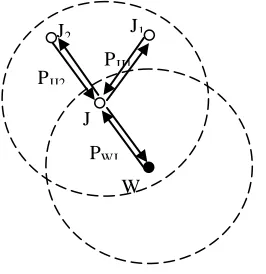
[image:4.612.225.358.205.342.2]As shown in Figure 1, the solid circle in the graph represents the unknown node, and the hollow circle represents the reference node, J is an unknown node W jump reference node, J1, J2 is the reference node within the J communications
Figure 1. The communication process between a hop reference node and an unknown node and other neighboring reference nodes.
range, J sends signals to unknown nodes W and reference nodes J1 and J2 within the communication range and receives their feedback packets, that is, signal strength. With the formula 5, the formula for calculating the distance J between the unknown node W and the reference node DWJ is shown as follows:
2 2 1 1
1 1
1
2 1
JJ n JJ JJ n JJ n WJ
WJ P D P D
P D
(6)
Improved MCL algorithm description based on RSSI
In order to overcome the signal attenuation of RSSI which influenced by the external environment, according to the scene of workshop, In the 2.1 section, the ranging model and the correction processing of RSSI are introduced, which reduces the error of distance estimation from outside environment, and improves the ranging precision effectively. On this basis, a workshop Mobile Resource Location Algorithm (R-MCL) based on RSSI improved MCL is proposed. The algorithm is divided into the following phases:
J1 J2
J
W PJJ1
INITIALIZATION
In order to obtain the prior data of MCL, N samples are selected randomly as the possible location of the node (workshop Mobile Resource) at the beginning of the
localization algorithm which record as K
K K K0N
2 0 1 0
0 , ,, , then we enter the
ranging prediction phase. At this stage, we introduce the RSSI model to calculate the distance between the unknown nodes and the reference nodes, and then correct them to reduce the error and improve the positioning accuracy.
RANGING PREDICTION AND SAMPLING
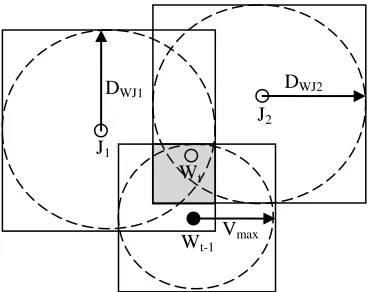
In order to obtain the sample set Kt of the current time point t, needing the location the sample set Kt-1 of the forward time point t-1 as the circle center, the maximum
[image:5.612.186.374.314.460.2]speed Vmax as the radius, a hop reference node communication radius.
Figure 2. A sampling region constructed based on an unknown node RSSI model.
R as the constraint condition (in order to reduce the amount of computation, when reference nodes are too many, we take the distance information of the nearest three reference nodes. And in order to facilitate the sampling algorithm, we take the circumscribed square of the communication circle instead of the effective communication circle.). The shaded section in Figure 2 shows the valid sampling area, Wt-1 and Wt respectively indicate the location of the previous time point and the current time point of the unknown node W, J1 and J2 are the closest two reference nodes of a jump reference node. If there is no overlap valid sampling area due to the RSSI range error, the other two nearest reference nodes are iteratively selected until a valid sampling region position is present.
PARTICLE FILTRATION
In the filtering phase, samples that are completely impossible are removed from
J1
J2
Wt-1 Wt DWJ1
the predicted location sample set by listening to broadcast information. The classical MCL filtering algorithm is adopted in this paper. When the distance between the unknown node W and one hop and two hop reference node J is greater than the node's own communication radius R, the sample is discarded. The sample accord with formula 6 is retained until the number of samples in accordance with the filter condition reaches N, otherwise the second stage is repeated.
WEIGHT ALLOCATION AND LOCATION ESTIMATION
According to the communication principle of nodes, the closer the sample node is to the reference node, the less the signal attenuation, and less interference from the outside world, the smaller the error of the RSSI model, which shows that the range accuracy of this sample is higher and the greater the proportion of the allocation because the predicted position of the sample is closer to the real location of the unknown node. According with the forward three steps, we can obtain the sample set K={K1,…,KN}, and take its coordinates as (x1,y1),…,(xN,yN). The distance between
unknown node W and one hop reference node J1,…,JM record as R1,…,RM. The RSSI
range error calculates the weights WKi
of the sample Ki as shown in the following
formula:
2 1 2 , 1 1 t t i M t t K R A K d R W i
(7)Through the formula 7 to obtain N samples with weight, then the current time point unknown node W position coordinates can be expressed as follows:
i N i K N i K x W W x i i
1 1 1 (8) i N i K N i K y W W y i i
1 1 1 (9)SIMULATION RESULTS AND ANALYSIS OF R-MCL
randomly distributed in a circular region with a radius of 200m, the values of the relevant parameters are as follows: the time interval T is 1s, the total sample M
number is 50, the reference node density Sd is 1, the unknown node density nd is 10.
Considering the influence of the number of obstacles and the obstacles on the signal to the threshold, through field experiments, the random error of the actual and estimated path loss in the RSSI ranging model is -35, and the signal loss factor n is 2.6. As following, the simulation experiments are carried out and experimental analyzed respectively from three aspects such as reference node density (Sd), unknown node density nd and RSSI error (Xσ).
The Location Error Varies with the Reference Node Density (Sd)
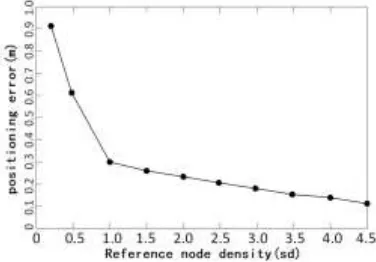
The influence of the reference node density (Sd) on the positioning accuracy is shown in Figure 3. When the reference node density is from 0 to 1, the positioning error is reduced rapidly, when the reference node density increases to a certain value (greater than 2), the localization error varies little with increasing density, this is because, for mobile nodes, as long as three effective reference node can achieve the filter condition of the R-MCL algorithm, and greatly reduce the sampling range. But with the RSSI model of range errors existing, if the increase of reference number of nodes, it not only increases the amount of calculation, but also cannot improve the positioning accuracy. Therefore, in order to save the cost of hardware input, R-MCL algorithm and MCL algorithm, the value the reference node density in general between of 1-2.
[image:7.612.212.400.418.549.2]
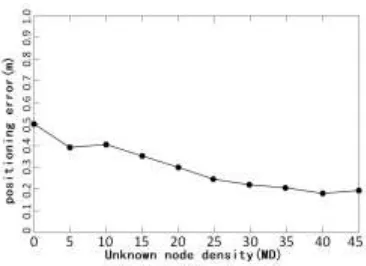
Figure 4. Influence of unknown node density (MD) on location accuracy.
The Localization Error Varies with the Unknown Node Density (Md)
The influence of the unknown node density (md) on the positioning accuracy is shown in Figure 4. In this paper the range prediction process of RSSI model is mainly based on the information of one hop reference node to determine the sampling area, the two hop reference node is used as a reference in the R-MCL algorithm particle filter. When the unknown node density increases, the two hop reference nodes increase, and to some extent, the localization error decreases, but the range is not large. Since we do not increase the reference node density in the simulation process, the localization accuracy increases little with the increase of unknown node density.
The Location Error Varies with the RSSI Ranging Error (XΣ)
As the improved Monte Carlo localization algorithm based on RSSI distance measurement is based on RSSI model ranging, obviously, RSSI ranging error will directly affect the positioning accuracy of R-MCL algorithm. As shown in Figure 5, the location error of R-MCL algorithm increases with the RSSI range error, and it is shown in the simulation experiment, when the reference node density is reduced to a
certain extent, the RSSI ranging error Xσ greater than 10, the RSSI ranging
information is not satisfied with the filter condition. At this time, if the reference nodes cannot be added, only the classical MCL algorithm can be considered, or other non-location algorithms are used.
Figure 5. Effect of RSSI ranging error (Xσ) on positioning accuracy.
1 2 3 4 5 6 7 8 9 10 1.0
0.9 0.8 0.7 0.6 0.5 0.4 0.3 0.2 0.1 0
RSSI(Xσ)
Th
e
lo
ca
ti
o
n
e
rr
o
r
v
ar
ie
s
位
误差
[image:8.612.184.402.554.692.2]SUMMARY
According to the location demand of mobile resources in workshop, taking into account the moving characteristics of workshop mobile resources, an improved Monte Carlo localization algorithm based on RSSI is proposed in this paper. The core idea of the algorithm is to use weighted sample sets to estimate the posterior probability density distribution of unknown node locations, and with the sample set updated iteratively, and finally used the weighted average to estimate the location of unknown nodes. The R-MCL algorithm is introduced into the RSSI ranging model, the correction processing is carried out and the sampling area is effectively reduced, which makes the algorithm can improve the positioning accuracy, convergence speed and computational complexity. Simulation experiments show that, the algorithm can effectively improve the positioning accuracy of 45%, reduce the invalid sampling and reduce the computational power consumption of nodes. The algorithm is based on ranging, as for the application of low positioning accuracy, the algorithm will be combined with the range free algorithm, and other studies will be carried out.
REFERENCES
1. Jamalabdollahi M, Zekavat. 2015. “S.Time of arrival estimation in wireless sensor networks via OFDMA,” Vehicular Technology Conference, pp:1-5.
2. Wang Y., and Ho K. C. 2013. “TDOA Source Localization in the Presence of Synchronization Clock Bias and Sensor Position Errors,” J. IEEE Transactions on Signal Processing, 61(18):4532-4544.
3. CUI W., Wu S. C., and Wang Y. Z. 2014. “A Gossip-Based AOA Distributed Localization Algorithm for Wireless Sensor Networks,” J. Applied Mechanics and Materials, pp:841-846. 4. Yaghoubi F, Abbasfar A. A., Maham B. 2014. “Energy-efficient RSSI-based localization for
wireless sensor networks,” J.IEEE Communications Letters, 18(6):973-976.
5. Bai Y., Li C. M., Xue Y. 2013. “A Centroid Localization Algorithm for Wireless Sensor Networks Based on RSSI,” Applied Mechanics & Materials, pp.303-306: 197-200.
6. Ren P., Liu W., Sun D., et al. 2016. "Node Localization based on Convex Optimization in Wireless Sensor Networks," International Conference on Fuzzy Systems and Knowledge Discovery IEEE, pp. 2169-2173.
7. Yi J., Yang S., Cha H. 2007. “Multi-hop-based Monte Carlo Localization for Mobile Sensor Networks,” Sensor, Mesh and Ad Hoc Communications and Networks, 2007. SECON '07. IEEE Communications Society Conference on IEEE, 2007:162-171.