ARTIGO ORIGINAL
Birth Rate and Fertility: Knowledge and
Expectations Analysis of 3585 University
Students
Natalidade e Fertilidade: Análise dos Conhecimentos e Expectativas de 3585
Estudantes Universitários Portugueses
1. Departamento de Pediatria. Centro Hospitalar Lisboa Norte. Lisboa. Portugal. 2. Serviço de Epidemiologia. Direcção-Geral de Saúde. Lisboa. Portugal.
3. Geografia da Saúde. Serviços Partilhados do Ministério da Saúde. Lisboa. Portugal. 4. Associação de Estudantes. Faculdade de Medicina. Universidade de Lisboa. Lisboa. Portugal. 5. Departamento de Ciências de Comunicação. Instituto de Higiene e Medicina Tropical. Lisboa. Portugal. Recebido: 22 de Janeiro de 2014 - Aceite: 19 de Maio de 2014 | Copyright © Ordem dos Médicos 2014
Maria do Céu MACHADO1, Maria Isabel ALVES2, Luísa COUCEIRO3, Francisco Goiana da SILVA4, Miguel MORAIS DE
ALMEIDA4, Isa ALVES5
Acta Med Port 2014 Sep-Oct;27(5):601-608
RESUMO
Introdução: Em Portugal, a taxa de natalidade não é suficiente para assegurar a renovação de gerações. A licenciatura e participação no mercado de trabalho das mulheres e a actual instabilidade económica são alguns determinantes e têm como consequência, o adiamento da parentalidade e infertilidade condicionada ainda pela obesidade, tabagismo e álcool.
Material e Métodos: Estudo epidemiológico transversal, analítico, através de questionários auto-preenchidos, online, divulgados pelas Associações de estudantes das Universidades Portuguesas. A análise estatística da amostra de 3585 estudantes foi desen-volvida em SPSS, Excel nas representações gráficas e ArcMap, para os mapas.
Resultados: Predomínio de estudantes de Ciências de Saúde (40,6%), da Universidade de Lisboa (59,4%) e sexo feminino (76,9%), mediana de idades de 22 anos; tabagismo 18,4%, consumo de álcool 22,3% e excesso de peso e obesidade 15,4%; intenção de casamento/união de facto 71,0%, projecto de parentalidade 85,7%; o emprego (47,4%) e a vontade do parceiro (39,9%) foram con-siderados determinantes na probabilidade de ter filhos assim como a segurança financeira para boa educação (33,6%) e cuidados de saúde (38,6%); 53,6% consideram a hipótese de infertilidade. Encontrámos valores mais elevados e significativos para o tabagismo (p = 0,001) e consumo de álcool (p = 0,000) no sexo masculino.
Discussão: Consideramos a amostra representativa, bem distribuída pelas áreas de estudo, a maioria jovem, predomínio feminino superior aos rácios das faculdades. Há mais estudantes com projectos de parentalidade do que de casamento/união de facto, o que está de acordo com a evolução em Portugal. No entanto, os mesmos estudantes identificam a família como prioritária relativamente ao emprego e carreira. A decisão da parentalidade é condicionada pelas condições socioeconómicas mas um factor importante a considerar é uma baixa fertilidade biológica devida ao adiamento da idade da primeira gestação.
Conclusão: As associações de estudantes universitários são um excelente instrumento de acesso; um número muito significativo pensa ter filhos mas adia essa decisão; há falta de informação relativamente às consequências de adiar a idade do primeiro filho e aos factores de infertilidade. A tendência negativa da fecundidade deve ser encarada como necessidade de desenvolver políticas específicas.
Palavras-chave: Natalidade; Estudantes Universitários; Infertilidade; Portugal.
ABSTRACT
Introduction: Nowadays, Portuguese birth rate is insufficient to ensure renewal of generations. Women high education levels and labor market integration and increased economic difficulties are some of multiple factors leading to a delay in average parenting age and an increase of infertility; also subject to others such as obesity, smoking and alcohol consumption.
Material and Methods: Transversal epidemiological study, analytical, uncontrolled, from self-filled online questionnaires, promoted by students’ university unions. A sample of 3585 university students was considered and a global and by gender statistic analysis was done through SPSS, Excel was used to build graphics and tables and ArcMap to represent maps.
Results: Mainly students from the Health Sciences (40.6%), Universidade de Lisboa (59.4%), female (76.9%), median age of 22; intention to marry/ union 71.0%, parenthood 85.7%. A total of 18.4% smoke, 22.3% consume alcohol and obesity 15.4%; employment (47.4%) and the partner’s will (39.9%) were important determinants for parenthood decision as well as having financial stability to provide a good education (33.6%) and healthcare (38.6%); A total of 53.6% have considered the hypothesis of infertility and highlight above 35 year old maternal age (18.7%), obesity (18%) and female smoking (19.0) as factors. Higher and more significant values for smoking (p = 0.001) and alcohol consumption (p = 0.000) in males were found.
Discussion: The sample seems representative, well distributed among different areas of study, with more female respondents than the university portuguese ratio. There are more students with parenting projects than marriage/cohabitation, in accordance with Portuguese data. Nevertheless, the same students identify the family as a priority in comparison with employment and career. Parenting decisions are tied by social-economic situation but an important factor is the low fertility due to the maternal age delay of the first pregnancy. Conclusion: University student unions are an excellent instrument to access them; a high number of respondents consider having children but delay the decision; there is a lack of information about the consequences of delaying parenting age and about infertility factors. The negative trend of fertility must be seen as a necessity to develop specific policies.
Keywords: Birth Rate; Students; Universities; Fertility; Portugal.
35
35 ano
s a p
rom
ov
er
as
ciê
CA
P
ORT
UGUE
SA
ARTIGO ORIGINAL INTRODUCTIONPopulation’s socio-demographic modulators include
birth rate, mortality and migrations. Birth rate has suffered an historic worldwide reduction, with synthetic fecundity in-dex dropping from six to 2.5 children per woman and reach-ing 1.28 in 2012 in Portugal1, an insufficient figure to ensure
the renovation of generations.
This situation is related to multiple individual, social and economic factors. From these, we underline increased women’s education and labour market participation level, with an impact on the balance between family, work and leisure times.2-5
Demography is directly influenced by migratory movements, which also contribute to birth rate increase. Immigration was responsible for a quarter of the population growth that occurred in developed countries over the nineties but was reduced due to financial crisis.6 In Portugal,
after strong immigration waves at the beginning of the 21st century, a significant slowdown has occurred, from 50 thousand new immigrants in 2000 to just eight thousand in 2008.7 In 2011, European countries had on average 7% of
foreign population while Portugal only had 4%.
In addition, society is currently facing a period of economic and financial instability with young graduate’s unemployment as a major issue. The uncertainty over the future may be crucial to parenthood decision as well as to the number of children.
Finally, the advances in Medicine allowed for pregnancy to be planned and gave answers to infertility, generating belief in guaranteed success. Infertility affects one in seven couples in western countries, related to environmental and biological factors and prevalence increases with postponement of maternity, sexually-transmitted diseases, obesity, smoking and alcohol addiction.8
Portuguese and international literature shows that most of the studies on birth rate are meta-analysis based on national data,9-11 they are not specific for any gender or age
group and use information based on responses within other contexts, such as national surveys. We are unaware of any research specifically designed and applied to undergraduate students on this issue.
Our study aimed to characterise undergraduate student’s awareness, behaviours and practices regarding fertility, parenthood decision and timing through the involvement of Portuguese Universities’ Student Associations.
MATERIAL AND METHODS
This was an epidemiological study, cross-sectional, uncontrolled and analytical, based on self-completion questionnaires involving undergraduate students from Portuguese universities (from Mainland Portugal, Azores and Madeira regions).
Infertility was defined in our study as the inability to conceive upon two years of regular sexual intercourse without any contraception8; Fertile Age was considered
between 15 and 49 years of age2; Synthetic Fecundity
Index was defined as the average number of life births of
women in child-bearing age; normal Body Mass Index (BMI) was considered between 18.5 and 24.9.
Questions were grouped as follows: University (education institution, course, academic year); Place of residence (full-time, school-time); Individual characteristics (age, gender, nationality, weight and height); Family characteristics (parental cohabitation, number of siblings and parent’s siblings); Marital status (current, planned); Contraception; Addictions (smoking, alcohol); Parenthood (plans, best age to have children); Determinant factors regarding the probability of having children; Awareness and convictions on postponing child-bearing decision; Infertility; Importance assigned to family, career and employment. The questions were included on a CreateSurvey.com edition and online survey application which automatically transfers data onto a spreadsheet.
The questionnaire was disclosed to students attending 40 higher education institutions (Universities. Polytechnic Institutions, Graduate Schools, Institutes) and sent to their personal email addresses, through the Student Associations, between July and October 2012.
Data were directly recorded by the questionnaire management software onto the spreadsheet and exported to SPSS (Statistical Package for the Social Science), version 20.0 software.
A total of 3,616 responses to the questionnaire were received and 31 responses from people aged 50 or above were excluded.
Based on the classification published in the website of the Direção-Geral do Ensino Superior12 three fields of study
were considered: Science and Technology (Agriculture and Natural Resources, Architecture, Visual Arts & Design, Science, Economy, Management and Accounting, Technology; Health Sciences(Medicine, Nursing, Pharmacy, Veterinary, Psychology); Human Sciences & Education (Teacher Training, Law, Social Sciences, Humanities, Translation, Physical Education, Sports and Performance Arts)
The Chi-square test was applied to the difference in the proportions observed in each group (female and male) and equality of proportions was considered as the null hypothesis (H0). A number of students in each group above 30 and the independence between them allows for a normal distribution to be followed when H0 is true for the sample distribution of the difference in proportions. The standard variable (z) has been used as the test statistics.
Statistical analysis was developed in SPSS, version 20.0 and Excel was used for graph and chart’s graphic representation and ArcMap was used for maps; ET Geowisard tools were used for origin-destination flow charts.
The questionnaires were developed based on rules and procedures to ensure respondent anonymity.
RESULTS
ARTIGO ORIGINAL
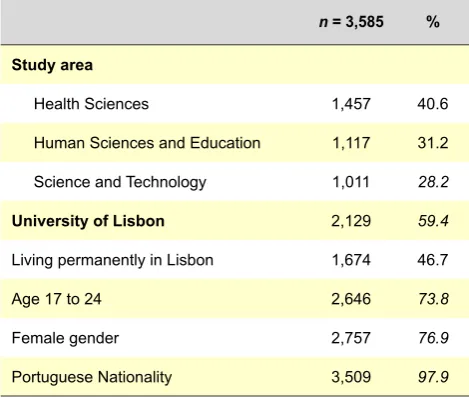
courses, 1,117 (31.2%) from Human Sciences & Education and 1,011 (28.2%) from Science and Technology (Table 1). Respondents attended mostly high education institutions from Lisbon (81.2%), mainly at the University of Lisbon: 2,129 (59.4%). From these, 39.7% attended the Faculty of Medicine, 21.1% the Faculty of Sciences and 9.4% the
Faculdade de Letras. At the Universidade Nova de Lisboa,
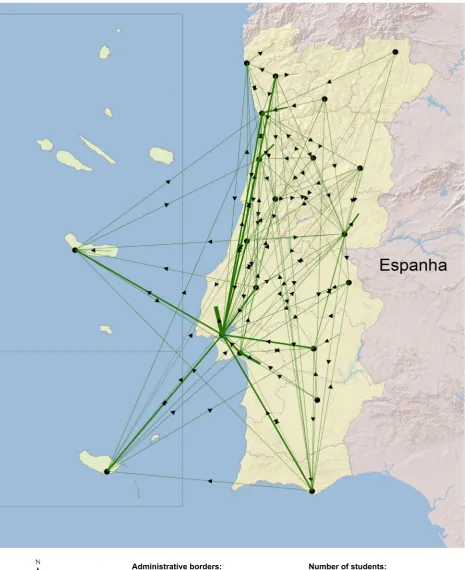
91.1% attended Social Sciences and the Universidade Técnica de Lisboa, 61.3% attended Human Kinetics. More than two thirds of the respondents (71.0%) lived in the Lisbon district during school time and there was a lower percentage of those living in this district permanently (1,674 -46.7%) (Fig. 1).
Most respondents (2,757 [76.9%]) were female and on average 23.7 years of age, with 5.7 years standard deviation and 22 years median age. There was a five-year interquartile range and 75% of the respondents were aged 20 to 25 (Fig. 2).
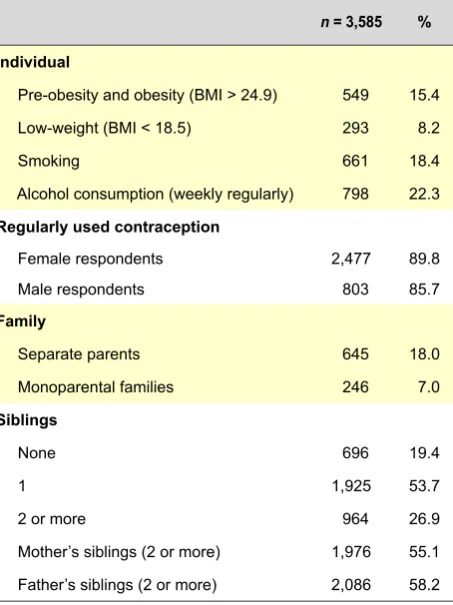
Regarding individual characteristics, 2,743 (76.5%) had normal BMI. We found pre-obesity scores in 454 (12.7%) and type I and II obesity in 95 (2.7%) respondents. The BMI was below the low-weight threshold in 293 (8.2%) respondents.
A minority of students smoked (n=661, 18.4%), from which 36.8% smoked between 10-20 cigarettes per day. Regarding student’s parents, 17.5% and 26.5% had regular smoking mothers and fathers, respectively.
Respondents started smoking on average at 16.7 years of age, with a 2.6 year standard deviation. There was a three-year interquartile range and 75% of responses between 15 and 18 years of age. One respondent referred having started smoking at the age of 8 years (Fig. 3). Most respondents did not drink alcohol, although 798 (22.3%) admitted to regular consumption.
The absence of any contraceptive method was referred by 280 (10.2%) female and 18 male (14.3%) respondents. The contraceptive pill was used by 992 (36.0%) and the combined use of the preservative-pill by 884 (32.1%)
Table 1 - Sample characteristics (absolute and relative frequency)
n = 3,585 %
Study area
Health Sciences 1,457 40.6
Human Sciences and Education 1,117 31.2
Science and Technology 1,011 28.2
University of Lisbon 2,129 59.4
Living permanently in Lisbon 1,674 46.7
Age 17 to 24 2,646 73.8
Female gender 2,757 76.9
Portuguese Nationality 3,509 97.9
of the female respondents. Male condom was used by approximately half of male respondents (408 – 49.3%) (Table 2).
Regarding family characteristics, 2,694 (75.1%) parents lived together, 246 (7%) families were monoparental and 645 (18.0%) of the respondents had separated parents. More than half (1,925: 53.7%) of the respondents had one sibling, 964 (26.9%) had two or more and 696 (19.4%) were single children. Regarding the number of parent’s siblings, we found that 494 (13.8%) mothers and 456 (12.7%) fathers were single children and 1,304 (36.4%) mothers and 1,397 (39.0%) fathers had more than three siblings.
One of the objectives of the study was to determine marriage and parenthood plans: from 3,262 (91.0%) respondents, 1,573 (48.2%) planned to get married and 745 (22.8%) to live as a couple. From the 3,337 respondents with no children, 2,856 (85.7%) had planned future parenthood and 224 (6.7%) responded that they intended not to have children.
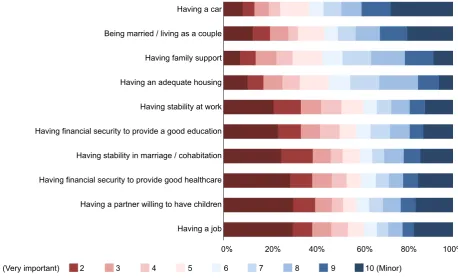
We found that 2,742 (91.9%) respondents intended to have their first child at the age of 25 to 35, 1,710 (56.0%) planned to have two and 231 (31.2%) three of more children. Based on the responses of 2,403 respondents regarding the determinant factors for having children, we found that having a job, having a partner willing to have children, having financial security in order to provide good healthcare and good education for children, having stability in marriage or in a cohabitation relationship, as well as in work, were the major issues (grade 1 or 2 were assigned by more than 30% of the respondents). The factors that were considered as less important (grade 9 or 10) by more than 30% of the respondents were the facts of having a car and being married or living as a couple. The fact of having an adequate place to live and family support were considered of average importance (Fig. 4).
Students were also inquired regarding the awareness of the consequences of postponing the age for having their first child; higher-risk pregnancy was referred by 32.3% and infertility by 21.9% of the respondents. Postponing the age for having the first child had no consequences to 166 respondents (1.9%).
Regarding infertility problems, 1,920 (53.6%) responded having already thought about the subject and referred female smoking habit (2,447; 19.0%), maternal age above 35 (2,417; 18.7%), obesity (2,326; 18.0%), regular alcohol consumption (2,167; 16.8%) and male smoking habit (2,056; 15.9%) as determinant factors.
Only 83 (2.3%) of the respondents referred that the option of having children is a generational obligation. Most respondents faced it as a rational option (1,819; 50.7%). Family was the personal life’s item most frequently referred as very important by respondents (84.3%), followed by employment (46.5%) (Fig. 5).
ARTIGO ORIGINAL good healthcare was referred by females (41.1%) and partner’s intention to have children by male respondents
(38.7%).
Differences were not found regarding the consequences of postponing the age for having the first child, nor regarding the most [maternal age > 35 (19.9%) and smoking (19.9%)]
Figure 1 - Flow chart of the 3,585 students: full-time and school time residence Administrative borders:
District capital 1 - 35 143 - 356
District 36 - 142 367 - 1,642
ARTIGO ORIGINAL
Table 2 - Individual and family characteristics
n = 3,585 %
Individual
Pre-obesity and obesity (BMI > 24.9) 549 15.4
Low-weight (BMI < 18.5) 293 8.2
Smoking 661 18.4
Alcohol consumption (weekly regularly) 798 22.3
Regularly used contraception
Female respondents 2,477 89.8
Male respondents 803 85.7
Family
Separate parents 645 18.0
Monoparental families 246 7.0
Siblings
None 696 19.4
1 1,925 53.7
2 or more 964 26.9
Mother’s siblings (2 or more) 1,976 55.1
Father’s siblings (2 or more) 2,086 58.2
and less (paternal age > 35) important infertility factors. Family was considered as the most important factor by 86.8% of female and 75.8% of male respondents, asked to choose from family, employment or career.
DISCUSSION
Our sample of 3,585 undergraduate students corresponded to approximately 9.2‰ of a total of 390,273 students enrolled in Portuguese universities in 2012.1
There was a respondent predominance from the University of Lisbon with a balanced dispersion among the three study areas: Health Sciences, Science and Technology, Human Sciences & Education, grouped according to common interests, cultures, job and career access.12
Full-time and school-time place of residence showed a mobility that seemed to be explained by reasons other than place availability. In North-America and in the United Kingdom, students choose one University on a different area from where they live as a way to achieve earlier autonomy and responsibility. However, Portugal is one of the European countries with higher percentage of undergraduate students living with their parents, which is a factor of postponement for parenthood plans. It reached 55% in 2005, more than in The Netherlands (37%) and was only surpassed by Spain (69%) and Italy (76%).13
Our study involved a young population, with 73.8% of the respondents aged 17 to 24, although there was a tendency (76.9%) towards female gender, much higher than the 53.5% female predominance in Portuguese universities,1
probably due to a female’s higher sensitivity towards this subject.
We found 15.7% of overweight and obese respondents related to possible infertility factors, in line with the national background (15.4%)14 and with what may be found in
secondary schools. The study Health Behaviour in School-aged Children / WHO in Portugal found a 15.2% prevalence in adolescent aged 11 to 15 years,15 which seems to show
that habits are acquired much earlier than University entry and showing very little subsequent change.
Smoking pattern (18.4%) is similar to the family pattern (17.5% of mothers and 26.4% of fathers). The average age for starting smoking was 16.7 years of age, although the previously referred study by Gaspar de Matos15 showed that
23% of female and 26% of male respondents smoked their first cigarette at the age of 13 or earlier. In another study,
Figure 2 - Age histogram
Frequency
0
20 30 40
Mean = 23.73 Std. Dev. = 5.749
n = 3,585
50 100
200 300 400 500 600
Age
Figure 3 - Histogram representing the age when respondents star-ted smoking
Frequency
0
10 15 20
Mean = 16.71 Std. Dev. = 2.621
n = 628
25 30
25 50 75 100 125
ARTIGO ORIGINAL
12% of the girls and 9% of the boys aged 15 referred to smoke at least with a weekly frequency.16
The pattern of alcohol consumption is similar: 22.3% referred regular consumption. The early and frequent consumption among the young people has increased and 10% of the Portuguese boys aged 15 got drunk for the first time at the age of 13 or earlier and 25% already got drunk at least twice by this age.16,17
A relatively low percentage of respondents (10.2% of girls
and 14.3% of boys) did not use any contraceptive method. The study The Reproductive Health Care Report on sexual and reproductive health in the European Union at the age of 1618 found differences regarding sexual life initiation from
11 to 40% according to country origin. Oral contraceptive drugs were used by 38% in the Nordic countries in contrast to 12% in Southern and Central European countries. As regards family, students in our study were from a generation that has lived an increasing number of divorces;
Figure 4 - Importance assigned to determinants of the probability of having children 1 (Very important)
Having a car
Being married / living as a couple
Having family support
Having an adequate housing
Having stability at work
Having a job Having financial security to provide a good education
Having stability in marriage / cohabitation
Having financial security to provide good healthcare
Having a partner willing to have children
2 3 4 5 6
0% 20% 40% 60% 80% 100%
7 8 9 10 (Minor)
Figure 5 - Importance assigned to personal life items
Very important Important Minor
Family Others
Career
Job
50%
0% 10% 20% 30% 40% 60% 70% 80% 90% 100%
ARTIGO ORIGINAL
we should note that we found 75.1% of respondents with married of cohabiting parents and 6.9% living in a monoparental family. In Portugal, the percentage of monoparental families is higher, especially regarding women (86.8% in 2009).1
Family’s dimension is one of the factors that may have an influence on planned parenthood.19 We found
in our study significantly more single-child students and more parents with three of more siblings. Generation gap narrowing between parents and sons is hereby shown. In 1990, 14.6% of live-births were born out of marriage and currently this percentage increased to 42.7%, which seems to show that planned future parenthood is different from marriage. In 2011, parents of 11% newborn children did not live as a couple.1
In fact, there were more respondents regarding planned future parenthood (85.7%) than with planned marriage/ cohabitation (71.0%). As regards the factors influencing the probability of having children, a job, a partner willing to have children, financial security in order to provide children with a good healthcare and a good education, stability in marriage or in living as a couple, were considered as very important. The comparative study by Liefbroer shows that there are differences between the desired and the real family and that only half of the participants met their expectations. Women explain deviations from the expected family background by not having found the ideal partner or not living an interesting and promising career.19,20 The intention also depends on
family and educational experiences. The postponement of having a first child affects a lower number of subsequent intentions, as well as halving the birth rate, when this is not consensual within the couple, as it is considered a sign of insecurity in marriage.
Parenthood decision is influenced by socio-economic conditions and by the option of the couple, although low biological fertility due to postponing the age of the first pregnancy, thereby reducing the probability of having more than one child, is a major factor to be considered.20 In
developed countries, the first pregnancy occurs increasingly late, which may be a direct consequence of an efficient contraception, in addition to the already referred lifestyle and professional choices.20,21
There are increasingly more girls attending Portuguese universities, who subsequently hold full-time rather than part-time jobs.3 In 2008, only 17% of these had a part-time
job, compared to the European Union average of 31% and other countries where this exceeds 40%, such as The Netherlands, Germany, the United Kingdom or Sweden.3
In a situation of economic crisis, uncertainty over the future may have a major impact on a parenthood decision and affect the number of children. Couples assign different weights to variables and conditions related to maternity, professional and financial stability, are certainly included in that group. The most important impacts of the current international crisis seem not only economic but also demographic.
Regarding the consequences of postponing the age of
the first pregnancy, 32.3% of the respondents referred a higher-risk pregnancy either as single factor or included in a group with other factors. The most frequent joint responses were higher-risk pregnancy, infertility and lower number of children. As a worldwide social phenomenon, from 1999 to 2009, the incidence of births in high-risk age (women aged 35 or above) also increased from 14.0 to 20.6% in Portugal, a higher rate than in some EU-15 countries: 15% in Denmark and 27% in Ireland.5 Older maternal age is one
of the factors implicated in low birth-weight and prematurity. More than half (53.6%) of the respondents reflected on the possibility of being infertile, an unexpected finding in a young-population sample and with relatively low risk factors. However, they showed low awareness regarding potential factors, with low response rates: only approximately 18% of the respondents referred maternal age above 35, obesity and female smoking habit and 15% referred male smoking habit and alcohol consumption.
When faced with the dilemma (having children is a generational obligation or a rational option), more than half of the respondents (50.7%) consider facing it as a rational option. Regarding the importance related to family, employment and career, family was the factor to which more importance was assigned (84.3%), followed by employment (46.5%) and career (32.0%).
As regards gender differences and despite our sample’s asymmetry (77% female), responses were compared. As expected, the use of condom is more frequent in boys (49.3% vs. 17.3%) and 14.3% of the boys did not use any contraceptive method.
We found more frequent male smoking habit (22.0%
vs. 16.9%) with a significant difference (p = 0.001) as well as more frequent weekly alcohol consumption (40.8% vs.
16.7%), again with a significant difference (p = 0.000). Financial security in order to provide good healthcare (41.1%) and stability in marriage (40.4%) were the two major factors influencing the probability of having children for females, whilst for males the presence of partner’s wishing to have children (38.7%) and having a job (34.4%) were the most important factors.
In the international study The Changing Face of Motherhood involving 10,000 young mothers from 13 European countries,25 509 from which were Portuguese,
66% considered that the economic crisis changed their plans of having children and made their role as mothers more difficult, whilst 52% reinforced an active role for the father in parenthood options and in children’s shared care. In what concerns the consequences of postponing the first pregnancy, the results of our study are similar for both genders regarding higher-risk pregnancy (approximately one third), as well as a possible infertility and lower number of children (20%). The same applies to the hypothesis considered as less probable: prematurity and low-birth weight, referred by 9 to 11%.
ARTIGO ORIGINAL whilst male (19.9%), female smoking (18.9%) and alcohol consumption (17.7%) were those referred by male
respondents. Even though these were low percentages, the conviction prevailed that these were not significant.
The perception of interference of the professional career with personal life and timing for being a mother or a father seemed to be similar on both genders (74.0% in female and 72.2% in male), despite this difference being statistically significant (p = 0.301). The gap is even higher regarding the interference of the biological clock (p = 0.000), which is in line with the general idea that maternal age is the major factor of infertility.
As regards the relative importance of family, career and employment, both genders considered family as more important.
CONCLUSION
From our study we may draw the conclusion that a low negative-tendency synthetic fecundity index must not be faced as an isolated need to develop policies supporting birth rate. Social and healthcare policies that may determine an increase in birth rate are a paradigmatic example of Health in every Policy, under the responsibility of every
areas and Ministries.
Joined-up policies involving government subsidies, extended parental leave, job stability and flexibility, free or subsidised childcare centres with extended opening hours have shown results in France, in Sweden and in Norway. Job flexibility, working from home and flexitime system creation for mother and father are crucial.26,27
In Sweden, individual were more efficient than family-oriented policies, although the interventions on tax systems for young people with no children, childcare systems and rewards for short intervals between two consecutive pregnancies seemed also efficient. Gender equality remains the driving power, such as encouraging women inclusion in the work market and improving the value of men’s role in family life.28
CONFLICTS OF INTEREST
The authors declare there were no conflicts of interest in writing this manuscript.
FINANCIAL SOURCES
There were no external financial gains for writing this manuscript.
REFERENCES
1. Pordata. Base de dados Portugal Contemporâneo. [consultado 2012 Out 10]. Disponível em: http://www.pordata.pt.
2. Almeida AN, André IM, Lalanda P. Novos padrões e outros cenários para a fecundidade em Portugal. Análise Social. 2002;37:371-409. 3. Rosa MJ, Chitas P. Portugal em números. Lisboa: Fundação Francisco
Manuel dos Santos; 2010.
4. Oliveira IT. Fecundação e educação. Rev Estudos Demogr. 2007;40:7-19.
5. Mendes MF, Rego C, Caleiro A. Educação e fecundidade em Portugal: as diferenças nos níveis de educação influenciam as taxas de fecundidade? Évora: Departamento de Economia da Universidade de Évora; 2006.
6. Lutz W, Scherbov S. Europe and its immigrants in the 21st century. Washington: Migration Policy Institute; 2006
7. Machado MC, Couceiro L, Alves I, Almendra R, Cortes M. A morte e o morrer em Portugal. Lisboa: Edição Almedina; 2011.
8. World Health Organization. Definitions and indicators in family planning maternal & child health and reproductive health used in the WHO regional office for Europe. Geneve: WHO-Euro; 2001.
9. Mills M, Rindfuss RR, McDonald P, TeVelde E, ESHRE Reproduction and Society Task Force. Why do people postpone parenthood? Reasons and social policy incentives. Hum Reprod Update. 2011;17:848-60. 10. Wong-Taylor LA, Lawrence A, Cowen S, Jones H, Nauta M,
Ramsay-Marcelle Z, et al. Maternal and neonatal outcomes of spontaneously conceived pregnancies in mothers over 45: a review of the literature. Arch Gynecol Obstet. 2012;285:1161-6.
11. Guerreiro MD, Abrantes P. Transições incertas: os jovens perante o trabalho e a família. Lisboa: Comissão para a Igualdade no Trabalho e no Emprego; 2007.
12. Direção-Geral do Ensino Superior [homepage na internet]. Classificação 2012; [consultado 2012 Out 10]. Disponível em http://www.dges.mctes. pt.
13. Eurostudent Report. Social and economic conditions of student life in Europe 2005. Hannover: HIS Hochschul-Informations-System; 2005. 14. Instituto Nacional de Estatística; [consultado 2012 Out 10]. Disponível
em: www.ine.pt.
15. Matos MG, Simões C, Tomé G, Camacho I, Ferreira M, Ramiro L, et al. A
saúde dos adolescentes portugueses – relatório do estudo HBSC 2010. Lisboa: Ed Aventura Social; 2012.
16. Hibell B, Guttormsson U, Ahlström S, Balakireva O, Bjarnason T, Kokkevi A, et al. The 2007 ESPAD Report. Substance use among students in 35 European Countries. Stockolm: CAN (The Swedish Council for Information on Alcohol and other Drugs); 2009.
17. Feijão F. Epidemiologia do consumo de álcool entre os adolescentes escolarizados a nível nacional e nas diferentes regiões geográficas. Rev Toxicodependências. 2010;16:29-46.
18. Oliveira Silva M, Jahn A, Olsen J, Karro H, Temmerman M, Gissler M, et al. The reprodutive health report. Eur J Contrac Reprod Health Care. 2011;16:S1-S70.
19. Liefbroer A. Changes in family size intentions across young adulthood: a life-course perspective. Eur J Population. 2009;25:363-86.
20. Joffe M, Key J, Best N, Jensen TK, Keiding N. The role of biological fertility in predicting family size. Hum Reprod. 2009;24:1999-2006. 21. Kausar S, Bewley S. Pregnancy after the age of 40. Women Health.
2006;2:839-45.
22. Harville EW, Boynton-Jarrett R, Power C, Hypponen E. Childhood hardship, maternal smoking and birth outcomes: a prospective cohort study. Arch Pediatr Adolesc Med. 2010;164:533-9.
23. Gluckman PD, Cutfield W, Hofman P, Hanson MA. The fetal, neonatal, and infant environments - the longterm consequences for disease risk. Early Hum Dev. 2005;81:51-9.
24. Machado MC, Alves MI, Couceiro L. Saúde Infantil e Juvenil em Portugal: indicadores do Plano Nacional de Saúde Acta Pediatr Port 2011:42(5):195-2.
25. The Social Issues Research Centre. The changing face of Motherhood. Oxford: Procter and Gamble; 2011.
26. Christensen K, Schneider B, Butler D. Families with school-aged children. Future Child. 2011;21:69-90.
27. Machado MC. Fecundidade e natalidade: problemas e políticas sociais e de saúde. In: Roteiros do Futuro. Lisboa: Edição Presidência da República; 2013.
Miguel MORAIS DE ALMEIDA, Isa ALVES