ECO-FRIENDLY INHIBITOR GLYCINE-Zn
2+SYSTEM
CONTROLLING CORROSION OF CARBON STEEL IN WELL
WATER
A. Sahaya Raja
[a], S. Rajendran
[b,c], R. Nagalakshmi
[d], J. AngelinThangakani
[e]and M.
Pandiarajan
[b]Keywords: Glycine, corrosion inhibitor, synergistic effect, carbon steel, well water, zinc ion, amino acids.
The environmental friendly inhibitor system glycine-Zn2+, has been investigated by weight loss method. A synergistic effect exists between glycine and Zn2+ system. The formulation consisting of 250 ppm of glycine and 50 ppm of Zn2+ offers good inhibition efficiency of 82%. Polarization study reveals that this formulation functions as an anodic inhibitor. The FTIR spectra study leads to the conclusion that the Fe2+-Gly complex formed on anodic sites of the metal surface controlled the anodic reaction and Zn(OH)
2 formed on the cathodic sites of the metal surface controlling the cathodic reaction. The surface morphology and the roughness of the metal surface have been analyzed with atomic force microscopy. A suitable mechanism of corrosion inhibition is proposed based on the results obtained from weight loss study and surface analysis technique. The eco-friendly inhibitor glycine-Zn2+ system may find application in cooling water system.
Corresponding Authors*
E-mail: [email protected]
[a] SBM College of Engineering and Technology, Thamaraipadi, Dindigul-624005, Tamil Nadu, India.
[b] PG and Research Department of Chemistry, GTN Arts College, Dindigul-624005, Tamil Nadu, India, Email:
[c] RVS School of Engineering and Technlology, India
[d] Department of Chemistry, Arupadaiveedu Institute of Technology,Chennai, Email: [email protected] [e] CEOA Matriculation Higher Secondary School
,
AKosakulam, Madurai, India
The principles and practices of corrosion inhibition in recent years have begun taking into account the health and safety considerations. The use of hazardous chemicals has been restricted to no contact with the environment. Hence, there is a search for non-toxic, eco-friendly corrosion inhibitors. The use of inhibitors is one of the most practical methods to protect metals from corrosion. Corrosion inhibitor is a chemical substance which when added to the corrosive environment at an optimum concentration, there is a decrease in the corrosion rate of metals (or) alloys significantly. Unfortunately, many common corrosion inhibitors are highly toxic and health-hazardable, such as chromates,1 nitrite2 and aromatic heterocyclic compounds3 etc. Therefore, it is better to look for environmentally safe inhibitors.4-6 Some researchers investigated the inhibition effect of environment friendly inhibitors like amino acids on metal corrosion.6-13 This is due to fact that aminoacids are non-toxic, biodegradable, relatively cheap and completely soluble in aqueous media and produced with high purity at low cost.
The environmental friendly, glycine, is chosen as the corrosion inhibitor for this present work. The literature presents some studies involving amino acids having the ability to prevent the corrosion of iron,14 steel,15-17 aluminium,18,19 nickel 20 and copper.21-25 The electrochemical studies such as polarization and AC impedance spectra 26-30 and cyclic voltametry have been studied by using amino acids. The adsorption of amino acids on carbon steel in acidic environment has been investigated by Akiyama et al. 31
The aim of the present study is
1. To evaluate the inhibition efficiency of glycine in controlling the corrosion of carbon steel in the absence and presence of Zn2+.
2. To analyze the protective film on carbon steel by FTIR spectrophotometry.
3. To study the mechanistic aspects by potentiodynamic polarization study.
4. To analyse the surface morphology by AFM
5. To propose a suitable mechanism for corrosion inhibition based on the results from the above study.
Experimental Procedure
Preparation of specimens
Carbon steel specimens (0.0267%S, 0.067%P, 0.4% Mn, 0.1%C and the rest iron) of the dimensions 1.0cm x 4.0cm x 0.2cm were polished to mirror finish and degreased with trichloroethylene and used for weight loss method and surface examination studies.
Weight loss method
Relevant data on the well water used in this study are given in Table 1. Carbon steel specimens, in triplicate were immersed in 100 ml of well water and various concentrations of glycine in the presence and absence of Zn2+ (as ZnSO
4.7H2O) for a period of seven days. The corrosion products were cleaned with Clarke's solution.32 The weight of the specimens before and after immersion was determined using Shimadzu balance AY62.
Glycine-Zn2+ system as corrosion inhibitor for carbon steel in well water Section A-Research Paper
where
W1 is the corrosion rate in the absence of the inhibitor and
W2 is the corrosion rate in the presence of inhibitor.
From the weight loss, the corrosion rate (CR) was calculated
where
CR is the corrosion rate, (mmpy)
m is the loss in weight (mg)
S is the surface area of the specimen (dm2)
timm is the period of immersion (day)
ρ is the density of the metal in g cm-3 (7.86)
Potentiodynamic polarization study
Potentiostatic polarization studies were carried out using a CHI electrochemical impedance analyzer, model 660 A. A three-electrode cell assembly was used. The working electrode was a rectangular specimen of carbon steel with one face of the electrode (1 cm2 area) exposed and the rest shielded with red lacquer. A saturated calomel electrode (SCE) was used as the reference electrode and a rectangular platinum foil was used as the counter electrode. Polarization curves were recorded using iR compensation. The results, such as Tafel slopes, and Icorr, Ecorr and LPR values were calculated. During the polarization study, the scan rate (v/s) was 0.01; hold time at Ef(s) was zero and quit time(s) was 2.
FTIR spectra
The structure of glycine is shown in Fig.1. The carbon steel specimens immersed in various test solutions for seven days were taken out and dried. The film formed on the metal surface was carefully removed and thoroughly mixed with KBr, so as to make it uniform throughout. The FTIR spectra were recorded in a Perkin-Elmer 1600 spectrophotometer.
Figure 1. Structure of glycine
microscope used for the present study was VECCO, Lab incorporation. Polished specimens prior to the initiation of all corrosion experiments were examined through an optical microscope to find out any surface defects such as pits or noticeable irregularities like cracks, etc., only those specimens, which had a smooth pit free surface, were subjected for AFM examination. The protective films formed on the carbon steel specimens after immersion in the inhibitor systems for different time durations were examined for a scanned area of 05 x 05 µm at a scan rate of 6.68 µm/second. the two dimensional and three-dimensional topography of surface film gave various roughness parameters of the film.
Results and Discussion
Weight loss method
The inhibition efficiency of glycine -Zn2+ system in controlling corrosion of carbon steel in well water (Table 1) has been evaluated by weight loss method.
Table 1. Physico –chemical parameters of well water.
Analysis of results of the weight loss method
Inhibition efficiencies (IE%) of Gly-Zn2+ systems in controlling corrosion of carbon steel in well water
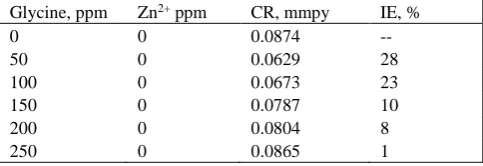
(immersion period = 7 days) are given in Table 2 to 4. It is observed that Gly alone has poor inhibition efficiency. In the presence of various concentration of Zn2+ (25 and 50 ppm), the IE of Gly increases. A synergistic effect exists between Gly and Zn2+. For example, 50 ppm of Gly has only 28% IE; 50 ppm of Zn2+ has 20% IE. However, their combination has 82% IE. This suggests a synergistic effect existing between Gly and Zn2+. The corrosion rates of Gly-Zn2+ systems are shown in Fig.2.
Table 2. Corrosion rates (CR) of carbon steel immersed in well water in the presence and absence of inhibitor system at various concentrations and the inhibition efficiencies (IE) obtained by weight loss method.
Glycine, ppm Zn2+ ppm CR, mmpy IE, %
0 0 0.0874 --
Parameter Well water
pH 8.0
Conductivity 3110 µmhos cm-1 Total dissolved solids 2013 ppm Chloride 665 ppm
Sulphate 14 ppm
Total hardness 1100 ppm
2
100 1 (%) (1)
1 W IE
W
0.365
(2)
imm m CR
t
S
Glycine-Zn system as corrosion inhibitor for carbon steel in well water Section A-Research Paper
Table 3. Corrosion rates (CR) of carbon steel immersed in well water in the presence and absence of inhibitor system at various concentrations and the inhibition efficiencies (IE) obtained by weight loss method.
Glycine,
ppm Zn
2+, ppm CR, mmpy IE, %
0 0 0.0874 --
0 25 0.0742 15
50 25 0.0603 31
100 25 0.0550 37
150 25 0.0524 40
200 25 0.0507 42
250 25 0.0472 46
Inhibitor system: glycine-Zn2+ (25 ppm), immersion period: 7 days, pH = 8
Table 4 : Corrosion rates (CR) of carbon steel immersed in well water in the presence and absence of inhibitor system at various concentrations and the inhibition efficiencies (IE) obtained by weight loss method.
Gly ppm Zn2+ ppm CR mmpy IE %
0 0 0.0874 --
0 50 0.0699 20
50 50 0.0350 60
100 50 0.0280 68
150 50 0.0219 75
200 50 0.0192 78
250 50 0.0157 82
Inhibitor system: glycine - Zn2+ (50 ppm), Immersion period: 7 days, pH = 8
Synergism parameter (SI) have been used to know the synergistic effect existing between two inhibitors.36-41 Synergism parameter (SI) can be calculated using the following relationship.
where
= surface coverage
1+2 = (1 + 2) – (12)
1 = surface coverage by glycine 2 = surface coverage by Zn2+ '
1+2 = surface coverage by both glycine and Zn2+
and where
The synergism parameters of Glycine-Zn2+ system are given in Table 5. For different concentrations of inhibitors, SI approaches 1 when no interaction between the inhibitor compounds exists. When SI > 1, it points to synergistic effects. In the case of SI < 1, it is an indication that the synergistic effect is not significant . From Tables 5 and 6, it is observed that value of synergism parameters (SI) calculated from surface coverage were found to be one and above. This indicates that the synergistic effect exists between glycine and Zn2+ .38,39,41 Thus, the enhancement of the inhibition efficiency caused by the addition of Zn2+ ions to glycine is due to the synergistic effect.
Figure 2. Corrosion rates (CR) of carbon steel immersed in various test solutions
Analysis of potentiodynamic polarization study (pH=8)
Polarization study has been used to confirm the formation of protective film formed on the metal surface during corrosion inhibition process.42-47 If a protective film is formed on the metal surface, the linear polarization resistance value (LPR) increases and the corrosion current value (Icorr) decreases.
The potentiodynamic polarization curves of carbon steel immersed in well water in the absence and presence of inhibitors are shown in Fig.3. The corrosion parameters are given in Table 6. When carbon steel was immersed in well water the corrosion potential was -668 mV vs SCE. When glycine (250 ppm) and Zn2+ (50 ppm) were added to the above system the corrosion potential shifted to the noble side (-652 mV vs SCE). This indicates that a film is formed on the anodic sites of the metal surface. This film controls the anodic reaction of metal dissolution by forming Fe2+-Gly complex on the anodic sites of the metal surface. The formation of protective film on the metal surface is further supported by the fact that the anodic Tafel slope (ba) increases from 104 to 132mV.
Further, the LPR value increases from 5.630 x 10⁴ ohm cm2 to 10.62 x 10⁵ ohm cm2; the corrosion current decreases from 5.775 x 10⁻⁷ A/cm2 to 3.461 x 10⁻⁷ A/cm2. Thus, polarization study confirms the formation of a protective film on the metal surface.
0 0.01 0.02 0.03 0.04 0.05 0.06 0.07 0.08 0.09
0 50 100 150 200 250
C
R
, m
m
p
y
GLYCINE, ppm
0 ppm Zn2+ 25 ppm Zn2+ 50 ppm Zn2+
1 1 2
(3) '
1 1 2 SI
(%)
100
IE
Glycine-Zn2+ system as corrosion inhibitor for carbon steel in well water Section A-Research Paper
Table 5 : Inhibition efficiencies and synergism parameters for various concentrations of Gly-Zn2+ (50 ppm) systems, when carbon steel is immersed in well water
Immersion period: 7 days, pH = 8
Table 6. Corrosion parameters of carbon steel immersed in well water in the absence and presence of inhibitor system obtained from potentiodynamic polarization study
System Ecorr, mV vs SCE bc, mV/decade ba, V/decade Icorr, Acm-2 LPR, ohm cm2
Well water -668 268 104 5.775 x 10⁻⁷ 5.630 x 10⁴
Well water+Gly(250ppm)+Zn2+(50ppm) -652 235 132 3.461 x 10⁻⁷ 10.62 x 10⁵
Figure 3. Polarization curves of mild steel immersed in various test solutions. a) well water (blank); b) well water + glycine (250 ppm) + Zn2+ (50 ppm)
Analysis of FTIR spectra
FTIR spectra have been used to analysis the protective film formed on the metal surface. 44,48-55 The FTIR spectrum (KBr) of pure glycine is shown in Fig.4(a). The C=O stretching frequency of carboxyl group appears at 1598 cm-1. The CN stretching frequency appear at 1126 cm-1. The NH stretching frequency of the amine group appears at 3105 cm-1. 50-52
The FTIR spectrum of the film formed on the metal surface after immersion in the solution containing well water, 250 ppm of glycine and 50 ppm Zn2+ is shown in Fig.4(b). The C=O stretching frequency has shifted from
Fe2+-glycine complex on the anodic sites of the metal surface. The peak at 1331 cm-1 corresponds to Zn-O stretching. The peak at 3422 cm-1 is due to OH- stretching. This confirms that Zn(OH)2 is formed on the cathodic sites of metal surface.48,53-55 Thus the FTIR spectral study leads to the conclusion that the protective film consist of Fe2+-gly complex and Zn(OH)2.
Figure 4. FTIR spectra of a) pure glycine; b) film formed on the metal surface after immersion in well water + Gly (250 ppm) + Zn2+ (50 ppm)
Atomic Force Microscopy Characterization
Atomic force microscopy is a powerful technique for gathering of roughness statistics from a variety of surfaces. 56 AFM is becoming an accepted method of roughness
Glycine, ppm
Inhibition efficiency, IE (%)
Surface coverage, θ1
Zn2+,
ppm
Inhibition efficiency, IE (%)
Surface coverage, θ2
Combined IE %, I'1+2
Combined surface co-verage, θ'1+2
Synergism parameter, SI
50 28 0.28 50 20 0.20 60 0.60 1.440
100 23 0.23 50 20 0.20 68 0.68 1.925
150 10 0.10 50 20 0.20 75 0.75 2.880
200 8 0.08 50 20 0.20 78 0.78 3.345
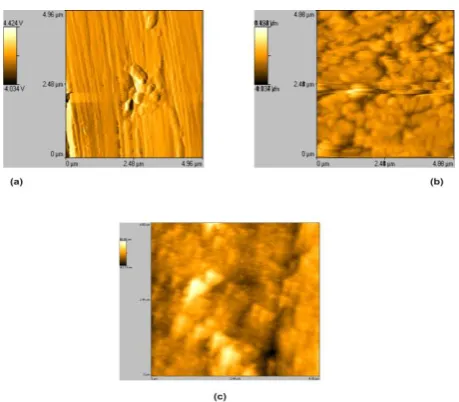
Figure 5. 2D AFM images of the surface of a) polished carbon steel (control); b) carbon steel immersed in well water (blank); c) carbon steel immersed in well water containing glycine (250 ppm) + Zn2+ (50 ppm)
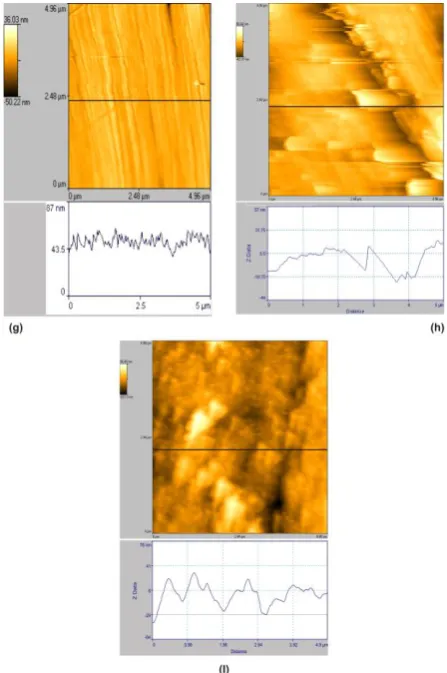
The two dimensional (2D), three dimensional (3D) AFM morphologies and the AFM cross-sectional profile for polished carbon steel surface (reference sample), carbon steel surface immersed in well water (blank sample) and carbon steel surface immersed in well water containing the formulation of Gly 250 ppm and 50 ppm of Zn2+ are shown as Fig.5(a,d,g), (b,e,h), (e,f,i) respectively.
Root– mean-square roughness, average roughness and peak-to-valley value
AFM image analysis was performed to obtain the average roughness, Ra (the average deviation of all points roughness profile from a mean line over the evaluation length), root-mean-square roughness, Rq (the average of the measured height deviations taken within the evaluation length and measured from the mean line) and the maximum peak-to-valley (P-V) height values (largest single peak-to-peak-to-valley height in five adjoining sampling heights).62 R
q is much more sensitive than Ra to large and small height deviations from the mean .63
Table 7 is the summary of the average roughness (Ra), rms roughness (Rq) maximum peak-to-valley height (P-V) value for carbon steel surface immersed in different environments.
The value of RRMS, Raand P-V height for the polished carbon steel surface (reference sample) are 31 nm, 10 nm and 63 nm respectively, which shows a more homogeneous surface, with some places in which the height is lower than the average depth.56 Fig.5(a,d,g) displays the uncorroded metal surface. The slight roughness observed on the polished carbon steel surface is due to atmospheric corrosion. The rms roughness, average roughness and P-V height values for the carbon steel surface immersed in well water are 68 nm, 18 nm and 131 nm respectively. These data suggest that carbon steel surface immersed in well water has a greater surface roughness than the polished metal surface. This shows that the unprotected carbon steel surface is rougher and is due to the corrosion of the carbon steel in
well water. Fig.5(b,e,h) displays the corroded metal surface with few pits.
The presence of 250 ppm of Gly and 50 ppm of Zn2+ in well water reduces the Rq by a factor of 32 nm from 68 nm and the average roughness is significantly reduced to 11 nm when compared with 18 nm of carbon steel surface immersed in well water. The maximum peak-to-valley height also was reduced to 60 nm from 131 nm. These parameters confirm that the surface appears smoother. The smoothness of the surface is due to the formation of a compact protective film of Fe2+- Gly complex and Zn(OH)
2 on the metal surface thereby inhibiting the corrosion of carbon steel.
Also the above parameters observed are somewhat greater than the AFM data of polished metal surface which confirms the formation of the film on the metal surface, which is protective in nature.
Table 7. AFM data for carbon steel surface immersed in inhibited and uninhibited environments
Figure 5. 3D AFM images of the surface of d) polished carbon steel (control); e) carbon steel immersed in well water (blank); f) carbon steel immersed in well water containing Glycine (250 ppm) + Zn2+ (50 ppm)
Samples Roughness, nm Maximum peak-to-valley height (nm) RMS (Rq) Average
(Ra)
Polished carbon steel
(control) 31 10 63
Carbon steel immersed in well water
68 18 131
Carbon steel immersed in well water Gly (250 ppm) + Zn2+ (50 ppm)
Glycine-Zn2+ system as corrosion inhibitor for carbon steel in well water Section A-Research Paper
Figure 5. The cross sectional profile which are corresponding to as shown broken lines in AFM images of the surface of g) polished carbon steel (Control); h) carbon steel immersed in well water (blank); i) carbon steel immersed in well water containing Glycine 250 ppm + Zn2+ 50 ppm
Mechanism of Corrosion inhibition
The results of the weight-loss study show that the formulation consisting of 250 ppm Gly and 50 ppm of Zn2+ has 82% IE in controlling corrosion of carbon steel in well water. A synergistic effect exists between Zn2+ and Gly. Polarization study reveals that this formulation functions as anodic inhibitor. FTIR spectra reveal that the protective film consists of Fe2+–Gly complex and Zn(OH)
2. (In order to explain these facts the following mechanism of corrosion inhibition is proposed.64-70
When the solution containing well water, 50 ppm Zn2+ and 250 ppm of Gly is prepared, there is formation of Zn2+ –Gly complex in solution.
When carbon steel is immersed in this solution, the Zn2+ - Gly complex diffuses from the bulk of the solution towards metal surface.
Zn2+ - Gly + Fe2+ → Fe2+ - Gly + Zn2+
The released Zn2+ combines with OH- to form Zn(OH) 2 on the cathodic sites. 49
Zn2+ + 2OH- → Zn(OH) 2
Thus the protective film consists of Fe2+-Gly complex and Zn(OH)2 .71,72 The AFM images confirm the formation of protective layer on the metal surface.
Acknowledgement
The authors are thankful to their management, UGC for their help and support and to Mr. S.Elango for his computer aided design.
References
1Baral, A., Engelken, R. D., Environ. Sci. Policy,2002, 5, 12.
2Gaidis, J. M., Cement Concrete Comp. 2004, 26, 181.
3Stupnisek-Lisac,E., Loncaric Bozic, A., Cafuk, I., Corros,1998,
54, 713
4El-Etre, A. Y., Corros. Sci, 2003,45, 2485.
5El-Etre, A. Y., Corros. Sci,1998, 40, 1842.
6Ashassi-Sorkhabi, H.,. Majidi, M. R., and Seyyedi, K., Appl. Surf.
Sci, 2004, 225, 176.
7Ghasemi, Z., Tizpar, A., Appl. Surf. Sci. 2006, 252 , 3667.
8Zhang, D. Q., Gao, L. X., Zhou, G. D., J. Appl. Electrochem. 2005,
35, 1081.
9Olivares, O., Likhanova, N. V., Gomez, B., Navarrete, J., Llanos-Serrano, M. E., Arce, E., Hallen, J. M., Appl. Surf. Sci., 2006,
252, 2894.
10Badawy, W. A., Ismail, K. M., Fathi, A. M., Electrochim. Acta,
2006, 51, 4182.
11Ismail, K. M., Electrochim. Acta, 2007, 52, 7811.
12Ashassi-Sorkhabi, H., Ghasemi, Z., Seifzadeh, D., Appl. Surf. Sci.
2005, 249, 408.
13Oguzie, E. E., Li, Y., Wang, F. H., J. Colloid Interface Sci, 2007,
310, 90.
14Onal, A. A., Bull. Electrochem, 1995, 1, 513. 15Gomma, G., Bull. Electrochem, 1998, 12, 456.
16Kalota, D., Silverman, D., Corros. Sci, 1994, 50, 138. 17Madkour, L., Ghoneion, M., Bull. Electrochem., 1997, 13, 1.
18Morad, M., Hermas, A., Aal, M., J. Chem. Technol. Biotechnol,
2002, 77, 486.
19El-Shafei, A. A., Moussa, M. N. H., El-Far, A. A., J. Appl.
Electrochem., 1997,27, 1075.
26Ita, B. I., Bull. Electrochem. 2005, 21,319.
27Pech Canul, M. A., Bartolo-Perez, P., Surf. Coat. Techn, 2004,
184, 184.
28Pech Canul, M. A., Echeverria, M., Corros. Engg. Sci. Techm.,
2003, 38, 135.
29Rajappa, S. K.,. Venkatesha, T. V., Turk. J. Chem., 2003, 27, 189.
30Chi-Canul, L. P., Corrosion, 1999,55, 948.
31Akiyama, A., Nobe, N., J. Electrochem. Soc.,1970, 117, 999.
32Wranglen, G., "An introduction to corrosion and protection of
metals", Chapman & Hall, New York, 1985.
33Holness, R. J., Williams, G., Worsley, D. A., and MacMurray, H. N., J. Electrochem. Soc.,2005, 152, B73.
34Telegdi, J. Shaglouf, M. M., Shaban, A., Karman, F. H., Bertoti, I., Mohai, M., Kalman, E., Electrochim. Acta, 2001, 46, 3791. 35Arockia Selvi, J., Rajendran, S.,and Jeyasundari, J., Zastit. Mater,
2009, 50(2), 91.
36Gomma,G. K., Mater. Chem. Phys., 1998, 55, 241.
37Aramaki, K.,and Hackermann, N., J. Electrochem. Soc., 1969,
116, 568.
38Quraishi, M. A., Rawat, J., and Ajmal, M., Corrosion, 1999, 55, 919
39Agnesia Kanimozhi S. and Rajendran, S., Int. J. Electrochem.
Soc., 2009, 4, 353.
40Gopi, D., Manimozhi, S., Govindaraju, K. M., Manisankar, P., and Rajeswari, S., J. Appl. Electrochem, 2007, 37, 439. 41Rajendran, S., Amal Raj, A. J., Joice, M. J., Anthony, N., Trivedi,
D. C., Sundaravadivelu, M., Corros. Rev. 2004,22, 233 42Morales Roque, J., Padiyan, T., Cruz, J., Garcia-Ochoa, E.,
Corros. Sci, 2008, 50, 614.
43Benali, O., Larabi, L., Traisnel, M., Gengembre, L., Harek, Y.,
Appl. Sur. Sci., 2007, 253, 6130.
44Amar, H., Braisaz, T., Villemin, D., Moreau, B., Mater. Chem.
Phys. ,2008, 110, 1.
45Arockia Selvi, J., Rajendran, S., Ganga Sri, V.,. John Amalraj, A., Narayanasamy, B., Port. Electrochim. Acta, 2009, 27(1), 1. 46Rajendran, S., Paulraj, J., Rengan, P., Jeyasundari, J., and
Manivannan, M., J. Dent. Oral Hyg., 2009, 1, 1
47Kalman, E., Felhosi, I., Karman, F. H., et al., Corrosion and
Environmental Degradation, M. Schutze, Ed., Weinheim :Wiky-VCH, 2000, 1, 471.
48Kalaivani, R., Narayanasamy, B., Selvi, J. A., Amalraj, A. J., Jeyasundari J. and Rajendran, S., Port. Electrochim. Acta, 2009, 27, 177.
49Sathiyabama, J., Susai Rajendran, Arockia Selvi,J., and Jeyasundari,J., The Open Corros. J.2009, 2,76.
50Silverstein, R. ., Bassler, G. C., Moril, T., “Spectrometric
Identification of Organic Compound”, John Wiley and Sons, New York,1981, 95.
51Cross, A. D., “Introduction to practical infrared spectroscopy”, Butterworths, Scientific Publication, London, 1990, 73. 52Nakamoto, K., Infrared and Raman spectra of inorganic
coordination compound, Wiley Interscience, New York,
1986.
53Rajendran, S., Apparao, B. V., and Palaniswamy, N., Bull.
Electrochem., 1996, 12, 15.
54Sekine, I. and Hirakawa, V.,Corrosion,1986,42, 276.
55Rajendran, S., Apparao B. V., and Palaniswamy, N., Proc.8th Europ. Symp. Corros. Inhibitors, Ferrara, Italy, 1995, 1, 465. 56Vera, R., Schrebler, R., Cury, P., Del Rio, R., and Romero, H., J.
Appl. Electrochem., 2007, 37, 519.
57Dumas, P., Butfffakhreddine, B., Am, C., Vatel, O., Ands, E., Galindo, R., and Salvan, F., Europhys. Lett. 1993, 22, 717. 58Bennett, J. M., Jahannir, J., Podlesny, J. C., Baiter, T. L., and
Hobbs, D. T., Appl. Opt.,1995,43, 213.
59Duparre, A., Kaiser, N., Truckenbrodi, H., Berger, M., and Kohler, A., “Microtopography investigations of optical surfaces and thin films by light scattering, optical profilometry, and atomic force microscopy, Int. Symp. on Optics", Imaging and instrumentation, San Diego, CA, Proc. SPIE. 1993, (Publ. 1995), 181.
60Duparre, A., Kaiser, N., and Jakobs, S., Morphology investigation
by Atomic Force Microscopy of thin films and substances for excimer laser mirrors, Annual Symp. on Optical Materials for High Power Lasers., Boulder, CO, proc. SPIE, 1993,
2114, 394.
61Amra, C., Deumie. C., Torricini., D., Roche, P., Galindo, R., Dumas, P., and Salvan, F., Int.Symp. on Optical Interference Coatings. 6-10 Jnne 1994. Grenoble, Proc. SPIE,1994.2253, 614.
62Thomas, T. R., Longman, New York, 1982.
63Stout, K. J., Sullivan, P. J.,and McKeown, P. A., Annals CRIP,
1992, 41, 621.
64Gopi, D., Bhuvaneswaran, N., Rajeswari, S., Bull. Electrochem.,
2002, 18, 29.
65Gopi, D., Rajeswari, S., J. Solid State Electrochem., 2002, 6, 194. 66Gopi, D., Rajeswari, S.,Proc. International Conference on
Advances in Surface Science and Engineering (INSURE), Chennai, India, 2001, 210.
67Gopi, D., Rajeswari, S., Proc. NACE International Conf.,
Corrosion its Mitigation and Preventive Maintenance, Mumbai, India, 2000, 1, 435.
68 Gopi, D., Rajeswari, S., Proc. Tenth National Congress on
Corrosion Control, Conf., Madurai, India, 2000, 353. 69Veres, A., Reinhard, G., Kalman, E., Brit. Corros. J., 1992, 27,
147.
70Kalman, E., Corrosion Inhibitors, Published for EFC No.11,
Institute of Materials London, 1994
71Ruba, H. F. G., Noreen, A. A., Sahayaraj, J. W., Amalraj, J. A., and Rajendran, S., Indian. J. Chem. Technol., 2005, 12, 472. 72Selvarani, F. R., Santhamadharasi, S., Sahayaraj, J. W., Amalraj,
A. J., and Rajendran, S., Bull. Electrochem, 2004, 20(12), 561.