R E S E A R C H
Open Access
Efficient quantum simulation of fermionic
and bosonic models in trapped ions
Lucas Lamata
1*, Antonio Mezzacapo
1, Jorge Casanova
1and Enrique Solano
1,2*Correspondence: [email protected] 1Department of Physical Chemistry, University of the Basque Country UPV/EHU, Apartado 644, Bilbao, 48080, Spain
Full list of author information is available at the end of the article
Abstract
We analyze the efficiency of quantum simulations of fermionic and bosonic models in trapped ions. In particular, we study the optimal time of entangling gates and the required number of total elementary gates. Furthermore, we exemplify these estimations in the light of quantum simulations of quantum field theories, condensed-matter physics, and quantum chemistry. Finally, we show that trapped-ion technologies are a suitable platform for implementing quantum simulations involving interacting fermionic and bosonic modes, paving the way for overcoming classical computers in the near future.
PACS Codes: 03.67.Ac; 03.67.Lx; 37.10.Ty
Keywords: quantum information; quantum simulation; trapped ions
1 Background
Quantum simulation is one of the most promising fields in quantum information science. Feynman already pointed out in [] that a controllable quantum platform could sim-ulate the dynamics or static properties of another quantum system exponentially faster than classical computers. Since then, this hypothesis has been demonstrated [], and im-portant theoretical and experimental work followed [–]. Furthermore, quantum simu-lators establish analogies between previously unconnected fields, and have as a main aim to overcome classical computers.
Many proposals and experimental realizations of quantum simulations in a broad variety of platforms have been put forward, as for example spin systems [–], the Bose-Hubbard model implemented with cold atoms [], quantum chemistry [] and quantum statis-tics [–] simulated with photonic systems, condensed matter models with Rydberg atoms [], relativistic quantum mechanics [–], quantum field theories [], and the lattice Schwinger model []. On the other hand, quantum simulations of fermionic and bosonic systems in trapped ions have been recently proposed []. Therefore, it is timely to study the experimental requirements needed, to assess the feasibility of the proposal and to compare it with other implementations.
In this article, we analyze the necessary resources to implement a quantum simulation of fermions and bosons with trapped ions [, –]. We show that the methods de-veloped for simulating fermionic and bosonic systems with ions can save a large amount of resources in terms of gates with respect to other platforms. This demonstrates that
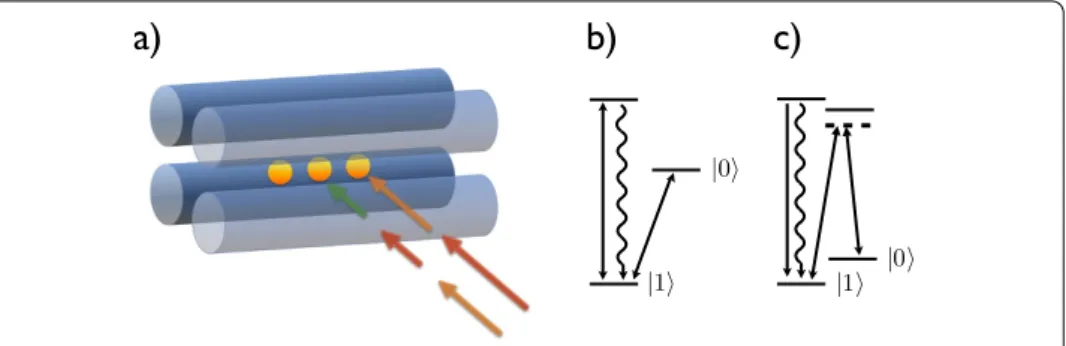
Figure 1 Quantum simulations with trapped ions.(a) Scheme of a rf Paul trap for digital-analog quantum simulations. Energy-level scheme for optical qubits (b), and rf qubits (c). In addition to the qubit levels|0and
|1, a third level is used for qubit readout.
trapped ions are a promising quantum technology for a wide variety of quantum simula-tions, including high energy physics, condensed matter, or quantum chemistry.
Trapped-ion systems are one of the most advanced technologies for implementing quan-tum information protocols. Ions are charged particles that can be confined either in Pen-ning traps [] or radio-frequency (rf ) Paul traps []. The former uses electrostatic and magnetic fields, whereas the latter requires time-dependent fields to confine the ions in an effective harmonic potential. Here, we will focus on rf Paul traps, see Figure a. Two dif-ferent kinds of qubits are currently employed, optical qubits and radio-frequency qubits (rf qubits). In the first ones, see Figure b, two internal metastable electronic levels cor-responding to an optical transition are used to encode the qubit. In the second ones, see Figure c, a third level is used to mediate a two-photon transition between the hyperfine or Zeeman electronic levels of the qubit.
Via sideband cooling, the ionic motional modes are able to reach their ground state, which is commonly used as a quantum bus to perform two-qubit gates between any pair of ions in a string. Finally, using resonance fluorescence by means of a cyclic transition, quan-tum nondemolition measurements of the qubit can be realized. Fidelities of state prepara-tion, single- and two-qubit gates, and qubit measurement, are currently above % [].
The basic Hamiltonian describing the coupling of a two-level cold ion with a laser beam is (= )
H=ω σz+νa
†
a+(σ++σ–)
×expi(kz–ωlt+φ)+exp–i(kz–ωlt+φ), ()
whereσ±andσzare Pauli matrices associated with the ionic internal levels,a(a†) is the
annihilation (creation) operator of the corresponding motional mode,ωis the frequency
of the internal ionic transition,νis the frequency of the trap,ωl is the frequency of the
laser field drive,φis the laser phase,kis the laser wave vector, andis the Rabi frequency associated with the ion-laser coupling.
Transforming into an interaction picture with respect to the internal and motional free-energy termω
σz+νa
†a, and after application of the optical rotating-wave approximation,
one obtains
HI=σ+e–i(t–φ)expiηae–iνt+a†
whereis the laser detuning with respect to the internal ionic transition,η=kzis the so called Lamb-Dicke parameter, where z=√/mν is the ground state width of the motional harmonic oscillator mode.
In the Lamb-Dicke regime, namely,η(a+a†) , Eq. () can be expressed as
HI=σ+e–i(t–φ)+iησ+e–i(t–φ)ae–iνt+a†
eiνt+ H.c.. ()
By choosing different internal vibrational transitions appropriately changing the laser detuning, , one can obtain the three basic interactions in trapped-ion technology. Namely, the carrier interaction (= ),
HI c=
σ+eiφ+σ–e–iφ, ()
the red-sideband interaction (= –ν),
HI r=iη
σ+aeiφ–σ–a†e–iφ, ()
and the blue-sideband interaction (= +ν),
HI b=iη
σ+a†eiφ–σ–ae–iφ. ()
One can also take into account several laser drivings acting upon different ions in a string. In this situation, one can express the basic interactions as
HI c,j=
σ+jeiφ+σ–je–iφ,
HI
r,j,k=iη
σ+jakeiφ–σ–ja†ke–iφ, ()
HI
b,j,k=iη
σ+ja†keiφ–σ–jake–iφ,
whereσ±j anda†k(ak) are the raising and lowering operators of thejth ion and the creation (annihilation) bosonic operators of thekth vibrational mode, respectively.
By appropriately combining the interactions appearing in Eq. () one may obtain the basic single and two-qubit gates necessary for universal quantum computing. Prototypical cases of two-qubit gates that can be realized in trapped ions are: the Cirac-Zoller gate [], corresponding basically to a controlled-NOT (CNOT) gate, and the Mølmer-Sørensen (MS) gate [], that is the basic building block for our quantum simulations of fermions and bosons in trapped ions.
2 Results and discussion
2.1 Fermionic and bosonic models in trapped ions
Interacting fermionic and bosonic systems are ubiquitous in physics. They appear as ef-fective models in condensed-matter physics and quantum chemistry, constituting also the natural language in which quantum field theories are analyzed. The numerical computa-tion of interacting fermionic and bosonic models is, in general, a hard problem due to the fast growth of the Hilbert space dimension with the number of modes []. The use of numerical methods such as quantum Monte Carlo is not always possible due to the so-called sign problem. In this sense, quantum simulations appear as the technique that will allow us to calculate the time evolution of interacting fermionic and bosonic theories in an optimized way [].
.. Efficient implementation of fermionic dynamics
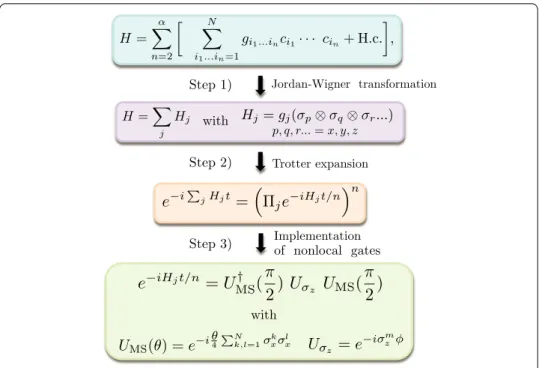
Here, we show how a linear Paul trap can efficiently encode the dynamics of interacting fermionic and bosonic systems using digital-analog techniques []. Our method consists of three steps, see Figure . Firstly, we map the HamiltonianHofNinteracting fermionic modes, via the Jordan-Wigner transformation, to a sum of nonlocal spin operators. The second step consists in decomposing the evolution operator associated withHvia a Trot-ter expansion. This yields products of exponentials, each of them associated with one of the nonlocal spin operators appearing in the Hamiltonian. Finally, we implement these exponentials, up to local rotations, on a set ofNtwo-level ions with a small number of laser pulses, by means of two Mølmer-Sørensen gates and a local gate. These three steps produce an efficient protocol employing just polynomial resources. A trapped ion im-plementation of the presented method will be able to simulate nonlinear and long-range fermionic and bosonic interactions for two-dimensional and three-dimensional problems. The reason for this is the fact that the time evolution associated with the nonlocal spin op-erators, which contains a large number of Pauli opop-erators, can nevertheless be efficiently realized (see the third step in Figure ). For about∼ or more particles, one could already overcome classical computers in a fermionic quantum simulation. The requirements for efficient quantum simulation of fermionic or spin models may also be developed in super-conducting circuits as recently shown in Refs [–].
.. Efficient implementation of fermions interacting with bosons
Figure 2 Scheme of the proposed three-step protocol.(1) Mapping of the HamiltonianH, where eachcik
corresponds to a fermionic operator,Nis the total number of fermionic modes, andαis the highest order of the many-body interaction, using the Jordan-Wigner transformation, to a sum of tensor products of spin operators. (2) Trotter expansion of the resulting evolution. (3) Implementation of each nonlocal evolution, up to local rotations, with a sequence of two MS gates and a local gate. We point out that the use of local rotations allows one to obtain an arbitrary fermionic Hamiltonian. While the MS gates correspond to an interaction upon all the ions, the intermediate one is a local rotation applied on just one ion. To simulate a dynamics of fermions coupled to bosons, one would substitute the local gateUσzby exp[–iφσzm(a+a†)],
resulting in a linear coupling of bosons to a quadratic fermionic operator.
the case of + dimensions and scalar particles, can be written as []
H=g
dxψ†(t,x)ψ(t,x)A(t,x). ()
Here, the fermionic fieldψis
ψ(t,x) = √ π
dpbpe–iωpteipx+d†peiωpte–ipx
()
with bp (dp) fermionic (antifermionic) operators obeying the anticommutation rules
{bp,b†p}=δ(p–p) and{dp,d†p}=δ(p–p). The bosonic electromagnetic fieldA(t,x) is
A(t,x) =√ π
dkake–iwkteikx+a†
kei
ωkte–ikx, ()
whereakanda†kobey [ak,a†k] =δ(k–k).
language, the different terms appearing will be nonlocal spin operators coupled linearly to the position operator of the bosons. The interaction between fermions will arise through the coupling to the bosons, that will act as mediators.
.. Optimization of entangling gates for implementing fermions and bosons in trapped ions
One possibility to improve the gate time in our protocol for simulating fermionic and bosonic systems in trapped ions is the following. It can be realized that the Hamiltonian of the MS gate used in our protocol,
HMS=g N
j,k=
σxjσxk, ()
may be substituted by the Hamiltonian
HUMQ=gσx
N
j=
σxj, ()
associated with a dynamics that we nameUltrafast Multi-Qubit(UMQ) gate for reasons that will be clarified later. Label denotes here the ion acted upon by the local gate applied between the two MS gates. Doing this substitution the protocol remains exactly the same, given that the terms not involving ion cancel out after the two MS gates. Notice that the label can refer to any spin which appears in the nonlocal spin interaction. Accordingly, one may just consider the UMQ gate for our protocol instead of the MS gate. That is, one would implement the UMQ gate pair by pair. This can be a significant advantage, given that unitary evolutions associated with Hamiltonians of the kindσxσxjcan be done in trapped
ions with resonant gates [, ], saving orders of magnitude in the gate time with respect to dispersive gates like the MS gate. Current proposals consider applying the resonant gates to neighboring ions, and to couple distant ions one can employ shuttling [, ]. We consider a setup analogous to the one in Ref. []. The shuttling time will depend on the specific experiment and the kind of protocol, either adiabatic or making use of reverse engineering techniques. Thus, for say ions, one will need resonant gates in the new protocol per MS gate in the old protocol, to implement the UMQ gate. However, given that the resonant gates can be done about orders of magnitude faster, one may reduce the total protocol time by orders of magnitude. For the relevant case of ions, which would simulate fermionic modes, one may reduce the simulator time a factor of using the UMQ gate with respect to the MS-based protocol. Instead of shuttling the ions, a further possibility is to couple distant sites via swap gates with just a linear resource overhead [].
2.2 Analysis of quantum-simulated dynamics
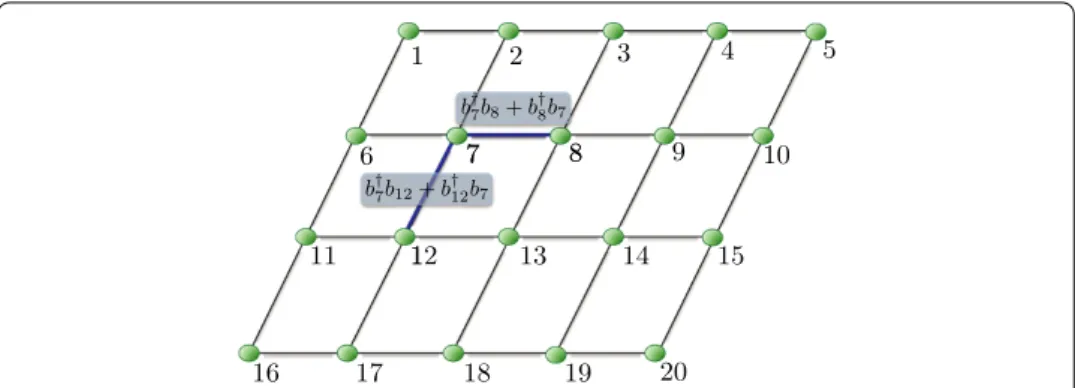
Figure 3 Scheme of the lattice for a quantum simulation of the Hubbard model with 40 fermionic modes.
.. Fermion models in trapped ions
We consider a trapped-ion quantum simulation of a × site fermionic lattice with two modes per site (↑,↓), see Figure . We propose to map this lattice onto a -ion string in a Paul trap. Developments of an ion trap allowing for up to ions in a string, for quantum simulations, and quantum interfaces, have been recently published [, ]. The total number of fermionic modes in our proposed system, i.e., , makes it be in the limit of the computational power of classical computers. Thus, this quantum simulator is one example of a relevant physical problem that trapped ions could solve efficiently while being hard for classical devices.
We compare now the total number of entangling gates needed both in our trapped ion implementation, making use of MS gates, and in other quantum optics platforms, that may employ CNOT gates. We point out that to implement anN-body spin operator, one typically needs N CNOT gates, while, with our protocol, in general one just needs MS gates. We consider the Hubbard model in the lattice shown in Figure . The system Hamiltonian is
H=w i,j,σ
b†i,σbj,σ+ H.c. +U
i
b†i,↑bi,↑b†i,↓bi,↓, ()
whereσ=↑or↓. Let us now make a counting of the number of gates needed for this quan-tum simulation. The first kind of terms in Eq. () that we consider are tunneling terms in a row, see Figure . After applying the Jordan-Wigner transformation,b†↓=I⊗⊗σ+,
b†↑=I⊗⊗σ+⊗σz, . . . , we have, e.g.,b†,↑b,↑+ H.c. = (σx⊗σz⊗σx+σy⊗σz⊗σy)/. This kind of term employs MS gates (two per summand), and given that we have of these terms, with two spins per site, the total number of entangling gates needed is MS gates. The second kind of terms in Eq. () are the tunneling terms in a column which are nonlocal in the spin-operator encoding. For example, the termb†,↓b,↓+ H.c. = –(/)(σ
x ⊗σz⊗ · · · ⊗σz⊗σx+σy⊗σz⊗ · · · ⊗σz⊗σy). The number of MS
gates of this kind of term is ××× = . Finally, the last type of term in Eq. () is the onsite Coulomb repulsion,U ib†i,↑bi,↑b†i,↓bi,↓. In the spin language we have, e.g., b†,↑b,↑b†,↓b,↓=|| ⊗ ||, where|i is the excited state of ioni(see Figure ),
lattice is gates per Trotter step. For Trotter steps, this will give a total number of , gates.
We want to compare now the previous calculation with fermionic implementations us-ing digital simulations in other quantum platforms. In those cases in which the MS gate is not available, and one has to employ, e.g., CNOT gates, for each nonlocal spin operator composed ofNPauli matrices one needs NCNOT gates [], instead of MS gates. Ac-cordingly, the number of CNOT gates for the tunneling terms in a row is ×× = for each spin, in total. Moreover, the number of CNOT gates for the tunneling terms in a column is ×× = per spin, in total. The number of entangling gates for the onsite Coulomb repulsion is still the same as before, . Accordingly, the total number of entangling gates per Trotter step is in this case ,. For Trotter steps, the total number of gates in implementations making use of CNOT gates and not of MS gates is of about ,. This is almost one order of magnitude larger than for the trapped ion case. Accordingly, one realizes that trapped-ion implementations, making use of MS gates, are a highly versatile tool for implementing a fermionic dynamics. Even though one can simulate free fermions efficiently with cold atoms, given that in this case the atoms can be fermionic, it is much more difficult to have nonlinearities and interactions among them than with our trapped-ion methods. Accordingly, we consider our protocol for im-plementing fermions in trapped ions as complementary to cold atoms and optical lattices. We make now a rough estimate of the total time of the protocol: for a MS gate time of about μs, and for∼, entangling gates, assuming the single qubit gates will con-tribute a small fraction of the total evolution period, this will give a total protocol time of about ms. This is on the order of magnitude of the decoherence time in some current experiments for digital quantum simulators []. Accordingly, near-future improvements may allow to reach similar numbers of gates in the protocol inside the coherence time. For a large number,N, of ions in the trap, the protocol may take a longer time for nonresonant gates due to the reduced ion-phonon coupling, that scales as /√N. The time of the MS gate will then increase by a factor ofN/, forNions with respect to , i.e., for ions a fac-tor of . This will give a total time of the protocol of s, which is, on the other hand, about the decoherence time for some quantum-simulation experiments with trapped ions, e.g., with Ytterbium []. A further possibility to reduce the time of the protocol, and in conse-quence increase the number of gates that may be realized in an experiment, is to substitute the standard dispersive MS gates by a UMQ gate based on resonant entangling gates, like in Refs [, ], as we pointed out in Section .. Given that we just need to applyN of these gates per MS gate as shown in previous section, and we can reduce the time of each gate by about orders of magnitude, forN= one could reduce the time of the protocol a factor , well below the decoherence time. An optimization of resonant entangling gates for simulating fermions in trapped ions may significantly improve these resources. A fur-ther issue is the fact that each single or two-qubit gate will have a finite error that will accumulate when applying many of them. On the other hand, recent estimations point to the fact that MS gates may be done in the near future with fidelity errors smaller than –[]. If this is the case, reaching about thousands of gates in a single quantum
simula-tion experiment with trapped ions, without error correcsimula-tion, may be a realistic possibility.
.. Fermions coupled to bosons in trapped ions
one considers phonon generation, the Hilbert space dimension of the simulated system can grow fast even with a small number of fermionic sites. Notice that the dynamics of a bosonic Hilbert space can be approximated with truncation at some level of the number of bosonic quanta. Therefore, the amount of computational resources that one needs in order to obtain a given fidelity for the quantum state of the simulation increases with the amount of bosonic excitations. Given that the bosonic part is analog in our formalism, just with ions, motional modes, and up to phonons per mode, one would reach a total Hilbert space dimension of , which is at the limit of the fastest classical computers. An example
of fermionic-bosonic simulation is the Holstein model []. The Holstein Hamiltonian is given by
H=h N–
i=
b†ibi++ H.c.
+g N i=
ai+a†i
b†ibi+ω N
i=
a†iai. ()
Here,bi(b†i) is the annihilation (creation) operator at the fermion sitei, andai(a†i) is the phonon annihilation (creation) operator at sitei. The parametersh,gandωare
respec-tively a nearest-neighbor (NN) site hopping for the fermions, fermion-phonon coupling and phononic free energy. The model describes a fermion-phonon correlated system, which has been proven to be of great importance for a large number of solid state systems. In condensed-matter systems, the correlation between the presence of fermions in a lattice and distortions of the latter can produce the creation of polarons: fermions and phonons can no more be regarded as independent particles. The lattice distortion surrounding the fermion can have different size depending on the intensity of the fermion-phonon inter-action. For strong coupling, the fermions can become trapped, with interesting changes of global transport properties.
We can map via Jordan-Wigner transformation the original Hamiltonian into a coupled spin-boson system. The mapped Hamiltonian has the form
H=h N–
i=
σ+iσ–i++ H.c.+g N
i=
ai+a†i(σ i z+ )
+ω
N
i= a†iai.
To implement anN-site Holstein lattice in a trapped-ion chain, we make use ofN+ ions. The first N ions will encode the dynamics of the fermionic sites, while the last passive ion is used to displace the motional modes. The first term can be rewritten as
h
N
i=(σxiσxi++σyiσyi+). One can implement in a single MS gate the interactions hσ i xσxi+
andhσi
yσyi+, for each couple of nearest-neighbor ions. One additional, combined red-blue
sideband interaction can implement the interaction of each ion of the chain with a partic-ular normal modeai. Finally, driving the passive ion in the chain, one can realize the free
displacement of the motional modes in the model.
In summary, with ten sites, in order to perform one Trotter step, one will need × = MS local gates to implement the NN fermionic interactions, red-blue detuned side-bands for having the fermionic-bosonic interactions, and pulses to couple each normal mode to the passive ion. Therefore, a number of gates per Trotter step, and considering Trotter steps, gives a total number of gates, which is foreseeable in the near future. In general, for the totalN-mode Hamiltonian, one will need (N– ) MS gates and N
should be compared with the resources needed for a classical simulation of this dynamics: when the number of bosonic excitations per mode exceeds , the associated Hilbert space will have a dimension larger than N, overcoming the capacities of classical computers for even smallN. Regarding the total time of the protocol, for fermionic and bosonic modes, one will need ions, and the MS gate will employ a time about times longer than for just ions, while the red and blue sidebands will take a time about times longer. Accordingly, the time of the protocol for a typical dynamics will be of about ms per Trotter step.
.. Quantum chemistry problems in trapped ions
We describe now how to deal with quantum chemistry problems within the approach presented in the previous sections []. Typical quantum chemistry problems involve the many-body interactions describing electrons and nuclei. A generic quantum chemistry Hamiltonian,H=Te+Ve+TN+VN+VeN, contains the kinetic energies of the electrons
Te≡–m i∇
e,iand nucleiTN ≡– i
Mi∇
N,i, and the electron-electron interactions Ve≡ j>ie/|r
i–rj|, the nuclei-nuclei potential energyVN ≡ j>iZiZje/|Ri–Rj|, and
electron-nuclei interactionVeN≡– i,jZje/|ri–Rj|, where we have usedrandRto
ad-dress electron and nuclei coordinates. Our methods can be complemented with a classical variational optimization method. In this way, one can perform a kind of quantum-assisted optimization, in order to approximate ground-state energies and the ground-state eigen-vectors for electronic molecular problems. Additional bosonic degrees of freedom can be encoded in the motional normal modes of the trapped ions to simulate vibrational and rotational degrees of freedom of a quantum chemistry problem. A generic quantum chemistry Hamiltonian, including two-body interactions in second-quantization formal-ism, reads
He(R) =
pq
hpqb†pbq+
pqrs
hpqrsb†pb†qbrbs. ()
Here,bp (b†
p) are annihilation (creation) operators for the electronic molecular orbitals, hpqare the one-particle amplitudes obtained from the computation of single electron in-tegrals of the kinetic energy of the electron and the nuclei-electron interaction. The coef-ficientshpqrscome from the two-particle electron-electron Coulomb repulsion. Namely, ifφp(r)≡ r|pis the coordinate wave function of modep, one has explicitly thathpq≡
–drφ∗p(r)(Te +VeN)φq(r), and the two-body term hpqrs ≡
dr,φ∗p(r)φq∗(r)Ve(|r – r|)φr(r)φs(r). To obtain this Hamiltonian one performs the Born-Oppenheimer
approx-imation and chooses a finite basis of molecular orbitals to expand the single-body and two-body terms. To include the bosonic degrees of freedom in the description, one can go beyond the Born-Oppenheimer approximation and expand the termVeNlinearly in the nuclei positions. Later, one substitutes these positions by the nuclei normal modes, com-puted in the Born-Oppenheimer zeroth order approximation, and obtains a linear bosonic term coupled to quadratic fermionic terms, that can account for nonadiabatic corrections to the Born-Oppenheimer solution that one can solve with our methods. To implement the dynamics of the Hamiltonian in Eq. () one can map it into a spin representation via Jordan-Wigner transformation, as described in Figure ,
He−→ JWT
i,j,k,...∈{x,y,z}
The associated dynamics can be simulated digitally with a Trotter expansion, as in Figure , implementing single nonlocal terms as a combination of global Mølmer-Sørensen gates and local ion rotations.
The mean value of the energyHecan be retrieved by obtaining mean values over
in-dividual terms of the Hamiltonian. Specifically, the expectation value of products of Pauli matrices can be mapped onto single qubit expectation values through application of non-local qubit gates []. Finally, the eigenvalues ofHecan be obtained using the phase es-timation algorithm, starting from trial states obtained with the previous method via uni-tary coupled-cluster techniques []. By letting the system evolve for different times, with a digital decomposition, one can perform the phase estimation algorithm with efficient resources.
One can also think of including vibrational and rotational degrees of freedom. The non-local gate can be performed in order to entangle the internal state of the ions with the normal motional modes, e.g. with operations like|ψθ ≡e–i
θ(σi⊗σj⊗···)(a+a†)|
ψ. On the one hand, one is able to compute the time evolution with fermionic-bosonic Hamiltoni-ans, and, on the other hand, to map correlation functions of coupled bosonic-fermionic degrees of freedom into the state of one single ion []. As described in Section .., a trapped-ion quantum computer with tens of fermionic and bosonic modes, implemented with a few hundreds of gates, would be able to perform quantum simulations within co-herence times. As shown in the previous section, one would easily overcome a classical computer, dealing with Hilbert space dimension∼. Although a quantum chemistry
simulation with chemical accuracy of the ground state energy of a large molecule would require many gates [], including bosonic degrees of freedom can significantly reduce this number. Moreover, for computing time evolution of quantum chemistry dynamics of even small molecules with correlations, a quantum simulator will be required, due to the fast entanglement growth that prevents the use of classical methods. In Section .. we have included specific examples of numbers of gates and total time of the protocols for specific fermion-boson Hamiltonians that can be extrapolated to the case of quantum chemistry dynamics.
Summarizing, we propose a hybrid quantum-classical simulation approach involving digital-analog methods for quantum chemistry.
3 Conclusions
We have analyzed the feasibility of efficient quantum simulations of fermionic and bosonic interacting models in trapped ions. We have shown that these quantum simulations are advantageous when compared with other quantum platforms and with classical comput-ers. Accordingly, the next generation of experiments with trapped ions may produce use-ful insight in the fundamental properties of condensed-matter, high-energy physics, and quantum chemistry models.
Competing interests
The authors declare that they have no competing interests.
Authors’ contributions
All the authors contributed to the realization and writing of the manuscript.
Author details
Acknowledgements
We thank Rene Gerritsma, Ben Lanyon, Juan Carlos Retamal, and Guillermo Romero for useful discussions. We acknowledge support from Basque Government IT472-10, Spanish MINECO FIS2012-36673-C03-02, Ramón y Cajal Grant RYC-2012-11391, UPV/EHU UFI 11/55, as well as from PROMISCE, CCQED, and SCALEQIT European projects.
Received: 8 January 2014 Accepted: 26 May 2014 Published: 18 June 2014
References
1. Feynman RP:Simulating physics with computers.Int. J. Theor. Phys.1982,21:467. 2. Lloyd S:Universal quantum simulators.Science1996,273:1073.
3. Buluta I, Nori F:Quantum simulators.Science2009,326:108.
4. Johanning M, Varón AF, Wunderlich C:Quantum simulations with cold trapped ions.J. Phys. B2009,42:154009. 5. Schneider C, Porras D, Schaetz T:Experimental quantum simulations of many-body physics with trapped ions.
Rep. Prog. Phys.2012,75:024401.
6. Jané E, Vidal G, Dür W, Zoller P, Cirac JI:Simulation of quantum dynamics with quantum optical systems.Quantum Inf. Comput.2003,3:15.
7. Porras D, Cirac JI:Effective quantum spin systems with trapped ions.Phys. Rev. Lett.2004,92:207901.
8. Friedenauer A, Schmitz H, Glueckert JT, Porras D, Schätz T:Simulating a quantum magnet with trapped ions.Nat. Phys.2008,4:757.
9. Kim K, Chang M-S, Korenblit S, Islam R, Edwards EE, Freericks JK, Lin G-D, Duan L-M, Monroe C:Quantum simulation of frustrated Ising spins with trapped ions.Nature2010,465:590.
10. Greiner M, Mandel O, Esslinger T, Hänsch TW, Bloch I:Quantum phase transition from a superfluid to a Mott insulator in a gas of ultracold atoms.Nature2002,415:39.
11. Lanyon BP, Whitfield JD, Gillett GG, Goggin ME, Almeida MP, Kassal I, Biamonte JD, Mohseni M, Powell BJ, Barbieri M, Aspuru-Guzik A, White AG:Towards quantum chemistry on a quantum computer.Nat. Chem.2010,2:106. 12. Matthews JCF, Poulios K, Meinecke JDA, Politi A, Peruzzo A, Ismail N, Wörhoff K, Thompson MG, O’Brien JL:Observing
fermionic statistics with photons in arbitrary processes.Sci. Rep.2013,3:1539.
13. Crespi A, Osellame R, Ramponi R, Giovannetti V, Fazio R, Sansoni L, Nicola FD, Sciarrino F, Mataloni P:Anderson localization of entangled photons in an integrated quantum walk.Nat. Photonics2013,7:322.
14. Sansoni L, Sciarrino F, Vallone G, Mataloni P, Crespi A, Ramponi R, Osellame R:Two-particle bosonic-fermionic quantum walk via integrated photonics.Phys. Rev. Lett.2012,108:010502.
15. Weimer H, Müller M, Lesanovsky I, Zoller P, Büchler HP:A Rydberg quantum simulator.Nat. Phys.2010,6:382. 16. Lamata L, León J, Schätz T, Solano E:Dirac equation and quantum relativistic effects in a single trapped ion.Phys.
Rev. Lett.2007,98:253005.
17. Gerritsma R, Kirchmair G, Zähringer F, Solano E, Blatt R, Roos CF:Quantum simulation of the Dirac equation.Nature
2010,463:68.
18. Casanova J, García-Ripoll JJ, Gerritsma R, Roos CF, Solano E:Klein tunneling and Dirac potentials in trapped ions.
Phys. Rev. A2010,82:020101.
19. Gerritsma R, Lanyon BP, Kirchmair G, Zähringer F, Hempel C, Casanova J, García-Ripoll JJ, Solano E, Blatt R, Roos CF:
Quantum simulation of the Klein paradox with trapped ions.Phys. Rev. Lett.2011,106:060503.
20. Casanova J, Lamata L, Egusquiza IL, Gerritsma R, Roos CF, García-Ripoll JJ, Solano E:Quantum simulation of quantum field theories in trapped ions.Phys. Rev. Lett.2011,107:260501.
21. Hauke P, Marcos D, Dalmonte M, Zoller P:Quantum simulation of a lattice Schwinger model in a chain of trapped ions.Phys. Rev. X2013,3:041018.
22. Casanova J, Mezzacapo A, Lamata L, Solano E:Quantum simulation of interacting fermion lattice models in trapped ions.Phys. Rev. Lett.2012,108:190502.
23. Mezzacapo A, Casanova J, Lamata L, Solano E:Digital quantum simulation of the Holstein model in trapped ions.
Phys. Rev. Lett.2012,109:200501.
24. Yung M-H, Casanova J, Mezzacapo A, McClean J, Lamata L, Aspuru-Guzik A, Solano E:From transistor to trapped-ion computers for quantum chemistry.Sci. Rep.2014,4:3589.
25. Brown LS, Gabrielse G:Geonium theory: physics of a single electron or ion in a Penning trap.Rev. Mod. Phys.1986,
58:233.
26. Leibfried D, Blatt R, Monroe C, Wineland D:Quantum dynamics of single trapped ions.Rev. Mod. Phys.2003,75:281. 27. Cirac JI, Zoller P:Quantum computations with cold trapped ions.Phys. Rev. Lett.1995,74:4091.
28. Mølmer K, Sørensen A:Multiparticle entanglement of hot trapped ions.Phys. Rev. Lett.1999,82:1835. 29. Mezzacapo A, Lamata L, Filipp S, Solano E:Many-body interactions with tunable-coupling transmon qubits.
arXiv:1403.3652.
30. Las Heras U, Mezzacapo A, Lamata L, Filipp S, Wallraff A, Solano E:Digital quantum simulation of spin systems in superconducting circuits.Phys. Rev. Lett.2014,112:200501.
31. Mezzacapo A, Las Heras U, Pedernales JS, DiCarlo L, Solano E, Lamata L:Digital quantum Rabi and Dicke models in superconducting circuits. arXiv:1405.5814.
32. Holstein T:Studies of polaron motion: Part I. The molecular-crystal model.Ann. Phys.1959,8:325. 33. Peskin ME, Schroeder DV:Quantum Field Theory. Reading: Addison-Wesley; 1995.
34. Garcia-Ripoll JJ, Zoller P, Cirac JI:Speed optimized two-qubit gates with laser coherent control techniques for ion trap quantum computing.Phys. Rev. Lett.2003,91:157901.
35. Duan L-M:Scaling ion trap quantum computation through fast quantum gates.Phys. Rev. Lett.2004,93:100502. 36. Kielpinski D, Monroe C, Wineland DJ:Architecture for a large-scale ion-trap quantum computer.Nature2002,
417:709.
37. Nielsen MA, Chuang IL:Quantum Computation and Quantum Information. Cambridge: Cambridge University Press; 2000.
39. Lamata L, Leibrandt DR, Chuang IL, Cirac JI, Lukin MD, Vuleti´c V, Yelin SF:Ion crystal transducer for strong coupling between single ions and single photons.Phys. Rev. Lett.2011,107:030501.
40. Lanyon BP, Hempel C, Nigg D, Müller M, Gerritsma R, Zähringer F, Schindler P, Barreiro JT, Rambach M, Kirchmair G, Hennrich M, Zoller P, Blatt R, Roos CF:Universal digital quantum simulation with trapped ions.Science2011,334:57. 41. Kim K, Korenblit S, Islam R, Edwards EE, Chang M-S, Noh C, Carmichael H, Lin G-D, Duan L-M, Wang CCJ, Freericks JK,
Monroe C:Quantum simulation of the transverse Ising model with trapped ions.New J. Phys.2011,13:105003. 42. Kirchmair G, Benhelm J, Zähringer F, Gerritsma R, Roos CF, Blatt R:Deterministic entanglement of ions in thermal
states of motion.New J. Phys.2009,11:023002.
43. Wecker D, Bauer B, Clark BK, Hastings MB, Troyer M:Can quantum chemistry be performed on a small quantum computer? arXiv:1312.1695.
doi:10.1140/epjqt9