O R I G I N A L A R T I C L E
Open Access
Evaluation of the food grade expression
systems NICE and pSIP for the production
of 2,5-diketo-D-gluconic acid reductase from
Corynebacterium glutamicum
Vanja Kaswurm
1*, Tien-Thanh Nguyen
1,2, Thomas Maischberger
1, Klaus D Kulbe
1and Herbert Michlmayr
1Abstract
2,5-diketo-D-gluconic acid reductase (2,5-DKG reductase) catalyses the reduction of 2,5-diketo-D-gluconic acid (2,5-DKG) to 2-keto-L-gulonic acid (2-KLG), a direct precursor (lactone) of L-ascorbic acid (vitamin C). This reaction is an essential step in the biocatalytic production of the food supplement vitamin C from D-glucose or D-gluconic acid. As 2,5-DKG reductase is usually produced recombinantly, it is of interest to establish an efficient process for 2,5-DKG reductase production that also satisfies food safety requirements. In the present study, three recently described food grade variants of theLactobacillalesbased expression systems pSIP (Lactobacillus plantarum) and NICE (Lactococcus lactis) were evaluated with regard to their effictiveness to produce 2,5-DKG reductase from Corynebacterium glutamicum. Our results indicate that both systems are suitable for 2,5-DKG reductase expression. Maximum production yields were obtained withLb. plantarum/pSIP609 by pH control at 6.5. With 262 U per litre of broth, this represents the highest heterologous expression level so far reported for 2,5-DKG reductase from
C. glutamicum. Accordingly,Lb. plantarum/pSIP609 might be an interesting alternative toEscherichia coliexpression systems for industrial 2,5-DKG reductase production.
Keywords:Ascorbic acid, 2,5-diketo-D-gluconic acid reductase, 2-keto-L-gulonic acid,Corynebacterium glutamicum, Food–grade, Lactic acid bacteria, pSIP, NICE
Introduction
The bacterial enzyme 2,5-diketo-D-gluconic acid reductase (2,5-didehydrogluconate reductase; 2,5-DKG reductase; EC 1.1.1.274) is an NAD(P)(H)-dependent oxidoreductase assigned to the aldo-keto reductase (AKR) family (Ellis 2002). 2,5-DKG reductase catalyses the stereo specific reduction of 2,5-diketo-D-gluconic acid (2,5-DKG) at pos-ition C-5 to 2-keto-L-gulonic acid (2-KLG), a key inter-mediate in the production of L-ascorbic acid (Anderson et al. 1985). At present, 2,5-DKG reductase is an integral part of several industrial processes designed to synthesize 2-KLG based on the 2,5-diketo-D-gluconic acid pathway (from D-glucose via D-gluconate, 2-keto-D-gluconate and
2,5-diketo-D-gluconate) (Hancock and Viola 2002, Bremus et al. 2006). An efficient hybrid process for the production of 2-KLG comprising the conversion of D-glucose or D-gluconic acid into 2,5-DKG by Pectobacter cypripedii HEPO1 (DSM 12939) and the subsequent reduction of 2,5-DKG to 2-KLG using 2,5-DKG reductase from
Coryne-bacterium glutamicum was previously developed in our
laboratory (Pacher et al. 2008). This process involves a commercially available glucose dehydrogenase in order to recycle the costly coenzyme NADPH in situ through oxidation of D-glucose to gluconic acid. An alternative biocatalytic process for 2-KLG production involving 2,5-DKG reductase has been presented by Genencor Inc. (Chotani et al. 2000).
The above mentioned processes depend on the heter-ologous (high-level) expression of the 2,5-DKG reduc-tase gene (dkr), usually achieved with Escherichia coli. However, the utilization of genetically modified organisms * Correspondence:[email protected]
1Food Biotechnology Laboratory, Department of Food Science and Technology, BOKU–University of Natural Resources and Life Sciences, Muthgasse 18, Vienna 1190, Austria
Full list of author information is available at the end of the article
(GMOs) to produce enzymes intended for food applica-tions is strictly regulated (Pedersen et al. 2005, Peterbauer et al. 2011). Lipopolysaccharide (endotoxin) production by
E. coli is a further obstacle for protein expressions
intended for food or medical purposes (Berczi et al. 1966, Beutler and Rietschel 2003). Therefore, laborious and costly measures of down stream processing and quality control are required to comply with the purity and safety specifications for food grade enzymes, as recommended for example by the Joint FAO/WHO Expert Committee on Food Additives (JECFA) and the Food Chemical Codex (FCC). While recombinant (GMO) as well, an attractive alternative is to use expression hosts with the “generally recognized as safe” (GRAS) status, as defined by the US Food and Drug Administration (FDA). Although the reported performance of food grade expression systems is usually low compared to standard expression systems usingE. coli(Nguyen et al. 2011a), an advantage of apply-ing GRAS (i.e., food-grade, Peterbauer et al. 2011) expres-sion systems is that the costs to satisfy food safety requirements could be drastically reduced. Accordingly, efforts using lactic acid bacteria (LAB) as expression hosts have gained significance in the last decade (Peterbauer et al. 2011). Recently, examples of true food grade host/ vector combinations have been presented and applied using the expression systems Lactobacillus plantarum / pSIP (Nguyen et al. 2011a) andLactococcus lactis / NICE (Maischberger et al. 2010). In both systems, antibiotic resistance marker genes have been replaced by selection markers (pSIP: alr, alanine racemase gene; NICE: lacF, gene encoding the soluble carrier enzyme IIA of the lac-tose specific phosphotransferase system) complementing corresponding gene deletions in the host chromosomes.
Previous studies on the above mentioned expression systems demonstrated high expression levels with bacterial
β-galactosidase genes (Nguyen et al. 2011a, Maischberger et al. 2010). However, in these studies, the target genes originated from members of the same taxonomic order (Lactobacillales) as the expression hosts. It is therefore im-portant as well to evaluate the performance of such LAB expression systems with genes of taxonomic distant origin. The aim of the present work was to evaluate the food grade expression systems pSIP and NICE for their capacity to produce the industrially important enzyme 2,5-DKG reductase fromC. glutamicum(orderActinomycetales).
Material and methods Materials
Chemicals for enzyme assays, protein analysis and media components were purchased from commercial suppliers at the highest available level of purity. 2,5-DKG, the substrate for 2,5-DKG reductase assays, was produced by fermentation of glucose with Pectobacter cypripedii (Pacher et al. 2008) and further purified as previously
described (Kaswurm et al. 2012). All oligonucleotide pri-mers used in this study are displayed in Table 1 and were synthesized by VBC-Biotech (Vienna, Austria). For preparation of genomic DNA from C. glutamicum, the Easy-DNAW Kit (Invitrogen, Carlsbad, CA) was used according to the instructions of the manufacturer. The PureYield™ Plasmid Miniprep System for isolation of E. coliplasmids and the WizardWSV Gel & PCR Clean-UP kit for the purification of DNA fragments were obtained from Promega (Madison, WI, USA). The Quick Ligation Kit and restriction enzymes with their cor-responding buffers were purchased from New England Biolabs (Ipswich, MA, USA). Phusion High-Fidelity PCR Master Mix (New England Biolabs) and a C1000 Thermal Cycler (Bio-Rad Laboratories Inc., Hercules, CA, USA) were used to amplify DNA by PCR.
Molecular cloning
All bacterial strains/plasmids used in this study are shown
in Table 2. Genomic DNA from C. glutamicum DSM
20301, cultivated in DSMZ medium 53 (German Collection of Microorganisms and Cell Cultures), was used as tem-plate for amplification of the 2,5-DKG reductase gene (dkr) (GenBank accession JQ407590.1). Plasmids were isolated
from Lactococcus und Lactobacillus following the
previ-ously described protocol (O’Sullivan and Klaenhammer 1993). All amplified sequences were verified by DNA sequencing (LGC Genomics, Berlin, Germany).
Construction of NICE-based expression vectors
NICE expression vectors were based on the pTM51 vector series as presented by Maischberger et al. (2010). The β -galactosidase encoding gene (lacLM) of pTM51R was excised with BglII and SpeI, and replaced by the multiple cloning site (mcs) from pNZ8150 (Mierau and Kleerebezem 2005) using the same restriction sites; the resulting plasmid was designated pVK51. Primer pair V1/V2 (Table 1) was used to amplify thedkrgene from genomicC. glutamicum DNA. The PCR product was digested with SpeI, and the resulting fragment was ligated to plasmid pVK51 prepared by digestion with ScaI (blunt-end) and SpeI. This yiel-ded the expression plasmid pVK51dkr. Additionally, the complete dkr open reading frame (ORF) with its start codon located 73 bases upstream of the dkr transla-tion start (Figure 1), was cloned in vector pVK51 using
50-ATGTCTGTTGTGGGTACCGG-30 as foward and V2
Construction of pSIP-based expression vectors under control of PsppAand PsppQ
The coding region ofdkr was amplified with the primer pair V1/V3 (Table 1). Promoters PsppA (pSIP603R) and PsppQ (pSIP609R) (Nguyen et al. 2011a), were amplified from the respective plasmid DNA using the primer pairs P1/P2 and P1/P3 (Table 1). The amplified dkr fragment was fused to the promoters PsppA and PsppQ by overlap
extension polymerase chain reaction. Each of the two resulting fragments (PsppA:dkr, PsppQ:dkr) was ligated dir-ectly to the pJet1.2 blunt-end cloning vector (CloneJET PCR cloning kit; Fermentas GmbH, St. Leon-Rot, Germany) and transformed into chemically competent E. coliNEB 5-αcells (New England Biolabs). The inserts were excised with SpeI and XhoI (restriction sites on primers, Table 1) and ligated to a ~5.5 kb fragment Table 1 Oligonucleotide primers used for PCR amplifications in this study
Primer name Restriction enzymec Sequence (50-30) Target gene
V1a - ATGGATCAGAAGAATAAGCTTTC dkr
V2b SpeI TCTACGACTAGTTCAGTTCAGATCATTCGG dkr
V3b XhoI CTATCGCTCGAGTCAGTTCAGATCATTCGGG dkr
P1a SpeI CGGAAATCACGGGAACTAGTCGCCAAA PsppA, PsppQ
P2b - CGGTACCTACAACAGACATGGGAATCATACTCCTATATATTATT PsppA
P3b - CGGTACCCACAACAGACATATATGCTGGCCAGCTAAGTA PsppQ
a
forward primer. b
reverse primer. c
restriction sites are underlined.
Table 2 Bacterial strains and plasmids used in this studya
Strains or plasmids Relevant characteristics Reference or source Strains
Corynebacterium glutamicum DMSZ strain 20301 DMSZ
Lactobacillus plantarumWCFS1 a single colony isolated fromLb. plantarumNCIMB8826, which was originally isolated from human saliva (National Collection of Industrial and Marine Bacteria, Aberdeen, U.K.)
Kleerebezem et al.2003
Lactobacillus plantarumTLG02 WCFS1 derivative,Δalr, D-alanine auxotroph, expression host Nguyen et al.2011a
Lactococcus lactisNZ3900 NZ3000 derivative,ΔlacF,pepN::nisRK, selection based on the ability to grow on lactose (lacF), expression host
de Ruyter et al.1996
Escherichia coli
MB2159 MC1000 derivative, D-alanine auxotroph, cloning host Strych et al.2001
NEB 5-alpha cloning host New England Biolabs
Plasmids
pJet1.2/blunt CloneJET™PCR Cloning Kit Fermentas
NICE derivative plasmids
pNZ8150 Cmr,PnisA Mierau and
Kleerebezem2005
pTM51R lacF, pNZ8150 derivative containingLb. reuteri lacLMgenes downstream of PnisA Maischberger et al. 2010
pVK51 lacF, pTM51R derivative containing the multiple cloning site (from pNZ8150) downstream of PnisA
this work
pVK51dkr lacF, pVK51 derivative containingC. glutamicum dkrdownstream of PnisA this work
pSIP derived plasmids
pSIP603R alr, pSIP403 derivative containingLb. reuteri lacLMcontrolled by PsppA Nguyen et al.2011a
pSIP609R alr, pSIP409 derivative containingLb. reuteri lacLMcontrolled by PsppQ Nguyen et al.2011a
pSIP603dkr alr, pSIP603R derivative,lacLMreplaced byC. glutamicum dkrcontrolled by PsppA this work
pSIP609dkr alr, pSIP609R derivative,lacLMreplaced byC. glutamicum dkrcontrolled by PsppQ this work
aalr
: alanine racemase;Cmr
: chloramphenicol resistance;lacF: the gene encoding the soluble carrier enzyme IIA from lactose specific PTS;nisRK: gene necessary for signal transduction integrated in the chromosome; PnisA: promoter nisin A; PsppA, PsppQ: the bacteriocin promoters in thesppgene cluster;lacLM
obtained by cleavage of pSIP603R with the same restriction enzymes, resulting in the expression plasmids pSIP603dkr and pSIP609dkr. Following the same procedure, pSIP-based expression vectors containing the completedkrORF (designated pSIP603dkrORF and pSIP609dkrORF) were constructed. For dkr ORF amplification forward primer 50-ATGTCTGTTGTGGGTACCGG-30 and reverse primer V2 (Table 1) were used. After plasmid amplification with E. coli MB2159 (Strych et al. 2001), the constructs were electroporated into the D-alanine auxotroph expression
host Lb. plantarumTLG02 (Nguyen et al. 2011a) as
des-cribed by Josson et al. (1989) and tranformants were culti-vated in de Man, Rogosa and Sharpe broth (MRS medium; Oxoid, Basingstoke, U.K.) at 37°C without agitation. Com-petent cells of E. coli MB1259 were prepared and trans-formed according to the method of Inoue et al. (1990). Cultures of E. coli NEB 5-α and E. coli MB1259 trans-formants were grown in Luria-Bertani medium (LB; Sambrook et al. 1989) at 37°C with constant agitation (200 rpm). For the selection ofE. coliNEB 5-α, ampicillin was added to a final concentration of 100 mg mL-1. For cultivation of E. coliMB2159 and Lb. plantarum TLG02 without plasmids, the respective growth media were sup-plemented with D-alanine (200μg mL-1).
Expression of 2,5-DKG reductase with food–grade vectors Batch cultivations of LAB with food grade vectors were performed in computer-controlled stirred reactors (6 × 0.5 L) of the HT-Multifors system (Infors HT, Bottmingen, Switzerland). Comparative studies without and with pH control (pH 6.5) were performed. Culture pH was main-tained by automated addition of sterile NaOH (1 M). To ensure homogenous distribution of the culture broth with limited oxygen transfer, a low agitation speed of 80 rpm was used. All experiments were performed in triplicate.
Inocula for the batch cultivations were prepared by transferring 20 μl of a frozen stock culture to 200 mL
fresh medium (M17 for L. lactis; MRS for Lb.
plan-tarum) and incubation at 30°C without shaking. After
12 hours, the cells were transferred to the bioreactor already containing the corresponding medium to reach an optical density at 600 nm (OD600) of∼0.1. Expression
was induced at an OD600 of 0.35 ± 0.03. For the
in-duction of Lb. plantarum harbouring pSIP alr-based vectors, the synthetic peptide pheromone SppIP (Eijsink et al. 1996) (25 ng mL-1; CASLO Laboratory, Lyngby, Denmark) was used. To induce the NICE expression sys-tem withL. lactisNZ3900, nisin (Mierau and Kleerebezem 2005), a 34 amino acid lantibiotic bacteriocin, was applied at a final concentration of 10 ng mL-1. In parallel to the induced cultures, noninduced negative controls were included to determine background activities and to calcu-late the induction factors (the quotient of specific activity obtained under induced conditions and the activity obtained under noninduced conditions). All experiments were carried out at 30°C for 20 hours following induction.
Off-line analysis of parameters
Samples were taken in appropriate time intervals during the fermentations to monitor the growth of bacterial cultures by measuring OD600 and wet cell weight
(WCW) after centrifugation at 15,000 × g for 15 min at 4°C. 2,5-DKG reductase activities and the total intracel-lular protein concentrations were determined in order to evaluate the expression levels. For that purpose, bacterial cells were harvested from 5 mL of culture by centrifuga-tion at 3,220 × g for 10 min at 4°C, washed with Bis-Tris buffer (50 mM, pH 6.5) and resuspended in 500 μL of the same buffer. The cells were mechanically disrupted through bead beating with ∼1 g glass beads (average diameter of 0.5 mm) using a Precelly 24 glass bead mill (PEQLAB Biotechnologie GmbH, Erlangen, Germany). The cell-free crude extracts obtained after 10 min cen-trifugation at 9,000 × g (4°C) were used for 2,5-DKG reductase activity assays and determination of protein concentrations.
2,5-DKG reductase activity assay was performed spec-trophotometrically as previously described (Kaswurm et al. 2012). One unit of 2,5-DKG reductase activity is defined as the enzyme quantity required to reduce 1 μmol of 2,5-DKG per min under assay conditions, which is equivalent to the production of 1 μmol of NADP+per min (Kaswurm et al. 2012). Protein concen-trations were determined by the dye binding method of Bradford (Bradford, 1976) using the Bio-Rad Protein Assay Kit (Bio-Rad Laboratories Inc.). Bovine serum al-bumin (BSA), in concentrations of 0.1 – 1.0 mg mL-1, was used for the standard calibration curve. All assays were performed in triplicate, and the data are expressed as mean values ± standard deviation (SD).
Figure 1N-terminal nucleotide sequence of the nativedkr
Electrophoresis
SDS-PAGE was performed with a PerfectBlue standard vertical gel electrophoresis system (PEQLAB Biotechno-logie GmbH) using 5% stacking gels and 10% separating gels. Samples were prepared according to method of Laemmli (Laemmli 1970) and loaded in aliquots of 10
μL per line onto gel. Protein bands were stained using Coomassie blue R250. Precision Plus Protein™Standard (Bio-Rad Laboratories Inc.) was used as molecular mass standard.
Codon usage analysis
The fraction of usage of each codon of the C.
glutami-cum dkr gene by L. lactis subsp. cremorisMG1363 and
Lb. plantarum WCFS1 (Kleerebezem et al. 2003), was
predicted with the Graphical Codon Usage Analyser (Fuhrmann et al. 2004) and the results are presented as relative adaptiveness values. The codon usage table of
L. lactis subsp. cremoris MG1363 is estimated based on
2572 CDS’s (739646 codons) and that of Lb. plantarum WCFS1 based on 3057 CDS’s (934462 codons) (Nakamura et al. 2000).
Results
Expression of theC. glutamicum dkrgene
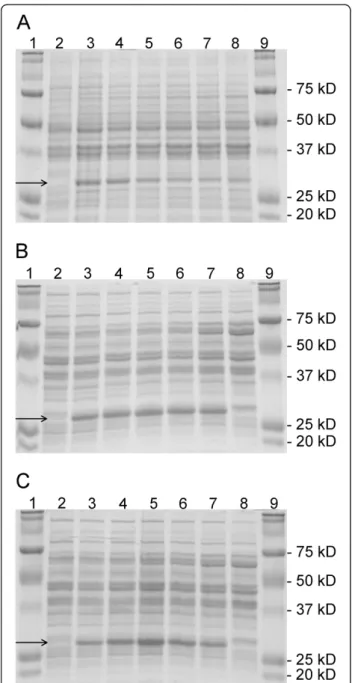
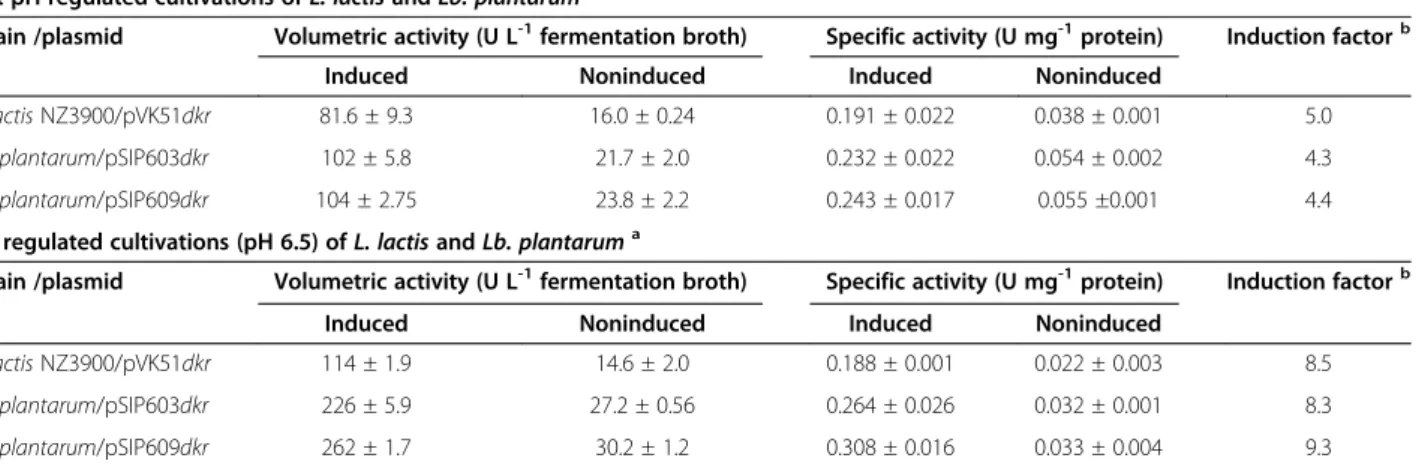
The first experiments were conducted without pH regu-lation during the fermentations. As judged by SDS-PAGE of the crude extracts (Figure 2), 2,5-DKG re-ductase could successfully be expressed with the three food–grade expression systems NICE, pSIP603 and pSIP609. Enzyme activities and protein concentrations were quantified during all experiments. The develop-ment of the monitored parameters over the ferdevelop-mentation time is plotted in Figure 3. In all cases, the highest yields of active 2,5-DKG reductase were observed during expo-nential growth. Table 3 summarizes the highest recorded activities during 2,5-DKG reductase expression. Consist-ent with previous reports (Maischberger et al. 2010, Nguyen et al. 2011a) the non-induced negative controls displayed some background activities, which were taken into account by calculating the net effect of induction (induction factor, Table 3).
With L. lactis NZ3900, the highest volumetric
activ-ities (82 U L-1fermentation broth) were obtained 4 hours after induction. L. lactis reached a maximum OD600 of
approx. 4 and a WCW of 3.6 g L-1. Lb. plantarum(with both pSIP603 and pSIP609) reached a maximum OD600
of just above 9 (WCW approx. 10 g L-1) and displayed maximum 2,5-DKG reductase activities of approximately 100 U L-1 after 8 hours of induction. The results of expressions without pH control (Figure 3) indicate that acid formation is the limiting factor for 2,5-DKG reductase production: In all cases, the volumetric activities of 2,5-DKG reductase decreased after reaching their maximum
values, concomitant with a decrease of pH, levelling off at approximately pH 4. This is also evident on SDS-PAGE (Figure 2), as the intensities of the protein bands corre-sponding to 2,5-DKG reductase (31 kDa) decrease during continued fermentation.
Figure 2SDS-PAGE of cell free extracts of strainsL. lactis
The results ofdkr gene expression with pH control at 6.5, but otherwise identical conditions are plotted in Figure 4. Compared to the experiments without pH con-trol, the volumetric activities of recombinant 2,5-DKG reductase could be increased by factors ranging from 1.4
(L. lactis NZ3900) to 2.5 (Lb. plantarum/pSIP609) (see Table 3). pH control resulted in higher cell densities as well: L. lactis reached a maximum OD600 of approx. 6
(WCW of 5.5 g L-1) and Lb. plantarum an OD600 of
with pSIP609) after 7–8 hours of induction. After reaching the growth maximum, volumetric activities began to drop in theLb. plantarumcultures (Figure 4B, C). In the studies using the L. lactis expression system, volumetric acitivites remained rather stable over the recorded fermentation period. In all cases, pH-regulated cultivation resulted in increased stability of the recombinant 2,5-DKG reductase as monitored during 20 hours of induced fermentations (compare Figures 3 and 4).
The highest production levels of 2,5-DKG reductase were obtained with the system Lb. plantarum/pSIP609, resulting in 104 U L-1 without pH regulation and 262 U L-1with pH control at 6.5. Although formation of re-combinant 2,5-DKG reductase by Lb. plantarum (both pSIP603 and pSIP609) was higher than withL. lactis, the induction factors did not differ significantly because of slightly higher basal expression of noninducedLb.
plan-tarumTLG02 cells. It can be concluded that some basal
2,5-DKG reductase expression, caused by “leakage” of the corresponding promoters, occured in noninduced
Lb. plantarumTLG02 cells (Table 3). Additional
experi-ments using wild typeLb. plantarum WCFS1 (ancestral strain of TLG02, see Table 2) (Kleerebezem et al. 2003) were performed in MRS medium under equal conditions as described above, but without induction. The highest 2,5-DKG reductase activities detected were 11.8 ± 0.8 U L-1 without pH regulation and 13.6 ± 0.9 U L-1with pH control at 6.5. Database research using the BLASTp algorithm (NCBI Database; http://www.ncbi.nlm.nih.gov/; Altschul et al. 1997) revealed the presence of several putative oxidor-eductases in theLb. plantarumWCFS1 genome with up to 47% amino acid sequence identities withdkr.This circum-stance might be an explanation for the recorded 2,5-DKG reductase background activities as well. Putative aldo/keto reductases with up to 48% amino acid sequence identities
todkrcould also be identified in the published genome of
L. lactis MG1363 (ancestral strain of L. lactis NZ3900)
(de Ruyter et al. 1996).
Investigation of an alternative "dkr genevariant"
In this and previous studies (Kaswurm et al. 2012, Pacher 2006) the dkr gene was cloned and expressed such that the third in-frame ATG codon of the complete open read-ing frame (ORF) (GenBank accession JQ407590.1) was used as translation start (Figure 1). This is a consequence of previous experiments conducted in our laboratory that demonstrated the presence of two protein bands with distinct electrophoretic mobilities (both identified as dkr gene products by MALDI-TOF analysis) when the com-pletedkrORF (His6-tagged) was expressed with anE. coli
expression system (Pacher 2006). Sequence analysis of the dkr gene shows a region with a high concentration of purine bases (GAG GAA GAG), located downstream of the first initiation codon (between position 36 and 54, see Figure 1), which may have been recognized as an alterna-tive ribosomal binding site byE. coli. Subsequent experi-ments (E. coli)using the third ATG codon as translational start (Figure 1) resulted in the presence of only a single discernable band on SDS-PAGE and especially, higher expression yields than with the complete ORF. Inte-restingly, the automated gene product annotations (i.e., predicted start of translation) of the currently available coding sequences of the dkr gene from C. glutamicum (GenBank, 99% sequence identities to JQ407590.1; BLASTn; Altschul et al. 1997), differ in the above dis-cussed respect, whereas either the first, second or third ATG codon are predicted as putative translation start sites (accession nos. CAF21024.1.; BAF55246.1; CCH25497.1 and BAB99752.1).
Table 3 Maximum 2,5-DKG reductase activities in cell free extracts of induced and noninducedL. lactisNZ3900 and
Lb. plantarumTLG02 cultures
Not pH regulated cultivations ofL. lactisandLb. plantaruma
Strain /plasmid Volumetric activity (U L-1fermentation broth) Specific activity (U mg-1protein) Induction factorb
Induced Noninduced Induced Noninduced
L. lactisNZ3900/pVK51dkr 81.6 ± 9.3 16.0 ± 0.24 0.191 ± 0.022 0.038 ± 0.001 5.0
Lb. plantarum/pSIP603dkr 102 ± 5.8 21.7 ± 2.0 0.232 ± 0.022 0.054 ± 0.002 4.3
Lb. plantarum/pSIP609dkr 104 ± 2.75 23.8 ± 2.2 0.243 ± 0.017 0.055 ±0.001 4.4
pH regulated cultivations (pH 6.5) ofL. lactisandLb. plantaruma
Strain /plasmid Volumetric activity (U L-1fermentation broth) Specific activity (U mg-1protein) Induction factorb
Induced Noninduced Induced Noninduced
L. lactisNZ3900/pVK51dkr 114 ± 1.9 14.6 ± 2.0 0.188 ± 0.001 0.022 ± 0.003 8.5
Lb. plantarum/pSIP603dkr 226 ± 5.9 27.2 ± 0.56 0.264 ± 0.026 0.032 ± 0.001 8.3
Lb. plantarum/pSIP609dkr 262 ± 1.7 30.2 ± 1.2 0.308 ± 0.016 0.033 ± 0.004 9.3
a
All data are mean values of three independent experiments. The maximum volumetric and specific activities measured in the culture are presented. b
Following these considerations, the expression of the completedkrORF was investigated with all presented LAB systems/variants as well (see results in Additional file 1, Additional file 2, Additional file 3, Additional file 4). Inter-estingly, in contrast to E. coli, only a single protein band
codon in frame) with all systems (see Additional file 2, Additional file 3, Additional file 4).
A possible explanation for the improved expression charateristics of "dkr" compared to the complete ORF may be indicated by codon usage analysis: Compared to
L. lactis subsp. cremoris MG1363 and Lb. plantarum
WCFS1, the mean difference of the codon usage in ORF of dkr gene from C. glutamicum was 39.6% and 36.7% for the complete ORF and 40.1% and 37.1% fordkrgene, respectively. Additionally, according to the codon usage table ofL. lactis subsp. cremorisMG1363 (Additional file 5) an analysis of usage of the first 50 codons of the complete ORF and dkr gene, shows that 10 codons (ORF) and 8 codons (dkr), respectively can be considered“rare codons” (i.e. codons used in less than 20% of the cases) or“very rare codons” (i.e. codons used in less than 10% of the cases). Conversely, forLb. plantarum there is no rare codon with a low fraction of usage within the first 50 codons of both ORF anddkrgene fromC. glutamicum(Additional file 6).
Discussion
The majority of the so far published studies concerned with the heterologous expression of dkr genes (
Coryne-bacterium sp.) were focussed on 2,5-DKG reductase
optimization by site-directed mutagenesis and the kinetic characterisation of the obtained mutants after expression inE. coli, rather than the optimization of expression yields (Banta et al. 2002a, b, Powers 1996, Sanli et al. 2004, Banta and Anderson 2002). However, Erwinia species (Erwinia herbicola and Erwinia citreus) that naturally accumulate 2,5-DKG from D-glucose have been used as expression host fordkras well, and have been employed in the one-step production of 2-KLG (Anderson et al. 1985, Grindley et al. 1988, Wührer 2006). The expression degree ofdkrin Erwiniastrains was evaluated through the production titer of 2-KLG, and the highest productivity rate of 6.6 g L-1d-1 was achieved with Erwinia citreus, mutant strain ER1026 (Grindley et al. 1988).
The focus of the present study was to determine the value of two recently developed LAB based food-grade expression systems for the production of 2,5-DKG re-ductase. The best results (judged by enzyme activity in the crude extract) were obtained with Lb. plantarum/ pSIP609. Interestingly, the corresponding production yields were in the same range as those previously obtained bydkr expression withE. coli/pET21d (approx. 200 U L-1 fermen-tation broth) (Kaswurm et al. 2012). Additionally, this is the highest expression level so far reported for this enzyme and shows that LAB systems are suitable fordkrexpression as well. However, it needs to be critically discussed whether LAB systems could compete with E. coli in an industrial production process. Considering the current costs of the required growth media (at the time of writing: MCHGly medium approx. 3€ per liter; MRS medium approx. 9€),
the estimated costs for 2,5-DKG reductase production with Lb. plantarumwould be at least 3 fold compared toE. coli. A strong argument to employ food grade expression sys-tems however is that such, the costs to satisfy food safety requirements may be significantly reduced (Mierau et al. 2005). Although the options presented here do not repre-sent "self-clones" and have therefore to be considered as GMO, the use of gram positive expression hosts is still highly attractive because lipopolysaccharide formation can be avoided such, which might indeed reduce the costs for downstream processing and quality assurance required for "food grade" enzymes. In addition, the here applied food grade expression systems do not contain potentially harm-ful, transferable antibiotic resistence markers (Peterbauer et al., 2011). Since vitamin C is an important and widely used food supplement, expression of 2,5-DKG reductase with such food grade systems could indeed represent an interesting option.
In this regard, it is important to note that research on LAB expression systems is still in progress, and it can reasonable be expected that expression efficiencies of such systems will be much improved over the next years. An important aspect to improve a particular system is the choice of the inducible promotor, which was also indicated in the present study: Heterologous expres-sion levels (Table 3) of theC. glutamicum dkrgene with
Lb. plantarum (pSIP603, pSIP609), clearly indicate that
the expression characteristics of the same system can be significantly influenced by the used promotor (PsppAand PsppQ, respectively), as pSIP609 showed improved ex-pression levels compared to pSIP603 in all cases. These data stand in contrast to the results recently published by Nguyen and co-workers (Nguyen et al. 2011a), who found no significant differences between pSIP603 and pSIP609 comparing the levels of β-galactosidase expres-sions. However, our results are in excellent accordance with those obtained for the β-glucuronidase (GusA)
fromE. coliand aminopeptidase N (PepN) fromL. lactis
expressed with Lb. plantarum NC8 harbouring corre-sponding pSIP based vectors with erythromycin resist-ance (Sørvig et al. 2005).
of fermentation medium and further optimization of cultivation conditions using a well reasoned strategy (Kennedy and Krouse 1999, Berlec et al. 2008) could contribute to multiple increases of cell densities and expression productivities.
In conclusion, with dkr from C. glutamicum as ex-ample, our results confirm that LAB expression systems such as NICE and pSIP are indeed attractive candidates for high level protein production and may gain further interest for industrial purposes in the near future.
Additional files
Additional file 1: Figure S1.SDS-PAGE of cell free extracts of strainsL. lactisNZ3900,Lb. plantarumTLG02 andLb. plantarumWCFS1 cultivated without pH maintainance. Panel A:L. lactisNZ3900/pVK51ORFdkr; Panel B: Lb. plantarum/pSIP603ORFdkr; Panel C:Lb. plantarum/pSIP609ORFdkr. Panel A: Lane 1 and Lane 8, molecular mass standard protein; Lane 2, culture uninduced; Lane 3-7, induced culture after 2, 4, 6, 8 and 10 hours. Panel B, C: Lane 1 and Lane 8, molecular mass standard protein; Lane 2, culture uninduced; Lane 3-6, induced culture after 2, 4, 6 and 8 hours; Lane 7, wild typeLb. plantarumWCFS1. The arrows indicate the band representing heterolougously expressed completedkrORF.
Additional file 2: Table S1.Maximum activities of 2,5-DKG reductase measured in cell free extracts of induced and noninducedL. lactisandLb. plantarumTLG02 after expression of the completedkrORF.
Additional file 3: Figure S2.Time course for growth ofL. lactisNZ3900 orLb. plantarumTLG02 cultivated without pH regulation. Panel A:L. lactis NZ3900/pVK51ORFdkr; Panel B:Lb. plantarum/pSIP603ORFdkr; Panel C:Lb. plantarum/pSIP609ORFdkr. The graph shows OD600(triangles down), pH (crosshairs), 2,5-DKG reductase activity (units per liter of fermentation broth) (circles white) and specific activity (units per milligram protein) (circles black).
Additional file 4: Figure S3.Time course for growth ofL. lactisNZ3900 orLb. plantarumTLG02 cultivated with pH control at pH 6.5. Panel A:L. lactisNZ3900/pVK51ORFdkr; Panel B:Lb. plantarum/pSIP603ORFdkr; Panel C: Lb. plantarum/pSIP609ORFdkr. The graph shows OD600(triangles down), 2,5-DKG reductase activity (units per liter of fermentation broth) (circles white) and specific activity (units per milligram protein) (circles black).
Additional file 5: Figure S4.Codon usage analysis of the 50 first codons in completedkrORF (A) anddkr(B) ofC. glutamicuminL. lactis subsp. cremorisMG1363. The vertical axis indicates the relative adaptiveness values (%) of triplet codons inL. lactis subsp. cremoris MG1363. The codons used in less than 20% of the cases are considered as rare and their codon usage fraction appears in grey.
Additional file 6: Figure S5.Codon usage analysis of the 50 first codons in completedkrORF (A) anddkr(B) ofC. glutamicuminLb. plantarumWCFS1. The vertical axis indicates the relative adaptiveness values (%) of triplet codons inLb. plantarumWCFS1. The codons used in less than 20% of the cases are considered as rare and their codon usage fraction appears in grey.
Abbreviations
AKR: Aldo-keto reductase; Alr: Alanine racemase gene; Cmr: Chloramphenicol resistance; DKG reductase: diketo-D-gluconic acid reductase; 2,5-DKG: 2,5-diketo-D-gluconic acid; FDA: Food and Drug Administration; GMO: Genetically modified organism; GusA:β-glucuronidase; 2-KLG: 2-keto-L-gulonic acid; LAB: Lactic acid bacteria;lacF: The soluble carrier enzyme IIA encoding gene;lacLM: Overlapping genes encodingβ-galactosidase; NADPH: Nicotinamide adenine dinucleotide phosphate (reduced form); NADP+: Nicotinamide adenine dinucleotide phosphate (oxidized form); NICE: Nisin controlled gene expression; ORF: Open reading frame; PepN: Aminopeptidase N; PnisA: Promoter nisin A; PsppAPsppQ: The bacteriocin promoters in thesppgene cluster.
Competing interest
The authors declare that they have no competing interests.
Acknowledgements
Herbert Michlmayr was supported by the Austrian Science Fund (FWF project 20246-B11). We thank the Austrian Academic Exchange Service (ÖAD) for scholarship support of Tien-Thanh Nguyen. We thank Dr. Martin, from Edinburgh Napier University, for kindly supplyingE. coliMB2159. We are grateful to Clemens Peterbauer for critically reading the manuscript.
Author details
1Food Biotechnology Laboratory, Department of Food Science and Technology, BOKU–University of Natural Resources and Life Sciences, Muthgasse 18, Vienna 1190, Austria.2School of Biotechnology and Food Technology, Hanoi University of Science and Technology (HUST), Hanoi, Vietnam.
Received: 19 January 2013 Accepted: 21 January 2013 Published: 28 January 2013
References
Altschul SF, Madden TL, Schäffer AA, Zhang J, Zhang Z, Miller W, Lipman DJ (1997) Gapped BLAST and PSI-BLAST: a new generation of protein database search programs. Nucleic Acids Res 25:3389–3402
Anderson S, Marks CB, Lazarus R, Miller J, Stafford K, Seymour J, Light D, Rastetter W, Estell D (1985) Production of 2-keto-gulonate, an intermediate in L-ascorbate synthesis, by a genetically modifiedErwinia herbicola. Science 230:144–149
Banta S, Anderson S (2002) Verification of a novel NADH-binding motif: combinatorial mutagenesis of three amino acids in the cofactor-binding pocket ofCorynebacterium2,5-diketo-D-gluconic acid reductase. J Mol Evol 55:623–631
Banta S, Swanson BA, Wu S, Jarnagin A, Anderson S (2002a) Alteration of the specificity of the cofactor-binding pocket ofCorynebacterium 2,5-diketo-D-gluconic acid reductase A. Protein Eng 15:131–140 Banta S, Swanson BA, Wu S, Jarnagin A, Anderson S (2002b) Optimizing an
artificial metabolic pathway: engineering the cofactor specificity of Corynebacterium 2,5-diketo-D-gluconic acid reductase for use in vitamin C biosynthesis. Biochemistry 41:6226–6236
Berczi I, Bertók L, Bereznai T (1966) Comparative Studies on the Toxicity of Escherichia coli Lipopolysaccaride Endotoxin in Various Animal Species. Can J Microbiol 12:1070–1071
Berlec A, Tompa G, Slapar N, FonovićUP, Rogelj I,Štrukelj B (2008) Optimization of fermentation conditions for the expression of sweet-tasting protein brazzein inLactococcus lactis. Lett Appl Microbiol 46:227–231
Beutler B, Rietschel ET (2003) Timeline: Innate immune sensing and its roots: the story of endotoxin. Nat Rev Immunol 3:169–176
Bradford MM (1976) A rapid and sensitive method for the quantitation of microgram quantities of protein utilizing the principle of protein-dye binding. Anal Biochem 72:248–254
Bremus C, Herrmann U, Bringer-Meyer S, Sahm H (2006) The use of microorganisms in L-ascorbic acid production. J Biotechnol 124:196–205 Chotani G, Dodge T, Hsu A, Kumar M, LaDuca R, Trimbur D, Weyler W, Sanford K
(2000) The commercial production of chemicals using pathway engineering. Biochim Biophys Acta Protein Struct Mol Enzymol 1543:434–455
de Ruyter PG, Kuipers OP, Beerthuyzen MM, van Alen-Boerrigter I, de Vos WM (1996) Functional analysis of promoters in the nisin gene cluster of Lactococcus lactis. J Bacteriol 178:3434–3439
Eijsink VG, Brurberg MB, Middelhoven PH, Nes IF (1996) Induction of bacteriocin production inLactobacillus sakeby a secreted peptide. J Bacteriol 178:2232–2237
Ellis EM (2002) Microbial aldo-keto reductases. FEMS Microbiol Lett 216:123–131 Friehs K (2004) Plasmid copy number and plasmid stability. Adv Biochem Eng
Biotechnol 86:47–82
Fuglsang A (2003) Lactic acid bacteria as prime candidates for codon optimization. Biochem Biophys Res Commun 312:285–291
Ganoza MC, Louis BG (1994) Potential secondary structure at the translational start domain of eukaryotic and prokaryotic mRNAs. Biochimie 76:428–439 Grindley JF, Payton MA, van de Pol H, Hardy KG (1988) Conversion of glucose to
2-keto-L-gulonate, an intermediate in L-ascorbate synthesis, by a recombinant strain ofErwinia citreus. Appl Environ Microbiol 54:1770–1775 Hancock RD, Viola R (2002) Biotechnological approaches for L-ascorbic acid
production. Trends Biotechnol 20:299–305
Holo H, Nes IF (1989) High-frequency transformation, by electroporation, of Lactococcus lactissubsp.cremorisgrown with glycine in osmotically stabilized media. Appl Environ Microbiol 55:3119–3123
Inoue H, Nojima H, Okayama H (1990) High efficiency transformation of Escherichia coliwith plasmids. Gene 96:23–28
Josson K, Scheirlinck T, Michiels F, Platteeuw C, Stanssens P, Joos H, Dhaese P, Zabeau M, Mahillon J (1989) Characterization of a gram-positive broad-host-range plasmid isolated fromLactobacillus hilgardii. Plasmid 21:9–20 Kaswurm V, Pacher C, Kulbe KD, Ludwig R (2012) 2,5-Diketo-gluconic acid
Reductase from Corynebacterium glutamicum: characterization of stability, catalytic properties and inhibition mechanism for use in vitamin C synthesis. Process Biochem 47:2012–2019
Kennedy M, Krouse D (1999) Strategies for improving fermentation medium performance: a review. J Ind Microbiol Biotechnol 23:456–475
Kleerebezem M, Boekhorst J, van Kranenburg R, Molenaar D, Kuipers OP, Leer R, Tarchini R, Peters SA, Sandbrink HM, Fiers MWEJ, Stiekema W, Lankhorst RMK, Bron PA, Hoffer SM, Groot MNN, Kerkhoven R, de Vries M, Ursing B, de Vos WM, Siezen RJ (2003) Complete genome sequence ofLactobacillus plantarumWCFS1. Proc Natl Acad Sci 100:1990–1995
Laemmli UK (1970) Cleavage of structural proteins during the assembly of the head of bacteriophage T4. Nature 227:680–685
Maischberger T, Mierau I, Peterbauer CK, Hugenholtz J, Haltrich D (2010) High-level expression ofLactobacillusβ-galactosidases inLactococcus lactisusing the food-grade, nisin-controlled expression system NICE. J Agric Food Chem 58:2279–2287
Mierau I, Kleerebezem M (2005) 10 years of the nisin-controlled gene expression system (NICE) inLactococcus lactis. Appl Microbiol Biotechnol 68:705–717 Mierau I, Leij P, van Swam I, Blommestein B, Floris E, Mond J, Smid EJ (2005)
Industrial-scale production and purification of a heterologous protein in Lactococcus lactisusing the nisin-controlled gene expression system NICE: the case of lysostaphin. Microb Cell Fact 4:15
Nakamura Y, Gojobori T, Ikemura T (2000) Codon usage tabulated from international DNA sequence databases: status for the year 2000. Nucleic Acids Res 28:292–292
Nguyen TT, Mathiesen G, Fredriksen L, Kittl R, Nguyen TH, Eijsink VGH, Haltrich D, Peterbauer CK (2011a) A food-grade system for inducible gene expression in Lactobacillus plantarumusing an alanine racemase-encoding selection marker. J Agric Food Chem 59:5617–5624
Nguyen TT, Nguyen TH, Maischberger T, Schmelzer P, Mathiesen G, Eijsink V, Haltrich D, Peterbauer C (2011b) Quantitative transcript analysis of the inducible expression system pSIP: comparison of the overexpression of Lactobacillus spp.β-galactosidases inLactobacillus plantarum. Microb Cell Fact 10:46–56
O’Sullivan DJ, Klaenhammer TR (1993) Rapid mini-prep isolation of high-quality plasmid DNA fromLactococcusandLactobacillusspp. Appl Environ Microbiol 59:2730–2733
Pacher C (2006) Recombinant DKR fromCorynebacterium glutamicum: screening, cloning, purification and use of the enzyme for L-ascorbic acid production. Dissertation, University of Natural Resources and Life Sciences, Vienna Pacher C, Kulbe KD, Steiner E, Rembart G (2008) Method for producing ascorbic
acid usingPectobacter cypripedii. WIPO Patent WO/2008/144792A1 4 Dez Pedersen MB, Iversen SL, Sørensen KI, Johansen E (2005) The long and winding
road from the research laboratory to industrial applications of lactic acid bacteria. FEMS Microbiol Rev 29:611–624
Peterbauer C, Maischberger T, Haltrich D (2011) Food-grade gene expression in lactic acid bacteria. Biotechnol J 6:1147–1161
Powers DB (1996) Structure/function studies of 2,5-Diketo-D-gluconic acid reductases. Dissertation, University of Medicine and Dentistry of New Jersey, Piscataway, NJ
Sambrook J, Fritsch EF, Maniatis T (1989) Molecular cloning: a laboratory manual, 2 N.Yth edn. Cold Spring Harbor Laboratory Press, Cold Spring Harbor Sanli G, Banta S, Anderson S, Blaber M (2004) Structural alteration of cofactor
specificity inCorynebacterium2,5-diketo-D-gluconic acid reductase. Protein Sci 13:504–512
Sørvig E, Mathiesen G, Naterstad K, Eijsink VG, Axelsson L (2005) High-level, inducible gene expression inLactobacillus sakeiandLactobacillus plantarum using versatile expression vectors. Microbiology 151:2439–2449
Strych U, Penland RL, Jimenez M, Krause KL, Benedik MJ (2001) Characterization of the alanine racemases from two Mycobacteria. FEMS Microbiol Lett 196:93–98
Terzaghi BE, Sandine WE (1975) Improved medium for lactic streptococci and their bacteriophages. Appl Microbiol 29:807–813
Wührer F (2006)Erwinia(Pectobacter)cypripediias Reichstein intermediates producing cell factory. Dissertation, University of Natural Resources and Life Sciences, Vienna
doi:10.1186/2191-0855-3-7
Cite this article as:Kaswurmet al.:Evaluation of the food grade expression systems NICE and pSIP for the production of
2,5-diketo-D-gluconic acid reductase fromCorynebacterium glutamicum.AMB Express
20133:7.
Submit your manuscript to a
journal and benefi t from:
7Convenient online submission
7Rigorous peer review
7Immediate publication on acceptance
7Open access: articles freely available online
7High visibility within the fi eld
7Retaining the copyright to your article