General Article
Salix
transect of Europe: latitudinal patterns in
willow diversity from Greece to arctic Norway
Quentin Cronk, Enrico Ruzzier, Irina Belyaeva, Diana Percy
‡ Department of Botany, University of British Columbia, Vancouver, BC V6T 1Z4, Canada § Department of Life Sciences, Natural History Museum, London SW7 5BD, United Kingdom
| Department of Bioinformatics and Spatial Analysis, Royal Botanic Gardens, Kew, Richmond, Surrey TW9 3AB, United Kingdom
Corresponding author: Quentin Cronk ([email protected]) Academic editor: Lyubomir Penev
Received: 20 Aug 2015 | Accepted: 21 Oct 2015 | Published: 30 Oct 2015
Citation: Cronk Q, Ruzzier E, Belyaeva I, Percy D (2015) Salix transect of Europe: latitudinal patterns in willow diversity from Greece to arctic Norway. Biodiversity Data Journal 3: e6258. doi: 10.3897/BDJ.3.e6258
Abstract
Background
Willows (Salix spp.) are ecosystem "foundation species" that are hosts to large numbers of associated insects. Determining their patterns of distribution across Europe is therefore of interest for understanding the spatial distribution of associated fauna. The aim of this study was to record species composition at multiple sites on a long latitudinal gradient (megatransect) across Europe as a baseline for the future detailed analysis of insect fauna at these sites. In this way we used willow stands as comparable mesocosms in which to study floristic and faunistic changes with latitude across Europe.
New information
To determine spatial patterning of an ecologically important group on a latitudinal gradient across Europe, we sampled willows at the stand level in 42 sites, approximately 100 km apart, from the Aegean (38.8°N) to the Arctic Ocean (70.6°N), but at a similar longitude (21.2 to 26.1°E). The sites were predominantly lowland (elevations 1 to 556 metres amsl, median = 95 m) and wet (associated with rivers, lakes, drainage ditches or wet meadows).
‡ § | §
The median number of willow taxa (species and hybrids) per stand was four, and varied from one to nine. There is a progressive increase in willow diversity from south to north with the median number of taxa per stand in southern Europe being three, and in northern Europe six. A total of 20 willow species were recorded, along with 12 hybrids. The most widespread willow in the transect was Salix alba L. (occurring in 20 sites out of 42) followed by S. triandra L. (15 sites), S. caprea L., S. phylicifolia L. (14 sites) and S. myrsinifolia Salisb., Salix ×fragilis L. (13 sites). Voucher specimens from this study are deposited in the herbaria of the Natural History Museum (BM) and the Royal Botanic Gardens Kew (K). These samples provide a "snapshot" of willow diversity along a latitudinal gradient and an indication of the geographically changing taxonomic diversity that is presented to willow-feeding herbivores across Europe. It is anticipated that further papers will examine the insect fauna collected from these sites as part of this study.
Keywords
Biogeography, Bulgaria, ecospace, Estonia, Finland, Greece, Hungary, latitudinal gradient, Latvia, Lithuania, megatransect, Norway, Poland, Romania, Salicaceae, salicophagy, spatial analysis, willow-feeding insects
Introduction
The ecological significance of the genus Salix
Willows (the genus Salix L.) are "foundation species" (Ellison et al. 2005) in many wet habitats in the north temperate region. By providing an abundant food-source for many willow-feeding animals (generalists and specialists) they provide the basis for characteristic ecosystems (Brändle and Brandl 2001, Nyman et al. 2007). Willow leaves frequently show signs of leaf damage resulting from herbivore feeding. Herbivores include mammals: rodents (Tahvanainen et al. 1985b), deer, elk and, in the arctic, reindeer (den Herder and Niemelä 2003) and also phytophagous insects, notably Lepidoptera, Coleoptera and Symphyta Hymenoptera (sawflies) (Volf et al. 2015).
The abundant herbivores further support a predator trophic level, from birds (Sipura 1999), ants and predatory beetles, as well as large numbers of parasitic wasps (Callan 1940). The diversity of willow-feeding herbivores suggests that willows can be considered a "superhost". The concept of superhost is usually applied to hosts of galling insects (de Araújo et al. 2013). Willows do indeed host many galling insects, but also act as a superhost more generally for many guilds of herbivorous insects. In a survey of 25 European tree species, willows had both the greatest number of phytophages and the greatest number of specialist herbivores (Brändle and Brandl 2001).
Taxonomy of willow
The genus Salix in Europe is usually considered to be a difficult and confusing group for classification and identification (Karrenberg et al. 2002, Meikle 1992, Rechinger 1992, Skvortsov 1999). The main reasons for this are: (1) genetically-based morphological polymorphism, (2) phenotypic plasticity (3) the prevalence of hybridization (4) differences in taxonomic opinion. Although some willows (such as S. pentandra L.) are rather uniform, other species are highly variable. Salix myrsinifolia is a good example of a species that shows extensive polymorphism: notably in leaf indumentum (hairy to glabrous) and leaf shape (narrowly to broadly elliptical). Although willow polymorphism is rarely formally tested in common garden experiments it is likely that much of this polymorphism is genetically based as different morphs can be found mixed in populations, having developed under the same environmental conditions.
Willows also exhibit phenotypic plasticity, such that even different plants of the same clone can look quite different, particularly if coppiced. Coppice shoots and their leaves can be very different from those of normal branches. However, probably the most remarkable and problematic aspect of willow taxonomy is the great ability for willows to hybridize. Crosses between quite unrelated species occur and many hybrids have a high degree of fertility. A recent study has shown that widespread hybridization is sufficient for chloroplast capture to occur even when species boundaries are maintained (Percy et al. 2014).
Coupled with this is the fact that many hybrids are of economic importance, due to their fast growth, and are widely planted. An example is the widespread hybrid Salix ×rubra
glabrescent Pale Willow (S. starkeana Willd.). However, S. starkeana is a comparatively rare willow.
Geography of willow and stand level sampling
Species of the genus Salix have a long history of being mapped in Europe starting with the monumental Atlas Florae Europaeae project (Jalas and Suominen 1976). In turn, these data have been used for detailed analyses of geographic distribution using numerical methods at a continent-wide (Myklestad and Birks 1993) and regional (Myklestad 1993) scale. A more recent resource at the country level (with more up-to-date taxonomy) is that of the Euro+Med Plantbase (Uotila 2011). However, stand composition cannot be easily predicted from occurrences in large grid squares or whole countries. Willows in natural stands across Europe provide a distinctive ecospace for the willow-feeding organisms and understanding the changing stand-level taxonomic composition of the Salix species is important for understanding the host choice and distribution of willow herbivores. It is the stand that provides the landscape unit and the ecospace within which host choice operates. Also large-scale mapping projects often exclude hybrids, which may be an important part of natural stands and particularly important as they may possibly form "hybrid bridges" (Floate and Whitham 1993) for herbivorous insects to move between hosts. Furthermore, direct observation of natural willow stands, as in this study, allows the co-collection of herbivores with the collection of voucher herbarium specimens.
The collection of data over a long geogrphical distance falls into the category of studies now dubbed 'megatransects'. The power and utility of this technique has been amply demonstrated by numerous recent studies. Some recent examples include: Anstett et al. 2014, Baltensperger and Huettmann 2015, Baltensperger et al. 2015, Barrios-Garcia et al. 2014, Hernández et al. 2007, Huber 2015, Senterre et al. 2004.
Material and methods
Stand selection
Because willow stands differ so much in size, shape and density, it was not practical to impose equal area or grid sampling. Time constraints limited entomological and botanical sampling to 1-2 hours per site. A total of 42 sites were sampled across Europe from south to north (38.8 to 70.6°N) while minimising east-west deviation to between approximately 21.2 and 26.1°E. In addition to the 42 sites, a series of "Supplemental sites" are recorded at which additional insect collections were made but the full site recording process was not carried out.
Data collection
At each site latitude, longitude and altitude data were collected using a hand held Garmin Etrex global positioning system, accurate to within 3 m. Basic notes on the immediate environment were taken to provide a habitat profile of the sites. At each site, the willow diversity was determined and voucher specimens were made in order to validate the species present and to capture variation in species that exhibited considerable phenotypic variation. If the willows were flowering, an attempt was made to collect both male and female individuals. Willow abundance relative to abundance of other woody plants was estimated on a fourpoint scale: 1) abundant 30% of individuals or more; 2) common -10-30%; 3) occasional <10%; 4) rare - one or two individuals only were detected. Samples were processed using standard herbarium techniques and specimens are deposited at the Natural History Museum, London (BM) or at the Royal Botanic Gardens Kew (K). Field identifications were made by QC and DMP. Confirmation, and critical determination of all vouchers, including hybrids, was done by IB. In addition to herbarium samples, samples of leaf tissue were dried using silica gel to permit future DNA-based studies and retained at NHM.
Figure 1.
Climate data
As background information, climate data for three contrasting individual sites is given from publically available data sources (Table 2). These use a dataset of mean historical monthly temperature (°Celsius) and rainfall (mm), computed globally for the period 1990-2009 by the Climatic Research Unit (CRU) of University of East Anglia (UEA) and available through the World Bank Climate Portal (World Bank Group 2015).
SITE Lat °N Long °E Alt (m asl)
date country river/site habitat
1 38.80007 22.462900 37 21-iv-2015
Greece River (R.) Asopos, west of Thermopylae
Bank of fast-flowing rocky river partly shaded by Platanus and with Arundo and Tamarix along the stream bank 2 38.902000 22.310150 33
21-iv-2015
Greece R. Sperchios, near Leianokladi, east of Lamia
Bank of wide and rocky river bed in wide floodplain with Tamarix and Rubus etc.
3 39.306694 22.528323 177 22-iv-2015
Greece R. Enipeas east of Farsala
By irrigation pumping station, bank of river flowing through agricultural area (fields of wheat). With Cercis, Populus, Rubus etc.
4 40.032685 22.175437 534 22-iv-2015
Greece Stream near Kokkinogeia, Thrace
Damp drainage in foothills of the Olympus range with rapidly flowing stream meandering through. Rough grassy terrain with poplar and willow trees.
5 41.113317 23.273893 31 23-iv-2015
Greece At R. Struma, near Lithotopos
In mud and shallow water at the edge of a broad and muddy irrigation canal through agricultural land with willows, poplar and Rubus etc.
6 41.412468 23.318609 90 23-iv-2015
Bulgaria R. Struma, near Topolnitsa
Bank of river in narrow sandy grazed floodplain between the river and hills. 7 42.165622 22.998141 392
24-iv-2015
Bulgaria R. Struma, north of Boboshevo
Sandy riverbank with poplar, ash, willow and elm between rocky side of gorge and sandy flat with small church/shrine.
8 42.923989 23.810563 339 24-iv-2015
Bulgaria R. Kalnitza, near Botevgrad
Sandy banks of small polluted river in construction area with Rubus, Urtica, Prunus spinosa etc.
9 43.739343 23.966755 35 24-iv-2015
Bulgaria R. Danube, at Oryahovo
River bank by light industrial area at ferry port on the Danube with poplars, tree willows, Phragmites etc. Table 1.
10 44.260343 23.786781 81 25-iv-2015
Romania R. Jiu, at Podari, near Craiova
Clayey/sandy bank of river with white mulberry, poplar etc
11 44.961981 23.190337 172 25-iv-2015
Romania R. Jiu, north of Rovinari
Along ditches in middle of ploughed fields with poplars and Phragmites etc. 12 45.510676 22.737225 556
26-iv-2015
Romania Meadow near Paucinesti, Carpathian region
Along ditches and in fields in grazed sedgy meadows in agricultural valley. Many plum trees in blossom.
13 46.518504 21.512839 102 26-iv-2015
Romania R. Crişul Alb, at Chișineu-Criș
Embanked river through town, grassy slope with thick willow patches. 14 46.700744 21.312680 94
27-iv-2015
Hungary R. Fekete-Körös, near Gyula
Bank of 20m wide river, grassy bank with willows and nettles etc
15 47.665648 21.261768 91 27-iv-2015
Hungary Drainage ditches near R. Hortobagy, north-east of Balmazújváros
Broad drainage ditch between road and ploughed field with Phragmites etc.
16 48.374291 20.725264 148 28-iv-2015
Hungary R. Bodva, south of Szendrő
Bank of small river running through landscape of forest and agricultural fields. With poplars, Euonymus europaeus and Prunus spinosa etc 17 49.463447 21.697255 385
28-iv-2015
Poland R. Panna, at Tylawa
Bank of small river (7-8 m wide) with stony to muddy bottom and alders, birches and blackthorns etc 18 50.470234 22.238372 157
29-iv-2015
Poland Fields north of Rudnik nad Sanem
Agricultural land by E77 highway with old and young Salix viminalis plantations. Birch, alder and blackthorn common. 19 50.673994 21.823391 141
29-iv-2015
Poland R. Łęg, near Gorzyce
Wet meadow near embanked river with Phragmites etc.
20 51.775039 21.197100 101 30-iv-2015
Poland R. Pilica, at Warka
Sandy banks of large river (30m wide), banks managed for angling. 20a 51.775039 21.197100 101
11-vi-2015
Poland R. Pilica, at Warka
Sandy banks of large river (30m wide), banks managed for angling. 21 52.693980 21.852900 96
12-vi-2015
Poland R. Bug, near Brok
Rough banks of wide muddy river used for angling with nettle, Rubus, Symphytum etc.
22 53.554830 22.302990 128 12-vi-2015
Poland Meadow near R. Biebrza at Wasocz, near Szczuczyn
Wet meadow with Typha, Menyanthes , Comarum etc.
23 54.069430 23.117450 137 13-vi-2015
Poland R. Czarna Hańcza, near Sejny on road from Suwalki
Sluggish 12m wide river with waterlilies and lined with Phragmites and Alnus, and adjacent meadow with Cirsium, Dactylorhiza etc.
24 54.925830 23.774200 28 13-vi-2015
Lithuania Embankment of River at Kaunas
25 55.795570 24.566780 62 13-vi-2015
Lithuania R. Levuo at Karsakiškis near to Panevėžys
Banks of river with birch and willow thicket
26 56.711410 24.251620 23 14-vi-2015
Latvia Near R. Misa, between Iecava and Kekana
Scrubby meadow beside farm track
27 57.749630 24.402300 7 14-vi-2015
Latvia R. Salaca short distance inland from Salacgriva
Rough meadow beside river with Alnus, Acer, Prunus etc
28 58.422570 24.440630 18 15-vi-2015
Estonia Field near Parnu
Rough pasture beside road, invaded by willows
29 59.402890 24.935770 48 15-vi-2015
Estonia R. Pirita at Lagedi near Tallinn
Banks of small shallow river with abundant aquatic macrophytes, by suspension footbridge
30 60.272990 24.658430 33 16-vi-2015
Finland Near Lake Bodom, Espoo, Finland
Along ditches near lake, in agricultural landscape of cereal fields and meadows, and aspen/birch groves 31 61.099650 25.628200 84
16-vi-2015
Finland Drainage flowing into lake Vesijärvi at Paimela near Lahti
Banks of small muddy river 6-7 m wide, in agricultural landscape with abundant aspen and birch
32 62.049620 26.123690 174 17-vi-2015
Finland Lake near Toivakka
Forest and lake margin where road crosses end of lake in birch, aspen, pine and spruce forest
33 63.015890 25.804570 139 17-vi-2015
Finland Near Viitasaari Along ditches beside forest track at margin of Pinus, Betula forest 34 64.050740 25.526640 91
17-vi-2015
Finland R. Pyhäjoki, at Joutenniva, south of Haapavesi
Banks of fast flowing rocky river through agricultural landscape with aspens, birches, alders and willows along banks
35 64.612870 25.538050 58 18-vi-2015
Finland Tributary of the R. Siikajoki near Mankila
Banks of small river (6m wide) and ditches, in agricultural area, with aspen and birch common 36 65.328350 25.291750 1
18-vi-2015
Finland R. Iijoki at mouth, near Kestilä, north of Oulu
Banks of very wide river
37 66.249470 23.89450 51 19-vi-2015
Finland Small river between Kainuunkylä and Väystäjä
Wet scrub and woodland edge (birch and spruce) with abundant Trollius and other northern herbs
38 67.212530 24.126290 160 19-vi-2015
Finland Near Vaattojärvi Between two small rivers flowing into lake with wet areas and ditches around birch, pine forest 39 67.911830 23.634110 233
19-vi-2015
Finland R. Muonion (Muonionjoki) just south of Muonio
40 68.813800 23.266580 374 20-vi-2015
Norway South of Siebe In birch scrub on heathy ridge above lakeshore in reindeer management area
41 69.724870 23.405810 289 20-vi-2015
Norway Shores of Lake Trangdalsvatn
Rocky slope down to clear, gravel bottomed lake, surrounded by birch and willow scrub
42 70.652340 23.665830 67 21-vi-2015
Norway Jansvannet Lake, Hammerfest
Wet areas and margins of birch wood around lake
SUPPLEMENTARY SITES
i-A 46.847908 8.631778 455 17-iv-2015
Switzer-land
R. Reuss, near Erstfeld
Gravel-bottomed river near motorway
i-C 39.235768 20.523075 -3 19-iv-2015
Greece R. Acheron, at Mesopotamo
Drained cultivated fields surrounded by drainage ditches in river delta i-J 45.447181 22.228965 236
26-iv-2015
Romania Near Caransebes
Wet area near highway interchange [no willows collected]
i-K 52.302400 5.525235 11 1-v-2015
Nether-lands
Dyke in Flevoland
Near abundant drainage dykes by sea on reclaimed land.
ii-A 56.411000 24.167880 33 13-vi-2015
Lithuania Near Bavska Planted S. alba
ii-B 56.715700 24.249580 12 14-vi-2015
Latvia R. Misa Banks of river
ii-C 59.403880 24.932620 43 15-vi-2015
Estonia Lagedi Rough grassland invaded by shrubs near houses
ii-D 65.324430 25.315300 6 18-vi-2015
Finland Kestilä Margins of birch wood by road
ii-E 66.229570 23.785480 87 19-vi-2015
Finland Near Kainuunkylä
Wet ditches by road at edge of birch wood
ii-F 67.934880 23.656410 238 20-vi-2015
Finland Muonio By river
ii-G 68.458680 23.425840 346 20-vi-2015
Finland North of Hetta Rocky area of birch and pine scrub
ii-H 69.343310 23.601290 317 20-vi-2015
Norway South of Masi Birch scrub with juniper
ii-I 69.881290 21.731950 7 22-vi-2015
Norway West of Badderen
Rocky scrub by fjord
ii-J 69.512520 20.703190 13 22-vi-2015
SITE 1 (nr. Thermopylae: 38.80, 22.46)
SITE 20 (Warka: 51.78, 21.20)
SITE 42 (Hammerfest: 70.65, 23.67)
Temperature,°C
Jan 5.31 -0.53 -12.51
Feb 7.01 1.02 -12.58
Mar 9.9 3.58 -10.92
Apr 12.41 8.39 -6.08
May 17.8 14.15 0.21
Jun 22.65 16.25 6.96
Jul 24.99 19.4 10.14
Aug 24.76 18.88 8.73
Sep 20.53 13.02 3.99
Oct 16.32 8.65 -3.07
Nov 10.76 2.82 -9.08
Dec 5.28 -3.33 -11.62
Precipitation, mm
Jan 49.06 25.28 79.46
Feb 28.5 29.7 76.35
Mar 43.45 29.48 73.6
Apr 52.78 34.13 54.42
May 44.53 40.14 33.99
Jun 15.56 65.88 42.68
Jul 24.76 79.65 53.09
Aug 15.41 55.42 55.79
Sep 34.78 53.66 51.47
Oct 42.38 42.62 82.58
Nov 66.34 42.03 75.12
Dec 91.11 27.17 87.93
Table 2.
Results
Sites
Table 1 shows the 42 sites recorded in this study as well as details of further "supplemental sites" where insect collections were made but without the level of sampling accorded to the main sites. The geographical distribution of sites is shown in Fig. 1. The supplemental sites will not be discussed here but their basic details are given, as subsequent papers on the insects sampled along the transect may refer to them. The latitudinal variation provides an enormous variation in climate. Table 2 shows summary climatic statistics for three sites: the most southerly, the most northerly and a central site (Poland).
As can be seen from Table 1, site elevations varied from 1 m to 556 m above mean sea level (amsl), with a median of 95 m. Because the sampling was predominantly in lowlands, the diversity of mountain or upland willows was not captured in this study, nor was it intended to be. Instead we capture the diversity of large stands of willow found in wet low-lying areas, which from an "insect eye view" or "insect chemosensory perspective" represent the largest areas of willow resource in the landscape, generally associated with landscape features such as rivers, lakes, drainage ditches or poorly drained meadows.
Willows
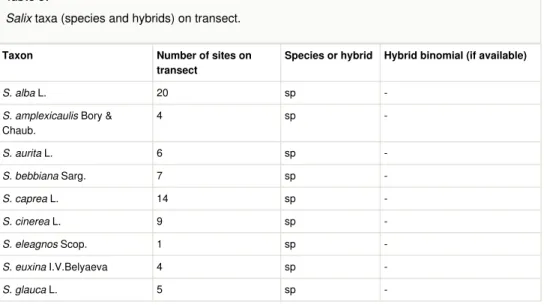
Table 3 lists the total of 20 willow species that were recorded, together with the 12 hybrids. For each taxon the total number of sites (out of 42) is given. In this transect, the most widespread willow is Salix alba, which occurs in 20 sites (out of 42). This species is followed by S. triandra (with 15 sites), S. caprea, S. phylicifolia (with 14 sites each) and by
S. myrsinifolia, S. ×fragilis (with 13 sites).
Taxon Number of sites on
transect
Species or hybrid Hybrid binomial (if available)
S. alba L. 20 sp
-S. amplexicaulis Bory & Chaub.
4 sp
-S. aurita L. 6 sp
-S. bebbiana Sarg. 7 sp
-S. caprea L. 14 sp
-S. cinerea L. 9 sp
-S. eleagnos Scop. 1 sp
-S. euxina I.V.Belyaeva 4 sp
-S. glauca L. 5 sp
-Table 3.
S. gmelinii Pall. 1 sp
-S. hastata L. 5 sp
-S. lanata L. 1 sp
-S. lapponum L. 4 sp
-S. myrsinifolia Salisb. 13 sp
-S. pentandra L. 7 sp
-S. phylicifolia L. 14 sp
-S. purpurea L. 8 sp
-S. silesiaca Willd. 1 sp
-S. triandra L. 15 sp
-S. viminalis L. 9 sp
-S. alba × -S. pentandra 1 h S. ×ehrhartiana G.Mey
S. aurita × S. myrsinifolia 1 h S. ×coriacea J.Forbes
S. cinerea × S. aurita 1 h S. ×multinervis Döll
S. cinerea × S. triandra 1 h S. ×krausei Andersson
S. euxina × S. pentandra 1 h S. ×meyeriana Rostk. ex Willd.
S. myrtilloides × S. glauca 1 h
-S. phylicifolia × -S. myrsinifolia 2 h S. ×tetrapla Walk.
S. purpurea × S. viminalis 8 h S. ×rubra Huds.
S. triandra × S. viminalis 3 h S. ×mollissima Sm.
S. viminalis × S. cinerea 1 h S. ×smithiana Willd.
S. alba × S. euxina 13 h S. ×fragilis L.
S. ×fragilis × S. triandra 1 h S. ×alopecuroides Tausch
Site Country No. of taxa
Willow species and hybrids
1 Greece 3 S. alba (O), S. eleagnos (O), S. purpurea (C) 2 Greece 3 S. alba (C), S. amplexicaulis (C), S. triandra (O)
3 Greece 1 S. alba (C)
4 Greece 3 S. alba (C), S. amplexicaulis (C), S. triandra (O) 5 Greece 2 S. alba (C), S. triandra (O)
6 Bulgaria 4 S. alba (C), S. amplexicaulis (C), S. purpurea × S. viminalis (O), S. ×fragilis (C)
7 Bulgaria 4 S. alba (C), S. amplexicaulis (C), S. euxina (O), S. triandra (C) 8 Bulgaria 2 S. alba (O), S. euxina (C)
9 Bulgaria 1 S. alba (A)
10 Romania 1 S. alba (A)
11 Romania 3 S. alba (C), S. purpurea × S. viminalis (C), S. triandra × S. viminalis (O) 12 Romania 3 S. cinerea (C), S. silesiaca (C), S. ×fragilis (O)
13 Romania 4 S. alba × S. pentandra (O), S. purpurea (O), S. triandra (O), S. ×fragilis (A) 14 Hungary 7 S. alba (O), S. euxina (O), S. purpurea × S. viminalis (O), S. triandra (C), S.
triandra × S. viminalis (C), S. viminalis (O), S. ×fragilis (O)
15 Hungary 4 S. alba (O), S. cinerea (C), S. purpurea × S. viminalis (C), S. ×fragilis (C) 16 Hungary 5 S. alba (C), S. aurita (O), S. purpurea (C), S. triandra (C), S. viminalis (O) 17 Poland 3 S. caprea (R), S. euxina (C), S. purpurea (C)
18 Poland 5 S. aurita (O), S. cinerea (C), S. purpurea × S. viminalis (O), S. triandra (O), S. viminalis (C)
19 Poland 6 S. alba (O), S. cinerea (C), S. purpurea × S. viminalis (C), S. triandra × S. viminalis (C), S. viminalis (C), S. ×fragilis (C)
20 Poland 6 S. alba (R), S. gmelinii (O), S. purpurea (C), S. triandra (C), S. viminalis (O), S. ×fragilis (A)
21 Poland 7 S. alba (O), S. cinerea (R), S. cinerea × triandra (R), S. purpurea (C), S. triandra (A), S. viminalis (C), S. ×fragilis (C)
22 Poland 2 S. bebbiana (A), S. ×fragilis (C) Table 4.
23 Poland 3 S. bebbiana (A), S. myrsinifolia (R), S. pentandra (O)
24 Lithuania 7 S. alba (R), S. caprea (A), S. purpurea (C), S. triandra (C), S. viminalis (O), S. viminalis × S. cinerea (O), S. ×fragilis (O)
25 Lithuania 7 S. alba (O), S. cinerea (O), S. myrsinifolia (A), S. pentandra (C), S. purpurea (C), S. triandra (O), S. ×fragilis (C)
26 Latvia 9 S. alba (O), S. bebbiana (O), S. caprea (O), S. cinerea (A), S. myrsinifolia (O), S. pentandra (C), S. purpurea × S. viminalis (O), S. triandra (O), S. viminalis (O)
27 Latvia 5 S. bebbiana (O), S. myrsinifolia (A), S. triandra (O), S. viminalis (C), S. × fragilis (C)
28 Estonia 6 S. caprea (C), S. cinerea x aurita (R), S. myrsinifolia (A), S. phylicifolia (C), S. triandra (O), S. ×fragilis (O)
29 Estonia 4 S. myrsinifolia (A), S. phylicifolia × S. myrsinifolia (R), S. purpurea × S. viminalis (C), S. ×fragilis × S. triandra (R)
30 Finland 5 S. aurita (R), S. caprea (R), S. cinerea (R), S. pentandra (R), S. phylicifolia (A)
31 Finland 6 S. cinerea (O), S. euxina × S. pentandra (O), S. myrsinifolia (A), S. pentandra (O), S. phylicifolia (O), S. phylicifolia × S. myrsinifolia (C)
32 Finland 6 S. aurita (C), S. bebbiana (O), S. caprea (O), S. myrsinifolia (A), S. pentandra (C), S. phylicifolia (C)
33 Finland 4 S. aurita (O), S. caprea (C), S. myrsinifolia (C), S. phylicifolia (A) 34 Finland 3 S. caprea (O), S. pentandra (R), S. phylicifolia (A)
35 Finland 4 S. aurita (R), S. caprea (O), S. aurita × myrsinifolia (R), S. phylicifolia (A) 36 Finland 2 S. myrsinifolia (O), S. phylicifolia (A)
37 Finland 4 S. caprea (O), S. hastata (O), S. myrsinifolia (O), S. phylicifolia (A) 38 Finland 6 S. caprea (R), S. glauca (A), S. hastata (O), S. lapponum (R), S. myrtilloides
× S. glauca (R), S. phylicifolia (A)
39 Finland 6 S. bebbiana (R), S. caprea (C), S. glauca (O), S. hastata (O), S. lapponum (A), S. phylicifolia (A)
40 Norway 2 S. glauca (O), S. phylicifolia (A)
41 Norway 7 S. bebbiana (O), S. caprea (C), S. glauca (C), S. hastata (O), S. lapponum (C), S. myrsinifolia (C), S. phylicifolia (C)
42 Norway 7 S. caprea (O), S. glauca (C), S. hastata (C), S. lanata (R), S. lapponum (C), S. myrsinifolia (C), S. phylicifolia (C)
A-i Switzerland 2 S. eleagnos, S. purpurea × S. viminalis
C-i Greece 1 S. alba
J-i Romania 2 S. cinerea [not collected], S. ×fragilis [not collected] K-i Netherlands 1 S. caprea
C-ii Estonia 7 S. bebbiana, S. cinerea, S. euxina × S. pentandra, S. myrsinifolia, S. phylicifolia, S. ×fragilis, S. ×fragilis × S. triandra
D-ii Finland 3 S. aurita × S. cinerea, S. caprea, S. myrsinifolia × S. phylicifolia E-ii Finland 2 S. bebbiana, S. lapponum
H-ii Norway 5 S. glauca, S. hastata, S. lapponum, S. myrsinifolia, S. phylicifolia I-ii Norway 3 S. caprea, S. hastata, S. myrsinifolia
Three stands (in Greece and Bulgaria) had just one willow taxon and in all cases this was
S. alba. One stand (site 26 in Latvia) had the maximum recorded number of taxa, nine per stand, while six sites (in Hungary, Poland, Lithuania and Norway) had seven taxa. Finally, Table 5 lists the voucher specimens collected.
Site No. Country Sex Name Notes
1 1 Greece f S. purpurea To 6m
1 2 Greece m S. eleagnos To 2m
1 3 Greece m S. cf. alba River-side shrubs to 2m
1 4 Greece f S. alba River-side shrubs to 2m
2 1 Greece f S. amplexicaulis Shrub to 5m, opposite leaves 2 2 Greece f S. triandra Pale bracts and stipules
2 3 Greece f S. alba Large tree willow to 20m
3 1 Greece m S. cf. alba Large tree to 20 m with fissured bark, 2 stamens per flower
3 2 Greece f S. cf. alba Female flowers pedicillate, bracts relatively narrow, not very hairy, brown tipped 3 3 Greece m S. cf. alba Small tree to 4m, 1 stamen per flower 3 4 Greece f S. cf. alba Female flowers sessile, bracts relatively wide,
very hairy
4 1a Greece m S. cf. alba Tall tree to 20m with fissured bark 4 1b Greece f S. cf. alba Tall tree to 20m with fissured bark 4 2a Greece m S. amplexicaulis Shrub to 4m
Table 5.
4 2b Greece f S. amplexicaulis Shrub to 4m 4 3 Greece m S. triandra (var.) Shrub to 4m
5 1a Greece m S. alba Grey-barked tree to 10m
5 1b Greece f S. alba Grey-barked tree to 10m
5 2a Greece m S. triandra (var.) Small shrub to 4m 5 2b Greece f S. triandra Small shrub to 4m 6 1a Bulgaria m S. alba Tall grey barked tree to 15m 6 1b Bulgaria f S. alba Tall grey barked tree to 15m 6 2 Bulgaria f S. ×fragilis Small tree to 6m
6 3 Bulgaria m S. purpurea × S. viminalis
Small shrub with reddish twigs, 2m
6 4 Bulgaria f S. amplexicaulis Small shrub 2m 7 1a Bulgaria m S. amplexicaulis
7 1b Bulgaria f S. amplexicaulis 7 2a Bulgaria m S. triandra 7 2b Bulgaria f S. triandra
7 3a Bulgaria m S. alba
7 3b Bulgaria f S. triandra 7 4a Bulgaria m S. euxina 7 4b Bulgaria f S. euxina 8 1a Bulgaria m S. euxina 8 1b Bulgaria f S. euxina
8 2 Bulgaria m S. alba
9 1a Bulgaria m S. alba Tall trees to 30m and possibly planted. Similar trees are very common along the banks of the Danube.
9 1b Bulgaria f S. alba Tall trees to 30m and possibly planted. Similar trees are very common along the banks of the Danube.
10 1a Romania m S. alba Large tree to 20m
10 1b Romania f S. alba Large tree to 20m
11 1 Romania m S. alba
11 2 Romania f S. purpurea × S. viminalis
11 3 Romania f S. triandra × S. viminalis
12 1a Romania m S. silesiaca Shrub, twigs ridged under bark 12 1b Romania f S. cinerea Tree to 10m, twigs ridged under bark 12 2 Romania m S. ×fragilis (towards S.
euxina?)
Glabrous tree to 10m
13 1b Romania f S. alba × S. pentandra Small coppiced growth by river 13 2 Romania f S. triandra
13 3 Romania f S. purpurea
14 1a Hungary m S. triandra × S. viminalis To 5m
14 1b Hungary f S. triandra To 5m
14 2a Hungary m S. euxina To 8m
14 2b Hungary f S. ×fragilis To 8m
14 3 Hungary f S. viminalis To 6m
14 4 Hungary f S. purpurea × S. viminalis
To 2m
14 5 Hungary f S. alba To 10m
15 1a Hungary m S. cinerea Shrub to 4m with striae 15 1b Hungary f S. cinerea Shrub to 4m with striae 15 2 Hungary m S. purpurea × S.
viminalis
15 3 Hungary f S. ×fragilis
15 4a Hungary m S. alba Small tree
15 4b Hungary f S. alba Large tree, branches weeping
16 1 Hungary m S. alba
16 2 Hungary m S. triandra 16 3 Hungary f S. purpurea 16 4 Hungary v S. viminalis 16 5 Hungary f S. aurita
16 6 Hungary m S. alba
17 1a Poland m S. euxina
17 1b Poland f S. euxina
17 2 Poland f S. purpurea
17 3 Poland f S. caprea
18 1 Poland f S. viminalis Young coppice plantation 18 2a Poland m S. aurita Shrub to 4m weakly striate
18 2b Poland f S. cinerea Shrub to 4m
18 3 Poland f S. purpurea × S. viminalis
18 5 Poland f S. triandra 18 6 Poland f S. purpurea × S.
viminalis
19 1 Poland m S. ×fragilis Abundant at this site 19 2 Poland f S. purpurea × S.
19 3 Poland f S. viminalis
19 4 Poland f S. triandra × S. viminalis
19 5 Poland m S. alba Occasional at this site
19 6 Poland f S. cinerea
20 1 Poland m S. ×fragilis
20 2 Poland f S. purpurea
20 3a Poland m S. triandra 20 3b Poland f S. triandra 20 4 Poland f S. viminalis 20 5 Poland f S. gmelinii
20a 1a Poland f S. triandra small tree/shrub to 4m 20a 1b Poland f S. triandra small tree/shrub to 4m
20a 2 Poland f S. ×fragilis to 40m
20a 3 Poland f S. alba to 30m
20a 4 Poland f S. ×fragilis
20a 5 Poland v S. gmelinii large open sprawling shrubs to 5m 20a 6 Poland v S. viminalis shrub to 5m
20a 7 Poland v S. purpurea shrub to 4m
20a 8 Poland v S. triandra
20a 9 Poland v S. ×fragilis very glossy green upper sides to leaves 21 1a Poland m S. triandra small trees or multi-stemmed shrubs to 10m
high ×20m across 21 1b Poland f S. triandra
21 2 Poland f S. ×fragilis small bush to large tree to 20m 21 3 Poland v S. ×fragilis
21 4 Poland f S. purpurea shrub to 4m
21 5 Poland f S. cinerea
21 5a Poland f S. cinerea × S. triandra shrub to 3m 21 5b Poland v S. purpurea
21 6 Poland f S. viminalis bush to 6m
21 7 Poland f S. alba tree to 30m
21 8 Poland f S. ×fragilis 21 9 Poland f S. triandra 21 10 Poland v S. purpurea
22 1 Poland f S. ×fragilis 15m medium tree
22 2 Poland v S. bebbiana low bushes 2-3m with abundant cercopid spittle bugs and willow feeding scaraboid beetle
22 4 Poland v S. ×fragilis sapling 1.5m
22 5 Poland v S. bebbiana
23 1 Poland v S. bebbiana blue/grey-green foliage, 2-5m high 23 2 Poland f S. pentandra trees all multistemmed (c. 4), to 15m, rugged
bark, foliage with somewhat weeping habit 23 3 Poland v S. myrsinifolia a few low bushes in the meadow with
yellow-green foliage and some red pigmentation on stems, 1-1.5m
23 4 Poland v S. bebbiana
23 5 Poland v S. bebbiana
24 1 Lithuania v S. caprea large shrub to 10m, planted? 24 2 Lithuania v S. purpurea bushes to 2m
24 3 Lithuania v S. viminalis × S. cinerea small sapling, no striae 24 4 Lithuania f S. ×fragilis medium tree to 20m 24 5 Lithuania v S. viminalis
24 6 Lithuania v S. purpurea 24 7 Lithuania m S. triandra 24 8 Lithuania f S. triandra 24 9 Lithuania f S. ×fragilis 24 12 Lithuania f S. alba 25 1 Lithuania v S. purpurea 25 2 Lithuania f S. alba 25 3a Lithuania m S. pentandra 25 3b Lithuania f S. pentandra 25 4 Lithuania f S. triandra 25 5 Lithuania v S. myrsinifolia 25 6 Lithuania v S. myrsinifolia 25 7 Lithuania v S. myrsinifolia 25 8 Lithuania v S. myrsinifolia 25 9 Lithuania f S. cinerea 25 10 Lithuania v S. triandra 25 11 Lithuania v S. ×fragilis
26 1 Latvia v S. cinerea 5m h ×6m w
26 2 Latvia m S. triandra
26 3 Latvia m S. pentandra small trees to 8m
26 4 Latvia v S. bebbiana
26 5 Latvia v S. purpurea × viminalis
26 7 Latvia v S. viminalis 26 8 Latvia v S. myrsinifolia 26 9 Latvia f S. myrsinifolia
26 10 Latvia v S. caprea
26 11 Latvia v S. alba
26 12 Latvia v S. purpurea × S. viminalis
26 13 Latvia f S. triandra 26 14 Latvia f S. triandra
27 1 Latvia f S. myrsinifolia subglabrous shrubs to 5m 27 2 Latvia v S. bebbiana small bush with striae 27 3 Latvia v S. viminalis
27 4 Latvia f S. triandra 27 5 Latvia v S. ×fragilis
28 1a Estonia m S. triandra wide bush, 3m h ×4m w 28 1b Estonia f S. triandra
28 2 Estonia v S. ×fragilis young plants to 4m 28 3 Estonia v S. ×fragilis
28 4 Estonia f S. cinerea × S. aurita bush 3 ×4m, with striae 28 5 Estonia v S. caprea vigorous bush to 4m, no striae 28 6 Estonia f S. myrsinifolia bush to 2m
28 7 Estonia f S. myrsinifolia 28 8 Estonia v S. phylicifolia 28 9 Estonia v S. myrsinifolia 29 1 Estonia v S. purpurea × S.
viminalis
29 2 Estonia v S. ×fragilis × S. triandra 29 3 Estonia f S. myrsinifolia 29 4 Estonia v S. myrsinifolia 29 5 Estonia v S. phylicifolia × S.
myrsinifolia
29 6 Estonia f S. myrsinifolia
30 1a Finland b S. phylicifolia shrub to 4m 30 1b Finland f S. phylicifolia
30 2 Finland f S. pentandra
30 5b Finland f S. phylicifolia
30 6 Finland v S. cinerea large shrub, no striae 30 7a Finland b S. phylicifolia
30 7b Finland v S. phylicifolia
31 1 Finland f S. myrsinifolia small shrub to 2m 31 2 Finland v S. phylicifolia × S.
myrsinifolia
31 3 Finland f S. myrsinifolia 31 4 Finland v S. phylicifolia
31 5 Finland v S. euxina × S. pentandra very small plants 1-2m 31 6 Finland v S. myrsinifolia
31 7 Finland f S. cinerea
31 8 Finland f S. myrsinifolia small plants 1-2m 31 9 Finland f S. myrsinifolia
31 10 Finland f S. myrsinifolia 31 11 Finland m S. pentandra
32 1 Finland f S. pentandra to 4m
32 2 Finland v S. aurita to 2m
32 3 Finland f S. myrsinifolia to 2m 32 4 Finland f S. phylicifolia to 2m 32 5 Finland f S. myrsinifolia to 4m 32 6 Finland f S. phylicifolia to 3m 32 7 Finland f S. myrsinifolia
32 8 Finland f S. myrsinifolia 32 9 Finland v S. bebbiana 32 10 Finland v S. caprea
33 1 Finland v S. caprea small shrubs to 3m
33 2 Finland f S. aurita to 2m
33 3 Finland f S. myrsinifolia to 4m 33 4 Finland f S. phylicifolia to 3m 34 1 Finland f S. phylicifolia to 3m
34 2 Finland v S. caprea to 3m
34 3 Finland m S. pentandra c. 4m
34 4 Finland f S. phylicifolia 34 5 Finland f S. phylicifolia
35 1 Finland v S. caprea small tree to 4m 35 2 Finland v S. aurita × S.
myrsinifolia
35 3 Finland f S. aurita old tree, 8m high 35 4 Finland f S. phylicifolia bushes to 6m 35 5 Finland f S. phylicifolia
35 6 Finland f S. phylicifolia 35 7 Finland f S. phylicifolia
36 1 Finland f S. phylicifolia to 4m 36 2 Finland f S. myrsinifolia to 6m 36 3 Finland f S. phylicifolia
37 1 Finland f S. phylicifolia shrub 1-3m 37 2 Finland m S. hastata 5m high spindly tree
37 3 Finland v S. caprea 3-4m high
37 4a Finland m S. hastata in wet heathy scrub, less than 75cm 37 4b Finland f S. hastata
37 5 Finland f S. myrsinifolia
38 1 Finland f S. phylicifolia to 3m
38 2 Finland f S. glauca to 1.5m
38 3 Finland f S. glauca
38 4 Finland f S. hastata 1-1.5m
38 5 Finland m S. phylicifolia
38 6 Finland v S. caprea
38 7 Finland f S. hastata 38 8 Finland f S. myrtilloides × S.
glauca
38 9 Finland v S. caprea
38 10 Finland f S. lapponum
39 1 Finland f S. phylicifolia bushes to 2m
39 2 Finland f S. hastata shrub to 1.5m
39 13a Finland m S. glauca 39 13b Finland f S. glauca 39 14 Finland f S. lapponum 39 15 Finland f S. lapponum 40 1a Norway m S. phylicifolia 40 1b Norway f S. phylicifolia
40 2 Norway b S. glauca
40 4 Norway m/f S. phylicifolia catkins bisexual 40 5 Norway f S. phylicifolia
40 6 Norway f S. phylicifolia
41 1 Norway f S. lapponum grey bush willow 1-1.5m
41 2 Norway b S. glauca
41 3 Norway f S. glauca
41 4 Norway f S. phylicifolia green bush willow 1-2m 41 5 Norway f S. phylicifolia
41 6 Norway v S. hastata dwarf willow
41 7 Norway v S. glauca
41 8 Norway f S. myrsinifolia
41 9 Norway f S. myrsinifolia 5m high with slender dark grey stems 41 10 Norway m S. myrsinifolia
41 11 Norway f S. bebbiana
41 12 Norway v S. caprea 5m high with slender pale grey stems 42 1a Norway v S. lapponum
42 1b Norway f S. lapponum shrub 1-1.5m
42 2 Norway m S. glauca shrub c. 1m
42 3a Norway m S. glauca dwarf shrub
42 3b Norway f S. lanata dwarf shrub
42 4 Norway v S. caprea to 5m
42 5 Norway f S. lanata shrub less than 75cm 42 6a Norway m S. myrsinifolia shrub to 4m 42 6b Norway f S. phylicifolia
42 7 Norway f S. myrsinifolia shrub 5m 42 9a Norway m S. myrsinifolia
42 14 Norway f S. glauca
42 15 Norway f S. glauca
A-i 1 Switzerland f S. eleagnos A-i 2 Switzerland m S. eleagnos A-i 3 Switzerland f S. purpurea × S.
viminalis
A-1 4 Switzerland m S. purpurea × S. viminalis
C-i 1 Greece m S. alba
J-i 1 Romania - S. cinerea [Not collected]
J-i 2 Romania - S. fragilis [Not collected] K-i 1 Holland f S. caprea
C-ii 1 Estonia f S. euxina × S. pentandra C-ii 2 Estonia v S. ×fragilis
C-ii 3 Estonia v S. ×fragilis × S. triandra C-ii 4 Estonia b S. phylicifolia C-ii 5 Estonia v S. myrsinifolia C-ii 6 Estonia f S. cinerea C-ii 7 Estonia f S. cinerea C-ii 8 Estonia v S. bebbiana C-ii 9 Estonia f S. bebbiana C-ii 10 Estonia f S. phylicifolia C-ii 11 Estonia f S. myrsinifolia C-ii 12 Estonia f S. myrsinifolia D 1 Finland f S. aurita × S. cinerea
D 2 Finland v S. caprea
D 3 Finland f S. myrsinifolia × S. phylicifolia
E 1a Finland m S. lapponum E 1b Finland f S. lapponum E 2a Finland m S. bebbiana E 2b Finland f S. bebbiana
H 1 Norway m S. hastata
H 2 Norway m S. hastata
H 3 Norway m S. hastata
H 6 Norway f S. myrsinifolia
H 7 Norway f S. hastata
H 8 Norway f S. phylicifolia
H 9 Norway m S. glauca
H 10 Norway f S. phylicifolia
H 11 Norway f S. hastata
H 12 Norway f S. glauca
H 13 Norway f S. glauca
H 14 Norway f S. lapponum
H 15 Norway f S. glauca
H 16 Norway f S. phylicifolia I 1a Norway m S. myrsinifolia
I 1b Norway f S. caprea
I 1c Norway v S. caprea
I 2a Norway f S. myrsinifolia I 2b Norway f S. myrsinifolia I 2c Norway f S. myrsinifolia I 2d Norway f S. myrsinifolia I 2e Norway f S. myrsinifolia
I 3a Norway f S. hastat a
I 3b Norway f S. hastata
I 3c Norway f S. hastata
I 3d Norway f S. hastata
I 3e Norway f S. hastata
Discussion
These samples provide a "snapshot" of willow diversity along a latitudinal gradient and an indication of the geographically changing taxonomic diversity that is presented to willow-feeding herbivores across Europe. What is particularly noticeable is the role in taxic diversity of hybrids. One third (10 out of 30) of the total taxa recorded were hybrids. This highlights the importance of recording hybrids, which are often inadequately reported in surveys. Salix hybrids are notable for their frequency in nature but comparative rarity in the literature on willows.
has undergone a major radiation in boreal regions which may go some way towards explaining this inversion of the norm.
Finally, it should be noted that these willows formed the background for a major sampling of insects and it is anticipated that further papers forming part of this study will examine the insect fauna collected.
Acknowledgements
Funding for the fieldwork was partly provided by the Natural History Museum (London, UK) Life Sciences Departmental Investment Fund (SDF13010) to DMP. QCC acknowledges appointments by RBG Kew (as Honorary Research Associate) and by Queen Mary University of London (as Visiting Professor), which greatly facilitated the conduct of this study. Finally, we thank the two reviewers for their many helpful suggestions.
Author contributions
QCC collected the willows, made preliminary identifications of the willow specimens and wrote the paper; ER assisted in the collection of willows and contributed to the writing; IB identified the willow specimens and contributed to the writing of the paper; DMP conceived and planned the study, jointly collected the willows and co-wrote the paper.
References
• Anstett D, Naujokaitis-Lewis I, Johnson MJ (2014) Latitudinal gradients in herbivory on Oenothera biennis vary according to herbivore guild and specialization. Ecology 95 (10): 2915‑2923. DOI: 10.1890/13-0932.1
• Baltensperger A, Huettmann F (2015) Predictive spatial niche and biodiversity hotspot models for small mammal communities in Alaska: applying machine-learning to conservation planning. Landscape Ecology 30 (4): 681‑697. DOI: 10.1007/ s10980-014-0150-8
• Baltensperger AP, Huettmann F, Hagelin JC, Welker JM (2015) Quantifying trophic niche spaces of small mammals using stable isotopes (δ15 N and δ13 C) at two scales across Alaska. Canadian Journal of Zoology 93 (7): 579‑588. DOI: 10.1139/ cjz-2015-0025
• Barrios-Garcia MN, Rodriguez-Cabal M, González A, Crutsinger G (2014)
Biogeographical variation in arthropod communities on coyote bush, Baccharis pilularis. Insect Conservation and Diversity 8 (1): 81‑91. DOI: 10.1111/icad.12086
• Belyaeva I (2009) Nomenclature of Salix fragilis L. and a new species, S. euxina
(Salicaceae). Taxon 58: 1344‑1348.
• Blackman RL, Eastop VF (2014) Aphids on the world’s plants. An online information and identification guide. http://www.aphidsonworldsplants.info. Accession date: 2015 7 09.
• Brändle M, Brandl R (2001) Species richness of insects and mites on trees: expanding Southwood. Journal of Animal Ecology 70 (3): 491‑504. DOI: 10.1046/
j.1365-2656.2001.00506.x
• Callan EM (1940) Hymenopterous parasites of willow insects. Bulletin of Entomological Research 31 (1): 35‑44. DOI: 10.1017/s0007485300004776
• de Araújo WS, Scareli-Santos C, Guilherme FA, Cuevas-Reyes P (2013) Comparing galling insect richness among Neotropical savannas: effects of plant richness, vegetation structure and super-host presence. Biodiversity and Conservation 22 (4): 1083‑1094. DOI: 10.1007/s10531-013-0474-8
• den Herder M, Niemelä P (2003) Effects of reindeer on the re-establishment of Betula pubescens subsp. czerepanovii and Salix phylicifolia in a subarctic meadow. Rangifer 23 (1): 3‑12. DOI: 10.7557/2.23.1.308
• Ellison A, Bank M, Clinton B, Colburn E, Elliott K, Ford C, Foster D, Kloeppel B, Knoepp J, Lovett G, Mohan J, Orwig D, Rodenhouse N, Sobczak W, Stinson K, Stone J, Swan C, Thompson J, Holle BV, Webster J (2005) Loss of foundation species: consequences for the structure and dynamics of forested ecosystems. Frontiers in Ecology and the Environment 3 (9): 479‑486. DOI: 10.2307/3868635
• Floate K, Whitham T (1993) The "Hybrid Bridge" hypothesis: host shifting via plant hybrid swarms. The American Naturalist 141 (4): 651‑662. DOI: 10.1086/285497
• Häggström H, Larsson S (1995) Slow larval growth on a suboptimal willow results in high predation mortality in the leaf beetle Galerucella lineola . Oecologia 104 (3): 308‑315. DOI: 10.1007/bf00328366
• Hernández H, Goettsch B, Gómez-Hinostrosa C, Arita H (2007) Cactus species turnover and diversity along a latitudinal transect in the Chihuahuan Desert Region. Biodiversity and Conservation 17 (4): 703‑720. DOI: 10.1007/s10531-007-9303-2
• Hill J, Hodkinson I (1995) Effects of temperature on phenological synchrony and altitudinal distribution of jumping plant lice (Hemiptera: Psylloidea) on dwarf willow (
Salix lapponum) in Norway. Ecological Entomology 20 (3): 237‑244. DOI: 10.1111/ j.1365-2311.1995.tb00453.x
• Hill J, Hamer K, Hodkinson I (1998) Variation in resource exploitation along an altitudinal gradient: the willow psyllids (Cacopsylla spp.) on Salix lapponum. Ecography 21 (3): 289‑296. DOI: 10.1111/j.1600-0587.1998.tb00566.x
• Hodkinson I, Bird J, Hill J, Baxter R (2001) Host plant growth characteristics as determinants of abundance and phenology in jumping plant-lice on downy willow. Ecological Entomology 26 (4): 376‑387. DOI: 10.1046/j.1365-2311.2001.00337.x
• Huber B (2015) Small scale endemism in Brazil’s Atlantic Forest: 14 new species of
Mesabolivar (Araneae, Pholcidae), each known from a single locality. Zootaxa 3942 (1): 1. DOI: 10.11646/zootaxa.3942.1.1
• Jalas J, Suominen J (1976) Atlas Florae Europaeae. Distribution of Vascular Plants in Europe. 3. Salicaceae to Balanophoraceae. The Committee for Mapping the Flora of Europe & Societas Biologica Fennica Vanamo, Helsinki, 128 pp.
• Karrenberg S, Edwards PJ, Kollmann J (2002) The life history of Salicaceae living in the active zone of floodplains. Freshwater Biology 47 (4): 733‑748. DOI: 10.1046/
• Kolehmainen J, Julkunen-Tiitto R, Roininen H, Tahvanainen J (1995) Phenolic glucosides as feeding cues for willow-feeding leaf beetles. Entomologia Experimentalis et Applicata 74 (3): 235‑243. DOI: 10.1111/j.1570-7458.1995.tb01896.x
• Kouki J, Niemela P, Viitasaaii M (1994) Reversed latitudinal gradient in species richness of sawflies (Hymenoptera, Symphyta). Ann. Zool. Fennici 31: 83‑88. • Leppänen S, Malm T, Värri K, Nyman T (2014) A comparative analysis of genetic
differentiation across six shared willow host species in leaf- and bud-galling sawflies. PLoS ONE 9 (12): e116286. DOI: 10.1371/journal.pone.0116286
• Meikle R (1984) Willows and Poplars of Great Britain and Ireland (BSBI Handbook No.4). Botanical Society of the British Isles, London, 198 pp.
• Meikle RD (1992) British willows; some hybrids and some problems. Proceedings of the Royal Society of Edinburgh. Section B. Biological Sciences 98: 13‑20.
• Myklestad A (1993) The distribution of Salix species in Fennoscandia - a numerical analysis. Ecography 16 (4): 329‑344. DOI: 10.1111/j.1600-0587.1993.tb00222.x
• Myklestad A, Birks HJB (1993) A numerical analysis of the distribution patterns of Salix
L. species in Europe. Journal of Biogeography 20 (1): 1‑32. DOI: 10.2307/2845736
• Nyman T, Bokma F, Kopelke J (2007) Reciprocal diversification in a complex plant-herbivore-parasitoid food web. BMC Biology 5 (1): 49. DOI: 10.1186/1741-7007-5-49
• Percy D, Argus G, Cronk Q, Fazekas A, Kesanakurti P, Burgess K, Husband B, Newmaster S, Barrett SH, Graham S (2014) Understanding the spectacular failure of DNA barcoding in willows (Salix): Does this result from a trans-specific selective sweep? Molecular Ecology 23 (19): 4737‑4756. DOI: 10.1111/mec.12837
• Rechinger KH (1992) Salix taxonomy in Europe–problems, interpretations, observations. Proceedings of the Royal Society of Edinburgh. Section B. Biological Sciences 98: 1‑12. DOI: 10.1017/S0269727000007417
• Rechinger KH, Akeroyd JR (1993) Salix. In: Tutin TG, Burges N, Chater A, Edmondson J, Heywood V, Moore D, Valentine D, Walters S, Webb D (Eds) Flora Europaea, volume 1. Psilotaceae to Platanaceae (ed. 2). Cambridge University Press, Cambridge. • Roininen H, Tahvanainen J (1989) Host selection and larval performance of two
willow-feeding sawflies. Ecology 70 (1): 129. DOI: 10.2307/1938419
• Rowell-Rahier M (1984a) The presence or absence of phenolglycosides in Salix
(Salicaceae) leaves and the level of dietary specialisation of some of their herbivorous insects. Oecologia 62 (1): 26‑30. DOI: 10.1007/bf00377368
• Rowell-Rahier M (1984b) The food plant preferences of Phratora vitellinae (Coleoptera: Chrysomelidae). Oecologia 64 (3): 369‑374. DOI: 10.1007/bf00379135
• Senterre B, Lejoly J, Sonké B (2004) Analyse du gradient de continentalité et identification de communautés végétales en forêts denses d'Afrique centrale par la méthode du méga-transect. Phytocoenologia 34 (3): 490‑515. DOI: 10.1127/0340-269x/ 2004/0034-0491
• Serbina L, Burckhardt D, Borodin O (2015) The jumping plant-lice (Hemiptera: Psylloidea) of Belarus. Revue Suisse de Zoologie 122: 7‑44. DOI: 10.5281/ ZENODO.14578
• Sipura M (1999) Tritrophic interactions: willows, herbivorous insects and insectivorous birds. Oecologia 121 (4): 537‑545. DOI: 10.1007/s004420050960
• Tahvanainen J, Julkunen-Tiitto R, Kettunen J (1985a) Phenolic glycosides govern the food selection pattern of willow feeding leaf beetles. Oecologia 67 (1): 52‑56. DOI: 10.1 007/bf00378451
• Tahvanainen J, Helle E, Julkunen-Tiitto R, Lavola A (1985b) Phenolic compounds of willow bark as deterrents against feeding by mountain hare. Oecologia 65 (3): 319‑323. DOI: 10.1007/bf00378905
• Uotila P (2011) Salicaceae. – In: Euro+Med Plantbase - the information resource for Euro-Mediterranean plant diversity. http://www.emplantbase.org/home.html
• Volf M, Hrcek J, Julkunen-Tiitto R, Novotny V (2015) To each its own: differential response of specialist and generalist herbivores to plant defence in willows. Journal of Animal Ecology 84 (4): 1123‑1132. DOI: 10.1111/1365-2656.12349
• World Bank Group (2015) The Climate Change Knowledge Portal (CCKP) Beta. http:// sdwebx.worldbank.org/climateportal/