www.ijemst.com
Understanding Middle School Students’
Motivation in Math Class: The
Expectancy-Value Model Perspective
Eyup Yurt
Gaziantep University
To cite this article:
Yurt, E. (2015). Understanding middle school students’ motivation in math class: The
expectancy-value model perspective.
International Journal of Education in Mathematics,
Science and Technology, 3
(4), 288-297.
This article may be used for research, teaching, and private study purposes.
Any substantial or systematic reproduction, redistribution, reselling, loan, sub-licensing,
systematic supply, or distribution in any form to anyone is expressly forbidden.
Authors alone are responsible for the contents of their articles. The journal owns the
copyright of the articles.
International Journal of Education in Mathematics, Science and Technology
Volume 3, Number 4, October 2015, Page 288-297
ISSN: 2147-611X
Understanding Middle School Students’ Motivation in Math Class: The
Expectancy-Value Model Perspective
Eyup Yurt
*
Gaziantep University
Abstract
One of the most important variables affecting middle school students’ mathematics performance is motivation. Motivation is closely related with expectancy belief regarding the task and value attached to the task. Identification of which one or ones of the factors constituting motivation is more closely related to mathematics performance may help more effective mathematics planning process. In this context, the purpose of this study was to investigate the relationships among middle school students’ task values concerning the math class, their expectancy perceptions and mathematics performance via a structural equation model. The study was conducted on 200 middle school students receiving their education in Konya provincial center. Fifty point five percent of the students (n=101) were female whereas 49.5 %. (n=99) were male. Twenty-nine percent of the students (n=58) were sixth graders, 35 % (n=70) were seventh graders and 36 % (n=72) were eighth graders. The Self and Task Perception Inventory in mathematics was used to identify the students’ task values and expectancy perceptions concerning mathematics, while end-of-the-term math class scores were used to determine their mathematics performances. The data obtained were analyzed using the structural equation modeling. According to the results that were obtained, it was understood that expectancy beliefs, task difficulty and intrinsic interest value were the most effective variables on mathematics performance. Moreover, findings of this study show that students with high expectancy perceptions in mathematics who derived pleasure from dealing with mathematics and had less difficulty in mathematics had higher mathematics achievements. The findings that were obtained were discussed in light of theoretical explanations.
Key words: Expectancy-value model, Motivation, Mathematics performance, Middle school students.
Introduction
Today, the need for mathematical knowledge and ability is increasing more than ever in many professions. In particular, mathematics has a special importance for different professions such as engineering, architecture, genetics, politics, economics and social studies (Chiu & Klassen, 2010; Hall, 2007; Roman, 2004). Moreover, having mathematical skills offer more opportunities to individuals in shaping their careers (National Council of Teachers of Mathematics [NCTM], 2000). Therefore, mathematics has a special importance among school subjects in many countries (Fuchs & Fuchs, 2005; Wang, 2006; Xiaobao & Yeping, 2008). Middle school years in particular are of critical importance in developing mathematics and science skills (Reynolds, 1991). Thus, gaining students mathematical knowledge and skills in accordance with their interests and abilities in this period is very important. Moreover, being successful in many disciplines in middle school requires mathematical knowledge and ability. For example, experimental calculations performed in science lesson, time and scale calculations used in social sciences lesson and selection and use of appropriate geometric shapes in technology and design lesson all require mathematical knowledge and ability.
There are cognitive (Çalışkan, 2014; Guay & McDaniel, 1977; Schommer‐Aikins, Duell & Hutter, 2005; Yurt & Sünbül, 2014), environmental (Brand, Glasson & Green, 2006; McConney & Perry, 2010; Savaş, Taş & Duru, 2010; Siegler, et al., 2012; Weissglass, 2002) and emotional (Çalışkan, 2014; Kitsantas, Cheema & Ware, 2011; Pajares & Miller, 1994) factors related to students’ mathematical performance in middle school years. It was pointed out that especially emotional factors have a significant effect on mathematics performance (Ramirez, Gunderson, Levine & Beilock, 2013; Yurt, 2014; Yurt & Sünbül, 2014; Yücel & Koç, 2011).
*
Motivation has a significant place among emotional factors affecting mathematics performance (Pintrich, Smith, García, & McKeachie, 1993; Üredi & Üredi, 2005). Motivation can be defined as a process by which activities aimed at a set target are initiated and continued (Pintrich & Schunk, 2002) or an intrinsic power that guides behaviors and enable behaviors to be continuous and permanent (Thorkildsen, Nicholls, Bates, Brankis, & DeBolt, 2002; Woolfolk, 2004). Various different theories have been generated to explain factors affecting individuals’ motivation and how they select tasks. These theories have tried to explain how individuals endeavor to attain their goals and how they control their efforts. One of these theories is Expectancy-value theory, which attempts to explain how expectancy and value perception affect individuals’ task selection (Atkinson, 1964; Wigfield & Eccles, 2000). Eccles et al. (1983), as modern expectancy-value theoreticians, argue that first, both the expectancy and value components are defined in richer ways, and are linked to a broader array of psychological, social, and cultural determinants. Second, these models have been tested in real-world achievement situations rather than with the laboratory tasks often used to test Atkinson’s (1964) theory and indicate them on a model.
Expectancy-Value Model of Achievement Performance
According to this model, expectancy and value are two fundamental factors controlling and guiding individuals’ behaviors. Expectancy expresses the probability of a behavior which an individual has performed to attain a goal whereas value expresses the extent of the importance of that goal for the individual. According to the expectancy-value theory, individuals take into consideration many options in their choices/selection. Individuals turn to the task that is most likely to be performed after comparing the choices they are faced with. Moreover, it is also important that the task to be selected should be appealing, easy, attainable and reasonable for individuals. Once individuals are convinced that they can accomplish the task they have chosen, then this means they are motivated to a certain extent to achieve that task. Eccles et al. (1983) explained achievement expectancies through individuals’ perceptions of to what extent they will be successful in achieving a task in the future. For example, a student’s perception of how successful they will be in mathematics next year reflects their expectancy of becoming successful in mathematics. In conclusion, individuals evaluate different choices that they encounter in their lives, compare and contrast them with one another and eventually turn to the one they most appreciate and with the highest possibility of implementation.
Both broad and field-specific definitions of the concept of value have been made (Wigfield & Eccles, 1992). Escless et al. (1983) explained the concept of value taking into consideration the qualities of different tasks. They dwelt on how these qualities influenced individuals to turn to a certain task and how they created a desire in them. The definitions made have emphasized the motivational aspect of the concept of value. Moreover, it has been pointed out that values carry subjective values and that the same task may carry different values in different people. For example, while being successful in mathematics is valuable for some students, it may not of any value to some students. Eccles et al. (1983) proposed four major components of subjective task values: attainment value/importance, intrinsic value, utility value or usefulness of the task, and cost.
Attainment Value/Importance expresses the importance of fulfilling a certain task for the individual (Wigfield, Tonks & Lutz Klauda, 2009). Tasks are important when individuals allow them to express or confirm important aspects of self, or view them as central to their own sense of themselves (Wigfield & Cambria, 2010). For example, if a student wants to be admitted to an elite student group where only students successful in mathematics are admitted, they will make an effort to get high scores in mathematics. Moreover, they will be inclined to do their mathematics assignments and projects fully and correctly. They will be more willing towards activities conducted in mathematics classes and take part actively in them.
Intrinsic Value expresses the feelings of pleasure and joy which an individual feels after fulfilling a task. If a task bears an intrinsic value for an individual, that individual concentrates more intensively to accomplish that task and demonstrates a longer lasting perseverance and effort (Wigfield et al., 2009). For example, it can be said that mathematics has an intrinsic value for a student who takes pleasure from doing mathematical problems. This student enjoys dealing with mathematical symbols and figures. This student will be inclined to exhibit more effort, perseverance and patience when they encounter a difficult mathematical problem.
290 Yurt
mathematics carries an extrinsic value. Some external reinforces are used for a task to carry extrinsic value for students. In some cases, the use of these reinforces are regarded as necessary and beneficial but overuse of these reinforces may lead to unfavorable consequences. When external reinforces are removed, the behavior that needs to be demonstrated disappears.
Perceived Cost is concerned with what factors dissuade an individual from performing a task. Moreover, cost expresses an individual’s perception of how much effort they have to exert to complete a task (Wigfield et al., 2009). For example, it can be said that the response given to the question “is getting a high score from mathematics worth studying hard and devoting ample time to it?” is closely related to the perceived cost imposed on mathematics. It has been stated that cost plays an important role especially in individuals’ task preferences (Eccles et al., 1983). Negative and positive characteristics of the task affect individuals’ task preferences. All task preferences are made taking into consideration the costs they carry for individuals. It is highly probable that tasks requiring low effort (cost) will be preferred by individuals. For example, children may decide that the cost of studying mathematics every day is not worth the effort, because it does not leave sufficient time for other activities in their life, such as sports and games.
Purpose of the Study
It is seen that in the relevant literature, longitudinal and cross-sectional studies were conducted in different fields such as music (Eccles, Wigfield, Harold & Blumenfeld, 1993; Barry, 2007), sport (Cox & Whaley, 2004; Eccles et al., 1993; Eccles & Harold, 1991), English (Marsh & Yeung, 1997), science (Simpkins, Davis-Kean & Eccles, 2006; Senler & Sungur, 2009; Xiang, McBride & Bruene, 2004) and mathematics (Eccles et al., 1993; Meece, Wigfield & Eccles, 1990; Simpkins et al., 2006) in order to identify which components of motivation were effective on performance according to the expectancy-value theory. The studies above clearly show that individuals’ expectancies for success and achievement values predict their achievement outcomes, including their performance, persistence, and choices of which activities to do. For example, Xiang et al. (2004) found that achievement goals, expectancy-related beliefs, and subjective task values were related to one another and were predictive of children's intention for future participation in running and their performance. Moreover, Xiang, McBride, Guan, and Solmon (2003) reported that elementary school children's intention for future participation in physical education was positively related to their subjective task values of physical education. On the other hand, there are limited studies in the relevant literature that investigated the effect of cost, which is one of the components of value, on performance and activity choices (Battle & Wigfield, 2003). The current study also investigated the relationship between task difficulty and required effort, which constitute cost components, and mathematics performance.
In addition, for further research, Wigfield and Cambria (2010) suggested investigating expectancies and values in diverse groups of children from different cultures. No study was encountered in the literature investigating the effect of Turkish middle school students’ values and expectancies on their mathematics performance. In this framework, this study investigated, according to the expectancy-value theory, what kind of a relationship there was between the expectancies and values in mathematic domain of Turkish students attending the 6th, 7th and 8th grades and their mathematics performance. Identifying which of the factors constituting motivation is more correlated with mathematics achievement may help plan the process of mathematics learning and teaching more effectively. Within this scope, an effort was made to determine the factors affecting students’ mathematics performance according to expectancy-value model of achievement performance.
Method
Research Model
This is a descriptive study which was conducted according to the relational survey model and intended to determine the presence and degree of relationship among task value, expectancy and math performance. Relational Survey models are models that aim to measure the presence and degree of variation between two or more variables (Karasar, 2008).
The study was conducted on 200 secondary school students aged 12-15. Fifty point five percent of the students (n=101) were female whereas 49.5 % of them were male (n=99). 29 % of the students (n=58) were 6th graders, 35 % (n=70) were 7th graders and 36% (n=72) were 8th graders.
Data Collection Process
In order to ensure participation of secondary school students, required application permissions were obtained from the Ministry of National Education office in Konya. Then, the implementation schedule was created through interviews with participant students’ teachers. According to implementation schedule, the participant students are provided to answer the inventory and demographic information form. Besides, willingness of the participants was a priority in filling out the scale form.
Variables
Task values and expectancy perceptions of participant students are measured by Self and Task Perception
Questionnaire (STPQ) originally developed by Eccles and Wigfield (1995) and adapted into Turkish by Yurt and Akyol (2015). The Self and Task Perception Questionnaire includes 19 7-point Likert-type items. The scale includes the following six subscales: intrinsic interest value (items 1 and 2), attainment value/importance (items 3, 4 and 5), extrinsic utility value (items 6 and 7), expectancy (items 8, 9, 10, 11 and 12), task difficulty (items 13, 14 and 15), and required effort (items 16, 17, 18 and 19). Confirmatory Factor Analysis method was used to examine the construct validity of Turkish version of the Self and Task Perception Questionnaire scale. Loading factors of the items in intrinsic interest value, attainment value/importance, extrinsic utility value, expectancy, task difficulty and required effort are calculated respectively as .75-.83, .67-.79, .62-.75, 0.72-.91, .73-.78 and .53-.91. The coefficients of internal consistency (Cronbach’s alpha) of the subscales are .81 for the intrinsic interest value, .77 for the attainment value/importance, .69 for the extrinsic utility value, .92 for the expectancy, .85 for the task difficulty and .82 for the required effort.
Math Performances of participant students are determined by end-of-term mathematics grades. End-of-term
mathematics grades are the averages of three mathematics exam results and the score of a performance task. The subjects that the students studied during the term consist of the learning areas of Numbers, Geometry, Algebra, Probability and Statistics. Students’ mathematics grades’ mean is 63.06, standard deviation is 9.59, median and mode are 60. After getting the necessary permissions, end-of-term mathematics grades were taken from school administration
Results
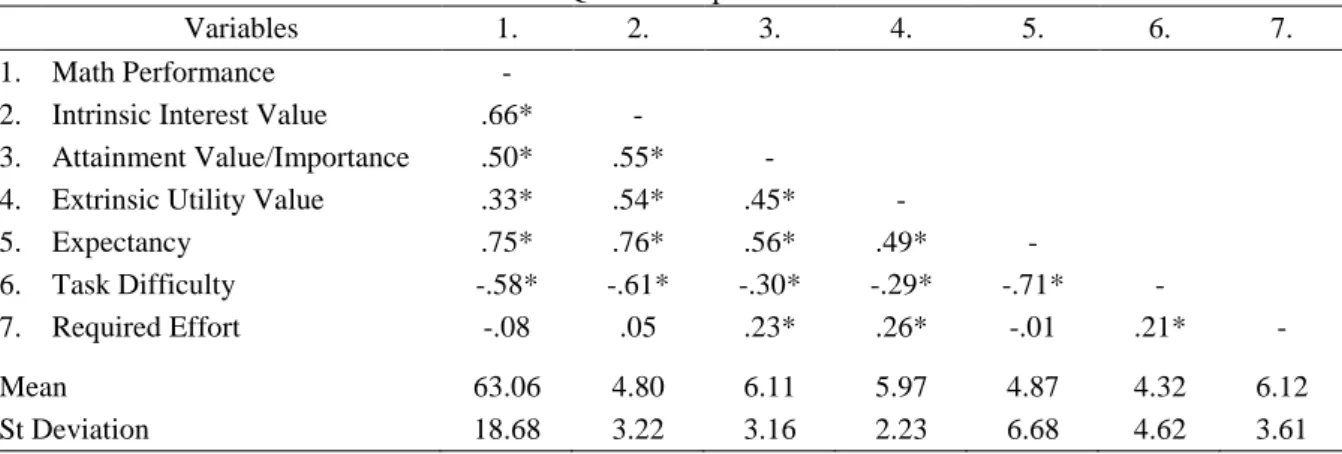
Means, standard deviations and Pearson product-moment correlation coefficients for the subscales of the STPQ and math performance are reported in Table 1. When each subscale mean was divided by the number of items on that particular subscale, results show that the highest perception was on required effort (M=6.12, SD=3.61) and lowest perception was on task difficulty (M=4.32, SD=4.62).
Table 1. Means, standard deviations and Pearson product-moment correlation coefficients, for the subscales of the STPQ and math performance
Variables 1. 2. 3. 4. 5. 6. 7.
1. Math Performance -
2. Intrinsic Interest Value .66* -
3. Attainment Value/Importance .50* .55* -
4. Extrinsic Utility Value .33* .54* .45* -
5. Expectancy .75* .76* .56* .49* -
6. Task Difficulty -.58* -.61* -.30* -.29* -.71* -
7. Required Effort -.08 .05 .23* .26* -.01 .21* -
Mean 63.06 4.80 6.11 5.97 4.87 4.32 6.12
St Deviation 18.68 3.22 3.16 2.23 6.68 4.62 3.61
292 Yurt
Before structural equation modeling (SEM) analysis, the assumption of multivariate normality was evaluated by Mardia's multivariate normality coefficient (Mardi's coefficient= 2.21, p>.01). The criterion for multivariate outliers was Mahalanobis distance at p<.001. Mahalanobis distance is evaluated as chi-square with degrees of freedom equal to the number of variables. Any case with a Mahalanobis distance greater than χ2(7) =24.32 was regarded as a multivariate outlier (p<.001). There was no multivariate outlier among these variables in the set. The final sample size was 200. We chose maximum likelihood parameter estimation because the data were distributed normally (Kline, 2011). Statistical analyses are conducted using SPSS (Statistical Package for Social Sciences) 19.0 and AMOS (Analysis of Moment Structures) 19.0 software.
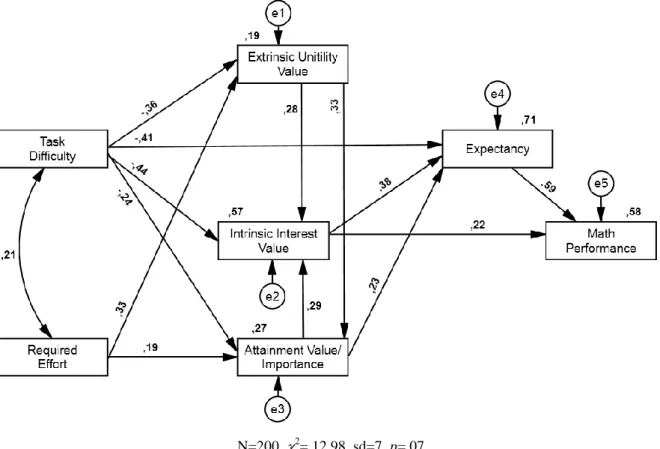
In the present study, structural equation modeling procedures are used to explore the relationships that exist among the variables. SEM analysis is a statistical approach to test a theoretical model to reveal the causal relationships between the observed and latent variables (Shumacker & Lomax, 2004). The hypothesized model is shown in Figure 1. According to the analysis results the fit indices (χ2/sd=1.86, RMSEA=.07, SRMR=.02, CFI=.99, GFI=.98, AGFI=.93, TLI=.97 and IFI=.99) showed that the hypothesized model fits the data perfectly (Bollen, 1990; Browne & Cudeck, 1993; Byrne, 2006; Hu & Bentler, 1999; Steiger, 2007; Tanaka & Huba, 1985).
N=200, 2= 12.98, sd=7, p=.07
Figure 1. Hypothesized structural model of value, expectancy, and math performance
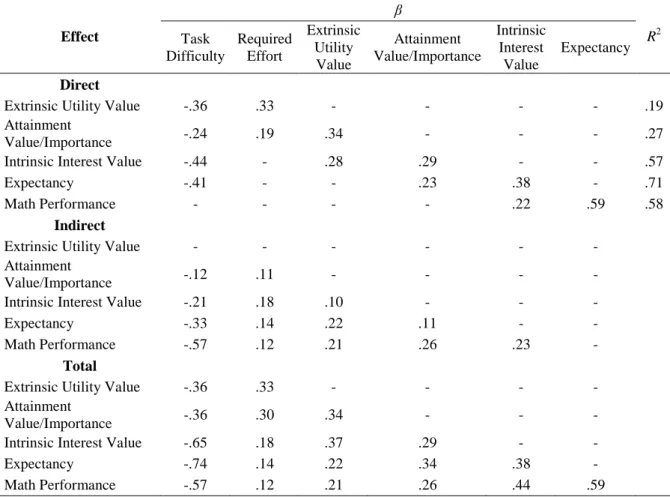
On the other hand, according to the results of the structural equation model analysis, task difficulty has a direct and negative effect on intrinsic interest value (β=-.44, t=3.07, p<.01), extrinsic utility value (β=-.36, t=5.04,
Another important variable in the model is extrinsic utility value. Extrinsic utility value refers to how a task fits into an individual’s future plans. In the model Extrinsic utility value has a direct and positive effect on intrinsic interest value (β=.34, t=4.96, p<.01) and attainment value/importance (β=.28, t=-3.58, p<.01). Also in the model, extrinsic utility value has an indirect and positive effect on intrinsic interest value (β=.10), expectancy (β=.22) and math performance (β=.21). Total effect of required effort on intrinsic interest value is .37, attainment value/importance is .34, expectancy is .22 and math performance is .21. Finally it is seen in the model, task difficulty and required effort affecting extrinsic utility value account for approximately 19% of the variation in extrinsic utility value.
The other important variable in the model is Attainment value/importance, Attainment value/importance has a direct and positive effect on intrinsic interest value (β=.29, t=-5.58, p<.01) and expectancy (β=.23, t=2.93,
p<.01). Also, attainment value/importance has an indirect and positive effect on expectancy (β=.11) and math performance (β=.26). Besides, total effect of attainment value/importance on intrinsic interest value is .29, expectancy is .34 and math performance is .26. Finally it is understood in the model that, task difficulty, required effort and extrinsic utility value affecting attainment value/importance account for approximately 27% of the variation in attainment value/importance.
Table 2.Decomposition of total effect for the structural equation model
Effect
β
R2
Task Difficulty
Required Effort
Extrinsic Utility
Value
Attainment Value/Importance
Intrinsic Interest Value
Expectancy
Direct
Extrinsic Utility Value -.36 .33 - - - - .19
Attainment
Value/Importance -.24 .19 .34 - - - .27
Intrinsic Interest Value -.44 - .28 .29 - - .57
Expectancy -.41 - - .23 .38 - .71
Math Performance - - - - .22 .59 .58
Indirect
Extrinsic Utility Value - - - -
Attainment
Value/Importance -.12 .11 - - - -
Intrinsic Interest Value -.21 .18 .10 - - -
Expectancy -.33 .14 .22 .11 - -
Math Performance -.57 .12 .21 .26 .23 -
Total
Extrinsic Utility Value -.36 .33 - - - -
Attainment
Value/Importance -.36 .30 .34 - - -
Intrinsic Interest Value -.65 .18 .37 .29 - -
Expectancy -.74 .14 .22 .34 .38 -
Math Performance -.57 .12 .21 .26 .44 .59
The other important variable in the model is intrinsic interest value. Intrinsic interest value is the enjoyment individual gains from doing a task. In the model, interest value has a direct and positive effect on expectancy (β=.38, t=-8.94, p<.01) and math performance (β=.22, t=5.50, p<.01). Also, interest value has an indirect and positive effect on math performance (β=.23). Total effect of intrinsic interest value on expectancy is .38 and math performance is .44. Finally it is assumed in the model that, task difficulty, required effort, extrinsic utility value and attainment value/importance affecting intrinsic interest value account for approximately 27% of the variation in intrinsic interest value.
294 Yurt
difficulty, required effort, extrinsic utility value, intrinsic interest value and attainment value/importance affecting expectancy value account for approximately 71% of the variation in expectancy. The last variable in the model is math performance. It is understood that the variables task difficulty, required effort, extrinsic utility value, intrinsic interest value, attainment value/importance and expectancy affecting math performance account for approximately 58% of the variation in math performance.
Discussion
According to the descriptive findings obtained from the study, it was understood that the students who participated in the study believed that the math class was a one that required a high level of effort, that the math class was quite a useful and important class and that mathematics was a highly beneficial means for them to attain their future plans. On the other hand, it was found that the participating students’ interest in mathematics, their perceptions of task difficulty and expectancies beliefs towards mathematics were at an average level. Moreover, according to the findings obtained as a result of correlation analysis, insignificant correlations were found between need for effort and mathematics performance, intrinsic value and expectancy. According to this result, it can be said that students exhibiting different levels of mathematics performance, take an interest in mathematics and have expectancy have a common perception of “mathematics is a class that requires a high
level of effort”.
It was found that task difficulty and required effort, which are components of cost in the model, have direct and indirect effects on mathematics performance. It was understood that there was a negative relationship between task difficulty and mathematics performance whereas there was a positive relationship between required effort and mathematics performance. This situation indicates that students with low task difficulty perceptions in mathematics and high required effort exhibit higher mathematics performance. Battle and Wigfield (2003), found that the perceived psychological costs of graduate school attendance were negative predictors of college students’ intentions to enter graduate school, Thus, when students value something, they also report that they are more likely to engage in the activity. When the activity is seen as having too great cost, students will be less likely to engage in it. In this study, on the other hand, it was found that students with higher task difficulty perception had lower mathematics performance. Moreover, students with higher required effort perceptions had higher mathematics performance.
In the model used in this study, task difficulty and required effort demonstrate direct and indirect correlations with extrinsic utility value, attainment value/importance and intrinsic interest. Task difficulty exhibits low and medium level and negative correlations with value components whereas required effort exhibits low and medium level and positive correlations with value components. According to this, students with high extrinsic utility value, attainment value/importance and intrinsic interest value in mathematics spend more effort on mathematics and exert less effort in mathematics. In other words, it was believed that students who state that they enjoy solving mathematical problems and see mathematics as an important means to fulfill their future plans study mathematics harder and have less difficulty in mathematics lessons. On the other hand, task difficulty has negative and direct and indirect effects on expectancy-related beliefs. On the other hand, required effort has an indirect and positive effect on expectancy-related beliefs. According to Bandura (1997), self-efficacy belief has an important effect on individuals’ performances. Self-self-efficacy beliefs affect individuals’ achievements, activity choices, target orientations, efforts and perseverance in various ways (Chen & Zimmerman, 2007; Schunk, 2011; Stevens, Olivárez & Hamman, 2006; Usher, 2009; Yurt, 2014). In parallel with these theoretical explanations, this study also found that students with high expectancy perceptions in mathematics have less difficulty in mathematics and spend more effort to do well.
effects are taken into consideration, the relative order of importance of the value components with regard to expectancy is as follows: intrinsic interest, attainment value/importance and extrinsic utility value. It was understood that especially students who had a more intrinsic interest in mathematics had higher expectancy in mathematics.
Lastly, expectancy affects mathematics directly and positively in the model. According to this, students with high expectancy perception have high mathematics performance. Moreover, it was thought that when all the variables in the model were taken into consideration, expectancy-related beliefs were the most effective variable on mathematics performance. A large body of research has showed that students’ expectancy-related beliefs influence their motivation, behavior, and learning (Bandura, 1997; Eccles et al., 1983; Jacobs, Lanza, Osgood, Eccles & Wigfield, 2002; Schunk, 2011). Children, for example, who have positive ability beliefs and approach achievement tasks with a high expectancy of success consistently, demonstrate high levels of performance on those tasks. Moreover, Wigfield and Cambria, (2010), stated that Students’ expectancies for success and beliefs about ability are among the strongest psychological predictors of performance, even when the effects of previous performance are controlled. The findings obtained in this study are in support of the studies in the literature.
Conclusion
It was understood in the model that value and expectancy-related beliefs, which were effective on mathematics performance, were also correlated with each other in parallel with theoretical explanations. It was understood in the study that task difficulty, one of the components of cost, was more effective on mathematics performance than Required Effort. Moreover, it was found that intrinsic interest value was more effective on mathematics performance than extrinsic utility value and attainment value/importance, all of which constitute value components. When the results obtained in the study are evaluated from an overall perspective, it can be said that expectancy, task difficulty and intrinsic interest value are the most effective variables on mathematics performance. While expectancy and intrinsic interest value have positive correlations with mathematics performance, task difficulty has a negative correlation with mathematics performance. According to this, it was thought that students with high expectation in mathematics, enjoy dealing with mathematics and have less difficulty in mathematics demonstrate higher mathematics performance.
Acknowledgement
This study was presented as an oral presentation at the 2015 ICEMST conference.
References
Atkinson, J. W. (1964). An introduction to motivation. Princeton, NJ: Van Nostrand. Bandura, A. (1997). Self-efficacy: The exercise of control. New York: Freeman. Barry N. (2007). Motivating the reluctant student. American Music Teacher, 4, 23-27.
Battle, A., & Wigfield, A. (2003). College women’s value orientations toward family, career, and graduate school. Journal of Vocational Behavior, 62(1), 56-75.
Bong, M. (2001). Role of self-efficacy and task-value in predicting college students' course performance and future enrollment intentions. Contemporary Educational Psychology, 26(4), 553-570.
Brand, B. R., Glasson, G. E., & Green, A. M. (2006). Sociocultural factors influencing students’ learning in science and mathematics: An analysis of the perspectives of African American students. School Science
and Mathematics, 106(5), 228-242.
Chen, P., & Zimmerman, B. (2007). A cross-national comparison study on the accuracy of self-efficacy beliefs of middle-school mathematics students. The Journal of Experimental Education, 75(3), 221-244.
Chiu, M. M., & Klassen, R. M. (2010). Relations of mathematics selfconcept and its calibration with mathematics achievement: Cultural differences among fifteen-year-olds in 34 countries. Learning and
Instruction, 20, 2-17.
Cox, A. E., & Whaley, D. E. (2004). The influence of task value, expectancies for success, and identity on athletes' achievement behaviors. Journal of Applied Sport Psychology, 16(2), 103-117.
296 Yurt
Eccles (Parsons), J. S., Adler, T. F., Futterman, R., Goff , S. B., Kaczala, C. M., Meece, J. L., & Midgley, C. (1983). Expectancies, values, and academic behaviors. In J. T. Spence (Ed.), Achievement and
achievement motivation (pp. 75–146). San Francisco, CA: W. H. Freeman.
Eccles, J. S., & Harold, R. D. (1991). Gender differences in sport involvement: Applying the Eccles' expectancy-value model. Journal of applied sport psychology, 3(1), 7-35.
Eccles, J. S., & Wigfield, A. (1995). In the Mind of the Actor: The Structure of Adolescents' Achievement Task Values and Expectancy-Related Beliefs. Personality and Social Psychology Bulletin, 21(3), 215-225. Eccles, J., Wigfield, A., Harold, R. D., & Blumenfeld, P. (1993). Age and gender differences in children's
self‐and task perceptions during elementary school. Child development, 64(3), 830-847.
Fan, W. (2011). Social influences, school motivation and gender differences: an application of the expectancy‐value theory. Educational Psychology, 31(2), 157-175.
Feather, N. T. (1988). Values, valences, and course enrollment: Testing the role of personal values within an expectancy-valence framework. Journal of educational psychology, 80(3), 381.
Fuchs, L. S., & Fuchs, D. (2005). Enhancing mathematical problem solving for students with disabilities.
Journal of Special Education, 39(1), 45–57.
Guay, R. B., & McDaniel, E. D. (1977). The relationship between mathematics achievement and spatial abilities among elementary school children. Journal for Research in Mathematics Education, 8(3), 211-215. Hall, L. E. (2007). Careers in Biotechnology. The Rosen Publishing Group.
Jacobs, J., Lanza, S., Osgood, D. W., Eccles, J. S., & Wigfield, A. (2002). Ontogeny of children’s self-beliefs: Gender and domain differences across grades one through 12. Child Development, 73, 509-527.
Karasar, N. (2008). Bilimsel araştırma yöntemi. Ankara: Nobel Yayın Dağıtım.
Kitsantas, A., Cheema, J., & Ware, H. W. (2011). Mathematics achievement: The role of homework and self-efficacy beliefs. Journal of Advanced Academics, 22, 310-339.
Kline, R. B. (2011). Principles and Practice of Structural Equation Modeling (3nd Edition ed.). New York: The Guilford Press.
Marsh, H. W., & Yeung, A. S. (1997). Causal effects of academic self-concept on academic achievement: Structural equation models of longitudinal data. Journal of educational psychology, 89(1), 41.
McConney, A., & Perry, L. B. (2010). Socioeconomic status, selfefficacy and mathematics achievement in Australia : A secondary analysis. Educational Research for Policy and Practice, 9, 77-91.
Meece, J. L., Wigfield, A., & Eccles, J. S. (1990). Predictors of math anxiety and its influence on young adolescents' course enrollment intentions and performance in mathematics. Journal of educational
psychology, 82(1), 60.
National Council of Teachers of Mathematics (2000). Principles and Standarts for School Mathematics. National Council of Teachers of Mathematics, Reston, VA.
Pajares, F., & Miller, M. D. (1994). Role of self-efficacy and self-concept beliefs in mathematical problem solving: A path analysis. Journal of educational psychology, 86(2), 193.
Passolunghi, M. C., Ferreira, T. I. R., & Tomasetto, C. (2014). Math–gender stereotypes and math-related beliefs in childhood and early adolescence. Learning and Individual Differences, 34, 70-76.
Pintrich, P. R., & Schunk, D. H. (2002). Motivation in education: Theory, research, and applications (2nd ed.). New Jersey: Prentice Hall.
Pintrich, P. R., Smith, D. A., García, T., & McKeachie, W. J. (1993). Reliability and predictive validity of the Motivated Strategies for Learning Questionnaire (MSLQ). Educational and psychological measurement,
53(3), 801-813.
Ramirez, G., Gunderson, E. A., Levine, S. C., & Beilock, S. L. (2013). Math anxiety, working memory, and math achievement in early elementary school. Journal of Cognition and Development, 14(2), 187-202. Reynolds, A. J. (1991). The middle schooling process: Influences on science and mathematics achievement
from the longitudinal study of American youth. Adolescence, 26(101), 133-158. Roman, H. T. (2004). Why math is so important. Tech Directions, 63(10), 16-18.
Ryan, R. M., & Deci, E. L. (2000). Intrinsic and extrinsic motivations: Classic definitions and new directions. Contemporary educational psychology, 25(1), 54-67.
Savaş, E., Taş, S., & Duru, A. (2010). Factors affecting students’ achievement in mathematics. İnönü
Üniversitesi Eğitim Fakültesi Dergisi, 11(1), 113-132.
Schommer‐Aikins, M., Duell, O. K., & Hutter, R. (2005). Epistemological beliefs, mathematical problem‐solving beliefs, and academic performance of middle school students. The Elementary School
Journal, 105(3), 289-304.
Schumacker, R. E., & Lomax R. G. (2004). A beginner’s guide to structural equation modeling. (2nd ed). Mahwah, NJ: Lawrence Erlbaum.
Schunk, D. H. (2011). Learning theories: An educational perspective. Pearson Education, Inc.
Siegler, R. S., Duncan, G. J., Davis-Kean, P. E., Duckworth, K., Claessens, A., Engel, M., Susperreguy, M. I., & Chen, M. (2012). Early predictors of high school mathematics achievement. Psychological Science, 23(7), 691-697.
Simpkins, S. D., Davis-Kean, P. E., & Eccles, J. S. (2006). Math and science motivation: A longitudinal examination of the links between choices and beliefs. Developmental psychology, 42(1), 1-70.
Stevens, T., Olivárez, A., & Hamman, D. (2006). The role of cognition, motivation, and emotion in explaining the mathematics achievement gap between Hispanic and White students. Hispanic. Journal of Behavioral
Sciences, 28(2), 161-186.
Thorkildsen, T. A., Nicholls, J. G., Bates, A., Brankis, N., & De-Bolt, T. (2002). Motivation and the struggle to
learn: responding to fractured experiences. Boston, Massachusetts: Allyn and bacon.
Usher, E. L. (2009). Sources of middle school student's self-efficacy in mathematics a qualitative investigation.
American Educational Research Journal, 46(1), 275–314.
Üredi, I., & Üredi, L. (2005). İlköğretim 8. sınıf öğrencilerinin öz-düzenleme stratejileri ve motivasyonel inançlarının matematik başarısını yordama gücü. Mersin Üniversitesi Eğitim Fakültesi Dergisi, 1(2), 250-260.
Wang, J. (2006). An empirical study of gender difference in the relationship between self‐concept and mathematics achievement in a cross‐cultural context. Educational Psychology, 26(5), 689-706.
Weissglass, J. (2002). Inequity in mathematics education: Questions for educators. The Mathematics Educator, 12(2), 34-39.
Wigfield, A., & Cambria, J. (2010). Expectancy-value theory: Retrospective and prospective. In T. Urdan, & S. A. Karabenick (Eds.), Advances in motivation and achievement (Vol. 16A, pp. 35-70). Bingley, UK: Emerald Group.
Wigfield, A., & Eccles, J. S. (1992). The development of achievement task values: A theoretical analysis. Developmental review, 12(3), 265-310.
Wigfield, A., & Eccles, J. S. (2000). Expectancy–value theory of achievement motivation. Contemporary
educational psychology, 25(1), 68-81.
Wigfield, A., Tonks, S., & Klauda, S. L. (2009). Expectancy-value theory. In K. R. Wentzel & A. Wigfield (Eds.), Handbook of motivation at school (pp. 55–76). Routledge: New York.
Woolfolk, A. E. (2004). Educational psychology (9th ed.). New York: Pearson.
Xiang, P., McBride, R. E., & Bruene, A. (2004). Fourth graders' motivation in an elementary physical education running program. The Elementary School Journal, 104, 253-266.
Xiang, P., McBride, R., Guan, J., & Solmon, M. (2003). Children's motivation in elementary physical education: An expectancy-value model of achievement choice. Research Quarterly for Exercise and Sport, 74(1), 25-35.
Xiaobao, L., & Yeping, L. (2008). Research on students’ misconceptions to improve teaching and learning in school mathematics and science. School Science and Mathematics, 108(1), 4-7.
Yurt, E. (2014). The predictive power of self-efficacy sources for mathematics achievement. Education and
Science, 39(176), 159-169.
Yurt, E., & Akyol, Ş. (2015). Matematikte benlik ve görev algısı envanterinin Türkçeye uyarlanması. 24. Ulusal Eğitim Bilimleri Kongresi’nde sunulan bildiri, Niğde, Türkiye.
Yurt, E., & Sünbül, A. M. (2014). A structural equation model explaining 8th grade students’ mathematics achievements. Educational Sciences: Theory & Practice, 14(4), 1642-1652.