Address for correspondence Dr. Neerja Puri
Department of Dermatology and Venereology,
G.G.S. Medical College & Hospital, Faridkot, 151203, Punjab, India Email: [email protected]
Original Article
A study of clinical and biochemical correlation in
patients of psoriasis in acute exacerbation
Neerja Puri, BB Mahajan
Department of Dermatology And Venereology, G.G.S. Medical College & Hospital, Faridkot, 151203, Punjab, India
Abstract Objectives To document various biochemical parameters like serum calcium, uric acid etc. and correlate them clinically.
Patients and methods An attempt was made to detect the biochemical changes during its exacerbations. Fifty biopsy proven psoriasis patients were selected. Clinical examination and the various biochemical tests were performed at the time of enrollment and at the end of eight weeks of treatment.
Results There were significant alterations in different biochemical values in patients before and after treatment. With clinical improvement there was shift of biochemical parameters towards normal value. Hyperuricemia was seen in 16% patients and hypocalcaemia was seen in 10% of patients.
Conclusions With improvement of clinical picture, a shift of biochemical values towards normal was recorded.
Keywords
Psoriasis, biochemical, hypoalbuminemia, hyperuricemia, hypocalcaemia.
Introduction
Psoriasis is a chronic recurrent papulosquamous
disorder characterized by epidermal
hyperplasia.1 There is increased mitotic activity of the basal cell layer which results in rapid epidermal cell turnover with the 28 day normal epidermal cell cycle reduced to 5 days. The stimulus for the increased rate of keratinization and even the site of the initial pathologic
changes remains controversial.2
Psoriasis even today continues to be a 'great
dermatologic mystery.' Controversy exists
regarding the mechanism underlying the rapidly
increased epidermal turnover.3 In any event, the
six- to nine-fold transit time increase does not allow the normal events of cell maturation and keratinization to take place. This is reflected clinically by profuse scaling, histologically by a greatly thickened epidermis with increased mitotic activity and by the presence of immature nucleated cells in the horny layer and under the electron microscope by reduced production of intracellular filaments and granules seen within normal keratinization and biochemically by
increased synthesis and degradation of
nucleoproteins.4 Psoriasis is associated with
changes in blood biochemistry too.
serum calcium, uric acid etc. and correlate them clinically.
Methods
We selected fifty psoriatic patients from the dermatology OPD. Prior approval of hospital ethics committee was taken and a written informed consent was taken from all the patients. All of them were subjected to detailed history and clinical examination. Routine investigations and histopathological examination were performed in each case.
The following biochemical investigations were performed in all the patients - serum uric acid, serum calcium, serum albumin, serum globulin, serum bilirubin, serum creatinine, serum alkaline phosphatase, SGOT and SGPT. The biochemical tests were done before the initiation of the therapy and during the remission phase of the disease.
Fifty histopathologically-proven cases of
psoriasis were selected. The following patients were excluded from the study: patients having impaired renal functions or pre-existing renal disease; patients with acute uncontrolled bacterial, viral or fungal infection; patients on concomitant use of hepatotoxic or nephrotoxic drugs for any other long standing illness.
The data was compiled and the results were analyzed statistically using chi square test.
Results
Mean age of patients was 38.46+3.287 year. The
Table 1 shows that maximum number of cases (22 %) was in the age group of 51-60 years, followed by 20% in the age group of 31-40 years, 18% in the age group 21-30 years, 16% in 11-20 years, 12% in the age group 0-10 years
Table 1 Age distribution of psoriasis (n=50).
Age (years) N (%)
0-10 2 (4)
11-20 6 (12)
21-30 9 (18)
31-40 10 (20)
41-50 8·(16)
51-60 11 (22)
> 60 4 (8)
Table 2 Different types of psoriasis (n=50). Types of psoriasis N (%)
Psoriasis vulgaris 16 (32)
Guttate psoriasis 14 (28)
Erythrodermic psoriasis 8 (16) Generalized pustular psoriasis 6 (12) Palmoplantar psoriasis 6 (12) Table 3 Triggering factors in psoriasis. Triggering factors N (%)
Stress 24 (48)
Sore throat 18 (36)
Drug intake 18 (36)
Alcoholism 16 (32)
Trauma 10 (20)
Photoaggravation 3 (6)
and 8% of the cases were above 60 years of age.
Regarding the frequency of different types of
psoriasis, Table 2 shows that out of 50 cases of
psoriasis, maximum incidence was of psoriasis vulgaris with 16 (32%) cases, followed by 14 (28%) patients of guttate psoriasis. The commonest triggering factor in psoriasis patients was stress seen in 24 (48%) patients (Table 3). Other factors were drugs in 18 (36%) patients, alcoholism in 16 (32%), trauma in 10 (20%), and sunlight in 3 (6%) patients.
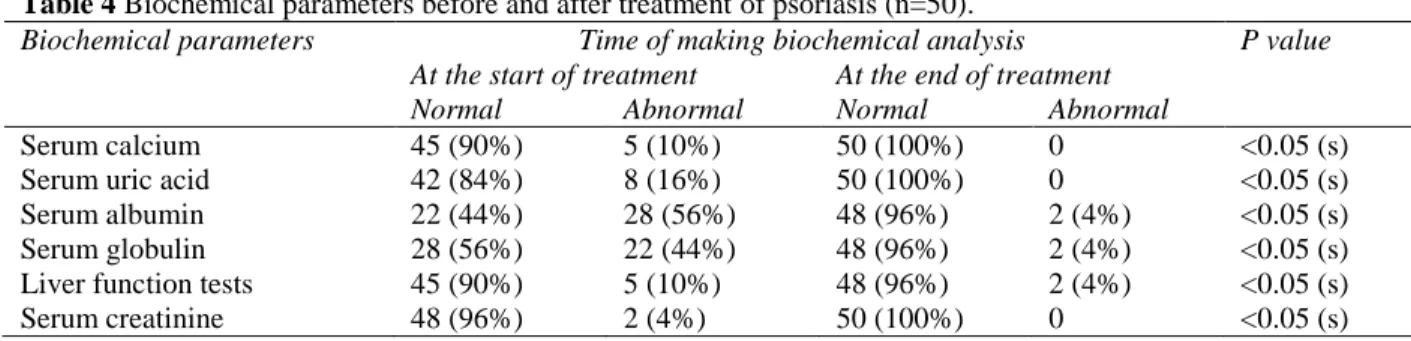
Different biochemical parameters before and
after treatment are shown in Table 4. Before the
Table 4 Biochemical parameters before and after treatment of psoriasis (n=50).
Biochemical parameters Time of making biochemical analysis P value At the start of treatment At the end of treatment
Normal Abnormal Normal Abnormal
Serum calcium 45 (90%) 5 (10%) 50 (100%) 0 <0.05 (s)
Serum uric acid 42 (84%) 8 (16%) 50 (100%) 0 <0.05 (s)
Serum albumin 22 (44%) 28 (56%) 48 (96%) 2 (4%) <0.05 (s)
Serum globulin 28 (56%) 22 (44%) 48 (96%) 2 (4%) <0.05 (s)
Liver function tests 45 (90%) 5 (10%) 48 (96%) 2 (4%) <0.05 (s)
Serum creatinine 48 (96%) 2 (4%) 50 (100%) 0 <0.05 (s)
Hyperuricemia was seen in 8 (16%) patients before treatment and it was normal in all the patients after the treatment, which was found to
be statistically significant (p<0.05).
Hypoalbuminemia was seen in 28 (56%) patients before treatment and 2 (4%) patients after treatment which was found to be
statistically significant (p<0.05).
Hyperglobulinemia was seen in 22 (44%) patients before treatment and 2 (4%) patients after treatment which was also found to be statistically significant (p<0.05). Liver function tests were deranged in 5 (10%) patients before treatment and 2 (4%) patients after treatment which was found to be statistically significant (p<0.05).Serum creatinine was abnormal in 2 (4%) patients before treatment and it was normal in all the patients after treatment, which was also found to be statistically significant (p<0.05).
Discussion
There were significant alterations in different biochemical values in patients before and after treatment. With clinical improvement, there was shift of biochemical parameters towards normal value.
While analyzing the triggering factors, it was seen that mental stress was the most important triggering factor seen in 48% of patients. Psychological factors can trigger the onset or
exacerbation of disease.6 Some say that psoriasis
is a psychosomatic disease and profound acute
or chronic emotional stresses can induce or aggravate the course of disease. It is still unknown how psychic stress affects the first occurrence or exacerbation of psoriasis. The stress reaction in the patients is mediated by hypothalamic, pituitary-adrenal relationship with immunologic effects.
The other commonest triggering factor was found to be drug intake, which was seen in 36% of patients. In our study, steroid withdrawal was the commonest triggering factor followed by use of beta-blockers. Sore throat was found to be a triggering factor in 36% of cases. ASO titres were positive in 10% of cases and were found to be positive in patients of guttate psoriasis only. Throat swab culture was found to be positive in
20% of cases and in all the cases, Streptococcus
hemolyticus was found to be the causative
organism.7
Alcoholism was found to be a triggering factor in 32% of cases. Alcohol intake should be discouraged in all the psoriatics. This is because there is a positive correlation between psoriasis
and alcohol intake.8 Moreover, alcohol-induced
liver problems may preclude the patients from receiving systemic therapy in future.
Trauma as a trigger was found in 22% of cases. Any form of trauma results in psoriasis appearing in the traumatized areas known as
Koebner's phenomenon.9 Koebner's phenomenon
persons with psoriasis. Koebner effect can be induced by trauma at sites distant from existing lesions.10
Regarding the seasonal variation, winter aggravation was seen in 52% cases,6% patients had summer aggravation,6% patients had spring aggravation and 4% had aggravation in the rainy season.11
Decreased serum proteins occur in psoriasis. A decrease in albumin occurs when there is either impairment of albumin formation or excessive
loss of albumin.12 There are many causes of
hypoalbuminemia. It is because of loss of albumin through skin in psoriatic patients. Increased endogenous catabolism of endogenous albumin is the real cause of hypoalbuminemia. Another cause of hypoalbuminemia is increased albumin clearance from involved psoriatic skin due to an increased lymphatic return, which might serve as a compensatory mechanism.
Hyperuricemia is seen in psoriasis. In our study, 16% of patients had increased serum uric acid levels. Increased purine metabolism occurs in psoriasis because of increased epidermal cell
turnover.13 Various studies have failed to
demonstrate any direct connection between the frequency of hyperuricemia and the extent of psoriatic skin involvemen.14 The fact that the incidence of hyperuricemia in psoriatic subjects is unchanged even after clearing of psoriatic lesions by various medications shows that psoriatic skin changes are not responsible for psoriatic hyperuricemia. Genetic predisposition
could be a reasonable explanation for
hyperuricemia in psoriasis patients.
Thus, the issue is still fraught with speculations. Total serum calcium alterations in psoriasis patients have been varyingly reported, showing
thereby decreased or normal level.15 Calcium
depletion from horny layer may play a role in the formation of psoriatic skin lesions. In our study, hypocalcemia was seen in 10% of patients and normal calcium levels in 90% of patients. The significance of total serum calcium in psoriasis is yet to be established. ASO titres were positive in 10% cases in our study. Also, it was seen that ASO titres were positive in patients of guttate psoriasis only. Throat swab culture was positive in 20% cases arid in all
cases S. hemolyticus was found to be the
causative organism.
Conclusion
There were significant alterations seen in the biochemistry of the patients before and after treatment. After treatment, clinical improvement along with shift of the deranged parameters towards normal values was seen.
Biochemical changes are important not only in understanding the pathogenesis of psoriasis but also act as a diagnostic and prognostic parameter in psoriasis in acute exacerbation. In addition, the recognition of triggering factors in psoriasis not only helps in the prevention of disease exacerbation but also its better management.
References
1. Farber EM, Nall ML. The natural history of psoriasis in 5600 patients. Dermatologica. 1974;148:1-18.
2. Barker JN. The pathophysiology of psoriasis. Lancet. 1991;338:222-30.
3. Bhalerao J, Bowcock AM. The genetics of psoriasis: a complex disorder of the skin and immune system. Hum Mol Genet. 1998;7:1537-45.
4. Natson W, Comn HM, Farber EM et al. The genetics of psoriasis Arch Dermatol. 1992;5:197.
1979;3:199-214.
6. Fortune DG, Main CJ, O'Sullivan TM, Griffiths CE et al. Quality of life in patients with psoriasis: the contribution of clinical variables and psoriasis specific stress. Br J Dermatol. 1997;137:755-60.
7. Whyte HJ, Baughman RD. Acute guttate psoriasis and streptococcal infection. Arch Dermatol. 1964;89:350-6.
8. Poikilolainew K, Karkkainem P. Alcohol intake: A risk factor for psoriasis in young and middle aged man. BMJ. 1990;300:780-3.
9. Reinertson R. Vascular trauma and pathogenesis of Koebner reaction in psoriasis. J Invest Dermatol. 1968;30:283. 10. Rosenberg EW, Noah PW. The Koebner
phenomenon and the microbial basis of psoriasis. J Am Acad Dermatol. 1988;18:151-8.
11. Kaveli G, Forde OH, Arnesen E, Stenvold SE. Psoriasis: familial disposition and environmental factors. Br Med J. 1985;291:999-1000.
12. Tickner A, Mier PD. Serum cholesterol, uric acid and proteins in psoriasis. Br J Dermatol. 1990;72:131-7.
13. Caraway WT. Determination of uric acid in blood in psoriatics. Am J Clin Pathol. 1995;25:840-843.
14. Bauman RR, Julson OP. Hyperuricaemia and psoriasis. J Invest Dermatol. 1991;36:105-7.
15. Clark EP, Collip JB. Determination of serum calcium in psoriatics. J Biochemistry. 1985;63:1961-3.