A Cross Layer Solution for Better
Interactions Between Routing and
Transport Protocols in MANET
So
fi
ane Hamrioui
1,2, Pascal Lorenz
1, Jaime Lloret
3and Mustapha Lalam
21GRTC, UHA University, France
2UMMTO and USTHB Universities, Algeria 3Universidad Politecnica de Valencia, Spain
This paper presents firstly a study of interactions between two routing protocols(AODV, DSR)and two transport protocol versions(TCP New Reno, Vegas). After this study, we conduct some simulations to analyze the be-havior of these protocols with different node mobility and network load values. The performance results of each protocol are examined to identify our own scenarios in order to evaluate our proposed solution for better interactions between these protocols. This solution is called CL-TCP(Cross Layer TCP). It is an adaptation of the TCP congestion control mechanism with some parameters provided by the routing layer(mobility nodes and the size of routing length). After the evaluation of CL-TCP, the results showed that it significantly im-proves the interactions between TCP Vegas and AODV protocols.
Keywords: MANET, transport protocol, routing
proto-col, cross layer solution, performance improvement
1. Introduction
The performance evaluation of MANETs has become a very important area. In the related literature we can find several studies about MA-NET network and transport layers. A MAMA-NET
(Basagni etal., 2004)is a set of mobile termi-nals independent from any infrastructure, com-municating by using radio waves, wherein each terminal can provide a relay service by accept-ing even the messages which are not intended for it in order to reissue them to another ter-minal in the network. MANET can be used in any application where the deployment of a wired network infrastructure is too restrictive and difficult to install(Garcia etal. 2008).
Routing function(Mohapatra and Krishnamur-thy, 2005)is a delivery method of information between two communicating mobiles through a given connection network. It consists of a strategy which guarantees at any time, a correct and effective establishment of routes between any pair of nodes in the network, which ensures the exchange of messages in a continuous way. The most important problem in MANET is how to adapt this method to a large number of mo-bile nodes because they have modest computing power and memory(Tarique etal. 2010). TCP protocol(Holland and Vaidya, 1999) ( Han-bali et al., 2005) is currently one of the main protocols used in Internet, more than 80% of wired communications use it. It seems then nat-ural to use it for reliable communications which involve a wireless link. Unfortunately, TCP is originally developed for fixed networks and is not suited to the characteristics of wireless links. For this reason, TCP suffers from several limi-tations which tend to grow especially when the interactions between this protocol and the other layers are not taken into account. The study of such interactions and its optimization for bet-ter performance of MANET is the aim of our present paper.
Our work is the continuation of those done in (Hamrioui et al., 2012a) and (Hamrioui et
EM-OLSR is based on the EM-OLSR routing protocol and adds a new energy fairness parameter to the Multi-Point Relay(MPR) technique. This new parameter is used by EM-OLSR and allows fairness energy consumption in the same set of MPR. In(Hamrioui etal., 2012b), we used the interactions between the MAC and routing lay-ers to improve the energy consumption in the network. We proposed a new approach called IMR-EE(Improvement of the Interactions be-tween MAC and Routing protocol for Energy Efficient). IMR-EE exploits tow communi-cation environment parameters which are the number of nodes and their mobility. However, in our present paper we use a different type of the interaction to improve the performance of another QoS parameter. We exploit the routing and transport levels to propose our improvement for better TCP protocol performance.
After studying the interactions between two routing protocols (AODV, DSR) and two TCP versions (NewReno, Vegas), CL-TCP (Cross Layer TCP) solution is proposed to improve these interactions. CL-TCP proposes an adap-tation of the congestion control mechanism of TCP with some information provided from the routing layer and focusing on route length (in terms of number of hops) and the mobility of nodes. CL-TCP will then be simulated and eval-uated using NS-2 simulator according to some performance parameters which are the through-put and the end-to-end delay.
The remainder of the paper is as follows. Af-ter a short presentation of the studied proto-cols in Section 2, we give the most significant works and approaches proposed for better inter-actions between transport and routing protocols in MANET in Section 3. Then, in Section 4, we turn to the presentation of our CL-TCP solution and show its implementation in NS-2 in Sec-tion 5. Next, in SecSec-tion 6, we study the impact of CL-TCP on the network performance, partic-ularly on throughput and the end-to-end delay. Finally, Section 7 provides our conclusion and future work.
2. Brief Overview of the Studied Protocols
TCP is a transport protocol that provides conne-ction-oriented service to upper layers(session, presentation and application). It provides reli-able service and is therefore used in end-to-end
packet communications between two comput-ers. Several variants of this protocol have been proposed to better adapt it to wireless networks, essentially TCP NewReno and TCP Vegas. TCP New Reno(Floyd and Henderson, 1999)is an improvement of TCP Reno, it makes changes in Fast Retransmit/Fast Recovery phase. It is used only if the SACK option is not negotiated during the establishment of the connection be-tween the end nodes. Its aim is to overcome the problem of TCP Reno, which is its inabil-ity to detect multiple losses simultaneously and therefore avoid the unnecessarily reduction of its congestion window(CWND).
Another version of TCP called TCP Vegas( Oli-veira and Braun, 2004)was proposed after some modifications in the source side of Reno. The amendments focus on how to predict the avail-able bandwidth and loss detection. This new algorithm, according to its authors, is able to interact with any valid implementation of TCP. Routing layer is responsible for forwarding the information to the correct destination through a given wireless connection. Several routing pro-tocols have been proposed in the literature, but only some are suitable for MANETs. In this work, we will study AODV and DSR protocols. The AODV protocol(Ad hoc On Demand Dis-tance Vector) (Perkins etal., 2006)is a routing protocol designed by Charles E. Perkins and Elizabeth M. Royer and specified in RFC 3561. It is a reactive protocol based on the distance vectors principle. This protocol uses two mech-anisms “route discovery” and “route mainte-nance” and builds the routes by using request cycle “route request/route reply”.
DSR (Dynamic Source Routing) (Johnson et
al., 2007)was developed by the monarch project at Carnegie Mellon University. It is a reactive and unicast routing protocol, simple and effec-tive, which is dedicated to multihop mobile ad-hoc networks. It is based on the use of the “source routing” technique. It computes cor-rect routes in the presence of asymmetric links
(unidirectional). In this protocol, the loop rout-ing problem is avoided.
3. Related Work
DSR routing protocol. Although CBR and TCP affect MANET significantly, these differences led to obtaining significant performance results of CBR over TCP with better throughput and less average maximum end-to-end delay. DSR was able to respond to link failure at low pause time, which led to the improvement of TCP’s performance in packets delivery. They conclude that TCP traffic models can be used for small network where frequent topology changes are limited and could be controlled by DSR proto-col.
In(Mohd Zaini etal., 2012), the authors stud-ied the behavior of TCP Friendly Rate Control
(TFRC) and TCP in the presence of DSR and AODV as routing protocols. The used evalua-tion parameters are throughput, delay and jitter. Their study also allowed them to identify which routing protocols have an impact on transport protocols. They showed that the rate of change of throughput between routing protocols is 3.74. In (Papanastasiou et al., 2006), the authors present an analysis of TCP performance ( in-cluding throughput) during the break route events. Three routing protocols are employed, AODV, DSR and OLSR, to better understand the different types of TCP behavior during these events while highlighting the mechanisms that affect each protocol. Their study showed that DSR interacts better with TCP protocol than the others which happens because of its quick routes restoration. AODV showed a good performance avoiding the RTO by caching TCP packets ex-iting when there is a link failure. For OLSR, by default it maintains settings under the optimal value for the studied scenario as if it were used for traffic loads across loaded topologies. In (Chaudhary and Singh, 2012) the authors conducted an investigation of the performance of some routing protocols in the presence of CBR and TCP traffic sources. Two reactive pro-tocols(AODV, DSR)and one proactive(DSDV) were used. Their results showed that reactive protocols have better performance with CBR than with TCP in terms of throughput, delay and packet loss. Moreover, reactive protocols are able to respond quickly to broken links, thus avoiding congestion.
In(Rahman etal., 2008)the authors investigate the performance of TCP over DSDV ( proac-tive)and AODV(reactive)protocols using sim-ulations in ns-2 for a range of node mobility with a single traffic source. They found that the proactive protocol consumes more bandwidth,
because it transmits routing updates frequently. It reacts slowly in dynamic topologies. Its per-formance decreases drastically as mobility in-creases. But the reactive one consumes less bandwidth and lower overhead of routing infor-mation. They concluded that to resist against the performance degradation of TCP under high mobility, it is necessary to have some sort of feedback from link layer protocol.
In (Appaji and Sreedhar, 2012) the authors improved transmission performance by distin-guishing between packet loss due to link fail-ure and arbitrary loss of packets. They intro-duced two algorithms: Congestion State Pre-diction Algorithm (CSPA) and Group Outlet Directive Algorithm(GODA). CSPA helps to distinguish between packet loss due to link fail-ure and arbitrary packet loss. Once the conges-tion contenconges-tion node is found, GODA attempts to resolve it at the source node and identifies it as a victim of congestion. If congestion is not resolved at node level, it attempts to handle at group level, and this process continues at pre-decessor groups if it fails to control congestion at current group level.
In (Hamrioui et al., 2012a), the author pro-poses a new approach to minimise the energy consumption called EM-OLSR (Energy Effi-ciency in MANET by improving OLSR proto-col). EM-OLSR is based on the OLSR routing protocol and adds a new energy fairness param-eter to the Multi-Point Relay(MPR)technique. This new parameter is used in our approach and allows fairness energy consumption in the same set of MPR. In this mechanism, nodes with low power are prevented in the routing process in or-der to maintain similar power values for all the mobile nodes. The simulation results showed that our proposed EM-OLSR approach allows significant power saving up to 14% and an in-crease in average lifetime of a mobile node as high as 22%.
the lost data by making the size of the back-off interval of MAC protocol adaptable to the nodes number in the network. The second pa-rameter is the mobility of nodes; IMR-EE uses also the mobility of nodes to calculate the fair-ness threshold in order to guarantee the same level of the residual energy for each node in the network.
In conclusion, none of the previous studies has addressed all or even some of the parameters of the communication involved in the degradation of the interactions between routing and trans-port protocols. Some works have only studied the parameters related to the network traffic. In fact, modeling of these parameters and their be-haviors in an approach to provide better inter-actions between the communication protocols will be a great contribution to MANET perfor-mance. Our work focuses precisely on these TCP parameters in order to provide an efficient solution in terms of performance. By exploiting some information provided at routing level we show that it is possible to ensure better through-put and the end-to-end delay performance.
4. Interactions between Routing and Transport Protocols
4.1. Evaluation Environment
The performance evaluation can be done using three techniques: analytical methods, real mea-surements, and, finally, the simulation. The use of simulation has many advantages, it is faster, less resource consuming, repeatable and can isolate parameters that can sometimes affect the performance. In addition, there are scenar-ios that are very difficult to be studied in the real world.
The evaluation is carried through the simula-tion environment NS-2(version 2.34). The im-plementation of AODV and DSR protocols is integrated in NS-2. At MAC level, the model 802.11b is used by keeping the default values of the parameters of this model.
Some values, such as the duration of simulation, the speed of nodes and the number of connec-tions have been configured properly in order to obtain interpretable results like those reported in the literature. The simulations are performed for 1000 seconds. Nodes were moving in an
area of 1000 m×1000 m. Each node had a transmission range of 250 m. We chose 1000 seconds in order to analyze the interaction of TCP with the routing alternatives in the simula-tion environment.
The choice of the AODV and DSR routing pro-tocols is justified by the fact that, although both are on demand routing protocols, each one has its own mechanism and is totally different from the other. For transport layer, we opted for TCP New Reno and TCP Vegas. TCP New Reno is a reactive variant. It is widely deployed, and its performance was evaluated in conditions sim-ilar to those conducted here. TCP Vegas is a proactive transport protocol with particular features and mechanisms completely different from TCP New Reno. TCP traffic has been used as the main network traffic.
This study is far from being exhaustive. It pre-sents the results using just one mobility model: Random Waypoint(Hyyti¨a and Virtamo, 2005). However, we have chosen it because the net-work is not designed for particular mobility and this model is widely used in the related literature. In this model, the mobility of the nodes is typically random and all nodes are uni-formly distributed in the simulation space. In this model, some mobile nodes are placed in an area where they cannot leave. An initial posi-tion, speed and destination are assigned to each mobile node. Whenever the mobile nodes reach their destination within the surface, they leave to another randomly chosen destination after an optional resting period.
4.2. Evaluation Parameters
4.3. Effect of Mobility on the Intercactions between Routing and TCP Protocols
Because our interest focuses on the interac-tion between routing and transport protocols in MANET, it is clear that the first evaluation should be the mobility performance. In this section we consider 20 different mobility sce-narios for each outcome. The scesce-narios consist of 50 nodes moving at a speed between 0 and 40 m/s according to the Random Waypoint mo-bility model with a time pause of 5 seconds. Ten TCP connections are established between ran-domly selected pairs.
As it is shown in Figure 1, independently of the speed, it is clear that DSR records better throughput than AODV for TCP New Reno. It should be noted that for low speeds the through-put increases, but it goes down as soon as the speed increases and this happens with both routing protocols. However, an increase was again recorded for both protocols when interact-ing with New Reno from the speeds exceedinteract-ing 35 m/s.
90 91 92 93 94 95 96 97 98 99
5 10 15 20 25 30 35 40
T
h
ro
u
g
hpu
t
(%
)
Speed(m/s)
NRͲAODV NRͲDSR vegasͲAODV VegasͲDSR
Figure 1.Effect of the mobility on the throughput.
Initially, the throughput increases because the number of received packets increases, but in-creasing speed causes more broken links and therefore transmission failures and packet loss which again degrade the throughput. The prob-lems of route failures in such environments lead to the activation of a congestion control system which reduces the congestion window and then the throughput is reduced.
It is obvious that the restoration of routes due to link failures caused by the mobility is heavy be-cause both routing protocols are reactive. How-ever, DSR recorded a poor performance because
of the invalid routes in the cache after changing the topology and therefore the need for an alter-native route or discovering a new one.
The throughput of TCP Vegas in both routing protocols shows an increase for low speeds but this increase is decreased when increasing the speed of the nodes.
For strong mobility, link breaks and node dis-connections make packet losses. With these losses, the congestion control system is acti-vated and it reduces the congestion window. However, this difference recorded between both routing protocols is mainly due to the principle of rehabilitation of routes used by every node and it allows a better throughput for TCP Ve-gas with DSR, although the correct routing is provided by AODV because its recovery mech-anism is more effective in this environment. However, the throughput of DSR decreases un-til it is lower than AODV. DSR throughput in-creases again from speed=25 m/s, but is still lower than AODV.
Generally, we can say that the good perfor-mance of DSR is quickly deteriorated due to mobility.
Figure 2 shows that New Reno records bet-ter end-to-end delay with AODV than with DSR. Certainly, DSR has the caching mecha-nism which reduces the routing overhead at in-termediate nodes. However, the available routes should be still valid. Mobility implies topology changes and generally broken links which leads to route failures and packet losses.
However, a very interesting point must be raised, at certain speeds the time may decrease, which means that mobility can also be beneficial.
0 0,2 0,4 0,6 0,8 1 1,2
5 10 15 20 25 30 35 40
End
Ͳ
To
Ͳ
En
d
Del
a
y
(s
)
Speed(m/s)
NRͲAODV NRͲDSR vegasͲAODV VegasͲDSR
A result that has been observed in simulations is that the end-to-end delay of TPC Vegas with DSR at low speeds is very similar to AODV and sometimes it can be better. This is due to the rapid restoration of routes from the caches of the intermediate nodes.
The average end-to-end delay of TPC Vegas recorded with AODV remains much lower, com-pared to that recorded with DSR when the speed increases. The delay for DSR increases rapidly with the mobility increase. In fact, when mo-bility increases AODV is better, compared to DSR. The unstable routes are the origin of this degradation.
4.4. Effect of Network Load
In the second step, we made an evaluation vary-ing the size of the network. The scenarios con-sidered in this section consist of nodes moving at a speed of 15 m/s according to the Random Waypoint mobility model, with a pause time of 5 seconds. Ten TCP connections were es-tablished between randomly selected pairs. An average of twenty different scenarios was con-ducted for each outcome. The number of nodes is varied between 20 and 100 nodes.
In Figure 3 we can see that in a network with a large amount of numbers of nodes TCP Vegas and TCP New Reno recorded a degradation of the throughput, particularly with the DSR pro-tocol. The difference between both recorded throughputs is due to the principle of routes rehabilitation used by every node. For a few numbers of nodes, DSR records better through-put with both TCP versions because its cache mechanism reduces the routing overhead at in-termediate nodes in order to get better through-put. However, for large values of the numbers of nodes, DSR, even with its mechanism, recorded a poor performance because of invalid routes in the cache after changing the network load and therefore the need of an alternative route or dis-covering a new one.
70 75 80 85 90 95 100
20 30 40 50 60 70 80 90 100
T
h
ro
ughp
ut
(%
)
NumberofNodes
NRͲAODV NRͲDSR vegasͲAODV VegasͲDSR
Figure 3.Effect of the network load on the throughput.
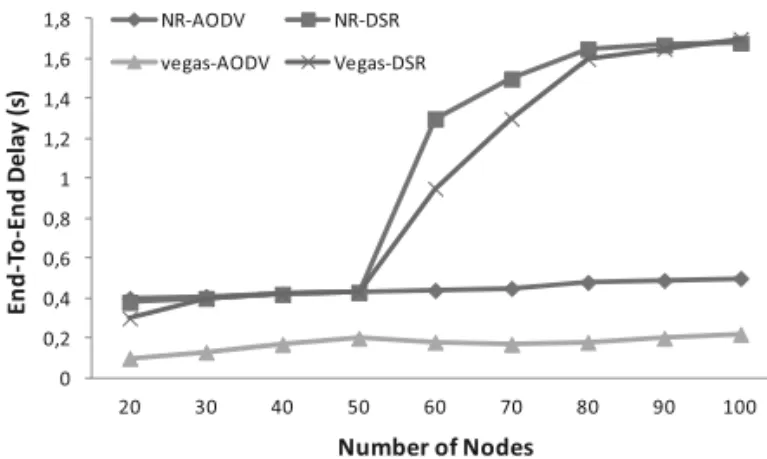
Figure 4 shows that in large size networks the end-to-end delay of a TCP Reno new packet is much better with DSR than with AODV, due to the overhead generated by the field path. In ad-dition, the non negligible probability of having an invalid route in the cache explains the higher end-to-end delay of DSR, compared to AODV. TCP Vegas recorded higher average end-to-end delay with DSR, compared to AODV, even for smaller number of nodes.
0 0,2 0,4 0,6 0,8 1 1,2 1,4 1,6 1,8
20 30 40 50 60 70 80 90 100
En
d
Ͳ
To
Ͳ
En
d
Del
a
y
(s
)
NumberofNodes
NRͲAODV NRͲDSR vegasͲAODV VegasͲDSR
Figure 4.Effect of the mobility on the end-to-end delay.
5. Improvement of Interactions between Routing and Transport Protocols
We have already seen that the performance of TCP is strongly influenced by the network layer. TCP Vegas, as proactive transport pro-tocol, shows good performance under different conditions. However, it provides much better results with AODV routing protocol than with DSR. For this reason, AODV and TCP Vegas will be used for our proposed optimizations. Our proposed solution CL-TCP uses the trans-port layer and gives more consideration to some information gathered from the routing layer that helps TCP to know the reasons of packet loss and reduces the number of cases of unnecessary initiation of the congestion control mechanism. The first part of our proposed CL-TCP consid-ers the mobility of the nodes. In fact, node mobility often leads to the breakdown of con-nectivity between nodes, resulting in data loss. These data losses may, although it is not always the case, be interpreted by the transport protocol as losses due to congestion. Then, it activates the congestion control mechanism which will reduce the unnecessarily throughput. For this reason, our solution also uses another thresh-old to guarantee the same level of the residual energy for each node in the network.
For this reason, TCP-CL takes into account the information of node mobility, which is received from the routing layer. As we know, the mobil-ity is generally characterized by its speed and angle of movement. These two factors deter-mine the degree of the impact of mobility on packet loss.
In order to model our system, we consider a nodei, in communication with another nodej, then we note:
i,j: the angle between the line(i,j)and the movement direction of nodei,
Wi: the speed of mobile nodei.
We have seen in the previous study that for very small speeds, TCP performance parameters are not affected, and larger values of mobility can also help to improve performance in the case where the communicating node doesn’t move far from its neighbouring node(with whom he communicates). Based on that, we proceed with the development of the first part of CL-TCP.
LetH(Wi)andG(Ai,j)be two logical functions whose values are determined as follows:
H(Wi) =
true ifSmin <Wi <Smax
false else (1)
Here, Smin is the speed of node i from which network performance begins to degrade. Its value is determined by the mobility model. In our case, it will be fixed at 10 m/s. Smax is the speed of nodeifrom which network perfor-mance begins to grow again. These two values must be determined according to the mobility model. In our case, it will be fixed at 35 m/s
(through our previous results).
G(i,j) is another logic function which relates to the anglei,jand informs TC-TCP if the di-rection of the movement of node i can lead to packet loss due to a broken link. Its value is determined as follows:
G(i,j)=
false if −/4≤i,j≤/4
true else (2)
CL-TCP allows each nodeito get the value of its current Si. The easiest way to do it is to deduce it by knowing the time spent between two geographical points. There are many sys-tems for node mobile location such as GPS and power measurement techniques(Elliott, 2005) (Doherty et al., 2001). With these systems, each node can know its position at any time, and then, it will be able to estimate the distance travelled during an interval of time. With the distance and time we can get the speed of the mobilityWi. Moreover, it is possible to deter-mine the direction of their movements and the value of the anglei,j.
CL-TCP also uses information relating to the number of nodes that contain the routing path. We have shown in (Hamrioui et al., 2007) (Hamrioui and Lalam, 2008), slightly delaying acknowledgment well received TCP packets can improve the performance of the protocol. We apply the same principle here, but instead of the number of nodes, we will use the time required for one packet to move between the source and destination. LetTrbe this time, each nodeiafter receivedTr will run the following treatment:
Tr :=Tr +Ti,i+1 (3)
HereTi,i+1is the time elapsed during the packet
Next two pseudo algorithms show how our pro-posed improvements are used by the CL-TCP protocol.
For routing side:
{The previous code of CL-TCP}
Begin
|Rup1,Rup2 :=False
|Fori := 1 to N−1do {N is the number of nodes in the network}
| | Tr :=Tr +Ti,i+1
|End For
|Send(Tr){send () is function which send in-formation from routing layer to transport layer}
|While(rup1=False)and(i≤N)do
| |Rup1:=H(Wi);Rep2:=G(i,j);i:=i+1 |End While
|Ifnon (Rep1or Rrep2)then
| | i :=1, | | While(Rup1 =False) and
(i≤N)do
| | |Rep1 :=F(Wi);i:=i+1
| |End While
|End If
|Send(Rup1,Rup2,Tr)
End
{The following code of CL-TCP}
For transport side:
{The previous code of CL-TCP}
Begin
|Inform(Ns,Nd);{Nsis the source node, Ndis the destination node}
|IfRTO<Tr Then | |RTO:= (RTO+Tr)/2 |End If
|Ifcongestion is detectedThen
| |If(Rup1orRup2)Then
| | |Ignore the congestion
| |End If
|End If End
{The following code of CL-TCP}
6. Incidences of the Improvement of Interactions between Routing and Transport Protocols
In this section, we evaluate our proposed solu-tion by showing its impact on the performance of MANET, especially on two parameters pre-viously studied(throughput and end-to-end de-lay). To do this, we kept the same simulation environment. Moreover, the same evaluation parameters are used. The results are compared to those obtained with AODV routing protocol and TCP Vegas version. This choice is justi-fied by the fact that in our previous study, these two protocols have allowed us to obtain the best results in terms of throughput and end-to-end delay.
6.1. Effect of the Mobility
Figure 5 shows that our TCP-CL solution pre-sents an improvement of TCP throughput. In fact, the two optimizations made for both AODV and TCP Vegas protocols allowed it to better manage the packet loss. When mobility in-creases, the probability of having more bro-ken links becomes important which leads to many packet losses in the network. CL-TCP informs TCP about the real reason of these losses, which allows it to avoid initiating un-necessarily the congestion control mechanism. This explains maintaining of better throughput although a slight decrease was recorded. CL-TCP therefore allows both AODV and CL-TCP Ve-gas protocols to interact and better understand the sources of packet losses in the network.
0 0,05 0,1 0,15 0,2 0,25 0,3 0,35
5 10 15 20 25 30 35 40
En
d
Ͳ
To
Ͳ
En
d
De
la
y
(s
)
Speed(m/s)
vegasͲAODV CLͲTCP
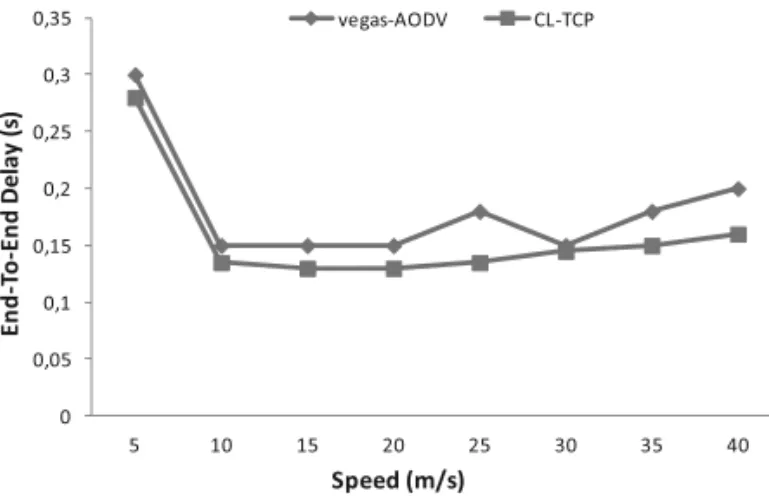
In Figure 6 we note that our solution also pro-vides an improvement of end-to-end delay. In fact, with CL-TCP, the congestion control mech-anism is not triggered unnecessarily after packet losses due to the mobility. Therefore, the trans-mission time of packets is minimized which leads to the improvement of the end-to-end de-lay. Moreover, with CL-TCP, an optimal time to wait for TCP packets acknowledgment (RTO)
is negotiated between the routing and TCP pro-tocols. The obtained time takes in consideration the new routes formed by the routing protocol after breaking the connectivity which can be short(in this case, the RTO must be reduced). With this optimization of time, CL-TCP im-proves the end-to-end delay.
92 93 94 95 96 97 98 99
5 10 15 20 25 30 35 40
T
h
rough
put
(%
)
Speed(m/s)
vegasͲAODV CLͲTCP
Figure 6. Effect of the mobility on
the end-to-end delay.
6.2. Effect of the Network Load
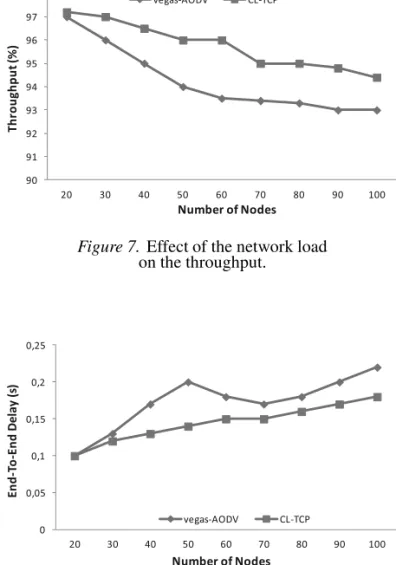
Figure 7 shows the effect of the number of nodes in the network of interactions between proto-cols AODV and TCP Vegas before and after the improvement. With the increasing number of nodes, there is a TCP throughput degradation, but this degradation is slight compared to that recorded before the improvement. In fact, TCP-CL takes into account the information about the number and the nodes used for the calcu-lation of an optimal waiting time for receiv-ing acknowledgments of TCP packets. With this optimization, retransmissions and unneces-sary waiting times are avoided, which allows a greater throughput with our solution CL-TCP.
90 91 92 93 94 95 96 97 98
20 30 40 50 60 70 80 90 100
T
hroughpu
t
(%
)
NumberofNodes
vegasͲAODV CLͲTCP
Figure 7.Effect of the network load
on the throughput.
0 0,05 0,1 0,15 0,2 0,25
20 30 40 50 60 70 80 90 100
En
d
Ͳ
To
Ͳ
En
d
De
la
y
(s
)
NumberofNodes
vegasͲAODV CLͲTCP
Figure 8.Effect of the network load on
the end-to-end delay.
7. Conclusion and Perspectives
In this paper, after studying the interactions be-tween two routing protocols(AODV and DSR)
and two TCP versions(NewReno and Vegas), CL-TCP (Cross Layer TCP) solution is pro-posed to improve these interactions. CL-TCP proposes an adaptation of the TCP congestion control mechanism with some information pro-vided from the routing layer and focusing on the route length (in terms of number of hops)and the mobility of nodes.
After the implementation and simulation of CL-TCP, we studied its incidences on the MANET performance, more particularly on some per-formance parameters which are the throughput and the end-to-end delay of the TCP protocol. The obtained results are very conclusive and satisfactory: CL-TCP helps the transport layer to distinguish the lost packets due to the con-gestion from those packets lost because of the load nodes and their mobility. With this im-provement, there is a significant increase of the performance of TCP in terms of throughput and end-to-end delay.
In our future work, we will continue modeling the maximum number of communication envi-ronment parameters. We will try to reflect the communication environment as much as possi-ble. Our CL-TCP solution will be compared with other solutions proposed in the same con-text and they will be tested on a real platform; in this case, we really need to produce all the phenomena existing in a real MANET.
References
[1] A. HANBALI, E. ALTMAN, P. NAIN, A Survey of TCP over Ad Hoc Networks.IEEE Communications
Sur-veys & Tutorials,7(3) (2005), pp. 22–36.
[2] S. BASAGNI, M. CONTI, S. GIORDANO, I. STOJMEN
-OVIC, Mobile Ad hoc Networking. Wiley-IEEE
Press, USA, 2004.
[3] C. E. PERKINS, E. M. ROYER, S. R. DAS, Ad Hoc
On-Demand Distance-Vector(AODV) Routing. IETF Internet draft(draft-ietf-manet-aodv-o6.txt).
[4] D. JOHNSON, Y. HU, D. MALTZ, The Dynamic Source Routing Protocol (DSR) for Mobile Ad Hoc Networks for IPv4, RFC4728, The IETF Trust
(2007).
[5] D. K. ELLIOTT,Understanding GPS: Principles and
Applications. Second Edition. Artech House
Pub-lishers,(2005).
[6] E. HYYTIA, J. VITTAMO, Randomwaypoint model in
n-dimensional space.Operations Research Letters,
33(2005), 567–571.
[7] G. HOLLAND, N. H. VAIDYA, Analysis of TCP
per-formance over mobile ad hoc networks. Seattle, August 1999.Annual International Conference on
Mobile Computing and Networking (Mobicom’99).
[8] K. MOHD ZAINI, A. M. M. HABBAL, F. AZZALI,
S. HASSAN, M. RIZAL, An Interaction between Congestion-Control Based Transport Protocols and Manet Routing Protocols. Journal of Computer
Science,8(4) (2012), 468–473.
[9] L. DOHERTY, K. S. J. PISTER, L. ELGHAOUI, Convex position estimation in wireless sensor networks.In
Proc. of the IEEE INFOCOM,(2001), vol. 3, pp.
1655-1663, Alaska.
[10] M. GARCIA, H. COLL, D. BRI, J. LLORET, Using MANET protocols in Wireless Sensor and Actor Networks.The Second International Conference on Sensor Technologies and Applications
(SENSOR-COMM 2008), August 25-31,(2008), Cap Esterel,
(France).
[11] M. M. RAHMAN, M. A. NASHIRY, T. K. GODDER, S. ALI, TCP Performance over Proactive & Reactive Routing Protocols for Mobile Ad Hoc Network. Accepted in theProceedings of International
Con-ference of Wireless Communication (ICWN), July
14-17,(2008), Las Vegas, Nevada, USA.
[12] M. S. CHAUDHARY, V. SINGH, Simulation and
anal-ysis of routing protocol under CBR and TCP traffic source. International Conference on
Communica-tion and Network Technologies, IEEE,(2012).
[13] M. TARIQUE, A. HOSSAIN, R. ISLAM, C. A. HOS -SAIN, Issues of Long-Hop and Short-Hop Routing
in Mobile Ad Hoc Networks: A Comprehensive Study. Network Protocols and Algorithms, 2(2) (2010), pp. 107–131.
[14] NS2. NETWORK SIMULATOR.
http://www.isi.edu/nsnam
[15] P. BAKALIS, B. LAWAL, Performance Evaluation of
CBR and TCP Traffic Models on MANET Using DSR Routing Protocol.CMC ’10 Proceedings of the 2010 International Conference on Communications
and Mobile Computing, vol. 03, 318–322.
[16] P. MOHAPATRA, S. V. KRISHNAMURTHY,Ad hoc
Net-works Technologies and Protocols. Springer Science
+Business Media, Inc, 2005, eBook ISBN: 0-387-22690-7, Print ISBN: 0-387-22689-3.
[17] R. OLIVEIRA, T. BRAUN, A Dynamic Adaptive
Ac-knowledgment Strategy for TCP over Multihop Wireless Networks.Proc. IEEE INFOCOM,(2005).
[18] S. FLOYD, T. HENDERSON,New Reno Modification
[19] S. HAMRIOUI, M. DAOUI, L. CHAMEK, M. LALAM,
P. LORENZ, Incidences of the Improvement of the
Interactions Between MAC and Routing Protocols on MANET Performance. Journal of Advanced
Computer Science and Technology, 1(4) (2012),
250–265, Science Publishing Corporation, ISSN: 2227-4332(online), ISSN: 2227-4839.
[20] S. HAMRIOUI, M. LALAM, Incidence of the
Improve-ment of the Transport – MAC Protocols Interactions on MANET Performance.8thAnnual International
Conference on New Technologies of Distributed
Systems (NOTERE 2008),(2008), France.
[21] S. HAMRIOUI, M. LALAM, Incidences of the
Im-provement of the MAC-Transport and MAC– Routing Interactions on MANET Performance. In-ternational Conference on Next Generation
Net-works and Services,(2010), Morocco.
[22] S. HAMRIOUI, M. LALAM, P. LORENZ, A new ap-proach for energy efficient in MANET based on the OLSR protocol.International Journal of
Wire-less and Mobile Computing,5(3) (2012), 292–299,
Inderscience Publishers, Issn(online): 1741-1092, Issn(print): 1741-1084.
[23] S. PAPANASTASIOU, L. M. MACHENZIE, M. OULD
-KHAOUAN, V. CHARISSIS, On the interaction of TCP
and Routing Protocols in MANETs.Advanced In-ternational Conference on Telecommunication and International Conference on Internet and Web
Ap-plications and Services, IEEE,(2006).
[24] V. V. APPAJI, M. SREEDHAR, CRT: Crosslayered
Routing Topology for Congestion Control in Mo-bile Ad Hoc Networks. International Journal of
Scientific & Engineering Research, Volume 3, Issue
9, September-2012 2 ISSN 2229-5518.
Received:February, 2013
Revised:May, 2013
Accepted:August, 2013
Contact addresses:
Sofiane Hamrioui GRTC University of Haute Alsace(UHA)
Colmar France e-mail:[email protected]
Pascal Lorenz GRTC University of Haute Alsace(UHA)
Colmar France e-mail:[email protected]
Jaime LIoret Universidad Politecnica de Valencia Spain e-mail:[email protected]
Mustapha Lalam LARI Mouloud Mammeri University(UMMTO)
Tizi Ouzou Algeria e-mail:[email protected]
SOFIANEHAMRIOUIreceived the engineering degree in computer sci-ence option parallel and distributed systems in 2004 and the master degree in computer science in 2007 from the Mouloud Mammeri Uni-versity of Tizi Ouzou, Algeria. Since 2008, he has been teacher at the Department of Computer Science, University of Science and Technol-ogy Houari Boumediene, Algiers, Algeria. He is enrolled in doctoral thesis since 2008 and it looks as part of its research are issues in mobile and ad hoc wireless networks as well as interactions between protocols, performance protocols, quality of services and saving energy.
PASCALLORENZreceived a PhD degree from the University of Nancy, France. Between 1990 and 1995 he was a research engineer at WorldFIP Europe and at Alcatel-Alsthom. He is a professor at the University of Haute Alsace and responsible for the Network and Telecommunication Research Group. His research interests include QoS, wireless networks and high-speed networks. He is senior member of the IEEE, member of many international program committees and he has served as a guest editor for a number of journals including Telecommunications Systems, IEEE communications Magazine and LNCS.
JAIMELIORETreceived his M.Sc. in Physics in 1997 from the Univer-sity of Valencia and a postgraduate Master in Corporative Networks and Systems Integration from the Department of Communications of the Polytechnic University of Valencia in 1999. He received his M.Sc. in Electronic Engineering in 2003 from the University of Valencia and his Ph.D. in Telecommunication Engineering(Dr. Ing.)from the Poly-technic University of Valencia in 2006. Until 2008, he had more than 55 scientific papers published in national and international conferences, more than 25 educational papers and more than 25 papers published in international journals(several of them with Journal Citation Report).
MUSTAPHALALAMreceived the Master’s degree in Computer