P a g e | 63 Design and Development of Solar Dryer for Chilli Drying| Hossain; Md. Abdul Awal; Md. Masud Alam& A.H.M. Maniruzzaman RabbaniMuhammad Zakaria Hossain; M. A.
Design and Development of Solar Dryer for Chilli Drying
Muhammad Zakaria Hossain1; M. A. Hossain2; Md. Abdul Awal3; Md. Masud Alam1& A.H.M.
Maniruzzaman Rabbani4
1(Spices Research Centre, Bangladesh Agricultural Research Institute, Bogra, Bangladesh)
2(Farm Machinery and Postharvest Process Engineering Division, Bangladesh Agricultural Research Institute, Gazipur, Bangladesh)
3(Farm Power and Machinery, Bangladesh Agricultural University, Mymensingh, Bangladesh)
4 (Department of Agricultural Extension)
ABSTRACT
A solar dryer was designed, fabricated and installed at Spices Research Centre, Bogra for drying of chilli. A DC fan of 10 watt was used for exhausting moisture with the help of a solar panel of 15 watt. In the solar dryer 8.75 kg dried chilli was obtained from 30 kg of red ripe chilli. The final drying levels of the red chili were obtained after 41 hours at upper tray and 46 hours at lower tray but took about 91 hours in the open sun drying system, having the same weather condition. The area of collector designed for 7.5 m2 dryer was 4 m2. The necessary volumetric air flow rate was calculated as 0.11 m3/s at vent area of 0.03 m2. The average solar radiation, ambient temperature, ambient relative humidity, upper tray temperature, lower tray temperature, exhaust relative humidity, exhaust temperature and air flow rate was 110 W/m2, 34.34°C, 68.69%, 48.45°C, 43.53°C, 50.23%, 44.28°C and 26.38 m3/s respectively during experiment. The temperature in the dryer was significantly (P<0.01) higher than that of outside temperature. The initial and final moisture content of chilli in the dryer was 73% and 14% respectively. Again the initial and final moisture content of chilli in open sun was 73% and 18% respectively. The final drying levels of the red chili were obtained after 41 h at upper tray and 46 h at lower tray but
took about 91 h in the open sun drying system having the same weather condition.
Key words-
Solar dryer; design; parameter estimation; performance; drying kinetics
1. Introduction
Bangladesh is located in the tropical region of South Asia (Latitude 20.57°-26.63°N and Longitude 88.02°-92.68°E), receives abundant solar radiation, and distribution of global solar radiation is found nearly uniform all over the country [21]. Solar drying is a promising alternative for chilli drying in Bangladesh, because mechanical drying is mainly used in industrial countries and is not applicable to small farms in developing countries due to high investment and operating costs [34]. Solar energy for crop drying is environmentally friendly and economically viable in developing countries. The natural convection solar drier appears to have potential for adoption and application in the tropics and subtropics [7].
P a g e | 64 Design and Development of Solar Dryer for Chilli Drying| Hossain; Md. Abdul Awal; Md. Masud Alam& A.H.M. Maniruzzaman RabbaniMuhammad Zakaria Hossain; M. A.
method drying can’t be controlled and relatively low quality dried product is obtained. Drying rate is very slow and takes 7-15 days, depending on the weather conditions [21]. Chillies become contaminated with dust, dirt, rainfall, animals, birds, rodents, insects and microorganisms. Under these conditions, losses can be as high as 40–60% of total quantity [32]. During the drying period if there is a heavy continuous rain, the damage to the product is as high as 70–80% [31]. As sun drying method is weather dependent, it generally does not yield good quality product due to breakage and loss of seeds. Some research work was done to reduce the drying time or improve the quality of chillies using mechanical drying method ([11],[13],[32],[36]).
A solar dryer was developed at Bhutan for 100-150 kg drying of chilli by Fuller et al. [18]. The collector area, mass flow rate, air velocity of air, drying air temperature, drying bed area was 73 m2, 3120 kg/h, 0.75 m/s, 600C and 2.75 m2 respectively. An energy analysis of solar drying of jackfruit leather in a solar tunnel dryer was presented by Chowdhury et al. [12]. Jackfruit leather was dried from an initial moisture content of about 76% (w.b.) to 11.88% moisture content (w.b.) in the solar tunnel dryer within 2 days of drying while at the same drying time the moisture content of similar sample reached 13.8% (w.b.) in the open sun drying method. A mixed- mode natural convection solar crop dryer (MNCSCD) designed by Forson et al. [16] and used for drying cassava and other crops in an enclosed structure. A prototype of the dryer was constructed to specification and used in experimental drying tests. A batch of cassava 160 kg by mass, having an initial moisture content of 67% wet basis from which 100 kg of water is required to be removed to have it dried to a desired moisture content of 17% wet basis, is used
as the drying load in designing the dryer. A drying time of 30–36 hours was assumed for the anticipated test location (Kumasi; 6.71N, 1.61W) with an expected average solar irradiance of 400W/m2 and ambient conditions of 25.10C and 77.8% relative humidity. According to the design a minimum of 42.4m2 of solar collection area was required. Under average ambient conditions of 28.2 0C and 72.1% relative humidity with solar irradiance of 340.4W/m2, a drying time of 35.5 hours was realised. When tested under full designed load signifying that the design procedure proposed is sufficiently reliable.
2. Materials and Methods
2.1 Solar dryer design considerations
A solar dryer was designed for chilli drying based on the procedure described by Hossain and Bala [22] for drying dates (a cabinet type) and procedure described by Basunia and Abe [8] for drying rough rice (natural convection a mixed-mode type). The following points were considered in the design of the natural convection solar dryer system:
1. The amount of moisture to be removed from a given quantity of wet chilli.
2. Harvesting period during which the drying is needed.
3. The daily sunshine hours for the selection of the total drying time. 4. The quantity of air needed for
drying.
5. Daily solar radiation to determine energy received by the dryer per day. 6. Wind speed for the calculation of air
vent dimensions.
P a g e | 65 Design and Development of Solar Dryer for Chilli Drying| Hossain; Md. Abdul Awal; Md. Masud Alam& A.H.M. Maniruzzaman RabbaniMuhammad Zakaria Hossain; M. A.
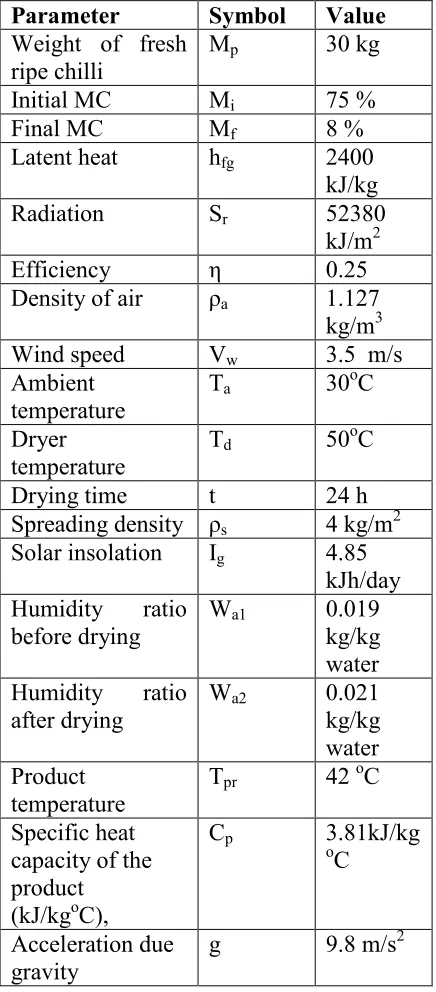
and collector. The dryer is composed of drying chamber, drying tray, and vent. To design the solar dryer the following assumptions were made for the location shown in Table 2.1 ([19], [3]).
Table 2.1 Design assumptions of solar dryer
Parameter Symbol Value Weight of fresh
ripe chilli
Mp 30 kg
Initial MC Mi 75 %
Final MC Mf 8 %
Latent heat hfg 2400
kJ/kg
Radiation Sr 52380
kJ/m2
Efficiency η 0.25
Density of air ρa 1.127
kg/m3
Wind speed Vw 3.5 m/s
Ambient temperature
Ta 30oC
Dryer temperature
Td 50oC
Drying time t 24 h
Spreading density ρs 4 kg/m2 Solar insolation Ig 4.85
kJh/day Humidity ratio
before drying
Wa1 0.019
kg/kg water Humidity ratio
after drying
Wa2 0.021
kg/kg water Product
temperature
Tpr 42 oC
Specific heat capacity of the product
(kJ/kgoC),
Cp 3.81kJ/kg oC
Acceleration due
gravity g 9.8 m/s
2
2.2 Moisture content of chilli
Moisture content of agricultural product is expressed as a percentage of moisture based on wet weight (wet basis) or dry matter (dry basis). Wet basis moisture content is generally used in commercial use. Dry basis is used primarily in research [28].
Mw (wet basis) =
w−d
w × 100
Md (dry basis) = wd−d ×100
The moisture content was determined by oven dry method, which is a direct method. The product is weighed and dried, then weighed. The moisture content was calculated using the moisture content equations [28]. The oven temperature was maintained 70 0C for drying of chilli. The total drying time was 24 hours. After 24 hours, the dried chilli was unloaded and taken to an electric balance (CP423S, Sartorius, Germany) for determining final weight of chilli.
2.3 Moisture to be removed from chilli
During drying, water at the surface of the substance evaporates and water in the inner part migrates to the surface to get evaporated. The ease of this migration depends on the porosity of the substance and the surface area available. Other factors that may enhance quick drying of food items are: high temperature, high wind speed and low relative humidity [10]. The amount of moisture to be removed from chilli was calculated using the followig equation:
Mr =
Mp (Mi - Mf)
(100 - Mf ) ---(1)
P a g e | 66 Design and Development of Solar Dryer for Chilli Drying| Hossain; Md. Abdul Awal; Md. Masud Alam& A.H.M. Maniruzzaman RabbaniMuhammad Zakaria Hossain; M. A.
2.4 Instantaneous or final moisture of the product
The percentage of moisture content is obtained from the following relations [29]:
Md = Mp (1 - Mi/100) --- (2)
Md = Mwf (1-Mfr/100) --- (3)
from relations (2-3) the final moisture content is obtained as:
Mf
= 100
−
100 MwMpf
1
−
Mi
100
---(4)
Where, Md = mass of dry product (kg), Mp = initial mass of wet product (kg), Mwf = final mass of wet product (kg), Mi = initial moisture content (%), Mf = final moisture content (%).
2.5 Pressure throughout the drying bed:
The airflow velocity decreases with increasing thickness of the drying bed, which reduces the efficiency of the dryer. In a passive solar collector, air flows from the collector into the drying chamber due to the air density difference (kg). The pressure difference across the chilli bed will be solely due to the density difference between the hot air inside the dryer and the ambient air. Air pressure can be determined by equation given by Jindal and Gunasekaran [24],
P = 0.00308 g (ti - tam) H ---(5)
Where, H = pressure head (height of the hot air column from the base of the dryer to the point of air discharge from the dryer) m, P = air pressure (Pa), g =is the acceleration due gravity (m/s2), and tam = ambient temperature (oC), ti= Inside temperature (oC).
2.6 Energy requirement
The quantity of heat required to evaporate the H2O from chilli would be:
E = Mr × hfg ---(6)
The amount needed is a function of temperature and moisture content of the crop. The latent heat of vaporization was calculated using equation given by Youcef-Ali et al. [40] as follows:
hfg = 4186 [597-0.56(Tpr)]---(7)
2.7 Collector area
The collector was made for maximum utilization of solar energy. The black body material was used for increasing the efficiency of collector. Kalogirou [27] stated that the best slope (tilt angle) for the flat plat collector is equals to the latitude of the physical location. Still, the arrangement can be varied by 100 to 150 depending on applications in which, for space heating purpose (solar collector), a latitude plus 100 is recommended for optimum solar radiation exposure during the summertime and a minus to the same degree during the winter [35]. Similar statement was made by Sulaiman et al. [38] in their solar electricity generation works. In Bangladesh average tilt angle of solar collector should be 23.50 for maximum exposure solar radiation [6].
Area collector, Ac = SE
r × η ---(8)
Width of collector, Wc = 1.50 m (assuming)
Length of collector, Lc = WAc
c ---(9)
Where, Ac = Collector area, (m2), E = Energy (kJ), Sr = Radiation, (kJ/m2), η = Efficiency, (%)
P a g e | 67 Design and Development of Solar Dryer for Chilli Drying| Hossain; Md. Abdul Awal; Md. Masud Alam& A.H.M. Maniruzzaman RabbaniMuhammad Zakaria Hossain; M. A.
The collector useful heat energy gain required to dry a given quantity of agricultural product, was obtained by using equation [14]:
Q = Cp Mp (Tc - Tam) + hfg Mwf ---(10)
Where: Cp = Specific heat capacity of the product (kJ/kgoC), Mp = Initial weight of product before drying (kg), hfg = Heat of evaporation of moisture from the product (kJ/ kg ), Mwf = Dry matter of product ( kg ), Tc = Collector temperature (oC), Tam = Ambient temperature (oC)
2.9 Drying rate and average drying rate
The drying rate is proportional to the difference in moisture content between material to be dried and the equilibrium moisture content [15]. The concept of thin layer drying was assumed for the experiments as reported by Dhanegopal et.al [13],
Dr =
dMdt ---(11)
Thus we can write from equation 11 as ,
Dr = Mr
t ---(12)
The mass of air needed for drying was calculated using equation given by Sodha et al. [37] as,
Mf = Dr
(Wa2 – Wa1) × 3600 ---(13)
2.10 Airflow rate
Drying efficiency may suffer at high airflow rates since air may not have adequate contact time with the food to increase its moisture content. Optimum airflow rate for solar dryers has been reported to be about 0.75 m3/min per square
meter of tray area [39]. Insufficient airflow can result in slow moisture removal as well as high dryer temperatures. However, the internal resistance to moisture movement in agricultural products is much greater when compared to the surface mass transfer resistance that the airflow rate beyond certain levels has no significant effect on the drying rate [20]. In natural circulation systems, airflow is primarily determined by the temperature rise in collector. Higher flow may be used at the beginning of drying and lower flow when drying enters the ‘falling-rate period’. Volumetric air flow rate can be calculated as follows,
Volumetric air flow rate, Vaf =Mf
ρa
---(14)
2.11 Vent area
Two air vents for ventilation were provided. Inlet air hole (front air vent) located above the base of absorber plate (black body CI sheet); The outlet vent (rear air vent); was located 10cm below the back top edge and provided with adjustable cover for dryer temperature control. The dryer was set on four casters to make it mobile [3].
The air vent was calculated as Av =
Vaf Vw
---(15)
Vent diameter, Dv
= { ∏ ×Vent area cm2 }/4 ---(16)
Where, Av = area of the air vent (m2), Vw = wind speed (m/s). Lv = length of air vent (m), will be equal to the length of the dryer, Vaf = Volumetric air flow rate, (m3/s).
2.12 Drying area
P a g e | 68 Design and Development of Solar Dryer for Chilli Drying| Hossain; Md. Abdul Awal; Md. Masud Alam& A.H.M. Maniruzzaman RabbaniMuhammad Zakaria Hossain; M. A.
polyvenyl sheet which could withstand at atmospheric attacks. An outlet vent was provided toward the upper end at the back of the cabinet to facilitate and control the convective flow of air through the dryer. The roof and the two opposite side walls of the cabinet are covered with transparent glass sheets of 4-mm thick, which provided additional heating due to greenhouse effect as shown in Figure 2.2.
Drying area, Ad = Mp
ρs
---(17)
Number of tray, Nt = 4,
Area of each tray, At = Ad
Nt
---(18)
Width of each tray, Wt =
At
Lt
---(19)
Where, Lt = Length of tray (m)
2.13 Physical features of the dryer
The dryer was made by PVC sheet, angle bar, square bar, polythene film, wheel, nut and bolt, poly coated wire net, corrugated iron sheet, paint, solar panel and fan. Poly Vinyl Chloride is water resistant sheet. It was used as an insulator of the dryer. Both the dryer chamber and the collector were surrounded by PVC sheet. The dryer means to be exposed in the open air. So the dryer need to be resistive from the weathering. Another important concern is to lighten the dryer for handling suitability. The PVC sheet is very light and resistive to water. According to design parameter there needed 5.1 m2 of PVC sheet of 12 mm. Angle bar was used as the main supporting structure of the dryer. The whole dryer structure was supported by the angle bar. There needed 16.5 m of angle bar (3.18 cm) for constructing of collector and 49.9 m
of angle bar (3.18 cm) for constructing of dryer chamber. Square bar was mainly used in the trays. It was also used for supporting the polythene sheet. There needed 64 m of square bar (8mm) for constructing the 4 trays and 32.3 m of square bar (8mm) for constructing the roof of the dryer. The polythene is an important element for trapping solar energy to the dryer. The solar incident of short wavelength enters through the polythene sheet and makes the chamber hot. The long wavelength generates into the dryer then trapped and makes the chamber hotter. The polythene film also protects from migration of dust or microorganisms into the dryer. There was used 7.5 m2 of polythene film (1.5 mm thick) both in the dryer and collector.
The approximate weight of the dryer when loaded with the drying product is 420 kg. So there needed heavy roller to support this whole structure. There was used 8 number of wheel of 101.6 mm diameter. The fixation of dryer component was done by nut and bolt. This type of fixation ensured ease of handling of all the parts as they can be repaired and replaced when needed. The dryer and collector were fixed with nut and bolt so that transportation can be done easily. There needed 100 piece of 12.7 mm diameter nut and bolt and 20 piece of 25.4 mm diameter nut and bolt.
P a g e | 69 Design and Development of Solar Dryer for Chilli Drying| Hossain; Md. Abdul Awal; Md. Masud Alam& A.H.M. Maniruzzaman RabbaniMuhammad Zakaria Hossain; M. A.
mm × 2700 mm × 1mm. The CI sheet was painted with black paint. The black paint absorbs solar radiation and heats of the chamber. The yellowish color was used to the MS bar for protecting of metal from corrosion. From the calculation the power required to operate a 10 watt fan and used 15 watt panel. The panel was faced 23.50 to the horizon. The angle ensures maximum utilization of solar radiation of the panel for producing electric power. The dimension of solar panel was 609.6 mm × 304.8 mm × 25.4 mm. A 15cm DC fan of 12 watt was used as a moisture exhauster. The fan plays important role for removing moisture from the drying chamber. The computer aided deign and prototype of the solar dryer is shown in Figure 2.1 and 2.2
2.14 Drying of chilli
About 30 kg of fresh harvested red ripe chilli of summer (line CO517) was collected from Spices Research Centre, Shibgonj, Bogra. The uniform size, shape with nice red color and physically healthy chillies were manually sorted for the experiment. The chilli was cleaned by water for removing dust and foreign matter. The large foreign materials were removed by hand. The chilli was then spreaded to the trays. Before placing into the dryer the chilli was weighed by an electric balance. Then the product was taken to the dryer for experimentation. The experimental data was taken from 9:00 am to 6:00 pm at one hour interval. The data of solar radiation was taken by a solar meter (UVA 18573, USA) in W/m2. The air flow rate was measured by
P a g e | 70 Design and Development of Solar Dryer for Chilli Drying| Hossain; Md. Abdul Awal; Md. Masud Alam& A.H.M. Maniruzzaman RabbaniMuhammad Zakaria Hossain; M. A.
Figure 2.1 Side view of solar dryer
The pictorial view of the dryer is shown as in Figure 2.2
Figure 2.2 Fabricated solar dryer
4 mm thick polythene 15 cm dia. fan
23.50
250 cm
24 cm Solar collector CI sheet
80 cm 150 cm
125 cm 125 cm
112 cm 50 cm
10.2 cm dia. wheel
P a g e | 71 Design and Development of Solar Dryer for Chilli Drying| Hossain; Md. Abdul Awal; Md. Masud Alam& A.H.M. Maniruzzaman RabbaniMuhammad Zakaria Hossain; M. A. 3 Results and discussion
3.1 Dryer design and parameter estimation
The field data during experiment was taken and shown as in Table 3.1 Table 3.1 Field investigated data
Parameter Symbol Value
final mass of wet product (kg) Mwf 8.75 kg
Pressure head H 1.45 m
Temperature inside of the dryer ti 44.28°C
ambient temperature tam 34.34°C
Collector Temperature tc 88°C
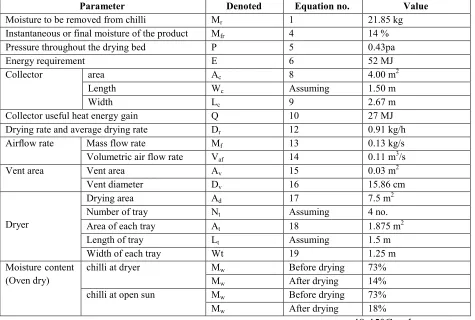
The designed and data and parameter estimated data has shown in Table 3.2 Table 3.2 Calculated data and parameter estimation
Parameter Denoted Equation no. Value
Moisture to be removed from chilli Mr 1 21.85 kg
Instantaneous or final moisture of the product Mfr 4 14 %
Pressure throughout the drying bed P 5 0.43pa
Energy requirement E 6 52 MJ
Collector area Ac 8 4.00 m2
Length Wc Assuming 1.50 m
Width Lc 9 2.67 m
Collector useful heat energy gain Q 10 27 MJ
Drying rate and average drying rate Dr 12 0.91 kg/h
Airflow rate Mass flow rate Mf 13 0.13 kg/s
Volumetric air flow rate Vaf 14 0.11 m3/s
Vent area Vent area Av 15 0.03 m2
Vent diameter Dv 16 15.86 cm
Dryer
Drying area Ad 17 7.5 m2
Number of tray Nt Assuming 4 no.
Area of each tray At 18 1.875 m2
Length of tray Lt Assuming 1.5 m
Width of each tray Wt 19 1.25 m
Moisture content (Oven dry)
chilli at dryer Mw Before drying 73%
Mw After drying 14%
chilli at open sun Mw Before drying 73%
Mw After drying 18%
3.2 Dryer performance
The data shown as in Table 4.1 was taken at 26 May 2013. The data was taken from 8:00 am to 6:00 pm of one hour interval. The average solar radiation was 110 W/m2, ambient temperature was 34.34°C, ambient relative humidity was 68.69%, upper tray
P a g e | 72 Design and Development of Solar Dryer for Chilli Drying| Hossain; Md. Abdul Awal; Md. Masud Alam& A.H.M. Maniruzzaman RabbaniMuhammad Zakaria Hossain; M. A.
Table 3.3 Temperature, relative humidity, airflow and solar radiation recorded during drying of chilli
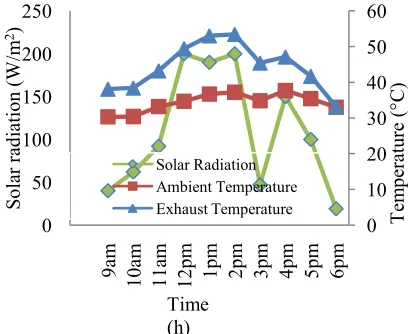
The solar radiation was very high from 12:00 pm to 2:00 pm. At 3:00 pm there was cloudy environment, so in this time the solar radiation diminishes significantly (P<0.01). The temperature in the dryer was significantly (P<0.01) higher than that of outside temperature shown as in Figure 3.1
Figure 3.1 Variation of temperature at different solar radiation
The relative humidity had inverse relation with solar radiation. Whenever the
solar radiation increased the relative humidity both in inside and outside of the dryer decreased. But the outside relative humidity was always higher than that of inside of the dryer shown as in Figure 3.2
Figure 3.2 Variation of relative humidity at different solar radiation
The air flow rate was directly proportionate to the solar radiation. When solar radiation increased the air flow rate was also increased as shown as in Figure 3.3
0 10 20 30 40 50 60 0 50 100 150 200 250
9am 10am 11am 12pm 1pm 2pm 3pm 4pm 5pm 6pm
So lar r ad iatio n (W /m 2) Solar Radiation Ambient Temperature
Exhaust Temperature Tem
per atu re (° C) Time (h) 0 10 20 30 40 50 60 70 80 90 0 50 100 150 200 250
11am 2pm 5pm
So lar R ad iatio n ( W /m 2) Solar Radiation
Ambient Relative Humadity
Exhaust Relative Humidity R
elativ e Hu m id ity ( %) Time (h) Time (h) A m bi ent Tem pe ra tur e ( °C) A m bi ent r el at ive H um id it y ( % ) U pper Tr ay Tem pe ra tur e ( °C) Low er Tr ay Tem pe ra tur e ( °C) Exhaus t Tem pe ra tur e ( °C) Exhaus t R el at ive H um id it y (%
) Air Flow
Sola r R adi at ion (W/ m 2 )
m/s m3/s
9:00 am 30.3 80.4 41.5 37.1 38.1 62.2 1.09 14.53 40 10:00 am 30.4 79.4 43.9 37 38.4 60.5 2.15 28.88 62 11:00 am 33.2 73.1 50.4 41.7 43.2 52.5 2.56 34.29 92 12:00 pm 34.7 68.1 48.8 45.3 49.4 40.4 3.02 40.46 200
1:00 pm 36.7 62.3 59 52.1 53 36.2 2.9 39.59 190
2:00 pm 37.2 59.1 58.5 51.6 53.4 33.9 2.45 33.51 200 3:00 pm 34.8 63.8 49.6 47.2 45.4 47.4 1.35 18.23 47
4:00 pm 37.7 55.8 53 45.7 47.1 40 2.54 33.71 150
5:00 pm 35.4 62.9 44.1 41.5 41.7 50.2 1.44 19.1 100
6:00 pm 33 82 35.7 36.1 33.1 79 0.11 1.49 19
P a g e | 73 Design and Development of Solar Dryer for Chilli Drying| Hossain; Md. Abdul Awal; Md. Masud Alam& A.H.M. Maniruzzaman RabbaniMuhammad Zakaria Hossain; M. A.
Figure 3.3 Variation of air flow at different solar radiation
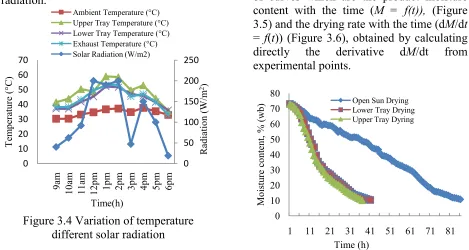
The upper tray temperature was always higher than that of lower tray temperature. The temperature profile shows that upper tray temperature > lower tray temperature > ambient temperature. The exhaust temperature of the dryer is nearly the average of upper tray and lower tray temperature resulting of combined effect. In about to all these cases the temperature increases with the increase of solar radiation.
Figure 3.4 Variation of temperature different solar radiation
3.3 Drying kinetics
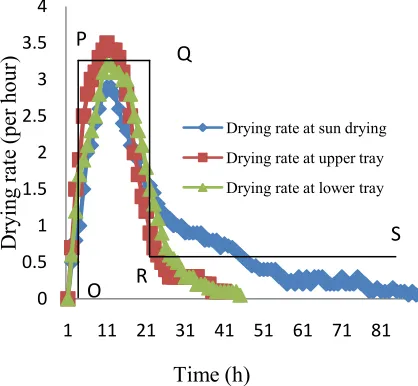
The drying rate of upper tray, lower tray and open sun chilli is shown as in Figure 3.5. The open sun drying of chilli was held from 25 May to 08 June 2013 which took 14 days (91 hours) for drying of the same variety of chilli of same weather condition. The drying rate in the dryer was double than that of the open sun drying of chilli. The drying rate of the upper tray chilli was higher than that of the lower tray chilli because upper tray temperature was higher than that of the lower tray.
The effect of various temperature gradients and pressures, makes the mass transfers (vapor and liquid) study complex. The problem becomes more complicated when it is a question of using achieved results to dimension or model the dryer. The approach is generally empirical. It consists in the determination of two representations of curves which are the product moisture content with the time (M = f(t)), (Figure 3.5) and the drying rate with the time (dM/dt = f(t)) (Figure 3.6), obtained by calculating directly the derivative dM/dt from experimental points. 0 5 10 15 20 25 30 35 40 45 0 50 100 150 200 250
10am 12pm 2pm 4pm 6pm
So lar R ad iatio n (W /m 2) Solar Radiation Air Flow A ir f lo w ( m 3/s) 0 50 100 150 200 250 0 10 20 30 40 50 60 70
9am 10am 11am 12pm 1pm 2pm 3pm 4pm 5pm 6pm
T em per atu re (° C) Time(h)
Ambient Temperature (°C) Upper Tray Temperature (°C) Lower Tray Temperature (°C) Exhaust Temperature (°C) Solar Radiation (W/m2)
R ad iatio n (W /m 2) 0 10 20 30 40 50 60 70 80
1 11 21 31 41 51 61 71 81
Mo is tu re co nten t, % ( w
b) Open Sun DryingLower Tray Drying Upper Tray Dyring
P a g e | 74 Design and Development of Solar Dryer for Chilli Drying| Hossain; Md. Abdul Awal; Md. Masud Alam& A.H.M. Maniruzzaman RabbaniMuhammad Zakaria Hossain; M. A.
Figure 3.5 Moisture content variations with drying time
In Figure 3.6, the drying kinetics enables the identification of four distinct drying phases, The first phase, noted OP is the short period of rise in temperature. It stops as soon as the product reaches the drying chamber air temperature. The second phase, noted PQ, is a constant rate drying phase. The product surface is constantly fed out of interstitial water by capillary forces.
Figure 3.6 Dehydration rate of chilli
This phase is also called isenthalpic phase since the energy received by the product is entirely used for the vaporization of surface waters. During this phase, all the product remains at the drying chamber temperature. In the third phase, noted QR, when the surface of the product reaches the hygroscopic threshold, drying enters into a first step of declination. At the start of this phase, the drying rate decreases very quickly. The evaporation zone is now inside the product. From each side of the evaporation zone, there are different methods of transport. Upstream, in the center of the product, there is always
migration of free water by capillarity and the temperature of the product is always equal to hygroscopic temperature. Downstream, the migration is due to the diffusion phenomena (vapor) or diffusion-sorption (water dependent) and there is increasing temperature in this zone. In the fourth phase, noted ST, the product is in hygroscopic field. Water does not exist any more but in dependent form and in vapor form. The drying rate decreases very slowly and tends towards zero. This value is reached when the moisture content balance of the surfaces in contact with air is obtained. This is related to the drying conditions which are given by the desorption isotherms. The drying process is then finished.
These results are in good agreement with those of Ayensu [4], Belahmidi et al. [9] and Lahsasni et al. [30]. So, it can be said that the drying rate makes possible to see that the isenthalpic phase duration is short, compared to the total drying time. The first phase of declination is very brutal and lasts little time. It is in fact a transition zone. On the other hand, the fourth phase of the drying process is very long. This can be explained by the fact that low moisture contents, close to moisture content balance, must be reached. For a safe storage of harvests products of a relative humidity of 80–90%, Ayensu [4] recommends a moisture content balance Mep14%. The value in this study is 14% for drying in the dreyer and 18% at open sun drying.
The final drying levels of the red chili were obtained after 41 h at upper tray and 46 h at lower tray but took about 91 h in the open sun drying system having the same weather condition. A significant saving in drying time was obtained for solar drying compared with open sun drying. Fig. 6 clearly indicates that the drying rate in the 0
0.5 1 1.5 2 2.5 3 3.5 4
1 11 21 31 41 51 61 71 81
D
ry
ing
r
at
e
(per
hour
)
Time (h)
Drying rate at sun drying
Drying rate at upper tray
Drying rate at lower tray
Q
S P
P a g e | 75 Design and Development of Solar Dryer for Chilli Drying| Hossain; Md. Abdul Awal; Md. Masud Alam& A.H.M. Maniruzzaman RabbaniMuhammad Zakaria Hossain; M. A.
solar drying system under forced convection can be much higher than that of the open sun drying, as reported by Akpinar [2].
The drying time obtained in the present study was compared with the results obtained in previous studies. Fudholi et al. [17] reported that the moisture content of fresh chili decreased from 80% (w.b) to 5% (w.b) in 48 h of solar drying. Banout et al. [5] compared the use of a double-pass solar dryer with a cabinet dryer via open sun drying of red chili in Central Vietnam. Drying 40 kg of red chili by using a double-pass solar dryer reduced the moisture content from 90% (w.b) to 10% (w.b) in 32 h (including nights). Mohanraj and Chandrasekar [33] reported that 40 kg of chili by using a forced convection solar drier integrated with gravel as heat storage material reduced the moisture content from 73% (w.b) to 9% (w.b) in 24 h . Janjai et al. [23] reported the use of a solar greenhouse dryer to dry 300 kg of red chili. In this dryer, the moisture content was reduced from 75% to 15% in 3 d. Kaewkiew et al. [25] investigated the performance of a large-scale greenhouse dryer to dry red chili in Thailand. Drying 500 kg of red chili by using this dryer reduced the moisture content from 74% to 9% in 3 d. Kaleemullah and Kailappan [26] studied the drying kinetics of red chili in a rotary dryer. They conducted drying experiments at a temperature range of 50oC to 65oC for 19 h to 33 h and observed that the quality of dried red chili and drying time increased at a low drying temperature. However, Hossain and Bala [22] reported that moisture content of red chilli was reduced from 2.85 to 0.05 kg kg-1 (db) in 20 h in solar tunnel drier and it took 32 h to reduce the moisture content to 0.09 and 0.40 kg kg-1 (db) in improved and conventional sun
drying methods, respectively. Upon in comparison with Hossain and Bala’s work
our research shows the same result that drying in the dryer take low drying time and can achieve low moisture content than that of open sun drying.
4 Conclusion
P a g e | 76 Design and Development of Solar Dryer for Chilli Drying| Hossain; Md. Abdul Awal; Md. Masud Alam& A.H.M. Maniruzzaman RabbaniMuhammad Zakaria Hossain; M. A.
5 References
[1] Adam and Luecke W. (2006), Design and construction of a solar dryer for mango slices Design
[2] Akpinar, E.K., 2010. Drying of mint leaves in solar dryer and under open sun: modeling, performance analyses. Energy Conversion and Management 51, 2407– 2418.
[3] Akoy EL - Amin Omda
Mohamed, Ismail Mohamed Ayoub, Ahmed El-Fadil Ampratwum, D.B. (1998). Design of solar dryer for dates. AMA, 29(3): 59-62
[4] Ayensu A. Dehydration of food crops using a solar dryer with convective heat flow. Sol Energy 1997; 59(4–6):121–6.
[5] Banout, J., Ehl, P., Havlik, J., Lojka, B., Polesny, Z., Verner, V., 2011. Design and performance evaluation of a double-pass solar drier for drying of red chilli (Capsicum annuum L.). Solar Energy 85, 506–525.
[6] Bala, B.K., 1998. Solar Drying Systems, Agrotech Publishing Academy, Udaipur – 313002, India
[7] Bala, B.K. and Woods, J.L., 1994, Simulation of the indirect natural convection solar drying of rough rice. Solar Energy 53 (3), 259–266.
[8] Basunia, M. A. and Abe .T. (2001). Design and construction of simple three-shelf solar rough rice dryer. AMA, 32 (3): 54-59
[9] Belahmidi E, Belghit A, Mrani A, Mir et A, Kaoua M. Approche experimentale de la cinetique du sechage des produits agro-alimnetaires. Applications aux peaux d’oranges et a¨ la pulpe de betterave. Rev Gen Therm 1993; 380– 381:444–53.
[10] Bukola, O., Bolaji and Ayoola P. Olalusi (2008) Performance Evaluation of a Mixed-Mode Solar Dryer. AU J.T. 11(4): 225-231
[11] Chandy, 1992, Effects of some physical treatments on drying characteristics of red chillies, Proceedings of International Agricultural Engineering Conference held at Bangkok, Thailand, pp. 492-498.
[12] Chowdhury, M.M.I., Bala B.K., Haque M.A., 2011, Research paper, energy and exergy analysis of the solar drying of jackfruit leather
[13] Dhanegopal, M.S., Shashidhara, S. D., & Kulakarni, G. N., 1988. Studies on drying characteristics of chillies. Journal of Agricultural Engineering, 25(3), 72–75.
[14] Eke, A. B. (2003). Performance evaluation of natural convection solar dryer for sliced tomato. Unpublished Ph D thesis. Dept. of Agric. Engineering, ABU Zaria, Nigeria.
P a g e | 77 Design and Development of Solar Dryer for Chilli Drying| Hossain; Md. Abdul Awal; Md. Masud Alam& A.H.M. Maniruzzaman RabbaniMuhammad Zakaria Hossain; M. A.
[16] Forson, F.K., Nazha, M.A.A., Akuffo F.O., Rajakaruna H., Renewable Energy 32 (2007) 2306–2319. Design of mixed-mode natural convection solar crop dryers: Application of principles and rules of thumb.
[17] Fudholi, A., Sopian, K., Ruslan, M.H., AlGoul, M.A., Sulaiman, M.Y., 2010. Review of solar dryers for agricultural and marine products. Renewable and Sustainable Energy Review 14, 1–30.
[18] Fuller, R.J., Lhendup T. and Lu Aye, 2005, Technical and financial evaluation of a solar dryer in Bhutan
[19] Folaranmi Joshua, 2008, Design Construction and Testing of Simple Solar Maize Dryer Issue 13, p. 122-130.
[20] Henderson SM, Perry RL. Agricultural process engineering. University of California, Library of Congress Catalog Card Number 54-12684, USA, 1974.
[21] Hossain, M.A., 2003. Forced Convection Solar Drying of Chilli. Ph.D. thesis, Bangladesh Agricultural University, Mymensingh, Bangladesh.
[22] Hossain, M.A. and Bala B.K. (2006) Drying of hot chilli using solar tunnel drier, Solar Energy 81 (2007) 85–92
[23] Janjai, S., Intawee, P., Kaewkiew, J., Sritus, C., Vathsana, K., 2011. A large-scale solar greenhouse dryer using polycarbonate cover: modeling and testing in a tropical environment of Lao
People’s Democratic Republic. Renewable Energy 36, 1053–1062.
[24] Jindal, V. K. and Gunasekaran, S. (1982). Estimating air flow and drying rate due to natural convection in solar rice dryers. Renewable energy review, 4(2): 1-9.
[25] Kaewkiew, J., Nabneaan, S., Janjai, S., 2012. Experimental investigation of the performance of a large-scale greenhouse type solar dryer for drying chilli in Thailand. Procedia Engineering 32, 433–439.
[26] Kaleemullah, S., Kailappan, R., 2005. Drying kinetics of red chillies in a rotary dryer. Biosystem Engineering 92 (1), 15–23.
[27] Kalogirou, S.A., 2009, Solar energy engineering process and system, Academic Press Elsevier Inc.
[28] Kenneth J., Hellevang, P.E., 1995, Extension Agricultural Engineer Grain Moisture Content Effects and Management AE-905 (Revised).
[29] Khalil EJ, Al juamily, AJ Khalifa N and Yassen TA 2007 Testing of the performance of a fruit and vegetable solar drying system in Iraq. Journal of Desalination 209, 163-170
[30] Lahsasni S, Kouhila M, Mahrouz M, Jaouhari JT. Drying kinetics of prickly pear fruit (Opuntia ficus indica). J Food Eng 2004; 61:173–9.
P a g e | 78 Design and Development of Solar Dryer for Chilli Drying| Hossain; Md. Abdul Awal; Md. Masud Alam& A.H.M. Maniruzzaman RabbaniMuhammad Zakaria Hossain; M. A.
sun drying of chillies. Indian Food Packer, 24(2), 22–27.
[32] Mangaraj, S., Singh, A., Samuel, D. V. K., & Singhal, O. P., 2001. Comparative performance evaluation of different drying methods for chillies. Journal of Food Science and Technology, 38(3), 296–299.
[33] Mohanraj, M., Chandrasekar, P., 2009. Performance of a forced convection solar drier integrated with gravel as heat storage material for chili drying. Journal of Engineering Science and Technology 4 (3), 305–314
[34] Muhlbauer, W., Esper, A., Muller, J., 1993. Solar energy in agriculture. ISES Solar World Congress, Budapest, August 23–27
[35] Okujagu, C.U. and Adjepong, S.K., 1989, Performance of a simple flat plat solar collectorat an equatorial location, Solar & Wind Technology, Vol.6 Iss.3, pp.283-289.
[36] Shivhare, U. S., Singh, B. P. N., and Saxena, R. P. 1995. Drying characteristics of chillies. In Proceedings of national seminar on post harvest technology of fruits. Bangalore, India
[37] Sodha, M. S.; Bansal, N. K.; Kumar, A.; Bansal, P. K and Malik, M. A. (1987). Solar cropdrying. Vol. I and II. CPR press, Boca Raton, Florida, USA
[38] Sulaiman, S., Kamaruzzaman, S., Ahmad, H.H. and Ruoss, D., 2005, solar electricity: PV battery systems for rural applications, Solar Energy Research
Institute, University Kebangsaan Malaysia.
[39] Tokar GM. Food drying in Bangladesh. Agro-based industries and technology project (ATDP), IFDC, Dhaka 1213, December, 1997.