
Modelling Continuing Professional
Development in an Innovative Context
Flemming K. Fink
Studies in Electronics and Information Technology, Aalborg University, Denmark
Being one step ahead of your competitors with incorpo-ration of new knowledge in the products puts focus on the importance of human resources as a significant resource for industrial development. A major competitive para-meter in knowledge society is engineering competence, especially in the industry subject to very fast innova-tion processes. Continuing professional development of engineering staff is therefore very important. A model for the continuing education process will be described. The elements of the model and their interaction will be discussed. Part of the modelling is based on interviews with development engineers from the very dynamic mo-bile communication industry. Some examples of CPD-programmes will be described.
Keywords: competence, CPD model, organisational strategies, lifelong learning
1. Introduction
Knowledge and competence have become two of the most competitive parameters in the infor-mation-technology (IT) consumer product
in-dustry in recent years. In order to maintain a competitive advantage, engineers must always be “one step ahead” in their incorporation of new knowledge into their products. For this reason, Continuing professional development
(CPD) of engineers within this field has
be-come increasingly vital. CPD includes the de-velopment of professional theoretical skills in addition to the practical work functions — i.e., a combination of continuing engineering edu-cation along with productive engineering. The extremely engineering-intensive field of mobile communications, which is subject to very rapid innovation processes in which the development of new products and services accounts for the majority of costs, provides an excellent example
of an environment in which CPD of engineers is especially valuable. Thus, there is a new focus on the importance of human resources, as a sig-nificant recourse for the industrial development in Europe1]2].
Planning of the educational activities within continuing professional development must be highly dynamic in order to accommodate the rapid innovation processes found in these or-ganisational environments and therefore cannot be rigidly established well in advance to the date in which the course work will actually take place. Further, the framework for the profes-sional development courses must include fast, periodic follow-ups on the needs identified by the organisation to ensure that the engineers are continuously obtaining the never-static know-ledge and skills necessary to attain their goals. Exchange of information between the univer-sity and the organisation is thus critical in the establishment of an effective framework for pro-fessional development.
2. Background for the Model
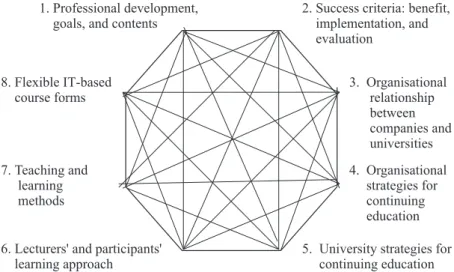
Described below is a first schedule for a model for organising professional development coope-ratively between the organisation and the uni-versity. The model is inspired by the Danish and Norwegian curriculum development models3] 4]5]6], along with models of organisational
theory7], and is constructed in such a way as to
— A number of elements that have influence on the specific development process are de-fined. Due to the complexity of each of the individual elements, each element is re-garded as a subject for the research and de-velopment activities.
— The elements are not part of a linear process but are to be regarded in relation to each other. A dynamic process exists and each element influences the other elements of the process.
— The relationships between the elements cre-ate demands on an organisational level i.e., there is certain accordance between, for ex-ample, the continuing education strategies of the organisation and the participants’ learn-ing capacity on one side and lecturer’s selec-tion of contents and learning methods on the other.
How learning is interpreted within the organi-sation is greatly influenced by the cultural prac-tices of the particular organisation and thus it is an important premise in the continuing educa-tion strategy that both the companies and uni-versities are dynamic units in the development process.
3. The 8 Elements of the Model
The model proposed in Fig. 1 consists of eight elements, based on current research findings in
the fields of didactics and organisational learn-ing. All of the elements and their unique charac-ters play a role in a flexible continuing education process.
Thus the organisational correlation between companies and universities, the companies’ and the universities’ different strategies for con-tinuing education, and especially the profes-sional development, goals and contents are of a more cultural and society-like character, than the other elements. However, it is the relation between all elements, that is decisively impor-tant for the concrete arrangements.
3.1. Professional Development, Goals, and Contents
The first element concerns the professional de-velopment process and its goals and content. Questions related to the specific types and levels of technical and knowledge-based needs must be answered cooperatively between the univer-sity and the participating organisation. Partic-ular attention should also be given to the tech-nological capacity of the society in which the organisation is based, as these needs may vary greatly across countries and the individual or-ganisations. The findings related to this element in the model will significantly influence the se-lection of strategy for carrying out the needs analysis.
3.2. Success Criteria: Benefit, Implemen-tation, and Evaluation
Consideration must be given to the methods for applying the learned knowledge and skills in the organisation and thus integration of the newly learned professional skills should serve as an important criterion for success of the develop-ment process. Because the needs and values of organisations will most certainly vary in nature, it is imperative that the individual organisation explicitly describes the specific criteria that will be used to evaluate their own professional de-velopment process.
The goals should be presented as specifically as possible and be part of a mutual agreement be-tween the university and the participating orga-nisation. The organisation should take an active part in formulating the goals and success cri-teria. Experiences from numerous continuing education courses indicate that it is quite often the absence of such formulations of success cri-teria that results in ambiguous and ineffective evaluation of the completed courses.
3.3. Organisational Relationship between Companies and Universities
A joint frame of reference must be established between the universities and the companies in order to foster a cooperative relationship con-cerning the continuing education. The cultural practices of both parties must support interac-tive cooperation so that each is able to contribute its own unique qualities to the development of the developmental program.
The nature of the interactions between the uni-versity and the organisation will vary in charac-ter, depending on the national setting in which the two operate, due to local cultural conditions and the norms for both parties’ with respect to research and education. The organisation must be aware of which resources are actually available from the university system — in other words, whether the university can effectively provide education on the theoretical knowledge and skills the organisation is seeking. It is crit-ical that communication channels between the university and the organisation are established from the start. Creativity in terms of estab-lishing open communication can be a distinct
asset to the planning of the professional devel-opment framework. Networking based in uni-versity research groups, such as acoustic net-works and signal-processing netnet-works that are centred around and organised by the university, can be quite advantageous.
In terms of the educational methods, project-organised studies can be recommended as they optimise close cooperation between the univer-sity and the participating organisation. With project-organised learning, the students often begin the course by presenting an actual pro-blem scenario from their own organisation. By utilising an actual problem scenario, opportuni-ties for both better communication and coope-ration between the organisation and the univer-sity are provided while, at the same time, better likelihood of successful application of the learn-ing in the workplace is ensured. Consideration should be given to both immediate and future needs as the organisation formulates its goals. Conversely, the organisation should be aware that there might be elements of the coursework that may not be immediately relevant but will become useful in the future.
3.4. Companies’ Strategies for Continuing Education
Internal organisation strategies for continuing education play a role in the planning of continu-ing education courses. Organisational strategies may vary greatly in the following manner: — Total strategic planning for the company,
where a basic education course plan is es-tablished for a number of employees. — Individual employee strategies, where
terms of selecting a particular strategy(or
com-bination of strategies) is that the professional
needs and goals of the organisation can be met and that the strategy best reflects the dynamic industrial environment in which the engineers function.
3.5. Universities’ Strategy for Continuing Education
Traditionally, the primary tasks of the univer-sity have been centred on teaching and educa-tion. As a natural outgrowth of the teaching and education, universities soon became inte-grally involved in research activities as well. It appears that continuing education may soon be-come a third and equally important function of the university system.
Because the field of continuing education is still relatively new, programs may not yet be inte-grated into the university’s educational and ad-ministrative practices. It is quite possible that the university wishing to integrate continuing education programs into their system will en-counter perceptual barriers — e.g., that there is less prestige associated with shorter continu-ing education courses than with research-related activities and thus less interest. The dynamic nature of the continuing education may also present a barrier to adoption of these programs because the university’s culture is usually based on rigid planning and clear administrative prac-tices that are not applicable in this case. The uni-versity must be prepared to offer these courses on demand, rather than according to a rigid and predetermined schedule. Further, flexibility in terms of class size, content, and scheduling will necessitate the allocation of additional person-nel resources in order to prevent overburdening of existing lecturers.
3.6. Target Group and Learning Approach
The target group and their approach to learn-ing play a role in the plannlearn-ing of the continulearn-ing education courses. Further, a number of spe-cific issues must be considered when planning the framework for the professional development program.
— Desired competency level at completion-con-tinuing education of advanced level engi-neers vs. re-education courses
— Age of participants
— Homogeneity with respect to age, needs, ed-ucation, experience, and job functions — Educational background of participants — Professional and working identification — Organisational expectations concerning form
and content of the education
— Investment of employee’s time for learning-coursework to be offered during paid work-ing hours vs. durwork-ing the participants’ spare time
— Investment of time and money
— Participant’s family responsibilities and time management resources
— Necessity to maintain highest quality of ed-ucational practices
— Participants access to technology
3.7. Teaching and Learning Methods
The selection of methods for teaching and learn-ing are clearly dependent on the other elements relevant to the professional development. Ba-sically, there are two broad types of teach-ing and learnteach-ing methods from which the or-ganisation may select: organisation-oriented or university-oriented methods. Organisation-oriented methods may then vary according to structure, such as:
— The project form such as work-based learn-ing, which may be characterised as a coope-rative agreement between the university and the organisation(development departments)
to participate in the development
— Just-in-time courses or courses-on-demand, in which the organisation defines its actual needs for knowledge development and the university quickly plans special courses to satisfy these needs.
At a more specific level, the choice of the con-crete teaching methods to be used is also impor-tant. Here again the relationship between the company and the qualification goals plays an important role, as more participation-oriented and interactive methods can be linked to the internal company work.
3.8. Flexible IT-Based Course Forms
The final element consists of various types of course forms and technologies, which may be used in both course development and course delivery. Typically, there are three basic course forms:
— Online-courses, in which the teaching form is a net-based(remote)education
— Mixed-courses, in which the teaching form combines face-to-face teaching with net-ba-sed education
— Face-to-face courses, in which traditional teaching forms are used.
Today, by far the majority of IT-based education is mixed-mode that allows the participants and the lecturers to establish social contact with each other and may facilitate subsequent communi-cation between the parties during the continuing education process. The disadvantage with for-mal qualifying continuing education is that the motivation for active participation may be low.
In an online-mode there is a risk of focusing too much attention on the presentation of the infor-mation, compared to dialog-based teaching and learning.
From a technological standpoint, there are quite a number of different options for assisting the teaching/learning process. For example, the
In-ternet, web pages, IT-based conference systems, CD-ROM, audio and videotapes, etc. While the selection of the technological tools to be used is certainly not unimportant, the choice should be viewed in terms of the technical contents of the course, the learning methods being applied, and especially, the composition of the target group and their access to the various forms of technology. Additionally, it is important that the choice of technological tools to be used in the professional development is compatible with the selected form for teaching, which will be inevitably influenced by the applied techno-logy.
4. Simplified Model
Based on experience from understanding and using the rather complex model described above, a revised model is given in Figure 28].
Because the field of continuing education is still relatively new to universities, programs may not
yet be integrated into the university’s educa-tional and administrative practices. It is im-portant to considerwhythe university teachers should be involved in this activity, what will be the goals to achieve andhowit must be im-plemented. Further, flexibility in terms of class size, content, and scheduling will make it neces-sary to allocate additional personnel resources in order to prevent overburdening existing lec-turers.
5. Continuing Professional Development as a Company Task
The industrial organisation must realize the ne-cessity of having access to the research-based knowledge present at the university and which goal they have to achieve. Consideration must be given to the methods for applying the learned knowledge and skills in the company and thus integration of the newly learned professional skills should serve as one important criterion for success of the development process. Be-cause the needs and values of organisations will most certainly vary in nature, it is imperative that the individual organisation explicitly de-scribes the specific criteria that will be used to evaluate their own professional development process.
To summarise from section three:
— The goals should be presented as specifically as possible and be part of a mutual agreement between the university and the participating company.
— The company should take an active part in formulating the goals and success criteria. — Internal organisation strategies for
contin-uing education play a role in the planning of continuing education courses and must, therefore, be defined and communicated to all staff members.
6. Continuing Professional Development as Cooperative Programmes
Until now, mostly private professional organisa-tions offer courses for engineering profession-als to update their skills, organised as in-plant
courses, five days intensive courses in nice lo-cations or major international cities etc. But this kind of upgrading, re-educations or just follow-up courses takes time. Most innovative companies are aware of the importance of im-provement of professional competence. From research on trying to describe the context of CPD 8] it is known that, even though
profes-sional development is identified as vital for the future of the company, the individual engineer-ing staff member often tells that he must find the time for such courses himself — they are not integrated in the time-plan for the project. Money for financing the course is normally no problem — buttimeis.
Another parameter that must be considered is the recognition of the course as being part of the personal curriculum — which means that some kind of standardised approvement is de-sirable. This means that we must develop a CPD-programme that is accepted by the ma-nagers as well as the engineers, a programme that integrates new academic knowledge into the productive daily process of the engineer or vice versa.
At Aalborg University we have done that in some specific “Master — programmes” im-plemented as research based PBL (problem
based learning). These “Master-programmes”
are 1–1.5 year programmes on half-time basis, which means that it takes 2–3 years to succeed. The programme consists of courses and project work. The project must involve at least 50% of the time and some of the courses must be applied in the project. The programme is organised in themes and for the engineer attending the pro-gramme it should be possible via the project to integrate his job tasks into his study — or to in-tegrate the application of the courses into his job tasks. In this way the workload from following the study will nominally be reduced. Until now we have only urged the engineers to do this in-tegration of study and work. We have, however, realised that this is not always easy. In the future we will consider new ways of more direct co-operation between university and company on management level to define the framework of the educational process.
In these master-programmes, IT-based distance education is very important 9]10]. In the
in the project work etc. distance education tools are being used. This means, for example, that even though an engineer for a period is posted to work from another country, he can still be an ac-tive student. Face-to-face seminars, though, are still important, if possible. We tend to schedule 7–8 two-day seminars a year at the university(or
whereever optimal for the group or the content).
Here the students and teachers can meet, hands-on laboratory exercises can be carried out, etc. The mentioned concept for CPD-programmes has been implemented at AAU for several years. By now the acceptance of this concept is so out-spoken that we have been requested to apply it to other programmes with less content.
7. Educational Degree Upgrading as Work-Based Learning
Teamwork often involves people with very dif-ferent educational backgrounds. In many com-panies engineering teams often include staff with non-engineering background such as tech-nicians. Such technicians with years of work-based experience can often be very difficult to tell from the group of engineers. Bright and ex-perienced technicians can often come up with good experience-based solutions; they can solve the problem without understanding the theoret-ical background of what they are doing. On the other hand — if these people want to evolve with their tasks and be able to work with the in-spiring engineering problems in the future, they must have some formal academic knowledge in addition to their work-based skills.
For people engaged in working life and hav-ing established a family and financial involve-ment etc. it is not attractive to leave their job and salary to study at the university. It might even be that they soon get bored and quit again. Therefore part-time programmes organised like the “Master-programmes” explained in section 6 might be a solution for an educational pro-gramme from technician to Bachelor of Engi-neering. A formal continuing education be-tween these two levels will take several years and is therefore not attractive — to both the technician and his company.
Therefore, the curriculum for this programme must be organised in modules making it pos-sible to identify professional fields and
com-posing a personal educational programme from these modules, for two reasons:
— The individual technician can make the choice of studying a narrow field to reach a certain academic level (Bs.C.E.) within this field
only
— The individual technician can go for a for-mal test within his strongest areas, without spending too much time attending lectures. It is very important not to underestimate the skills obtained from years of experience. Uni-versities must, therefore, develop ways to evalu-ate and compare work-based skills to academic skills within these fields 11]. Compared to
the PBL concept, it is identified that there is a strong similarity between projects carried out by students in an ordinary PBL curriculum and projects carried out by students in a continu-ing education programme. One major differ-ence is that full-time students in a university-based team are all on the same academic level whereas this is not the case with company-based teams. We consequently have to learn to evalu-ate projects and test students who are part of a very inhomogeneous team with respect to for-mal educational background, practical experi-ence and goals to achieve.
8. Discussion
In PRO-ACTT 1], there is focus on
establish-ing the framework for cooperation between the mobile communication companies and the uni-versities in order to analyse the needs for con-tinuing education and, subsequently, to develop and implement this continuing education via the Internet in a transnational way. Core elements have been pointed out in this article as important to establish the corporation between company and university.
1. The company is aware of the necessity of allocating additional resources to continu-ing education and these expenses become a part of the operating budget. Management trusts the individual engineer’s ability to ac-cess his own needs pertaining to professional development and it is thus the engineer who determines whether he will participate in a continuing education program.
2. The management believes that graduate en-gineers, who have a research-based educa-tion by definieduca-tion, do not need continuing education, as they should know how to ac-quire new knowledge. Time and financial resources would not be allocated for contin-uing education.
3. The organisation has an active management practice in which the product strategy is con-tinuously revised, requiring continuous eval-uation and re-evaleval-uation of the engineer’s technical professional skills. When neces-sary skills are found lacking, the engineers are either replaced or professional develop-ment programmes are impledevelop-mented.
4. The company is organised into teams of en-gineers and the team managers are responsi-ble for currently accessing the professional skills of the group as well as the planning of continuing professional development. University organisation and strategy is similarly influenced by cultural, historic, political, and economic factors, in addition to the prevailing research traditions. Especially in older, histori-cal universities, there are very “proud academic traditions”, which can often mean that little to no basic educational and pedagogical changes have occurred. Research in these institutions is often “basic”, or aimed solely at reaching higher levels of theoretical knowledge in narrow fields. Other more innovative, technical universities have directed research towards a combination of application-controlled research and discipline-oriented research. Universities in which their is sustained interest in applied theoretical educa-tion may be much more open to the demands and changes which occur outside of the univer-sity environment (i.e., societal) and may thus
be more open to undertaking new tasks12].
However there are several “system issues” to be resolved before implementing a continuing education program:
— State-universities are economically controlled by very strict rules, which are seldom in-tended to work together with more commer-cially characterised activities (i.e., private
industry).
— Professors and other researchers, who are normally accustomed to state-financed re-search and education, ordinarily do not give consideration to income. Correspondingly, there is no interference with how he or she conducts the job activities.
— Theoretically oriented university employees may have a certain fear of establishing con-tact with persons or organisations outside the university environment due to their lack of experience in this area.
In spite of the numerous obstacles that arise with the implementation of a continuing edu-cation programme, the intensive technological innovations occurring today create a significant need for methods of providing on-going and continuous professional development to indus-trial engineers. For a large number of these engineers — and especially those who are re-sponsible for the application of new technology within their organisation, it is becoming increas-ingly difficult to obtain and maintain the high level of professional knowledge and skills de-manded by the industry. By taking advantage of the research activities and educational expe-rience existing in the university system, private organisations may well be able to satisfy their needs for continuous professional development of their engineers. It will be a challenging de-velopment for both companies and universities.
References
1] F. K. FINK ET.AL., “PRO-ACTT: PRO-active
con-tinuous learning in the European telecommu-nications industry”, Leonardo Pilot project no. DK/98/06212/PI/II.1.1.c/CONT
2] F. K. FINK ET.AL., “Continuing Professional
De-velopment Programs in University-Industry Co-operations”,Proceedings of Frontiers in Education Conference (FIE’99),Puerto Rico, November 1999.
3] ALGREEN-USSING, H., BERINGKEIDING, TINA OG
KOLMOS, A.,(1999), “Pædagogisk omstilling,
4] HIM, HILDE OGHIPPE, ELSE,(1993), “Læring
gjen-nom oplevelse, forstaelse og handling. En studiebok˚
i didaktikk”, Universitetsforlaget.
5] DALE, ERLINGLARS, “Pedagogisk Profesjonalitet”, (1989), ad Notam, Gyldendal.
6] ANETTE KOLMOS AND HELLE ALGREEN-USSING, (2000), “Implementing PBL and Project
Orga-nized Curriculum — A Cultural Change”, Paper to be published for the International Consortium of Educational Development,Bielefeld, July 2000. 7] ARGYRIS, CHRIS, PUTNAM, ROBERT, MCLAIN
SMITH, DIANA,(1985),“Action Science”,
Jossey-Bass Publishers, San Francisco.
8] F. K. FINK, “Understanding the Dynamics of
Con-tinuing Professional Development”,Proceedings of IACEE 8th World Conference On Continuing Engi-neering Education,May 2001, Toronto, Canada. 9] O. BORCH, M. KNUDSEN, J. HELBO, “From
Class-room Teaching to Remote Teaching”,EURO Edu-cation Conference 2000,February 2000, Aalborg, Denmark.
10] M. KNUDSEN ET AL, “Project Work in Networked
Distance Education”,International Conference on Networked Learning,April 2000, Lancaster, UK. 11] G. R. BURNS, C.U. CHRISHOLM ANDW.A.MCKEE,
“Work Based Learning — an economic and strate-gic issue”, 2nd Global Congress on Engineering Education,July 2000, Wismar, Germany.
12] F K FINK, “Integration of Engineering Practice into
Curriculum — 25 Years of Experience with Prob-lem Based Learning”, Proceedings of Frontiers in Education Conference (FIE’99), Puerto Rico, November 1999.
Received:June, 2001 Accepted:September, 2001
Contact address: Flemming K. Fink Director of Studies, Electronics and Information Technology,
Aalborg University Fredrik Bajers Vej 7A, 9220 Aalborg, Denmark e-mail:[email protected]
FLEMMINGK. FINKis currently Director of Studies in Electronics and In-formation Technology at Aalborg University, Denmark. He received his M.Sc.E.E. from Aalborg University in 1978. Subsequently he worked at Odense University and The Engineering College in Odense. Since 1986 he has been doing research and teaching at Aalborg University within speech recognition and digital signal processing. His major re-search is in auditory modelling and he has patented a new concept for parametric hearing aids. Since 1993 he has been Director of Studies and initiated an internationalisation of the curriculum and he is very active in setting up Continuing Professional Development programmes on postgraduate level. His major production of papers are dealing with problem-based learning and with continuing professional development. In 2001 he received a major funding from the Ministry of Education to establish a Centre of Competence for Continuing Professional De-velopment at Aalborg University. He is representing his university in more university consortia working on establishing CPD-programmes in cooperation and developing the Virtual University Campus.
![Fig. 2. Operational Model for CPD 8 ] .](https://thumb-us.123doks.com/thumbv2/123dok_us/8046757.2130751/5.892.100.721.858.1144/fig-operational-model-cpd.webp)
