Volume 2, Issue 3, March 2013
Page 65
ABSTRACT
In this paper we developed an inventory system with the effect of permissible delay in payments and stock dependent demand. The occurrences of shortages are natural phenomenon allowed in inventory. Therefore, shortages are occurring with partial backlogging. Backlogging rate is taken as waiting time for the next replenishment. Holding cost is variable and it is linear increasing function of time. Numerical example is presented to illustrate the model and the sensitivity analysis of the optimal with respect to parameters of the system is also carried out.
1.
INTRODUCTION
In today's business transactions, it is frequently observed that a customer is allowed some grace period before settling the account with the supplier or the producer. The customer does not have to pay any interest during this fixed period but if the payment gets beyond the supplier will charge the period interest. This arrangement comes out to be very advantageous to the customer as he may delay the payment till the end of the permissible delay period. During the period he may sell the goods, accumulate revenues on the sales and earn interest on that revenue. Thus, it makes economic sense for the customer to delay the payment of the replenishment account up to the last day of the settlement period allowed by the supplier or the producer. This concept is known as permissible delay in payments. Goyal (1985)
was the first to develop the economic order quantity under conditions of permissible delay in payments. Author has assumed that the unit selling price and the purchase price are equal. The unit selling price should be greater than the unit purchasing price. Aggarwal and Jaggi (1995) developed ordering policies of deteriorating items under permissible delay in payments. The demand and deterioration were consumed as constant. Jamal et al. (1997) developed a model to determine an optimal ordering policy for deteriorating items under permissible delay of payment and allowable shortage. Different facets of the permissible delays in payment are discussed, and this generalized model exhibits a set of solutions that reduces to an existing model. Kun-Jen Chung (1998) discussed the economic quantity under conditions of permissible delay in payments. Jamal et al. (2000) presented optimal payment time for a retailer under permitted delay of payment by the wholesaler. The wholesaler allowed a permissible credit period to pay the dues without paying any interest for the retailer. In the study, a retailer model was considered with a constant rate of deterioration. Dye (2002) developed a deteriorating inventory model with stock-dependent demand and partial backlogging. The conditions of permissible delay in payments were also taken into consideration. Chung and Liao (2004) deals the problem of determining the economic order quantity for exponentially deteriorating items under the conditions of permissible delay in payments. In addition, the objective function is modeled as a total variable cost-minimization problem. Teng et al. (2005) developed various EOQ models for a retailer when the supplier offers a permissible delay in payments. In this paper, they complement the shortcoming of the previous models by considering the difference between the selling price and the purchase cost. Soni et al. (2006) formulate optimal ordering policies for the retailer when the supplier offers progressive credit periods to settle the account. The objective function to be optimized is considered as present value of all future cash-out-flows. Singh, S.R. and Singh, T.J. (2008) developed the perishable inventory model with quadratic demand, partial backlogging and permissible delay in payments. Soni, H. et al. (2008) developed a mathematical model to formulate optimal ordering policies for retailer when demand is partially
constant and partially dependent on the stock, and the supplier offers progressive credit periods to settle the account. This chapter proposed a two storage inventory model for deteriorating items with inventory level dependent demand.
Shortages are allowed and partially backlogged. Backlogging rate is taken as waiting time for the next replenishment. The effect of permissible delay in payments is also taken in this study. Holding cost is variable and it is linear
EFFECT OF PERMISSIBLE DELAY ON
TWO-WAREHOUSE INVENTORY MODEL
FOR DETERIORATING ITEMS WITH
SHORTAGES
1
Dr. Ajay Singh Yadav, 2Ms. Anupam Swami
1Assistant Professor, Department of Mathematics, SRM University NCR Campus, Ghaziabad, U.P 2
International Journal of Application or Innovation in Engineering & Management (IJAIEM)
Web Site: www.ijaiem.org Email: [email protected], [email protected]
Volume 2, Issue 3, March 2013
ISSN 2319 - 4847
Volume 2, Issue 3, March 2013
Page 66
increasing function of time. Numerical example is presented to illustrate the model and the sensitivity analysis of the optimal with respect to parameters of the system is also carried out, which is followed by concluding remarks.
2.
ASSUMPTIONS
AND
NOTATIONS
The mathematical model is based on the following assumptions:
1. Lead-time is zero.
2. The initial inventory is zero.
3. The demand rate D (t) is deterministic and is a known function of instantaneous stock level; the function D (t) is given by:
Where > 0 and 0 < < 1.
4. Replenishment rate is infinite and replenishments are instantaneous.
5. The owned warehouse (OW) has a fixed limited capacity of W units.
6. The rented warehouse (RW) has unlimited capacity.
7. The items of OW are started to consume when RW is empty.
8. The inventory costs (including holding cost and deterioration cost) in RW are higher than those in OW.
9. Shortages are permitted and the backlogging rate is defined to be 1/[1+δ(T-t)] when the inventory is negative.
The backlogging parameter δ is positive constant.
In addition, the following notations are used throughout this paper: L1 represents an inventory system with an OW only.
L2 represents an inventory system with both OW and RW.
c0 the replenishment cost per order.
cd deterioration cost per unit.
ch1 the inventory holding cost per unit per unit time in OW.
ch2 the inventory holding cost per unit per unit time in RW.
Note that implies assumption 6, ch2 + cd > ch1 + cd.
cs shortage cost per unit time.
the deterioration rate in OW, where 0 < < 1.
the deterioration rate in RW, where 0 < < 1. S the highest stock level at RW and OW.
B the maximum shortage level. P purchase cost per unit.
M permissible delay period in settled the accounts. Ic interest charges per rupee per year.
Ie interest that can be earned on the sales revenue of units sold during the permissible delay period (Ie < Ic).
W storage capacity of OW, fixed constant and W < S. I0(t) the inventory level in OW at any time t.
Ir(t) the inventory level in RW at any time t.
3.
MATHEMATICAL
FORMULATION
Here, we discuss the deterministic inventory model for deteriorating items with two-warehouse where shortages occur at the end of the cycle. For a L2 system (see fig. 1(a)), at time t=0, a lot size of S units enters the L2 system in which W
units are kept in OW and S-W units in RW. The goods of OW are consumed only when RW is empty. During the time interval [0, t1], the inventory S-W in RW decreases due to demand and deterioration and it vanishes at t=t1. In OW, the
inventory W decreases during [0, t1] due to deterioration only, but during [t1,t2] the inventory is depleted due to both
demand and deterioration . At time t=t2. The inventory in OW reaches zero and thereafter the shortages occur during
the time interval [t2, T]. The shortage quantity is supplied to customers at the beginning of the next cycle. The objective
of the inventory system is to determine the timings of t1, t2 and T in order to keep the total relevant cost per unit of time
as low as possible. As to a L1 system (see fig. 1(b)), the firm receives W units in OW at t=0. The inventory W depleted
due to both demand and deterioration, and reaches zero at t=t2, and thereafter the shortages occurs during [t2, T]. Note
that the L1 system here is, in fact, equivalent to the L2 system with t1=0.
1
1 2
2
( ) , 0 ,
,
I t t t
D t t t
t t T
Volume 2, Issue 3, March 2013
Page 67
For a L2 system, the inventory level at RW during the time interval [0,t1] is depleted by the combined effect of demand
and deterioration, the inventory level at time t € [0,t1], Ir(t), is governing by the following differential equation:
… (7.1) with the boundary condition the Ir(t1)=0. Solving the differential equation (1), we have
1
1 1 , 0
t t r
I t e t t
… (7.2)
During the time interval [0,t1], as the demand is meet from RW, the stock at OW decreases due to deterioration only.
Thus, the inventory level at time t € [0,t1], I0(t) is governed by the following differential equation:
0
0 , 0 1
d I t
I T t t
d t
… (7.3)
with the initial condition I0(0)=W. Again, during the time interval [t1,t2], the inventory level at OW is depleted by the
combined effect of demand and deterioration, the inventory level at time t € [t1,t2], I0(t), is governed by the following
differential equation:
0
0 , 1 2
dI t
I t t t t
dt … (7.4) with the boundary condition I0(t2)=0. Solving the differential equation (7.3) and (7.4), we have
0 , 0 1
t
I t W e t t
… (7.5)
2
0 1 ,1 2
t t
I t e t t t
… (7.6)
Due to continuity of I0 (t) at t=t1, if follows eq. (7.5) and (7.6), we have
1 2 1
0 1 1
t t t
I t W e e
… (7.7)
Furthermore, during the period [t2, T], the behavior of the inventory system can be described by
0
2
, 1
d I t
t t T
d t T t
… (7.8)
with initial condition I0(t2)=0, we have
0 1 2 1 , 2
I t In T t In T t t t T
… (7.9)
From the equations (7.2), (7.5), (7.6) and (7.10), the total per cycle consists of the elements: 1. Ordering cost per cycle = c0
2. Holding cost per cycle in RW 1
0
( )
t
r
F h t I t d t
( )1
2
1 1 1
2 ( ) 1 2 2 ( )
( ) 2 ( )
t
F h
e t t t
3. Holding cost per cycle in OW
1 2
1
0 0
0
( ) ( )
t t
t
H t I t d t H t I t d t
2 1 1
2 1 2
1 t ( t t 1)
W
H e e t t
2 1 2 1 2 2
2 1 2 1
2 2
1
2 2
t t t t
t t e e t t
, 0 1r
r r
d I t
I t I T t t
International Journal of Application or Innovation in Engineering & Management (IJAIEM)
Web Site: www.ijaiem.org Email: [email protected], [email protected]
Volume 2, Issue 3, March 2013
ISSN 2319 - 4847
Volume 2, Issue 3, March 2013
Page 68
4. Shortage cost per cycle
2 T
0 t
s I t d t
2 2
2 s
T t In 1 T t
The amount of deteriorated items in both RW and OW are
1
1
2 1
t r
D e t
And D0 I0 0 t2 t1W t2 t1
5.Deterioration cost per cycle
1
0 2 1 1 2 1
t r
P D D P e t W t t
6. Opportunity cost due to lost sale per cycle
T 2 2 t 2 1O C 1 d t T t – In 1 T t
1 T t
Case I: when Mt2
In this situation, since the length of period with positive stock is larger then the permissible delay period, the buyer can use the sale revenue to earn interest at an annual rate Ie in (0, t2). The interest earn IE1 is
1 2 1 11 1 2
0
3 2 2 2
1 2 1 1
3 2 2 1
2 t t e t t e
I E P I t t I t d t t t d t
P I
t t t e t
… (7.10)
However beyond the permissible delay period, the unsold stock is supposed to be financial with an annual rate Ir and
interest payable is given by
2
2
0 2 1 2
t t M r r M P I
I P P I I t d t e t M
… (7.11)
Therefore total average cost per unit time is
R W O W 1
1 1
O C H C H O S C O C D C IP IE
T C t , T
T
( )1
2
0 2 1 2 1 1
1
{ ( ) 1 2 ( )
( ) 2 ( )
t
F h
c e t t t
T
1
2 1 2 1 2 12 2
2 1 2 1
2 1
2 2 2
1
1 ( 1)
2 2
t t t t
t t
t t t e t t
W e
H e e t t
1
2 2 1 2 1
2 1 2 1
t s
T t In T t P e t W t t
1 23 2 2 2
1 2 1 1 2
3 2 2 1 2 1
2
t t M
e r
PI PI
t t t e t e t M
… (7.12)
For minimizing the total relevant cost per unit time, the approximate optimal values of t1 and T (denoted by t1* and T*)
can be obtained by solving the following equations:
1 1
1
0 0
T C T C
a n d
t T
… (7.13)
which also satisfies the conditions:
* * * *
1 1,
2 2
1 1
2 , 2
1
| 0 | 0
t T t T TC TC and t T and * * , 1 2
2 2 2
1 1 1
2 2
1 1
| 0
t T
TC TC TC
t T t T
Next by using the optimal values t1* and T*, the approximate optimal values of t2 (denoted by t2*) and the approximate
minimum total cost per unit time can be obtained from (13) respectively.
Volume 2, Issue 3, March 2013
Page 69
SinceM>t2 the buyer pays an interest but earns interest at an annual rate Ie during the period (0, M), interest earns inthis case, denoted by IE2, is given by
1 2 1
21 1
t t t t
2 e 1 2 2
0 t 0 t
IE P I t t I( t ) d t t t d t M t I t d t d t
1 13 2 2 2 t
e
1 2 1 1
3
3 2 2 t
2 1 2 1 1
P I
2 t t t 2 2 e 1 t
2
M t 2 t t t 2 2 e 1 t
… (7.14) Then the total average cost per unit time is
2 1 R W O W 2
1
T C t , T O C H C H C S C O C D C IE
T
( )1
2
1
2 1 0 2 1 2 1 1 2 2 1
1
( ) 1 2 ( ) 1 ( 1)
( ) 2 ( )
t t
t t
F h W
c e t t t H e e t t
T
2 1 2 1 2 2
2 1 2 1
2 2 2
1
2 2
t t t t s
t t e e t t
1
2 1 2 2 1 1 2 1
t
T t I n T t P e t W t t
3 2 2 2 11 2 1 1
3 2 2 2 1
2
t e
P I
t t t e t
3 2 2 1
2 2 1 2 1 2 2 1 1
t
M t t t t e t
… (7.15)
For minimizing the total relevant cost per unit time, the approximate optimal values of t1 and T (denoted by t1* and T*)
can be obtained by solving the following equations:
2 2
1
0 0
T C T C
a n d
t T … (7.16)
which also satisfies the conditions:
* * * *
1 1,
2 2
2 2
2 , 2
1
| 0 | 0
t T
t T
T C T C
a n d
t T
and
1*, *
2
2 2 2
2 2 2
2 2
1 1
| 0
t T
T C T C T C
t T t T
Next by using the optimal values t1* and T*, the approximate optimal values of t2 (denoted by t2*) and the approximate
minimum total cost per unit time can be obtained from (7.15) respectively.
4.
NUMERICAL
EXAMPLES
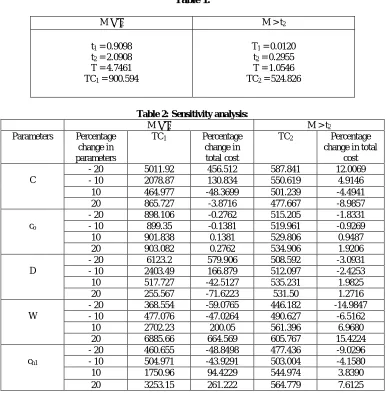
To illustrate the results, we apply the proposed method to solve the following numerical example:
Let α = 350, β = 0, co = 60, ch1 = 8,
ch2 = 10, W = 100, γ = 0.05, θ = 0.06,
cs = 3, Ir = 0.15, Ie = 0.12, P = 68,
M = 0.31, cd = 0.25.
International Journal of Application or Innovation in Engineering & Management (IJAIEM)
Web Site: www.ijaiem.org Email: [email protected], [email protected]
Volume 2, Issue 3, March 2013
ISSN 2319 - 4847
Volume 2, Issue 3, March 2013
Page 70
Table 1:
Table 2: Sensitivity analysis:
M ≤ t2 M > t2
Parameters Percentage change in parameters
TC1 Percentage
change in total cost
TC2 Percentage
change in total cost
C
- 20 5011.92 456.512 587.841 12.0069
- 10 2078.87 130.834 550.619 4.9146
10 464.977 -48.3699 501.239 -4.4941
20 865.727 -3.8716 477.667 -8.9857
co
- 20 898.106 -0.2762 515.205 -1.8331
- 10 899.35 -0.1381 519.961 -0.9269
10 901.838 0.1381 529.806 0.9487
20 903.082 0.2762 534.906 1.9206
D
- 20 6123.2 579.906 508.592 -3.0931
- 10 2403.49 166.879 512.097 -2.4253
10 517.727 -42.5127 535.231 1.9825
20 255.567 -71.6223 531.50 1.2716
W
- 20 368.554 -59.0765 446.182 -14.9847
- 10 477.076 -47.0264 490.627 -6.5162
10 2702.23 200.05 561.396 6.9680
20 6885.66 664.569 605.767 15.4224
ch1
- 20 460.655 -48.8498 477.436 -9.0296
- 10 504.971 -43.9291 503.004 -4.1580
10 1750.96 94.4229 544.974 3.8390
20 3253.15 261.222 564.779 7.6125
5.
OBSERVATIONS
1.From table 7.1 and table 7.2, it is observed that TC2 is always less then TC1 with respect to the change in every
parameter. This is due to in the second case M > t2. So, we have not paid any interest and we earn some interest.
2.As the purchasing cost (P) increases, the total cost is decreases in both cases. 3.As the ordering cost increases (c0), the total inventory cost is increases in both cases.
4.As the demand rate increases (D), the total inventory cost is decrease in both cases.
5.As the capacity of the own warehouse increases, the total inventory cost is also increases in both cases. 6.As the holding cost of own warehouse increases, the total inventory cost is also increases in both cases. 7.The total inventory cost is very sensitive with respect to W and very less effected by the variation of c0.
6.
CONCLUSION
In this study an inventory system is developed for decaying items with two-warehouses and stock dependent demand. Shortages are permitting in this model and partially backlogged. And backlogging rate is time dependent and it is waiting time for the next replenishment. The conditions of permissible delay in payments and time dependent holding cost are also taken into account. Holding costs and deterioration costs are different in OW and RW due to different preservation environments. The inventory costs (including holding cost and deterioration cost) in RW are assumed to be higher than those in OW. To reduce the inventory costs, it will be economical for firms to store the goods in OW to the maximum level and after that the remaining goods store in RW, but clear the stocks in RW before OW. So that rent of rented warehouse is minimum. From the viewpoint of the costs, decisions rules to find the optimal order cycle time t2
contains two cases: (i)M ≤ t2
(ii) M > t2.
M ≤ t2 M > t2
t1 = 0.9098 t2 = 2.0908 T = 4.7461 TC1 = 900.594
Volume 2, Issue 3, March 2013
Page 71
Finally, a numerical example in Table 1 is studied to illustrate the theoretical results. From the above table 1 and 2, it is observed that the total inventory cost TC2 is always less then TC1 with respect to the change in every parameter. This isdue to in the second case M > t2. So, we have not paid any interest and we earn some interest. So, we conclude that the
effect of permissible delay cannot be ignored.
Thus, this model incorporates some realistic features that are likely to be associated with some kinds of inventory. The model is very useful in their retail business. It can be used for electronic components, fashionable clothes, domestic goods and other products which are more likely with the characteristics above.
In future research on this problem, it would be of interest to add effect of more realistic demand rate in the model (e. g. time-varying and stock-dependent demand patterns). On the other hand, the possible extension of this work may relax the assumption of constant deterioration rate.
REFERENCES
[1]Aggarwal, S.P. and Jaggi, C.K. (1995): “Ordering policies of deteriorating items under permissible delay in payments”, Journal of Operational Research Society (J.O.R.S.), 46, 658-662.
[2]Chung, K.J. (1998): A theorem on the determination of economic order quantity under conditions of permissible delay in payments, Computers & Operations Research, 25, 1, 49-52.
[3]Chung, K.J. and Liao, J.J. (2004): “Lot sizing decision under trade credit depending on the ordering quantity”, C.O.R., 31, 909-928.
[4]Dye, C.Y. (2002): “A deteriorating inventory model with stock dependent demand and partial backlogging under conditions of permissible delay in payments”, Opsearch, 39(3&4), 189-200.
[5]Goyal, S.K. (1985): “Economic order quantity under conditions of permissible delay in payments”, J.O.R.S., 36, 335-338.
[6]Jamal, A.M.M., Sarker, B.R. and Wang, S. (1997): “An ordering policy for deteriorating items with allowable shortage and permissible delay in payment”, J.O.R.S., 48, 826-833.
[7]Jamal, A.M.M, Sarker, B.R. and Wang, S. (2000): “Optimal payment time for a retailer under permitted delay of payment by the wholesaler”, I.J.P.E., 66, 59-66.
[8]Soni, H. et al. (2006): “An EOQ Model For Progressive Payment Scheme Under DCF Approach”, Asia-Pacific Journal of Operational Research, 23, 4, 509-524.
[9]Soni, H. and Shah, N.H. (2008): “Optimal ordering policy for stock-dependent demand under progressive payment scheme”, E.J.O.R., 184 (1), 91-100.
[10]Singh, S.R. and Singh, T.J. (2008): “Perishable inventory model with quadratic demand, partial backlogging and permissible delay in payments”, International Review of Pure and Applied Mathematics, 1, 53-66.
[11]Teng, J.T., Chang, C.T. and Goyal, S.K. (2005): “Optimal pricing and ordering policy under permissible delay in payments”, I.J.P.E., 97, 121-129.
Dr. Ajay Singh Yadav has done M.Sc. in Mathematics and Ph.D. in “inventory Modelling, he has over 6 years experience in teaching Mathematics in defferent Engineering Colleges. Presently he is Assistant Professor in SRM University NCR Campus Ghaziabad