15
Bacterial Concrete: A Review
Satyajeet
1, Sandeep Singh
21
M.tech Student, Dept. of Civil, M.R.I.E.M. Rohtak
2
Asst. Prof., Dept. of Civil, M.R.I.E.M. Haryana, India
ABSTRACT
Concrete is the foremost building material broadly used in building construction, but cracks in concrete are inevitable and are one of the inherent weakness of concrete. The major drawback of concrete is its low tensile strength due to which micro crack develops when the load applied is more than its limit and this makes way for the seepage of water and other salts. This corrosion is started and makes the whole structure vulnerable and leads to the failure of structure. To avoid this type of failure due to cracks an approach of using bio mineralisation in concrete has evolved in recent years. In this method, of enhancing the performance of concrete, the calcite precipitating spore forming bacteria is introduced into concrete. When water enters through the cracks, it reacts with bacteria and forms precipitates of calcium carbonate, as a by product, which fills the cracks and makes crack free concrete. This type of concrete prepared with bacteria is called as bacterial concrete. So, this paper is an attempt to define bacterial concrete, types and classification of micro organisms, working of bio concrete as a repair material, advantages and disadvantages of bacterial concrete and applications by literature review are discussed.
Keywords: Concrete, Bio Mineralisation, Calcium Carbonate, Bacterial Concrete
INTRODUCTION
Cement concrete is one of the most widely used material for construction works. This is mainly due to low cost of materials and construction, low cost of construction. Concrete can bear a large compressive strength, but is weak in tensile strength. Because of this steel reinforcement is provided and the steel bars takes the load when the concrete cracks in tension. Due to reasons like, shrinkage, low tensile strength of concrete etc. cracks occur during the process of concrete hardening and this finally leads to weakening of the buildings. Water droplets entered into the concrete structure can damage the steel reinforcement present in the concrete member if there is a high permeability. When this phenomenon occurs, the strength of the concrete decreases and which results in the decay of structure. Synthetic materials like epoxies are used to remediate, but they are costly, not compatible and need constant maintenance.
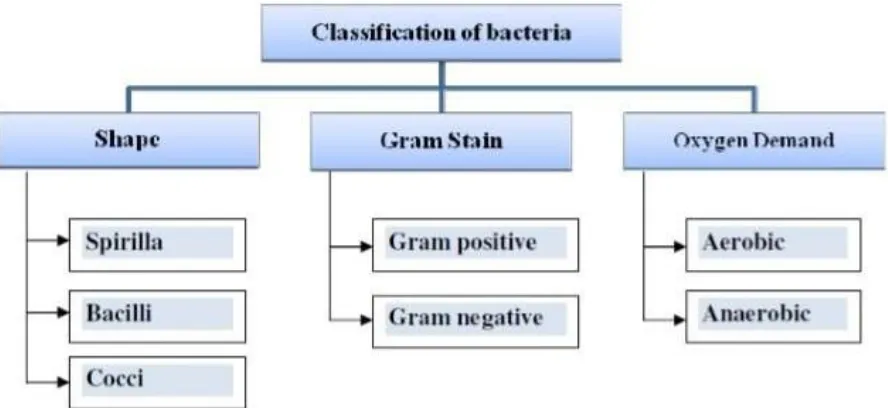
16 Figure 1 Classification of bacteria
WORKING OF BIO CONCRETE AS A REPAIR MATERIAL
Self healing concrete is a product that will biologically produce limestone(calcium carbonate) to heal cracks that appear on the surface of concrete structures. Selected types of bacteria genus, bacillus, with calcium based nutrient known as calcium lactate and nitrogen and phosphorous are added to the ingredients of the concrete when it is being mixed. These self healing agents can lie dormant within the concrete for up to 200 years. However, when a concrete structure is damaged and water starts to seep through the cracks that appear in the concrete, the pores of the bacteria, germinate on contact with water and nutrients. After being activated, the bacteria start to feed on the calcium lactate. As the bacteria feeds oxygen is consumed and the soluble calcium lactate is converted to insoluble limestone. The limestone solidifies on the cracked surface and seal it up . As the bacteria consumes oxygen, it prevents corrosion of the embedded reinforcement and thus the durability of the steel increases .On the surface of control concrete, Calcium Carbonate will be formed due to the reaction of CO2 present with Calcium Hydroxide present in the concrete maix according to the following reaction: CO2 + Ca(OH)2 → CaCO3 + H2O
As Ca(OH)2 is a soluble mineral, it gets dissolved in entering water and diffuse out of the crack in the form of leaching. The self-healing process in bacteria incorporated concrete is much more efficient due to the active metabolic conversion of Calcium nutrients by the bacteria present in concrete:
Ca(C3H5O2)2 + 7O2 → CaCO3 + 5CO2 + 5H2O
Here Calcium Carbonate is produced directly due to microbial metabolic process and also indirectly due to autogeneous healing. This process results in efficient bacteria-based crack sealing mechanism.
Chemical Process to Remediate Cracks
Various bacteria and biotic factors contribute to this in different ways. In the process of calcium carbonate precipitation, the key factors governing the process are , Calcium concentration Concentration of dissolved inorganic carbon The pH and the availability of nucleation sites. Thus concrete crack remediation technique by Microbiologically Induced Calcite Precipitation (MICP) using environment friendly bacteria to precipitate calcium carbonate (CaCO3) during its microbial activities under prevailing local conditions is investigated to formulate a strategy to present Bacterial Concrete as best innovative self healing method in concrete structures.
LITERATURE REVIEW
17 about the different types of bacteria and their applications. The bacterial concrete is very much useful in increasing the durability of cemetous materials, repair of limestone monuments , sealing of concrete cracks to highly durable cracks etc.It also useful for construction of low cost durable roads , high strength buildings with more bearing capacity, erosion prevention of loose sands and low cost durable houses. They have also briefed about the working principle of bacterial concrete as a repair material. It was also observed in the study that the metabolic activities in the microorganisms taking place inside the concrete results into increasing the overall performance of concrete including its compressive strength. This study also explains the chemical process to remediate cracks.
Meera C M and Dr Subha V2, have published a paper on Strength And Durability assessment Of Bacteria Based Self-Healing Concrete. In this paper they have discussed about the effect of Bacillus subtilis JC3 on the strength and durability of concrete. They used cubes of sizes 150mm x 150mm x 150mm and cylinders with a diameter of 100mm and a height of 200mm with and without addition of micro organisms, of M20 grade concrete. For strength assessments, cubes were tested for different bacterial concentrations at 7 days and 28 days and cylinders were tested for split tensile strength at 28 days. It was observed that the compressive strength of concrete showed significant increase by 42% for cell concentration of 105 of mixing water. And also, with the addition of bacteria there is a significant increase in the tensile strength by 63% for a bacteria concentration of 105cells/ml at 28 days. For durability assessment, acid durability test, chloride test and water absorption test were done. From the results it could be inferred that the addition of bacteria prevents the loss in weight during acid exposure to a certain limit, proving the bacterial concrete to have higher Acid Attack Factor. The Water Absorption Test, showed a lesser increase in weight of bacteria concrete sample than control, from which it could be reckoned that the concrete will become less porous due to the formation of Calcium Carbonate, due to which it resulted in lesser water absorption rate. Chloride test results showed that the addition of bacteria decreases weight loss, due to Chloride exposure and enhances the Compressive Strength.
Ravindranatha, N. Kannan, Likhit M. L3,have published a paper on Self-Healing Material Bacterial Concrete. In this paper a comparison study was made with concrete cubes and beams subjected to compressive and flexural strength tests with and without the bacterium Bacillus pasteurii. The concrete cubes and beams were prepared by adding calculated quantity of bacterial solution and they were tested for 7 and 28 day compressive and flexural strengths. It was found that there was high increase in strength and healing of cracks subjected to loading on the concrete specimens. The microbe proved to be efficient in enhancing the properties of the concrete by achieving a very high initial strength increase. The calcium carbonate produced by the bacteria has filled some percentage of void volume thereby making the texture more compact and resistive to seepage.
A.T.Manikandan1, A.Padmavathi4, have published a paper on An Experimental Investigation on Improvement of Concrete Serviceability by using Bacterial Mineral Precipitation. In this paper,the bacteria Bacillussubtilis strain 121 was from Microbial Type Culture Collection and Gene Bank, Chandigarh. Samples were prepared in sets of three for a water cement ratio of 0.5 by mass for conventional concrete and a water cement ratio of 0.25 and bacterial culture of 0.25 for bacterial concrete by mass. The cubes were tested by Non-Destructive Testing and HEICO compression testing machine on the 3rd, 7th and 28th days after casting. There was an improvement in compressive strength by B. subtilis strain 121 due to deposition of Calcite (CaCO3) in cement-sand matrix of microbial concrete which remediate the pore structure within the mortar. The temperature sustainability test of B. subtilis in bacterial concrete was carried out at various temperatures and found that the B. subtilis was found to be alive at –30 C low temperatures to 700 C high temperatures. There is increase in compressive strength of the bacterial concrete with B. subtilis bacteria with microbial calcite precipitation in the crack sample was examined in SEM .The sample showed the presence of calcite crystals grown all over the surface of the crack and also the presence of B. subtilis bacteria is the evidence, that suggests microbial remediation properties of bacterial concrete.
18 Chithra P Bai and Shibi Varghese6,have published a paper on an experimental investigation on the strength properties of fly ash based Bacterial concrete. In this paper, The bacteria Bacillus Subtilis was used for study with different cell concentrations of 103, 105 and 107 cells/ml for preparing the bacterial concrete. Cement was partially replaced by 10%, 20% and 30% of fly ash by weight for making the bacterial concrete. Concrete of grade M30 was prepared and tests such as Compressive strength, Split tensile strength, Flexural strength and Ultrasonic Pulse Velocity were conducted after 28 and 56 days of water curing. For fly ash concrete, maximum compressive strength, split tensile strength, flexural Strength and Ultrasonic Pulse Velocity values were obtained for 10% fly ash replacement. For bacterial concrete maximum compressive strength, split tensile strength, flexural strength, and UPV values were obtained for the bacteria cell concentration of 105cells/ml. The improvement in the strength properties of fly ash concrete is due to the precipitation of calcium carbonate (CaCO3) inthe micro environment by the bacteria Bacillus Subtilis.
V Srinivasa Reddy, M V SeshagiriRaoand S Sushma7, have published a paper on Feasibility Study on Bacterial Concrete as an innovative self crack healing system. This paper describes about the effect of bacterial cell concentration of Bacillus subtilis JC3, on the strength, by determining the compressive strength of standard cement mortar cubes of different grades, incorporated with various bacterial cell concentrations. This shows that the Improvement in compressive strength reaches a maximum at about 105/ml cell concentration. The cost of using microbial concrete compared to conventional concrete which is critical in determining the economic feasibility of the technology, is also studied. The cost analysis showed an increase in cost of 2.3 to 3.9 times between microbial concrete and conventional concrete with decrease of grade. And nutrients such as inexpensive, high protein- containing industrial wastes such as corn steep liquor (CSL) or lactose mother liquor (LML) effluent from starch industry can also be used, so that overall process cost reduces dramatically. Precipitation of these crystals inside the gel matrix also enhances the durability of concrete significantly. Furthermore, this analysis has shown an increase in the cost of production and a significant decrease in carbon footprint compared to conventional concrete.
Mohit Goyal and P. Krishna Chaitanya8 published a paper on Behaviour of Bacterial Concrete as Self Healing Material. In this paper they have carried out laboratory investigations to compare the different parameters of bacterial concrete with ordinary concrete and concrete, in which 70% cement was partially replaced with 30% of Fly Ash and 30% of GGBS. In this paper, Bacillus pasteurii, is used to prepare M25 concrete. Various tests such as slump flow test, compressive strength, flexural strength and split tensile strength were conducted for different specimens of, bacterial concentrations of 40ml, 50ml and 60 ml for each specimen. In order to identify atomic and molecular structure and to check the presence of formation of calcium carbonate X- Ray diffraction test was conducted.
There was significant improvement of compressive strength by 30% in concrete mix with bacteria and more than 15% in fly ash and 20% in GGBS. It was observed that bacterial concrete achieves maximum split tensile strength and flexural strength when 40 ml and 50 ml bacterial solution was used but loses this trend after 14 days with 60ml bacterial solution when flexural strength test was performed. Also, 50ml bacterial solution proved to be effective in increasing the split tensile strength, compressive strength and flexural strength of the specimen as compared to 40ml and 60 ml bacterial solution. Also, from the XRD analysis, it is proven that the presence on bacteria is contributing to CaCO3 production, which has reduced the percentage of air voids, thus, increasing the strength of the structure considerably.
N. Ganesh Babu and Dr. S. Siddiraju9,has published a paper onan experimental study on strength and fracture properties of self healing concrete. In this paper they have made an attempt is made to arrest the cracks in concrete using bacteria and calcium lactate. The percentages of bacteria selected for the study are 3.5% and 5% by weight of cement. In addition, calcium lactate was used at 5% and 10% replacement of cement by weight. Bacteria produce calcium carbonate crystals which blocks the micro cracks and pores in the concrete after reacting with calcium lactate. Bacillus pasteurii is used for different bacterial concentrations for M40 grade of concrete. Various tests such as compressive strength, elastic modulus and fracture of concrete were analyzed. The cubes of dimensions of 100x100x100 mm were used for compressive strength test. It was observed that compressive strength for controlled concrete using calcium lactate, at 7 days and 28 days were 19.8 MPa and 40.53 MPa respectively. With the addition of calcium lactate, there is considerable decrease in compressive strength. Compressive strength of concrete with 5% bacteria was found to be 49.5
19 APPLICATIONS
The use of bacterial concrete in Civil Engineering has become increasingly popular.
•
Enhancement in durability of cement materials to improvement in sand properties•
Repair of monuments that are made of limestone•
Sealing of cracks in concrete•
Used in construction of low cost durable housing•
Used in construction of low cost durable roadsCONCLUSION
The paper describes that the bacterial concrete is better than the conventional technology because of its high durability, self healing and eco friendly nature and is also very effective in increasing the strength and durability of concrete. Bacrerial concrete shows better resistance to drying shrinkage, acid attack and makes better resistant against sulphate. Bacterial concrete prepared with admixtures like silica fume, fly ash , also gives better strength and durability. This paper enhances our understanding on bacterial concrete. It let us know that the future use of bacterial concrete can be done significantly. Due to the introduction of bacteria into concrete there has been increase in the compressive and flexural strength with decrease in permeability, water absorption and corrosion of reinforcement when compared to conventional concrete.
REFERENCES
[1] IS-456:2000
[2] Mandeep Sindhu, Paramjeet Malik, “Research Paper on Risk Analysis of BOT Scheme”, International Journal of All Research Education and Scientific Methods (IJARESM), ISSN: 2455-6211, Volume 4, Issue 7, July- 2016.
[3] Structural Concrete; Textbook on Behavior, Design and Performance, July -1999 [4] Manual of Concrete Practice – 2005 ISSN 0065- 7875
[5] Mandeep Sindhu, “Study of Waste Polythene in Road Construction and its Methodologies”, IJRAR- International Journal of Research and Analytical Reviews, Volume 5 , Issue 2, April – June 2018, E ISSN 2348 –1269, P ISSN 2349-5138, 2018.
[6] Măgureanu C. (1999) Mechanical properties of high strength concrete.
[7] Mandeep Sindhu, “Effects of Road Accidents and Safety Concerning Adolescent”, IJRAR- International Journal of Research and Analytical Reviews, E ISSN 2348-1269, Volume 5 , Issue 2, April – June 2018.
[8] Magureanu C. – The influence of repeated loads upon short and long term strain concrete.
[9] Mandeep Sindhu, “Design and study of motor sports and racing car setups”, International Journal of Advanced Science and Research, ISSN: 2455-4227, Volume 2; Issue 4; July 2017; Page No. 145-148.
[10]Magureanu C. – Influence of the long term and repeated loading on fracture mechanics of partially prestressed beams. [11]Mandeep Sindhu, “Effect of Efficient and Productive Transport in Economic Development of a Country”, 3rd International
Conference on Emerging Trends in Engineering, Technology, Science and Management ICETETSM-2017, IETE Lodhi Road, Delhi, India, 11th June 2017, ISBN: 978-93-86171-48-1.
[12]Magureanu C. – Influnece of admixture on creep and shrinkage of concrete.