Tareq A. Wani (Correspondence)
wanitariq.bio.iiim @gmail.com
+This article is published under the terms of the Creative Commons Attribution License 4.0 Author(s) retain the copyright of this article. Publication rights with Alkhaer Publications. Published at: http://www.ijsciences.com/pub/issue/2018-07/
DOI: 10.18483/ijSci.1747; Online ISSN: 2305-3925; Print ISSN: 2410-4477
Phytochemical Screening and Antioxidant
Activity of Methanolic Extract of
in vitro
Raised
Plants of
Atropa acuminate
Royle
Farhana Maqbool
1,2
, SeemaSingh
1
, Tareq A. wani
1
, Mudasir
Ahmad
1,2
, Bashir A. Ganai
2
, Mahroofa Jan
1
1
Plant Tissue Culture Laboratory, Department of Botany, University of Kashmir, Srinagar J&K 190006
2
Phytochemistry Lab,Centre for research and development (CORD), University of Kashmir, Srinagar J&K 190006
Abstract: Due to overexploitation from the natural resources, an efficient regeneration protocol for medicinally important and rare plant species, Atropa acuminate for conservation was developed. Leaf explants were inoculated on MS medium supplemented with different concentrations of BAPfor callus induction and organogenesis. After one and a half week, callus induction was recorded with the highest frequency at 3mg/l BAP. After 3 weeks of subsequent sub-culturing, optimum shoot induction frequency of 100% was achieved at 3mg/l BAP. Also, highest mean shoot numbers per explant (15.2) were recorded at the same concentration. Successful in vitro rooting of the microshoots was achieved on MS medium fortified with(0.5mg/l)IBA. The regenerated shoots with well developed roots were successfully acclimatized in vermicompost and hardened with 100% survival rate under greenhouse conditions. Furthermore, methanolic extract of in vitro regenerated plants were screened forimportant secondary metabolites and antioxidant potential. Alkaloids, phenolics, flavonoids and terpenes were present abundantly. Also, the plants revealed antioxidant activity in dose dependent manner. Current study can serve as an efficient protocol for mass multiplication and conservation of medicinally important plant A. acuminata.
Keywords: Atropa acuminata, Callus, Micropropagation, antioxidant, DPPH
1. Introduction
Medicinal plants are part and parcel of human society to combat diseases, from the dawn of civilization [11]. There exists overindulgence of knowledge, information and benefits of herbal drugs in our ancient literature of Ayurvedic (Traditional Indian Medicine), Siddha, Unani and Chinese medicine. Herbal medicines are in great demand in the developed as well as developing countries for primary healthcare because of their wide biological and medicinal activities, higher safety margins and lesser costs [12]. Since the time immemorial our traditional system of medicine and folklore claiming that medicinal plants as a whole or their parts are being used in all types of diseases successfully [13]. About 65% of world populations have access to local medicinal plant knowledge system [14].
Atropa acuminate Royle, family Solanaceae, is an important medicinal plant species growing in Kashmir Himalaya. Itserves the repository of medicinally important tropane alkaloids, including atropine, scopolamine and hyoscyamine [1].The
Phytochemical Screening and Antioxidant Activity of Methanolic Extract of in vitro Raised Plants of Atropa acuminate Royle
http://www.ijSciences.com
Volume 7
– July
2018 (07
)
7
has been taken over by in vitro regenerationtechniques, which include useful tools for conservation and large scale production of many threatened plant species [6]. Of the plants species, many species of genus Atropa have also been used in in vitro regeneration techniques [7]. The techniques of in vitro regeneration may be helpful in the mass-multiplication of this endangered species for large scale cultivation in the natural populations [8]. However, reports on literature shows that limited success has been achieved by employing shoot apices and nodal explants for in vitro propagation of Atropa acuminate [9, 10].
Biological combustion involved in various processes produces harmful products or intermediates called reactive oxygen species or free radicals. Excess of free radicals in living beings has been known to cause various problems like asthma, cancer, cardiovascular diseases, liver diseases, muscular degeneration, and other inflammatory processes [15], resulting in the so-called oxidative stress. Oxidative stress is defined as imbalance between oxidants and antioxidants and causes damage in all types of biomolecules like protein, nucleic acid, DNA, and RNA[16]. Antioxidants act as free radical scavengers, reducing agents, quenchers of singlet oxygen molecule, and activators for antioxidative enzyme to suppress the damage induced by free radicals in biological system. It has been found by many researchers that there is an inverse association between the mortality from age related diseases and the consumption of plant products [17], which could be due to the presence of various antioxidant compounds, especially, phenolics, which are the most reactive compounds. Antioxidants present in plant products help in the stimulation of cellular defense system and biological system against oxidative damage.
The current study aimed for developing an efficient and reproducible in vitro mass-multiplication protocol for Atropa acuminate. Also, the phytochemical and antioxidant potential of in vitro raised plants was evaluated.
2. Materials and methods
2.1. Plant material and Culture conditions
Atropa acuminata plants were collected from Gulmarg and Daksum of Kashmir Himalaya and were transplanted at the Kashmir University Botanical Garden (KUBG), Srinagar. The specimen collected and processed for herbarium preparation and latter deposited at Kashmir University Herbarium (KASH) under Voucher Specimen No. 1913. Leaf explant was collected from plants grown in KUBG University of Kashmir, India (3407ˈ57.17ˈˈN; 740 50ˈ15.19ˈˈE and 1595m altitude). The leaf explants collected from Kashmir University Botanical Garden
were originally used for the initiation of aseptic
cultures of A. acuminata. The explants were
thoroughly washed under tap water in order to
remove dirt and dust. Then they were surface sterilised by using detergent Labolene (Proxor Group)and surfactant Tween-20 for 30-45 min and subsequently rinsed 3-4 times with distilled water. After surface sterilisation, they were chemically sterilised in Laminar Air Flow Hood by using sodium hypochlorite at a concentration of 2% for 8 minutes. The explants were trimmed followed by washing with autoclaved double distilled water to remove the hypochlorite before inoculation. After blotting on a sterile filter paper, the surface-sterilized leaves were cultured on MS (Murashige and Skoog, 1962) basal medium, containing 3% (w/v) sucrose gelled with 0.8% Agar and adjuvanted with different combinations of BAP and IAA ( Table 1). Media was adjusted to pH 5.8±0.1 with either 1 N NaOH prior to autoclaving at 121 0C for 15 minutes. The cultures were kept under a 16-h photoperiod with a light intensity of 25–30 μE/m2/s provided by 40-W cool white fluorescent lamps. Cultures were maintained at 22±4 °C and a relative humidity (RH) of 50–60%. This was followed by periodic observation of cultures.
2.2. Callusing of the explant
Callusing was observed after inoculation of leaf explant on MS medium supplemented with different combinations of BAP and IAA (Table 1). Parameters like number of days taken for callusing, callus texture, colour of callus and percent culture response were recorded.
2.2. Shoot regeneration from callus
Hard and nodular callus obtained was sub-cultured on MS medium containing different combinations of BAP and IAA (Table 2). Parameters like mean number of shoots regenerated, mean shoot length (cm), mean number of days taken for shoot regeneration and percent culture response were recorded.
2.3. Root initiation medium
Individual microshoots consisted of 20 in vitro regenerated shoots per treatment were used for root induction. They were subjected to rooting in MS medium supplemented with different combinations of auxins.(Table 3). Parameters like mean number of roots regenerated, mean root length (cm), mean number of days taken for root regeneration and percent culture response were recorded.
2.4. Hardening and Transplantation
Phytochemical Screening and Antioxidant Activity of Methanolic Extract of in vitro Raised Plants of Atropa acuminate Royle
http://www.ijSciences.com
Volume 7
– July
2018 (07
)
8
Styrofoam cups and grown in a controlled environment chamber at 27±1 °C under 16 h/8 h photoperiod and relative humidity RH 80–90%. The polyethylene bags were removed gradually after 10 days and exposed under green house conditions.Plants were watered on alternate days with tap water. After three months, hardened plants were first transplanted in earthen pots containing soil: sand mixture (3:1; v/v) and then after two months to field conditions.
2.5. Antioxidant activity
The phytochemical screening of methanolic extract of acclimatized plants of Atropa acuminate was carried out by standard procedures andwas evaluated for antioxidant activity by 1, 1- diphenyl-2-picrylhydrazyl (DPPH) free radical. For this process crude extracts were prepared from 100 mg dried sample of shade dried in vitro raised plant tissues which were powdered and extracted thrice with methanol at 30°C. The crude extracts thus obtained were analyzed using spectrophotometer (Nano Drop 2000c, Thermo Fisher Scientific, USA). Measurement of radical scavenging activity of the extract was carried out according to the method described by (18).To 1 ml of 0.5 mM DPPH solution, 100 μl of different concentrations (50-250 μg/ml) ofin vitro raised plant extract or standard antioxidant were added. The reaction mixture was shaken vigorously and allowed to stand at room temperature for 30 minutes under dark conditions. After
incubation, absorbance was read at 517 nm against methanol as blank. The decrease in absorbance indicates increase in DPPH free radical scavenging potential. The percentage DPPH free radical inhibition was calculated by following equation:DPPH free radical inhibition (%) = [(Ac-As) / Ac] ×100. Where (Ac) is the absorbance of control and (As) is the absorbance of sample. α- tocopherol were used as standard antioxidant and served as positive control.
2.6. Data and Statistical analysis
Visual observations were recorded on the frequency in terms of number of cultures responding for axillary and apical shoot proliferation, shoot development, number of shoots per explant, average length of regenerated shoots and number of roots per shoot and average length of root. All the experiments were conducted with a minimum of twenty explants. All assays were repeated at least thrice. The experimental data were statistically analyzed by one way ANOVA (Analysis of variance) using the DMRT (Duncan’s Multiple Range Test) (P < 0.05) and were presented as the mean ± SE (standard error).
Result and Discussion
The highest callogenic response (100%) was recorded on MS medium supplemented with 3.0 mg/l BAP alone among all the PGR concentrations tested (Table 1).
Table 1:Callus production from leaf explants of Atropa acuminata
Callus production Number of days taken
for callus
Texture and color % culture
response
MS + BAP (1 mg/l) 44 Hard and green 75
MS + BAP (2 mg/l) 13 Nodular and light green 85
MS + BAP (3mg/l) 12 Hard and green 100
MS + BAP (4mg/l) 39 Nodular and creamish 60
MS + BAP (5mg/l) 40 Nodular and light green 55
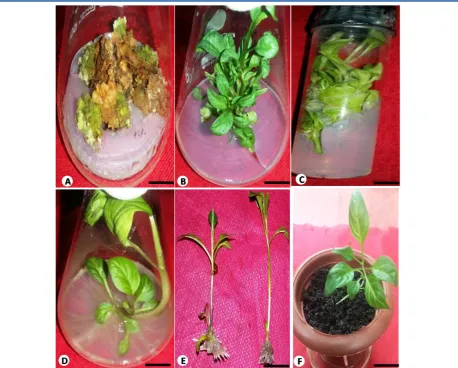
The results corroborate well with the previous observations of Solanumm elongena where callus induction from cotyledonary leaf explant was obtained on the same hormonal combination[19].The colour and texture of callus was green and nodular emerged from the leaf explant (Fig. 1A). Callus organogenesis resulted in the formation of
Phytochemical Screening and Antioxidant Activity of Methanolic Extract of in vitro Raised Plants of Atropa acuminate Royle
http://www.ijSciences.com
Volume 7
– July
2018 (07
)
9
Figure 1.Effect of different phytohormones on different developmental stages in A. acuminata: Profuse callusing (A), Morphogenesis of callus and multiple shoot induction (B, C), rooting of shoots (D) Acclimatization (E,F). Similar results of shoot regeneration from leaf callus were obtained in Solanum laciniatum where BAP in combination with IBA instead of IAA was used [20]. The maximum mean number of shoots (15.2 cm) and mean shoot length (4.8cm) was achieved on MS medium fortified with BAP (3.0 mg/l) alone (Table 2).
Table 2: Shoot regeneration from Callus of Atropa acuminata
Shoot regeneration Number of days taken
for shoot regeneration
Mean number of shoots
Mean length of shoots
(cm)
% culture response
MS + BAP (1mg/l) 15 7.6±2.73 2.6±0.21 60
MS + BAP (2 mg/l) 12 14.2±5.97 3.7±0.30 90
MS+ BAP (3mg/l) 8 15.2±5.39 4.8±0.32 100
MS + BAP (4mg/l) 22 9.2±4.0 2.3±0.17 80
MS + BAP (5 mg/l) 24 10.6± 2.51 1.9± 1.21 35
Data represented mean ± SD of
The present study reveals that optimized BAP concentration is effective for the induction of vigorous microshoots in stipulated time period withmaximum mean number of shoots. Similar results for mean shoot length were achieved in
Withania somnifera and Withania coagulans on optimum BAP concentration [21] [22].
Phytochemical Screening and Antioxidant Activity of Methanolic Extract of in vitro Raised Plants of Atropa acuminate Royle
http://www.ijSciences.com
Volume 7
– July
2018 (07
)
10
Table 3:Rooting of regenerated shoots of Atropa acuminata
Root regeneration Number of days
taken
Mean number of roots
Mean root length (cm)
% culture response
MS + IBA (0.2 mg/l) 31 2.7 ± 2.32 2.8 ± 0.31 28
MS+IBA (0.3mg/l) 29 3.6±1.20 3.3±0.28 30
MS + IBA(0.5mg/l) 12 31.2±14.6 3.7±0.18 100
MS+IBA (1mg/l) 14 16.8±7.99 2.3±0.09 80
MS+IBA (2 mg/l) 20 14.8±7.99 2.0±0.09 85
Data represented mean ± SD of
Moderate concentrations of IBA were more beneficial for rooting while further increase in concentrations inhibited percent rooting response. Similar results were previously reported for Atropa acuminate on full strength rooting medium enriched with IBA [9]. Induction of rooting in micro-shoots on medium without auxin supplement may be due to endogenous auxin levels along with some root inducing factors which occur naturally within the micro-shoots that may help for root primordia initiation [26]. Root initiation started 17 days after transfer onto rooting medium. Our results also support the findings for root induction in Datura stramonium L on MS medium augmented with IBA [23]. In another study on Atropa baetica, rooting was
reported on MS medium supplemented with NAA which is in contrast to our results [7]. When transferred to vermicompost in green house showed a survival rate of 100%. Later the in vitro regenerated plants were successfully transferred to the field conditions.
Phytochemicalscreening
Whole plant extract of in vitro raised plants of Atropa acuminate exhibited differences in the presence of secondary metabolites. The whole plant was extracted with methanol. Alkaloids, phenolics, flavonoids and terpenes show strong presence where as tannins, steroids and saponins shows moderate presence and glycosideswere totally absent (Table 4).
Table 4: Presence of secondary metabolites in in vitro raised plants of Atropa acuminata
Chemicalcompounds Methanolic extract
Alkaloids ++
Phenolics ++
glycosides -
tannins +
steroids +
terpenes ++
saponins +
flavonoids ++
Preliminary phyto-chemical screening of plant extract hasbeen reported in several medicinal plants[24]. In the present study,Atropa acuminate contain flavonoids, phenolics, terpenes, alkaloids steroids and
saponins. In vitro raised plants showed higher activity (71.0%) to detoxify free radicals at a concentration of 250μg/ml (Fig. 2).
Phytochemical Screening and Antioxidant Activity of Methanolic Extract of in vitro Raised Plants of Atropa acuminate Royle
http://www.ijSciences.com
Volume 7
– July
2018 (07
)
11
The higher antioxidant potential fromin vitro raisedplants could be ascribed to the plant’s response against the increased production of ROS as a result of combinatorial effect of PGRs, culture room conditions and external conditions on Atropa acuminata. Our results are in accordance with the reported higher antioxidant activity in regenerated tissues of Sinapis alba against DPPH free radical [8]. Furthermore, similar results were obtained for black pepper [25]. In the current study, the efficient regeneration protocol was established. Also, the feasible amounts of active antioxidants from hardened plants redirecting towards scaling up bioreactor level for production of chemically consistent Atropa acuminate plantlets.
Conclusions
The current study entails establishment of an efficient and reproducible system for the in vitro regeneration and conservation of medicinally important and endangered species of Atropa acuminata. This protocol can be further exploited for potential large scale production, as these species do not propagate suitably under natural conditions. The in vitro raised plants showed antioxidant activity as depicted by DPPH radical scavenging activity supporting the traditional use of this plant. However, further research on the pharmacological activities of this in vitro raised plant is needed.
References
1. Phillipson, JD, and Handa, SS. (1975). N-oxides of
hyoscyamine and hyoscine in the
Solanaceae.Phytochemistry.14: 999-1003.
2. Kaul, MK. (1997). Medicinal plants of Kashmir and Ladakh. Indus Publications, New Delhi, India pp. 173.
3. Mehmood, MA, Anis, I., Khan, PM., Riaz, M., Makhmoor, T., and Choudhary, MI. (2002).Highly oxygenated triterpenes from the roots of Atropaacuminata. Natural Product Letters.16: 371–376.
4. Jayakanthi, J, Dhanarajan, MS., and Vijay, T. (2011). Found main constituents of Atropa acuminata belongs to monoterpene, sesquiterpene, phenylpropanoid, flavonoid and quinine. International Journal of Pharmacy and Pharmaceutical Sciences.3: 0975-1491.
5. Wani, AP, Nawchoo, IA., and Wafia, BA. (2007). Improvement of sexual destination in AtropaacuminataRoyle (Solanaceae)-a critically endangered medicinal plant of northwestern Himalaya Pakistan Journal of Biological Science.10: 778-782.
6. Hussain, A, Qarshi, IA., Nazir, H., Ullah, I., Rashid, M., and Shinwari,ZK. (2013)In vitro callogenesis and organogenesis in TaxuswallichianaZucc.The Himalayan Yew. Pakistan Journal of Botany. 45: 1755-1759. 7. Zarate, R, Cantos, M.,andTroncoso, A. (1997).Induction and
development of adventitious shoots of
Atropabaeticaas a means of propagation.Euphytica.94: 361-366.
8. Abbasi, BH, Rashid, A., Khan, MA.,Shinwari, ZK., Ahmad, N., and Mahmood, T. (2011).In vitro plant regeneration in Sinapisalbaand evaluation of its radical scavenging activity. Pakistan Journal of Botany.43:21-27.
9. Ahuja, AM, and Sambyal, SK. (2000).In vitro propagation and conservation of Atropa acuminataRoyle ex Lindi-An indigenous threatened medicinal plant.Journal of Plant
Biochemistryand Biotechnology.11: pp121-124.
10. Hussain, A, Naz, S., Nazir, H.,andShinwari, ZK. (2011). Tissue culture of black pepper (Piper nigrumL.) in Pakistan.Pakistan Journal of Botany.43:pp1069-1078. 11. Biswas, K, Chattopadhyay, I., Banerjee, RK.,and
Bandyopadhyay, U. (2002).Biological activities and medicinal properties of neem (Azadirachtaindica).Current
Science.82:1336-1345.
12. Cragg, GM, Newman, DJ.,and Snader, KM. (1997). “Natural products in drug discovery and development” Journal of Natural Products.60: 52-60.
13. Shivhare, Y, Singh, P., and Singh.S. (2010). “Ethanobotanical and ethano pharmacological profile of
Abutilon indicum Linn, A Review”, Der Pharmacia Sinica.1:40-45.
14. Srivastava, SP, Singh, P., Mishra, GKK,Jha, KK.,and Khosa, RL. (2011). “Costus speciosus (Keukand): A review”,
Der Pharmacia Sinica.2:118-128,
15. Sen, S, Chakraborty, R., Sridhar, C., Reddy, YSR.,and De, B. (2010). “Free radicals, antioxidants, diseases and phytomedicines: current status and future prospect.”
International Journal ofPharmaceutical Sciences Review and Research.3:91– 100.
16. Droge, W. (2002). “Free radicals in the physiological control of cell function,” Physiological Reviews.82:47–95. 17. Sharma, S, Nagpal, A.,andVig, AP. (2012).“Genoprotective
potential of Brassica juncea(L.) Czern.against mercury-induced genotoxicity in AlliumcepaL.” Turkish Journal of Biology.36:622–629.
18. Shah, Syed Naseer, Tareq Ahmad Wani, Bhimi Ram, Monika Koul, Praveen Awasthi, Deependra Singh Rajput, and Gillela Ravi Shanker Reddy (2016). An efficient protocol for in vitro organogenesis and antioxidant studies in Meliadubia Cav." African Journal of Biotechnology 15, no. 19: 768-775. 19. Ray, BP, Hassan, L., and Nasiruddin, KM (2011).In vitro
regeneration of brinjal (SolanumMelongenaL.) Bangladesh Journal of Agricultural Research.36: 397-406.
20. Bhatnagar, P, Bhatnagar, M., Nath, AK.,and Sharma, DR. (2004).Production of solasodine by Solanumlaciniatum using plant tissue culture technique. Indian Journal of Experimental Biology. 42: 1020-1023.
21. Fatima, N, and Anis, M. (2012). Role of growth regulators on
in vitro regeneration and histological analysis in indian ginseng (WithaniasomniferaL.) Dunal.Physiology and Molecular Biology of Plants.18: 59-67
22. Joshi, H, Nekkala, S., Sooner, D., Kher, MM.,and Nataraj, M. (2016).In vitro shoot multiplication of
Withaniacoagulans(Stocks) Dunal. Plant Tissue Culture and
Biotechnology.26: 187‐195.
23. Amiri, S,Kazemitabar, SK., Ranjbar., GA., and Azadbakht,M. (2011).In vitro propagation and whole plant regeneration from callus in Datura (Daturastramonium. L). AfrricanJournal of Biotechnology.10: 442-448.
24. Amerjothy, S, Ezhilarasi, R., and Shanmugakumar, SD. (2007). Antimicrobial Assay of the leaf extracts of Xanthium indicumKoen. Pharmacognosy Magazine. 3: 196-197 25. Ahmad, N, Fazal, H., Abbasi, BH., Rashid,M.,Mahmood,
T.,andFatima,N. (2010) Efficient regeneration and antioxidant potential in regenerated tissues of Piper nigrumL.
Plant Cell Tisue Organ Culture.102: 129-134.
26. Wani T, Rana S, Bhat W, Pandith S, Dhar N, Razdan S, Chandra S, Sharma N, Lattoo SK (2016). Efficient In Vitro Regeneration, Analysis of Molecular Fidelity and