203 Copyright © 2011-15. Vandana Publications. All Rights Reserved.
Volume-5, Issue-1, February-2015
International Journal of Engineering and Management Research
Page Number: 203-208
An Overview of the Mobile Number Portability in Asian Countries
Renu Bala1, Samriti Bansal2, SoniaSachdeva3
1,2
Assistant Professor, DAV College, Malout, Punjab, INDIA
3
Assistant Professor, Gopichand Arya Mahila College, Abohar, Punjab, INDIA
ABSTRACT
This paper gives insight to cellphone network providers on how to meet the challenge of possibility of losing existing customers’ due to Mobile Number Portability (MNP) feature launched by Government of India recently. The survey conducted reveals customers’ reasons and preferences for shifting to the other network provider, their satisfaction level with the current mobile service provider(s), and their suggestions for improving services to hold in the existing customers. Suggestions are made as to what the cellphone network providing companies should do in order to take maximum benefit of Mobile Number Portability by offering benefits to their existing customers.
Keywords— Mobile number portability (MNP), Switching costs, Mobile communications industry.
I.
I
NTRODUCTIONOver the past two decades, the mobile industry has experienced considerable technological progress with the introduction of digital technology and the advent of broadband, which are arguably changing the world more quickly and more profoundly than any other innovation. Effective competition in the communication markets benefits consumers by affording them increased choice, lower prices, better quality and greater innovation. The presence of network effects and switching costs in the mobile telecommunications industry can favor larger firms, causing distortions that are absent in conventional markets. Switching costs include time, money and the psychological impact on consumers of switching mobile operators. Compatibility, size of discount and transaction costs are the three main sources of switching costs in the context of mobile communications. First, there are compatibility costs, which are related to operators’ SIM-locking practices, as well as to standards compatibility.
The adoption of common European standards has eliminated compatibility costs by forcing operators to choose a unique type of network technology (GSM, UMTS), but SIM- locking practices still exist as a way of protecting handset subsidies. If clients wish to switch operator, they need to buy another handset or unlock their current mobile phone in order to use the new company’s services. Second, mobile operators usually offer customer discounts, such as handset subsidies and lower prices for on-net calls to raise customer switching costs and lock consumers into their networks. Lastly, transaction costs are accrued when customers breach their contract with their current operator and a contract termination fee is levied. Portability of various types of numbers is a fact in most liberalised telecommunications markets, and portability of mobile numbers is fast becoming more widespread. This may, in part, be due to arguments that the scale of the benefits from mobile number portability may be smaller than for portability of other types of numbers. If this is the case, the smaller benefits may be because, for many users, the ability to retain their mobile number when switching network is desirable but not critical, particularly when mobile phones are used only occasionally or predominately for outgoing calls. It may also be that the scope for efficiency gains through increased competition is lower in the mobile market because the rate of churn rate is generally relatively high even before portability is introduced. If the benefits of portability of mobile numbers are relatively less substantial than for other types of numbers, then the success of mobile number portability is likely to depend on factors such as how simple and inexpensive the implementation of portability is, relative to the value users put on their numbers and the retention of them.
204 Copyright © 2011-15. Vandana Publications. All Rights Reserved.
their current contacts of their new number. This is more costly to business clients because they may lose potential customers. In addition, no portability leads to inconvenience as a result of missed calls from contacts still using the old number. Several studies provide evidence that MNP may play a significant role in reducing the costs to subscribers of changing service providers in the mobile communications industry. Best is, we don’t have to go through the trouble of informing all your friends & family that our number has changed - it stays the same.
II.
MNP
IMPLEMENTATIONToday, consumers can switch mobile operators while keeping their telephone number. Several approaches used by national regulatory authorities (NRAs) to implement MNP vary according to two key factors: Porting period and consumer fees incurred when switching service provider. The porting period is the length of time required for subscribers to switch providers, and portability fees are the charges the subscriber must pay in order to switch. These two factors, porting period and retail prices, affect the switching decision, and the task befalling the NRAs is to make sure these do not act as disincentives to the take-up of number portability. On the other hand, with respect to timing, the time needed to port a number has dropped significantly since MNP was first adopted in Europe.
Number Portability has to ensure that call routing for all mobile sessions Voice, SMS,MMS should be enabled with routing to the ported network for the same called subscriber number. IETF defines three types of number portability (NP): Service provider number portability (SPNP), location portability and service portability. The current paper focuses on the SPNP, which
is the agenda set by TRAI to the service provider bodies in India. SPNP allows subscribers to switch service providers while retaining the same phone number. The technology challenges towards implementation come through complexities in number administration, network signaling functions, call routing, billing and service management. A translation element is necessitated in the network as the mobile number addressing scheme becomes a virtual address. Central to the address translation scheme is the NP translation database hereafter to be termed as NPDB (Number Portability Database).
The network classification is done as follows:
Donor Network: The network that first assigns a telephone number to a subscriber from one of its administered ranges.
New Serving Network: The network of the current service provider serving the ported number.
Old Serving Network: The network prior to porting in of the number to the current network. It is not necessarily the Donor network as multiple provider switches is feasible. The implementation of the routing is through four different schemes:
A. All Call query (ACQ)
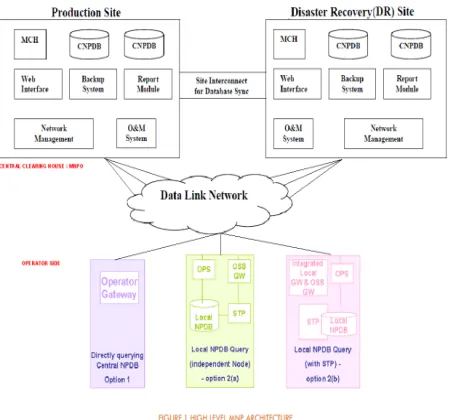
The Originating Network receives a call from the caller and sends a query to a centrally administered Number Portability Database (NPDB), a copy of which is usually residing on a network element within its network (like SCP).
Fig. 1 All Call query setup
205 Copyright © 2011-15. Vandana Publications. All Rights Reserved.
doesn’t get involved in the entire call flow ACQ scheme is called direct routing as shown in fig. 1.
B. Query on Release (QoR)
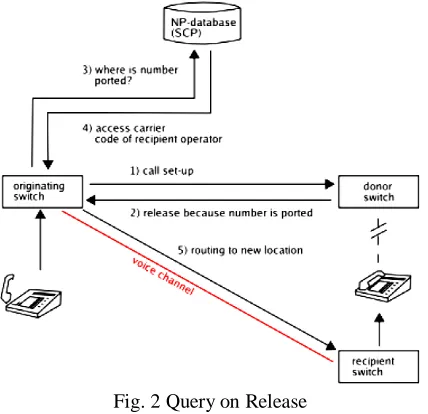
Fig. 2 shows the Originating Network receives a call from the caller and routes the call to the donor network. The donor network releases the call and indicates that the dialled directory number has been ported out of that switch. The Originating Network sends a query to its copy of the centrally administered NPDB.
Fig. 2 Query on Release
The NPDB returns the routing number associated with the dialled directory number. The Originating Network uses the routing number to route the call to the new serving network. The QOR mechanism can hold out to be a smart implementation when the MNP porting figures are low. There are no unnecessary SCP queries for B party subscribers that are not ported yet, which is likely to save ample processing capacity on the network as well as associated call setup delay.
However as the porting figures rise (which is close to 25% in most mature MNP markets), the cost of call setup and subsequent release in case of ported out numbers is likely to take an adverse hit on the network utilisation as well as setup cost.
C. Call Dropback
Fig.3 Call Dropback
The Originating Network receives a call from the caller and routes the call to the donor network. The donor network detects that the dialled directory number has been ported out of the donor switch and checks with an internal network‐specific NPDB. The internal NPDB returns the routing number associated with the dialled directory number. The donor network releases the call by providing the routing number. The Originating Network uses the routing number to route the call to the new serving network. Fig. 3 shows Call Dropback.
D. Onward Routing (OR)
206 Copyright © 2011-15. Vandana Publications. All Rights Reserved.
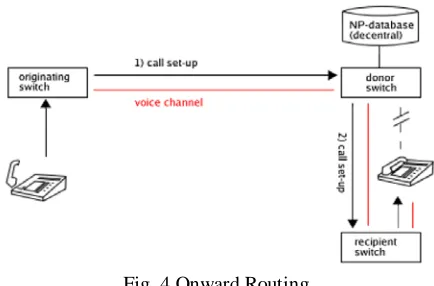
Fig. 4 Onward Routing
Fig. 4 illustrates Onward Routing. The switching matrix as well as the CPU of the donor switch will be kept loaded for the entire duration of the call, for which it is no longer responsible. Except the ACQ scheme all other schemes initiate a call to the Donor network, only to be released or rerouted back to the serving network. Thus ACQ is the most efficient scheme with the most optimal use of the switching and associated network facilities. The ACQ scheme queries the NPDB to retrieve the routing information. The centralized NPDB contains the ported number information from multiple networks.
III.
HOW
DOES
MNP
WORK?
According to TRAI regulation, to facilitate Mobile Number Portability by providing unique porting code as requested by their subscribers (existing customers) is the obligation of all Indian network service providers towards their all types of subscribers in entire network without any discrimination. Changing from one service provider to the other is known as ‘Porting’. New service provider to whom the customer is requesting to port his/her cell number is known as Recipient operator. Previous service provider from whom the customer wants to port-out his/her cell number is known as Donor Operator. Customers can change the service provider only within their current service area. Recipient Operator can disconnect customers’ post-paid connection if the customers do not pay due bill amount to Donor Operator before requesting for porting. Pre-paid connection balance will be lapsed after porting. For porting, customers have to send an SMS to 1900, unique porting code will be sent to their cell number. It will charge customers maximum `19. This unique porting code is to be mentioned in the form submitted to Recipient Operator. TRAI has allowed maximum porting time of seven working days, except in Jammu and Kashmir, Assam and North East service areas, where it will be 15 working days. If a subscriber buys a new SIM card, and s/he wants to change service provider using Mobile Number Portability, s/he will have to wait
for 90 days after cell number is activated. The subscriber can port again, but not before 90 days. There must be a gap of 90 days between every porting requested by the subscribers. It will be very difficult to judge service provider by number prefix after Mobile Number Portability implementation. Before implementation of Mobile Number Portability, mobile numbers from BSNL CellOne used to begin from 94, for Reliance it was 93, 98 for Airtel, 92 for TataIndicom, etc.
IV.
SERVICE PROVIDED NUMBER
PORTABILITY
call routing Schemes The Internet Engineering Task Force (IETF) has defined four flavors of call routing that support number portability. These schemes are :- All Call Query (ACQ)• Query on Release (QoR)• Call Dropback.• Onward Routing (OR)• All material on each page should fit within a rectangle of 18 x 23.5 cm (7" x 9.25"), centered on the page, beginning 2.54 cm (1") from the top of the page and ending with 2.54 cm (1") from the bottom. The right and left margins should be 1.9 cm (.75”). The text should be in two 8.45 cm (3.33") columns with a .83 cm (.33") gutter.
V.
M
OBILEN
UMBERP
ORTABILITYREGULATORY GUIDELINES
1. Out of several types of number portability DoT has recommended Service Provider Number Portability (SPNP) for all mobile service operators.
2. MNP will be restricted only for intra circle operators. 3. MNP will be allowed between CDMA and GSM operators. 4. ACQ (All Call Query) direct routing method is to be
adopted to implement MNP.
5. The Department of Telecoms (DoT) in India has awarded licenses for two mobile number portability clearing house vendors to operate clearinghouses in two zones within the country.
6. Syniverse Technologies India (North‐West zone) and MNP Interconnection, a joint venture by US‐based Telcordia Technologies (South‐East zone), would act as the clearing houses in the respective zones to manage porting activities.
207 Copyright © 2011-15. Vandana Publications. All Rights Reserved.
VI.
NUMBER PORTABILITY CALL
ROUTING MECHANISMS
In mobile service, the network tracks the location of every MS. The location information is stored in two mobile databases, the HLR and the VLR. To deliver a call to an MS, the databases are queried for routing information of the MSC where the MS resides. Figure 1 illustrates a simplified GSM call termination procedure where the interaction between the HLR and the VLR are omitted. Refer to [6, 8] for the detailed call termination procedure without number portability. The message flow is described in the following steps. • Step GSMCT.1: When the calling party dials the MSISDN of a mobile station MS2, the call is routed to the gateway MSC (GMSC) of MS2 using the ISDN user part (ISUP) initial address message (IAM). • Step GSMCT.2: The GMSC queries the HLR to obtain the mobile station roaming number (MSRN), the address of the terminating MSC where MS2 resides. • Step GSMCT.3: Based on the MSRN, the IAM message is routed to the destination MSC, and the call is eventually set up. In Fig. 1, the terminating network (where the MS resides) may be different from its subscription network. Call termination to the MS must be routed to the GMSC at the subscription network due to the following restrictions. • Restriction 1: The GMSC must be in the call path for the provision of special features and services as well as for billing.
VII.
MNP
BUSINESS
OPPORTUNITIES
To understand the opportunities in the field of MNP it is imperative to understand the challenges faced for implementing and sustaining the MNP scheme. Cutting across all service providers or the central regulatory body for sustaining the MNP infrastructure, the identified cost element would be as follows:
1. Centralized NPDB setup cost.
2. Upgrading the Signalling infrastructure to support NPDB routing.
3. Network interface and software upgrade for supporting elements in the MNP ecosystem like HLR, MSC, GMSC, SMSC, MMSC, STP, Signalling gateway etc.
4. Upgrade of BOSS component software System for
provisioning of NPDB and the UI interfaces.
5. Customer Relationship Management (CRM) enhancement. 6. IVR/IP interface upgrade for interactive provisioning and
support.
7. Software and system upgrade maintenance lines to keep up with regulatory changes.
VIII. COMPETITIONS
AND
CHALLENGES
Switching costs for consumers is one of the most important issues affecting market competition in the mobile communications industry. The existence of switching costs enhances firms’ market power by allowing them to charge their customer base higher prices. The introduction of MNP is one of the main regulatory measures taken to reduce switching costs in the mobile industry and is designed to generate significant benefits both for consumers and market competition. At an individual level, several studies have estimated consumer switching costs, both directly and indirectly, and indicate that clients who adopt MNP have lower switching costs compared with clients who do not maintain their number when changing provider. This evidence reveals the effectiveness of MNP in lowering customer switching costs and shows that they will not disappear because leading operators use lock-in strategies such as network-based discriminatory pricing schemes and because of increasing barriers for new entrants or small operators to grow sufficiently.
However, some theoretical studies argue that the introduction of MNP does not benefit consumers at all because it can make it difficult for them to distinguish who is the provider when placing a call and may therefore erode the information related to the termination charges they must pay provided theoretical evidence to show that the introduction of MNP cannot guarantee social benefits under specific demand characteristics. Specifically, they concluded that in developing telephony markets with low penetration rates, MNP benefited consumers and new entrants but had no effect on incumbents. Subsequently reported that the effect of introducing MNP on over all welfare is ambiguous. A branch of the literature empirically examines the impact of portability on market competition and results do not always point in the same direction. For example, in a study, although the primary objective was not to investigate the effect of MNP on prices, they found that the regulatory environment variable was not statistically significant in the mobile industry. Similarly, it is also examined the effect of lowering switching costs when number portability is applied to toll-free telephony and found that introducing number portability may not reduce prices when firms cannot price-discriminate between old locked-in consumers and new ones.
208 Copyright © 2011-15. Vandana Publications. All Rights Reserved.
in addition to the differences in terms of the timing of the introduction of MNP, European countries vary in how MNP has been implemented in the mobile industry with respect to portability period and customer fees, which could affect the adoption of MNP and its impact on competition. For example, it is noted that the porting period is an important determinant of the impact of MNP on competition and that it reduces average prices when switching takes place in less than five days. ‘‘Higher charges tend to lead to higher consumer switching costs and therefore to a lower use of MNP’’, based on data available regarding switched numbers. The variable that measures the number of operators in the mobile industry is positively related to the churn rate and highly significant, indicating that the more operators there are in each market, the higher the churn rate. Since there is a scarcity of empirical studies that consider the rules and requirements put in place by the NRAs to implement MNP, the current study examines how two factors, longer porting period or higher charges, can affect market competition in the mobile industry.
MNP also impacts the internet telephony or VOIP business. A VOIP originated voice call with a termination on traditional mobile operator need to be aware of the porting status of the mobile subscriber before the call can be routed. Thus VOIP now need to know the current serving network for call routing purposes.
IX.
C
ONCLUSIONThis article introduced mobile number portability. We described and analyzed number portability routing mechanisms and their implementation costs. MNP requirements, such as the porting period and the charges levied on consumers when switching service providers, are important factors affecting the porting of numbers. The finding reveals the importance of MNP implementation on customer churn rate in the mobile industry in European countries. This appears to be the first empirical study to provide evidence of the MNP conditions that have hindered the competitive process and prevented consumers from reaping the benefits of the reduced switching costs they should have been able to obtain through the introduction of MNP. The results show that the portability period and the portability fee required to switch service provider are negatively related to the level of churn rate in the mobile industry. This means that the cost of switching providers increases along with the increase in the porting period and charges. Longer portability periods and higher portability charges contribute to consumer lock-in and reduce effective competition in the mobile industry. This study is a first attempt to understand how the MNP process affects customer churn rate in the mobile industry. Future studies should focus on the types of strategies operators
have used to reduce the effect of MNP on their customer churn.
REFERENCES
[1] Kim, H.S.,&Yoon, C.H.(2004). Determinants of subscriber churn and customer loyalty in the Korean mobile telephony market. Telecommunications Policy, 28(9–10), 751–765.
[2] Klemperer,P.(1995).Competition when consumers have switching costs: An overview with applications to industrial organization macroeconomics, and international trade. Review of Economic Studies, 62(4), 515–539. [3] Koski,H.,&Kretschmer,T.(2004).Survey on competing in network industries: Firm strategies, market outcomes, and policy implications. Journal of Industry, Competition and Trade, 4(1), 5–31.
[4] Regulation and competition in the European mobile communications industry: An examination of the implementation of mobile number portability, Bele´n Usero Sa´nchez ,Grigorios Asimakopoulos, Business Management Division,Universidad Carlos III de Madrid,C/Madrid,126(28903)Getafe,Madrid,Spain.