83
Copyright © 2011-15. Vandana Publications. All Rights Reserved.
Volume-5, Issue-3, June-2015
International Journal of Engineering and Management Research
Page Number: 83-88
An In-Depth Study of Safety and Health Management in Manufacturing
Sector of India to Set Benchmarks for a Better Path Ahead.
Meha Joshi1, Dr. Ritu Bajaj2 1
Assistant Professor, Delhi School of Management, Delhi Technological University, Delhi, INDIA 2
Professor, JIMS, Rohini, Delhi, INDIA
ABSTRACT
Employee Health and safety have not been ambit of focus for once. But today the realisation is such, that occupational health and safety is true indicator of country’s success. If they are well taken care of, the productive results may be achieved.
The paper gives a complete overview of the manufacturing sector of India on the issues relating to the occupational health and safety, Status of Safety and Health , the legislative framework within which organisations operate with respect to Occupational Safety and Health, the international standards adopted by the organisations, the initiatives taken by ILO to foster safety culture and highlight the gaps which need to be closed and provides recommendation to ensure better health and safety culture.
Keywords--- Manufacturing, S/M Enterprises, Budget
I.
INTRODUCTION
India is a vast country having a surface area of about 3.3 million square kms. The total population of India according to 2013 c e n s u s is estimated to be around 1.27 billion with a huge working population out of which 13100129 people are working in manufacturing sector and thus Manufacturing assumes significance for the Indian economy. Presently this sector contributes15% as reported in November 2013 towards GDP of the country.
Though India has umpteen opportunities to bolster its manufacturing prowess and prove its mettle yet there is a long way to go as there are many issues to be addressed, out of which Safety and Health assume great significance.
Small and medium enterprises are considered to be the backbone of Indian economy , employing close to 40% of
India’s workforce and contributing around 45% to India’s manufacturing output(1)
Researches show that many political and scientific interests have grown in the recent years in small and medium enterprises. Several policies and programs have been launched especially by the government to boost this sector. But its worth to mention that due to the capacity size and other issues, this sector has to operate in constraints.
Consequently health and safety are the issues that are often pushed aside by the management.
Health and safety are important responsibilities that every industry must consider . Health and safety are serious risks that companies face. These risks directly and indirectly affect business operations. Consequently, for a company to grow and prosper, it is pertinent that risks are effectively managed, because by managing business risks, an organization’s health, assets and opportunities will be secured and taken full advantage of (3)
Khan in one of his studies on Labour welfare states that the lot of the worker is the mirror of the prosperity of a country. If industrial worker is sick, industrial unit will be sick. To neglect the labour class is to neglect country’s welfare.(2)
84
Copyright © 2011-15. Vandana Publications. All Rights Reserved.
ill-health in operational areas, especially those involving low probability and high consequence events, does not necessarily indicate that these areas are managed effectively. While health and safety management systems provide the foundations for developing an acceptable safety performance (4), a move towards excellence is accelerated by the adoption of a continuous improvement philosophy (3) that is supported by the process of benchmarking (5).
The paper tries to address issues related to health, safety of employees in manufacturing sector. Although India has been trying to put these issues in focus and have formulated several guidelines in their respective National Policies, yet discrepancy areas are still a question of concern.
The objectives of this paper are:
• To gain an insight into the occupational safety and Health Profile of India
• To know about the current scenario of Occupational Safety and Health in India and to highlight the legislative framework within which organisations operates.
• To gain an insight into the various certifications and standards for ensuring Safety and Health in the organisations and ILO initiatives on Occupational Safety and Health.
• To suggest action plans in terms of Capacity Building, motivation enhancement and collaborative linkages with institutions in order to improve the Occupational Health and Safety Aspects at work.
II.
STRUCTURE OF
OCCUPATIONAL SAFETY AND
HEALTH IN INDIA
The role of government
Occupational Safety and Health is one of the matters allotted to Ministry of Labour and Employment under Government of India Allocation of Business. The Industrial Safety and Health branch of ministry discharges entire functions relating to policy decision and laying down guidelines for countrywide adoption.
As most of the legislations on OSH are Central Government legislations, the ministry performs the important function of piloting bills thorough Parliament after inter ministerial consultations and consultation with State government and other organizations of employers and employees.
Liasoning with International Labour Organisation and other countries is carried out by Ministry.(6)
Factories in India fall within the purview of DGFASLI, which is the technical organisation of the ministry of labour and takes care of Occupational Safety and Health and other issues of Factory workers. It provides
training for Factory Inspectors and coordinates. The occupational health training is carried out in a few medical colleges for graduate and postgraduate diplomas and degrees. The Central Labour Institute under DGFASLI offers a 3-month certificate course in Industrial Health, which is statutorily approved.(10)
It has 5 regional Labour Institutes. These Institutes carry out training and research related to industrial safety and health. Until recently, Central Labour Institute was the only institute conducting statutory training / certification course. The certification is mandatory for all industrial medical officers employed in hazardous industries. National Institute of Occupational Health [NIOH] is one of the prime institutes of the Indian Council of Medical Research [ICMR] and has two Regional Occupational Health Centres (ROHC) at Bangalore (1977) and Calcutta (1980) for catering to regional needs. Established in 1966 and originally designated as the Occupational Health Research Institute and it was re-designated as the National Institute of Occupational Health (NIOH), in 1970. Its major activity is research in occupational health. The Institute has published over 500 research papers in national and international journals. The other activities of the Institute include short-term training programmes for industrial medical officers, industrial hygienists, factory inspectors, workers and trade unions, etc. The Institute advises the Ministry of Health, Ministry of Labour, Ministry of Environment and Ministry of Commerce on issues related to occupational health, safety and environment.(7)
Besides this, the autonomous organisation of national repute is National Safety Council, Central Board of worker’s education and National Institute of Occupational health. It also assists the Ministry of Labour and employment in Operation of National Safety Awards, Vishwakarma Rashtriya Puraskar and Prime Minister’s Shram Award(8)
Non government organisations intervention
There are some nongovernmental organisations like IAOH(Indian Association of Occupational Health ), working for the cause and has the membership of more than 3000 OSH Professionals .It has been regularly conducting conferences for creating awareness, proactively influencing national policy through appropriate linkages since past 64 years.(9)
III.
LEGISLATIVE FRAMEWORK
FOR SAFETY AND HEALTH IN
MANUFACTURING SECTOR IN
INDIA
85
Copyright © 2011-15. Vandana Publications. All Rights Reserved.
Occupational Safety and Health form under the purview of the following Acts.
1. Factories Act 1948: This Act contains 120 sections, and is divided into Chapters concerning inspection staff, health, safety, hazardous processes, welfare, working hours of adults, employment of young persons, annual leave with wage, and penalties and procedures This act has the provisions for Safety, Health and Welfare and special chapters on Hazardous processes added after the catastrophic Bhopal Gas Tragedy, which took away lot many lives. This Act places talks about formation of safety committees with equal number of representatives from management and workers and consultation with employees for framing Occupational Safety and Health Policy..
2. Worker's Compensation Act: It is an act to provide for payment by certain classes of employers to their workmen of compensation for injury. Its an act meant to protect the rights of injured workers . It aims at securing the right of injured workers so that they get appropriate medical care , necessary training and rehabilitation. If the workers die due to injury at work, the family is entitled for compensation.
3. Employees’ State Insurance Act It is the act which
protects the workers in case of sickness, maternity and disabilities caused by injuries and resultant loss of wages.
Besides this, keeping in the view the urgent and unavoidable need of Occupational Safety and Health, in February 2009, The Government of India has declared
National Policy on Safety, Health and Environment at
Work place and has set to build and maintain national preventive and safety & health culture, as a goal. In order to achieve the aforesaid goal in the national agenda, government has stressed to promote inclusion of safety, health and environment improvement at the workplace as an important component for quality of working life. (3) The main focus of National Policy on Safety and Health at workplace is placed on Compliance, awareness, Occupational Safety and Health, skill capacity building and research. The national policy on OSH has the following objectives:
• Continuous reduction in incidence of work related injuries, fatalities, diseases, disasters and loss of national assets.
• Maintain comprehensive database of the above for better performance and monitoring.
• Continuous enhancement of community awareness on SHE issues at work related areas.
• Improving SHE at workplace by creation of green jobs contributing to sustainable development.(4) International certifications and standards
There are a number of international certifications
and standards framed on Occupational Safety and Health
which are gaining prominence in the recent times.. Some of them are here below.
1. OHSAS 18001: It is a British standard for Occupational Safety and Health Management systems.. The main reason why it exists is to help all kinds of organisations to put in place demonstrably sound Occupational Safety and Health performance. It puts special focus on forming OSH objectives to help organisations develop policies and objectives keeping into account legal requirements and information about Occupational Safety and Health risks. It was updated in the year 2007 and new specifications are more closely aligned with structured with ISO 9000 AND 14000 so that organisations can more easily align with existing management systems.
2. Integrated Management systems: These are written
generally so that they can be applied to all kinds and all types of organisations. Its major focus is on Environment Health and Safety elements that the organisations can reasonably be expected to control. The basic elements which it includes are environmental aspects, hazard identification, risk assessment, objective formulation, performance measurement ad monitoring
3. IS-18001: It is standard of Bureau of Indian Standards started with an aim of maintain and continuously improving the Occupational Safety and Health Management Systems. It does not state the criteria for Objective setting as such but its Unique feature is the stipulation of initial OSH review, design and engineering, Purchasing and critical incident recovery plan which are considered to be critical for the success of OSHMS. Besides these standards, International Labour Organisation and Health Safety Executive provide the guidelines on this critical and very important issue. Some notable points are as mentioned below
1. HSG65: Its a popular guide of Health and Safety
executive, mainly developed for line managers, leaders and owners who want to oversee their organisations Health and safety arrangement. It extends guidelines to enable organisations strike a balance between systems and behavioural aspects of OSH.
2. ILO guidelines on Occupational Safety and Health exist to provide a unique international model which is compatible with other management systems standards and guidelines at national levels and international levels .
IV.
ABOUT ILO INITIATIVES ON
OCCUPATIONAL SAFETY AND
HEALTH
86
Copyright © 2011-15. Vandana Publications. All Rights Reserved.
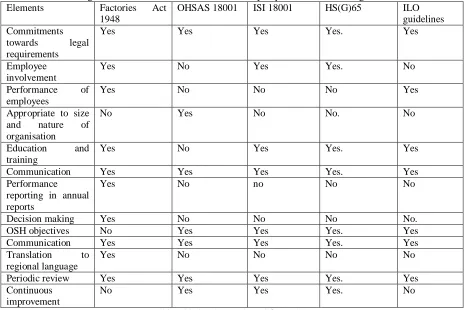
Table showing statement of various elements in statutory requirements and Management Standards Elements Factories Act
1948
OHSAS 18001 ISI 18001 HS(G)65 ILO guidelines Commitments
towards legal requirements
Yes Yes Yes Yes. Yes
Employee involvement
Yes No Yes Yes. No
Performance of employees
Yes No No No Yes
Appropriate to size and nature of organisation
No Yes No No. No
Education and training
Yes No Yes Yes. Yes
Communication Yes Yes Yes Yes. Yes
Performance
reporting in annual reports
Yes No no No No
Decision making Yes No No No No.
OSH objectives No Yes Yes Yes. Yes
Communication Yes Yes Yes Yes. Yes
Translation to regional language
Yes No No No No
Periodic review Yes Yes Yes Yes. Yes
Continuous improvement
No Yes Yes Yes. No
This table has been adapted from (11)
V.
FINDINGS OF THE STUDY
Since the beginning of liberalisation in 1991, many regulations have been brought about to facilitate economic growth and development but hardly any initiative has been taken to ameliorate the working conditions of labour from health and safety angle. It is found that unsafe work conditions is one of the major causes of death and disability among the working population of India (12). These deaths can be prevented. ILO estimates that 4,03,000 people in India die every year due to work‐ related problems, that is, about 46 every hour (12)
• In India, occupational health is not integrated with primary health care. Occupational Safety and Health till date remains under the mandate of the Ministry of Labour and not the Ministry of Health. Enforcement is carried out through the Directorate of Industrial Safety and Health at state levels that operate through factory inspecting engineers and medical inspectors of factories.
• Occupational health in India has to compete with primary & curative health for its budget. While 4% of the gross domestic product (GDP) is spent
on health care, almost 75% of this is spent on curative health.(9)
• Despite the increasing manufacturing activities, regulatory authorities ensuring occupational safety have been restricted to 1,400 safety officers, 1,154 factory inspectors and 27 medical inspectors. These numbers are very less even for the units which employing only 10% of working population in formal and organised sector(around 26 million), and there is a big number of work force employed in informal sector with no safety measures at all (12)
• The numbers of trained professional are grossly inadequate for a country with bludgeoning workers population. A lot of demand for safety officers is there but training on OSH is still in infancy .The existence of 1125 qualified occupational health professional against the requirement of more than 8000 such qualified occupational health doctors. (7)
87
Copyright © 2011-15. Vandana Publications. All Rights Reserved.
occupational health specialists in the country is much higher and there is a significant gap in the demand and supply of this specialist service (13)
• The impact of OSH hazard on women and children is more grave as , women has also to do other demanding jobs like cooking, cleaning and bearing and taking care of children. Because of uncomfortable positions at workplaces and that too for long hours, women develop muscular‐skeletal disorders.(15)
• There are only a few progressive industries which emphasise on certifications and go much beyond merely following the laws which are compulsory.
• There is a need for capacity building of employees as there is a wide gap between the number of OSH professionals needed and the available ones.
Thus, it could be seen that safety and health scenario in India has to be paid attention to, as productivity of a worker depends largely on health of the worker and national productivity may suffer as a result of it. (16)
VI.
SUGGESTED FRAMEWORK
FOR ENHANCING SCENARIO
OF OCCUPATIONAL SAFETY
AND HEALTH IN INDIA
1. Need for an apex body
The Apex government body taking care of OSH needs to be created which works exclusively for Occupational Health and Safety issues.
2. Need of credible Universities and Institutions
There is a need to have credible Universities and Institutions offering specialised courses to the students to learn OSH which could help improve the Occupational Safety and Health situation as there is a wide gap between required professionals for improving the Occupational Safety and Health of Employees and the available ones and it would also increase the level of employment,. For this matter, the action plan could be offering OSH as specialisation in M.B.A and disciplines of Engineering with the expert training to the students opting for it and at the end of the training, the OSH trainees could be given employment. In the similar fashion, live projects to the interns in terms of surprise audits can be conducted
3. Linking safety with Rewards for the employers
The motivation level of employers to have adequate Safety and Health systems can be reinforced by linking the credits (to the practitioners of Occupational Health and Safety in conjunction with the laws ) and then those credits may be linked to some considerable tax relief 4. Need of specificity of objectives and coordination with international bodies for shaping the national policies.
The objectives of the policies framed are required to be more specific rather than broad statements and
integration with the international bodies for reshaping with required changes in the National Policies and implementation of safety and health policies is needed. 5. Integration of Occupational Health with Primary health care.
There is a need to integrate Occupational Health with primary health care .
6. Need for amendment in the Factories Act
There is a need to make amendments in the Factories Act with more provision and separate chapters on Occupational Health and Safety. In 1987 after Bhopal gas Tragedy, some chapters on Occupational Safety and Health were added but there is a need to revise Factories Act 1948, keeping in view the present day scenario. 7. International Collaborations
More number of International Collaborations are a must to stay abreast with the standards set and implemented in other parts of the globe. Some lessons are worth learning from China and other countries which are holding joint and collaborative projects with the other parts of the globe on Work Safety and Health of Employees. 8. Addressing the problem of non reporting of accidents
To curtail the problem of non reporting of accidents, integration of Information Technology can work. In order to strengthen the system of OSH, a web portal may be created (wherein the accidents and unsafe practices can be reported ) to keep employers on alert in maintaining a safe and healthy work environment.
9. Extending the outreach of basic education to the workers. –
• The motivation level of employees needs to be boosted, so as to enforce safety culture in the organisations. This has to be taken up jointly by the employers and the government. In this regards, behavioural training can make a lot of difference.
• Web portal can also be used for imparting basic education on safety to the workers. Course credits can be made mandatory at joining/ regular intervals and promotions.
• Video films for impeccable effects on the minds of the workers can be created by projecting the “heroes” from the similar establishments so that other employees are able to relate to it and retain the learning for long.
• Emphasis needs to be put on Activity based learning of the employees and for the feedback, suggestion boxes may be put.
• After the training on safety and health safety issues and practices (to be applied) has been imparted, there is a need to keep a check on whether those safety measures are being made a part of their regular working style or not.
88
Copyright © 2011-15. Vandana Publications. All Rights Reserved.
10. Following an intelligence led and targeted approach A good safety culture can be created by creating an intelligence led and targeted approach towards resolving safety related issues like highly prone industries can be identified and can be kept under close surveillance by the government.
11. Adequate communication of Safety Policies by the top management
The policies framed by the professional at the top level of management related to OSH needs to be disseminated properly so as to bridge the gap between documented and actual practices.
REFERENCES
[1] SMEs employ close to 40% of India's workforce, but contribute only 17% to GDP by Malini Goyal, ET Bureau Jun 9, 2013, 05.00AM IST. The Economic times SME POLICY AND TRENDS
[2] Khan, M.A. (1981), Labour welfare work in Indian railways .Department of Railways. Department of Economics, University of Gorakhpur
[3] Fuller (1997), "Key performance indicators for benchmarking health and safety management in intra- and inter-company comparisons", Benchmarking for Quality Management & Technology, Vol. 4 No.3, pp.165-74. [4] Health and Safety Executive (2000), Successful Health and Safety Management, HSG65, HSE Books, Sudbury. [5] Vassie, L.H. (1998), "A proactive team-based approach to continuous improvement in health and safety
management", Employee Relations, Vol. 20 No.6, pp.577-93
[6] Ministry of Labor and employment. (2012). Report on working group on Occupational Health and Safety for 2012-17. Delhi: Ministry of Labor and Employment [7] Saiyed H.N./ Tiwari RR(2004), Occupational Health Research in India :Industrial Health,2012,50,161-171 [8] National Policy on Safety, Health and Environment at Workplace. http://www.dgfasli.nic.in/info.htm. Accessed January 2013
[9] Pingle, Shyam.(2012). Occupational Health and Safety in India: Now and Future. Delhi: Industrial Health, 2012,50,161-171
[10] DGFASLI(2010).dgfasli.nic.in/info.htl. Retrieved March 11, 2014, from www.dgfasli.nic.in/info.htl
[11] Mohan Babu Yarlagadda, Raju, Sita Rama Raju(2010-2011). Occupational Safety and Health Policy-A tool for improving working conditions of an organisation. Curie, Volume 3, no.3 and 4.
[12] Pandita, Sanjiv” Status of Occupational safety and health in India, “Infochange Agenda.
[13] Zodpey, S.P., Himanshu Negandhi and R.R. Tiwari (2009), “Mapping ‘Occupational Health’ courses in India: A systematic review,” Indian Journal of Occupational & Environmental Medicine, 13(3), Pp.135–140.
[14] Pandita, op. cit.
[15] Saiyed, Habibullah N. and Rajnarayan R. Tiwari (2004), “Occupational Health Research in India,” Industrial Health, 42, Pp. 141–148.