Exotic Animals
Exotic pet suitability: Understanding some problems and using a
labeling system to aid animal welfare, environment, and consumer
protection
Clifford Warwick
a,*, Catrina Steedman
a, Mike Jessop
b, Phillip Arena
c, Anthony Pilny
d,
Emma Nicholas
eaEmergent Disease Foundation, Tonbridge, Kent, UK bVeterinary Expert, Swansea, UK
cMurdoch University, Mandurah, Western Australia, Australia dAccess Specialty Animal Hospital, Culver City, California, USA eNotting Hill Veterinary Centre, London, UK
a r t i c l e i n f o
Article history:
Received 18 February 2018 Received in revised form 8 March 2018
Accepted 30 March 2018 Available online 10 April 2018
Keywords:
exotic pet suitability labeling
consumer protection animal welfare public health and safety
a b s t r a c t
Exotic pets are essentially animals that are non-native to a region and/or nondomesticated. The trade in and keeping of exotic pets has been frequently criticized for the commonly inhumane and harmful practices that are associated with supply and keeping, including animal welfare, species conservation, invasiveness, and public health and safety. Relatedly, a growing issue is that of unwanted exotic pets handed to animal care centers due to their overly demanding requirements and the confiscation of animals suffering from abuse. Mis-selling exotic species as“easy to keep”or“beginner”animals is widely regarded to be a major common and problematic factor. Efforts, after pet acquisition, to educate sellers and keepers to improve animal welfare and public health issues have proven unproductive. We propose that a system is required that facilitates decision-making at the interface between sale and purchase sectors and that uses clear evidence-based labeling. We review current options for developing such a pet labeling scheme and recommend a novel approach based on the EMODE (“easy,” “moderate,” “difficult,” or“extreme”) pet suitability assessment tool to provide a preventative educational approach to allevi-ating the multifactorial issues of concern.
Ó2018 The Authors. Published by Elsevier Inc. This is an open access article under the CC BY-NC-ND license (http://creativecommons.org/licenses/by-nc-nd/4.0/).
Introduction
Exotic pets are commonly considered to be animals that are either non-native to a region or nondomesticated. However, issues such as local collection and keeping of many indigenous species and varying degrees of wild animal domestication infer that definition may prove to be less precise in some cases. Pet keeping (including wild animals) has a long history dating back at least 17,000 years. Historically, acquiring“pets”involved taking local wildlife in various benign or destructive ways, for example, via food inducements or killing of parents and quasiadoption of their offspring (Serpell, 2015). Despite concomitant harm during acquisition of some of these early pets, these
animals were largely at liberty to roam between their natural habitat and human “captivity”(Serpell, 2015), and probably often in accor-dance with natural affiliative behaviors (Warwick, 2015a). Notwith-standing certain undesirable or tragic strategies in primitive pet collection, it has been argued that modern pet sourcing and husbandry are more welfare-negative than ancient methods due to the gross deprivation of freedoms inherent to caged life (Warwick, 2015a).
Inarguably, today there is greater understanding in all branches of science relevant to both free-roaming and captive wild animals. In addition, there are local, national, and global legislative fra-meworks and approaches designed to avoid activities that are inhumane, ecologically unsustainable, and that threaten public health and safety, such as, the Convention on International Trade in Endangered Species of Wild Fauna and Flora, International Air Transport Association guidelines, World Organisation for Animal Health/Office des International Epizooties Code documents, and various animal welfare acts.
*Address for reprint requests and correspondence: Clifford Warwick, Emergent Disease Foundation, Riverside House, River Lawn Road, Tonbridge, Kent TN9 1EP, UK. Tel: 0044 (0) 7757267369.
E-mail address:[email protected](C. Warwick).
Contents lists available atScienceDirect
Journal of Veterinary Behavior
j o u r n a l h o m e p a g e : w w w . j o u rn a l v e t b e h a v i o r . c o m
https://doi.org/10.1016/j.jveb.2018.03.015
Regardless of the raft and diversity of“regulations”in operation, all concerns and problems associated with exotic pet trading in particular remain and indeedflourish (Toland, et al., 2012; Grant et al., 2017; Unger et al., 2017).
Modern and greater scientific understanding reveals that the biological needs of animals are significantly more complex than previously thought; thus, the more we learn about animals and their natural needs, the more difficult becomes the challenge to humanely provide for them in captivity (Mellor, 2016; Grant et al., 2017). Among many possible examples of these biological needs is recent recognition of play infishes, frogs, and reptiles, which raises the challenge to provide novel stimulation (Burghardt, 2015). Also, spatial studies regarding free-living lizards and snakes demonstrate extensive home range activity, highlighting long-standing concerns over cage space provisions (Warwick et al., 2013). In addition, behavioral, physiological, and neurological research has enhanced identification and understanding of numerous states, including anxiety, fear, panic, frustration, anger, helplessness, loneliness,“boredom,”and depression (Mellor, 2016). All of these issues and more continue to“raise the bar”for meeting positive states and avoiding negative states. The trade in and keeping of exotic pets has been frequently criticized for the commonly inhumane and harmful practices that are associated with both commercial supply of animals as well as their poor and inadequate maintenance in the home. Issues of concern involve
1. Animal welfaredmany animals suffer at all points in the chain
from point of capture/breeding to sales/housing (Laidlaw, 2005; Arena, et al., 2012; Toland, et al., 2012; Ashley, et al., 2014; Grant et al., 2017).
2. Species conservation and ecologydmany species are
threat-ened due to individuals being taken from the wild and many animals released in a new area can become invasive alien species (Auliya, 2003; Vilà et al., 2010; Henderson & Bomford, 2011; Keller et al., 2011; Langton et al., 2011; Böhm et al., 2013; Kubiak & Pellet, 2018). Similarly, as our understanding of ecologies and species conservation has developed, so too has recognition of both intrinsic eco-sensitivities and the“ knock-on”effects for wider systems and its inter-relatedness to other issuesdspawning the“eco-/One-Health”movement.
3. Public health (i.e., notably related to zoonoses) and safe-tydmodern research and analysis indicates that these
prob-lems will co-persist with animal trading and keeping because microbial colonization and defensive behaviors (bites, scratches) are inseparable from keeping inherently wild species (Brown, 2004; Mermin et al., 2004; Chomel et al., 2007; Karesh et al., 2007; Jones et al., 2008; Brugere-Picoux & Chomel, 2009; Praud & Moutou, 2010; Abbott et al., 2012; Akhtar, 2012; Hale et al., 2012; Smith et al., 2012; Warwick & Steedman, 2012; Warwick et al., 2012; HPA, 2014; Smith et al., 2017). More recently, antimicrobial resistance associated with chemical prophylactics and veterinary overuse has also attracted signif-icant concern (AVMA, 2015; Martins et al., 2015; CDC 2017a, 2017b; Leite-Unger et al., 2017).
While recognizing challenges in keeping exotic pets, some view certain species (e.g. amphibians and reptiles) to be“compatible”
with modern human lifestyles and the desire to keep pets based on, for example, these animals being relatively quiet and the wide-spread availability of husbandry information (Burghardt, 2017). Certain animal trading and keeping advocates also acknowledge a range of problematic issues but regard these as resolvable using education and other minimalist intervention (Pasmans et al., 2017) although such positions have been countered for downplaying both the scale and severity of harm associated with exotic pet trading
and keeping and for proposing resolutions that remain evidentially unsustainable (Warwick et al., 2017).
In this article, we aim to summarize key challenges associated with the large scale of the exotic pet trade and the diversity of species involved as well as issues concerning the ways in which animals are promoted as pets. We also aim to discuss current possible options for managing how objective information on pet species suitability labeling and marketing may be provided, in particular, to better safeguard animal welfare and informed decision-making regarding potential pet acquisition.
Background
Numbers of animals
Recent analysis of one major wildlife consuming nation, the United States, found that over 11 billion specimens equating to 977 million kilograms of“wildlife”were imported into the United States (during the years 2000e2013), one-third of which was facilitated
by the pet trade (Smith et al., 2017). Clear numbers of individuals in trade have not been established; however, globally billions of wild animals are traded annually as pets (Karesh et al., 2007; Smith et al., 2012). Incomplete formal record-keeping and endemic fraudulent activity frequently thwart efforts to clarify the scale of the global exotic pet industry (Laidlaw, 2005; Karesh, et al., 2007; Natusch & Lyons, 2012; Toland, et al., 2012; Traffic, 2012; Grant et al., 2017). It has been estimated that 25% of the global exotic pet trade is illegal (Karesh, et al., 2007), and key supply sectors (for example, for the amphibian and reptile industries) reportedly involves 44% illegal trade (Natusch & Lyons, 2012). In addition, animals marketed as captive bred, including species common in trade, may actually be wild-caught (Traffic, 2012).
Some data are available to indicate the breakdown of pet keeping in at least in 2 major consuming countries, the United Kingdom and the United States. In the United Kingdom, data indi-cate that 12 million households (44%) possess around 54 million domestic and exotic animals (PFMA, 2017). These animals include 30-40 millionfish, 8.5 million dogs, 8 million cats, 0.7 million in-door birds, 0.9 million rabbits, 0.8 million guinea pigs/hamsters, and 0.7 million reptiles (PFMA, 2017). In the United States, data indicate that 84.6 million households (68%) possess around 393 million domestic and exotic animals comprising of 158 millionfish, 89.7 million dogs, 94.2 million cats, 20.3 million birds, 14 million small animals, and 9.4 million reptiles (APPA, 2017). The trade in exotic pets involves both wild-caught and captive-bred animals. Various packaging and transportation methods are used to supply animals, which may be locally bred or remotely sourced.
Species diversity in trade and keeping
It is often cited that more than 1000 species are involved in trade and keeping (CAWC, 2003); however, recent investigations suggest that the actual numbers are far greater. For example,Yan (2016) reported that 2000 marine fish species and 650 marine inverte-brate species were involved, whereas Biondo (2017) cites 2000 coral reeffish species alone. TheIUCN (2011)referred to studies (published in 2003 and 2007) stating freshwater species as the most popular ornamental sector with 4000 species. Birdlife International (2017) cited 4000 bird species being sold and kept. Fischer et al. (2015)estimated 291 pet mammal species by studying just 2 sales platforms in Germany, and The Netherlands Government (2016) estimated 280 mammal species were sold and kept in that country. In a study of 3 amphibian and reptile
websites in the United Kingdom and United States identified at least 550 reptile species and over 170 amphibian species on sale. The same survey found over 860 invertebrate species. It seems probable that these incompletefigures represent only a fraction of the overall global market in pet animal species, but nevertheless indicate that 13,000þspecies across all major animal classes may be involved. In addition to the large diversity of species, there are also within particular species innumerable different types or
“morphs” of animals, such as notable color variations, pattern mutations, and hybrids resulting from selective breeding (Rose & Williams, 2014; Warwick, 2015b).
The substantial diversity of wild pet species presents major is-sues regarding the dearth of information relevant to species natural histories and biological needs, and with respect to providing for those needs (Warwick et al., 2014; Wensley et al., 2014; Whitehead & Vaughan-Jones, 2015) and for the harboring of human zoonotic pathogens (Brown, 2004; Chomel et al., 2007; Warwick, et al., 2012).
Mislabeling or misdescription of species suitability
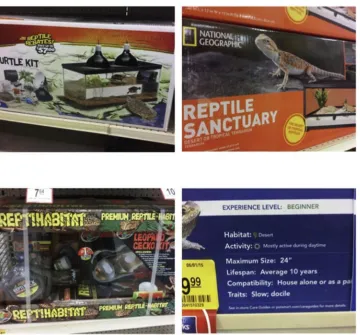
Concern regarding the mislabeling or misdescription of a species biological needs or suitability, and implying that they are“beginner”
or“easy to keep”animals (e.g.,Figure 1.), has been frequently raised in recent years (e.g.,Altherr & Freyer, 2001; Laidlaw, 2005; Toland et al., 2012; Jessop & Warwick, 2014; Warwick et al., 2014; Whitehead & Vaughan-Jones, 2015). Contrary to some trade-led promotions,
responsible organizations including animal welfare groups such as the American Society for the Prevention of Cruelty to Animals (ASPCA, 2015), the Animal Protection Agency (APA, 2015), and also the pet industry (ZZF, 2015) acknowledge that exotic animals are not easy to keep. Mislabeled and/or misdescribed species are seriously and negatively compounded by poor-quality trade-led, breeder, owner-to-owner, and online guidance that misrepresents animals’
needs (Altherr & Freyer, Laidlaw, 2005; Toland et al., 2012; Jessop & Warwick, 2014; Warwick 2015a, 2015b; Krautwald-Junghanns et al., 2017).
Knowledge and husbandry deficits
An adjunct issue to that of misleading trade information is the matter of generalized knowledge deficiencies regarding exotic an-imal biology and husbandry (Whitehead and Forbes, 2013; Warwick, 2014; Grant et al., 2017). Indeed, conditions for captive exotic animals (e.g., amphibians and reptiles) have been described as“depauperate,”and even in the best zoos as“controlled depri-vation”(Burghardt, 2013). The prospects for exotic species in do-mestic environments without the relative benefits of professional management and facilities are highly concerning, and several studies demonstrate that poor husbandry is commonplacedeven
for commonly traded and kept species (e.g.,Kohler, 2010; Pees et al., 2014; Krautwald-Junghanns et al., 2017). The consequences of this lack of knowledge are often tragic with highly disturbing annual pet mortality rates such as 75% of reptiles (Toland et al., 2012) and over
90% of aquariumfish (Toland et al., unpublished). Poor welfare in the commercial sector reveals industry standard mortality rates across several animal classes to be approximately 70% during 6 weeks at wholesalers (Ashley et al., 2014). Although there are some reported health benefits from keeping some animals, mostly domesticated dogs and cats, as well as observing aquaria (Headey, 1999; Barker et al., 2003; Friedmann et al., 2011; Peacock et al., 2012; Cherniack & Cherniack, 2014), human health and safety may also be negatively affected by keeping pets (Cherniack & Cherniack, 2014), with exotic species being considered a dispro-portionate risk (Warwick & Steedman, 2012; Warwick & Corning, 2013). One common example of pet-linked zoonoses is reptile-related salmonellosis, which in the United States and United Kingdom is responsible for an estimated 74,000 and 6,000 cases, respectively (Mermin et al., 2004; Toland et al., 2012), and research in the United Kingdom has indicated that 27% of children aged under 5 years who were hospitalized with salmonellosis infections were reptile associated (Murphy & Oshin, 2015).
Studies into efforts to educate sellers and keepers such as those concerning reptiles appear unproductive with both welfare and public health information uptake and application being dispro-portionately minimal (Kohler, 2010; Abbott et al., 2012; Pees et al., 2014; Whitehead, 2016; Williams & Jackson, 2016; Howell & Bennett, 2017; Moorhouse et al., 2017). Underlying reasons for the poor uptake and application of even limited information are un-clear. Some research indicates that exotic pet acquisition is signif-icantly motivated by status factors, narcissistic and borderline personality traits, ostentation, social recognition, conformity, and materialistic indulgence (Pajarskaite & Cekavicius, 2012; Vonk, et al., 2016) rather than an intrinsic respect for animals or their wellbeing. However, a study of lizard keepers found that acquisition followed interest in those animals, although the welfare outcomes remained poor (Howell & Bennett, 2017).
A frequent and growing issue is that of unwanted exotic pets, which present a considerable burden on animal care centers or
“sanctuaries”(AAP, 2018; Smart, 2018). Typically, sources of hand-over to sanctuaries are former purchasers of exotic animals who realize that caring for these animals is considerably more demanding than had been conveyed, as well as confiscations due to abuse and neglect (RSPCA, 2004; 2016; 2017).
It is widely recognized that keeping common domesticated species, notably cats and dogs, frequently involves challenges with negative welfare outcomes (Howell et al., 2016a, 2016b). However, whereas most people, and in particular veterinarians, are very familiar with the needs and problems of domesticated animals, exotic species are not only far less familiar but also their needs and problems are typically far more specialized (Whitehead & Forbes, 2013). Accordingly, it is probably correct to state that, unlike for domesticated dogs and cats, the needs of exotic animals cannot be reliably met in the home environment.
Discussion
Essential welfare safeguards such as those contained within the
“five freedoms”(FFs) (Table 1) and the“five welfare needs”(FWNs) (Table 2) permeate both concepts and provisions, including legal, for animals in human care.
Mellor & Beausoleil (2015)and Mellor (2016) promoted“ ex-tensions”to the FFs to more appropriately reflect greater scientific understanding of the biological sophistication of animals and the requirements for their welfare. Whereas the FFs (and the FWNs) mostly focus on avoiding negative states, Mellor proposes redirec-tion to both negative state avoidance and positive state assurance to include“no compromise enhancement”of conditions to achieve good welfare and a“life worth living.”Indeed,Mellor & Beausoleil
(2015) stated that certain negative behaviors that the FFs aspire to prevent can only be temporarily neutralized and not eliminated by the FF approach. Similarly,Warwick et al. (2016)suggested that if objective scientific evidence is applied to reptile welfare needs, then the provisions of the FFs (or the FWNs) are inadequate. A recent review byMcBride (2017)of small prey mammals empha-sized the need to generously interpret the concepts and provisions of the FFs in an animal-centric manner to offer a“life worth living.”
These messages are consistent with the notion that the current foundational principles of husbandry, and in some cases law, are poorly designed or unfit for purpose, and that new measures are necessary to resolve persistent welfare problems associated with captive animals.
Case example
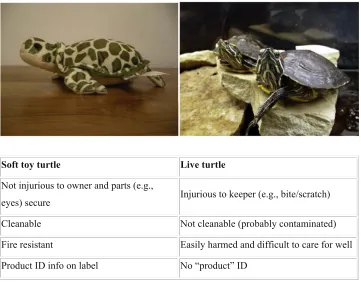
Figure 2and associated case example raises questions regarding
“consumer”capacity to practice informed consent when purchas-ing a pet animal (here a turtle).
Soft toy
Production standards for soft toys typically require several fea-tures intended for both consumer safety and confidence. These features include“eyes”that cannot be pulled from the productdto
prevent a child from ingesting or choking on them; an absence of sharp edges that could cause incidental harm; environment- and child-safe materialsdbecause a child is likely to put the toy into his
or her mouth; machine-washabledfor hygiene purposes; and a
variablefire-resistant capacity. Product labeling conveys safeguards for these important features and/or the traceability of the manufacturer.
Live turtle
In comparison, the purchase of a live turtle from a pet store may deliver the animal directly into the hands of a child with no verifications or genuine guarantees whatsoever regarding either the safety implications of the “product” or the turtle’s own health state. Relatedly, a purchaser is unlikely to know where the animal came from, how the animal was transported, or how to care for it (information that, in many cases, is not available even at the scientific level). Significantly, unlike the Table 1
Five freedoms
1. Freedom from hunger and thirstdby ready access to fresh water and a diet to maintain full health and vigor;
2. Freedom from discomfortdby providing an appropriate environment including shelter and a comfortable resting area;
3. Freedom from pain, injury, or diseasedby preventing them from getting ill or injured and by making sure animals are diagnosed and treated rapidly if they do;
4. Freedom to express normal behaviordby providing sufficient space, proper facilities, and company of the animal’s own kind;
5. Freedom from fear and distressdby ensuring conditions and treatment, which avoid mental suffering.
Webster, 1994.
Table 2
Five welfare needs (FWNs)
1. Need for a suitable environment; 2. Need for a suitable diet;
3. Need to be able to exhibit normal behavior patterns; 4. Need to be housed with, or apart, from other animals; 5. Need to be protected from pain, suffering, injury, and disease.
soft toy example, surface contaminants, skin detritus, feces, and bacteria inherently reside on and within the pet turtle and become disseminated on handlers and items throughout the home. Ironically, whereas the soft toy is subject to contamina-tion by the home environment, the home environment is sub-ject to contamination by the live turtle. In addition, sharp jaw plates and claws can easily cause bite and scratch injuries and result in infections. Infection and injury risks from turtles, like other pets, cannot be eradicated.
Positive lists
The aforementioned issues have consolidated much objective expert opinion and governmental inclination in favor of allowing in trade only a smaller number of species for which sound objective scientific evidence exists (Wensley et al., 2014; Whitehead & Vaughan-Jones, 2015). This evidence also should demonstrate natural adaptability of the animal to the human environment, availability of adequate biological and husbandry information, the risk level of significant zoonotic and safety issues, and no significant invasive species risks. Relatedly, the relevant evidential thresholds for“allowing in”species as pets should be set high (Warwick et al., 2016) not least to counter the low-quality information common to trade- and hobbyist-led sources (Warwick, 2014). This “ precau-tionary”principle of using evidence-based methods to determine which species are suitable for trading and keeping is enshrined in the concept of“positive lists,”and of course this is also inherent to many commercial and professional sectors with responsibilities to public health and safety issues and to the environment. Positive lists share the precautionary principles familiar to responsible in-dustry and consumer protection and thus are relevant to any pet suitability and labeling scheme.
At least 10 European countries and 20 Canadian regions either already use or are at various stages of considering and developing positive lists for pets. Positive lists are likewise gaining significant
support not least among veterinary and allied professionals who are often at the forefront of addressing exotic pet welfare. A“straw poll”survey at a major veterinary event in 2017 reported a 512-to-one “vote” in favor of positive lists for only approved species in trade and keeping as part of greater controls on the exotic pet business (APA, 2017).
Given the historical and current high levels of uncontrolled, unlawful, and other negative practices associated with the exotic pet business, it is inevitable that these problematic issues will persist for the foreseeable future. However, it is probable that greatly reduced species diversity in trade and keeping, as guided by positive lists, will significantly aid in decreasing monitoring work-loads and facilitate greater scrutiny. Also, a more informed, discerning or circumspect public ought to further reduce overall demand and thus reduce the scale of concerning issues.
Current evidence-based options for pet suitability and labeling
Schuppli & Fraser (2000)probably provided thefirst scientific framework for assessing species suitability as “companions”. Schuppli & Fraser’s principles have essentially guided subsequent key“pet suitability tools”. This method involves a self-assessment checklist of 12 questions designed to raise awareness of welfare-related, human health and safety, conservation, and invasive species factors; however, the system was directed primarily at scientific professionals and requires significant background bio-logical information to use.
Warwick et al. (2014)published a pet suitability algorithm called
“EMODE,” which classifies animals as “easy,” “moderate,” “diffi -cult,”or“extreme”in terms of how challenging they may be to keep in relation to animal welfare and human health and safety factors. EMODE was developed (in part by some of the present authors) to offer a user-friendly system both for scientific purposes and to aid informed consent for anyone considering acquiring any type of pet and for use by formal authorities. The system uses a series of 6
Soft toy turtle
Live turtle
Not injurious to owner and parts (e.g.,
eyes) secure
Injurious to keeper (e.g., bite/scratch)
Cleanable
Not cleanable (probably contaminated)
Fire resistant
Easily harmed and difficult to care for well
Product ID info on label
No “product” ID
preweighted closed questions that accumulate points toward an overall“keeping challenge”score.
Schuppli et al. (2014)provided a discussion in which three major welfare concerns are prioritized, these being that pet animals
“function well biologically,”are“free from negative psychological states”and are“able to experience normal pleasures,”and to“lead reasonably natural lives.” In addition, risks from zoonoses and invasive potential are also raised as integral considerations. These factors are used to form a checklist of various concerns as part of an informative self-assessment approach. Accordingly, this method offers an analysis of pet suitability rather than a working instru-ment for determination.
Koene et al. (2016)also developed a model that comprises a decision tree to assess pet species suitability. This method uses an evidence-based algorithm that requires accumulation and grading of relevant scientific bibliographic information for its insertion into the algorithm. The system requires information input regarding animal biology, behavior, husbandry, welfare, health, zoonoses, and human-animal relationship. The Koene et al. system is notably aimed at the scientific and professional community and as such is arguably unsuited to nonbiologists.
Wensley et al. (2014)on behalf of several key British veterinary organizations proposed fundamental principles for only approving species in trade and keeping where there is a reasonable expecta-tion from published evidence and professional experience that the
“FWNs” can be met and that animal’s needs must be fully researched and understood before acquisition.
The British Veterinary Zoological Society (BVZS, 2014) has proposed a “traffic light” approach to flagging species at the point of sale as either red (“species that should never be kept except for specific conservation purposes”), amber (“species that require a Dangerous Wild Animals Act, UK license and/or a greater degree of expertise”), or green (“species considered suitable species for all, provided the owner has demonstrated suitable education and ability to fulfill their welfare needs”). Determination of which species meet respective categories is suggested to be achievable by intersector (e.g., veterinary and trade) assessment and is therefore highly limited, committed to using vested interest input and exclusive of some key objective expert input.
Comparative evaluation of current options for pet suitability and labeling
Assessment tools developed bySchuppli & Fraser (2000)and Schuppli et al. (2014)undoubtedly provided similar essential con-siderations for a range of pet-related issues and useful contribu-tions to promoting a responsible mindset across a range of individuals from animal keepers (including prospective) to law makers. In addition, these proposals manifestly offer vital questions that can be used to form the bases of diverse protocols for labeling animals according to suitability or otherwise. Unfortunately, these assessment tools do not offer standalone mechanisms for scoring animals as part of a clear labeling system. AlthoughKoene et al.’s (2016)method does not“score”animals in a manner comparable to other product labeling, it does enable animals to be assessed based on objective scientific data. However, this tool is, as indicated earlier, a high-level scientific protocol meaningfully accessible only to biologists and other informed professionals, and therefore, in our view, precludes its regular use by nonacademics. Furthermore, it does not have clear application to simple pet labeling. We consider the principle of traffic lightflagging systems to be acceptable and the simplicity of color-coded labeling is wholly in concert with the ethos of this report. However, methodologies for this approach require that objective assessments are used and this necessarily
should exclude vested interests, or if such involvement is manda-tory, proportionate minimal weight ought to be assigned to that sector to avoid problematic biases. Unfortunately, in our view, the specific methodology proposed by British Veterinary Zoological Society does not meet the objectivity/nonbias test due to vested interest input, and the “amber” and “green” light categories are overly inclusive of diverse species, which may effectively encourage wild animal keeping.Wensley et al.’s (2014)outline for principles for only approving species in trade and keeping where there is a reasonable expectation from published evidence and professional experience that the “FWNs” can be met and that animals’needs must be fully researched and understood before acquisition are, in our view, absolute fundamentals when designing any pet suitability guidance.
Of the approaches and systems reviewed previously (the only systems of which the present authors are aware),Warwick et al.’s (2014)EMODE provides the sole tool that acts as a standalone pet suitability assessment guide designed to be accessible across nonacademic and academic sectors. Again, we reiterate that some of the present authors were involved in the development of EMODE, although with nofinancial interests deriving from its use. Unlike other methods, the EMODE system does not take into ac-count species conservation and invasive risk potential. The fact that EMODE does not include these ecological factors reflects the dy-namic nature of species risk classification, which does not easily lend itself to scoring parameters.
EMODE is available free, both online and as a“desktop”brochure (EDF, 2014) and the full-length, peer-reviewed, scientific report on which it is based is also available open access and online for full disclosure. EMODE fully supports the development of a clear, user-friendly, and objective pet labeling scheme by offering a scientific evidence-based tool that allows easy labeling of any type of animal. This clear messaging is capable of being represented on individual display “cages” within any pet-vending outlet (see “Practical operation”).
EMODE has also benefited from widespread support by key organizations and figures, such as the international animal coalition Eurogroup for Animals and ZooCheck Canada. The British Government Home Office also reviewed the system and endorsed its scientific credibility. The EMODE system is frequently referred to in key literature as a preferred or note-worthy option for species assessment (e.g.,Whitehead & Forbes, 2013; Grant et al., 2017) and on governmental and veterinary websites (e.g., Brighton & Hove City Council, 2018; Enfield Council, 2018; Morris, 2018; RCVS, 2018; Test Valley Borough Council, 2018).
Recommendations
We propose that a system is required that facilitates decision-making at the interface between sale and purchase sectors and that uses clear evidence-based labeling. Such a system may loosely recognize methods already used in the advertisement and sale of commercial products, although with additional safeguards to reflect the inherent welfare needs of live animals. Moreover, given the long-established ineffectiveness of public education in pre-venting the raft of problematic issues associated with pet keeping, we feel that it is important that future efforts are focused in the most preventative capacity as possible, in particular at the point of sale and earlier.
Pet labeling scheme
concerns. It is widely acknowledged that obtaining and keeping any animal as a pet, whether an exotic or domesticated species, con-stitutes a significant responsibility and that a decision to acquire a pet must be given careful consideration. Labeling schemes for food products are widely used and take various forms, including basic data on nutrient values and levels of certain content (e.g., salt, sugar, fat, and allergens) that raise current concerns (DoH, 2017a, 2017b; FSA, 2017). Color-coded “traffic light” systems are often used in food selling to convey various health implications (FPH, 2008; DoH, 2016).
It may seem inappropriate or even“distasteful”to refer to any animal as a“product”; however, in terms of commercial and legal considerations, pets are effectively categorized as“ prod-ucts”. Regardless, using the term“product”here does not imply that animals are merely “possessions” or “objects”. Despite various evolutions in food package information, concerns remain regarding the clarity and convenience to the public of some existing labeling schemes, and the need to do more to deliver straightforward messaging. Accordingly, while debate around the detail of message delivery is ongoing, the need to provide reliable messaging regarding foods (and many other products) via labeling is well recognized. Notwithstanding an-imals being“products”in commercial terms, neither pets nor their purchasers benefit from the current typical accountability or health and safety standards assigned to food or indeed any other“goods”.
We feel that the EMODE system (https://link.springer.com/ article/10.1007/s10806-013-9455-x) provides the most appropriate model for pet suitability and labeling schemes. The proposed pet labeling scheme herein emphasizes 2 important messages that are vital to public education and informed decision-making. First, the scheme provides a refined progressive traffic lightebased indicator
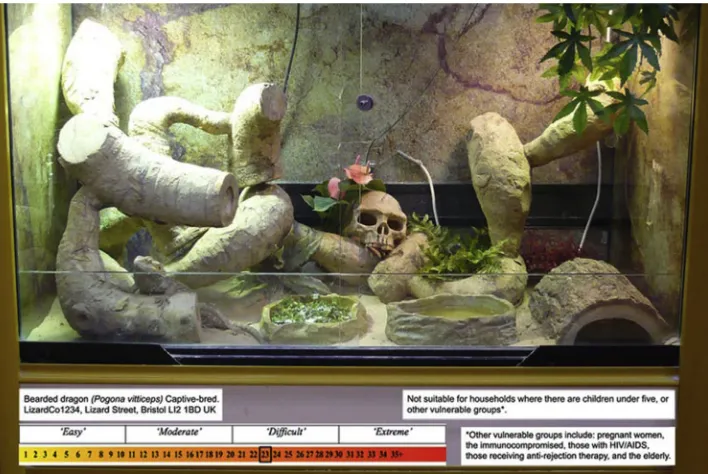
flagging the challenges of keeping any animal based on EMODE’s public health and safety and animal welfare scores, and second, the scheme provides a clear statement to be added to specific animal enclosures conveying that certain animals are considered unsuit-able for homes with young children and other vulnerunsuit-able groups (see Practical operation). EMODE becomes applicable following
reference to current existing bans and restrictions in relevant countries or regions.
We would suggest that issues concerning species conservation and invasive risk potential are separately factored-in as additional considerations if and when universal assessment methodologies are also developed for those particular risks. Development of a species conservation and invasive risk assessment does not pre-clude prior adoption of a method addressing animal welfare and public health and safety.
Practical operation
Given the widely differing ways in which national controls and regulations are applied, it is beyond the scope of this article to consider detailed legislative implementation methodologies. We are, however, able to envisage operational procedures following legislative implementation, and thus, we envisage that practical operation of the pet labeling scheme would be applied approxi-mately as follows:
1. A database should be maintained of animal species and types that have been prescored (using the EMODE system) according to the husbandry and public health and safety challenges they present. This system will be available online and freely acces-sible (http://www.emodepets.com).
2. The EMODE database will be regularly updated by its designers to include new species or alter the score of species based on new evidence.
3. Each responsible regional authority can compile a list of all species to be licensed for sale in their respective jurisdictions. 4. If an animal is not already listed in the EMODE database, then each authority (or individual) can refer to the EMODE system and directly calculate the species“score,”for which guidance will be found on the site itself.
5. Each responsible authority can provide their regional pet-vending outlets with the confirmed list of scores for each spe-cies so that these may be affixed to each animal enclosure.
6. Each pet-vending outlet may then refer to the EMODE website to download the universal colored template bar chart/child caution with the appropriate score highlighted and then affix the signage to each relevant enclosure (Figure 3).
We also consider that permitted lists (known as“positive lists”) should be formally developed of species regarded as suitable to be generally traded and kept within the household to serve as an adjunct measure to control diversity of species available. Positive lists may be country or region specific to account for local factors such as available veterinary and other impartial expertise and climate-associated invasive risk, and assessed using only objective evidence-based criteria. Our preference would be to adopt criteria from the EMODE system together with species conservation and invasive risk assessments derived from, for example,Schuppli & Fraser (2000).
Conclusions
Animal welfare, public health and safety, and species and ecological conservation have endured decades of sufferance and harm as the result of the exotic pet trade being significantly out of reasonable control. Regulations, whether mandatory or as codes of practice, have failed to prevent or abate the range of issues con-cerned. Post animal acquisition educational “cures” have not worked, and best evidence implies that this trend will continue, given that the more we learn about animal needs, the more apparent it becomes that they cannot be met in the restrictive conditions of domestic captivitydand arguably also within the
professional zoological sector.
There is a strong and urgent need for an objective, balanced, and proportionate means of labeling pet animals (particularly exotic species) to facilitate informed decision-making by prospective purchasers and safeguard animal welfare, public health, species conservation, and the environment. Current and future remedial emphasis needs to be directed at prevention and hence focused on preacquisition information and decision-making. The use of posi-tive lists in conjunction with the EMODE-based pet labeling scheme would be strongly and mutually self-augmenting.
The EMODE-based pet labeling scheme we propose offers a long overdue approach to bringing pet animal trading in line with other industries that are already obliged to comply with relevant stan-dards and therefore responsible product description and selling, and also benefits from its user-friendly design, independence, and evidence-based structure. Proposal of a pet labeling scheme does not, however, imply condonation of trading or keeping exotic pets but rather aims to promote much needed greater responsibility within the industry.
Acknowledgments
The Animal Protection Agency contributed financially to the literature search and review by C.Warwick and C.Steedman, while having no design, research, data collection, analysis, interpretation, writing, decision-making or other directional role in this report.
Conflict of interest
C. Warwick, C. Steedman, and M. Jessop have acted as profes-sional consultants to the Animal Protection Agency.
References
AAP, 2018. Animal advocacy and protection. Available at:https://www.aap.nl/en. Accessed February 9, 2018.
Abbott, S.L., Ni, F.C.Y., Janda, M.J., 2012. Increase in extraintestinal infections caused by Salmonella enterica subspecies IIeIV. Emerg. Infect. Dis. 18, 637e639. Akhtar, A., 2012. Animals and Public Health: Why Treating Animals Better Is Critical
to Human Welfare. Palgrave Macmillan, Hampshire, UK.
Altherr, F., Freyer, D., 2001. Morbidity and Mortality in Private Husbandry of Rep-tiles. Report by Pro Wildlife to the Royal Society for the Prevention of Cruelty to Animals. RSPCA, Horsham.
APA, 2015. I’m a chameleon.get me out of here! Animal Protection Agency. Available at:http://www.apa.org.uk/lush/. Accessed June 25, 2017.
APA, 2017. Positive lists for exotic pets get vote at LVS. Animal Protection Agency. Veterinary Times (21st Nov). Available at:https://www.vettimes.co.uk/news/ positive-lists-for-exotic-pets-get-vote-at-lvs/. Accessed February 11, 2018. APPA, 2017. National pet owners survey 2017-2018, American Pet Products
Asso-ciation. Available at: http://www.americanpetproducts.org/press_industry-trends.asp. Accessed June 25, 2017.
Arena, P.C., Steedman, C., Warwick, C., 2012. Amphibian and reptile pet markets in the EU an investigation and assessment. Animal Protection Agency, Animal Public, International Animal Rescue, Eurogroup for Wildlife and Laboratory Animals, Fundación para la Adopción, el Apadrinamiento y la Defensa de los Animales, 52 pp. Available at: https://www.apa.org.uk/pdfs/AmphibianAn-dReptilePetMarketsReport.pdf. Accessed February 9, 2018.
Ashley, S., Brown, S., Ledford, J., Martin, J., Nash, A.E., Terry, A., Tristan, T., Warwick, C., 2014. Morbidity and mortality of invertebrates, amphibians, rep-tiles and mammals at a major exotic companion animal wholesaler. J. Appl. Anim. Welf. Sci. 17, 1e14.
ASPCA, 2015. Adoption tips. American Society for the Prevention of Cruelty to An-imals. Available at: http://www.aspca.org/adopt/adoption-tips/exotic-animals-pets. Accessed February 9, 2018.
Auliya, M., 2003. Hot Trade in Cool Creatures: A Review of the Live Reptile Trade in the European Union in the 1990s with a Focus on Germany. TRAFFIC Europe, Brussels, Belgium.
AVMA, 2015. Understanding companion animal practitioners’ attitudes toward antimicrobial stewardship. J. Am. Vet. Med. Assoc. 247 (8), 883e884. Barker, S.B., Rasmussen, K.G., Best, A.M., 2003. Effect of aquariums on
electrocon-vulsive therapy patients. Anthrozoös 16 (3), 229e240.
Biondo, M.V., 2017. Quantifying the trade in marine ornamental fishes into Switzerland and an estimation of imports from the European Union. Glob. Ecol. Conserv. 11, 95e105.
Birdlife International, 2017. Wild bird trade and CITES. Available at: http:// www.birdlife.org/worldwide/policy/wild-bird-trade-and-cites. Accessed January 26, 2018.
Böhm, M., Collen, B., Baillie, J.E., Bowles, P., Chanson, J., Cox, N., Rhodin, A.G., 2013. The conservation status of the world’s reptiles. Biol. Conserv. 157, 372e385. Brighton & Hove City Council, 2018. Available at:
https://present.brighton-hove.-gov.uk/mgconvert2pdf.aspx?id¼78343. Accessed February 14, 2018.
Brown, C., 2004. Emerging zoonoses and pathogens of public health significance -an overview. Rev. Sci. Tech. 23 (2), 435e442.
Brugere-Picoux, L., Chomel, B., 2009. Importation of tropical diseases to Europe via animals and animal products: risks and pathways. Bull. Acad. Natl. Med. 193, 1805e1819.
Burghardt, G.M., 2013. Environmental enrichment and cognitive complexity in reptiles and amphibians: concepts, review, and implications for captive pop-ulations. J. Appl. Anim. Behav. Sci. 147, 286e298.
Burghardt, G.M., 2015. Play infishes, frogs and reptiles. Curr. Biol. 25, 9e10. Burghardt, G.M., 2017. Keeping reptiles and amphibians as pets: challenges and
rewards. Vet. Rec. 181, 447e449.
BVZS, 2014. Statement of the British Veterinary Zoological Society’s (BVZS) Position on Non-traditional companion animals, 2pp. Available at: https:// www.bvzs.org/images/uploads/Statement_of_the_BVZS_Position_on_Non_ Traditional_Companion_Animals.pdf. Accessed February 9, 2018.
CAWC, 2003. Report on the Welfare of Non-domesticated Animals Kept for Companionship. Companion Animal Welfare Council, Devon.
CDC, 2017a. Pets & antibiotic resistance. Available at: https://www.cdc.gov/health-ypets/pets-and-antibiotic-resistance.html. Accessed February 9, 2018. CDC, 2017b. Take care with pet reptiles and amphibians. Centers for Disease Control
and Prevention. Available at: https://www.cdc.gov/features/salmonella-frogturtle/index.html. Accessed February 9, 2018.
Cherniack, E.P., Cherniack, A.R., 2014. The benefit of pets and animal-assisted therapy to the health of older individuals. Curr. Gerontol. Geriatr. Res. 2014, 623203. Chomel, B.B., Belotto, A., Meslin, F.-X., 2007. Wildlife, exotic pets and emerging
zoonoses. Emerg. Infect. Dis. 13 (1), 6e11.
DoH, 2016. Guide to Creating a Front of Pack (FoP) Nutrition Label for Pre-packed Products Sold through Retail Outlets. Department of Health. Available at: https://www.gov.uk/government/uploads/system/uploads/attachment_data/ file/566251/FoP_Nutrition_labelling_UK_guidance.pdf. Accessed February 9, 2018.
DoH, 2017a. Technical Guidance on Nutrition Labeling. Department of Health. Available at: https://www.gov.uk/government/uploads/system/uploads/attach-ment_data/file/595961/Nutrition_Technical_Guidance.pdf. Accessed February 9, 2018.
DoH, 2017b. Food Labelling and Packaging. Department of Health. Available at: https://www.gov.uk/food-labelling-and-packaging. Accessed February 9, 2018. EDF, 2014. PetseEasy or Difficult to Keep? Emergent Disease Foundation. Available
Enfield Council, 2018. Available at:https://governance.enfield.gov.uk/documents/ s54325/Pet%20Shop%20Lic%20Comm%20report%20FINAL.pdf. Accessed February 14 2018.
Fischer, A.C., Bartsch, F., Altherr, S., 2015. Endstation Wohnzimmere Exotische Säugetiere Als Haustiere. Pro Wildlife, Munich, p. 32. Available at:https:// www.prowildlife.de/wp-content/uploads/2016/06/Final_Station_Living_Room.pdf. Accessed February 14, 2018.
FPH, 2008. Traffic Light Food Labelling, a Position Statement. Faculty of Public Health. Available at: http://www.fph.org.uk/uploads/ps_food_labelling.pdf. Accessed February 9, 2018.
Friedmann, E., Barker, S.B., Allen, K.M., 2011. Physiological correlates of health benefits from pets. In: McCardle, P., McCune, S., Griffin, J.A., Maholmes, V. (Eds.), How Animals Affect Us: Examining the Influences of Humaneanimal Interac-tion on Child Development and Human Health. American Psychological Asso-ciation, Washington, DC, pp. 163e182.
FSA, 2017. European Food Information to Consumers Regulation No 1169/2011 (FIC). Food Standards Agency. Available at:https://www.food.gov.uk/enforcement/ regulation/fir/labelling. Accessed February 9, 2018.
Grant, R.A., Montrose, V.T., Wills, A.P., 2017. ExNOTic: Should we be keeping exotic pets? Animals 7 (47), 1e11.
Hale, C.R., Scallan, E., Cronquist, A.B., Dunn, J., Smith, K., Robinson, T., Lathrop, S., Tobin-D’Angelo, M., Clogher, P., 2012. Estimates of enteric illness attributable to contact with animals and their environments in the United States. Clin. Infect. Dis. 54 (S5), S472eS479.
Headey, B., 1999. Health benefits and health cost savings due to pets: Preliminary estimates from an Australian national survey. Soc. Indic. Res. 47 (2), 233e243. Henderson, W., Bomford, M., 2011. Detecting and Preventing New Incursions of Exotic Animals in Australia. Report prepared for the Detection and Prevention Project 9.D.9 Risk assessment processes in Australia. Invasive Animals Cooper-ative Research Centre, Canberrra, ACT.
Howell, T.J., Mornement, K., Bennett, P.C., 2016a. Pet cat management practices among a representative sample of owners in Victoria, Australia. J. Vet. Behav.: Clin. Appl. Res. 11, 42e49.
Howell, T.J., Mornement, K., Bennett, P.C., 2016b. Pet dog management practices among a representative sample of owners in Victoria, Australia. J. Vet. Behav.: Clin. Appl. Res. 12, 4e12.
Howell, T.J., Bennett, C.P., 2017. Despite their best efforts, pet lizard owners in Vic-toria, Australia, are not fully compliant with lizard care guidelines and may not meet all lizard welfare needs. J. Vet. Behav.: Clin. Appl. Res. 21, 26e37. HPA, 2014. Reducing the Risk of salmonella Infection from Reptiles. Health
Pro-tection Agency. Available at:https://www.gov.uk/government/uploads/system/ uploads/attachment_data/file/377731/Salmonella_in_reptiles_factsheet__2_.pdf. Accessed February 9, 2018.
IUCN, 2011. Importance of Freshwater Fishes. International Union for Conservation of Nature. Available at:http://www.iucnffsg.org/freshwater-fi shes/importance-of-freshwater-fishes/. Accessed February 9, 2018.
Jessop, M., Warwick, C., 2014. Pets: to keep or not to keepeperhaps EMODE has the answer. Vet. Times 44, 23e25. Available at:https://www.vettimes.co.uk/app/ uploads/wp-post-to-pdf-enhanced-cache/1/pets-to-keep-or-not-to-keep-perhaps-emode-has-the-answer.pdf. Accessed February 14, 2018.
Jones, K.E., Patel, N.G., Levy, M.A., Storeygard, A., Balk, D., Gittleman, J.L., Daszak, P., 2008. Global trends in emerging infectious disease. Nature 451, 990e993. Karesh, W.B., Cook, R.A., Gilbert, M., Newcomb, J., 2007. Implications of wildlife
trade on the movement of avian influenza and other infectious diseases. J. Wildl. Dis. 43 (S3), 55e59.
Keller, R.P., Geist, J., Jeschke, J.M., Kühn, I., 2011. Invasive species in Europe: Ecology, status, and policy. Environ. Sci. Eur. 23, 23.
Koene, P., de Mol, R.M., Ipema, B., 2016. Behavioral ecology of captive species: using bibliographic information to assess pet suitability of mammal species. Front. Vet. Sci. 3, 35,.
Kohler, R., 2010. Der‘Schildkrötentest’: das neue Gesundheitsprojekt für engagierte Mitglieder. Elaphe 2, 57e62.
Krautwald-Junghanns, M.-E., Sobing, A., Plenz, B., Bartels, T., Baur, M., Blahak, S., Dayen, M., Hetz, S.K., Kirmair, R., Kölle, P., Kummerfeld, N., Kunze, A., Moll, J., Mutschmann, F., Pees, M., Pieper, K., Reichelt, C., Riedel, U., Schmidt, V., Schmitz Ornés, A., Tischbirek, D., Wolf, P., Cramer, K., 2017. Haltung exotischer und wild lebender Vögel und Reptilien in Privathand. Deutsches Tierärzteblatt 65 (12), 1644e1648.
Kubiak, M., Pellet, S., 2018. Invasive alien species legislation: A veterinary perspective. Companion Anim. 23, 44e48.
Laidlaw, R., 2005. Scales and tails: The welfare and trade of reptiles kept as pets in Canada. Zoocheck Canada, 135pp. Available at:https://www.zoocheck.com/ wp-content/uploads/2016/06/Reptile_Report_FA.pdf. Accessed February 14, 2018. Langton, T.E.S., Atkins, W., Herbert, C., 2011. On the distribution, ecology and management of non-native reptiles and amphibians in the London area. Part 1. Distribution and predator/prey impacts. Naturalist 90, 83e156.
Leite-Martins, L., Mahú, M.I., Costa, A.L., Bessa, L.J., Vaz-Pires, P., Loureiro, L., Niza-Ribeiro, J., de Matos, A.J.F., Martins da Costa, P., 2015. Prevalence of antimicrobial resistance in faecal enterococci from vet-visiting pets and assessment of risk factors. Vet. Rec. 176, 674.
McBride, E.A., 2017. Small prey species’ behavior and welfare: implications for veterinary professionals. J. Small Anim. Pract. 58, 423e436.
Mellor, D.J., 2016. Updating animal welfare thinking: moving beyond the “five freedoms”towards“a life worth living”. Animals 6, 21.
Mellor, D.J., Beausoleil, N.J., 2015. Extending the‘five domains’model for animal welfare assessment to incorporate positive welfare states. Anim. Welf. 24 (3), 241e253.
Mermin, J., Hutwagner, L., Vugia, D., Shallow, S., Daily, P., Bender, J., Angulo, F.J., 2004. Reptiles, amphibians, and human Salmonella infection: A population-based, case-control study. Clin. Infect. Dis. 38 (Suppl 3), S253eS261. Moorhouse, T.P., Balaskas, M., D’Cruze, N.C., Macdonald, D.W., 2017. Information
could reduce consumer demand for exotic pets. Conserv Lett 10, 337e345. Morris, G., 2018. Grahame Morris MP. Available at:http://grahamemorrismp.co.uk/?
p¼3846. Accessed February 14, 2018.
Murphy, D., Oshin, F., 2015. Reptile-associated salmonellosis in children aged under 5 years in South West England. Arch. Dis. Child 100 (4), 364e365.
Natusch, D.J., Lyons, J.A., 2012. Exploited for pets: the harvest and trade of am-phibians and reptiles from Indonesian New Guinea. Biodivers. Conserv. 21 (11), 2899e2911.
Pajarskaite, M., Cekavicius, T., 2012. Pets as Status Symbols. Master’s Thesis in Business Administration. Jönköping International Business School, Jönköping, Sweden, p. 71.
Pasmans, F., Bogaerts, S., Braeckman, J., Cunningham, A.A., Hellebuyck, T., Griffiths, R.A., Sparreboom, M., Schmidt, B.R., Martel, A., 2017. Future of keeping pet reptiles and amphibians: towards integrating animal welfare, human health and environmental sustainability. Vet. Rec. 181, 450,.
Peacock, J., Chur-Hansen, A., Winefield, H., 2012. Mental health implications of human attachment to companion animals. J. Clin. Psychol. 68 (3), 292e303. Pees, M., Muller, K., Mathes, K., Korbel, R., Seybold, J., Lierz, M.,
Krautwald-Junghanns, M., 2014. Evaluation of the husbandry conditions of reptile species commonly kept in Germany. Kleintierpraxis 59, 477e491.
PFMA, 2017. UK pet population statistics. Pet Food Manufacturers’Association. Available at:http://www.pfma.org.uk/pet-population-2017. Accessed February 14, 2018.
Praud, A., Moutou, F., 2010. Health Risks from New Companion Animals. Eurogroup, Brussels, p. 31.
RCVS, 2018. Available at: https://knowledge.rcvs.org.uk/library-and-information-services/keeping-up-with-your-pdp-and-cpd/topics-in-focus/animals-as-petse easy-or-difficult-to-keep/. Accessed February 14 2018.
Rose, M.P., Williams, D.L., 2014. Neurological dysfunction in a ball python (Python regius) colour morph and implications for welfare. J. Exot. Pet. Med. 23 (3), 234e239.
RSPCA, 2004. Handle with care. Available at: https://www.rspca.org.uk/advi-ceandwelfare/pets/other. Accessed February 14, 2018.
RSPCA, 2005. The five welfare needs. Available at: https://www.rspca.org.uk/ whatwedo/endcruelty/changingthelaw/whatwechanged/animalwelfareact. Accessed February 14, 2018.
RSPCA, 2016. Exotic animals as pets - Together We Can.Improve Pet Animal Welfare. Available at: http://politicalanimal.org.uk/wp-content/uploads/2016/ 02/Exotics2016.pdf. Accessed February 14, 2018.
RSPCA, 2017. Understanding the motivation of beginner reptile owners. Available at: https://www.rspca.org.uk/webContent/staticImages/Downloads/ReptileReport.pdf. Accessed February 14, 2018.
Schuppli, C.A., Fraser, D., 2000. A framework for assessing the suitability of different species as companion animals. Anim. Welf. 9, 359e372.
Schuppli, C.A., Fraser, D., Bacon, H.J., 2014. Welfare of non-traditional pets. Rev. Sci. Tech. 33 (1), 221e231.
Serpell, J.A., 2015. The human-animal bond. In: Kalof, L.(Ed.), The Oxford Handbook of Animal Studies. Oxford University Press, Oxford, UK, pp. 81e95.
Smart, M., 2018. North Devon exotic animal sanctuary to close. North Devon Gazette. Available at: http://www.northdevongazette.co.uk/news/safe-haven-exotics-closing-1-5386845. Accessed February 14, 2018.
Smith, K.M., Anthony, S.J., Switzer, W.M., Epstein, J.H., Seimon, T., Jia, H., et al., 2012. Zoonotic viruses associated with illegally imported wildlife products. PLoS One 7 (1), e29505.
Smith, K.M., Zambrana-Torrelio, C., White, A., Asmussen, M., Machalaba, C., Kennedy, S., Lopez, K., Wolf, T.M., Daszak, P., Travis, D.A., Karesh, W.B., 2017. Summarizing US wildlife trade with an eye toward assessing the risk of infec-tious disease introduction. EcoHealth 14 (1), 29e39.
Test Valley Borough Council, 2018. Available at: https://www.testvalley.gov.uk/ housingandenvironmentalhealth/animalwelfare/pets/pet-ownership-the-emode-system. Accessed February 14 2018.
The Netherlands Government, 2016. Regeling van de Staatssecretaris van Econo-mische Zaken van 31 oktober 2016, nr. WJZ/16017269, houdende wijziging van de Regeling houders van dieren (positieflijst; wijziging van bijlage 2). Available at:http://bit.ly/2stET0p. Accessed February 14, 2018.
Toland, E., Warwick, C., Arena, P.C., 2012. The exotic pet trade: Pet hate. Biologist 59 (3), 14e18.
Toland, E., Warwick, C., Arena, P. C., Steedman, C. (unpublished manuscript in preparation) Premature Mortality Rates in Exotic Pet Fishes, Amphibians and Reptiles in the UK. n.d.
Traffic, 2012. Captive Bred, or Wild Taken? TRAFFIC International, Cambridge, UK. Available at: http://www.traffi c.org/publications/captive-bredor-wild-taken-examples-of-possible-illegal-trade.html. Accessed February 14, 2018. Unger, F., Eisenberg, T., Prenger-Berninghoff, E., Leidner, U., Ludwig, M.L., Rothe, M.,
Vilà, M., Basnou, C., Pysek, P., Josefsson, M., Genovesi, P., Gollasch, S., Nentwig, W., Olenin, S., Roques, A., Roy, D., Hulme, P.E., DAISIE partners, 2010. How well do we understand the impacts of alien species on ecosystem services? A pan- European, cross-taxa assessment. Front. Ecol. Environ. 8 (3), 135e144.
Vonk, J., Patton, C., Galvan, M., 2016. Not so cold-blooded: narcissistic and border-line personality traits predict attachment to traditional and non-traditional pets. Anthrozoös 29 (4), 627e637.
Warwick, C., Arena, P.C., Lindley, S., Jessop, M., Steedman, C., 2013. Assessing reptile welfare using behavioral criteria. Practice 35 (3), 123e131.
Warwick, C., 2014. The morality of the reptile“pet”trade. J. Anim. Ethics 4 (1), 74e94. Warwick, C., 2015a. How the exotic pet business as changed from ancient times
eand it’s not good news. Vet. Pract. 21, 27. Available at: http://emergent-disease.org/assets/documents/vp_12_2015-Clifford-Warwick.pdf. Accessed February 14, 2018.
Warwick, C., 2015b. Captive breeding - saving wildlife? Or saving the pet trade? The Ecologist (Sept). Available at:http://www.theecologist.org/News/news_analysis/ 2985202/captive_breeding_saving_ wildlife_or_saving_the_pet_trade.html. Accessed February 14, 2018.
Warwick, C., Corning, S., 2013. Managing patients for zoonotic disease in hospitals. J. R. Soc. Med. Sh. Rep. 4, 1e9.
Warwick, C., Steedman, C., 2012. Injuries, envenomations and stings from exotic pets. J. R. Soc. Med 105, 296e299.
Warwick, C., Steedman, C., Toland, E., 2016. Welfare of exotic pets. Vet. Rec. 178, 640. Warwick, C., Arena, P.C., Steedman, C., Jessop, M., 2012. A review of captive exotic animal-linked zoonoses. J. Environ. Health Res. 12, 9e24. Available at:
http://www.cieh.org/jehr/default.aspx?id¼41594. Accessed February 14, 2018.
Warwick, C., Steedman, C., Jessop, M., Toland, E., Lindley, S., 2014. Assigning degrees of ease or difficulty for pet animal maintenance: the EMODE system concept. J. Agric. Environ. Ethics 27 (1), 87e101.
Warwick, C., Jessop, M., Arena, P.C., Pilny, A., Nicholas, E., Lambiris, A.J.L., 2017. The future of keeping pet reptiles and amphibians: animal welfare and public health perspective. Vet. Rec. 181, 454e455.
Webster, J., 1994. Assessment of animal welfare: The five freedoms. In: An-imal Welfare: A Cool Eye towards Eden. Blackwell Science, Oxford, UK, pp. 10e14.
Wensley, S., Dawson, S., Stidworthy, M., Soutar, R., 2014. Welfare of exotic pets. Vet. Rec. 178, 540.
Whitehead, M.L., 2016. Welfare of exotic pets. Vet. Rec. 178, 477. Whitehead, M.L., Forbes, N., 2013. Keeping exotic pets. Vet. Rec. 173, 558. Whitehead, M.L., Vaughan-Jones, C., 2015. Suitability of species kept as pets. Vet.
Rec. 177, 573.
Williams, D.L., Jackson, R., 2016. Availability of information on reptile health and welfare from stores selling reptiles. Open J. Vet. Med. 6, 59e67.
Yan, G., 2016. Saving NemoeReducing mortality rates of wild-caught ornamental fish. Live Reef Fish Information Bull. 21, 3e7.