A Review on Graphs with Unique Minimum
Dominating Sets
1
D.Malarvizhi 2 V.Revathi
1
Research Scholar, Sakthi College of Arts and Science For Women, Oddanchatram.
2
Assistant Professor, Department of Mathematics, Sakthi College of Arts and Science For Women, Oddanchatram.
ABSTRACT – A dominating set for a graph G is a subset D of V such that every vertex not in D is adjacent to at least one member of D. This paper deals with some of the graphs having unique minimum dominating sets. We also find a unique minimum dominating sets for block graphs and maximum graphs.
Keywords: Domination sets, Block graphs, Unique ϒ set, Unique minimum Domination sets.
1. INTRODUCTION
Graphs can be used to model many types of
relations and processes in physical,
biological, social and information systems. Many practical problems can be represented by graphs. Emphasizing their application to real-world systems, the term network is sometimes defined to mean a graph in which attributes (e.g. names) are
associated with the nodes and/or edges.
In computer science, graphs are used to represent networks of communication, data organization, computational devices, the flow of computation, etc. For instance, the link structure of a website can be represented by a directed graph, in which the vertices represent web pages and directed edges represent links from one page to another. A similar approach can be taken to problems in social media, travel, biology, computer chip design, and many other fields. The development of algorithms to
handle graphs is therefore of major interest in computer science. The transformation of graphs is often formalized and represented by graph rewrite
systems. Complementary to graph
transformation systems focusing on rule-based
in-memory manipulation of graphs are graph
databases geared towards
transaction-safe, persistent storing and querying of graph-structured data.
Graph theory is also used to study molecules
in chemistry and physics. In condensed matter
physics, the three-dimensional structure of
complicated simulated atomic structures can be studied quantitatively by gathering statistics on graph-theoretic properties related to the topology of the atoms. In chemistry a graph makes a natural
model for a molecule, where vertices
represent atoms and edges bonds. This approach is especially used in computer processing of
molecular structures, ranging from chemical
editors to database searching.
In statistical physics, graphs can represent local connections between interacting parts of a system, as well as the dynamics of a physical
process on such systems. Similarly,
areas of the brain and the edges represent the connections between those areas. Graphs are also used to represent the micro-scale channels of porous media, in which the vertices represent the pores and the edges represent the smaller channels connecting the pores.
2. GRAPHS WITH UNIQUE MINIMUM DOMINATING SETS
Lemma: Let D be a γ-set of a graph G. Suppose for every 𝑥𝑥 ∈ 𝐷𝐷, γ(D − 𝑥𝑥) >γ(G). Then D is the unique γ-set of G.
Proof : Suppose there exists a second γ-set 𝐷𝐷′ of G. If D ≠ 𝐷𝐷′, choose a ∈ 𝐷𝐷 − 𝐷𝐷′. Now 𝐷𝐷′ dominates G, and hence 𝐷𝐷′ certainly dominates
𝐺𝐺 − 𝑎𝑎, so that |𝐷𝐷′| ≥γ(G − 𝑎𝑎). However, γ(G −
𝑎𝑎) >γ(G) = |𝐷𝐷| = |𝐷𝐷′| ≥ γ(G − 𝑎𝑎), which is a contradiction.
We see that there are three conditions of interest (i) G has a unique γ-set D.
(ii) G has a γ-set D for which every vertex in D has at least two private neighbours other than itself.
(iii) G has a γ-set D for which every vertex
𝑥𝑥 ∈ 𝐷𝐷 satisfies γ(G − 𝑥𝑥) > γ(G).
As Lemmas 3.2.2 and 3.2.3 show, for all graphs G we have (i) ⇒ (ii) and (iii) ⇒ (i), the converse of those, however, is false, as the following examples sh
a b c
h f g
Figure – 1: Connected Graph
𝐶𝐶6 shown above in Figure-1 has a γ-set𝐷𝐷 = {𝑎𝑎, 𝑑𝑑} both vertices in D have two private neighbours; however, D is not a unique γ-set.
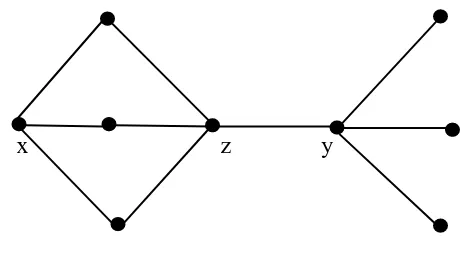
x z y
Figure-2: Connected Graph
The graph shown in Figure-2 has the unique γ-set 𝐷𝐷 = {𝑥𝑥, 𝑦𝑦}. If we delete 𝑥𝑥,the resultant graph still has domination number 2 as it is dominated by {𝑥𝑥, 𝑦𝑦}.
Lemma : Let G be a graph which has a unique γ-set
𝐷𝐷.Then for any 𝑥𝑥 ∈ 𝐺𝐺 − 𝐷𝐷,γ(G − 𝑥𝑥) =γ(G).
Proof : Certainly D dominates G − 𝑥𝑥 and so γ(G − 𝑥𝑥) ≤γ(G). If γ(G − 𝑥𝑥) <γ(G),then G − 𝑥𝑥 is dominated by some set 𝐷𝐷′ with |𝐷𝐷′| < |𝐷𝐷|. But then 𝐷𝐷′ ∪ {𝑥𝑥} would be a second γ-set for G, different from D, contradicting the uniqueness of D.
Lemma: Let G be a graph with unique γ-set 𝐷𝐷. Then γ(G − 𝑥𝑥) ≥γ(G)for all 𝑥𝑥 ∈ 𝐷𝐷.
Proof : Suppose γ(G − 𝑥𝑥) <γ(G)for some 𝑥𝑥 ∈ 𝐷𝐷. Let 𝐷𝐷′ be a γ-set of G − 𝑥𝑥.Then|𝐷𝐷′| < |𝐷𝐷| and 𝐷𝐷′ dominates all the private neighbours of 𝑥𝑥 with respect to D, other than 𝑥𝑥. But now the set 𝐷𝐷′ ∪
3. MAXIMUM GRAPHS WITH A UNIQUE MINIMUM DOMINATING SET
Theorem: Let G = (V, E) be a graph without isolated vertices with a unique minimum dominating set of cardinality γ≥ 2 and order
𝑛𝑛 = 3γ. Then
𝑚𝑚 = |𝐸𝐸| ≤ �n2� − γ�n +γ− 5
2 �
= 2γ+ 2 �γ
2�.
Proof : Let 𝐷𝐷 = �𝑥𝑥1,𝑥𝑥2, ⋯ , 𝑥𝑥γ� be the unique minimum dominating set of G and let 𝑃𝑃𝑖𝑖 =
𝑒𝑒𝑒𝑒𝑛𝑛 (𝑥𝑥𝑖𝑖, 𝐷𝐷, 𝐺𝐺) for 1 ≤ 𝑖𝑖 ≤γ. Since |𝑃𝑃𝑖𝑖| ≥ 2
for1 ≤ 𝑖𝑖 ≤γ and 𝑛𝑛 = 3γ, we have |𝑃𝑃𝑖𝑖| = 2 for 1 ≤ 𝑖𝑖 ≤γ. Let 𝑃𝑃𝑖𝑖 = �𝑒𝑒𝑖𝑖′, 𝑒𝑒𝑖𝑖"�for 1 ≤ 𝑖𝑖 ≤γ. If
there is some 1 ≤ 𝑖𝑖 ≤γsuch that 𝑒𝑒𝑖𝑖′, 𝑒𝑒𝑖𝑖" ∈ 𝐸𝐸, then
(𝐷𝐷\{𝑥𝑥𝑖𝑖}) ∪ {𝑒𝑒𝑖𝑖′} ≠ 𝐷𝐷is a minimum dominating set
of G, which is a contradiction.
If there are some 1 ≤ 𝑗𝑗 < 𝑘𝑘 ≤γ such that there are two independent edges between 𝑃𝑃𝑖𝑖 and 𝑃𝑃𝑗𝑗, say 𝑒𝑒𝑖𝑖′𝑒𝑒𝑗𝑗′, 𝑒𝑒𝑖𝑖"𝑒𝑒𝑗𝑗" ∈ 𝐸𝐸,then �𝐷𝐷\�𝑥𝑥𝑖𝑖, 𝑥𝑥𝑗𝑗�� ∪ �𝑒𝑒𝑖𝑖′, 𝑒𝑒𝑗𝑗"� ≠
𝐷𝐷 is a minimum dominating set of G, which is a contradiction.
If there are some1 ≤ 𝑖𝑖 < 𝑗𝑗 ≤γ such that
𝑥𝑥𝑖𝑖𝑥𝑥𝑗𝑗, 𝑒𝑒𝑖𝑖′𝑒𝑒𝑗𝑗′ and 𝑒𝑒𝑖𝑖′𝑒𝑒𝑗𝑗" ∈ 𝐸𝐸, then �𝐷𝐷\�𝑥𝑥𝑗𝑗�� ∪
{𝑒𝑒𝑖𝑖′} ≠ 𝐷𝐷 is a minimum dominating set of G,
which is a contradiction. This implies that for all
1 ≤ 𝑖𝑖 < 𝑗𝑗 ≤ γ there are at most two edges between
𝑃𝑃𝑖𝑖 and 𝑃𝑃𝑗𝑗 and if there are two such edges, then they are incident. Furthermore, if 𝑥𝑥𝑖𝑖𝑥𝑥𝑗𝑗 ∈ 𝐸𝐸, thenthere is at most one edge between 𝑃𝑃𝑖𝑖 and 𝑃𝑃𝑗𝑗 . Let 𝑣𝑣𝑙𝑙 for
𝑙𝑙 ≥ 0 be the number of pairs {𝑖𝑖, 𝑗𝑗} with 1 ≤ 𝑖𝑖 <
𝑗𝑗 ≤γ such that there are exactly 𝑙𝑙edges between 𝑃𝑃𝑖𝑖 and 𝑃𝑃𝑗𝑗. By the above reasonings, we obtain that
𝑣𝑣𝑙𝑙 = 0 for all 𝑙𝑙 ≥ 3 and 𝑚𝑚(𝐺𝐺[𝐷𝐷]) ≤ 𝑣𝑣0+ 𝑣𝑣1.This implies that 𝑚𝑚 = |𝐸𝐸| = 2γ+ 𝑚𝑚(𝐺𝐺[𝐷𝐷]) + 0. 𝑣𝑣0 +
1. 𝑣𝑣1+ 2. 𝑣𝑣2
≤ 2γ+ 𝑣𝑣0+ 𝑣𝑣1+ 0. 𝑣𝑣0+ 1. 𝑣𝑣1+ 2. 𝑣𝑣2
≤ 2γ+ 2(𝑣𝑣0+ 𝑣𝑣1+ 𝑣𝑣2)
= 2γ+ 2 �γ
2�
This completes the proof.
Theorem: If γ ≥ 2,then 𝑚𝑚�(𝑛𝑛,γ) = �n2� − γ�n +γ−5
2 �.
Proof : We prove that 𝑚𝑚�(𝑛𝑛,γ) ≤ �n2� − γ�n +γ−5
2 �. Therefore, let G be a graph of order n without isolated vertices that has domination number γ and property(∗).
Let 𝐷𝐷 = �𝑥𝑥1,𝑥𝑥2, ⋯ , 𝑥𝑥γ� be the unique
minimum dominating set and for 1 ≤ 𝑖𝑖 ≤γ let
𝑃𝑃𝑖𝑖 = 𝑒𝑒𝑒𝑒𝑛𝑛 (𝑥𝑥𝑖𝑖, 𝐷𝐷, 𝐺𝐺). As above |𝑃𝑃𝑖𝑖| ≥ 2 for
1 ≤ 𝑖𝑖 ≤γ . Let 𝑅𝑅 = 𝑉𝑉\�𝐷𝐷 ∪ ∪𝑖𝑖=1γ 𝑃𝑃𝑖𝑖). Let
𝑛𝑛0 = |𝑅𝑅|and 𝑛𝑛𝑖𝑖 = |𝑃𝑃𝑖𝑖|for 1 ≤ 𝑖𝑖 ≤γ. We assume
𝑛𝑛1 ≥ 𝑛𝑛2 ≥ 𝑛𝑛3 ≥ ⋯ ≥ 𝑛𝑛γ .
We will estimate the number of edges of G. There are exactly ∑γ𝑖𝑖=1𝑛𝑛𝑖𝑖 edges between D and
∪γ𝑖𝑖=1 𝑃𝑃𝑖𝑖 . There are at most �2� + �γ 𝑛𝑛2 � +0 γ𝑛𝑛0 edges in G [𝐷𝐷 ∪ 𝑅𝑅]. Let 1 ≤ 𝑖𝑖 ≤γ. Since there is no vertex 𝑒𝑒𝑖𝑖 ∈ 𝑃𝑃𝑖𝑖such that 𝑃𝑃𝑖𝑖 ⊆ N[𝑒𝑒𝑖𝑖, G], there are at most �𝑛𝑛𝑖𝑖
2 � − �𝑛𝑛𝑖𝑖� �2 edges in G[𝑃𝑃𝑖𝑖]. Since there is no vertex 𝑟𝑟𝑖𝑖 ∈ 𝑅𝑅 such that 𝑃𝑃𝑖𝑖 ⊆ N[𝑟𝑟𝑖𝑖, G] there are at most 𝑛𝑛0(𝑛𝑛𝑖𝑖 − 1)edges between 𝑃𝑃𝑖𝑖 and R. Now let
1 ≤ 𝑖𝑖 < 𝑗𝑗 ≤ γ.
Since there is no vertex 𝑒𝑒𝑖𝑖 ∈ 𝑃𝑃𝑖𝑖such that
Furthermore, if 𝑛𝑛𝑖𝑖 = 2, then also 𝑛𝑛𝑗𝑗 = 2 and it is easy to see that there is at most one edge between 𝑃𝑃𝑖𝑖 and 𝑃𝑃𝑗𝑗 .
Altogether we obtain that 𝑚𝑚 = |𝐸𝐸| ≤
𝑓𝑓�𝑛𝑛0,𝑛𝑛1,⋯ , 𝑛𝑛γ� for a function 𝑓𝑓 defined as follows
𝑓𝑓�𝑛𝑛0,𝑛𝑛1,⋯ , 𝑛𝑛γ�
= � 𝑛𝑛𝑖𝑖
γ
𝑖𝑖=1
+ �2� + �γ 𝑛𝑛2 � + 0 γ 𝑛𝑛0
+ � ��𝑛𝑛2 � − �𝑖𝑖 𝑛𝑛𝑖𝑖
2�� γ
𝑖𝑖=1
+ �( 𝑛𝑛0 𝑛𝑛𝑖𝑖− 𝑛𝑛0) γ
𝑖𝑖=1
+ � � 𝑛𝑛𝑖𝑖 𝑛𝑛𝑗𝑗 − 𝑚𝑚𝑎𝑎𝑥𝑥{ 𝑛𝑛𝑖𝑖, 3}� 1 ≤𝑖𝑖<𝑗𝑗 ≤γ
= �n2� − (γ− 1) � 𝑛𝑛𝑖𝑖
γ
𝑖𝑖=1
− � �𝑛𝑛𝑖𝑖
2� −γ 𝑛𝑛0 γ
𝑖𝑖=1
− �(γ− i)
γ
𝑖𝑖=1
𝑚𝑚𝑎𝑎𝑥𝑥{ 𝑛𝑛𝑖𝑖, 3}.
Claim: Let γ≥ 2, 𝑛𝑛𝑖𝑖 ≥ 2 for 1 ≤ 𝑖𝑖 ≤ γ and
𝑛𝑛0 ≥ 0 be integers.
Let 𝑛𝑛 = γ+ ∑ 𝑛𝑛γi=0 𝑖𝑖 and let 𝑛𝑛1 ≥ 𝑛𝑛2 ≥
𝑛𝑛3≥ ⋯ ≥ 𝑛𝑛γ . If γ = 2, 𝑛𝑛1 = 𝑛𝑛2 ≥ 4, 𝑛𝑛1 and 𝑛𝑛2 are even, then
𝑓𝑓�𝑛𝑛0,𝑛𝑛1,⋯ , 𝑛𝑛γ� ≤ �n2� − γ�n +γ−52 � + 1. otherwise
𝑓𝑓�𝑛𝑛0,𝑛𝑛1,⋯ , 𝑛𝑛γ� ≤ �n2� − γ�n +γ− 5
2 �.
Proof :
We claim that, If there is some 1 ≤ 𝑖𝑖 ≤γ−
1 such that 𝑛𝑛𝑖𝑖 ≥ 4 and 𝑛𝑛𝑖𝑖 > 𝑛𝑛𝑖𝑖+1, then
𝑓𝑓�𝑛𝑛0,𝑛𝑛1,⋯ , 𝑛𝑛i⋯ , 𝑛𝑛γ�
≤ 𝑓𝑓�𝑛𝑛0+ 1, 𝑛𝑛1,⋯ , 𝑛𝑛i− 1, ⋯ , 𝑛𝑛γ�
−(γ− 1) − �𝑛𝑛𝑖𝑖
2� + �
𝑛𝑛𝑖𝑖−1
2 � +γ− (γ− i)
≤ 𝑓𝑓�𝑛𝑛0+ 1, 𝑛𝑛1,⋯ , 𝑛𝑛i− 1, ⋯ , 𝑛𝑛γ�.
Similarly, if γ= 2 and 𝑛𝑛𝑖𝑖 ≥ 𝑛𝑛2+ 2, then
𝑓𝑓�𝑛𝑛0,𝑛𝑛1,𝑛𝑛2� < 𝑓𝑓(𝑛𝑛0+ 2, 𝑛𝑛1− 2, 𝑛𝑛2) and if
γ= 2, 𝑛𝑛1 = 𝑛𝑛2 + 1 and 𝑛𝑛2 is even, then
𝑓𝑓�𝑛𝑛0,𝑛𝑛1,𝑛𝑛2� < 𝑓𝑓(𝑛𝑛0+ 1, 𝑛𝑛1− 1, 𝑛𝑛2).
We will consider two special cases.
First, let 𝑛𝑛1 = 𝑛𝑛2 = ⋯ = 𝑛𝑛𝑙𝑙 = 3 and
𝑛𝑛𝑙𝑙+1 = 𝑛𝑛𝑙𝑙+2 = ⋯ = 𝑛𝑛γ= 2 for some 0 ≤ 𝑙𝑙 ≤ γ.
We obtain
𝑓𝑓�𝑛𝑛0,𝑛𝑛1,⋯ , 𝑛𝑛γ�
= �n2� − (γ− 1)(2γ+ l) − (γ+ l)
−γ�n − (3γ+ l)�
−3 �γ2−1
2γ(γ+ 1)�
= �n2� −γ�n +γ− 5
2 �.
Now let 𝑛𝑛1 = 𝑛𝑛2 = ⋯ = 𝑛𝑛γ ≥ 4. For ∈=1
2[𝑛𝑛1(𝑚𝑚𝑚𝑚𝑑𝑑 2)] we obtain
𝑓𝑓�𝑛𝑛0,𝑛𝑛1,⋯ , 𝑛𝑛γ�
= �n2� − (γ− 1)γ 𝑛𝑛1−γ�𝑛𝑛1
2� −γ𝑛𝑛0
− �γ2−1
2γ(γ+ 1)� 𝑛𝑛1
= �n2� − (γ− 1)γ 𝑛𝑛1−γ𝑛𝑛1
2 −γ
∈ −γ𝑛𝑛0− �γ2−1
2γ(γ+ 1)� 𝑛𝑛1
= �n2� −γ�3
= �n2� −γ�3
2γ− 1� 𝑛𝑛1−γ(𝑛𝑛 − ( 𝑛𝑛1+ 1)γ)
−γ ∈
= �n2� −γ�1
2γ− 1� 𝑛𝑛1−γ(𝑛𝑛 −γ) −γ ∈
≤ �n2� −γ(2γ− 4) −γ(𝑛𝑛 −γ) −γ∈
𝑓𝑓�𝑛𝑛0,𝑛𝑛1,⋯ , 𝑛𝑛γ� = �n2� −γ(n +γ− 4) −γ
∈
If γ= 2 and 𝑛𝑛1 = 𝑛𝑛2 ≥ 5 are odd or if γ ≥ 3, then this implies
𝑓𝑓�𝑛𝑛0,𝑛𝑛1,⋯ , 𝑛𝑛γ� ≤ �n2� −γ�n + �γ− 5� ��.2
If γ= 2 and 𝑛𝑛1 = 𝑛𝑛2 are even, then this implies 𝑓𝑓�𝑛𝑛0,𝑛𝑛1,⋯ , 𝑛𝑛γ� ≤ �n2� −
γ�n + �γ− 5� �� + 1.2
In view of the above remarks, this completes the proof of the claim. In order to complete the proof of the theorem, it remains to consider the case whereγ = 2 , 𝑛𝑛1 = 𝑛𝑛2 ≥
4, 𝑛𝑛1 𝑎𝑎𝑛𝑛𝑑𝑑 𝑛𝑛2 are even 𝑚𝑚 = 𝑓𝑓�𝑛𝑛0,𝑛𝑛1,⋯ , 𝑛𝑛γ�.
In this case,𝐺𝐺[𝑃𝑃1] and 𝐺𝐺[𝑃𝑃2] are complete graphs in which perfect matchings have been removed and 𝐺𝐺[𝑃𝑃1, 𝑃𝑃2] is a complete bipartite graph in which a perfect matching has been removed.(The graph 𝐺𝐺[𝑃𝑃1, 𝑃𝑃2] has vertex set 𝑃𝑃1∪ 𝑃𝑃2 and contains all edges of G that join a vertex in 𝑃𝑃1and a vertex in
𝑃𝑃2). If 𝐷𝐷′ = �𝑒𝑒1′, 𝑒𝑒1"� consists of two non-adjacent vertices in 𝑃𝑃1 then (𝑃𝑃1 ∪ 𝑃𝑃2) ⊆ 𝑁𝑁 [𝐷𝐷′, 𝐺𝐺] which is a contradiction.
Hence if γ = 2 , 𝑛𝑛1 = 𝑛𝑛2 ≥ 4, 𝑛𝑛1 𝑎𝑎𝑛𝑛𝑑𝑑 𝑛𝑛2 are even m<=f(𝑛𝑛0,𝑛𝑛1,⋯ , 𝑛𝑛γ) − 1 .In view of the claim, hence the proof.
4. BLOCK GRAPHS WITH UNIQUE MINIMUM DOMINATING SETS
Lemma: Let D be a γ -set of a graph G. If γ(𝐺𝐺 −
𝑥𝑥) >γ(G)for every 𝑥𝑥 ∈ 𝐷𝐷, then D is the unique γ -set of G.
Proof : Let D be a γ-set of the graph G, such that γ(𝐺𝐺 − 𝑥𝑥) >γ(G) for every 𝑥𝑥 ∈ 𝐷𝐷. Suppose, there is a γ -set 𝐷𝐷′ of G different from D. Then, there is at least one vertex 𝑥𝑥 ∈ 𝐷𝐷 − 𝐷𝐷′ and
𝐷𝐷′ dominates 𝐺𝐺 − 𝑥𝑥. Hence, |𝐷𝐷′| ≥γ(𝐺𝐺 − 𝑥𝑥) >
γ(G), which is a contradiction.
Result : Let G be a connected graph with at least one cut vertex. If 𝐵𝐵1, 𝐵𝐵2, ⋯ , 𝐵𝐵𝑡𝑡 are all blocks of G, then the following conditions hold
(i) �𝑉𝑉(𝐵𝐵𝑖𝑖) ∩ 𝑉𝑉�𝐵𝐵𝑗𝑗�� ≤ 1 for any 1 ≤ 𝑖𝑖 <
𝑗𝑗 ≤ 𝑡𝑡.
(ii) 𝐸𝐸(𝐵𝐵𝑖𝑖) ∩ 𝐸𝐸�𝐵𝐵𝑗𝑗� = ∅ for any 1 ≤ 𝑖𝑖 < 𝑗𝑗 ≤
𝑡𝑡 and 𝐸𝐸(𝐺𝐺) =
𝐸𝐸(𝐵𝐵1) ∪ ⋯ ∪ 𝐸𝐸(𝐵𝐵𝑡𝑡).
(iii) If 𝑥𝑥 ∈ 𝑉𝑉(𝐵𝐵𝑖𝑖) ∩ 𝑉𝑉�𝐵𝐵𝑗𝑗� for any 1 ≤ 𝑖𝑖 <
𝑗𝑗 ≤ 𝑡𝑡, then x is a cutvertex of G.
(iv) If x is a cutvertex of G, then x belongs to at least two different blocks of G.
(v) If the vertices a and b do not belong to a common block, then every path from a to b contains a cutvertex 𝑥𝑥 ≠ 𝑎𝑎,b of G, such that a and b
lie in different
𝑐𝑐𝑚𝑚𝑚𝑚𝑒𝑒𝑚𝑚𝑛𝑛𝑒𝑒𝑛𝑛𝑡𝑡𝑐𝑐 𝑚𝑚𝑓𝑓 𝐺𝐺 − 𝑥𝑥.
6. CONCLUSION
given for trees, this leads to a constructive characterization for those trees which have a unique gamma-set.
REFERENCES
[1] S. Arumugam and S. Ramachandran, Invitation to Graph Theory, Scitech Publications (India) Pvt Ltd,Chennai,2006.
[2] M. Fischermann, L. Volkmann, “Unique minimum domination in trees”, Australas. J. Combin.vol.25, pp.117–124, 2002.
[3] M. Fischermann, L. Volkmann, “Cactus graphs with unique minimum dominating sets”, Utilitas Math., toappear.
[4] M. Fischermann, “Block graphs with unique minimum dominating sets”, Discrete Math., 240, pp. 247–251, 2001.
[5] D.L.Grinstead and P.J.Slater,”On minimum dominating sets with minimum intersection, Discrete Math.86,239-254, 1990.
[6] F.Harary, Graph Theory (Addision Wesley,Reading,Mass, 1969).
[7] T.W. Haynes, S.T. Hedetniemi and P.J. Slater, Domination in Graphs:Advanced Topics (Marcel Dekker, New York, 1998).
[8] T.W. Haynes, S.T. Hedetniemi, P.J. Slater, “Fundamentals of Domination in Graphs,” Marcel Dekker Inc.New York, 1998.
[9] MirancaFischermann and Lutz Volkmann, Unique minimum domination in trees,Australas. J. Combin.25(2002), 117–124.
[10] NarshingDeo, Graph Theory with Applications to Engineering and Computer Science, PHI Learning Private Limited, New Delhi – 110001,2009.