I.
Introduction
N
OWADAYS, e-learning has become an unbroken part of our daily use. A vague definition of e-learning would be using the electronic components that an individual own or may have direct access to in order to access a knowledge resource remotely. These resources are widely spread over Internet forming a huge number of valleys which makes the access to them even more fast, easy and simple unlike searching in a physical library for example. Educational institutions are the most effective providers of organized and efficient online trainings since the most capable educators in the society form their human resources.A few years ago, Cadi Ayyad University (UCA) in Morocco was offering a traditional learning to its learners in face-to-face mode, relying on direct exchange of information until 2013 when was the birth of UC@MOOC [1] project to respond to some serious big challenges.
In December 2016, Morocco declaration on Open Educational Resources was addressed to the Moroccan Government, education agencies, schools, middle schools, high schools, universities, the third sector, and all organizations and individuals involved in teaching and learning including galleries, libraries, archives and museums. This declaration was addressed in the frame of the OpenMed project, a focused project on development of OER, open frameworks for technology enhanced learning and massive open online courses (MOOCs), recognition of prior learning, adoption of Open Educational Practices [2]. As this declaration was a result of many initiatives of Cadi Ayyad University, it is carrying an educational responsibility to
achieve some important goals [3] that are resulted in: • A top-down and bottom-up implementation of OER.
• Supporting staff in using and integrating Open Practices and Open Resources.
• Collaborative creation in communities of practice, enhancing the quality of student learning.
• Licensing of OER content.
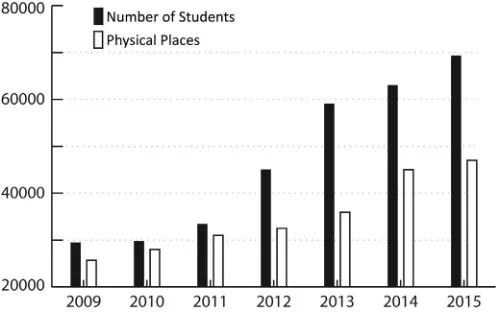
The open access establishments of UCA are having an increase of students surpassing the actual physical places each year [4] as shown in Fig. 1.
Fig. 1. Number of students and the provided places at UCA.
Providing places has become one of our university’s top occupying issues that requires a satisfying resolution as well as for most of * Corresponding author.
E-mail addresses: [email protected]
Keywords
Open Education, E-Learning, MOOC, Blended Learning, Educational Platform.Abstract
Open education is one of the most important settings in every society. It grants everyone the right to learn freely. Today, technology is helping to make learning even more open by providing an environment of online education, which plays a remarkable role in shortening distances and encouraging students to learn. At Cadi Ayyad University (UCA) the new-enrolled students are facing linguistics barriers as well as overcrowding in classrooms, in particular for those in open access institutions. Subsequently, they cannot have an easy access to their face-to-face courses. To help students to overcome these problems, the university has decided to design an online environment for all courses and programmes. The most innovative project adopted at UCA to face massification was inspired from the massive open online courses and was designed as an open Educational platform entitled UC@MOOC. More than 120 scripted courses have been posted online so far. In this paper we will describe and discuss an analytics research on geometrical optics course designed for around 2000 students at UCA. Through out this research we will explain how this initiative has been considered as a source
of producing open educational resources. DOI: 10.9781/ijimai.2018.02.007
UC@MOOC's Effectiveness by Producing Open
Educational Resources
Abdellah Idrissi J., Sofia Margoum, Rachid Bendaoud, Khalid Berrada*
Trans ERIE – Faculty of Sciences Semlalia – Cadi Ayyad University, Marrakech (Morocco)
Moroccan universities. Because of massification (Total number of students in Morocco increase from 350.000 students in 2012 to around 850.000 in 2017), an interesting number of students are not able to be a part of the face-to-face learning position due to the insufficient places in classrooms. Even more, those who managed to have a place and sits far from the professor, they face the most common difficulties of receiving the information. We will try to summarize some of these face-to-face learning defects as follows:
• The disturbing noise generated by students that makes hearing the professor more difficult.
• Unclear and blurred sighting of the course projection on the wall and the explaining table.
• The interrupting questions to the professor during the course. Fig. 2 is showing that for the last 3 academic years there was an increase of 15-20% of the entire enrolled students each year in the faculty of sciences Semlalia (FSSM) only. Moreover, there are 9 other similar open access establishments at Cadi Ayyad University.
Fig. 2. Number of enrolled students at Faculty of Sciences Semlalia.
Along with massification, the new students aren’t prepared to enter Higher education. Earlier in their studies everything has been teached by Arabic language except for foreign language materials (English, French, Spanish etc.). In one year, a sudden change from Arabic to French without any preparation that only increases the challenges that complicates learning process.
As a result, learners are not able of assimilating knowledge and which leads them to double the year or in the worst cases, abandon their studies. The percentage of students who abandoned their studies in the year 2015-2016 was calculated around 25% [5].
UC@MOOC is an original initiative of Cadi Ayyad University. Its main goal is to help reducing the effects of the massification and the other challenges by taking advantage of the revolutionary MOOC in the e-learning history. A simple emulation consists of producing the actual courses to open educational resources with a similar shape of MOOC. Basically, a professor presents his course in a digital studio by the same form respecting the given statement of work. The output is a scripted video put online with free open access to everyone.
Simply by transforming the face-to-face to an online environment using open educational resources (OER), students are now having a helpful escort to have online access to the OER presented by the same professors in face-to-face. This form of MOOC has some of MOOC’s characteristics defined by Glance et al. [6]. This hybrid mode of education has proven its efficiency by combining the present and physical with the digital worlds. Moreover, a big number of viewing rates and viewing durations goes with an intensive presence of students in classrooms seems to complements one another [7].
These courses offered as an open educational resources are essentially
meant to serve the students of the Cadi Ayyad University, but not only. However, the fact of being open they have attracted learners from other Moroccan universities and learners from the outside of Morocco. As part of Trans ERIE research team on innovation we have conducted this study to find out the added value of these online resources and their effects on UCA students.
II.
Methodology
The access the courses of UC@MOOC whose main targeted learners are the students of the university can be done via 3 different tunnels as shown in Fig. 3.
Fig. 3. Accessibility of OER UC@MOOC’s.
The first one is through the official platform of UC@MOOC project [1] where all the scripted courses are not uploaded but being called and gathered from YouTube in one place organizing the resources’ accessibility by providing many ways of filtering courses, search by establishment, disciplinary fields etc. [8]. It also offers to students some interactive learning activities. However, 10.6% of learners access this platform to learn from UC@MOOC’s resources and the other 89.4% watches them from YouTube platform.
The second way of access is via YouTube knowing that it’s the platform used to upload these resources, which are open so anyone can have direct access to these videos. YouTube also has another content organizing methods. Playlists are a good example of that where some of learners organize all the videos of a course in one link. YouTube can be described as a less professional platform for education because it is not meant for that and some of the irrelevant suggestions may redirect learners to some unrelated floods.
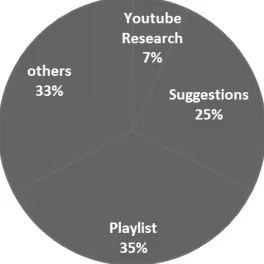
Inside of YouTube there are many routes to reach the videos of courses. Research inside YouTube is a less taken route to arrive at the courses, suggestions and playlists are the top traffic-driving areas in YouTube then comes the “others” category that combines the traffic from the platform and the shares in other places like the social media. This data is resumed in Fig. 4.
The last resource provided by the university is DVDs. All these courses were burned on DVDs and put at their disposal inside the campus. As a result, students are able to share these courses between themselves offline using the different storage supports they have.
Our model for this study is the Geometrical Optics course. This course was the first recorded. It was scripted and put online in April 2013. It is divided in 6 chapters each one was encapsulated in one video except for chapter 4, which was divided in 2 videos for being long as presented in Table I. These videos were uploaded on YouTube on Nov-Oct 2013.
TABLE I.
Online & Face-to-face Duration of Geometrical Optics Course
Chap 1 Chap 2 Chap 3 Chap 4.1 & 4.2 Chap 5 Chap 6 Duration 32:28 11:13 29:05 25:28 28:32 10:54 35:13
Total Online
duration 2 hours 52 minutes 53 seconds
Face-to-face
duration 40 Hours
As shown in Table I it is evident the face-to-face duration is much longer than the same course online duration. The professor in class gets interrupted frequently by questions from students then explaining one thought takes more time than the expected. When the professor presents the course in studio he takes enough and necessary time in order to mount the course properly, thus the recording time is far too small in comparison with presenting it before students. Another advantage has been shown, many professors found themselves practicing more pedagogy when using scripted videos of their courses. Some others asked to re-make new scripted courses after putting online their courses.
The other massification factors such as noise goes also against the regular course rate. Online, if the learner missed an idea in the video he can simply go back and replay the less-understood part.
Geometrical Optics course is being teached around the year during two semesters. In the first one it serves one curricula while in the second one it serves a different curricula. There is a slice difference between the programs of these trainings so the course has been produced online twice with adapted modification in every case. Online, there is a version of the same course for each training/semester.
In our study we will process the version of the course presented in the first semester where the students are new-graduates and they face this course right after their entry to higher education.
III.
UC@MOOC Serving UCA Students
A. Providing an International Needs of OER
During the online life of this course until the end of October 2017 it recorded a significant number of views calculated from our UC@ MOOC YouTube Channel only.
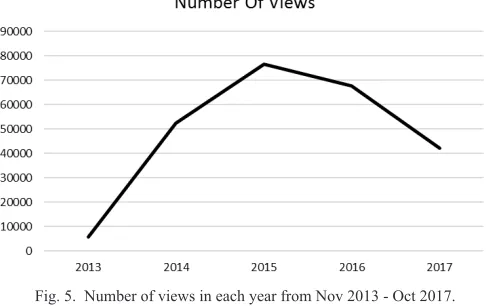
The number of views reached 244898 and counting every second. Fig. 5 shows the variation of views each year. It is obvious that since the creation of the course in October 2013 until October 2017 the number of views has been increasing each year where 5858 views was counted in 2013 and 76679 views in 2015 alone. But in 2016 this number dropped to 67748 views. The reason behind this fall is some new channels on YouTube have reuploaded the course into their channels so the views of the course were separated between our official channel and the other channels.
Fig. 5. Number of views in each year from Nov 2013 - Oct 2017.
Let’s take a deeper look at the course’s views variation in months and see what happens to the course monthly (see Fig. 6).
Fig. 6. Number of views from Oct. 2013 to Feb. 2017.
This figure shows that there is a resemblance of the shape of graph twice every year. Well, each year there is the start of two semesters where students try to learn online in conjunction with the faculty. A semester started along with the course after October 2015 where the entire views of that month were 1667. Suddenly this number grows up to 8698. Then when the exams week approach the numbers grows-up again in March to reach their higher limits (10735) in comparison with the rest of the months.
The only reasonable explanation that may accord to any logic is that students find something they need and they are interested in. To strengthen this idea, we’ll prove that the number of views is also related to the viewing duration of the course.
Fig. 7. Duration of views from Oct. 2013 to Feb. 2017.
In May, the viewing duration in hours was too close to hit 600. In fact, 583 hours of views equals 24 days and a third. The duration of the entire course is about 2 hours and 53 minutes. Then we found that the whole course has been watched continuously 18 hours a day for 31 days straight.
The viewers of this course are not all Moroccans as shown in Fig. 8.
Fig. 8. The origin countries of viewers.
According to Fig. 8, viewers in Morocco contribute with 84.51% of the views and the 15.49% is coming from viewers from the outside of Morocco. This course’s targeted learners are the students of the Cadi Ayyad University who, unwillingly, are not able to learn in the recommended and adequate face-to-face situations as mentioned before. These countries are Algeria, France, Tunisia and other south-African countries. Egypt for example is excluded from the equation knowing that they do have English language instead of French as their first foreign language. French is the first foreign language used in Morocco and in this course, which was the key factor that led the learners from these francophone countries to consider and learn using this course even if it wasn’t meant for them [9,10].
These videos, being watched on YouTube until October 31st, 2017, have also sparked 823 likes, 98 comments, 1556 shares to social networks and triggered 585 new and unique subscribers to the channel. All of this results to the significant importance of this course as an effective online educational resource by students. Then, did it bring some benefits to student’s curriculum? and how?
B. The Effectiveness of UC@MOOC
1) Successful Rate:
After this course was put online to serve the face-to-face training’s students at the first place by helping them surpassing the major difficulties they encounter in campus. A positive effect has been projected in the successful rate of students during the years where this online course was put online.
The results that follows were gathered from the archive of the faculty where a lot of data is recorded. The judgement point of our study and how the online course helped is the results obtained by the students in the exams. And the course under our radar is still Geometrical Optics.
Firstly, to prove that the big part of viewers are students we’ll present the data that shows viewing duration in comparison with age ranges as provided in Fig. 9 during the month of October 2017 only.
Surly young people are the ones whose viewing duration exceeds all the other ranges combined together. The new-graduates who studies in the first semester have their ages between 17-24 years. Only a small number of students are 16 years old. At this point, for sure students are watching the course [11].
Fig. 9. The age of viewers related with viewing duration.
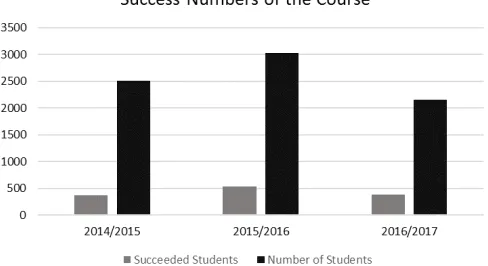
For the first semester of the academic year 2014-2015 a total of 2514 students were enrolled in the face-to-face course. This is the second year after the course was put online. Only 14.75% of them succeeded in this course. In the next academic year 2015-2016, the number of enlistees went up to 3023 students and success rate was 17.5%. As for the next and last academic year 2016-2017, the success percentage hit 17.8% knowing that the number of enrolled students (2155) was less than the previous year. All of this data is shown in Fig. 10.
From 14.5% to 17.8% of success rate gives a clear vision on the effectiveness of UC@MOOC initiative. Based on the data provided before, a bigger success rate is estimated to be observed in the current semester (First semester of academic year 2017-2018).
Now we have proven that there is a noticeable improvement on success rates of students. In fact, if this open online course helps at least 10 students to overcome defection and support them to succeed each year in the face-to-face course then the efforts provided for the purpose of creating this helpful course are worth investing time, competences and money [12].
Fig. 10. Number of enrolled and succeeded students on Geometrical Optics Course.
2) Successful Rate of Non-Supported Online Courses:
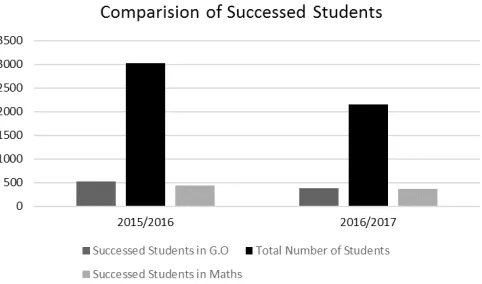
Geometrical Optics is without a doubt can be called an online supported course. Other courses in the faculty starts parallelly with this course. Not all of them have an online version. We will process now the Mathematics course which is being teached until now in face-to-face only and there is no online version of it. The professors of this course haven’t recorded it and it will be an interesting point to focus-on and its success rates [13].
Mathematics course has the same enrolled students as Geometrical Optics. They are being teached in the same time-frame and the exams are also taken in the same period and they serve the same trainings.
success rate of 14.35% whereas Geometrical Optics had 17.5%. The next year, the courses simultaneously recorded 16.8% and 17.8%. The fact that Geometrical Optics has higher success rates results to the fact that there is a result of providing OER and supporting students online. The graph in Fig. 11 presents the numbers.
Fig. 11. The difference between the two courses in success numbers.
IV.
Conclusion
The massification may have made learning in face-to-face difficult for some students but it may be a diverging point of creating a good or perhaps some better alternatives. As a result of massification we created UC@MOOC. This initiative proved to be a helpful and supportive online educational environment that is not serving the students of the university only, but keeps on providing online learning and knowledge to international learners in their proper context of requesting information. A genius idea, low cost material, a small number of staff and pedagogical researchers and professors are the major elements of building such a wonderful project.
The pedagogical innovation was the start of the route of creating UC@MOOC project. Research on education will be an unstoppable science as long as societies continue on development and invention. However, it is still only a supporting system to students and not an ultimate solution of massification.
The work on providing more open educational resources within the innovative initiative of UC@MOOC is still ongoing. The form of producing these OER will definitely change and thrive to higher levels of efficiency where online learning breaks the current barriers.
Acknowledgment
Authors would like to thank all the people involved in UC@MOOC platform for their engagement and for making this project happen at Cadi Ayyad University. Special thanks also to the OpenMed Erasmus plus consortium for considering this initiative as an innovative practice of Open education in the MENA region.
References
[1] Website of Cadi Ayyad University, Marrakech 2013, http://mooc.uca.ma
[2] OER Morocco Declaration https://www.change.org/p/universit%C3%A9s- d%C3%A9claration-du-maroc-sur-les-ressources-educatives-libres-oer-morocco-declaration?utm_source=embedded_petition_view
[3] Compendium Of Case Studies Of Open Education In The Mediterranean, retrieved from: http://openmedproject.eu/results/compendium/
[4] K. Berrada, A. Miraoui, La capacité d’accueil de l’université Cadi Ayyad face au problème de massification des étudiants, MENA Higher Education Conference, Beirut, Lebanon (May 2015). http://cmimarseille.org/sites/ default/files/newsite/library/files/fr/Khalid%20Berrada.pdf
[5] D. Glance, M. Forsey, M. Riley M., “The pedagogical foundation of massive online courses”, 2012, First Monday Journal, retrieved from http://firstmonday.org/ojs/index.php/fm/article/view/4350/3673
[6] A. Idrissi. J, S. Machwate, R. Bendaoud, K. Berrada, A. Miraoui, UC@ MOOC: Pedagogical innovation to challenges of massification at university level in Africa, ICCMIT, Poland, 2017.
[7] L. Guàrdia, M. Maina, A. Sangrá A, “MOOC Design Principles. A Pedagogical Approach from the Learner’s Perspective”, May 2013, retrieved from http://elearningeuropa.info/sites/default/files/asset/ Indepth_33_4_0.pdf
[8] N. Mirriahi, S. Dawson S., “The Pairing of Lecture Recording Data with Assessment Scores: A Method of Discovering Pedagogical Impact”, 2013, doi: 10.1145/2460296.2460331
[9] P. Hill, “Emerging Student Patterns in MOOCs: A (Revised) Graphical View”, 2013, online blog post retrieved from http://mfeldstein.com/ emerging-student-patterns-in-moocs-a-revisedgraphical-view/
[10] R. Kizilcec, C. Piech. E.Schneider, “Deconstructing Disengagement: Analyzing Learner Subpopulations in Massive Open Online Courses”, 2013, retrieved from http://www.stanford.edu/~cpiech/bio/papers/ deconstructingDisengagement.pdf
[11] N. Schroeder, O. Adesope, “A Case for the use of Pedagogical Agents in Online Learning Environments”, 2012, retrieved from http://jotlt.indiana. edu/article/view/2126/3045
[12] M.P. Papazoglou, “Agent-oriented technology in support of ebusiness”, 2001, Communications of the ACM, Vol. 44 No. 4, pp. 71-77.
[13] Commonwealth of Learning (COL), “Perspectives on Open and Distance Learning: Open Educational Resources: Innovation, Research and Practice”, May 2013, retrieved from http://www.col.org/resources/ publications/Pages/detail.aspx?PID=446
Abdellah Idrissi Jouicha
Abdellah Idrissi J. is a PhD student at Cadi Ayyad University. He is conducting research on pedagogical innovation, MOOC & OER at Trans ERIE group of research of Cadi Ayyad University.
Rachid Bendaoud
Rachid Bendaoud is professor of physics in charge of e-Learning at Cadi Ayyad University. He is working on blended learning and one of developers of Uc@MOOC initiative at Cadi Ayyad University.
Sofia Margoum
Sofia Magroum is a PhD student at Cadi Ayyad University.
She is developing research on Micro-computer Based-Laboratory and OER at Trans ERIE group of research of Cadi Ayyad University.
Khalid Berrada