The Thirty-Third AAAI Conference on Artificial Intelligence (AAAI-19)
Trust Region Evolution Strategies
Guoqing Liu,
†∗Li Zhao,
‡Feidiao Yang,
‡§Jiang Bian,
‡Tao Qin,
‡Nenghai Yu,
†Tie-Yan Liu
‡ †University of Science and Technology of China‡Microsoft Research
§Institute of Computing Technology, Chinese Academy of Sciences
[email protected];{lizo, jiang.bian, taoqin, tyliu}@microsoft.com; [email protected]
Abstract
Evolution Strategies (ES), a class of black-box optimization algorithms, has recently been demonstrated to be a viable al-ternative to popular MDP-based RL techniques such as Q-learning and Policy Gradients. ES achieves fairly good per-formance on challenging reinforcement learning problems and is easier to scale in a distributed setting. However, stan-dard ES algorithms perform one gradient update per data sample, which is not very efficient. In this paper, with the purpose of more efficient using of sampled data, we pro-pose a novel iterative procedure that optimizes a surrogate objective function, enabling to reuse data sample for multiple epochs of updates. We prove monotonic improvement guar-antee for such procedure. By making several approximations to the theoretically-justified procedure, we further develop a practical algorithm called Trust Region Evolution Strate-gies (TRES). Our experiments demonstrate the effectiveness of TRES on a range of popular MuJoCo locomotion tasks in the OpenAI Gym, achieving better performance than ES al-gorithm.
Introduction
Developing agents that can accomplish challenging tasks in complex, uncertain environments is a primary goal of Reinforcement Learning (RL). The most popular paradigm for analyzing such problem has been using a class of MDP-based algorithms, such as DQN (Mnih et al. 2015), DDPG (Lillicrap et al. 2015), and TRPO (Schulman et al. 2015), which have gained significant achievements af-ter applying to a variety of applications, including Atari games (Mnih et al. 2015; Van Hasselt, Guez, and Silver 2016; Mnih et al. 2016), robot locomotion tasks (Schulman et al. 2015; 2017) and the game of Go (Silver et al. 2016; 2017).
Recently, as a class of black-box optimization algorithms, Evolution Strategies (ES) (Salimans et al. 2017) has been risen to be a viable alternative to popular MDP-based RL techniques. As comparable to state-of-the-art policy gradient methods, ES has demonstrated its success in training poli-cies on a variety of simulated robotics tasks in MuJoCo and
∗
This work was done when the first author was on an internship with Microsoft Research.
Copyright c2019, Association for the Advancement of Artificial Intelligence (www.aaai.org). All rights reserved.
𝑐𝑢𝑟𝑟𝑒𝑛𝑡 𝑝𝑎𝑟𝑎𝑚𝑒𝑡𝑒𝑟 𝜃 𝑙𝑜𝑐𝑎𝑙 𝑎𝑝𝑝𝑟𝑜𝑥𝑖𝑚𝑎𝑡𝑖𝑜𝑛 𝐿𝜃( ෨𝜃)
𝑡𝑟𝑢𝑒 𝑜𝑏𝑗𝑒𝑐𝑡𝑖𝑣𝑒 𝐽( ෨𝜃)
𝑙𝑜𝑐𝑎𝑙 𝑎𝑝𝑝𝑟𝑜𝑥𝑖𝑚𝑎𝑡𝑖𝑜𝑛 𝑤𝑖𝑡ℎ 𝐾𝐿 𝑝𝑒𝑛𝑎𝑙𝑡𝑦 𝐿𝜃𝜃 − 𝑐𝐷෨ 𝐾𝐿𝑚𝑎𝑥(𝜃, ෨𝜃)
Figure 1: Red curve represents true objective. Green curve represents local approximation. Blue curve represents local approximation with KL penalty, which is the surrogate ob-jective function. The surrogate obob-jective function forms a lower bound of the true objective, so optimizing this surro-gate objective is guaranteed to improve the true objective.
on Atari games. With competitive performance and good parallelization, ES algorithms are receiving more and more attention as a scalable alternative to popular MDP-based RL techniques.
Compared to MDP-based RL techniques, ES algorithms employ a different path of techniques by directly searching optimal policy in parameter space. To be specific, the ES algorithm in (Salimans et al. 2017) proposed to optimize the Gaussian smoothingof objective function,
J(θ) =EX∼N(θ,σ2I)[F(X)], (1)
whereF(X)is the objective function representing the ex-pected total reward. In each training iteration of above ES al-gorithm, two phrases are executed sequentially: 1) Sampling search directionsi from Gaussian distributionN(0, σ2I)
and evaluating these search directions by sampling data us-ing policy with parameter (θ+i) in the environment. 2)
Using sampled data to estimate the gradient which are then applied to update the corresponding parameter. Given such procedure, in order to enhance ES algorithms, one vital di-rection is to improve sample efficiency, which is not that high in current ES algorithm since the sampled data is only used for one gradient update.
aspect. However, to the best of our knowledge, there is no existing work exploring another perspective: given the sam-pled data, how can we make more efficient use of them?
To take deeper investigation on the other aspect of sample efficiency, in this paper, we propose a novel iterative pro-cedure that introduces a surrogate objective, by optimizing which can give rise to efficiently reusing sample data for multiple epochs of updates. In particular, we first introduce a local approximationLθ(˜θ)to theGaussian smoothing
ob-jective J(˜θ)around current parameterθ where we sample data, with the purpose to approximately optimize J(˜θ)by reusing sampled data fromθinstead of sampling new data fromθ˜. However, this local approximation only works well whenθ˜is close enough to current parameterθ, as shown in Figure 1. It’s still not clear that how much can we update when optimizing the local approximationLθ(˜θ). To address
this issue, we propose a novel procedure that optimizes a surrogate objective function, namely a local approximation with a KL divergence penalty, which forms a lower bound of the true objectiveJ(˜θ). We prove theoretical monotonic im-provement guarantee for such procedure. At last, we make a series of approximations to the theoretically-justified pro-cedure, yielding a practical algorithm, which leads to better performance than ES algorithm, called Trust Region Evolu-tion Strategies (TRES).
To summarize, our contributions are as follows:
• Make more efficient use of sampled data by optimizing surrogate objective function for multiple epochs of up-dates, instead for just one gradient update.
• Prove theoretical monotonic improvement guarantee for this optimization procedure.
• Develop practical algorithm TRES after making several approximations. Experiments on five popular physical lo-comotion tasks in the OpenAI Gym demonstrate the ef-fectiveness of TRES.
Background
The goal of reinforcement learning (RL) is to find, through trial and error, a feedback policy that prescribes how an agent should optimally act in a dynamic, uncertain environ-ment. ES address RL problem by directly searching for op-timal policy in parameter space, casted as a maximization problem of the form:
max
θ∈Rd
F(θ), (2)
where a family of deterministic policies mapping states to actions is parameterized by θ ∈ Rd, and the objective
F : Rd →
Rmeasures the expected total reward of policy parameterθ.
However, when the environment is stochastic and imple-mented in black-box physics simulators, the objective func-tionF is only accessible via noisy and expensive function evaluations, and may not be smooth. So the gradient ofF
cannot be computed with a backpropagation-like algorithm. That means we cannot directly use standard gradient-based optimization methods to find a good solution forθ.
In order to both make the problem smooth and to find a way to estimate its gradients, it is necessary to add noise. In this way, we turn to optimize theGaussian Smoothingof the objective function,
max
θ∈Rd
J(θ) =EX∼pθ(x)[F(X)], (3)
wherepθ(x)denotes the probability density function of
mul-tivariate Gaussian distribution with diagonal covariance ma-trixN(θ, σ2I).
Such process can be interpreted as adding a Gaussian blur to the original objective, which results in a smooth, differen-tiable objectiveJ(θ)that can be solve with stochastic gradi-ent ascgradi-ent.
Estimating Gradients of Gaussian Smoothing
The gradient ofJ(θ)is given by∇J(θ) = 1
σ2EX∼pθ(x)[F(X)(X−θ)]. (4)
In practice, this gradient is intractable, and must be esti-mated. The gradient∇J(θ)can be estimated via a variety of Monte Carlo estimators. In this paper, we investigate two fundamental estimators:
Vanilla ES gradient estimator. The first estimator is de-rived via the Monte Carlo REINFORCE (Williams 1992) estimator, and coincides with a standard Monte Carlo esti-mator of the expectation appearing in Equation (4):
ˆ
∇V NJ(θ) =
1
N σ2
N X
i=1
F(xi)(xi−θ), (5)
where(xi)Ni=1 i.i.d
∼ N(θ, σ2I)can be interpreted as search parameters sampled from search distributionN(θ, σ2I). We refer to this gradient estimator as the vanilla ES gradient es-timator.
Antithetic ES gradient estimator. Secondly, we consider the version of vanilla ES gradient estimator augmented with antithetic variables, as in (Salimans et al. 2017), given by
ˆ
∇A NJ(θ) =
1 2N σ2
N X
i=1
((F(xi)−F(2·θ−xi))(xi−θ)),
(6) where again(xi)Ni=1
i.i.d
∼ N(θ, σ2I). The two terms appear-ing in the summand are contributed by search parameter
xi ∼ N(θ, σ2I)and its antithetic counterpart(2·θ−xi),
We refer to this gradient estimator as the antithetic ES gra-dient estimator, owing to its use of antithetic Monte Carlo samples.
In summary, Evolution Strategies (ES) introduced by (Salimans et al. 2017) aims to optimize Gaussian Smoothingobjective by directly using stochastic gradient as-cent, with the antithetic ES gradient estimator, and each gra-dient update step of ES algorithm could be divided into two sub-steps: 1) Sampling search parameters{x1, ..., xN}from
sampled data{F(x1), ..., F(xN)} to estimate the gradient
and updating current parameter with the estimated gradient. For each parameter update, ES needs to sample new data to estimate the gradient, which is not very efficient.
Methodology
In this section, we present a new algorithm, Trust Region Evolution Strategies (TRES), with the purpose of more ef-ficient using of sampled data. We will start with an intro-duction of a local approximation Lθ(˜θ)to the true
objec-tiveJ(˜θ), aiming to approximately optimizeJ(˜θ)by reusing sampled data fromθinstead of sampling new data fromθ˜. Then, we derive that the difference between local approxi-mationLθ(˜θ)and true objectiveJ(˜θ)is bounded by a KL
divergence termDmax
KL (θ,θ˜). Based on this bound, we
pro-pose to optimize a surrogate objective function, namely lo-cal approximation with a KL divergence penalty, which is a lower bound of the true objectiveJ(˜θ)and thus can provide explicit lower bounds on the improvement of J(˜θ). After making a series of approximations to the theoretical proce-dure, we finally develop the practical TRES algorithm and propose a distributed implementation of it.
Local Approximation of Gaussian Smoothing
In this subsection, we introduce a local approximation to the true objective J(˜θ) around current parameter θ where we sample data.We start by introducing the difference of the true objective between new parameterθ˜and current parameterθ:
J(˜θ)−J(θ) =EX∼pθ˜(x)[F(X)]−EX∼pθ(x)[F(X)]. (7)
Given that X stands for ad-dimension search parameter, we can rewrite it in vector form[X1, ..., Xd],where the super-script denotes the corresponding dimension. Thus Equation (7) becomes:
J(˜θ)−J(θ) =EX1...d∼θ˜[F(X)]−EX1...d∼θ[F(X)]. (8)
For compactness, we use the notationX1...ito represent the firstidimensions ofX, namely[X1, ..., Xi]and the notation
pθ(x1...i)to represent the marginal distribution ofX1...i,for
i∈ {1, ..., d}. Besides, we further compresspθ(x1...i)down
toθin expectation forms.
We decompose this difference as a sum of per-dimension difference:
d−1
X
i=0
EX1...i+1∼θ˜ Xi+2...d∼θ
[F(X)]−E X1...i∼θ˜ Xi+1...d∼θ
[F(X)]
. (9)
For convenience, we will give the following definitions of the value functionVθ, and the advantage functionAθin our
framework:
Vθ(x1...i) =EXi+1...d∼θ
h
F(X)|X1...i=x1...i i
,∀i= 0, ..., d.
Aθ(x1...i+1) =Vθ(x1...i+1)−Vθ(x1...i),∀i= 0, ..., d−1.
(10)
Specifically, wheni= 0,Vθ(x1...0) =EX1...d∼θ[F(X)] = J(θ); wheni=d,Vθ(x1...d) =F(x1...d) =F(x).
In other words, value function Vθ(x1...i) represents the
expectation ofF(X)when firstidimensions ofXare given and remaining dimensions are sampled from pθ(xi+1...d),
and advantage functionAθ(x1...i+1)represents the
expecta-tion difference in whether(i+ 1)th dimension ofXis given or sampled frompθ(xi+1). We can rewrite Equation (9) with
the notations described above:
J(˜θ) =J(θ) +EX∼θ˜
"d−1
X
i=0
(Vθ(X1...i+1)−Vθ(X1...i))
#
=J(θ) +EX∼θ˜
"d−1
X
i=0
Aθ(X1...i+1)
#
.
(11)
Then we proceed to expand Equation (11):
J(˜θ) =J(θ) + d−1
X
i=0 EX∼θ˜
h Aθ(X
1...i+1
)i
=J(θ) + d−1
X
i=0
X
x1...i+1
pθ˜(x 1...i+1
)Aθ(x1...i+1)
=J(θ) + d−1
X
i=0
X
x1...i
pθ˜(x1...i)
X
xi+1
pθ˜(xi+1)Aθ(x1...i+1).
(12)
The complex dependency ofpθ˜(x1...i)onθ˜makes Equation (12) difficult to optimize directly without new sampled data overθ˜. With the purpose to approximately optimizeJ(˜θ)by reusing sampled data fromθ instead of sampling new data fromθ˜, we introduce the following local approximation to
J(˜θ),
Lθ(˜θ) =J(θ) + d−1
X
i=0
X
x1...i
pθ(x1...i)
X
xi+1
pθ˜(x i+1
)Aθ(x1...i+1).
(13)
Although Lθ(˜θ) usespθ(x1...i)rather than pθ˜(x1...i), we can find thatLθ(˜θ)matchesJ(˜θ)to zero order and first
or-der. That is, for any parameter valueθ,
Lθ(˜θ)|θ˜=θ=J(˜θ)|θ˜=θ,
∇θ˜Lθ(˜θ)|θ˜=θ=∇θ˜J(˜θ)|θ˜=θ.
(14)
which implies that a sufficiently small stepθ →θ˜that im-provesLθ(˜θ)will also improveJ(˜θ).
Monotonic Improvement Guarantee
In this subsection, we first derive KL divergence bound of the difference between local approximationLθ(˜θ)and true
objectiveJ(˜θ). Based on this bound, we propose to optimize a surrogate objective function, namely local approximation with a KL divergence penalty, with theoretical monotonic improvement guarantee.
The particular distance measure we use here is the to-tal variation divergence, which is defined byDT V(p||q) =
1 2
P
i|pi−qi|for discrete probability distributionsp, q.
De-fineDmax T V (θ,θ˜)as
DT Vmax(θ,θ˜) = max
1≤i≤dDT V(θ
For simplicity, we use the notationDT V(θi,θ˜i)to represent
DT V(N(θi, σ2),N(˜θi, σ2)).
Theorem 1 Letα=Dmax
T V (θ,θ˜). Then the following bound
holds:
|J(˜θ)−Lθ(˜θ)| ≤2d·(d+ 1)α2
where = max
x1...i 1≤i≤d
|Aθ(x1...i)|. (16)
Theorem 1 provides a TV divergence bound of the differ-ence between true objectiveJ(θ) and local approximation
Lθ(˜θ), and we defer the proof of Theorem 1 to
supplemen-tary material.
In consideration of the following relationship between the total variation divergence and the KL divergence:
DT V(p||q)2 ≤ DKL(p||q), we define DKLmax(θ,θ˜) =
max1≤i≤dDKL(θi,θ˜i), and then the KL divergence bound
follows directly from Theorem 1:
J(˜θ)≥Lθ(˜θ)−c·DKLmax(θ,θ˜),
where c= 2d·(d+ 1). (17)
where we also use DKL(θi,θ˜i) to represent
DKL(N(θi, σ2I),N(˜θi, σ2I)), and we defineDmaxKL (θ,θ˜)
asmax1≤i≤dDKL(θi,θ˜i).
Based on Equation (17), we further define Mθ(˜θ) =
Lθ(˜θ)−c·DmaxKL (θ,θ˜). Then
J(˜θ)≥Mθ(˜θ)by Equation (17),
J(θ) =Mθ(θ)by definition, ⇒J(˜θ)−J(θ)≥Mθ(˜θ)−Mθ(θ).
(18)
Thus, by maximizingMθ(˜θ)at each iteration, we
guaran-tee that the true objectiveJ(˜θ)is non-decreasing. This al-gorithm is a type of minorization-maximization (MM) algo-rithm (Hunter and Lange 2004). In the terminology of MM algorithms,Mθ(˜θ)is called the surrogate objective function
that minorizesJ(˜θ)with equality atθ.
Practical Algorithm
After justifying the effectiveness of optimizing a surrogate objective function, we now describe how to derive a practical algorithm from these theoretical foundations.
Constrained Optimization As indicated by Equation (18), by performing the following maximization, we are guaranteed to improve the true objectiveJ(˜θ):
max
˜
θ h
Lθ(˜θ)−c·DmaxKL (θ,θ˜) i
. (19)
In practice, considering c = 2d·(d+ 1), the penalty coefficient increases accordingly to the dimension size of the policy parameter, and then the update step size would be very small. A natural way to take larger steps in a robust way is to use a constraint on the Dmax
KL (θ,θ˜), i.e., a trust
region constraint, so we can transform Equation (19) to the following constraint optimization problem:
max
˜
θ
Lθ(˜θ)
subject toDmaxKL (θ,θ˜)≤δ.
(20)
Sampled-Based Estimation We seek to solve the follow-ing optimization problem, obtained by expandfollow-ingLθ(˜θ)in
Equation (20):
maxθ˜
d−1
X
i=0
X
x1...i
pθ(x1...i) X
xi+1
pθ˜(xi+1)Aθ(x1...i+1)
subject toDmaxKL (θ,θ˜)≤δ.
(21)
We first replace the sum over firsti+ 1dimensions ofxin this objective by the expectation:
maxθ˜
d−1
X
i=0
EX1...i∼θ Xi+1∼θ˜
Aθ(X1...i+1)
subject toDKLmax(θ,θ˜)≤δ.
(22)
Note that in Equation (22),Xi+1still follows the distribu-tionpθ˜(Xi+1), rather thanpθ(Xi+1). we solve this problem
by using an importance sampling estimator:
maxθ˜
d−1
X
i=0
EX1...i+1∼θ p
˜
θ(X i+1) pθ(Xi+1)
Aθ(X1...i+1)
subject toDKLmax(θ,θ˜)≤δ.
(23)
Next we replace the advantage functionAθ(x1...i+1)by the
value functionVθ(x1...i+1),which only changes the
objec-tive by a constant.
At last, our optimization problem in Equation (23) is ex-actly equivalent to the following one:
max
˜
θ E X∼θ
"d−1
X
i=0
pθ˜(Xi+1) pθ(Xi+1)
Vθ(X1...i+1) #
subject toDKLmax(θ,θ˜)≤δ.
(24)
All that remains is to replace the expectation by sample aver-ages and replace the value function by an empirical estimate.
Clipped Surrogate Objective However, the optimization of Equation (24) is exactly a constrained optimization prob-lem with box constraint, which is complicated and hard to solve precisely. Inspired by PPO (Schulman et al. 2017), we propose a novel surrogate objective with clipped probability ratio, which forms a lower bound of the local approxima-tionLθ(˜θ), and we can optimize this clipped objective via
multiple epochs of gradient updates. Letri(˜θ)denotes the
probability ratio ofith dimension, namely,ri(˜θ) = pθ˜(X
i)
pθ(Xi),
the main objectiveLCLIP
θ (˜θ)is the following:
LCLIPθ (˜θ) =EX∼θ " d
X
i=1
min(li(˜θ), liCLIP(˜θ)) #
where li(˜θ) =ri(˜θ)Vθ(X1...i),
liCLIP(˜θ) =clip(ri(˜θ),1−λ,1 +λ)Vθ(X1...i).
(25)
The motivation for this objective is as follows: the first term
li(˜θ)is theith dimension’s contribution to local
clipping the probability ratio, which removes the search pa-rameters for movingrioutside of the interval[1−λ,1 +λ]
and thus constrains the update step during training process. Finally, we take the minimum of the clipped and unclipped objective, so the final objective is a lower bound on the lo-cal approximation, which ensures that the improvement of local approximation Lθ(˜θ)when we optimize LCLIPθ (˜θ).
Although this objective is not exactly constrained in trust region, we still call our algorithm Trust Region Evolution Strategies since in spirit it encourages the parameter to stay in trust region.
Distributed Implementation The resulting practical al-gorithm repeatedly executes two phases: 1) Sampling search parameters{x1, ..., xN}from search distributionN(θ, σ2I)
and evaluating sampled search parameters by doing roll-outs in the environment, and 2) Reusing sampled data
{F(x1), ..., F(xN)}and performingK epochs of gradient
updates to optimize the clipped surrogate objective. The evaluation of various search parameters in the first phase is well suited to be scaled up to many parallel workers: the rollout process of each search parameter operates inde-pendent of each other. Following the efficient communica-tion strategy introduced by (Salimans et al. 2017), we share random seeds to sample search parameters between work-ers and each worker knows what search parameter the other workers used, so each worker only needs to communicate a single scalar to and from each other worker to agree on a parameter update, TRES thus requires extremely low band-width, in sharp contrast to policy gradient methods, which require workers to communicate entire gradients. We give the parallel version of TRES in Algorithm 1.
Algorithm 1Trust Region Evolution Strategies
1: Input:noise standard deviationσ, clip factorλ, epoch numberK, learning rateα
2: Initialize: N workers with known random seeds, and initial policy parametersθ0
3: foreach iterationt= 0,1,2, ...do 4: foreach workeri= 1, ..., Ndo 5: Samplexi∼ N(θt, σ2I)
6: Compute rollout returnsF(xi)
7: end for
8: Send all rollout returns to every worker
9: foreach workeri= 1, .., Ndo 10: Reconstruct all search parameters
11: Compute value function with rollout returns
12: Letθt,1=θt
13: foreach epochj= 1, ..., Kdo 14: Reusing sampled data fromθt
15: θt,j+1=θt,j+α∇LCLIPθt (θt,j)
16: end for
17: Update policy parameter viaθt+1=θt,K+1
18: end for 19: end for
Experiments
To demonstrate the effectiveness of TRES, we conducted experiments on the continuous MuJoCo locomotion tasks from the OpenAI Gym (Brockman et al. 2016). These tasks have been widely studied in the reinforcement learn-ing community (Duan et al. 2016; Gu et al. 2016; 2017; Rajeswaran et al. 2017a). In these tasks, the states of the robots are their generalized positions and velocities, and the controls are joint torques. And, these tasks are challeng-ing due to under-actuation, high dimensionality, and non-smooth dynamics.
Experimental Settings
The empirical result from (Rajeswaran et al. 2017b; Mania, Guy, and Recht 2018) shows that linear policies are suffi-ciently expressive to capture diverse behaviors in MuJoCo; thus, we use linear policy structure in all tasks we evaluated. Thus, the policy parameter size is equal to the product of state space dimension and action space dimension in the en-vironment. We uniformly initialize policies with zero matrix before training in all tasks.
To reduce variance, We use the antithetic sampling (also known as mirrored sampling) technique following (Sali-mans et al. 2017). For some of tasks, such as Walker-v1 and Ant-v1, the default reward functions include a survival bonus, which rewards RL agents with a constant reward at each timestep as long as a terminal condition has not been reached. This may cause that finding policies are more likely to be local optimal. To resolve this problem, we subtract the the survival bonus from the rewards outputted as in (Mania, Guy, and Recht 2018).
To remove the influence of outlier individuals in sampled parameters and avoid falling into local optima, we perform fitness shaping (Sun et al. 2009; Wierstra et al. 2011; 2014; Salimans et al. 2017) by applying a rank transformation to the rollout returns before computing each parameter update. We also perform state normalization trick, which is widely used in various RL related works (Schulman et al. 2015; 2017; Wu et al. 2017; Mania, Guy, and Recht 2018) and is similar to data whiting used in regression tasks. Intuitively, it ensures that policies put equal weight on the different com-ponents of the states.
Our algorithms are built based on the implementation of OpenAI evolution-strategies-starter code (Salimans et al. 2017). Each algorithm has been evaluated on 5 environ-ments, with 6 random seeds on each. For fair comparison, we sample six random seeds uniformly from the interval [0, 1000) and share them in all environments.
Main Results
(a) (b) (c)
(d) (e)
Figure 2: Training curves of TRES (red) versus ES (blue) on the MuJoCo locomotion tasks. For each run, after every ten training iterations, we evaluate current policy parameter via average returns of 100 independent rollouts. The curves are averaged over six random seeds, and the shaded region shows the standard deviation of these seeds.
Environment Threshold TRPO timesteps PPO timesteps ES timesteps TRES timesteps
Swimmer-v1 128 4.6e+6 4.4e+5 4.5e+5 2.4e+5
HalfCheetah-v1 2385 2.6e+6 1.2e+6 1.7e+6 9.8e+5
Walker2d-v1 2872 2.9e+6 1.9e+6 1.2e+7 3.6e+6
Ant-v1 3000 N/A 1.0e+7 1.5e+7 1.3e+7
InvertedDoublePendulum-v1 9104 4.4e+6 1.9e+6 8.8e+5 6e+5
Table 1: A comparison of TRES, ES, TRPO and PPO on the MuJoCo locomotion tasks. For each task we show the average number of timesteps required to reach a prescribed reward threshold, averaged over six random seeds.
PPO in most tasks. This indicates that TRES can achieve ro-bust and consistent performance for various tasks. A partic-ular notable case is the walker2d-v1 task, which is known for its difficulty and falling into local optimal easily. In such task, our TRES converges much faster than ES and achieves better final performance, without falling into the local op-tima that ES stuck into. In Figure 2, we also find that the shaded region of TRES is smaller than that of ES in most tasks. This suggests that TRES achieves stronger robust-ness across different random seeds. Especially in Swimmer-v1 task, ES has a very high variance during training, while TRES can obtain a stable training process with low variance.
Impact of hyper-parameters
There are two main hyper-parametersλandKin TRES al-gorithms. In this subsection, we conducted several experi-ments to investigate their impact.
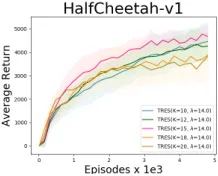
Impact of clip factorλ Clip factorλis introduced to strain policy parameter update in each iteration. We con-ducted several experiments on HalfCheetah-v1 task to study the impact ofλ. We plot the training curves of differentλ
in Figure 3. From Figure 3, we can see thatλ∈[8.0,20.0]
can improve sample efficiency consistently against baseline, and λ = 14.0 has the best performance. Reducing or in-creasingλfrom 14.0 hurts the performance. Intuitively, too small clip factor means that policy parameter update is con-strained strictly, which may slow down the training process, while too big clip factor means that policy parameter update is completely unconstrained, which may make the training process unstable. Therefore, a medium clip factor is a bet-ter choice to obtain a fast and stable training process. These results well suggest our intuitive understanding.
Impact of epoch numberK By reusing the sampled data, we perform K gradient steps over clip surrogate objec-tive in each iteration. We conducted some experiments on HalfCheetah-v1 task to study the impact of epoch number
be-tween reuse frequency and gradient precision, we try differ-ent epoch numbers with fixedλ. Figure 4 shows the training curves of various settings ofK. From Figure 4, we can ob-serve that a smallKdoes not make the best of sampled data, and a largeKcauses a performance drop. We observe that
K= 15can gain best performance.
Figure 3: Impact ofλon HalfCheetah-v1 task.
Figure 4: Impact ofKon HalfCheetah-v1 task.
Parallel version
The good parallelizability is one of the most important char-acteristics of ES algorithm, which allows a very fast training over distributed computing environment. Our TRES retains this valuable property.
We show time analysis between TRES and ES on HalfCheetah-v1 task in Figure 5. From figure 5(a), we can see that TRES is the same with ES with respect to time cost of rollout process. From figure 5(b), we can see that although TRES needs to update parameter for multiple rounds in each iteration, which is more complex than ES, TRES curve is al-most coincident with ES curve with respect to overall cess. This makes sense because the time cost of rollout pro-cess is far greater than that of update propro-cess during the ac-tual training process.
Related work
Evolution Strategies (ES) is an age-old black-box optimiza-tion method (Rechenberg 1971; Sun et al. 2009; Schaul, Glasmachers, and Schmidhuber 2011; Wierstra et al. 2011; 2014), which generates a descent direction via finite differ-ences over random sampled directions. Recently, (Salimans et al. 2017; Mania, Guy, and Recht 2018) applied it to re-inforcement learning domain and empirically demonstrated that ES is comparable to state-of-the-art policy gradient al-gorithms, which has generated renewed interest in ES as a promising direction in reinforcement learning.
(a) Rollout time cost (b) Total time cost
Figure 5: Time Analysis for TRES and ES
However, how to improve sample efficiency of ES algo-rithm is still a challenging problem. Recent methods pro-posed for this purpose could be divided into two categories: (1) Adapting the search distribution by encouraging the ex-ploration diversity. (2) Adapting the search distribution with the help of extra gradient information. In the first cate-gory, (Choromanski et al. 2018) propose to enforce orthog-onality conditions on the Gaussian perturbations for param-eter exploration, and they demonstrate theoretically and em-pirically that random orthogonal and Quasi Monte Carlo (QMC) finite difference directions are much more effective for parameter exploration than random Gaussian directions used in (Salimans et al. 2017). (Conti et al. 2017) hybridize ES with some existing algorithms which promote directed exploration like novelty search (NS) and quality diversity (QD), improving ES performance on sparse or deceptive deep RL tasks. In the second category, (Maheswaranathan et al. 2018) proposesGuided Evolution Strategies, the main idea of such method is to use extra surrogate gradient infor-mation (directions that may be correlated with, but not nec-essarily identical to, the true gradient) along with ES random perturbations. Specifically, they define a new search distri-bution for ES that is elongated along a guiding subspace spanned by the surrogate gradients.
All of above mentioned works focus on sampling better or more diverse search directions to improve sample efficiency of ES algorithm. Quite different from these methods, our approach focuses on how to fully utilize the sampled data, no matter how they are sampled.
Conclusion and Future Work
In this paper, we have proposed a new algorithm, Trust Re-gion Evolution Strategies (TRES) in the context of rein-forcement learning. With the purpose of making more effi-cient use of sampled data, we propose a novel iterative pro-cedure that optimizes a surrogate objective function, with guaranteed monotonic improvement. After making a series of approximations to the theoretically-justified procedure, we further develop the practical algorithm TRES. Experi-ments on five popular MuJoCo locomotion tasks in the Ope-nAI Gym show that our TRES has more efficient perfor-mance than ES algorithm.
Acknowledgments
This work was supported in part by the Natural Science Foundation of China under Grant U1636201.
References
Brockman, G.; Cheung, V.; Pettersson, L.; Schneider, J.; Schulman, J.; Tang, J.; and Zaremba, W. 2016. Openai gym. arXiv preprint arXiv:1606.01540.
Choromanski, K.; Rowland, M.; Sindhwani, V.; E., T. R.; and Weller, A. 2018. Structured evolution with compact ar-chitectures for scalable policy optimization. InInternational Conference on Machine Learning.
Conti, E.; Madhavan, V.; Such, F. P.; Lehman, J.; Stan-ley, K. O.; and Clune, J. 2017. Improving exploration in evolution strategies for deep reinforcement learning via a population of novelty-seeking agents. arXiv preprint arXiv:1712.06560.
Duan, Y.; Chen, X.; Houthooft, R.; Schulman, J.; and Abbeel, P. 2016. Benchmarking deep reinforcement learn-ing for continuous control. InInternational Conference on Machine Learning.
Gu, S.; Lillicrap, T.; Sutskever, I.; and Levine, S. 2016. Con-tinuous deep q-learning with model-based acceleration. In Proceedings of The 33rd International Conference on Ma-chine Learning, 2829–2838.
Gu, S.; Lillicrap, T.; Ghahramani, Z.; Turner, R. E.; and Levine, S. 2017. Q-prop: Sample-efficient policy gradient with an off-policy critic. ICLR.
Hunter, D. R., and Lange, K. 2004. A tutorial on mm algo-rithms.The American Statistician58(1):30–37.
Lillicrap, T. P.; Hunt, J. J.; Pritzel, A.; Heess, N.; Erez, T.; Tassa, Y.; Silver, D.; and Wierstra, D. 2015. Continuous control with deep reinforcement learning. arXiv preprint arXiv:1509.02971.
Maheswaranathan, N.; Metz, L.; Tucker, G.; and Sohl-Dickstein, J. 2018. Guided evolutionary strategies: escaping the curse of dimensionality in random search.arXiv preprint arXiv:1806.10230.
Mania, H.; Guy, A.; and Recht, B. 2018. Simple ran-dom search provides a competitive approach to reinforce-ment learning. arXiv preprint arXiv:1803.07055.
Mnih, V.; Kavukcuoglu, K.; Silver, D.; Rusu, A. A.; Ve-ness, J.; Bellemare, M. G.; Graves, A.; Riedmiller, M.; Fidjeland, A. K.; Ostrovski, G.; et al. 2015. Human-level control through deep reinforcement learning. Nature 518(7540):529–533.
Mnih, V.; Badia, A. P.; Mirza, M.; Graves, A.; Lillicrap, T.; Harley, T.; Silver, D.; and Kavukcuoglu, K. 2016. Asyn-chronous methods for deep reinforcement learning. In In-ternational Conference on Machine Learning, 1928–1937.
Rajeswaran, A.; Kumar, V.; Gupta, A.; Vezzani, G.; Schul-man, J.; Todorov, E.; and Levine, S. 2017a. Learning com-plex dexterous manipulation with deep reinforcement learn-ing and demonstrations. arXiv preprint arXiv:1709.10087.
Rajeswaran, A.; Lowrey, K.; Todorov, E. V.; and Kakade, S. M. 2017b. Towards generalization and simplicity in con-tinuous control. In Guyon, I.; Luxburg, U. V.; Bengio, S.; Wallach, H.; Fergus, R.; Vishwanathan, S.; and Garnett, R., eds., Advances in Neural Information Processing Systems 30. Curran Associates, Inc. 6550–6561.
Rechenberg, I. 1971.Evolutionsstrategie–optimierung tech-nisher systeme nach prinzipien der biologischen evolution. Ph.D. Dissertation, Technical University of Berlin.
Salimans, T.; Ho, J.; Chen, X.; Sidor, S.; and Sutskever, I. 2017. Evolution strategies as a scalable alternative to rein-forcement learning. arXiv preprint arXiv:1703.03864. Schaul, T.; Glasmachers, T.; and Schmidhuber, J. 2011. High dimensions and heavy tails for natural evolution strate-gies. In Proceedings of the 13th Annual Conference on
Genetic and Evolutionary Computation, GECCO ’11, 845–
852. New York, NY, USA: ACM.
Schulman, J.; Levine, S.; Abbeel, P.; Jordan, M.; and Moritz, P. 2015. Trust region policy optimization. InProceedings of the 32nd International Conference on Machine Learning (ICML-15), 1889–1897.
Schulman, J.; Wolski, F.; Dhariwal, P.; Radford, A.; and Klimov, O. 2017. Proximal policy optimization algorithms. arXiv preprint arXiv:1707.06347.
Silver, D.; Huang, A.; Maddison, C. J.; Guez, A.; Sifre, L.; Van Den Driessche, G.; Schrittwieser, J.; Antonoglou, I.; Panneershelvam, V.; Lanctot, M.; et al. 2016. Mastering the game of go with deep neural networks and tree search.
Nature529(7587):484–489.
Silver, D.; Schrittwieser, J.; Simonyan, K.; Antonoglou, I.; Huang, A.; Guez, A.; Hubert, T.; Baker, L.; Lai, M.; Bolton, A.; Chen, Y.; Lillicrap, T.; Fan, H.; Sifre, L.; van den Driess-che, G.; Graepel, T.; and Hassabis, D. 2017. Master-ing the game of go without human knowledge. Nature 550(7676):354–359.
Sun, Y.; Wierstra, D.; Schaul, T.; and Schmidhuber, J. 2009. Stochastic search using the natural gradient. InInternational Conference on Machine Learning.
Van Hasselt, H.; Guez, A.; and Silver, D. 2016. Deep rein-forcement learning with double q-learning. InAAAI, 2094– 2100.
Wierstra, D.; Schaul, T.; Glasmachers, T.; Sun, Y.; and Schmidhuber, J. 2011. Natural evolution strategies. arXiv preprint arXiv:1106.4487.
Wierstra, D.; Schaul, T.; Glasmachers, T.; Sun, Y.; Peters, J.; and Schmidhuber, J. 2014. Natural evolution strategies. Journal of Machine Learning Research15(1):949–980. Williams, R. J. 1992. Simple statistical gradient-following algorithms for connectionist reinforcement learning. Ma-chine Learning58(3-4):229–256.