A Monthly Double-Blind Peer Reviewed (Refereed/Juried) Open Access International e-Journal - Included in the International Serial Directories
Indexed & Listed at:
Ulrich's Periodicals Directory ©, ProQuest, U.S.A., EBSCO Publishing, U.S.A., Cabell’s Directories of Publishing Opportunities, U.S.A. as well as in Open J-Gage, India [link of the same is duly available at Inflibnet of University Grants Commission (U.G.C.)]
VOLUME NO.2(2012),ISSUE NO.9(SEPTEMBER) ISSN2231-5756
CONTENTS
CONTENTS
CONTENTS
CONTENTS
Sr.No.
TITLE & NAME OF THE AUTHOR (S)
Page No.
1. HIGH PERFORMANCE ORGANIZATION AND ORGANIZATIONAL EFFECTIVENESS IN BAPPEDA (DEVELOPMENT AND PLANNING BOARD), ACEH- INDONESIA
FIFI YUSMITA & DR. VIMALASANJEEVKUMAR
1
2. SOCIAL ENTREPRENEURS IN BANGLADESH
DEWAN MAHBOOB HOSSAIN & MOINUL HOSSAIN
7
3. IMPACT OF WORKING CAPITAL MANAGEMENT ON FIRM’S PERFORMANCE: EVIDENCES FROM LISTED COMPANIES OF INDIA
DR. AVANISH KUMAR SHUKLA
13
4. ENGLISH TEACHERS’ EMOTIONAL INTELLIGENCE AND ITS IMPACT ON THEIR ORGANIZATIONAL CITIZENSHIP BEHAVIOUR IN SRI LANKAN SCHOOLS
U.W.M.R. SAMPATH KAPPAGODA
18
5. A QUALITATIVE INQUIRY OF LEADERSHIP PRACTICES AND ITS BEHAVIORAL AND PSYCHOLOGICAL OUTCOMES
MADIHAREHMANFAROOQUI
23
6. LINKING ORGANIZATIONAL CULTURE, STRUCTURE, AND ORGANIZATIONAL EFFECTIVENESS
FAKHRADDIN MAROOFI, AFSHINGHASEMI & SAMIRA DHGHANI
29
7. SWOT ANALYSIS: AN INSTRUMENT FOR STRATEGIC PLANNING – A CASE STUDY
GOMATESH M. RAVANAVAR & DR. POORNIMA M. CHARANTIMATH
35
8. THE ROLE OF HRM PRACTICES IN ORGANIZED RETAILING A STUDY OF SELECT RETAILERS IN BANGALORE CITY
LAKSHMI NARAYANA.K, DR. P. PARAMASHIVAIAH & DR. SREENIVAS. D. L
41
9. WATER CRISIS AT COAL CAPITAL OF INDIA: A PRAGMATIC STUDY OF ROOT CAUSES, IMPACT AND SOLUTION OF WATER CRISIS IN REGIONS OF WORKING COAL MINES OF BHARAT COKING COAL LIMITED DHANBAD
ABHINAV KUMAR SHRIVASTAVA & DR. N. C. PAHARIYA
46
10. PORTFOLIO MANAGEMENT OF INDIAN MUTUAL FUNDS: A STUDY ON DIVERSIFIED EQUITY FUNDS PERFORMANCE
E. UMA REDDY & C. MADHUSUDANA REDDY
50
11. A STUDY OF DIFFERENCES IN PERCEPTION OF EMPLOYEES ABOUT THE HRD CLIMATE PREVAILS IN THE ENGINEERING INSTITUTE ON THE BASIS OF AGE GROUP
MUKESH KUMAR PARASHAR & DR. MURLIDHAR PANGA
54
12. INSTITUTIONAL FINANCING OF AGRICULTURE IN INDIA WITH SPECIAL REFERENCE TO COMMERCIAL BANKS: PROBLEMS FACED BY FARMERS – AN EMPIRICAL STUDY
DR. KEWAL KUMAR & ATUL GAMBHIR
58
13. MULTIPLE FACETS OF ORGAN TRANSPLANTATION IN A TERTIARY CARE HOSPITAL MANAGEMENT, INDIA
DR. PRAKASH.K.N, DR. CYNTHIA MENEZES, DR. ANNAPURNA RAMESH & S. HARISH BABU
61
14. FDI, TRADE, AND ECONOMIC GROWTH IN SINGAPORE--EVIDENCE FROM TIME-SERIES CAUSALITY ANALYSES
DR. G. JAYACHANDRAN
66
15. AN EVALUATION OF MICRO CREDIT IMPACT ON RURAL POOR WOMEN – A CASE STUDY IN BELLARY DISTRICT, KARNATAKA
K. S. PRAKASHA RAO
77
16. APPRECIATION AND APPREHENSIONS OF INDIAN CORPORATE SECTOR ABOUT CORPORATE SOCIAL RESPONSIBILITY
DR. B. M. HARSHAVARDHAN, DR. A. PRASAD & A V LAL
84
17. SOCIAL MEDIA MARKETING: THE NEXT FRONTIER (AN EXPLORATORY STUDY ON SOCIAL MEDIA MARKETING PROSPECTIVE WITH REFERENCE TO PUNE CITY)
GUNJN SINGH
92
18. ROLE OF INFORMATION TECHNOLOGY IN AGRICULTURE AND AGRO-BASED INDUSTRIES
DR. B. RAMACHNADRA REDDY, E. LAVANYA & P. HUSSAIN BASHA
97
19. ADVENTURE TOURISM POTENTIAL: A STUDY OF KASHMIR
FARHAT BANO BEG & DR. ASHOK AIMA
99
20. INVENTORY MODEL IN A FUZZY ENVIRONMENT WITH ITS ASSOCIATED COSTS IN EXPONENTIAL MEMBERSHIP FUNCTIONS
K. PUNNIAKRISHNAN & K. KADAMBAVANAM
102
21. EMPLOYEES PERSPECTIVE VIEW TOWARDS PERFORMANCE APPRAISAL AND TRAINING PROGRAMMES PRACTICED IN SUGAR INDUSTRIES IN ERODE DISTRICT
M. SELVI SRIDEVI & DR. L. MANIVANNAN
107
22. INTEREST IN MANAGEMENT EDUCATION: THE CURRENT TREND AND ITS IMPLICATIONS
VIJENDRA KUMAR S. K. & ANCY MATHEW
116
23. IMPACT OF CORPORATE GOVERNANCE PRACTICES ON THE FIRM PERFORMANCE: AN EMPIRICAL EVIDENCE OF THE SMALL AND MEDIUM ENTERPRISES IN INDIA
PARTHA SARATHI PATTNAYAK & DR. PRIYA RANJAN DASH
119
24. A REVIEW OF HUMAN ERROR IN MAINTENANCE AND SAFETY
ROSHAN KURUVILA
124
25. SEARCH-EXPERIENCE FRAMEWORK: A CASE OF MOVIE INDUSTRY
T. SAI VIJAY & TANUSHREE GOSWAMI
127
26. GENDER EQUALITY AND INCLUSIVE GROWTH: IN CASE OF PUNJAB
DR. SANGEETA NAGAICH & PREETI SHARMA
132
27. ESTIMATION OF POPULATION MEAN USING RANKED SET SAMPLING
DR. SUNIL KUMAR, DR. SANDEEP BHOUGAL & RAHUL KUMAR SHARMA & DR. KULDIP RAJ
139
28. A GOAL PROGRAMMING FORMULATION IN NUTRIENT MANAGEMENT OF FERTILIZERS USED FOR RUBBER PLANTATION IN TRIPURA
NABENDU SEN & MANISH NANDI
142
29. A STUDY ON THE FACTORS INFLUENCING INDIVIDUAL INVESTOR BEHAVIOR IN IT SECTOR
SINDU KOPPA & SHALINI .P
145
30. RELIGION, LAW & THE ROLE OF STATE
NITUJA KUMARI & MOHD YASIN WANI
150
INTERNATIONAL JOURNAL OF RESEARCH IN COMMERCE, IT & MANAGEMENT
CHIEF PATRON
CHIEF PATRON
CHIEF PATRON
CHIEF PATRON
PROF. K. K. AGGARWAL
Chancellor, Lingaya’s University, Delhi
Founder Vice-Chancellor, Guru Gobind Singh Indraprastha University, Delhi
Ex. Pro Vice-Chancellor, Guru Jambheshwar University, Hisar
FOUNDER
FOUNDER
FOUNDER
FOUNDER PATRON
PATRON
PATRON
PATRON
LATE SH. RAM BHAJAN AGGARWAL
Former State Minister for Home & Tourism, Government of Haryana
Former Vice-President, Dadri Education Society, Charkhi Dadri
Former President, Chinar Syntex Ltd. (Textile Mills), Bhiwani
CO
CO
CO
CO----ORDINATOR
ORDINATOR
ORDINATOR
ORDINATOR
AMITA
Faculty, Government M. S., Mohali
ADVISORS
ADVISORS
ADVISORS
ADVISORS
DR. PRIYA RANJAN TRIVEDI
Chancellor, The Global Open University, Nagaland
PROF. M. S. SENAM RAJU
Director A. C. D., School of Management Studies, I.G.N.O.U., New Delhi
PROF. M. N. SHARMA
Chairman, M.B.A., Haryana College of Technology & Management, Kaithal
PROF. S. L. MAHANDRU
Principal (Retd.), Maharaja Agrasen College, Jagadhri
EDITOR
EDITOR
EDITOR
EDITOR
PROF. R. K. SHARMA
Professor, Bharti Vidyapeeth University Institute of Management & Research, New Delhi
CO
CO
CO
CO----EDITOR
EDITOR
EDITOR
EDITOR
DR. BHAVET
Faculty, M. M. Institute of Management, Maharishi Markandeshwar University, Mullana, Ambala, Haryana
EDITORIAL ADVISORY BOARD
EDITORIAL ADVISORY BOARD
EDITORIAL ADVISORY BOARD
EDITORIAL ADVISORY BOARD
DR. RAJESH MODI
Faculty, Yanbu Industrial College, Kingdom of Saudi Arabia
PROF. SANJIV MITTAL
University School of Management Studies, Guru Gobind Singh I. P. University, Delhi
PROF. ANIL K. SAINI
Chairperson (CRC), Guru Gobind Singh I. P. University, Delhi
DR. SAMBHAVNA
Faculty, I.I.T.M., Delhi
DR. MOHENDER KUMAR GUPTA
VOLUME NO.2(2012),ISSUE NO.9(SEPTEMBER) ISSN2231-5756
DR. SHIVAKUMAR DEENE
Asst. Professor, Dept. of Commerce, School of Business Studies, Central University of Karnataka, Gulbarga
MOHITA
Faculty, Yamuna Institute of Engineering & Technology, Village Gadholi, P. O. Gadhola, Yamunanagar
ASSOCIATE EDITORS
ASSOCIATE EDITORS
ASSOCIATE EDITORS
ASSOCIATE EDITORS
PROF. NAWAB ALI KHAN
Department of Commerce, Aligarh Muslim University, Aligarh, U.P.
PROF. ABHAY BANSAL
Head, Department of Information Technology, Amity School of Engineering & Technology, Amity University, Noida
PROF. A. SURYANARAYANA
Department of Business Management, Osmania University, Hyderabad
DR. SAMBHAV GARG
Faculty, M. M. Institute of Management, Maharishi Markandeshwar University, Mullana, Ambala, Haryana
PROF. V. SELVAM
SSL, VIT University, Vellore
DR. PARDEEP AHLAWAT
Associate Professor, Institute of Management Studies & Research, Maharshi Dayanand University, Rohtak
DR. S. TABASSUM SULTANA
Associate Professor, Department of Business Management, Matrusri Institute of P.G. Studies, Hyderabad
SURJEET SINGH
Asst. Professor, Department of Computer Science, G. M. N. (P.G.) College, Ambala Cantt.
TECHNICAL ADVISOR
TECHNICAL ADVISOR
TECHNICAL ADVISOR
TECHNICAL ADVISOR
AMITA
Faculty, Government H. S., Mohali
MOHITA
Faculty, Yamuna Institute of Engineering & Technology, Village Gadholi, P. O. Gadhola, Yamunanagar
FINANCIAL ADVISORS
FINANCIAL ADVISORS
FINANCIAL ADVISORS
FINANCIAL ADVISORS
DICKIN GOYAL
Advocate & Tax Adviser, Panchkula
NEENA
Investment Consultant, Chambaghat, Solan, Himachal Pradesh
LEGAL ADVISORS
LEGAL ADVISORS
LEGAL ADVISORS
LEGAL ADVISORS
JITENDER S. CHAHAL
Advocate, Punjab & Haryana High Court, Chandigarh U.T.
CHANDER BHUSHAN SHARMA
Advocate & Consultant, District Courts, Yamunanagar at Jagadhri
SUPERINTENDENT
SUPERINTENDENT
SUPERINTENDENT
SUPERINTENDENT
SURENDER KUMAR POONIA
INTERNATIONAL JOURNAL OF RESEARCH IN COMMERCE, IT & MANAGEMENT
CALL FOR MANUSCRIPTS
CALL FOR MANUSCRIPTS
CALL FOR MANUSCRIPTS
CALL FOR MANUSCRIPTS
Weinvite unpublished novel, original, empirical and high quality research work pertaining to recent developments & practices in the area of Computer, Business, Finance, Marketing, Human Resource Management, General Management, Banking, Insurance, Corporate Governance and emerging paradigms in allied subjects like Accounting Education; Accounting Information Systems; Accounting Theory & Practice; Auditing; Behavioral Accounting; Behavioral Economics; Corporate Finance; Cost Accounting; Econometrics; Economic Development; Economic History; Financial Institutions & Markets; Financial Services; Fiscal Policy; Government & Non Profit Accounting; Industrial Organization; International Economics & Trade; International Finance; Macro Economics; Micro Economics; Monetary Policy; Portfolio & Security Analysis; Public Policy Economics; Real Estate; Regional Economics; Tax Accounting; Advertising & Promotion Management; Business Education; Management Information Systems (MIS); Business Law, Public Responsibility & Ethics; Communication; Direct Marketing; E-Commerce; Global Business; Health Care Administration; Labor Relations & Human Resource Management; Marketing Research; Marketing Theory & Applications; Non-Profit Organizations; Office Administration/Management; Operations Research/Statistics; Organizational Behavior & Theory; Organizational Development; Production/Operations; Public Administration; Purchasing/Materials Management; Retailing; Sales/Selling; Services; Small Business Entrepreneurship; Strategic Management Policy; Technology/Innovation; Tourism, Hospitality & Leisure; Transportation/Physical Distribution; Algorithms; Artificial Intelligence; Compilers & Translation; Computer Aided Design (CAD); Computer Aided Manufacturing; Computer Graphics; Computer Organization & Architecture; Database Structures & Systems; Digital Logic; Discrete Structures; Internet; Management Information Systems; Modeling & Simulation; Multimedia; Neural Systems/Neural Networks; Numerical Analysis/Scientific Computing; Object Oriented Programming; Operating Systems; Programming Languages; Robotics; Symbolic & Formal Logic and Web Design. The above mentioned tracks are only indicative, and not exhaustive.
Anybody can submit the soft copy of his/her manuscript anytime in M.S. Word format after preparing the same as per our submission guidelines duly available on our website under the heading guidelines for submission, at the email address: [email protected].
GUIDELINES FOR SUBM
GUIDELINES FOR SUBM
GUIDELINES FOR SUBM
GUIDELINES FOR SUBMISSION OF MANUSCRIPT
ISSION OF MANUSCRIPT
ISSION OF MANUSCRIPT
ISSION OF MANUSCRIPT
1. COVERING LETTER FOR SUBMISSION:
DATED: _____________ THE EDITOR
IJRCM
Subject: SUBMISSION OF MANUSCRIPT IN THE AREA OF .
(e.g. Finance/Marketing/HRM/General Management/Economics/Psychology/Law/Computer/IT/Engineering/Mathematics/other, please specify)
DEAR SIR/MADAM
Please find my submission of manuscript entitled ‘___________________________________________’ for possible publication in your journals.
I hereby affirm that the contents of this manuscript are original. Furthermore, it has neither been published elsewhere in any language fully or partly, nor is it under review for publication elsewhere.
I affirm that all the author (s) have seen and agreed to the submitted version of the manuscript and their inclusion of name (s) as co-author (s).
Also, if my/our manuscript is accepted, I/We agree to comply with the formalities as given on the website of the journal & you are free to publish our contribution in any of your journals.
NAME OF CORRESPONDING AUTHOR:
Designation:
Affiliation with full address, contact numbers & Pin Code: Residential address with Pin Code:
Mobile Number (s): Landline Number (s): E-mail Address: Alternate E-mail Address:
NOTES:
a) The whole manuscript is required to be in ONE MS WORD FILE only (pdf. version is liable to be rejected without any consideration), which will start from the covering letter, inside the manuscript.
b) The sender is required to mention the following in the SUBJECT COLUMN of the mail:
New Manuscript for Review in the area of (Finance/Marketing/HRM/General Management/Economics/Psychology/Law/Computer/IT/
Engineering/Mathematics/other, please specify)
c) There is no need to give any text in the body of mail, except the cases where the author wishes to give any specific message w.r.t. to the manuscript. d) The total size of the file containing the manuscript is required to be below 500 KB.
e) Abstract alone will not be considered for review, and the author is required to submit the complete manuscript in the first instance.
f) The journal gives acknowledgement w.r.t. the receipt of every email and in case of non-receipt of acknowledgment from the journal, w.r.t. the submission of manuscript, within two days of submission, the corresponding author is required to demand for the same by sending separate mail to the journal.
2. MANUSCRIPT TITLE: The title of the paper should be in a 12 point Calibri Font. It should be bold typed, centered and fully capitalised.
3. AUTHOR NAME (S) & AFFILIATIONS: The author (s) full name, designation, affiliation (s), address, mobile/landline numbers, and email/alternate email address should be in italic & 11-point Calibri Font. It must be centered underneath the title.
4. ABSTRACT: Abstract should be in fully italicized text, not exceeding 250 words. The abstract must be informative and explain the background, aims, methods,
VOLUME NO.2(2012),ISSUE NO.9(SEPTEMBER) ISSN2231-5756
5. KEYWORDS: Abstract must be followed by a list of keywords, subject to the maximum of five. These should be arranged in alphabetic order separated by commas and full stops at the end.
6. MANUSCRIPT: Manuscript must be in BRITISH ENGLISH prepared on a standard A4 size PORTRAIT SETTING PAPER. It must be prepared on a single space and
single column with 1” margin set for top, bottom, left and right. It should be typed in 8 point Calibri Font with page numbers at the bottom and centre of every page. It should be free from grammatical, spelling and punctuation errors and must be thoroughly edited.
7. HEADINGS: All the headings should be in a 10 point Calibri Font. These must be bold-faced, aligned left and fully capitalised. Leave a blank line before each
heading.
8. SUB-HEADINGS: All the sub-headings should be in a 8 point Calibri Font. These must be bold-faced, aligned left and fully capitalised.
9. MAIN TEXT: The main text should follow the following sequence:
INTRODUCTION
REVIEW OF LITERATURE
NEED/IMPORTANCE OF THE STUDY
STATEMENT OF THE PROBLEM
OBJECTIVES
HYPOTHESES
RESEARCH METHODOLOGY
RESULTS & DISCUSSION
FINDINGS
RECOMMENDATIONS/SUGGESTIONS
CONCLUSIONS
SCOPE FOR FURTHER RESEARCH
ACKNOWLEDGMENTS
REFERENCES
APPENDIX/ANNEXURE
It should be in a 8 point Calibri Font, single spaced and justified. The manuscript should preferably not exceed 5000 WORDS.
10. FIGURES & TABLES: These should be simple, crystal clear, centered, separately numbered & self explained, and titles must be above the table/figure. Sources of data should be mentioned below the table/figure. It should be ensured that the tables/figures are referred to from the main text.
11. EQUATIONS: These should be consecutively numbered in parentheses, horizontally centered with equation number placed at the right.
12. REFERENCES: The list of all references should be alphabetically arranged. The author (s) should mention only the actually utilised references in the preparation
of manuscript and they are supposed to follow Harvard Style of Referencing. The author (s) are supposed to follow the references as per the following:
•
All works cited in the text (including sources for tables and figures) should be listed alphabetically.•
Use (ed.) for one editor, and (ed.s) for multiple editors.•
When listing two or more works by one author, use --- (20xx), such as after Kohl (1997), use --- (2001), etc, in chronologically ascending order.•
Indicate (opening and closing) page numbers for articles in journals and for chapters in books.•
The title of books and journals should be in italics. Double quotation marks are used for titles of journal articles, book chapters, dissertations, reports, working papers, unpublished material, etc.•
For titles in a language other than English, provide an English translation in parentheses.•
The location of endnotes within the text should be indicated by superscript numbers.PLEASE USE THE FOLLOWING FOR STYLE AND PUNCTUATION IN REFERENCES: BOOKS
•
Bowersox, Donald J., Closs, David J., (1996), "Logistical Management." Tata McGraw, Hill, New Delhi.•
Hunker, H.L. and A.J. Wright (1963), "Factors of Industrial Location in Ohio" Ohio State University, Nigeria.CONTRIBUTIONS TO BOOKS
•
Sharma T., Kwatra, G. (2008) Effectiveness of Social Advertising: A Study of Selected Campaigns, Corporate Social Responsibility, Edited by David Crowther & Nicholas Capaldi, Ashgate Research Companion to Corporate Social Responsibility, Chapter 15, pp 287-303.JOURNAL AND OTHER ARTICLES
•
Schemenner, R.W., Huber, J.C. and Cook, R.L. (1987), "Geographic Differences and the Location of New Manufacturing Facilities," Journal of Urban Economics, Vol. 21, No. 1, pp. 83-104.CONFERENCE PAPERS
•
Garg, Sambhav (2011): "Business Ethics" Paper presented at the Annual International Conference for the All India Management Association, New Delhi, India, 19–22 June.UNPUBLISHED DISSERTATIONS AND THESES
•
Kumar S. (2011): "Customer Value: A Comparative Study of Rural and Urban Customers," Thesis, Kurukshetra University, Kurukshetra.ONLINE RESOURCES
•
Always indicate the date that the source was accessed, as online resources are frequently updated or removed.WEBSITES
INTERNATIONAL JOURNAL OF RESEARCH IN COMMERCE, IT & MANAGEMENT
SWOT ANALYSIS: AN INSTRUMENT FOR STRATEGIC PLANNING – A CASE STUDY
GOMATESH M. RAVANAVAR
PROFESSOR & DEAN (ACADEMIC)
BAHUBALI COLLEGE OF ENGINEERING
SHRAVANABELAGOLA
DR. POORNIMA M. CHARANTIMATH
PROFESSOR
KLS’ INSTITUTE OF MANAGEMENT EDUCATION & RESEARCH
BELGAUM
ABSTRACT
SWOT (acronym for ‘Strengths, Weakness, Opportunities and Threats) is an instrument for analysis and evaluating various aspects of the functioning of an organisation. It is a tool that not only generates the data regarding the internal functioning of an organisation but also helps to outline the future course of action for its growth and development. While ‘Strengths’ and ‘Weaknesses’ will help to realise the data on internal functioning, analysis of ‘Opportunities’ and ‘Threats’ depicts the external factors that impinge upon its present day working. SWOT can also influence the decisions on the future prospects and plan of action of an organisation. Thus while it evaluates existing situation in an organisation, it is also futuristic. It shows the road that an organisation can take and the difficulties and problems it is likely to face in its march towards growth and development. Thus this is a tool many organisations use for strategic planning as well. The present paper describes the different steps to carryout SWOT analysis of an educational institution with a case study of a rural engineering college. The paper puts forward major recommendations in the form of strategic actions for bringing about significant quality improvements for making an engineering college more efficient, effective and responsive.
KEYWORDS
Strategic Planning, SWOT Analysis.
1. INTRODUCTION
he success of an organisation depends upon its planning process and effective execution of these plans. Almost all organisations make use the most basic and efficient technique “SWOT Analysis” as a strategic planning tool for their growth and development. ‘Strengths’ and ‘Weaknesses’ of an organisation are its internal determinants that can be analysed by scanning four elements (4 P’s) representing People, Properties, Processes and Products. In case of an engineering college, people means management people, faculty, staff, students, parents and alumni, Properties represent infrastructure, equipment, machine etc., Processes refer to teaching-learning process, admission process, evaluation process and Products implies to pass out students. The ‘Opportunities’ and ‘Threats’ are the external determinants of effectiveness. For the convenience of carrying out an analysis of external determinants, an evaluation is made of Social, Technological, Economical, Environmental and Political (STEEP) factors contributing to the success of an organisation.
1.1 SWOT ANALYSIS –PURPOSE AND SCOPE
SWOT is an instrument for analyzing and evaluating various aspects of the functioning of the institutions. It is a tool that generates data regarding the internal functioning of the institutions and also helps in outlining the future course of action for its growth and development. While ‘strengths’ and ‘weakness’ will help to realize data on internal functioning, analysis of ‘opportunities’ and ‘threats’ provides a portrayal of the external factors that impinge upon its present-day working and can also influence the decisions on the future prospects and plan of action of the institutions. Thus, while it evaluates existent situation in the institutions, it is also futuristic. It shows the road that the institutions can take and the difficulties or problems it is likely to face in its march towards growth and development. Thus this is a tool many institutions use for strategic planning as well.
An important pre-requisite for obtaining fully representational and authentic information and data is that those who carry out the SWOT exercise should be open and objective. Otherwise the data will not give a realistic picture, leading to a distorted portrayal of the organization and a false sense of satisfaction. SWOT is used to develop a plan or find a solution that takes into consideration many different internal and external factors and maximizes the potential of the strengths and opportunities while minimizing the impact of the weaknesses and threats.
1.2 STEPS TO PERFORM SWOT ANALYSIS: STEP 1
First consider the two quadrants of the SWOT Matrix (Figure 1.) namely, strengths and weaknesses of the educational institution. In the quadrant of ‘strengths’, write all the elements or factors which are considered as strong or positive points of the institution. These are the assets of the institution and the advantages that the institution enjoys. There is nothing absolute about these elements or factors. For instance: the infrastructure facilities of the institution; its location; or the professional level of its teaching staff may be the strengths or assets of one institution but with respect to another, these elements may be regarded as its weaknesses or liabilities.
FIGURE 1: A SWOT MATRIX Strengths
(Assets)
Weaknesses (Liabilities) Opportunities
(Possibilities of growth and developments)
Threats
(from competitors and other external factors)
In the second quadrant of ‘Weaknesses’, list out all possible elements or factors which can be considered as disadvantages or liabilities for effective functioning of the institution.
Remember that the two above cases, the focus should be on internal environment of the institution. This analysis will be typical to the institution and truly reflect its existent state of affairs.
STEP 2
Now turn the attention to the analysis of the external environment. Some key elements that constitute the external environment are:
Situation in other similar educational institutions and the way they are functioning. Changing scenario of education and its elements that are relevant to the institution, Lifestyle of the adolescents in the areas from where the students come and its impact on their choices and expectations with regards to college education, Facilities and activities in the institutions, Views and preferences of the parents about the college education of their children, General pattern of educational opportunities available to college students especially in the area served, Perceptions of the community about this and other institutions, Government policies, rules and regulations appropriate to the institution, Support mechanism – government agencies, other organisations and individuals, Availability of funds and other resources from external sources etc. This is not an exhaustive list and however many other elements those are present in the external environment may be added. It is also likely that all these elements are not relevant to the institution under consideration.
VOLUME NO.2(2012),ISSUE NO.9(SEPTEMBER) ISSN2231-5756 STEP 3
Considering these elements, a catalogue of ‘Opportunities’ should be prepared that could be available to the institution for sustenance, growth and development, on a short and long term basis.
Alongside, keeping in view of these elements, recognise the ‘Threats’ also that are present in the external environment and can act as constraints or even jeopardise the present position or future prospects of growth and development.
Going over the list of Opportunities, now match each of these against Strengths and weaknesses, assessing which of these can be translated into accomplishments and added to the portfolio of the institution, without the investment of additional resources or efforts i.e. on a here-and-now basis.
Review the list again and identify those Opportunities that are significant to the growth and future of the institution but will require further efforts – in terms of resources, infrastructure facilities, level of proficiency of the teachers, general governance of the institution, etc. – on the part of the institution if required to make the most of them.
On the basis of the assessment, develop a realistic, practical and appropriate strategy – keeping in view the vision of the institution, overall policy and methods of working, programmes and availability of resources – to further reinforce the Strengths to ensure that these become stronger supporting factors for the Action Plan. It is also important to address the weaknesses and consider what steps are necessary to either minimise their adverse impact on the functioning of the institution or eliminate them from the list of weaknesses. In other words, once again it is required to go back to the internal environment, because that is where greater control on the factors and circumstances can be exercised. This is perhaps the only legitimate way for controlling or mitigating the Threats.
STEPS 4
On the basis of the above data, now it is ready for preparing the strategic plan for the growth and development of the institution. The data generated by this analysis become meaning and suggestive only when potential implication of the information for the present and future of the institution are examined and interpreted.
1.3 SIMPLE RULES FOR SUCCESSFUL SWOT ANALYSIS
• Be realistic about the strengths and weaknesses of the organization when conducting SWOT analysis.
• SWOT analysis should distinguish between where the organization is today, and where it could be in the future.
• SWOT should always be specific. Avoid grey areas.
• Always apply SWOT in relation to the competition i.e. better than or worse than your competitors.
• Keep the SWOT short and simple. Avoid complexity and over analysis.
• SWOT is subjective.
2. A CASE STUDY: SWOT ANALYSIS FOR BAHUBALI COLLEGE OF ENGINEERING (BCE)
BCE was established in the year 1997 and is situated in a rural place namely Shravanabelagola. Though Shravanabelagola is a world famous tourist centre and religious place as well, it has limited facilities. College is facing few challenges to run effectively and efficiently compared to other colleges in urban places. SWOT analysis is a strategic planning method used to evaluate the Strengths, Weaknesses/Limitations, Opportunities, and Threats involved in an organisation. It involves specifying the objectives of the organization identifying the internal and external factors that are favorable and unfavorable to achieve those objectives. SWOT analysis was conducted in BCE with the following objectives in mind:
1) To understand the present status of the college.
2) To discover relative priorities of expectations of the customers. 3) To discover the customers dissatisfaction.
4) To discover the college performance with the competitors. 5) To determine opportunities for improvement.
6) To prepare next five years plan for the college.
3. METHODOLOGY
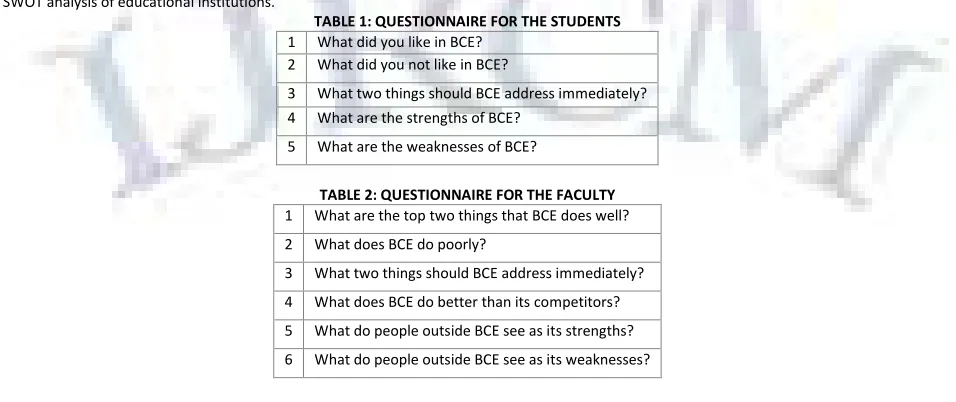
3.1 RESEARCH DESIGNExploratory research design was chosen to carry out this research project of SWOT analysis of the college. Four sets of open ended questionnaire were prepared and feedback from Faculty, Parents, Students and Alumni were obtained. All the responses were tabulated. The similar responses were grouped in the order of their preferences. SWOT matrix was prepared. Finally the recommendations and action plan for the engineering college was given.
3.2 SAMPLE PLAN
Four separate samples of faculty, parents, students and alumni were selected. The technique of selecting these samples was purposive random. Responses from a sample of 143 students, 43 teachers, 44 parents and 43 alumni were collected for the analysis.
3.3 RESEARCH INSTRUMENTS
Since the study was exploratory in nature and being conducted first time for the engineering college, it was decided to go for first hand data information collection. For achieving this objective, four sets of questionnaire were designed (Table 1-4), one each for faculty, parents, students and alumni. The questions were open ended to explore all frank and independent attitudinal aspects of the respondents. These questionnaires were pilot tested and validated for reliability. The data collected were tabulated. But before collecting primary data, secondary data sources were also explored. Earlier studies were scanned for studying SWOT analysis of educational institutions.
TABLE 1: QUESTIONNAIRE FOR THE STUDENTS 1 What did you like in BCE?
2 What did you not like in BCE?
3 What two things should BCE address immediately? 4 What are the strengths of BCE?
5 What are the weaknesses of BCE?
TABLE 2: QUESTIONNAIRE FOR THE FACULTY 1 What are the top two things that BCE does well?
2 What does BCE do poorly?
3 What two things should BCE address immediately?
4 What does BCE do better than its competitors?
5 What do people outside BCE see as its strengths?
INTERNATIONAL JOURNAL OF RESEARCH IN COMMERCE, IT & MANAGEMENT
TABLE 3: QUESTIONNAIRE FOR THE PARENTS 1 What are the top two things that BCE does well?
2 What does BCE do better than its competitors?
3 What two things should BCE address immediately?
4 What does BCE do poorly?
5 What do people outside BCE see as its strengths?
6 What do people outside BCE see as its weaknesses?
TABLE 4: QUESTIONNAIRE FOR THE ALUMNI 1 What are the top two things that BCE does well?
2 What two things should BCE address immediately?
3 What does BCE do poorly?
4 What should BCE preserve at all costs?
5 What is changing in the environment, which could adversely affect BCE?
4. DATA COLLECTION AND ANALYSIS
To derive full benefits of the SWOT analysis, it is important to use the tool in the right manner. Listing out the strengths, weaknesses, opportunities and threats of the organisation by itself cannot be of any value. The data generated by the analysis become meaningful and suggestive only when potential implications of the information for the present and future of the institution are examined and interpreted. Needless to emphasise, this appraisal of the data should be characterised by a sincere and open approach.
Keeping these things in mind, data was collected from the outgoing batch of the students with an understanding that they are well versed with the strengths and weaknesses of the college as they stayed in the college for four years and have experienced with the different factors. The data was collected at the end of their semester so that they will be open and frank to give the real picture of the college. Data was collected from the faculty and from the parents during their respective meetings. The feedback was taken from the alumni through internet and also during Alumni Meet. The total numbers of opinions / remarks given by the Students, Faculty, Parents and Alumni are shown in the Table 5.
Collected data was tabulated, analysed and interpreted. The filled questionnaires received were examined for the correctness and few responses (4%) which were incomplete were rejected. Simple statistical techniques like weighted averages, percentages were used to analyse the tabulated qualitative data. The analysed data was interpreted to draw inferences and conclusions. On the basis of analysis and interpretation thrust areas and recommendations were put forward.
TABLE 5: TOTAL NUMBERS OF REMARKS/OPINIONS RECEIVED
S.No. Questions Students Faculty Parents Alumni
1 What did you like in BCE? 252 ** ** **
2 What did you not like in BCE? 266 ** ** **
3 What 2 things should BCE address immediately? 180 42 73 50
4 What are the strengths of BCE? 202 53 50 **
5 What are the weaknesses of BCE? 214 47 29
6 What are the top 2 things that BCE does well? ** 63 87 81
7 What does BCE do poorly? ** 38 25 29
8 What does BCE do better than its competitors? ** 49 40 **
9 What should BCE preserve at all costs? ** ** ** 27
10 What is changing in the environment which could adversely affect BCE? ** ** ** 30 ** Questions not asked
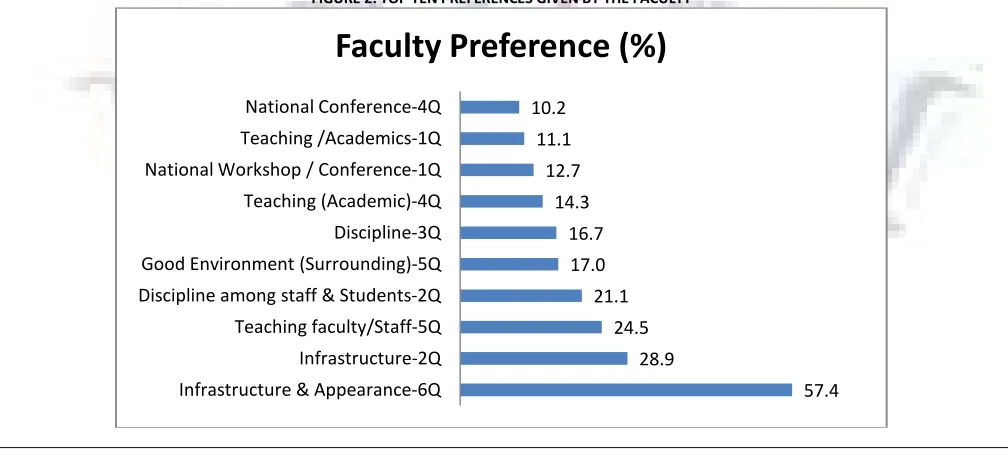
Most common remarks/opinions from each category were then grouped and calculated in terms of percentage. The top ten preferences as given by the students, faculty, parents and alumni are shown separately in the Figures 2, 3, 4 and 5 respectively. The strengths, weaknesses, opportunities and threats as suggested by the stakeholders are represented in the SWOT matrix (Figure 6.)
FIGURE 2: TOP TEN PREFERENCES GIVEN BY THE FACULTY
57.4
28.9
24.5
21.1
17.0
16.7
14.3
12.7
11.1
10.2
Infrastructure & Appearance-6Q
Infrastructure-2Q
Teaching faculty/Staff-5Q
Discipline among staff & Students-2Q
Good Environment (Surrounding)-5Q
Discipline-3Q
Teaching (Academic)-4Q
National Workshop / Conference-1Q
Teaching /Academics-1Q
National Conference-4Q
VOLUME NO.2(2012),ISSUE NO.9(SEPTEMBER) ISSN2231-5756 FIGURE 3: TOP TEN PREFERENCES GIVEN BY THE STUDENTS
FIGURE 4: TOP TEN PREFERENCES GIVEN BY THE PARENTS
FIGURE 5: TOP TEN PREFERENCES GIVEN BY THE ALUMNI
FIGURE 6: SWOT MATRIX FOR BCE Strengths
S1. Calm and quite environment, good for studies S2. Good and care taking faculty and staff S3. Small class size
S4. Cost of education is less (Economical) S5. Good teaching
S6. Transparent administration
Weaknesses
W1. Lack of competitive strength W2. Low financial status (Fundraising) W3. No accreditations
W4. Less marketing and advertising W5. Low academic standards of students W6. Limited campus life
W7. Limited student services W8. Less exposure due to rural place W9. Very less placements
Opportunities
O1. Discipline among staff and students O2. Build infrastructure
O3. Take advantage of location for programming O4. Local community relations - fundraising opportunities O5. Partner with business, industry and government O6. Multi-campus structure
O7. Adding new courses/Enhance intake
Threats
T1. Loss of key staff
T2. Competitor intentions are complex T3. Sustaining internal capabilities T4. Sustainable financial backing T5. Increased competition from other T6. Lack of Professional Approach
20.2
16.4
15.8
12.2
11.9
11.7
11.3
11.1
8.9
8.3
Good Environment …
Students (unity)-4Q
Teaching faculty/Staff (good interaction)-…
Infrastructure/Buildings /Appearance-2Q
Internet/Network management (Wi-fi)-3Q
Students Preference (%)
24.1
24.0
23.0
19.5
19.2
16.0
12.5
12.0
12.0
10.0
10.0
Campus selection (Placements) is Poor -6Q
Teaching & Staff (Good)-1Q
Canteen Building (Only Vegitarian)-3Q
Teaching (Academic)-2Q
Nothing (All is good)-4Q
Good (very) College-5Q
Parents Preference (%)
14.8
14.3
14.3
13.8
12.9
12.3
12.3
11.1
11.1
11.1
Good Teachers - 4Q
campus recruitments - 2Q
Nothing. All changes have been done - 5Q
Alumni meet - 1Q
Infrastructure development -4Q
INTERNATIONAL JOURNAL OF RESEARCH IN COMMERCE, IT & MANAGEMENT
5. FINDING AND RECOMMENDATIONS:
The major findings and recommendations of this study are as follows:
1. College location, surrounding and environment is liked by most of the Students (20.2%), Faculty (17%), Parents (20%) and expressed that it is calm, quite, cool, homely, peaceful and good for study.
2. Teachers and staff of the college are cooperative and having helping nature. The Students (11.6%) have mentioned that teachers are easily available and encourage for their progress.
3. Teaching staff are the strength of the college. They interact freely with the students and teach & guide nicely as told by Students (11.9%), Faculty (24.5%) and Parents (18%). Alumni (14.8%) say BCE should preserve good teachers at any cost.
4. College is good in everything (staff, teaching & training, discipline, facilities etc) is mentioned by the Parents (20%). 5. Academic and teaching works are done well as mentioned by the Faculty (11.1%), Parents (23%) and Alumni (11.1%). 6. Functions and events are organized well in the college as mentioned by Faculty (12.7%), Parents (19.5%) and Alumni (12.3%). 7. Alumni (12.3%) say Hospitality and traditions are done well by BCE.
8. The students’ unity and their team work is the strength of BCE as said by the Students (15.8%).
9. Teaching and academic activities are better than competitors as mentioned by Faculty (14.3%) and Parents (12.5%).
10. The students are given opportunities for their overall development. BCE does it better than its competitors as told by the Parents (10%)
11. The infrastructure / building appearance is not liked by the Students (11.3%) and they (16.4%) say it is the weakness of BCE. The Faculty (57.4%) agree infrastructure & building appearance is the weakness of BCE. Faculty (9.5%) and Alumni (14.3%) say BCE should address it immediately.
12. A separate Canteen building should be constructed immediately as expressed by the Students (11.1%) and Parents (19.2%).
13. A good internet Facility (Wi-Fi) should be provided to the students and staff immediately as said by the Students (8.9%) and the Faculty (9.5%).
14. Campus placements are less/not good. No good companies are visiting the college as told by the Students (11.7%) and it is the weakness of BCE said by the Parents (24.1%).
15. Being in rural area, the students are lagging and have less scope for exposure as told by the Parents (6.9%).
16. Discipline among the staff and students is very poor as expressed by the Faculty (21.1%) and they (16.7%) say BCE should address it immediately. 17. BCE should address immediately to guide failed / academically poor students as said by the Parents (6.8%).
18. Alumni (6.9%) say BCE is poor in retaining senior staff and they (14.8%) say BCE should retain them at any cost.
The above mentioned few important findings pinpointed certain Strengths and Weaknesses of BCE. There are certain needs and expectations expressed by the stakeholders that management has to take actions to meet them immediately. Apart from these there are certain problematic areas where stakeholders have shown their dissatisfaction. The stake holders also have suggested certain areas of opportunities for improvement of BCE. Some of the problems are such that these can lead to making situation further worse if not tackled by taking timely decisions.
6. ACTIONS PLANS
Setting of objective should be done after performing the SWOT analysis. This would allow achievable goal(s) or objective(s) to be set for the organization. Based on the information collected from various stakeholders of BCE through SWOT Analysis, Sixteen action plans covering important thrust areas have been suggested and are shown in the Table 6. All the action plans are expressed with respect to the SWOT factors, the person(s) responsible to carry out the actions with the time line for each action.
TABLE 6: PROPOSED ACTION PLANS FOR BCE Sl.
No.
Proposed Action Plans Related SWOT Codes Timeline Responsibility
1 Improving Infrastructure by adding separate buildings for Civil, Mechanical departments.
S1, O2, O4,O7, W2,W6, July 2015
Management
2 Additional Hostel buildings to be constructed to meet additional requirements. S1, O2,O4, W2,W6, Dec 2014
Management
3 A separate building for Canteen and recreation centre for both staff and students is being constructed.
S1, O2, O6, W6 Dec 2013
Management
4 Reducing failure rate of students by taking extra care and counseling to academically poor students.
S2,S3,W5,W8, T5 Ongoing Dean-Academic /HODs 5 Incorporating overall personality development and entrepreneurship development
programmes as major components of teaching learning process.
O5,W1,W5,W7, W8, W9, T2,T6
Ongoing Principal/Dean /HODs
6 Improving industrial orientation, training and placement services. O5,W1,W4,W5, W7, W8, T2,T6
Ongoing HODs/TPO
7 Developing suitable performance evaluation, feedback reporting and recording system, standard academic templates.
S6, O1,W1, W3, T3 Ongoing Dean-Academic /HODs
8 Developing suitable HRD policies. S6,T1,T2,T3,T6 Dec
2013
Management
9 Providing Wi-Fi facility to all department blocks including hostel blocks with security system.
O2,O6, W6,W7 Dec 2013
Principal /Head-ICTC 10 Encourage both staff and students for participation in workshops, conferences
with leave and monitory benefits.
S6, W5,W6,W8, T3,T5 Ongoing Dean-academic /HODs
11 Training of faculty and staff every semester under Faculty development programme.
W1,T3 Ongoing Dean-Academic
12 Enhancing facilities of sports, library, transportation, malty gym centre, internet and intranet etc.
O2,O6,W6,W7 July 2014
Management
13 Strengthening with adequate qualified and experiences faculty and staff. S2,T1 Ongoing Management /Dean-Academic/HODs 14 Updating library and teaching learning resources. W7,T6 Ongoing
Principal/Dean-Academic/HODs
15 Improving Hostel and Mess facilities. O2,W7 Dec
2013
Management /Principal /Warden
16 Improving discipline among both staff students with proper code of conducts and guidelines.
VOLUME NO.2(2012),ISSUE NO.9(SEPTEMBER) ISSN2231-5756 After careful study of the data it is concluded that a systematic approach with technical vision and management strategies these issues could be tackled. It is hoped that administrators, members of management, head of the institution/department will take strategic measures for the overall growth and development of BCE.
The SWOT analysis through feedback on questionnaire is proved to be an instrument for developing strategic plans for the growth and development of an engineering college. It is expected that the integrated efforts of all the stake holders shall bring significant improvement in the quality, efficiency and effectiveness of BCE.
REFERENCES
1. Developing Your Strategic SWOT Analysis. Austrainer. Viewed on June 10, 2012 http:// www.austrainer.com/archives/1397.htm. 2. Ferrell, O., Hatline, M., Lucas, G., Luck, D. (1998), “Marketing Strategy”. Orlando, FL Dryden Press.
3. FJEI Trustee Programme workshop Manual (2008), Pune, India
4. J. David Hunger, Thomas L. Wheelen (2007), “Essentials of Strategic Management”, Fourth Edition, Prentice-Hall of India Pvt. Ltd., New Delhi 5. R. Srinivasan (2006), “Strategic Management, The Indian Context”, Second Edition, Prentice-Hall of India Pvt. Ltd., New Delhi
6. SPRING 2005 STRATEGIC PLANNING SURVEY (SWOT), Viewed on January 20, 2012 www.iea.fau.edu/inst/swot2.doc
7. SWOT Analysis- Strengths, Weaknesses, Opportunities, Threats. PMI- Plus. Minus. Interesting, Viewed on June 22, 2012 http:// www.mindtools.com/swot.html
8. Swoting Your Way to Success. BHC, Viewed on June 5, 2012 http://www.bradhuckelco.com.au/ swot.htm
INTERNATIONAL JOURNAL OF RESEARCH IN COMMERCE, IT & MANAGEMENT
REQUEST FOR FEEDBACK
Dear Readers
At the very outset, International Journal of Research in Commerce, IT and Management (IJRCM)
acknowledges & appreciates your efforts in showing interest in our present issue under your kind perusal.
I would like to request you to supply your critical comments and suggestions about the material published
in this issue as well as on the journal as a whole, on our E-mail i.e.
for further
improvements in the interest of research.
If you have any queries please feel free to contact us on our E-mail
.
I am sure that your feedback and deliberations would make future issues better – a result of our joint
effort.
Looking forward an appropriate consideration.
With sincere regards
Thanking you profoundly
Academically yours
Sd/-