Kinetic studies on bioadsorption of arsenate fromaqueous solutions
using chitosan
Nematollah Jaafarzadeh Nematollah Jaafarzadeh Nematollah Jaafarzadeh Nematollah Jaafarzadeh1111
, , ,
, Nezamaddin MengelizadehNezamaddin MengelizadehNezamaddin MengelizadehNezamaddin Mengelizadeh2222
, Afshin Takdastan , Afshin Takdastan, Afshin Takdastan , Afshin Takdastan2222
, , , , Mehrnush Haji
Mehrnush HajiMehrnush Haji
Mehrnush Haji----AmadiAmadiAmadiAmadi3333
1 Department of Environmental Health Engineering AND Environmental Technology Research Center, Ahvaz Jundishapur University of Medical Sciences, Ahvaz, Iran
2 Department of Environmental Health Engineering, Ahvaz Jundishapur University of Medical Sciences, Ahvaz, Iran 3 Department of Philosophy, Tehran Branch, Islamic Azad University, Tehran, Iran
Abstract Abstract Abstract Abstract
Arsenic, one of the most toxic and dangerous elements in the environment affecting millions of people around the world, is associated with several diseases. In this pilot study, we investigated removal of arsenate from aqueous solutions using chitosan under the influences of initial arsenic ion concentrations, pH, contact time, and adsorbent dosages of chitosan. In order to assess the sorption mechanism and the potential rate of controlling steps, the pseudo-first and pseudo-second order kinetic models and the Langmuir and Freundlich isotherm models were used. The obtained results showed that the removal of As(V) by chitosan was found to be pH dependent, with optimum sorption occurring at pH = 4. The kinetics of arsenate adsorption on chitosan is well described by the pseudo-second order model. Furthermore, As (V) sorption isotherm was developed at optimal conditions and sorption equilibrium data were fitted to the Freundlich isotherm model.
KEYWORDS: KEYWORDS: KEYWORDS:
KEYWORDS: Adsorption, As (V), Chitosan, Kinetic Models
Date of submission: Date of submission: Date of submission:
Date of submission: 10 Sep 2013, Date of acceptance:Date of acceptance:Date of acceptance:Date of acceptance: 11 Dec 2013
Citation: Jaafarzadeh N, Mengelizadeh N, Takdastan A, Haji-Amadi M. Kinetic studies on bioadsorption of arsenate from aqueous solutions using chitosan. J Adv Environ Health Res 2014; 2(1): 7-12
Introduction
1Arsenic (As), is a widely distributed semi-metallic element found in various compounds in the crust of the earth and it is considered as one of the most important environmental hazards.1 It is released
into the environment mostly through natural processes, such as weathering reactions, volcanic emissions, biological activity, inputs from geothermal sources, and as an outcome of anthropogenic activities, such as mining activities and discharges of various industries.2-6 The
exposure to this semi-metallic element leads to black foot disease, skin cancer, liver, and lung
Corresponding Author Corresponding Author Corresponding Author Corresponding Author:::: Nezamaddin Mengelizadeh
Email: [email protected]
cancer.7 Therefore, the maximum allowed
concentration of arsenic, according to World Health Organization (WHO) and Environmental Protection Agency (EPA), in drinking water equals to 10 µg/l.8 To remove As(V), many
physical/chemical treatment methods have been applied. Among them, adsorption treatment has been widely used. In this method, various adsorbents have been used such as activated alumina, activated carbon, fly ash, ferric hydroxide, and chitosan.9 Among the adsorbents,
molecular weight and has other characteristics such as being soluble in different mediums, degradable, hydrophilic, biocompatible, antibacterial, antioxidant, and an agent for removing metals. This biopolymer is polycationic at pH values under 6 and simply reacts with compounds with negative charge such as anionic polysaccharides, fatty acids, and phospholipids. Chitosan performs coagulation and flocculation through charge neutralization, adsorption, and interparticle bridging.10-16 The objective of this
research is to determine the efficiency level of chitosan, as an effective adsorbent for the removal of arsenate from aqueous solutions.
Materials and Methods
Chitosan with 75-85% deacetyl prepared from shrimp shells was obtained from the GMA Chemical Company. The pilot sorption experiment was performed in 100 ml of arsenate(V) solution in a mixer incubator at room temperature for 120 minutes. To study the influence of pH on the As(V) adsorption capacity of the adsorbent, experiments were conducted at different pH values (3-7). The effect of contact time was studied with an initial arsenic concentration of 1 mg/l and adsorbent dose of 25 mg/l; pH was kept constant at 4 and contact time was varied from 30 to 240 minutes. Isotherm study was conducted by varying initial As(V) concentrations (100–2000 µg/l), fixed adsorbent dose of 25 mg/l, and contact time of 2 hours at pH = 4.
In each set of the experiments, the concentration of arsenate ions was determined using inductively coupled plasma atomic emission spectrometry (ICP-AES), (Ultima 2C, France). Biosorption of the arsenate ions in the sorption system was calculated using the mass balance:
q = ( ) (1)
Where Co and Ce are the initial and final
concentrations (mg/l), V is the volume of aqueous solution (L), and W is the mass of absorbent (g).
Results and Discussion
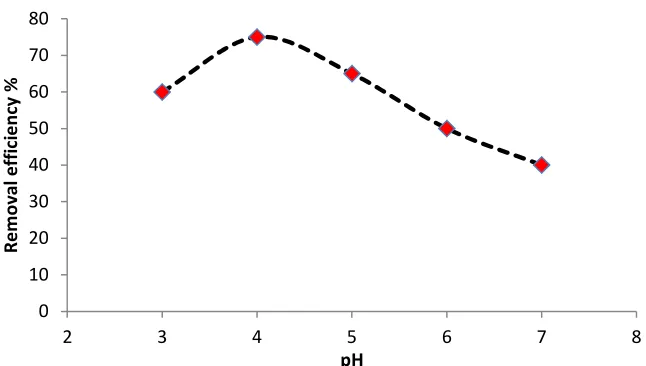
Effect of pHOne of the important parameters for adsorption of metal ions from aqueous solution is pH because it affects the solubility of the metal ions and species of metal in water.17 Figure 1 shows
the effect of pH on uptake capacity of arsenate ions. It can be seen that the adsorption capacity of arsenate ions was decreased as the pH values were increased. This effect can be explained as follows: at low pH values, H2AsO-4 is the
dominant species, and therefore, H2AsO-4 would
be easily expected to interact more strongly with the chitosan, which is carrying positive charges.18
These observations are in agreement with previous works of Gérente et al. and Jeon9,18
Effect of adsorbent dosage
Dosage is one of the most important parameters, which should be considered to determine the optimum condition for the performance of chitosan in adsorption. Figure 2 shows the effect of adsorbent dosage on the value of arsenate removal at equilibrium conditions. From figure 3, it can be observed that removal efficiency of the adsorbent generally improved with increasing dose. This is due to the increase in available surface active sites which results from the increase in dose of adsorbent.18
Effect of initial metal concentration
The experimental data shown in figure 3 revealed that the metal uptake capacity increases with increase in initial concentration of metal ion while the arsenate removal percentage decreases due to increase in initial metal ion concentration. This effect can be explained as follows: At low concentrations, all arsenate ions present in solution could interact with the binding sites and thus the biosorption percentage was higher for higher initial arsenate ion concentrations. At lower concentrations, lower biosorption yield is due to the saturation of biosorption sites.19
Effect of contact time
Figure 1. Effect of pH on uptake capacities of arsenate ions using chitosan
Figure 2. Effect of biosorbent dosage on biosorption of arsenate
Figure 3. Effect of metal ion concentration on the biosorption of arsenate by chitosan 0
10 20 30 40 50 60 70 80
2 3 4 5 6 7 8
R
e
m
o
v
a
l
e
ff
ic
ie
n
cy
%
pH
0 10 20 30 40 50 60 70 80 90
0 20 40 60 80 100 120
R
e
m
o
v
a
l
e
ff
ic
ie
n
cy
%
Absorbent dosage (mg)
40 45 50 55 60 65 70 75 80 85 90
0 500 1000 1500 2000 2500
R
e
m
o
v
a
l
e
ff
ic
ie
n
cy
%
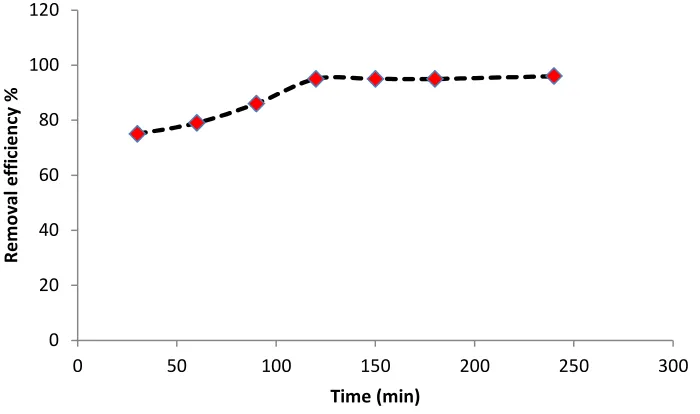
time in the range of 30–240 minutes. It was observed that arsenate removal (%) increased with time up to about 120 minutes and then the curves became quite level, indicating the attainment of the adsorption equilibrium. Optimum contact time for chitosan adsorbent was found to be 120 minutes. Therefore, the chitosan adsorbent requires a shorter contact time. Greater availability of several functional groups on the surface of chitosan, which are required for interaction with pollutants, significantly improved the binding capacity and the process proceeded rapidly. This result is important, as equilibrium time is one of the important parameters for an economical aqueous solutions treatment system.20
Isotherm and kinetics of biosorption
Adsorption isotherm is important to describe how solutes interact with adsorbent. The Langmuir and Freundlich models are often used to describe sorption isotherm equilibrium. Table 1 presents the calculated result of the arsenate sorption equilibrium on the chitosan as a function of the initial concentration of arsenate. Moreover, in order to study the controlling mechanism of the adsorption process, such as mass transfer and chemical reaction, pseudo-first and pseudo-second
equations were used to test the experimental data. Table 2 shows the results of the kinetic parameters for arsenate adsorption. As table 1 and 2 indicate, the R2 values fit with Freundlich isotherm and
pseudo-second order kinetics providing a proper model of the sorption system. These results are similar to those reported by Gang et al. and Thirunavukkarasu et al.21,22
Comparison of chitosan with other biosorbents for arsenic removal
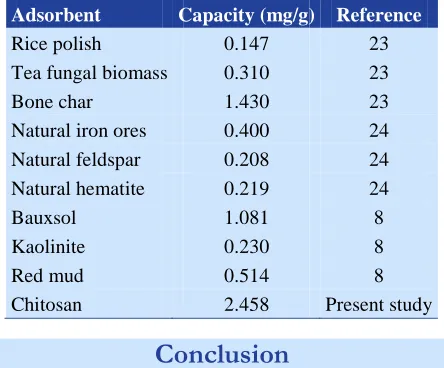
Arsenate adsorption by chitosan, as quantified in this study from batch experiments, was compared with values of other biosorbents in literature, including natural materials, microbial and algal biomass, industrial and agricultural wastes, activated carbons, and some commercial cation exchange resins (Table 3). Although the data collated in table 3 may not represent equivalent or optimized conditions or various As(V) removal mechanisms in each case, it still provides a useful comparison for engineers in their selection of a suitable biosorbent in engineering practice. According to table 3, the chitosan adsorbent shows a good adsorption capacity when compared with the adsorption capacity of various low-cost adsorbents for arsenate removal.
Figure 4. Effect of contact time on biosorption of arsenate by chitosan 0
20 40 60 80 100 120
0 50 100 150 200 250 300
R
e
m
o
v
a
l
e
ff
ic
ie
n
cy
%
Table 1. Langmuir and Freundlich isotherm constants and correlation coefficients
Adsorbent Freundlich parameters Langmuir constants
Kf n R2 qmax RL R2
Commercial chitosan 0.172 1.315 0.9982 2.458 0.196-0.830 0.937
Kf: Freundlich sorption constant; n: The heterogeneity factor; R2: The correlation coefficient; qmax: Maximum adsorption capacity; RL: Separation parameter
Table 2. Kinetic constants for arsenate onto chitosan
Adsorbents qe (exp) mg/g
Pseudo-first-order kinetics Pseudo-second-order kinetics
K1 qe R2 K2 qe R2
Chitosan 0.95 0.0133 0.317 0.9388 0.131 0.928 0.9963
qe (exp): The sorption capacity determined from the experiment; K1: First-order rate constant; qe: The sorption capacity determined from the model; R2: The correlation coefficient; K2: Second-order rate constant
Table 3. Comparison of sorption capacities of chitosan and other adsorbents for the removal of arsenate
Adsorbent Capacity (mg/g) Reference
Rice polish 0.147 23
Tea fungal biomass 0.310 23
Bone char 1.430 23
Natural iron ores 0.400 24
Natural feldspar 0.208 24
Natural hematite 0.219 24
Bauxsol 1.081 8
Kaolinite 0.230 8
Red mud 0.514 8
Chitosan 2.458 Present study
Conclusion
In this study, we investigated the applicability of the chitosan for As(V) removal. The experiments show that chitosan can absorb arsenate ions from aqueous solution effectively, and the sorption capacity has been improved greatly with a maximum sorption capacity of about 2.458 mg/g. The experimental data of the sorptionequilibrium from arsenate ions solution are well fitted with the Freundlich isotherm equation.
Conflict of Interests
Authors have no conflict of interests.Acknowledgements
The authors are grateful for the financial support of this project by the Environmental Technology Research Center of Ahvaz Jundishapur University of Medical Sciences
under grant number E-9007.
References
1. Chen CL, Chiou HY, Hsu LI, Hsueh YM, Wu MM, Chen CJ. Ingested arsenic, characteristics of well water consumption and risk of different histological types of lung cancer in northeastern Taiwan. Environ Res 2010; 110(5): 455-62.
2. Menhage-Bena R, Kazemian H, Ghazi-Khansari M, Hosseini M, Shahtaheri SJ. Evaluation of Some Natural Zeolites and Their Relevant Synthetic Types as Sorbents for Removal of Arsenic from Drinking Water. Iranian J Publ Health 2004; 33(1): 36-44.
3. Lievremont D, Bertin PN, Lett MC. Arsenic in contaminated waters: biogeochemical cycle, microbial metabolism and biotreatment processes. Biochimie 2009; 91(10): 1229-37.
4. Manju GN, Raji C, Anirudhan TS. Evaluation of coconut husk carbon for the removal of arsenic from water. Water Research 1998; 32(10): 3062-70. 5. Smedley PL, Kinniburgh DG. A review of the source, behaviour and distribution of arsenic in natural waters. Applied Geochemistry 2002; 17(5): 517-68.
6. Valencia-Trejo E, Villicaña-Méndez M, Alfaro-Cuevas-Villanueva R, Garnica-Romo MG, Cortés-Martínez R. Effect of temperature on the removal of arsenate from aqueous solutions by titanium dioxide nanoparticles. Journal of Applied Sciences in Environmental Sanitation 2010; 5(2): 171-84. 7. Biterna M, Arditsoglou A, Tsikouras E, Voutsa
D. Arsenate removal by zero valent iron: batch and column tests. J Hazard Mater 2007; 149(3): 548-52.
8. Mohan D, Pittman CU, Jr. Arsenic removal from water/wastewater using adsorbents--A critical review. J Hazard Mater 2007; 142(1-2): 1-53. 9. Gérente C, Andrès Y, McKay G, Le Cloirec P.
process. Chemical Engineering Journal 2010; 158(3): 593-8.
10. Renault F, Sancey B, Badot PM, Crini G. Chitosan for coagulation/flocculation processes – An eco-friendly approach. European Polymer Journal 2009; 45(5): 1337-48.
11. Juang RS, Shao HJ. A simplified equilibrium model for sorption of heavy metal ions from aqueous solutions on chitosan. Water Res 2002; 36(12): 2999-3008.
12. Varma AJ, Deshpande SV, Kennedy JF. Metal complexation by chitosan and its derivatives: a review. Carbohydrate Polymers 2004; 55(1): 77-93. 13. Guibal E, Roussy J. Coagulation and flocculation of dye-containing solutions using a biopolymer (Chitosan). Reactive and Functional Polymers 2007; 67(1): 33-42.
14. Dutta PK, Dutta J, Tripathi VS. Chitin and chitosan: Chemistry, properties and applications. JSIR 2004; 63(1): 20-31.
15. Assaad E, Azzouz A, Nistor D, Ursu AV, Sajin T, Miron DN, et al. Metal removal through synergic coagulation–flocculation using an optimized chitosan–montmorillonite system. Applied Clay Science 2004; 37(3-4): 258-74.
16. Shetty AR. Metal anion removal from wastewater using Chitosan in a polymer enhanced diafiltration system [PhD Thesis]. Massachusetts, MA: Worcester Polytechnic Institute 2006.
17. Amiri H, Jaafarzadeh N, Ahmadi M, Silva Martínez
S. Application of LECA modified with Fenton in arsenite and arsenate removal as an adsorbent. Desalination 2011; 272: 212-7.
18. Jeon CH. Removal of As(V) from aqueous solutions by waste crab shells. Korean Journal of Chemical Engineering 2011; 28(3): 813-6.
19. Nageswara Rao L, Prabhakar G. Equilibrium and kinetic studies for biosorption system of chromiumions from aqueous solution using Ficus benghalensis L. powder. J Chem Pharm Res 2011; 3(6): 37-87.
20. Nomanbhay SM, Palanisamy K. Removal of heavy metal from industrial wastewater using chitosan coated oil palm shell charcoal. Electronic Journal of Biotechnology 2005; 8(1): 43-53.
21. Gang DD, Deng B, Lin L. As(III) removal using an iron-impregnated chitosan sorbent. J Hazard Mater 2010; 182(1-3): 156-61.
22. Thirunavukkarasu OS, Viraraghavan T, Subramanian KS. Arsenic removal from drinking water using granular ferric hydroxide. Water SA 2003; 29(2): 161-70.
23. Ranjan D, Talat M, Hasan SH. Biosorption of arsenic from aqueous solution using agricultural residue 'rice polish'. J Hazard Mater 2009; 166(2-3): 1050-9.