Advances in Radio Science, 3, 119–123, 2005 SRef-ID: 1684-9973/ars/2005-3-119
© Copernicus GmbH 2005
Advances in
Radio Science
Shielding properties of a conducting bar calculated with a boundary
integral method
L. O. Fichte, S. Lange, Th. Steinmetz, and M. Clemens
Professur f¨ur Theoretische Elektrotechnik und Numerische Feldberechnung, Helmut-Schmidt-Universit¨at, Universit¨at der Bundeswehr Hamburg, PO. Box 700822, 22008 Hamburg, Germany
Abstract. A plane rectangular bar of conducting and per-meable material is placed in an external low-frequency mag-netic field. The shielding properties of this object are in-vestigated by solving the given plane eddy current problem for the vector potential with the boundary integral equation method. The vector potential inside the rectangle is governed by Helmholtz’ equation, which in our case is solved by sep-aration. The solution is inserted into the remaining bound-ary integral equation for the exterior vector potential in the domain surrounding the bar. By expressing its logarithmic kernel as a Fourier integral the overall solution inside and outside the bar is calculated using analytical means only.
1 Introduction
Subject of this investigation are the shielding properties of a rectangular bar of constant conductivityκi and permeabil-ity µi. The space outside the bar has the arbitrary con-stant permeabilityµa and conductivityκa=0. The vector rq=xqex+yqeyis pointing at the lower left corner of the bar, the dimensions of it beinga andb, as shown in Fig. 1. We name the cross-section of the barand its contourC=∂.
An exciting loop consists of two thin conductors, which carry the currentsi(t )and−i(t ), withi(t )=<{I ej ωt},I be-ing the phasor describbe-ing the complex current . They are located at
re= ±xeex.
The angular frequencyωis considered to be low enough so that displacement currents can be neglected:J∂
∂tD, where Jis the current density inside the bar andDthe electric flux. Thez-directed dimensions of both bar and loop are sup-posed to be infinite.
2 Differential equations for the vector potential
As all exciting currents are oscillating at one single fre-quency, all fields will show the same time dependency and can be expressed by their complex phasors.
Correspondence to: L. O. Fichte
Introducing a complex vector potential A as B=curlA, where B denotes the magnetic flux, and investigating its properties, we find that an additional term has to be added to the vector potential if we consider points inside the bar. The additional term can be expressed as the time domain in-tegral of the gradient of a complex electrical scalar potential φi(z)by
Z
(gradφi)dt =Cez,
where C denotes an unknown complex constant. The vec-tor potentialAiinside the bar can be redefined by using the Buchholz convention
A∗i =Ai +
Z
grad8idt=Ai+Cez
from which the fields can be computed with Bi=curlA∗i and Ei= −j ωA∗i.
From Maxwell’s equations we find that the modified vec-tor potential inside the bar is governed by Helmholtz’ equa-tion, which for complex fields takes the form
1A∗i −j ωµiκiA∗i =0. (1)
Outside the bar the equation
1Aa= −µaJe, (2)
is valid for the vector potentialAa. The exciting current den-sityJecan be expressed as
Je= {δ1(x−xe)−δ1(x+xe)}δ1(y)·Iez.
The symbol δ1(x−xo) denotes the one-dimensional Dirac function; accordingly, δ2 and δ3 are the two- and three-dimensional Dirac functions.
Since we allow onlyz-directed exciting currents, all vector potentials will also be exclusivelyz-directed. They can be described by theirz-componentsAaz andA∗iz, respectively. The boundary conditions forAazandA∗izare
Aaz=A∗iz−C ∧ 1
µano·gradAaz= 1
µino·gradA ∗ iz,
120 L. O. Fichte et al.: Shielding properties of a conducting bar calculated with a boundary integral method
SHIELDING PROPERTIES OF A CONDUCTING BAR
CALCULATED WITH A BOUNDARY INTEGRAL METHOD
Lars Ole Fichte, Sebastian Lange, Thorsten Steinmetz, Markus Clemens Professur f¨ur Theoretische Elektrotechnik und Numerische Feldberechnung
Helmut-Schmidt-Universit¨at Universit¨at der Bundeswehr Hamburg PO. Box 700822, D-22008 Hamburg, Germany Tel.(+49)40-6541 2460, Fax.(+49)40-6541 3764
ABSTRACT: A plane rectangular bar of con-ducting and permeable material is placed in an ex-ternal low-frequency magnetic field. The shielding properties of this object are investigated by solving the given plane eddy current problem for the vec-tor potential with the boundary integral equation method. The vector potential inside the rectangle is governed by Helmholtz’ equation, which in our case is solved by separation. The solution is inserted into the remaining boundary integral equation for the exterior vector potential in the domain surround-ing the bar. By expresssurround-ing its logarithmic kernel as a Fourier integral the overall solution inside and outside the bar is calculated using analytical means only.
1. INTRODUCTION
Subject of this investigation are the shielding prop-erties of a rectangular bar of constant conductivity
κi and permeability µi. The space outside the bar
has the arbitrary constant permeabilityµaand
con-ductivity κa = 0. The vector ~rq = xq~ex+yq~ey is
pointing at the lower left corner of the bar, the di-mensions of it beingaandb, as shown in Fig.1. We name the cross-section of the bar Ω and its contour
C=∂Ω.
An exciting loop consists of two thin conductors, which carry the currentsi(t) and−i(t), withi(t) =
<{Iejωt}, I being the phasor describing the
com-plex current . They are located at
~re =±xe~ex.
The angular frequency ω is considered to be low enough so that displacement currents can be ne-glected: J~¿ ∂t∂D~, where J~ is the current density inside the bar and D~ the electric flux.
Thez-directed dimensions of both bar and loop are supposed to be infinite.
2. DIFFERENTIAL EQUATIONS FOR THE VECTOR POTENTIAL
As all exciting currents are oscillating at one single PSfrag replacements
x, x0
y, y0
−I0 +I0
xc, x0c yc, y0c
a b
conducting bar
~rq
Figure 1: Screening bar and exciting loop
frequency, all fields will show the same time de-pendency and can be expressed by their complex phasors.
Introducing a complex vector potential A~ as B~ = curlA~, whereB~ denotes the magnetic flux, and in-vestigating its properties, we find that an additional term has to be added to the vector potential if we consider points inside the bar. The additional term can be expressed as the time domain integral of the gradient of a complex electrical scalar potential
ϕi(z) by w
(gradϕi)dt=C~ez,
where C denotes an unknown complex constant. The vector potential A~i inside the bar can be
re-defined by using the Buchholz convention
~
A∗i =A~i+
w
(gradϕi)dt=A~i+C,
from which the fields can be computed with
~
Bi= curlA~
∗
i and E~i =−jω ~A
∗
i.
From Maxwell’s equations we find that the modi-fied vector potentialinside the baris governed by
Fig. 1. Screening bar and exciting loop.
3 Derivation of Boundary Integral Equation (BIE)
In Green’s second theorem
Z Z
τ Z
(8 19−9 18)dτ=
= v
F=∂τ(8grad9
−9grad8)·nodF,
we insert the single component of the vector potentialAaas 9 and a kernel functionK satisfying1K=−δ3as8. As a result, we get an integral representation valid forAa: Aa= − v
F=∂τ(AagradK
−KgradAa)·nodF+
+µaI +∞ Z −∞ K xo=±xe yo=0
dzo.
The integrand of the surface integral at the right hand side of the above equation does not depend onz. Hence thez -directed integration is only affecting the kernel functionK, for which the elementary Kernel function
K= 1
4π r,
is inserted. Thereby we can define a new kernel functionG20 as
G20= +∞
Z
−∞
Kdzo=1 4π
+∞
Z
−∞
dzo p
(x−xo)2+(y−yo)2+(z−zo)2
= − 1 2π ln
p
(x−xo)2+(y−yo)2 ρo
!
= − 1 2π ln
ρ
ρo
,
withρ=p(x−xo)2+(y−yo)2andρo=const. While we are aware that the above integral is divergent, it can be solved by performing a suitable renormalization.
The function G20 satisfies 1G20=−δ2, as is shown in Ehrich et al. (2000).
Helmholtz’ equation, which for complex fields takes the form
∆A~∗
i −jωµiκiA~
∗
i = 0. (1)
Outsidethe bar the equation
∆A~a=−µaJ~e, (2)
is valid for the vector potential A~a. The exciting
current densityJ~ecan be expressed as
~
Je={δ1(x−xe)−δ1(x+xe)}δ1(y)·I~ez.
The symbolδ1(x−xo) denotes the one-dimensional Dirac function; accordingly, δ2 andδ3are the
two-and three-dimensional Dirac functions.
Since we allow onlyz-directed exciting currents, all vector potentials will also be exclusivelyz-directed. They can be described by their z-componentsAaz
andA∗
iz, respectively. The boundary conditions for
AazandA∗izare
Aaz=A
∗
iz−C ∧
1
µa~no·gradA
az=
1
µi~no·gradA
∗
iz,
where~nois a unit vector normal to the boundary.
3. DERIVATION OF BOUNDARY INTE-GRAL EQUATION (BIE)
In Green’s second theorem
ww
τ
w
(Φ ∆Ψ−Ψ ∆Φ)dτ =
= {
F=∂τ
(Φ gradΨ−Ψ gradΦ)·~nodF,
we insert the single component of the vector po-tential Aa as Ψ and a kernel functionKsatisfying
∆K =−δ3 as Φ. As a result, we get an integral
representation valid forAa:
Aa=−
{
F=∂τ
(AagradK−KgradAa) ·~nodF+
+µaI
+w∞ −∞
K¯¯ ¯x
o=±xe
yo=0
dzo.
The integrand of the surface integral at the right hand side of the above equation does not depend on z. Hence thez-directed integration is only affecting the kernel function K, for which the elementary Kernel function
K= 1 4πr,
PSfrag replacements
xc, x0c ~n1=~ey ~n2=−~ex
~n4=~ex ~n3=−~ey yc, y0c
Ω
a b
xq yq
Figure 2: Normals on boundary scetions
is inserted. Thereby we can define a new kernel functionG20as
G20= +w∞ −∞
Kdzo= 1 4π
+w∞ −∞
dzo p
(x−xo)2+ (y−yo)2+ (z−zo)2
= − 1
2πln( p
(x−xo)2+ (y−yo)2 ρo
) =−1
2πln( ρ ρo
),
withρ =p
(x−xo)2+ (y−yo)2 andρo = const. While we are aware that the above integral is di-vergent, it can be solved by performing a suitable renormalization.
The functionG20satisfies ∆G20=−δ2, as is shown
in [3].
If we use the new kernel and define the influence of the exciting loop as
Ae:=µaIG20|x
o=±xe
yo=0
,
we can write the integral representation forAaas
Aa=−
z
C=∂Ω
(AagradG20−G20gradAa)·~nods+Ae.
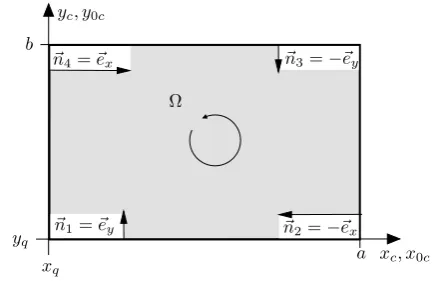
We use the cross-section of the bar as integration domain Ω with its facet normals defined as shown in Fig. (2).
By taking into account the boundary conditions dis-cussed above, we get an integral representation for the vector potential outside the bar:
Aa=−
z
C=∂Ω
[(Wi−C) gradG20−
−G20
µa
µigradWi]·~nods+A
e.
(3) Fig. 2. Normals on boundary scetions.
If we use the new kernel and define the influence of the exciting loop as
Ae:=µaI G20|x o=±xe yo=0
,
we can write the integral representation forAaas Aa= −
I
C=∂
(AagradG20−G20gradAa)· nods+Ae.
We use the cross-section of the bar as integration domain with its facet normals defined as shown in Fig. (2).
By taking into account the boundary conditions discussed above, we get an integral representation for the vector poten-tial outside the bar:
Aa= −
I
C=∂
[(A∗i−C)gradG20−G20 µa µi
gradA∗i] ·nods+Ae. (3)
It can be shown that
I
C=∂
(CgradG20)·nods=0,
so we can omit this term in Eq. (3).
In a last step we take the normal derivative ofAaon each of the four contour sections ofand move the observation point to the very same section, i.e.
(1)y =yq, (3)y =yq+b, (2)x =xq+a, (4)x =xq.
As a result, we get four independent integral equations µa
µi
no· gradA∗i =no·grad (4)
I
C=∂
(A∗i gradG20−G20 µa
µi gradA ∗
i)nods+Ae
x=xq∨x=xq+a,y x,y=yq∨y=yq+b Conventionally, one would derive another boundary inte-gral equation, this one valid forA∗i, using
G20i= 1 4jH
1 0(k
ρ ρ0
L. O. Fichte et al.: Shielding properties of a conducting bar calculated with a boundary integral method 121
PSfrag replacements
x/m y/m
−0.1 +0.1
−0.1 +0.1
~ B
Figure 3: Quadratic bar in homogenous field
Figure 4: Abs(A∗
i) for bar in homogenous field
As an additional verification, different values ofω, κ andµri= µµ0i are considered. We calculated the
av-erage of the absolute ofA∗
i over the cross-section of
the bar Ω as functions of . By this we can estimate which amount of the outside field permeates into the conducting area. The average ofA∗
i has been
normalized on the valueA0 = 1·10−6V sA in Figs.
(5) and (6) and onA1= 1·10−7V sA in Fig. (7).
4.2 SINGLE EXCITING LINE
In a next step, one conducting bar of quadratic cross-section with a = b = 0,1m is placed at ~rq= (−0.1,−0.1)m. One single exciting line, carry-ingI= 100 A, is placed at (0.0,−0.15) m, as shown in Figure (8).
Figure (9) displays the resulting lines of the mag-netic field forω= 501
s andκ= 57·10 6 A
Vm, µri= 1;
the field attenuation ∆Aa (and thereby the
shield-PSfrag replacements ¯A/A
0
ω/(2π) / 1
s
Figure 5: ¯A/A0as a function ofω,κ, µconst.
PSfrag replacements ¯A/A
0
κ/ 106 A Vm
Figure 6: ¯A/A0as a function ofκ,ω, µconst.
PSfrag replacements ¯A/A
1
µri
Figure 7: ¯A/A0as a function ofµi,ω, κconst. Fig. 3. Quadratic bar in homogenous field.
PSfrag replacements
x/m y/m
−0.1 +0.1
−0.1 +0.1
~ B
Figure 3: Quadratic bar in homogenous field
Figure 4: Abs(A∗
i) for bar in homogenous field
As an additional verification, different values ofω, κ andµri=µµi
0 are considered. We calculated the
av-erage of the absolute ofA∗
i over the cross-section of
the bar Ω as functions of . By this we can estimate which amount of the outside field permeates into the conducting area. The average ofA∗
i has been
normalized on the valueA0= 1·10−6V sA in Figs.
(5) and (6) and onA1= 1·10−7V sA in Fig. (7).
4.2 SINGLE EXCITING LINE
In a next step, one conducting bar of quadratic cross-section with a = b = 0,1m is placed at ~rq= (−0.1,−0.1)m. One single exciting line, carry-ingI= 100 A, is placed at (0.0,−0.15) m, as shown in Figure (8).
Figure (9) displays the resulting lines of the mag-netic field forω= 501
s andκ= 57·10 6 A
Vm, µri= 1;
the field attenuation ∆Aa(and thereby the
shield-PSfrag replacements ¯A/A
0
ω/(2π) / 1
s
Figure 5: ¯A/A0as a function ofω,κ, µconst.
PSfrag replacements ¯A/A
0
κ/ 106 A Vm
Figure 6: ¯A/A0as a function ofκ,ω, µconst.
PSfrag replacements ¯A/A
1
µri
Figure 7: ¯A/A0as a function ofµi,ω, κconst.
Fig. 4. Abs(A∗i) for bar in homogenous field.
as a kernel function Hanson and Yakovlev (2002). The func-tion H10 is the Hankel function of the first kind and order zero. The resulting system of two integral equations could be solved to yield the solutions for the two unknown func-tionsAaandA∗i.
Here, we find a solution to Eq. (1) by separation, using a product of functions depending only on one coordinate for the descrition ofA∗i.
A∗i(xc, yc)= ∞
X
n=1
v1ncosh(βn(b−yc))+v3ncosh(βnyc)cos(αnxc)
+v2ncosh(β˜n(a−xc))+v4n cosh(β˜nxc)cos(α˜nyc), αn=
nπ a , βn=
q α2
n+j ωκµ, ˜
αn= nπ
b , ˜ βn=
q
˜ α2
n+j ωκµ. (5)
Then, the unknown constantsvin, i=1, ...,4 will have to be determined.
We can now insert the result forA∗i into Eq. (4). Using the PSfrag replacements
x/m y/m
−0.1 +0.1
−0.1 +0.1
~ B
Figure 3: Quadratic bar in homogenous field
Figure 4: Abs(A∗
i) for bar in homogenous field
As an additional verification, different values ofω, κ andµri= µµi
0 are considered. We calculated the
av-erage of the absolute ofA∗
i over the cross-section of
the bar Ω as functions of . By this we can estimate which amount of the outside field permeates into the conducting area. The average ofA∗
i has been
normalized on the valueA0 = 1·10−6V sA in Figs.
(5) and (6) and onA1= 1·10−7V sA in Fig. (7).
4.2 SINGLE EXCITING LINE
In a next step, one conducting bar of quadratic cross-section with a = b = 0,1m is placed at ~rq= (−0.1,−0.1)m. One single exciting line, carry-ingI= 100 A, is placed at (0.0,−0.15) m, as shown in Figure (8).
Figure (9) displays the resulting lines of the mag-netic field forω= 501
s andκ= 57·10 6 A
Vm, µri= 1;
the field attenuation ∆Aa(and thereby the
shield-PSfrag replacements ¯A/A
0
ω/(2π) / 1
s
Figure 5: ¯A/A0 as a function ofω,κ, µconst.
PSfrag replacements ¯A/A
0
κ/ 106 A Vm
Figure 6: ¯A/A0 as a function ofκ,ω, µconst.
PSfrag replacements ¯A/A
1
µri
Figure 7: ¯A/A0 as a function ofµi,ω, κconst.
Fig. 5.A/A¯ 0as a function ofω,κ, µconst.
PSfrag replacements
x/m y/m
−0.1 +0.1
−0.1 +0.1
~ B
Figure 3: Quadratic bar in homogenous field
Figure 4: Abs(A∗
i) for bar in homogenous field
As an additional verification, different values ofω, κ andµri=µµ0i are considered. We calculated the
av-erage of the absolute ofA∗
i over the cross-section of
the bar Ω as functions of . By this we can estimate which amount of the outside field permeates into the conducting area. The average of A∗
i has been
normalized on the valueA0 = 1·10−6V sA in Figs.
(5) and (6) and onA1= 1·10−7V sA in Fig. (7).
4.2 SINGLE EXCITING LINE
In a next step, one conducting bar of quadratic cross-section with a = b = 0,1m is placed at ~rq= (−0.1,−0.1)m. One single exciting line, carry-ingI= 100 A, is placed at (0.0,−0.15) m, as shown in Figure (8).
Figure (9) displays the resulting lines of the mag-netic field forω= 501
s andκ= 57·10 6 A
Vm, µri= 1;
the field attenuation ∆Aa (and thereby the
shield-PSfrag replacements ¯A/A
0
ω/(2π) / 1
s
Figure 5: ¯A/A0 as a function ofω,κ, µconst.
PSfrag replacements ¯A/A
0
κ/ 106 A Vm
Figure 6: ¯A/A0 as a function ofκ,ω, µconst.
PSfrag replacements ¯A/A
1
µri
Figure 7: ¯A/A0 as a function ofµi,ω, κconst.
Fig. 6.A/A¯
0as a function ofκ,ω, µconst.
orthogonality of the cosine functions 2π
Z
0
cos(nξ )cos(pξ )dξ =
0 n6=p π n=p6=0 2π n=p=0,
we can isolate one coefficient vim on the left hand side of Eq. (4). Expanding the right hand side into a series of cosine functions by multiplication with cos(αmxc)(or cos(αmyc)˜ , respectivly) and computing its integral along one of the con-tour sections we get
µa µi
vimdim= 4
X
i=1 ∞
X
n=1
[γinmvin] +bm, m∈N.
If we take only the firstN series elements into account, this equation can be written as a matrix equation
0v=b, (6)
with matrix0and vectors v, b of finite dimensions. Equa-tion (6) represents a system of linear equaEqua-tions from which the 4N unknown coefficientsvincan be computed.
122 L. O. Fichte et al.: Shielding properties of a conducting bar calculated with a boundary integral method PSfrag replacements
x/m y/m
−0.1 +0.1
−0.1 +0.1
~ B
Figure 3: Quadratic bar in homogenous field
Figure 4: Abs(A∗
i) for bar in homogenous field
As an additional verification, different values ofω, κ andµri=µµ0i are considered. We calculated the
av-erage of the absolute ofA∗
i over the cross-section of
the bar Ω as functions of . By this we can estimate which amount of the outside field permeates into the conducting area. The average ofA∗
i has been
normalized on the value A0 = 1·10−6V sA in Figs.
(5) and (6) and onA1= 1·10−7V sA in Fig. (7).
4.2 SINGLE EXCITING LINE
In a next step, one conducting bar of quadratic cross-section with a = b = 0,1m is placed at ~rq= (−0.1,−0.1)m. One single exciting line, carry-ingI= 100 A, is placed at (0.0,−0.15) m, as shown in Figure (8).
Figure (9) displays the resulting lines of the mag-netic field forω= 501
s andκ= 57·10 6 A
Vm, µri= 1;
the field attenuation ∆Aa (and thereby the
shield-PSfrag replacements ¯A/A
0
ω/(2π) / 1
s
Figure 5: ¯A/A0 as a function ofω,κ, µconst.
PSfrag replacements ¯A/A
0
κ/ 106 A Vm
Figure 6: ¯A/A0 as a function ofκ,ω, µconst.
PSfrag replacements ¯A/A
1
µri
Figure 7: ¯A/A0 as a function ofµi,ω, κconst.
Fig. 7.A/A¯
0as a function ofµ,ω,κconst.
PSfrag replacements
x/m
y/m
0.1 +0.3 0.1
0.3
0.05
Figure 8: Quadratic bar and single line
Figure 9: Magnetic field at 50 Hz
ing effect of the conducting bar) is plotted in Figure (10). The resulting plots are slightly non-symmetric because of roundoff-errors.
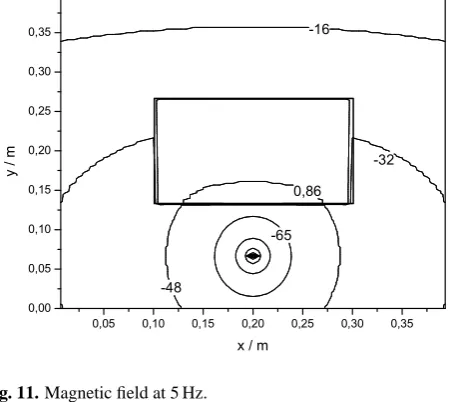
Figs. (11) and (12) show the lines and the attenua-tion of the magnetic field for the same configuraattenua-tion and a significantly lower frequency ofω= 51
s.
Con-ductivity and permeability areκ= 57·106 A Vm, µri=
1.
5. CONCLUSIONS
We applied a hybrid method to determine the field properties of a rectangular conducting bar in the field of an exciting loop. While Helmholtz’ equation governing the vector potential inside the bar has been solved by separation, we obtained an integral
Figure 10: Field attenuation at 50 Hz
Figure 11: Magnetic field at 5 Hz Fig. 8. Quadratic bar and single line.
Once the values of these coefficients are known, they can be used to express the vector potential outside the shielding bar as a series of known functionsAk(x, y), k=1, ...,4:
Aa(x, y)= M X
n=1
v1nA1(x, y)+v2nA2(x, y)+
+v3nA3(x, y)+v4nA4(x, y).
This solution for the vector potentialAa is used to deter-mine the shielding properties of the bar by
1A=Aa Ae .
4 Numerical results
4.1 Verification of method
The applied method involves rarely used special functions, i.e. the exponential integral function for complex arguments, E1(z)(see Abramowitz and Stegun (1970), pp. 227 for de-tails), which is not included in commericial numerical soft-ware packages. A focus of our paper is on the validation of the model. Therefore, in a first step, we use the presented method on a conducting bar which has been placed into an
PSfrag replacements
x/m y/m
0.1 +0.3
0.1 0.3
0.05
Figure 8: Quadratic bar and single line
Figure 9: Magnetic field at 50 Hz
ing effect of the conducting bar) is plotted in Figure (10). The resulting plots are slightly non-symmetric because of roundoff-errors.
Figs. (11) and (12) show the lines and the attenua-tion of the magnetic field for the same configuraattenua-tion and a significantly lower frequency ofω= 51
s.
Con-ductivity and permeability areκ= 57·106 A Vm, µri=
1.
5. CONCLUSIONS
We applied a hybrid method to determine the field properties of a rectangular conducting bar in the field of an exciting loop. While Helmholtz’ equation governing the vector potential inside the bar has been solved by separation, we obtained an integral
Figure 10: Field attenuation at 50 Hz
Figure 11: Magnetic field at 5 Hz Fig. 9. Magnetic field at 50 Hz.
PSfrag replacements
x/m y/m
0.1 +0.3
0.1 0.3
0.05
Figure 8: Quadratic bar and single line
Figure 9: Magnetic field at 50 Hz
ing effect of the conducting bar) is plotted in Figure (10). The resulting plots are slightly non-symmetric because of roundoff-errors.
Figs. (11) and (12) show the lines and the attenua-tion of the magnetic field for the same configuraattenua-tion and a significantly lower frequency ofω= 51
s.
Con-ductivity and permeability areκ= 57·106 A Vm, µri=
1.
5. CONCLUSIONS
We applied a hybrid method to determine the field properties of a rectangular conducting bar in the field of an exciting loop. While Helmholtz’ equation governing the vector potential inside the bar has been solved by separation, we obtained an integral
Figure 10: Field attenuation at 50 Hz
Figure 11: Magnetic field at 5 Hz Fig. 10. Magnetic field at 50 Hz.
homogenous magnetic field – see Fig. (3 – and compare the results with the expected behaviour.
The following Fig. 4 shows the absolute value of the mod-ified vector potential inside the plate.
As an additional verification, different values ofω, κ and µri=µµi
0 are considered. We calculated the average of the ab-solute ofA∗i over the cross-section of the baras functions of . By this we can estimate which amount of the outside field permeates into the conducting area. The average ofA∗i has been normalized on the valueA0=1·10−6V sA in Figs. 5 and 6 and onA1=1·10−7V sA in Fig. 7.
4.2 Single exciting line
In a next step, one conducting bar of quadratic cross-section with a=b=0,1 m is placed at rq=(−0.1, −0.1) m. One single exciting line, carrying I=100 A, is placed at (0.0, −0.15) m, as shown in Fig. 8.
L. O. Fichte et al.: Shielding properties of a conducting bar calculated with a boundary integral method 123 PSfrag replacements
x/m
y/m
0.1 +0.3 0.1
0.3
0.05
Figure 8: Quadratic bar and single line
Figure 9: Magnetic field at 50 Hz
ing effect of the conducting bar) is plotted in Figure (10). The resulting plots are slightly non-symmetric because of roundoff-errors.
Figs. (11) and (12) show the lines and the attenua-tion of the magnetic field for the same configuraattenua-tion and a significantly lower frequency ofω= 51
s.
Con-ductivity and permeability areκ= 57·106 A Vm, µri=
1.
5. CONCLUSIONS
We applied a hybrid method to determine the field properties of a rectangular conducting bar in the field of an exciting loop. While Helmholtz’ equation governing the vector potential inside the bar has been solved by separation, we obtained an integral
Figure 10: Field attenuation at 50 Hz
Figure 11: Magnetic field at 5 Hz Fig. 11. Magnetic field at 5 Hz.
Figure 12: Field attenuation at 5 Hz
representation for the vector potential in the exte-rior space from Green’s second theorem. Coupling these two equations for points on the contour of the bar resulted in a system of linear equations. The solution to this system delivered the coefficients de-scribing all fields. This method has been used to calculate the shielding properties of a conducting bar placed in the field of a exciting loop.
References
[1] Abramowitz, M.; Stegun, I.A.: Handbook of Mathematical Functions, New York 1970
[2] Hanson, G.W., Yakovlev, A.B.; Operator The-ory for Electromagnetics, Springer, New York 2002
[3] Ehrich, M.; Fichte, L.O.; L¨uer, M.: Contri-bution to Boundary Integrals by the Singu-larity of Kernels satisfying Helmholtz’ Equa-tion CJMW’2000 China-Japan Joint Meeting on Microwaves, Nanjing
[4] Fichte, L.O.; Ehrich, M.; Kurz, S.: An Ana-lytical Solution to the Eddy Current Problem of a Conducting Bar EMC 2004 International Symposium on Electromagnetic Compatibility, Sendai Conference Proceedings CD-ROM Fig. 12. Field attenuation at 5 Hz.
1Aa(and thereby the shielding effect of the conducting bar) is plotted in Fig. 10. The resulting plots are slightly non-symmetric because of roundoff-errors.
Figures 11 and 12 show the lines and the attenuation of the magnetic field for the same configuration and a significantly lower frequency ofω=51s. Conductivity and permeability areκ=57·106 AVm, µri=1.
5 Conclusions
We applied a hybrid method to determine the field proper-ties of a rectangular conducting bar in the field of an exciting loop. While Helmholtz’ equation governing the vector po-tential inside the bar has been solved by separation, we ob-tained an integral representation for the vector potential in the exterior space from Green’s second theorem. Coupling these two equations for points on the contour of the bar re-sulted in a system of linear equations. The solution to this system delivered the coefficients describing all fields. This method has been used to calculate the shielding properties of a conducting bar placed in the field of a exciting loop.
References
Abramowitz, M. and Stegun, I. A.: Handbook of Mathematical Functions, New York 1970.
Ehrich, M., Fichte, L. O. and L¨uer, M.: Contribution to Bound-ary Integrals by the Singularity of Kernels satisfying Helmholtz’ Equation CJMW’2000 China-Japan Joint Meeting on Mi-crowaves, Nanjing, 2000.
Fichte, L. O., Ehrich, M., and Kurz, S.: An Analytical Solution to the Eddy Current Problem of a Conducting Bar EMC 2004 Inter-national Symposium on Electromagnetic Compatibility, Sendai Conference Proceedings CD-ROM, 2004.