Title: What is a Replication?
Abstract
This article develops a new, general account of replication (“the Resampling Account of replication”): I argue that a replication is an experiment that resamples the experimental components of an original experiment that are treated as random factors and that the function of replications is, narrowly, to assess the reliability of the replicated experiments. On this basis, I argue that the common notion of conceptual replication is confused, and that the on-going controversy about the relative value of direct and conceptual replications should be dissolved.
Contact Information Edouard Machery
Department of History and Philosophy of Science University of Pittsburgh
1117 CL
What is a Replication? Edouard Machery
Abstract
1. Introduction
Over the last ten years, we have learned that a surprising large proportion of alleged findings in psychology fail to replicate—up to 60% according to some way of identifying replication failures (Open Science Collaboration 2015). This “repligate” (Machery and Doris 2017) has spread to other areas of contemporary science: By some measures of replication success, more than a third of experiments in experimental economics fail to replicate (Camerer et al. 2016) as do most reported findings about cancer treatment (Begley and Ellis 2012). Repligate has also moved beyond the confines of academic research, and it is now widely discussed in public media.
(2017, 237): “the repetition of an experimental procedure.” By contrast, roughly, a
replication is conceptual if and only if it attempts to establish the same theoretical conclusion as an original experiment with different experimental manipulations or measures. Thus, Schmidt describes conceptual replication as follows (2017, 37): “the repetition of a test of a hypothesis or of a result of an earlier research work with different methods.”
Pashler and Harris feel the need to address the belief in the superiority of conceptual replications (2012, 533), which they ascribed to “senior psychologists” and which they put as follows: “[R]esearchers frequently attempt (and publish) conceptual replications, which are more effective than direct replications for assessing the reality and importance of findings.” To rebut this belief, they give the following argument (2012, 533):
A failure to confirm a result based on a serious direct replication attempt is interesting gossip, and the fact is likely to circulate at least among a narrow group of interested parties. (…) If a conceptual replication attempt fails, what happens next? Rarely, it seems to us, would the investigators themselves believe they have learned much of anything. We conjecture that the typical response of an investigator in this (not uncommon) situation is to think something like “I should have tried an experiment closer to the original procedure—my mistake.”
By contrast, Stroebe and Strack endorse the superiority of conceptual replications as follows (2014, 64):
Because failures of exact replications do not tell us why findings cannot be replicated, they are ultimately not very informative. The believers will keep on believing,
the nonbelievers will maintain their belief system drawing on the failed replications for support of their rejection of the original hypothesis.
Strikingly, both articles appeal to similar considerations to defend opposite conclusions: On the one hand, the failure of a conceptual replication is said to be uninformative because it could result from relevant differences between the original experiment and its conceptual replication; on the other hand, the failure of a direct replication is said to be uninformative because it does not tell us why the replication failed.
The controversy about the best form of replication is on going, and the available arguments have failed to sway scientists’ opinion in one direction. The stakes are high, however: While replication is meant to allow scientists to correct the empirical record (but see Romero, 2016), this controversy may stand in the way of prompt and consensual self-correction. To defend themselves, psychologists often appeal to successful conceptual replications when direct replications of their work have failed (e.g., Bargh 2012; Baumeister, Tice, and Vohs 2018), and people who have run failed direct replications are prone to dismiss successful conceptual replications (e.g., Chambers 2017).
2014; Stroebe and Strack 2014; Lynch, Bradlow, Huber, and Lehmann 2015; Crandall and Sherman 2016).
This article develops a general account of replication (“the Resampling Account”2) that is applicable in many disciplines and that helps resolve the controversy about the value of direct and conceptual replications: I argue that a replication is an experiment that
resamples the experimental components of an experiment that are treated as random factors and that the function of replications is, narrowly, to assess the reliability of the replicated experiments.3 (Much of this article is dedicated to explaining this account.) On the basis of the Resampling Account, I argue that the usual notion of a conceptual replication is confused, and I end up rejecting the very distinction between direct and conceptual replication, as it is usually drawn. I conclude that the debate about the relative value of direct and conceptual replications should be dissolved rather than resolved.
To develop a general account of replication will require a fair amount of stage setting, which will take place in Section 2 of this article. On this basis, Section 3 will present the general account of replication. Section 4 investigates the implications of this general account for the controversy about direct and conceptual replications. Section 5 responds to two objections.
2 This appellation has the downside of suggesting a connection to the use of resampling in statistics (thanks to Geoff Cumming for this point), where there is none. I have decided to still use this appellation because it captures the core idea of the account and because my account has already been discussed under this appellation.
The following caveat might be useful. The Resampling Account of replication is not meant to capture what scientists mean when they use the word “replication”: It is not a piece of conceptual analysis. Rather, it is a characterization of what a replication is, based on a principled account of what experiments are; it is meant to replace scientists’ often vague understanding of what replications are and what they are for: That is, it is a piece of conceptual engineering (on conceptual engineering, see, e.g., Machery 2017).
1. Phenomena, Experiments, Experimental Components, and Reliability
Four pieces are needed to develop the Resampling Account of replication: the distinction between data and phenomena, the narrow notion of an experiment, the notion of an
experimental component, and the notions of reliability and validity. I examine them in turn.
2.1 Data and Phenomena
While there is no consensus about how to draw the distinction between data and phenomena (Bogen and Woodward 1988; McAllister 1997; Colaço 2019), most philosophers of science would agree with the following minimal account. Phenomena are what scientific theories by themselves predict and explain: They are what the empirical consequences of theories are about.4 They correspond to what scientists often call “effects.” Data are the values of
the exact values of the data points are not predictable since data points are influenced by a myriad of factors, including sampling and measurement error. Naturally, the average tendencies of data are predictable within a margin of errors, but the data points themselves aren’t. For all that, data and phenomena are related. In particular, the reality and nature of phenomena are typically inferred from the data, which themselves are the products of measurement.
To illustrate, the conjunction fallacy is a well-known phenomenon in psychology (Tversky and Kahneman 1982): People tend to judge that an individual is more likely to fall under a conjunction (e.g., to be a feminist bank teller) than under one of the conjuncts (e.g., to be a bank teller) when the individual is more typical of the conjunction than of the relevant conjunct. Participants’ answers to the question of whether Linda is more likely to be a feminist bank teller or just a bank teller in Tversky and Kahneman’s (1982) experiment are the data. These data served as evidence for the existence of the conjunction fallacy.
2.2 What’s an Experiment?
The word “experiment” is used in various ways in and outside philosophy. Sometimes, it encompasses any scientific activity that involves some measurement. Here, however, the notion of experiment will be used more narrowly, standing in contrast with the notion of observation.
As a first approximation, a token experiment is a sequence of events (e1,…, ej)
given state, prior to measurement. For instance, participants in a pharmacology experiment are assigned to the treatment or placebo condition. As characterized here experiments do not require a comparison between an experimental and a control condition (in contrast to the characterization of experiments typically found in textbooks in the behavioral sciences).
The sequence of events that constitutes a token experiment (e1,…, ej) belongs to a
given type (E1,…, Ej). Two token experiments (e1A,…, ejA) and (e1B,…, ejB) are the same
experiment if and only if their constitutive sequences of events fall under the same sequence type (E1,…, Ej). Event types can be individuated more or less coarsely (as can any type), and
depending on how these types are individuated two token experiments count or fail to count as the same experiment. For example, a token psychological experiment could involve collecting data from 100 participants from a given population (perhaps to obtain a given power). The corresponding type could specify the exact number of participants, in which case any study with a different number of participants would not count as the same
experiment, however similar it is to the original study in other respects. Or, more coarsely, it could just specify that some participants were sampled from the relevant population, in which case a follow up study would count as the same experiment whatever its sample size is.
Lynch and colleagues are thus too hasty when they write (2015, 333; see also Schmidt 2009, 92):
[T]he very concept of an “exact replication” in social science is flawed. Even if one used the exact same procedures, respondents may have changed over time. Exact replication is impossible. Therefore, the only issue is how close the replication is to the original, and whether it is desirable to be “as close as possible.”
The mere existence of unavoidable differences between an original experiment and its follow-up does not entail that an experiment cannot be exactly replicated. Two token experiments are the same if they are identical in the relevant respects, even if they differ in other respects. It would be correct to say that no experiment could ever be exactly replicated only if the differences between an original experiment and its follow-up would always be relevant to the individuation of the event types, but there is no reason to believe this to be the case. Admittedly, it can be difficult to specify what the relevant respects are, but specifying them is certainly possible; indeed, psychologist typically agree that some differences just don’t matter, while others undoubtedly do.
used) scientists’ knowledge of the events that constitute experiments is tacit and hardly verbalizable, and thus hard, if not impossible, to report.
2.3 Experimental Components
An experimental component is an aspect of an experiment that can be independently modified. Psychologists often distinguish four different experimental components:
experimental units, treatments (aka “independent variables”), measurements (aka “dependent variables” or “response variables”), and settings.5
The experimental units are the entities to which treatments are applied and whose reaction (or behavior) is measured. Experimental units can be individuals (e.g., human beings or animals) or groups (e.g., factories or countries).
A treatment is an exogenous cause that changes the state of some aspect of the experimental units (i.e., the value of some variable characterizing them). Scientists intend to determine whether and how this change influences some other aspect of the experimental units (i.e., some other variable). When an experiment has several conditions (e.g., drug vs. placebo), the treatment can be in one of several states; psychologists often say that it has several “levels.” In a typical psychology experiment, participants assigned to different levels of the treatment are presented with different stimuli. An experiment can involve several treatments. Two treatments are crossed when measurement happens for each combination of the levels of these two treatments. They are nested when measurement happens for some combinations of the levels of these two treatments.6
Measurement is a causal interaction with the experimental units aimed at determining what state a particular aspect of the experimental units is in. Measurement typically involves creating an observable variable (e.g., the height of the column of mercury in a mercury thermometer) that is causally influenced by (and thus provides information about) the variable (e.g., temperature) scientists hope to influence by means of the treatment (e.g., ingesting a dose of paracetamol).
The setting is a vague and umbrella construct, which includes the identity of the experimenter and of the lab conducting the experiment, whether the experiment is done on line or in a lab, etc.
Psychology journals require authors to describe the experimental components that constitute their experiments, with a special focus on experimental units, treatments, and measurements. (Less emphasis is put on settings.) Gigerenzer and Hoffrage (1995) describe the experimental units—the participants—as follows (1995, 692):
Sixty students, 21 men and 39 women from 10 disciplines (predominantly psychology) from the University of Salzburg, Austria, were paid for their
participation. The median age was 21 years. None of the participants was familiar with Bayes’ theorem.
Their description of the sample does not describe precisely the population sampled from. It isn’t clear which aspect of the sample is meant to characterize this population (e.g., whether it is made of students, of people of a certain age, of people ignoring Bayes’ theorem, etc.).
nested under these two treatments: Depending on which of the four conditions a participant is in, she will be exposed to different versions of 15 vignettes. Table 1 of their article presents the generic form of the four conditions as well as the relevant version of one of the 15 vignettes for each of these conditions together with the dependent variable (688; the first condition is reproduced here as Table 1).
Format and Menu Description of problem
Standard probability format
The probability of breast cancer is 1% for women at age forty who participate in routine screening. If a woman has breast cancer, the probability is 80% that she will get a positive mammography. If a woman does not have breast cancer, the probability is 9.6% that she will also get a positive
mammography. A woman in this age group had a positive mammography in a routine screening. What is the probability that she actually has breast cancer? ____%
Table 1: One of the 4 Combinations of Information Formats and Menus for the Mammography Problem
Each participant is presented with 2 versions (out of the 4 possible) of 15 vignettes (or “problems” as Gigerenzer and Hoffrage call them).
Finally, the setting is briefly described as follows (693):
Participants were studied individually or in small groups of 2 or 3 (in two cases, 5). We informed participants that they would need approximately 1 hr for each session but that they could have more time if necessary. On the average, students worked 73 min in the first session (range = 25-180 min) and 53 min in the second (range = 30-120 min).
is a random factor) or other stimuli could have been used (if treatment is a random factor). The experimenter intends to generalize statistically from the sample (i.e., the observed levels) to the population as a whole, and thus to unobserved, but possible levels, instead of limiting her conclusions to the observed levels. Because the levels of random factors are sampled from a population, they can represent this population more or less accurately, and sampling error must be taken into account.7 By contrast, if the levels of experimental components are fixed factors, the levels used in an experiment exhaust the relevant population. That is, the experiment examines all the possible values the experimental component could take, and the levels of an experimental component couldn’t have been different. The experimenter does not aim to generalize statistically to unobserved levels; rather, she limits her conclusion to the observed levels. In a randomized controlled trial testing a new drug, treatment is often conceived as a fixed factor: The new drug is not conceived as one of the many drugs
participants could have received, and the experimenter does not intend to generalize to other drugs. There is no sampling error related to the choice of treatment to be concerned with.
Whether an experimental component should be treated as a random or a fixed factor depends on the particular scientific context. Experimental units are typically explicitly treated as the levels of a random factor since they are typically meant to stand for a population. The participants in a psychology experiment are often assumed to be randomly sampled from a particular population, although the identity of the relevant population is rarely made explicit (as is the case in Gigerenzer and Hoffrage 1995), and the sample is almost never genuinely random. Treatment is sometimes properly conceived as a fixed factor, as is illustrated in the 7 How to take into account the sampling error introduced by treating treatment as a random
drug testing example above. In other cases it should be viewed as a random factor. When participants are exposed to some particular stimuli (words in psycholinguistics experiments, vignettes in judgment and decision making experiments, faces in face perception
experiments, etc.) that are meant to stand for a broader class of stimuli (e.g., all the words participants could have been presented with in a psycholinguistics experiment), treatment should be conceived as a random factor, although psychologists rarely explicitly do so in such conditions (except in psycholinguistics). The points just made about treatment extend to measurement. In psychology, the particular measurement used in an experiment is rarely explicitly treated as the value of a random sample from a population of measurements.
The distinction between fixed and random factors determines which statistical generalization is allowed by an experiment: It is only when an experimental component is a random factor that one can generalize statistically from the observed levels of this
experimental component to the unobserved levels.
Importantly for the Resampling Account, experimental unit is not the only
treat an experiment’s experimental units as randomly sampled when they are a convenience sample. A psychologist could require the students in one of her classes to complete an experiment for credits, but still treats her participants as a random sample. One might
however resist this comparison as follows. Even when not randomly sampled, participants in an experiment are not chosen because of their properties; they are chosen because their availability, and any other sample would have been equally good. By contrast, treatments and measurement are often chosen because of their distinctive properties, and it is not the case than any other treatment or measurement would have been equally good. This response fails however: When treatment and measurement are viewed as random factors, their distinctive properties (which result from piloting, measure development, etc.) are taken to be shared by the other members of the population from which they are by idealization assumed to be randomly sampled. Similarly, if a psychologist asks her male students to complete a study for credit because she studies how men react to some stimuli, being male is taken to be a
property of all the members of the population she assumes to be sampling from.
Second, it is often unclear what the populations of treatments and measurements could be, and it might thus seem to make little sense to treat treatments and measurements as being sampled from a population. However, it is also often unclear which population
populations of treatments and measurements. The difficulty of specifying such populations is often exaggerated: For instance, for the standard probability format condition in Gigerenzer and Hoffrage (1995), one can, and arguably should (Section 5.1), specify the population of vignettes by describing a recipe for producing more vignettes:
1. A vignette should refer to a given condition that can be detected by a test; 2. it should specify the base rate of this condition in a population by means of a
percentage;
3. it should specify the test’s hit rate by means of a percentage;
4. it should specify the test’s false positive rate by means of a percentage;
5. it should indicate that a member of the population has received a positive test. One may wonder whether it is realistic to require specifying populations of stimuli. However, to the extent that the psychologist is making a claim that goes beyond the stimuli she is using, she must specify the population of stimuli she intends to generalize to, even if she could learn that her hypothesis was mistaken.
2.4 Reliability
Once a scientist has collected experimental data, she can assess whether a phenomenon is genuine and attempt to characterize it on the basis of these data. The inference from data to the reality and nature of phenomena would be unjustified if the token experiment having produced the data were unreliable or if it were invalid.
sampling new stimuli from the original population of stimuli), everything else being kept constant, the same experimental outcome would be found with high frequency. A token experiment is unreliable just to the extent that its experimental outcome is an outlier: Most experimental outcomes resulting from repeated resampling would be different. Unreliability results from several sources. It can result from non-directional error: A token experiment is reliable only if its experimental outcome is not due to non-directional error. Non-directional error is error (distance between the estimate of a quantity and its true value) that is as likely to result in overestimation as in underestimation of the quantity to be estimated. It results from measurement error, sampling error, or imprecise manipulation. The less precise measurement is (think, e.g., about an imprecise thermometer) or the less precise the manipulation is (e.g., the more the vignettes in psychology are open to interpretation), the less frequently the same result will be found. Unreliability can also result from other sources such as honest mistakes, frauds, or questionable research practices. When a scientist makes up her data, if one sampled new values for the experimental units, one would likely get a different experimental outcome; the experiment is unreliable.
This characterization of reliability appeals to the notion of sameness of outcome and thus requires a way of individuating experimental outcomes. There is no interest-independent way of individuating experimental outcomes. Some outcome that counts as the same result as another outcome given some interests may well count as a different result given other
replication were similar (what counts as sufficiently similar itself is interest-dependent). Naturally, once interests are fixed, there is a matter of fact as to whether an experimental outcome counts as the same as another one.
A token experiment is valid just in case it actually supports the conclusion it claims to establish. It is internally valid just in case it actually supports the causal claim that the
treatment caused the measured difference between the conditions. Plausible, but uncontrolled confounds undermine the internal validity of an experiment. A token experiment is externally valid just in case it actually supports a conclusion about a situation outside the lab that is of interest to scientists and motivated the research in the first place.
3. What is a Replication?
3.1 The Resampling Account of Replication
We can now characterize the notion of replication:
Experiment A replicates experiment B if and only if A consists of a sequence of events of the same type as B, while resampling some of its experimental components in order to assess the reliability of the original experiment.
In the remainder of this section, I comment on the main aspects of this characterization and highlight some of its most significant consequences.8
always a matter of interpretation: It depends on how the relevant types are individuated, a matter often left implicit. In Open Science Collaboration 2015, differences were intentionally introduced between some of the original experiments and their replications. For instance, participants in Shnabel and Nadler (2008) were Israeli, while its replication took place in the USA. Because what is meaningful for Israeli participants might not be meaningful for American participants, superficial features of the vignettes used as stimuli were modified, while the significant structural features remained the same. Nosek (2016) takes this difference to be irrelevant for the identity of the stimuli: They are the same type of stimuli because they share the same structural features. Gilbert, King, Pettigrew, and Wilson (2016) take this difference to be significant, and contest that the alleged replication is a genuine replication of the original study. (Section 5 discusses this issue further.)
According to my proposal, replications should be conceived as involving the resampling of the experimental components when these are random factors. Each of the experimental components so treated can be the target of resampling. Most obviously, replications nearly always, but not necessarily, involve sampling another group of
vignettes.9 To determine whether an experiment type is reliable with respect to its treatment, we resample the particular treatment from the relevant population of treatments. The same is true of measurement (think, e.g., of various scales meant to measure the same construct) or of settings. By contrast, when an experimental component is a fixed factor, changing its value is not a replication; it is a different experiment.
some lesion in cognitive neuropsychology (e.g., HM in Scoville and Milner 1957; Squire 1989). In this case, the experimental unit is a fixed factor: Its value is the patient under consideration (e.g., HM). Doing another case study with a patient suffering from a similar lesion (e.g., DC in Scoville and Milner 1957) is not replicating the first study.
The Resampling Account seems to have two counterintuitive consequences. First, on this account a follow-up experiment that would use the same participants, manipulations, and measures (e.g., to assess measurement error) would not count as replicating the original experiment. In response, it is enough to notice that the setting of the experiment would change since the experiment would not be done at the same time: Resampling would thus be taking place. Second, if all the experimental components are resampled, a follow-up
experiment could replicate an original experiment despite looking very different (because it involves different manipulations and measures). In response, one should note that this consequence holds on any account of replication: What are called “conceptual replications” can be very different from the original experiments. In addition, while the follow-up
The Resampling Account of replication might not seem compatible with the fact that populations can change: Psychological phenomena that held, say, in the 1970s might not hold anymore in the 2010s (for related discussion, see Lovett and Munge, ms). If the phenomena change, then a replication would not regularly give the same result despite being prima facie reliable. However, on second thoughts, such “time-sensitivity” does not challenge the
Resampling Account since if the population changes, psychologists aren’t sampling from the same population anymore. What looks like a replication is in fact what an extension.
The Resampling Account is not narrowly tailored to psychology, but extends to other disciplines, including pharmacology, experimental economics, molecular biology, and other life sciences. It is meant to apply to any experiment that fulfills the following two conditions: (1) It is possible to distinguish its experimental units, treatment, measurement, and setting; and (2) at least some of its experimental components can be viewed as sampled from a population. Experiments in many scientific disciplines fulfill these conditions. For example, a drug test can involve a sample of participants assigned to one of two conditions (e.g., drug vs. placebo), and the effect of treatment is measured by some outcome variable; experimental unit is a random factor while other experimental components such as treatment is be treated as a fixed factor.10
Finally, the Resampling Account converges with Hacking’s (1992) description of experiments. Hacking distinguishes the target of modification (which corresponds to the experimental units), the source of modification (treatment), and “the detector”
(measurement). Although Hacking does not insist on sampling, the target of modification of
a particular experiment, the source of modification, and the detector can, are often are, conceived as samples from some populations.
3.2 The Function of Replications
According to the Resampling Account, the function of replications is to check whether a token experiment e that claims to identify and characterize a candidate phenomenon is reliable: That is, whether an experimental outcome similar to the one found in e would be found frequently were one to resample from the populations corresponding to the
experimental components treated as random factors (if similar results would not be found frequently, then the results of e are due to the sources of unreliability such as sampling or measurement error). Reliability can be assessed with respect to the four experimental
components identified in Section 2: For instance, when the treatment of e is modified, it is to test whether the experimental outcome of e is not due to one of the threats to reliability, including (but not limited to) sampling error in the type of manipulations used in this experiment (that is, if the outcome of e is not due to atypical stimuli or manipulations).
So, on the Resampling Account, the function of replications is really to test reliability rather than validity; further, it is not to determine the invariance range of a finding: One does not replicate in order to control for confounds or to find out whether the phenomenon still occurs when background conditions are modified. In this respect, the Resampling Account differs starkly from the vague characterizations of replication in psychology and other sciences.
There are few general accounts of replication and of their function. Before comparing the Resampling Account to one of them, it is worth highlighting the three main virtues of this characterization of replication. First, it treats all the components of experiments
(experimental units, treatment, measurement, and setting) similarly. Treatments or
measurements can be sampled exactly as experimental units, and when one uses new stimuli or measurements (sampled from their respective populations) one does exactly the same thing as once does when one examines new experimental units (e.g., new participants). There is no need to introduce a fundamental distinction between those replications that modify experimental units and those that modify treatments and measurements (more on this in Section 3.4). Second, the resulting account of replication is satisfactorily delimited: On this account, not every experiment that is in some respect or other similar to an original
experiment counts as a replication. Third, and relatedly, it allows us to distinguish extensions from replications in a principled manner. In practice, scientists usually distinguish these two forms of experiments, as shown by the fact that psychologists re-doing a psychological study in a new cultural context don’t characterize their work as a replication. Any acceptable account of replication must be able to draw this distinction.
Replications serve several different functions. The general function of replication is (…) to verify a fact or piece of knowledge. However, this implies the following more specific functions:
1. To control for sampling error (chance result), 2. To control for artifacts (lack of internal validity), 3. To control for fraud,
4. To generalize results to a larger or to a different population, 5. To verify the underlying hypothesis of the earlier experiment.
Schmidt limits sampling error to the selection of participants (93), failing to acknowledge that all the experimental components can be random factors and failing to treat all the experimental components similarly. His notion of replication is also extremely broad and does not to distinguish a replication from the testing of a result’s robustness by different means (Wimsatt, 2007). It also leads him to treat extensions as a distinct type of replication.
3.4 Doing Without “Conceptual Replication”
The Resampling Account reveals that the notion of conceptual replication is confused: It fails to distinguish different ways of modifying the treatment, measurement, and setting of an original experiment. Psychologists often only view experimental units as a random factor, and they do not acknowledge that treatments, measurements, and settings too can be
(1) changing the value of a fixed factor (a first kind of extension);
(2) resampling from the same population of treatments, measurements, and settings as in the original experiment (what I view as a genuine replication);
(3) sampling from a distinct population (a second kind of extension).
The usual notion of conceptual replication treats all modifications of treatment, measurement, and setting on the model of (1), leaving no room for modifications along the lines of (2) and (3). It thus treats modifications of treatments differently from the
modifications of experimental units: Modifications of experimental units are rarely treated on the model of (1) in behavioral sciences (except in case studies). Rather, these modifications are treated on the model of (2) or (3): Either they resample from the original population (what is usually called a “direct replication”) or sample from a different population, which is what happens when an experiment originally run on neurotypical individuals is again run on neuroatypical individuals.
Furthermore, because of the confusion built into the usual notion of conceptual replication, the function of modifying the treatment, measurement, and setting of an original experiment is misunderstood. Because a conceptual replication modifies the treatment and the measurement of an original experiment, in contrast to a direct replication, which only modifies the experimental units of the original experiment, psychologists often believe that it is meant to test the validity of the original experiment or the invariance range of the
Perhaps I am uncharitably interpreting psychologists’ position about the modification of treatment, measurement, and setting: On an alternative interpretation, psychologists are aware that treatment, measurement, and setting could be random instead of fixed factors, but they don’t treat them as random factors because they do not intend to generalize beyond the specific stimuli, measures, or settings of an experiment or because on their view it makes no sense to treat these as values of random factors. However, scientists often generalize beyond the original stimuli, measurements, and settings, and the concerns against treating these experimental components as random factors have already been addressed in Section 2.3.
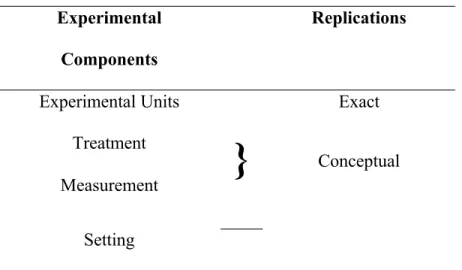
3.5 A New Typology of Replications
The lack of a general account of replication and the acceptance of the contrast between direct and conceptual replication has resulted in an unprincipled and unclear typology of
replications (Table 2):
Experimental Components
Replications
Experimental Units Exact
Treatment
}
ConceptualMeasurement
Setting
Table 2: The Usual Typology of Replications
corresponds to experimental units; no replication corresponds to setting.11 The usual typology is unclear because it does not specify what is required for a replication to occur: That is, the usual typology does not specify what a psychologist must do (resample, change the value of a fixed factor, etc.) to an experimental component for her experiment to count as a replication.
This typology contrasts with a principled, systematic typology of replications based on the Resampling Account (Table 3):
Experimental Components Replications
Experimental Units
→
re-sampling
Experimental units replication Treatment
Treatment replication
Measurement Measurement replication
Setting Setting replication
Table 3: The Revised Typology of Replications
On this revised typology, a replication is a treatment replication if and only it resamples from a population of treatments. It can also resample from the population of experimental units (e.g., participants), in which case it would be an experimental units replication and a measurement replication (mutatis mutandis for the three other types).12 A distinct type of replication corresponds to each experimental component.13 Finally, the relation between the replication and the experimental component is made explicit, and it is the same for all the experimental components: resampling.
11 Schmidt’s (2009, 95) typology suffers from similar problems.
4. The Debate About Direct and Conceptual Replications
The debate about the best type of replication contrasts what is, according to the Resampling Account, a genuine type of replication, i.e., experimental units replication (usually called “direct replication”), and a notion that confuses extensions and replications. Rejecting the notion of conceptual replication, we must then clarify the terms of the debate, and distinguish two conceptually distinct debates:
Debate 1: experimental units vs. treatment vs. measurement vs. setting replication Debate 2: replication vs. extension
Each debate compares comparable notions. Debate 1 asks whether it is more important to resample one of the four experimental components that have been distinguished in Section 2 than for the others. Debate 2 asks whether replication, as characterized by the Resampling Account, or extension is more important for science.
Let’s now consider each debate in turn, starting with Debate 1. The different types of replication are, everything else being equal, equally important to assess the reliability of experiments and to establish the reality and nature of phenomena. They complement each other rather than competing with one another. Psychologists pay more attention to
information, all experimental components matter for assessing the reliability of an experiment.
Turning to Debate 2, replication and extension have different functions: Replications test the reliability of token experiments; extensions their validity as well as the invariance range of a phenomenon. It is strange to think that there can be a meaningful comparison between these two goals. Consider a particular case: A psychologist obtains a particular result with Westerners as her explicitly stated population. Is it more important to replicate it with a different sample of Westerners so as to assess the reliability of the experiment or is it more important to extend it to a different population of participants (e.g., people from East Asia or people from small-scale societies) so as to examine the invariance range of the finding? It is difficult to see how this question could be meaningful in the first place; there is no clear common measure to compare their importance.
The upshot of this discussion is that once we have a clear notion of replication, the debate about the importance of the different types of replication stops to make sense at all.
5. Two Objections
5.1 Replication and Extension
The difference between a replication and an extension hangs on whether the second
experiment samples from the same population as the original experiment. Which population the original experiment sampled from is, however, often unclear and left unspecified,
psychologist conducting the original experiment intended to sample from a given, more or less explicitly and precisely characterized population and to generalize to this population.
The first point—that we don't always know, perhaps even rarely know, what the relevant populations are—is not an objection to the Resampling Account of replication. It is rather a criticism of the actual practices in the behavioral sciences: Psychologists and others should make explicit the relevant populations experimental components are sampled from, as Simons, Shoda, and Lindsay (2017) have recently argued. Furthermore, the issue affects not only the Resampling Account of replication, but also the usual notion of direct replication, since direct replications resample from an unchanged population of experimental units.
It is true that what population is sampled from and thus what experiment is conducted depends on the intention of the experimenter, but this can’t count as an objection against the Resampling Account. First, all actions are individuated by agents’ intentions, and an
experiment just is an action. Second, the subjective nature of the targeted population is a problem only if subjectivity is erroneously confused with privacy. Experimenters’ intentions can be made explicit, even before running the experiment, as is done in preregistrations. The requirement of making explicit experimenters’ intentions concerning the features of the experiments they intend to run applies as much to the populations they intend to sample from and generalize to as it does to the stopping rules for data collection. Thus, the Resampling Account provides a new argument for preregistration, and extends the scope of the
information to be provided in preregistrations.
The Resampling Account does not enable psychologists to quell all possible controversies about whether an experiment replicates another one, for elements that are crucial for deciding whether an experiment replicates another one and whether replication is successful are not fixed in an objective, experimenter-independent manner. First, what population is sampled from and whether an experimental component is treated as a random or fixed factor depend on the often unknown intention of the experimenter. Second, whether experiment e2
replicates experiment e1 depends on whether the respective sequences of token events that are
constitutive of e1 and e2 are of the same type, and as noted above events can be typified in
more or less coarse ways. This leaves room for a psychologist to deny that e2 was genuinely a
replication of e1 on the grounds that the experimental units, populations, treatments, and
settings were not of the same type. Finally, whether experiment e2 successfully replicates
experiment e1 depends on some individuation criterion for sameness of experimental
outcomes (significant results, same p-values, same effect sizes, etc.), something that is interest-dependent too. This dependence leaves room for a psychologist to deny that e2 was a
failed replication of e1.
That intentions determine whether a second experiment replicates an original one is not a problem, as was just argued: Intentions can, and should, be made public in
Resampling Account does, in contrast to these accounts, is identify precisely the two points where controversies stem from: (1) whether two experiments are instances of the same experiment type and (2) what the sameness of outcomes criteria are. Whether two
experiments fall under the same types depends on how coarsely the constituting event types are individuated: Such individuation gives us criteria of identity. What makes two
experimental outcomes the same depends on scientists’ interests, and those can be made explicit.
Conclusion
A replication is an experiment that resamples from the populations targeted in an original experiment in order to assess its reliability. A distinct kind of replication corresponds to each of the four experimental components usually distinguished by psychologists: experimental units, treatments, measurements, and settings. This reveals that the traditional understanding of conceptual replication is confused, failing to distinguish different modifications of
References
Asendorpf, Jens B., et al. 2013. “Recommendations for Increasing Replicability in Psychology.” European Journal of Personality 27:108-19.
Bargh, John 1992. “Priming Effects Replicate Just Fine, Thanks.” Psychology Today, www.psychologytoday.com/us/blog/the-natural-unconscious/201205/priming-effects-replicate-just-fine-thanks.
Baumeister, Roy F., Dianne M. Tice, and Kathleen D. Vohs. 2018. “The Strength Model of Self-Regulation: Conclusions from the Second Decade of Willpower Research.” Perspectives on Psychological Science 13:141-45.
Begley, C. Glenn, and Lee M. Ellis. 2012. “Drug Development: Raise Standards for Preclinical Cancer Research.” Nature 483:531–33.
Bogen, James, and James Woodward. 1988. “Saving the Phenomena.” The Philosophical Review 97:303-52.
Bonett, Douglas G. 2012. “Replication-Extension Studies.” Current Directions in Psychological Science 21:409-12.
Camerer, Colin F. et al. 2016. “Evaluating Replicability of Laboratory Experiments in Economics.” Science 351:1433-36.
Cesario, Joseph. 2014. “Priming, Replication, and the Hardest Science.” Perspectives on Psychological Science 9:40–8.
Chambers, Christopher D. 2017. The Seven Deadly Sins of Psychology: A Manifesto for Reforming the Culture of Scientific Practice. Princeton: Princeton University Press.
Collins, Harry M. 1985. Changing Order. London: Sage.
Crandall, Christian S., and Jeffrey W. Sherman. 2016. “On the Scientific Superiority of Conceptual Replications for Scientific Progress.” Journal of Experimental Social Psychology 66:93-9.
Gigerenzer, Gerd, and Ulrich Hoffrage. 1995. “How to Improve Bayesian Reasoning Without Instruction: Frequency Formats.” Psychological Review 102:684-704.
Gilbert, Daniel T., Gary King, Stephen Pettigrew, and Timothy Wilson. 2016. “Comment on “Estimating the Reproducibility of Psychological Science”.” Science 351:1037.
Hacking, Ian. 1992. “The Self-Vindication of the Laboratory Sciences.” In Science as Practice and Culture, ed. Andrew Pickering, 29-64. Chicago: University of Chicago Press. Hüffmeier, Joachim, Jens Mazei, and Thomas Schultze. 2016. “Reconceptualizing
Replication as a Sequence of Different Studies: A Replication Typology.” Journal of Experimental Social Psychology 66:81-92.
Judd, Charles M., Jacob Westfall, and David A. Kenny. 2012. “Treating Stimuli as a Random Factor in Social Psychology: A New and Comprehensive Solution to a Pervasive but Largely Ignored Problem.” Journal of Personality and Social Psychology 103:54-69.
Kenny, David A. 1985. “Quantitative Methods for Social Psychology.” In Handbook of Social Psychology, vol. 1, ed. Gardner. Lindzey and Elliot Aronson, 487-508. New York: Random House.
Lynch Jr, John G., Eric T. Bradlow, Joel C. Huber, and Donald R. Lehmann. 2015.
Reflections on the Replication Corner: In Praise of Conceptual Replications.” International Journal of Research in Marketing 32:333-42.
Machery, Edouard 2008. “The Folk Concept of Intentional Action: Philosophical and Experimental Issues.” Mind & Language 23:165-89.
--- 2017. Philosophy Within Its Proper Bounds. Oxford: Oxford University Press. Machery, Edouard, and John M. Doris. 2017. “An Open Letter to Our Students: Doing Interdisciplinary Moral Psychology.” In Moral psychology: A multidisciplinary guide, ed. Benjamin Voyer and Tor Tarantola, 119-43. Berlin: Springer.
Machery, Edouard, and Tiziana Zalla. 2015. “The Concept of Intentional Action in High Functioning Autism.” Oxford Studies in Experimental Philosophy 1:152-72.
McAllister, James W. 1997. “Phenomena and Patterns in Data Sets.” Erkenntnis 47:217-28. Nosek, Brian. 2016. “Let’s Not Mischaracterize Replication Studies: Authors.”
http://retractionwatch.com/2016/03/07/lets-not-mischaracterize-replication-studies-authors/. Open Science Collaboration. 2015. “Estimating the Reproducibility of Psychological
Science.” Science 349:1422–25.
Pashler, Harold, and Christine R. Harris. 2012. “Is the Replicability Crisis Overblown? Three Arguments Examined.” Perspectives on Psychological Science 7:531-36.
Richter, Martin. L., and Mary B. Seay. 1987. “ANOVA Designs with Subjects and Stimuli as Random Effects: Applications to Prototype Effect on Recognition Memory.” Journal of Personality and Social Psychology 53:470-80.
Schmidt, Stefan. 2009. “Shall we Really Do it Again? The Powerful Concept of Replication is Neglected in the Social Sciences.” Review of General Psychology 13:90-100.
--- 2017. “Replication.” In Toward a More Perfect Psychology: Improving Trust, Accuracy, and Transparency in Research, ed. Matthew C. Makel and Jonathan A. Plucker, 233-53. Washington: American Psychological Association.
Schnall, Simone. 2014. “Moral Intuitions, Replication, and the Scientific Study of Human Nature.” The Edge. https://www.edge.org/conversation/simone_schnall-simone-schnall-moral-intuitions-replication-and-the-scientific-study-of.
Scoville, William B., and Brenda Milner. 1957. “Loss of Recent Memory After Bilateral Hippocampal Lesions.” Journal of Neurology, Neurosurgery, and Psychiatry 20:11-21. Shnabel, Nurit, and Arie Nadler. 2008. “A Needs-Based Model of Reconciliation: Satisfying the Differential Emotional Needs of victim and Perpetrator as a Key to Promoting
Reconciliation.” Journal of Personality and Social Psychology 94:116-32.
Simons, Daniel J. 2014. “The Value of Direct Replication.” Perspectives on Psychological Science 9:76-80.
Simons, Daniel J., Yuichi Shoda, and D. Stephen Lindsay. 2017. “Constraints on Generality (COG): A Proposed Addition to All Empirical Papers.” Perspectives on Psychological Science 12:1123-28.
Squire, Larry R. 2009. “The Legacy of Patient HM for Neuroscience.” Neuron 61:6-9. Stroebe, Wolfgang, and Fritz Strack. 2014. “The Alleged Crisis and the Illusion of Exact Replication.” Perspectives on Psychological Science 9:59-71.
In Judgment Under Uncertainty: Heuristics and Biases, ed. Daniel Kahneman, Paul Slovic, and Amos Tversky, 153-60. Cambridge: Cambridge University Press.
Wells, Gary L., and Paul D. Windschitl. 1999. “Stimulus Sampling and Social Psychological Experimentation.” Personality and Social Psychology Bulletin 25:1115-25.