Introduction
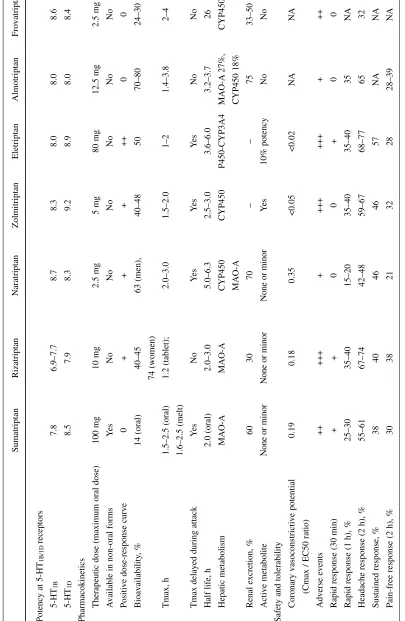
The triptans are a class of compounds defined by their potent and selective agonist activity at the 5-HT1B and 5-HT1D serotonin receptor subtypes. Since the introduc-tion of sumatriptan in 1991, triptans have sparked a revo-lution in migraine management. Recently, sufficient data has been published to begin to bring into focus the thera-peutic profiles of the triptans, permitting clinicians to match the needs of individual patients with the optimal drug for them. The purpose of the current review is to pro-vide a brief summary of the key pre-clinical and clinical characteristics of the triptans that might influence the choice of drug. Table 1 provides a summary of the
com-parative profile of the currently marketed triptans. Eletriptan, almotriptan and frovatriptan are included in the discussion, although fewer data are available for these 3 drugs.
Pharmacology
All marketed triptans are potent 5-HT1Band 5-HT1D ago-nists, but there is a 10-fold range of receptor binding potencies. The clinical significance of these variations in potency cannot be translated directly into efficacy due to the influence of various pharmacokinetic (PK) parame-ters [1].
All triptans are not the same
A.M. Rapoport () •S.J. Tepper The New England Center for Headache, 778 Long Ridge Road, Stamford, CT 06902-1251, USA
e-mail: [email protected] Tel.: +1-203-968-1799 Fax: +1-203-968-8303
A.M. Rapoport •S.J. Tepper Department of Neurology,
Yale University School of Medicine, New Haven, CT, USA
Alan M. Rapoport Stewart J. Tepper
Abstract The current review pro-vides a brief summary of the key pre-clinical and clinical characteris-tics of the triptans that might influ-ence the choice of drug. Data from extensive clinical trials tentatively suggest that eletriptan and rizatriptan may offer an advantage over other triptans on the basis of two clinically important efficacy parameters: eletriptan has the highest likelihood of sustained headache response, while rizatriptan has the highest like-lihood of achieving and sustaining a pain-free response. In terms of tol-erability, best-in-class goes to nara-triptan, almonara-triptan, and frovanara-triptan, though the tolerability profile of
trip-tans is very good overall, and patient preference appears to be more close-ly correlated with efficacy than toler-ability. A need is noted for more double-blind studies that directly compare triptans.
Key words Migraine •Vascular headaches •5-HT1 agonist •Triptan
T
able 1
Comparative pre-clinical and clinical profiles of triptans
Sumatriptan Rizatriptan Naratriptan Zolmitriptan Eletriptan Almotriptan Frovatriptan
Potency at 5-HT
1B/1D receptors 5-HT 1B 7.8 6.9–7.7 8.7 8.3 8.0 8.0 8.6 5-HT 1D 8.5 7.9 8.3 9.2 8.9 8.0 8.4 Pharmacokinetics
Therapeutic dose (maximum oral dose)
100 mg 10 mg 2.5 mg 5 mg 80 mg 12.5 mg 2.5 mg A
vailable in non-oral forms
Y es N o N o N o N o N o N o
Positive dose-response curve
0 + + + ++ 0 0 Bioavailability , % 14 (oral) 40–45 63 (men), 40–48 50 70–80 24–30 74 (women) Tmax, h 1.5–2.5 (oral) 1.2 (tablet); 2.0–3.0 1.5–2.0 1–2 1.4–3.8 2–4 1.6–2.5 (melt)
Tmax delayed during attack
Y es N o Y es Y es Y es No No
Half life, h
2.0 (oral) 2.0–3.0 5.0–6.3 2.5–3.0 3.6–6.0 3.2–3.7 26 Hepatic metabolism MAO-A MAO-A CYP450 CYP450 P450-CYP3A4 MAO-A 27%, CYP450 MAO-A CYP450 18%
Renal excretion, %
6 0 3 0 7 0 – – 7 5 33–50 Active metabolite
None or minor
None or minor
None or minor
Y
es
10% potency
No
No
Safety and tolerability
Coronary vasoconstrictive potential
0.19 0.18 0.35 <0.05 <0.02 NA NA
(Cmax / EC50 ratio)
Adverse events ++ +++ + +++ +++ + ++
Rapid response (30 min)
+ + 0 0 + 0 0
Rapid response (1 h), %
25–30 35–40 15–20 35–40 35–40 35 NA
Headache response (2 h), %
55–61 67–74 42–48 59–67 68–77 65 32
Sustained response, %
3 8 4 0 4 6 4 6 5 7 N A N A
Pain-free response (2 h), %
3 0 3 8 2 1 3 2 2 8 28–39 NA MAO
, monoamine oxidase;
NA
It is uncertain the extent to which migraine efficacy is con-tingent on penetration in the central nervous system (CNS). It seems clear that central activity is not essential since sumatriptan appears to have minimal CNS penetrance, though some may cross the blood-brain barrier due to altered permeability during a migraine attack, as suggested by reports of CNS adverse events in some patients. Two sig-nificant factors contribute to the level of an individual trip-tan in the CNS: its lipophilicity, which is associated with increased CNS penetration, and P-glycoprotein (Pgp) affin-ity, which reduces levels by an active transport mechanism. None of the triptans are highly lipophilic, but they exhibit a greater than 5-fold within-class difference in lipophilicity, with eletriptan being the most lipophilic, and sumatriptan the least. Pgp is a protein component of the blood-brain bar-rier and functions as an efflux pump actively transporting selected molecules out of the CNS. Eletriptan is the only triptan known to be a substrate for Pgp. The effect of eletriptan’s higher lipophilicity may be partially cancelled out by the effect of the Pgp, pump. Nonetheless, animal studies suggest that the CNS-to-free-plasma concentration ratio of eletriptan is more than 3-fold higher than that of sumatriptan, zolmitriptan, or rizatriptan (comparative data-on-file, Pfizer). The Pgp pump can be inhibited by a wide array of drugs, but typically at concentrations that are much higher than commonly achieved at therapeutic doses [2–4]. Quinidine is one possible exception, though other drugs may be added to the list as more drug interaction studies are reported. Currently, Pgp inhibition at the blood-brain barri-er appears unlikely to have a clinically significant effect on the use of eletriptan, although rare occurrences of interfer-ence have been observed with the concomitant use of quin-dine [5–8].
Safety and tolerability
The triptans as a class are generally very well-tolerated, with less than half of patients reporting adverse events, mostly mild in intensity and transient in nature. Most of the triptans show a modest increase in the incidence of adverse events at higher doses. Overall, naratriptan appears to have the most favorable adverse event profile, though emerging data also suggests that both almotriptan (released in Europe in 2000, and in the US in June 2001) and frovatriptan may also have favorable adverse event profiles. It should be emphasized, though, that tolera-bility problems as a reason for medication discontinuation are relatively low for all triptans. In fact, patient preference rat-ings favor those triptans with higher and faster efficacy, even if adverse event rates are somewhat higher. Nonetheless, if a
side effects, then naratriptan, or possibly almotriptan or frova-triptan, may be considered better choices.
For the triptans as a class there is a potential risk of coro-nary vasoconstriction. Extensive use of triptans over the past decade has provided substantial reassurance that the risk is very minimal, which is consistent with data suggesting that 5-HT2receptors mediate approximately 25% of the overall vasoconstrictive potential of the coronary arteries. Parenteral challenge with sumatriptan has been reported to result in approximately 14% coronary vasoconstriction. It should be noted that the differential vasoconstrictive selec-tivity of triptans is partly due to the significantly higher den-sity of 5-HT1Breceptors in the meningeal arteries compared to the coronary arteries. The most clinically useful index of vasoconstrictor potential is the Cmax / EC50 ratio. A ratio of “1” indicates a plasma concentration of triptan that would result in 50% of the maximal vasoconstrictive effect (which, as noted, amounts to only 25% of the overall vasoconstric-tive potential of the coronary artery). As can be seen in Table 1, the triptan with the highest Cmax / EC50 ratio is nara-triptan, with a ratio of 0.35 [9]. Eletriptan appears to have the highest margin of safety using this index, with a ratio <0.02, although the clinical implications of these differences must be confirmed by in vivo studies. In summary, all trip-tans appear to be relatively safe in the absence of coronary artery disease and uncontrolled hypertension. But there is no “safest” triptan since no triptan is without some risk, and it should be emphasized that all are contraindicated in the presence of significant vascular disease [10].
Pharmacokinetics
The key PK parameters for the triptans are also summarized Table 1. Tmax, and whether Tmax is influenced by the pres-ence of a migraine attack, help to determine the speed of onset of action. Rizatriptan would appear to have an advan-tage in this regard, with a Tmax of 1.2 hours with no length-ening during an attack. Zolmitriptan (1.5–2.0 hours), suma-triptan (1.5–2.5 hours), and elesuma-triptan (1–2 hours) also show favorable Tmax values.
plasma concentrations for a given dose. The extent to which this is correlated with consistency of therapeutic effect is uncertain.
A third key PK parameter is half-life, since it is likely to be correlated with duration of clinical effect. Compared to sumatriptan, frovatriptan has by far the longest, with a life of 26 hours. Naratriptan and eletriptan also have half-lives that are significantly longer than sumatriptan. In addi-tion to half-life, the receptor dissociaaddi-tion constant (Koff) may contribute to the duration of action of each triptan, with eletriptan having the longest reported Koff, and sumatriptan having the shortest.
An important consideration in triptan treatment is the potential for drug-drug interactions. Sumatriptan, zolmitrip-tan and rizatripzolmitrip-tan show increased plasma levels if taken with an inhibitor of monoamine oxidase (MAO). Plasma levels of rizatriptan increased significantly when co-admin-istered with propranolol, which is widely used for migraine prophylaxis. When used concomitantly, it is recommended that the dose of rizatriptan be reduced to 5 mg. Eletriptan appears to have a high potential for drug-drug interactions because it is metabolized by the CYP3A4 enzyme which is susceptible to inhibition by various marketed drugs such as ketoconazole, erythromycin, clarithromycin, protease inhibitors, and nefazodone. Co-administration of eletriptan with a potent inhibitor may cause up to a 2–3-fold increase in Cmax. Drugs that are potent CYP3A4 inhibitors should be avoided in patients taking eletriptan, or if taken, then lower doses of eletriptan should be used. Analysis of the tol-erability of eletriptan taken concomitantly with a CYP3A4 inhibitor has found only minimal and transient increases in adverse events, as presented in pooled data in abstracts and platform presentations [11].
Preclinical evidence (the very low Cmax / EC50 ratio noted previously) suggests that the risk of coronary vaso-constriction is minimal even when eletriptan is used togeth-er with a CYP3A4 inhibitor. Preclinical results must be extrapolated with caution, though, to the clinical setting, and final judgment on the impact of potent CYP3A4 inhibitors on eletriptan’s cardiac safety awaits the results of a par-enteral challenge study that is currently underway.
Efficacy
An ideal migraine drug must show efficacy across a range of outcome measures that include overall headache response, pain-free response, ability to sustain efficacy without the need for further medication, rapid onset of efficacy, improvement in associated symptoms, low recurrence or relapse rate (defined as a return of a headache of moderate-or-greater severity after headache response), and a good
adverse event profile. Ideally, treatment with a triptan will result in complete remission of headache pain by 2 hours (i.e. the 2-hour pain-free response), with no recurrence and no need for rescue medication in the ensuing 24 hours (i.e. the sustained pain-free response). Several of these key clin-ical parameters are summarized in Table 1.
In terms of headache response at 2 hours, among patients whose headache had become moderate-to-severe in intensi-ty, the primary outcome measure on more than 90% of all phase II and III migraine studies, the 80-mg dose of eletrip-tan may be the most effective of all oral doses of tripeletrip-tans. It is surpassed only by subcutaneous sumatriptan. Rizatriptan, zolmitriptan, and the 40-mg dose of eletriptan have headache response rates in the same range as the 100-mg oral dose of sumatriptan, while naratriptan appears to have a somewhat lower headache response rate. The melt forms of rizatriptan has been reported to be slower, while the melt form of zolmitriptan has a Tmax that is equivalent to its tablet counterpart. Consequently, the melt forms convey no advantage in terms of headache relief, though they may offer added convenience for some patients, especially those with prominent nausea and/or vomiting [12].
Rapid onset of headache response is an efficacy parame-ter that is important to many patients. As can be seen in Table 1, rizatriptan, eletriptan, and zolmitriptan have a rapid onset advantage when compared to the other triptans (though the early response efficacy of zolmitriptan was less significant vs. placebo).
Rizatriptan is distinguished from other triptans by hav-ing the best pain-free rate at 2 hours, with an average rate of approximately 38%. In terms of sustained headache response, defined as relief of headache pain within 2 hours, and no recurrence or use of rescue medication within 24 hours, eletriptan appears to offer a clear advantage over all the other triptans, with the 80-mg dose showing a sustained response rate of 57%, while rizatriptan offers the highest sustained pain-free response, in the range of 25% [13]. Sustained headache response and sustained pain-free response results are highly correlated with restoration of normal levels of functioning, and is important from a phar-macoeconomic standpoint because it is the outcome mea-sure that best determines the average number of pills taken per migraine attack. It should be noted that rates of recur-rence from naturalistic studies in the community suggest lower rates of headache recurrence than has been reported in double-blind, placebo-controlled studies. In these naturalis-tic studies, rizatriptan appears to show a lower recurrence rate than naratriptan, zolmitriptan, and sumatriptan (other triptans were not studied), when treatment with additional doses of triptan is used as a marker for recurrence.
use double-blind, placebo-controlled methodology and report on intra-patientresponse across several attacks. Open label designs yield consistency data that is probably more generalizable to clinical practice. These studies show most triptans to have a long-term consistency of response that is in the range of 80% [8].
Zolmitriptan is the only triptan with published evidence suggesting a benefit (over placebo) from taking a second dose for a persistent headache when the first dose fails, and for the likelihood of achieving pain-free response 2 hours after the second dose. These results suggest that zolmitrip-tan may have increased consistency over time if more than one dose can be utilized by a patient [15]. Finally, results of a preliminary poster presentation suggest that eletriptan may have a significant benefit among non-responders to 40-mg who are subsequently increased to the 80-mg dose [16]. This finding is consistent with evidence suggesting that eletriptan has a significant dose-response curve.
Conclusions
The individual therapeutic profiles of the triptans are com-ing into focus, but still await more definitive results based on double-blind, head-to-head comparator trials. The almost
research is a public health issue to be noted. The data-to-date suggest several tentative conclusions: first, sumatriptan is the only triptan available in multiple formulations, and therefore is the treatment option in patients with vomiting, or in those who need ultra-fast onset of action. Second, eletriptan and rizatriptan appear to be the only triptans that differentiate themselves on the basis of two clinically impor-tant efficacy parameters: eletriptan has the highest likeli-hood of sustained headache response, while rizatriptan has the highest likelihood of achieving and sustaining a pain-free response. In addition, eletriptan appears to have a steep dose-response curve, permitting rational dose adjustments to be made.
In terms of tolerability, best-in-class goes to naratriptan, almotriptan, and frovatriptan, though the overall good toler-ability profile of all triptans suggests that patient preference is more correlated with efficacy than tolerability. Furthermore, evidence suggests that zolmitriptan may offer an advantage in terms of consistency of response.
Finally, eletriptan appears to have more potential for drug-drug interactions than other triptans, but based on pre-liminary pooled data presented at platform presentations and in abstract form, the effect of CYP3A4 inhibitors appears to result in minimal changes in tolerability. Nonetheless, it is recommended that lower doses be used when eletriptan is co-administered with CYP3A4 inhibitor medications.
References
1. Schoenen J (1997) Acute migraine therapy: the newer drugs. Curr Opin Neurol 10:237–243
2. Yu DK (1999) The contributions of P-glycoprotein to pharmacokinetic drug-drug interactions. J Clin Pharmacol 39:1203–1211
3. Evans DC, O’Connor D, Scott-Stevens P, Beer MS, Tattersall MJ, Hargreaves RJ (1999) Central sites of action are important for the antimigraine efficacy of triptan-5-HT1B/1D agonists. In: Proceedings of the 9th International Headache Congress. Barcelona, Spain. LMOP-3 (abstract)
4. Wacher VJ, Wu CY, Benet LZ (1995) Overlapping substate specificities and tissue distrbution of cytochrome P450 3A and P-glycoprotein: implications for drug delivery and activity in cancer chemotherapy. Mol Carcinog
13:129–134
5. Choo EF, Leake B, Wandel C, Imamura H, Wood AJJ, Wilkinson GR, Kim RB (2000) Pharmacological inhi-bition of P-glycoprotein transport enhances the distribution of HIV-1 pro-tease inhibitors into brain and testes. Drug Met Dis 28:655–660
6. Kim RB, Wandel C, Leake B, Cvetkovic M, Fromm MF, Dempsey PJ, Roden MM et al (1999) Interrelationship between substrates and inhibitors of human CYP3A and P-glycoprotein. Pharm Res 16:408–414 7. Wandel C, Kim RB, Kayiji S,
Ghebreselaise K, Guengerich FP, Wilkinson GR,Wood AJJ (1999) P-gly-coprotein and cytochrome P-450 3A inhibition: dissociation of inhibitory potencies. Cancer Res 59:3944–3948 8. Tepper SJ, Rapoport AM (1999) The
triptans: a summary. CNS Drugs 12:403–417
9. Tfelt-Hansen P, De Vries P, Saxena PR (2000) Triptans in migraine: a compar-ative review of pharmacology, pharma-cokinetics and efficacy. Drugs 60:1259–1287
10. MacIntyre PD, Bhargava B, Hogg, KJ, Gemmill JD, Hillis WS (1993) Effect of subcutaneous sumatriptan, a selec-tive 5HT1 agonist, on the systemic, pulmonary, and coronary circulation. Circulation 87:401–405
11. Relpax, Information for Health Professionals Data Sheet (Prescribing Information). Distributed by Douglas Pharmaceuticals, Aukland, New Zealand and Pfizer, West Ryde NSW, Australia, April 17, 2000
13. Ferrari M, Loder E, McCarroll K, Lines C (2001) Meta-analysis of rizatriptan efficacy in randomized controlled clini-cal trials. Cephalalgia 21:129–136 14. Kramer MS, Matzura-Wolfe D, Polis A,
Getson A, Amaraneni PG, Solbach MP, McHugh W, Feighner J, Silberstein S, Reines SA (1998) A placebo-controlled crossover study of rizatriptan in the treatment of multiple migraine attacks. Neurology 51:773–781
15. Tepper SJ, Donnan GA, Dowson AJ, Bomhof MAM, Elkind A, Meloche J, Tepper S (1999) A long-term study to maximize migraine relief with Zomig. Curr Med Res Opin 15:254–271