Tools for sampling Multivariate Archimedean Copulas
Tools for sampling Multivariate Archimedean Copulas
Tools for sampling Multivariate Archimedean Copulas
Tools for sampling Multivariate Archimedean Copulas
Mario R. Melchiori CPA†
Universidad Nacional del Litoral Santa Fe - Argentina
March 2006
Abstract
Abstract
Abstract
Abstract
A hurdle for practical implementation of any multivariate Archimedean copula was the absence of an efficient method for generating them. The most frequently used approach named conditional distribution one, involves differentiation step for each dimension of the problem. For this reason, it is not feasible in higher dimension. Marshall and Olkin proposed an alternative method, which is computationally more straightforward than the conditional distribution approach. We present the tools necessary for understand it and use it. We introduce the Laplace Transform and its role in the generation of multivariate Archimedean copulas. In order to cover the gap between the theory and its practical implementation VBA code and R one are provided.‡
The prices do not follow models. We invent models to describe prices. Glyn Holton – www.contingencyanalysis.com
Introduction
Introduction
Introduction
Introduction
A hurdle for practical implementation of any multivariate Archimedean copula was the absence of an efficient method for generating them. The most frequently used approach named conditional distribution one, involves differentiation step for each dimension of the problem. For this reason, it is not feasible in higher dimension. Marshall and Olkin proposed an alternative method, which is computationally more straightforward than the conditional distribution approach. A disadvantage is that it requires the generation of an additional variable. For bivariate applications, this means generating 50% more uniform random variables, but for higher dimension that drawback is negligible.
We describe now the algorithm to generate multivariate Archimedean copula. The d-dimensional Archimedean copulas may be written as:
( ) 1( ( ) ( ))
1
,...,
d 1...
d,
C u
u
=
φ
−φ
u
+
+
u
Where
φ
is a decreasing function known as the generator of the copula andφ
−1denotes the inverse of the generator(Frees and Valdez; McNeil et al.). In addition,
φ
−1is equal to the inverse of the Laplace transformLaplace transformLaplace transform of a distribution Laplace transformfunction
G
on +satisfyingG
( )0
=
0
, the following algorithm can be used for simulating from the copula:Algorithm 1:
Algorithm 1:
Algorithm 1:
Algorithm 1:
1. Simulate
d
independent uniform variableu
ifor i
=
1,...,
d
2. Simulate a variable
Y
with distribution functionG
such that the Laplace transformLaplace transformLaplace transform of Laplace transformG
is the inverse of the generator.3. Define i
ln
( i)1,...,
u
s
for i
d
Y
−
=
=
4. Define
X
i=
φ
−1( )s
ifor i
=
1,...,
d
Then
X
1,...
X
d have Archimedean copula dependence structure. [image:2.612.91.554.439.665.2]Table Table Table
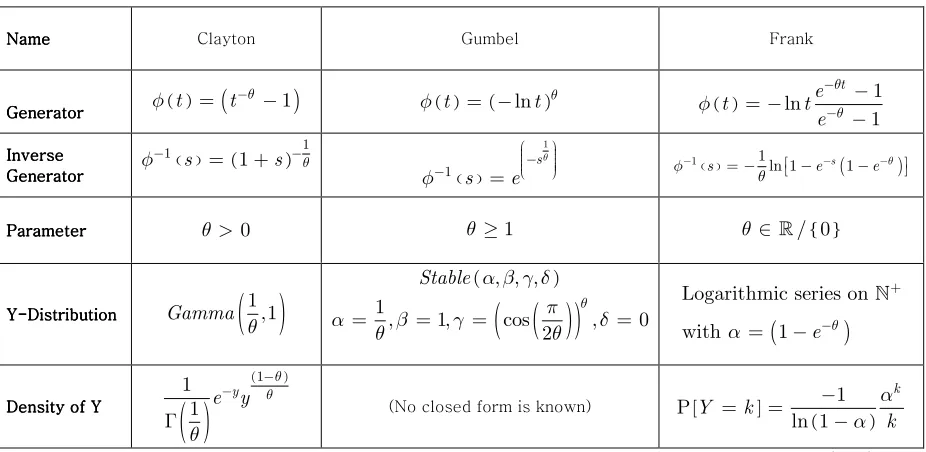
Table IIII:::: Some generators for Archimedean copulas, their inverses and their Laplace transforms. Source: Marshall and Olkin (1988).
Though the density of a
α
−
stable
distribution’s closed form is not known Nolan proposed the following simulation algorithm for generating random variablesα
−
stable
distributed:Name Name Name
Name Clayton Gumbel Frank
Generator Generator Generator
Generator ( )
t
(
t
1
)
θ
φ
=
−−
φ
( )t
= −
(ln
t
)θ ( )ln
1
1
te
t
t
e
θ θφ
− −−
= −
−
Inverse Inverse Inverse Inverse Generator Generator Generator Generator ( ) ( ) 11
s
1
s
θ
φ
−=
+
−( )
1
1
s
e
s θφ
− −
=
φ 1(s) 1ln 1 e s(
1 e θ)
θ − = − − − − − Parameter Parameter ParameterParameter
θ
>
0
θ
≥
1
θ
∈
/ 0
{ }Y Y Y
Y---Distribution-DistributionDistributionDistribution
Gamma
( )
1
,1
θ
(
, , ,
)Stable
α β γ δ
( )
(
)
1
,
1,
cos
,
0
2
θ
π
α
β
γ
δ
θ
θ
=
=
=
=
(
)
+
Logarithmic series on
with
α
=
1
−
e
−θDensity of Y Density of Y Density of Y Density of Y
( )
(1 )
1
1
e
yy
θ θ
θ
− −
Γ
(No closed form is known) [ ] ( )1
ln 1
kY
k
k
α
α
−
Ρ
=
=
Algorithm 2:
Algorithm 2:
Algorithm 2:
Algorithm 2:
1. Simulate an uniform variable
(
,
)
2 2
U
π π
Θ
∼
−
2. Simulate an exponentially distributed variable
W
with mean 1 independently ofΘ
. 3. Setθ
0=
arctan
(
β
tan
(
πα
/ 2 /
)
)
α
.4. Compute
Z
∼
St
(α β
, ,1, 0
)(
)
(
)
(
)
( )(
)
(
)
1
sin
0
cos
0
1
1
1/
cos
0
cos
cos
2
2
2
tan
ln
=1
2
Z
W
W
Z
α
α
α θ
αθ
α
α
α
αθ
π
β
β
π
α
π
π
β
−
+ Θ
+
−
Θ
≠
=
Θ
Θ
=
+ Θ
Θ −
+ Θ
5. Compute
X
∼
St
(α β γ δ
, , ,
):( )
(
2
)
1
ln
1
X
Z
X
Z
γ
δ
α
γ
δ
β
γ
γ
α
π
=
+
≠
=
+
+
=
Below, we use Kemp’s second accelerated generator of Logarithmic Distribution random variables from Luc Devroye’s book titled “Non-Uniform Random Variate Generation” chapter 10, page 548, freely available on
http://cgm.cs.mcgill.ca/~luc/rnbookindex.html.
Algorithm 3
Algorithm 3
Algorithm 3
Algorithm 3::::
Set
c
=
ln 1
(−
α
)Simulate an uniform variable
V
[0,1
]. IFIFIF
IF
V
≥
α
then setX
=
1
ELSE ELSEELSE ELSE
Simulate an uniform variable
U
[0,1
].Set
q
= −
1
e
cUCASE CASECASE CASE
2
:
V
≤
q
set ( )( )
ln
int 1
ln
V
X
q
=
+
. 2:
q
<
V
≤
q
setX
=
1
.:
V
>
q
setX
=
2
.X
is Logarithmic Series distributed.No other algorithm is necessary because the most of software have a built-in function that generates random variables Gamma distributed, such as GammaInv GammaInv GammaInv GammaInv function on Excel and rgammargammargamma on R. rgamma
Laplace Transform
Laplace Transform
Laplace Transform
Laplace Transform
The Laplace TransformLaplace TransformLaplace Transform of a function Laplace Transform
f t
( ) is denoted byL
[f t
( )]and defined by:L
[ ( )] ( )0
st
f t
f t e
dt
∞−
=
∫
L
−1[f s
( )]=
f t
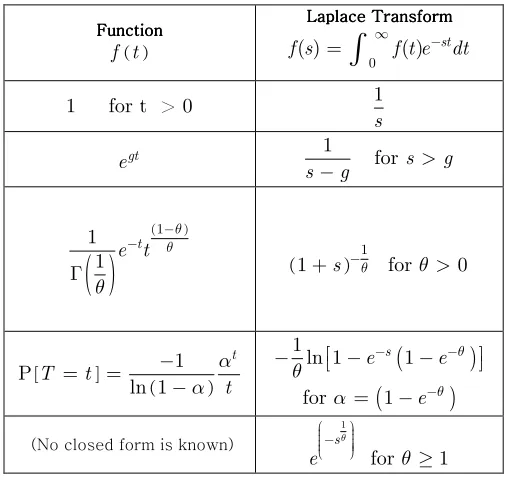
( ).Table of Laplace TransformLaplace TransformLaplace TransformLaplace Transform pairs, which are of interest for our work:
Function FunctionFunction Function ( )
f t
Laplace Transform Laplace Transform Laplace Transform Laplace Transform 0( )
( )
stf s
=
∫
∞f t e
−dt
1 for t > 0
1
s
gt
e
s
−
1
g
for
s
>
g
( )
(1 )
1
1
te t
θ θθ
− −Γ
( )1
1
+
s
−θfor
θ
>
0
[ ] ( )
1
ln 1
tT
t
t
α
α
−
Ρ
=
=
−
(
)
1
ln 1
e
s1
e
θθ
− −
−
−
−
(
)
for
α
=
1
−
e
−θ(No closed form is known)
1
for
1
se
θθ
− ≥
Table Table TableTable IIIIII -II--- Laplace Transform pairs
From an economic point of view we immediately recognize the Laplace transformLaplace transformLaplace transformLaplace transform as the present value of a stream of returns
f t
( )at the interest rates
. The present value of cash flows of $1,f t
( )=
1
, paid annually and perpetually at the continuous interest rates
isL
[ ( )]0
1
1
stf s
e
dt
s
∞−
=
∫
=
. On the other hand, the present discounted value at thecontinuous interest rate
s
of a cash flow growing at the rateg
,f t
( )=
e
gt, isL
[ ( )] 01
gt stf s
e e
dt
s
g
∞ −
=
=
−
∫
. If( )
f t
is continuous and differentiable at allt
≥
0
, then it is possible to recoverf t
( ) fromL
[f s
( )]through the inverse transformation:L
1[ ( )] ( )lim
1
2
a ib st b
a ib
f s
f t
e
i
π
+ −
→∞ −
=
=
∫
L
[f s ds a
( )],
≥
α
.This has the economic meaning that if we know the present discounted value of a stream of returns at every interest rate, we can recover the whole pattern of the stream of returns.
Experiment I
We conduct an experiment for seeing practically in what manner, by knowing the Laplace transform of a function, we can recover it. We will do it here, but you can reproduce it on your own computer. For doing this, we need an approach that implements numerically the inverse transformation
L
−1[f s
( )]. We will use the Euler1 method. Readers interestedin deepeningthis subject should consult the following link:
http://www.columbia.edu/~ww2040/Laplace http://www.columbia.edu/~ww2040/Laplacehttp://www.columbia.edu/~ww2040/Laplace
http://www.columbia.edu/~ww2040/LaplaceInversionJoC95.pdfInversionJoC95.pdfInversionJoC95.pdfInversionJoC95.pdf
The experiment consists of computing the flow of returns by knowing its net present value using the inverse Laplace
transform
.
As we already saw, the net present value of a stream of returns that grows to the continuous rateg
,represented by the function
f t
( )=
e
gt, discounted to the continuous interest rates
to be1
s
−
g
. Also1
s
−
g
is theLaplace Transform of the function
f t
( )=
e
gtas well. So that, we can calculate the stream of returns that grows atrate
g
2 discounted to the continuous interest rates
usinge
gt or employing the InverseLaplace Transform of
1
s
−
g
.In the VBA alluded to t
he
Laplace transform
1
s
−
g
, is specified by the variable FsFsFsFs in the function Rf Rf Rf, in complex Rfnotation. The VBA should look as follow:
Function Rf(ByVal X, ByVal Y) As Double
s = imsum(X, improduct("i", Y))
g=0.02
Fs = imdiv(1, (imsum(s, - g)))
Rfs = imreal(Fs)
Rf = Rfs
End Function
So in Excel’s language
e
gt is represented as =Exp(0.02*A1)=Exp(0.02*A1)=Exp(0.02*A1)=Exp(0.02*A1) fort
=
1
,=Exp(0.02*A2)=Exp(0.02*A2)=Exp(0.02*A2) for =Exp(0.02*A2)t
=
2
and so on. On theother hand, the Inverse Laplace Transform of
1
s
−
g
as =InverseLaplace(A1)=InverseLaplace(A1)=InverseLaplace(A1)=InverseLaplace(A1) fort
=
1
. =InverseLaplace(A2)=InverseLaplace(A2)=InverseLaplace(A2)=InverseLaplace(A2) for2
t
=
and so on.Experiment II
The previous experiment was a warm-up for this one, which has more relation with our research. The point 2 of the
Algorithm 1 Algorithm 1Algorithm 1
Algorithm 1requires simulating a variable
Y
with distribution functionG
such that the Laplace transformLaplace transformLaplace transform of Laplace transformG
is the inverse of the generator. In Table I, we can see in the Clayton case that the probability density functionG
is( )
1
,1
Gamma
θ
. So that, the inverse Laplace transform Laplace transform Laplace transform of the inverse generator Laplace transform ( ) 11
+
s
−θ forθ
>
0
3333 equals to theProbability Density Function of a
Gamma
( )
1
,1
θ
distribution. For doing this in the VBA alluded to, the Laplace Laplace Laplace Laplacetransform transformtransform
transform (
1
+
s
)−1θ, is specified by the variable FsFsFsFs in the function Rf Rf Rf Rf, in complex notation. The VBA should look as follow:Function Rf(ByVal X, ByVal Y) As Double
s = imsum(X, improduct("i", Y))
theta= 1.84
Fs = impower(imsum(1, s), -1 / theta)
Rfs = imreal(Fs)
Rf = Rfs
End Function
So that t
he
Laplace transform
(1
+
s
)−θ1in Excel’s language is represented by the function ====InverseLaplace(A1)InverseLaplace(A1)InverseLaplace(A1) for InverseLaplace(A1)1
t
=
, ====InverseLaplace(A2)InverseLaplace(A2)InverseLaplace(A2) for InverseLaplace(A2)t
=
2
and so on. Also, the ProbabilityDensity Function of a( )
1
,1
Gamma
θ
distribution equals to( )
(1 )
1
1
te t
θ θ
θ
− −
Γ
or in Excel’s language =1/(Exp(Gamma.Ln(1/1.84)))*Exp(=1/(Exp(Gamma.Ln(1/1.84)))*Exp(=1/(Exp(Gamma.Ln(1/1.84)))*Exp(-=1/(Exp(Gamma.Ln(1/1.84)))*Exp(--
-A1)*A1^((1 A1)*A1^((1A1)*A1^((1
A1)*A1^((1--1.84)/1.84) or =GammaDist(A1,1--1.84)/1.84) or =GammaDist(A1,11.84)/1.84) or =GammaDist(A1,11.84)/1.84) or =GammaDist(A1,1/1.84,1,0)/1.84,1,0)/1.84,1,0)/1.84,1,0) for
t
=
1
and, =1/(Exp(Gamma.Ln(1/1.84)))*Exp(=1/(Exp(Gamma.Ln(1/1.84)))*Exp(=1/(Exp(Gamma.Ln(1/1.84)))*Exp(-=1/(Exp(Gamma.Ln(1/1.84)))*Exp(-- -A2)*A2^((1A2)*A2^((1A2)*A2^((1
A2)*A2^((1---1.84)/1.84) or =GammaDist(A2,1/1.84,1,0) -1.84)/1.84) or =GammaDist(A2,1/1.84,1,0) 1.84)/1.84) or =GammaDist(A2,1/1.84,1,0) 1.84)/1.84) or =GammaDist(A2,1/1.84,1,0) for
t
=
2
and so on.We invite to readers to conduct a third experiment that computes the probability density function in the Frank case
using both the function [ ]
( )
1
ln 1
k
Y
k
k
α
α
−
Ρ
=
=
−
and the inverse Laplace TransformLaplace TransformLaplace TransformLaplace Transform of(
)
1
ln 1
e
s1
e
θθ
− −
−
−
−
for
α
=
(
1
−
e
−θ)
.Conclusions
Conclusions
Conclusions
Conclusions
There is clear evidence that equity returns have unconditional fat tails, to wit, the extreme events are more probable than anticipated by normal distribution, not only in marginal but also in higher dimensions. This is important both for market risk models as credit risk one, where equity returns are used as a proxy for asset returns that follow a multivariate normal distribution, and, therefore, default times have a multivariate normal dependence structure as well. Other than normal distribution should be used both in marginal as joint distributions. To overcome these pitfalls, the concept of copula emerges. A hurdle for practical implementation of any multivariate Archimedean copula was the absence of an efficient method for generating them. The most frequently used approach named conditional distribution one, involves differentiation step for each dimension of the problem. For this reason, it is not feasible in higher dimension. Marshall and Olkin proposed an alternative method, which is computationally more straightforward than the conditional distribution approach. We present the tools necessary for understand it and use it. We introduce the Laplace Transform and its role in the generation of multivariate Archimedean copulas. In order to cover the gap between the theory and its practical implementation VBA code and R one are provided.
References
References
References
References
Abate, Joseph and Whitt Ward 1995 Numerical Inversion of Laplace Transforms of Probability Distributions. ORSA Journal on Computing, vol. 7, 1995, pp. 36.
(http://www.columbia.edu/~ww2040/LaplaceInversionJoC95.pdf)
Devroye, Luc (1986). Non-uniform random variate generation. Springer, Berlin, Heidelberg, New York. ( http://cgm.cs.mcgill.ca/~luc/rnbookindex.html )
Duncan K. Foley (2005) Laplace Transform – Class Notes (http://homepage.newschool.edu/~foleyd/GECO6289/laplace.pdf )
Embrechts, P., A. J. McNeil and D. Straumann (1999) Correlation and Dependence in Risk Management: Properties and Pitfalls. ( http://www.math.ethz.ch/~strauman/preprints/pitfalls.pdf )
Frees, E. W. and Valdez, E. A. (1998): Understanding relationships using copulas, North American Actuarial Journal, 2, pp. 1-25.
Kjersti Aas (December 2004) Modelling the dependence structure of financial assets:
A survey of four copulas . Norwegian Computing Center (http://www.nr.no/files/samba/bff/SAMBA2204b.pdf )
Lindskog, F. (2000) Modeling Dependence with Copulas ETH Zurich (http://www.math.ethz.ch/~mcneil/ftp/DependenceWithCopulas.pdf)
Marshall, Albert W. and Ingram Olkin (1988) Families of multivariate distributions. Journal of the American Statistical Association, 83, 834–841.
Melchiori, Mario R. (2003) Which Archimedean Copula is the right one? Universidad Nacional del Litoral Argentina ( www.riskglossary.com/papers/Copula_carta.PDF )
Nolan, J.P. (Forthcoming) Stable Distributions: Models for Heavy Tailed Data. (http://academic2.american.edu/~jpnolan/stable/chap1.pdf)
Appendix A
Appendix A
Appendix A
Appendix A
Abate, Joseph and Whitt Ward 1995
Numerical Inversion of Laplace Transforms of Probability
Distributions.
ORSA Journal on Computing, vol. 7, 1995, pp. 36.(http://www.columbia.edu/~ww2040/LaplaceInversionJoC95.pdf
)
Function InverseLaplace(t As Double) As Double
Const Pi = 3.14159265358979 Dim SU(13), C(12)
m = 11
For n = 0 To m
C(n + 1) = Application.WorksheetFunction.Combin(m, n) Next
A = 18.4 Ntr = 15
u = Exp(A / 2) / t X = A / (2 * t) h = Pi / t
Sum = Rf(X, 0) / 2 For n = 1 To Ntr Y = n * h
Sum = Sum + (-1) ^ n * Rf(X, Y) Next
SU(1) = Sum For k = 1 To 12 n = Ntr + k Y = n * h
SU(k + 1) = SU(k) + (-1) ^ n * Rf(X, Y) Next
Avgsu = 0 Avgsu1 = 0 For j = 1 To 12
Avgsu = Avgsu + C(j) * SU(j) Avgsu1 = Avgsu1 + C(j) * SU(j + 1) Next
Fun = u * Avgsu / 2048 Fun1 = u * Avgsu1 / 2048
InverseLaplace = Fun1 errt = Abs(Fun - Fun1) / 2
End Function
Function Rf(ByVal X, ByVal Y) As Double s = imsum(X, improduct("i", Y))
Fs = imdiv(1, (imsum(s, -0.02))) Rfs = imreal(Fs)