Ames Laboratory Accepted Manuscripts
Ames Laboratory
12-19-2017
R14(Au, M)51 (R = Y, La−Nd, Sm−Tb, Ho, Er, Yb,
Lu; M = Al, Ga, Ge, In,Sn, Sb, Bi): Stability Ranges
and Site Preference in the Gd14Ag51 Structure
Type
Chris Celania
Iowa State University and Ames Laboratory
Volodymyr Smetana
Stockholm University and Ames Laboratory
Alessia Provino
University of Genova and Ames Laboratory
Pietro Manfrinetti
University of Genova and Ames Laboratory
Anja-Verena Mudring
Iowa State University and Ames Laboratory
Follow this and additional works at:
https://lib.dr.iastate.edu/ameslab_manuscripts
Part of the
Condensed Matter Physics Commons
, and the
Materials Science and Engineering
Commons
This Article is brought to you for free and open access by the Ames Laboratory at Iowa State University Digital Repository. It has been accepted for inclusion in Ames Laboratory Accepted Manuscripts by an authorized administrator of Iowa State University Digital Repository. For more information,
please [email protected].
Recommended Citation
Celania, Chris; Smetana, Volodymyr; Provino, Alessia; Manfrinetti, Pietro; and Mudring, Anja-Verena, "R14(Au, M)51 (R = Y, La−Nd, Sm−Tb, Ho, Er, Yb, Lu; M = Al, Ga, Ge, In,Sn, Sb, Bi): Stability Ranges and Site Preference in the Gd14Ag51 Structure Type" (2017).Ames Laboratory Accepted Manuscripts. 119.
R14(Au, M)51 (R = Y, La−Nd, Sm−Tb, Ho, Er, Yb, Lu; M = Al, Ga, Ge,
In,Sn, Sb, Bi): Stability Ranges and Site Preference in the Gd14Ag51
Structure Type
Abstract
Twenty new ternary representatives of the Gd14Ag51 structure type have been synthesized within the R-Au-M family (R = Y, La–Nd, Sm–Tb, Ho, Er, Yb, Lu; R-Au-M = Al, Ga, Ge, In, Sn, Sb, Bi) using solid state synthesis techniques. The list of post transition metals (M) involved in the formation of this type of structure could be augmented by five new representatives. All compounds crystallize in the hexagonal space groupP6/m(#175) with the unit cell ranges ofa= 12.3136(2)–12.918(1) Å andc= 8.9967(3)–9.385(1) Å, and incorporate different degrees of Au/M mixing. The involvement of the post transition element in the structure varies from one to another compound both qualitatively and quantitatively. A rather significant phase width can be expected for the majority of compounds, however, not without exclusions. The distribution of the post transition metals within the structure has been analyzed via single crystal X-ray diffraction. While the positional disorder of one near-origin Au position is expectable for all compounds due to steric reasons, two specimens show an obvious deviation from the others including another Au position split along thecaxis. Possible factors affecting this behavior are discussed.
Disciplines
Condensed Matter Physics | Materials Science and Engineering
R
14
(Au, M)
51
(R = Y, La
−
Nd, Sm
−
Tb, Ho, Er, Yb, Lu; M = Al, Ga, Ge, In,
Sn, Sb, Bi): Stability Ranges and Site Preference in the Gd
14
Ag
51
Structure Type
Published as part of a Crystal Growth and Design
virtual special issue
on Crystalline Functional Materials in
Honor of Professor Xin-Tao Wu
Chris Celania,
†,‡Volodymyr Smetana,
†,∥Alessia Provino,
†,§,⊥Pietro Manfrinetti,
†,§,⊥and Anja-Verena Mudring
*
,†,‡,∥†The Ames Laboratory, U.S. Department of Energy and‡Department of Materials Science and Engineering, Iowa State University,
Ames, Iowa 50011, United States
∥Department of Materials and Environmental Chemistry, Stockholm University, Svante Arrhenius väg 16 C, 106 91 Stockholm, Sweden
§Department of Chemistry, University of Genova, Via Dodecaneso 31, 16146 Genova, Italy
⊥Institute SPIN-CNR, Corso Perrone 24, 16152 Genova, Italy
*
S Supporting InformationABSTRACT: Twenty new ternary representatives of the Gd14Ag51 structure type have been synthesized within the R-Au-M family (R = Y, La−Nd, Sm−Tb, Ho, Er, Yb, Lu; M = Al, Ga, Ge, In, Sn, Sb, Bi) using solid state synthesis techniques. The list of post transition metals (M) involved in the formation of this type of structure could be augmented by five new representatives. All compounds crystallize in the hexagonal space groupP6/m(#175) with the unit cell ranges of a = 12.3136(2)−12.918(1) Å and
c= 8.9967(3)−9.385(1) Å, and incorporate different degrees of Au/M mixing. The involvement of the post transition element in the structure varies from one to another compound both qualitatively and quantitatively. A rather significant phase width can be expected for the majority of compounds, however, not without exclusions. The distribution of the post transition metals within the structure
has been analyzed via single crystal X-ray diffraction. While the positional disorder of one near-origin Au position is expectable for all compounds due to steric reasons, two specimens show an obvious deviation from the others including another Au position split along the caxis. Possible factors affecting this behavior are discussed.
1. INTRODUCTION
Gold has been revered for itsflexibility in chemical bonding as well as its ability to form interesting structural features owning to the strong relativistic effect on its 5d and 6s valence orbitals.1−8 These properties make gold an opportune component for the discovery of new complex intermetallic compounds. The varied bonding capabilities and size of gold also provide a prime oppor-tunity for the incorporation of slight structural changes akin to the substitution of various group 13−15 elements. Examples of gold’sflexibility in structure and bonding are numerous, including the formation of quasicrystals, their approximants and related crystalline formations with crystallographically forbidden sym-metries, along with various homoatomic gold assemblies.8−12 Such motifs comprise isolated Au7clusters as found in A4Au7X2 (A = K, Rb, Cs; X = Ge, Sn),13,14one-dimensional columns such as Au zigzag chains like in Ca3Au3In,15and two-dimensional slabs
which are observable in K2Au3.16Three dimensional gold
net-works also form in several arrangements: interconnected trigo-nal bipyramids are found in KAu5,
17
hexagonal diamond-like frameworks of Au are the characteristic structural motifs in the Ae-Au-Tr (Ae = alkaline earth, Tr = triel element) systems,18−24 and assemblies of tetrahedral and square planar Au fragments are observed in Rb3Au7.25
Rare earth intermetallic compounds with gold have received much research interest in the past few years, with shifting attention toward the exploration of gold-rich regions of the systems.20,26−31Various compounds within these systems show exciting or rare structural motifs and a variety of often useful
Received: October 20, 2017
Revised: December 12, 2017
Published: December 19, 2017
Article
pubs.acs.org/crystal
Cite This:Cryst. Growth Des.XXXX, XXX, XXX−XXX
© XXXX American Chemical Society A DOI:10.1021/acs.cgd.7b01469
magnetic and electronic properties such as the magnetocaloric effect,30ferromagnetism,31superconductivity,27 thermoelectric-ity,32etc. Compounds with rare earths are regarded for their diverse magnetic properties, which they owe to the unpaired spins provided by their well-shielded 4f electrons. By moving down the series of rare earth elements, various magnetic moments and atomic sizes become available, permitting an intriguing alter-ation of magnetic interaction.
The gold-rich section of the R-Au-M family remains a par-ticularly interesting region for further exploration. The high content of gold allows for a higher chance of homoatomic for-mations and more opportunities to explore the variety of Au−Au bonding and to investigate the capability of group 13−15 ele-ments to stabilize the structures and to affect such forma-tions. For example, substitution of gold by a post transition metal M may allow the stabilization of ternary compounds where cer-tain binary compounds have not been reported. Of these com-pounds, much recent research has focused on ternary compounds with tin and has led to the discovery of the R3Au6Sn5,33,34 R3Au4Sn3,33R5Au8Sn5,33R4Au7Sn4,33R2Au5Sn226and R3Au7Sn3
series of compounds,27,28The latter can be described as super-structural polyhedral packing of ZrBeSi-type featuring a new homoatomic Au cluster, Au@Au6. Recent work also led to the discovery of a compositionally and structurally related series R3Au9Pn.35The R3Au9Pn structure contains Au@Au6trigonal antiprisms and stacking features similar to those found in R14Au51
structures that are not present in the R3Au7Sn3structure, acting as a bridge between the Gd14Au51and Cu10Sn3parent structure
types. However, gold rich systems in combination with rare earth elements and group 13−15 elements are still largely underexplored, showing specific scarcity with compounds featuring pnictogens (Pn, group 15) aside from the previously mentioned work. Because of the structural and compositional similarities between R3Au9Pn series and the Gd14Ag51structure type, exploration of
samples at the R:Au:M compositional ratio of 3:9:1 with rare earth and group 13−15 metal variation often yielded more thermodynamically stable R14(Au, M)51.
Reportsfirst identified the Gd14Ag51structure type under the
formula of Ag3Gd in 1968 and further refined it to the formal structure type in 1970 with representatives spanning the near entirety of the rare earths.36,37The structure falls under space groupP6/m(175) and ranges in size from Hf14Cu51(a= 11.18 Å, c = 8.25 Å) to Sr14Hg51 (a = 13.78 Å, c = 9.88 Å).38,39 The structure type has come under increased study in the past decade (specifically within ternary compounds) resulting in numerous representatives of the type and its derivative structures.40,41 Reported compounds have displayed actinide mixing in U7Th7 -Au51;42,43group 11 mixing between Cu, Ag, and Au in Dy14Ag42.3
-Cu8.7, U14Au42Ag9, and U14Ag42Cu9;44,45and group 11 and group 13−14 element mixing with a focus on Cu−Ga ranging from Gd14Cu48Ga3to Sc14Cu36.7Ga14.3.46,47R-Au-M (R = rare earth, M = groups 13−15) representatives have only recently been reported solely for Ga and Sn.48,49Though studied more recently in detail, a consensus on how site mixing and coloring occur within these ternary compounds does not appear to exist,48,50,51 and the numerous R-Au-M compounds studied within this work shed more light on this phenomenon.
2. EXPERIMENTAL SECTION
Synthesis.Starting materials used for synthesis were Au (99.98%), rare earth elements (99.9%), and group 13−15 elements Al, Ga, Ge, In, Sn, Bi (99.99%) from the Materials Preparation Center, Ames Laboratory, and Sb (99.99%) from Alfa Aesar. Extra Au and Bi were
obtained from MaTeck (99.99%) and Alfa Aesar (99.999%) respec-tively. A representative of the R14(Au, M)51series wasfirst observed in the Gd−Au−Sb system as a minor phase in a sample loaded with Gd:Au:Sb in a 2:5:1 ratio. The sample was reacted in a sealed tantalum ampule jacketed in fused silica at 1000 °C for 3 h, followed by annealing at 850°C for 12 h. Different synthetic conditions were then tested at loaded (R:Au:M) 3:9:1 compositions in order to explore the R3Au9Pn series, often yielding R14(Au, M)51 as the majority phase product. Investigation spanned the breadth of the rare earths (Y, La− Nd, Sm−Lu tested with Au and Sb) as well as various group 13−15 elements (Al, Ga, In, Sn, Sb, and Bi tested with Gd and Au). This con-stitutes the majority of included compounds. However, R14(Au, M)51 compounds discovered through other, unrelated R-Au-M explorations loaded at different Au-rich compositions have also been included for a more comprehensive overview (Gd:Au:Sb and Yb:Au:Sn at 3:7:3 and Er:Au:Ga, Ce:Au:Ga, and Lu:Au:Ga at 14:34.1:16.9). Regardless of loaded composition, the general strategy was to react the starting materials at high temperatures (either by heating in an electrical-resistance furnace until at least one component reached the liquid state or by arc melting), followed by annealing at lower temperature to create higher quality single crystals for X-ray structure analysis. Total mass of samples prepared was 0.5 g. All samples were handled under inert conditions using standard techniques.
Samples to be arc melted werefirst formed into pellets using a die press to combine the starting materials (as small chunks orfilings) with two metric tons of force. Because of the low melting points and high vapor pressures of some group 13−15 elements,∼6% extra mass was added to the loaded compositions to account for loss during the process. These elements were strategically loaded on one side of the pellet so that it could be placed out of direct contact with the arc to discourage vaporization. Arc melting occurred in short bursts (∼5 s or until buttons appeared fully molten) in an inert Ar environment. Between subsequent melts, buttons wereflipped (three to four times in total) to improve homogeneity. Samples were sealed in tantalum tubes (under inert Ar atmosphere by arc welding) followed by fused silica jackets (under vacuum) before annealing at 850°C in a tube furnace.
Samples to be formed by high temperature self-flux reactions in furnaces were first loaded at a R:Au:M stoichiometric ratios into Ta tubes which were then sealed by arc welding in Ar followed by jacketing in fused silica under a vacuum. To ensure full reactions while discouraging Ta−Au binary formation, temperatures slightly under the melting point of the main component (Au) were used. The fully molten M component and high surface area to volume ratio of the other com-ponents (small chunks orfilings) encouraged reactivity. All samples, despite the synthesis technique, appeared dark gray with a metallic luster, and remained stable weeks later.
X-ray Analysis. X-ray powder diffraction for phase analysis was performed on samples by either a STOE STADI P diffractometer with a STOE image plate detector with Cu Kα1;λ= 1.54059 Å (Si as an internal standard,a= 5.4308(1) Å). For powder preparation the brittle samples were ground, then sieved to <38μm particles, and dispersed onto either vacuum grease sandwiched between Mylar sheets andfixed by Al rings. Data analysis was performed with the WinXPow 3.06
software package.52
Scanning electron microscopes (SEM) were used for character-ization of microstructure and homogeneity for several representatives of the series. A Leica Cambridge 360 equipped with an Oxford X-Max 20 analyzer (for energy dispersive X-ray analysis, EDS) allowed for semiquantitative elemental analysis. Utilizing a high-tension voltage of 20.0 kV, distinct phases were recognized and further analyzed via EDS to identify the phase composition (counting time of 60 s). The Pr14 -(Au, Sb)51 sample was analyzed with a JEOL JSM 6060LV (20.0 kV and counting time of 160 s). With the accuracy within 1 atom %, the data allow for verification of the estimated compositions by the single crystal method.
For single crystal X-ray diffraction, samples were crushed in a die press, and single crystals were selected under a microscope and then affixed to a glassfiber with grease. Single crystal X-ray diffraction took place at room temperature on either a Bruker APEX CCD diff rac-tometer or a Bruker D8 VENTURE diffractometer (both with
Crystal Growth & Design Article
DOI:10.1021/acs.cgd.7b01469
Cryst. Growth Des.XXXX, XXX, XXX−XXX
Mo Kαradiation;λ= 0.71073 Å), utilizing the APEX 2 and APEX 3
software suites (for the former and the latter diffractometer, respec-tively) for data collection, integration, polarization, and empirical absorp-tion correcabsorp-tion.53,54Scans ranged 2θvalues of∼3−63°. The SHELXTL suite, and XPREP algorithms within were used to check for extinction conditions andEstatistics in the intensity data sets necessary for the assignment of the proper P6/m space group. Direct methods were used for structure solution (SHELXS-97).55APEX 3 software was then used to carry out full structure refinement (refining atomic positions, determining mixed site occupancies, and anisotropic displacement parameters).
3. RESULTS AND DISCUSSION
Pursuit of R3Au9Pn within the wider realm of the R-Au-M systems
produced numerous ternary representatives of the compositionally similar R14(Au, M)51phases. These compounds exhibit variation
in overall composition as well as Au/M site mixing despite par-allel elemental ratios and synthesis conditions. Representatives of R14(Au, M)51compounds comprise R = Y, La−Nd, Sm−Tb, Ho, Er, Yb, Lu; M = Al, Ga, Ge, In, Sn, Sb, Bi, including Yb14(Au, Sn)51,
and Lu14(Au, Ga)51 which are ternary representatives with no reported binary phase, as well as a replication of the recently reported Er14(Au, Ga)51ternary representative for comparison.48 The details of the crystallographic investigation along with the positional data for three example compounds (Gd14(Au, Sb)51, Lu14(Au, Ga)51, and La14(Au, Bi)51) are summarized inTables 1
and2. (SeeAppendixfor CCDC numbers of all samples.)
Crystal Chemistry.The crystal structure of the R14(Au, M)51
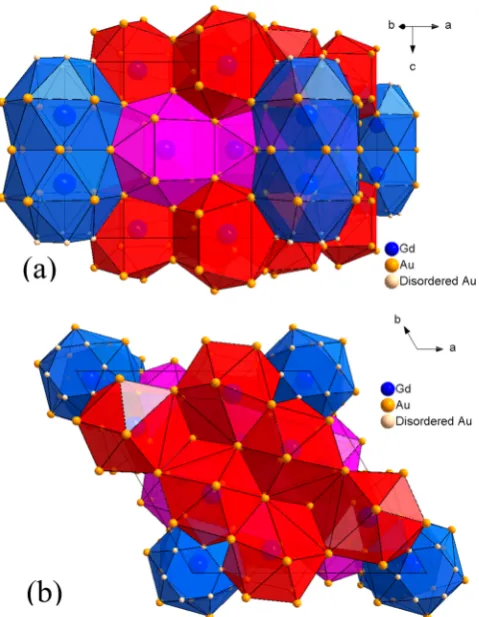
compounds accounts for 10 independent crystallographic sites, three of which are occupied by the rare earths. The coordination polyhedra of these three rare earth element positions (Figure 1) build up a layered structure (Figures 2andS4). A characteristic feature of the structure is the Au7 site, which forms hexagons cen-tered around thecaxis. Due to Au−Au short distances (∼1.6 Å), these sites are only half-filled and practically form triangles. In the case of Gd14Ag51structures, these triangles are statistically
disor-dered, while ordering is observed in structurally related amalgam
structures.40,56−58Independent refinement of this positions results in 50(1) % occupancy for the binary compounds.41The occu-pancy for Au7 has beenfixed at 50% to explore Au/M mixing at this site. This disordered site is highlighted in the top and bottom planes of the face-sharing double coordination poly-hedra for the R2 sites displayed inFigure 2a (with coordination number (CN 15 instead of CN 18). The R3 coordination poly-hedra form the top and bottom slabs of the layered structure via face sharing (Figure 2b) and incorporate the disordered posi-tion by forming either 13 or 14 atom coordinaposi-tion polyhedra depending on the conformation of the triangle of the partially
filled Au7 sites. A second slab of R1 coordination polyhedra (CN 14) share edges with the R2 face-sharing double poly-hedra and share faces with the R3 polypoly-hedra slabs above and below. An alternative perspective of the structure is shown in
Figure S3, displaying a pinwheel of the R1 and R3 coordination polyhedra about the R2 site and thecaxis.
While almost all compounds in this report adopt minor modifi -cations of the basic Gd14Ag51structure type through alterations in
[image:5.625.71.562.490.752.2]bond lengths, one noticeable difference occurs in the La−Au−Bi and Lu−Au−Ga ternary representatives. The Au6 site within this structure becomes disordered, creating a secondary posi-tion∼0.5 Å offset along thecaxis (see Table 2). The coordi-nation polyhedra of this site for both structures are represented in Figure 3, with unoccupied positions as black spheres for clarity. The comparatively small radii of Lu and Ga create a noticeably small unit cell for the Lu−Au−Ga representative of the series. When the Ga6A site is occupied (Figure 3a, right), the distance to adjacent Au6 sites lengthens to 3.540 Å, which appears unreasonably long. Simultaneously, a short Ga6A−Au5 distance of only 2.488 Å forms. While uncommon, shorter distances are reported in other Au−Ga compounds.11 For La−Au−Bi, the expanded structure leads to an unreasonably long Au6−Au6 distance (3.870 Å), reducing the coordination poly-hedra regardless of if the disordered position is occupied. The Bi6A disordered site has an occupancy of 17% over the normal
Table 1. Crystallographic Details and Refinement Parameters for Gd14(Au, Sb)51, Lu14(Au, Ga)51, and La14(Au, Bi)51a
Gd−Au−Sb Lu−Au−Ga La−Au−Bi Crystal data
chemical formula Au48.27Gd14Sb2.73 Au35.30Ga15.70Lu14 Au49.93Bi0.70La14
Mr 12041.21 10497.10 11925.56
temperature (K) 296 293 297
a,c(Å) 12.6929(5), 9.2006(5) 12.3233(4), 8.9664(3) 12.918(1), 9.385(1)
V(Å3) 1283.7(1) 1179.24(9) 1356.1(3)
Z 1 1 1
μ(mm−1) 156.43 147.02 147.38
crystal size (mm) 0.1×0.1×0.1 0.1×0.1×0.1 0.1×0.1×0.1 Data collection
diffractometer Bruker CCD Bruker Venture Bruker Venture
Tmin,Tmax 0.1, 0.2 0.1, 0.2 0.1, 0.2
no. of measured, independent and observed 11869, 681, 541 13515, 1231, 997 38695, 1404, 1274 [I> 2σ(I)] reflections
Rint 0.122 0.090 0.111
θmax(deg) 23.5 30.0 30.0
(sinθ/λ)max(Å−1) 0.56 0.703 0.703
Refinement
R[F2> 2σ(F2)],wR(F2),S 0.027, 0.057, 1.01 0.031, 0.060, 1.09 0.027, 0.055, 1.17
no. of reflections 681 1231 1404
no. of parameters 63 66 64
Δρmax,Δρmin(e Å−3) 2.34,−3.22 4.33,−4.93 3.75,−3.42 aFor all structures: hexagonal,P6/m. Experiments were carried out with Mo Kαradiation with empirical absorption correction.
Crystal Growth & Design Article
DOI:10.1021/acs.cgd.7b01469
Cryst. Growth Des.XXXX, XXX, XXX−XXX
Au6 site, but occupation of this Bi6A site appears problematic as it forms an unrealistically short Bi6A−Au5 distance of 2.233 Å. However, a complementary occupancy of 82% is noted for the Au5 site, representing an absence in both the Au5 and Au6 sites when the Bi6A site is occupied (Figure 3b, right). The origin of this disorder is speculated to stem from size effects, as it only appears present in a sample with a large R element mixed with a large M element, and a sample with a small R element mixed with a small M element. However, future experimentation or theoretical calculations may elucidate this.
A similar disorder is seen in the related amalgam Eu10Hg55 structure.56Because of the ordering of the split Au7 position,
[image:6.625.83.298.62.763.2]Table 2. Atomic Position and Site Occupancy Data for Three Representative Samples a Gd 14 Au 48.3 Sb 2.7 Lu 14 Au 35.3 Ga 15.7 La 14 Au 49.9 Bi0.7 xy z Occ. xy z Occ. xy z Occ. R1 0.4627(2) 0.1392(2) 1/2 0.13413(7) 0.46549(8) 1/2 0.14246(8) 0.46760(8) 1/2 R2 0 0 0.3083(3) 0 0 0.3017(2) 0 0 0.3017(2) R3 0.1163(2) 0.3936(2) 0 0.39266(9) 0.12020(8) 0 0.3927(1) 0.1193(1) 0 Au1 0.10199(9) 0.44196(9) 0.3387(1) 0.07155(6) 0.26917(6) 0.22642(7) 0.762(5) 0.07235(4) 0.26868(4) 0.23752(5) M1 0.07155(6) 0.26917(6) 0.22642(7) 0.238(5) Au2 0.0590(1) 0.2377(1) 1/2 0.2292(1) 0.0587(1) 1/2 0.464(6) 0.23858(5) 0.06035(5) 1/2 M2 0.2292(1) 0.0587(1) 1/2 0.536(6) Au3 0.49142(9) 0.11140 (9) 0.1513(1) 0.44488(5) 0.11326(5) 0.33656(6) 0.44025(4) 0.10250(4) 0.33498(5) M3 Au4 0.26716(9) 0.07549(9) 0.2335(1) 0.10893(7) 0.49172(7) 0.14548(9) 0.553(4) 0.11118(4) 0.49308(4) 0.15141(5) M4 0.10893(7) 0.49172(7) 0.14548(9) 0.447(4) Au5 1/3 2/3 0 1/3 2/3 0 1/3 2/3 0 0.814(6) Au6 1/3 2/3 0.2998(2) 0.53(2) 1/3 2/3 0.3277(5) 0.379(7) 1/3 2/3 0.2938(3) 0.830(6) M6 1/3 2/3 0.2998(2) 0.48(2) M6A 1/3 2/3 0.2775(8) 0.621(7) 1/3 2/3 0.238(1) 0.170(6) Au7 0.0313(3) 0.1394(3) 0 0.36(1) 0.1351(2) 0.0326(3) 0 0.203(6) 0.1412(1) 0.0345(1) 0 1/2 M7 0.0313 (3) 0.1394(3) 0 0.14(1) 0.1351(2) 0.0326(3) 0 0.297(6) a Filled mixed sites are designated as M while a disordered split position unique to the Lu − Au − Ga and La − Au − Bi samples is designated as M6A.
Figure 1.Coordination polyhedra for the three rare earth sites R1−R3 in Gd14Au51. The disordered half-filled Au7 position is highlighted in the R2 and R3 polyhedra for clarity. Because of its occupancy, R2 sites are coordinated by only 15 atoms, and R3 sites are coordinated by 13 or 14 Au atoms depending on if the Au7 site is occupied.
Figure 2.Side and top perspectives ((a) and (b) respectively) of the polyhedral packing within Gd14Au51 made up of the three Gd sites’ coordination polyhedra. The disordered, half-filled Au7 site is highlighted in tan for clarity. Polyhedra form face and edge sharing slabs around columns of interpenetrating Frank−Kasper polyhedra (shown in blue).
Crystal Growth & Design Article
DOI:10.1021/acs.cgd.7b01469
Cryst. Growth Des.XXXX, XXX, XXX−XXX
[image:6.625.326.566.252.561.2]the system moves into the P6̅ space group. Additionally, the R2 site becomes a mixed Eu/Hg position (accounting for the composition change). Aside from these differences, both the Au5 and Au6 positions appear disordered along thec axis. The dis-ordered positions are more nearly equidistant between their orig-inal site and the nearest above/below and are approximately 50% occupied.
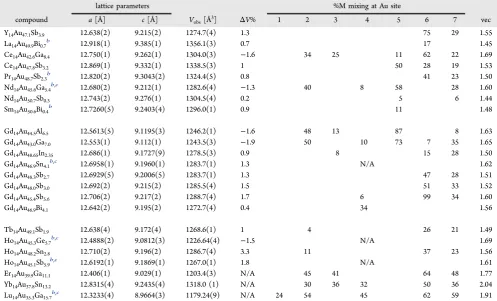
The full list of discovered ternary gold intermetallics organized by rare earth and then post transition metal components is pre-sented inTable 3. Three values are listed for Gd−Au−Sb that were taken from samples loaded from different starting Au-rich compositions for comparison. The Er14(Au, Ga)51 compound,
though already reported in the literature, was replicated to confirm Au−Ga mixing is possible at each Au crystallographic site as described and will be discussed further. As a note, testing a second crystal from the same Er14(Au, Ga)51 sample showed
comparable mixing percentages in the same sites. This asserts that the single crystal data within this work are representative of site preference and not stochastic for all sites.
Deviations from reported binary cell volumes range from
−1.9% to +3.3% with substitutions typically increasing the unit cell size despite Bi being the only tested M element with a noticeably larger covalent radii than Au.59In fact, the largest cell volume increase is noted for the Ho14(Au, Sn)51sample despite
not having an exceptional amount of post transition metal mixed into the gold sites. Another example of tin’s ability to expand the
structure is found in Yb14(Au, Sn)51 which contains a large amount of tin and is the only heavy rare earth element example with an unit cell volume over 1300 Å3. Ho−Au/Sn interatomic distances for coordination polyhedra range from 3.066−3.311 Å (excepting a short 2.846 Å distance connecting the R3 position to the disordered Au7 site when forming the 14-atom coor-dination polyhedra), approaching the sum of the Ho and Au covalent radii of 3.180 Å. Au/Sn−Au/Sn distances show a similar variance, ranging from 2.718−3.218 Å (ignoring the distance well under 2 Å between two adjacent disordered Au7 sites). These values are shorter than, and longer than, the Au−Au covalent radii summation of 2.880 Å respectively, but are not unheard of values within gold intermetallics.60
While there is no known binary for unit cell volume com-parison, the smallest cell is found in Lu14(Au, Ga)51. This is due not only to small radius of Lu, but also significant mixing of Au with smaller Ga atoms. In fact, this sample has the highest con-centration of post transition metal of the list of tested com-pounds. Aside from those distances involved with the extra disordered position that was discussed above, short distances between Au/Ga sites exist between Au2−Au2 sites (2.541 Å) and Au1−Au4 sites (2.645 Å). However, neither are exception-ally short within the literature.11,61 And more generally, atomic R−Au, Au−Au, and Au−M distances within all other samples appear within expected values from literature from their respec-tivefields of intermetallics.62−64
SEM images with EDS analysis of La−Au−Bi, Pr−Au−Sb, Nd−Au−Ga, Sm−Au−Bi, and Lu−Au−Ga samples (Figure S1 and Table S1respectively) are in agreement with atomic com-positions predicted from refinements of single crystals and support claims that samples in this report are in fact ternary representatives and not simply the reported binary phases. Atomic phase width reported for the Pr14Au51 and Gd14Au51 binary
phases (as well as within a ternary representative: Pr14(Au, Sn)51) allows for slightly more gold-rich compositions than expected from the line composition.49 EDS elemental values from the report on the R3Au9Pn structure describe a secondary phase
labeled as“Tb14(Au, Sb)51,”which are also within 1 atom % of the composition designated for the Tb−Au−Sb sample by the single crystal refinement data of this work. In the cases of Gd−Au−Sn, Ho−Au−Ge, and Ho−Au−Sb, powder X-ray dif-fraction shows representatives of the R14(Au, M)51structure are
forming in these systems (see Figure S2 for a R14(Au, M)51 main-phase example). This is further supported by SEM/EDS analysis which also supplies overall compositions.
The degree of Au/M site mixing is summarized inTable 3. The overall amount of the M component within the composition varies greatly from only 0.5% in Nd14Au50.7Sb0.3 to 24.2% in Lu14Au35.3Ga15.7. While the amount of overall M within the
phase may be limited by the starting composition as well as if other phases were present, there is some indication of available phase widths. This point is emphasized by the three Gd−Au−Sb samples that stemmed from three different starting compo-sitions (multiphase samples starting from Gd:Au:Sb ratios of 3:9:1 to 3:7:3) that show increasing overall Sb mixing from 4.2−8.6%. Single crystal refinements of these separate samples all show mixing in sites Au6 and Au7. The most Sb-rich crystal appears to fully occupy the Au6 site with Sb before allowing mixing to take place in a third location, the Au4 site. The majority of samples were synthesized from a 3:9:1 R:Au:M ratio (7.8% M), and yet over half of the R14(Au, M)51 compounds contain
[image:7.625.63.300.71.355.2]less than this amount of M (∼R14Au46M5). This proposes that a maximum phase width has been reached for those samples.
Figure 3.A representation of the additional split position located in the La−Au−Bi and Lu−Au−Ga samples where unoccupied sites are displayed as black spheres. The shorter unit cell for Lu−Au−Ga and Ga’s significantly smaller radii to that of A create an unreasonably long Au5−Ga6A distance (∼3.5 Å) when Ga6A is occupied (A right). While the Ga6A−Au5 distance is short (∼2.5 Å), it is not unheard of. When the Bi6A site is occupied (B right), a short Bi6A−Au5 distance is formed; however, we see a complementary vacancy in the Au5 site. Au6−Au6 lengths also increase significantly to unreasonable lengths (∼3.9 Å).
Crystal Growth & Design Article
DOI:10.1021/acs.cgd.7b01469
Cryst. Growth Des.XXXX, XXX, XXX−XXX
A trend of high Au/M mixing stood out for Ga samples, prompting testing at higher concentrations (the Er−Au−Ga and Lu−Au−Ga samples). These high-Ga samples were used as a comparison to an Er14Au34.1Ga16.9 sample reported by
Verbovytskyy that conveyed mixing in all seven Au sites, as determined by powder X-ray diffraction analysis.48 While the starting composition may be limiting in some cases, this report covers samples with overall M of up to 24.2%, and yet none of the samples displayed Au/M mixing in all seven sites simul-taneously, as described in Verbovytskyy’s report. Lu14(Au, Ga)51,
with its extensive mixing, is also the only sample that refines mixing into the Au1 site. For comparison, the Nd14(Au, Sb)51
sample with only 0.5% overall Sb showed small amounts of mixing in two sites. Three samples with Bi (La14(Au, Bi)51, Sm14(Au, Bi)51, and Gd14(Au, Bi)51) display another trend: low
Au/Bi mixing. Each sample displays mixing in only one site, which is different for each of the three samples.
It should also be noted that in all but three samples, refi ne-ment data propose mixing in the half occupied, disordered Au7 site. The three outliers are all samples that include Bi, which is slightly larger than Au. Even after the Au7 hexagons have been ordered into triangles, there are still relatively short Au−Au bonds (∼2.70 Å) across the series. Substitution of Au with smaller atoms (or similar sized atoms that still create favorable heteroatomic bonds) may alleviate the local energy of this site. The literature appears inconsistent with its allowance of mixing at this disordered atomic site. In the work previously mentioned by Verbovytskyy, mixing was determined by powder X-ray dif-fraction to exist at all seven sites, including the disordered Au7,48 while in recent works by Belgacem et al. and Lin and Corbett
mixing at this site is discounted.50 A disordered Er site in the Er14Cu51‑xGax(5.5≤x≤11.0) compound reported by Belgacem et al. that is near the Au7 site would have likely shown pref-erential occupancy if the Au7 site showed mixing.51No analogous disordered rare earth site is present in the samples of this work. Other works do not discuss individual site mixing in detail and assume mixing in all sites based on the overall starting compo-sition of the samples.46,47,65
Statistical analysis of data within Table 3 was attempted in order to draw structural and mixing relationships. Factors analyzed include size of R and M atoms, valence electron count (VEC),ΔVfrom binary structures, overall %M in samples, and individual site mixing. No direct relationships between the parameters listed were unraveled due to the limited data set available. Such interactions may be determined if a larger data set (systematic testing of possible R-Au-M combinations with multiple replications) was available. On the other hand, site pref-erence for Au/M mixing within a given system may be better understood by performing theoretical structure calculations such as total energies analysis for each possible combination. Such analysis has been performed in detail for the neighboring Au-rich phases of the NaZn13 type and its derivatives31 showing the importance of site preference on the structural stability and the choice of the symmetry. On the other hand the role of chemical pressure in the formation of the Gd14Ag51type has been
eval-uated in a previous work.66
4. SUMMARY
[image:8.625.65.563.96.397.2]A series of R-Au-M ternary representatives of the Gd14Ag51 structure have been investigated, greatly expanding on the list of Table 3. Lattice Parameters, Cell Volume (As Well As Comparison to Reported Binary Compounds) a Summary of Individual Site Mixing Data for all R14(Au, M)51Single Crystal Data from This Worka
lattice parameters %M mixing at Au site
compound a[Å] c[Å] Vobs[Å3] ΔV% 1 2 3 4 5 6 7 vec
Y14Au47.1Sb3.9 12.638(2) 9.215(2) 1274.7(4) 1.3 75 29 1.55
La14Au49.9Bi0.7b 12.918(1) 9.385(1) 1356.1(3) 0.7 17 1.45
Ce14Au42.6Ga8.4 12.750(1) 9.262(1) 1304.0(3) −1.6 34 25 11 62 22 1.69
Ce14Au47.8Sb3.2 12.869(1) 9.332(1) 1338.5(3) 1 50 28 19 1.53
Pr14Au48.7Sb2.3b 12.820(2) 9.3043(2) 1324.4(5) 0.8 41 23 1.50
Nd14Au45.6Ga5.4b,c 12.680(2) 9.212(1) 1282.6(4) −1.3 40 8 58 28 1.60
Nd14Au50.7Sb0.3 12.743(2) 9.276(1) 1304.5(4) 0.2 5 6 1.44
Sm14Au50.6Bi0.4b 12.7260(5) 9.2403(4) 1296.0(1) 0.9 11 1.48
Gd14Au44.5Al6.5 12.5613(5) 9.1195(3) 1246.2(1) −1.6 48 13 87 8 1.63 Gd14Au43.0Ga7.0 12.553(1) 9.112(1) 1243.5(3) −1.9 50 10 73 7 35 1.65
Gd14Au48.65In2.35 12.686(1) 9.1727(9) 1278.5(3) 0.9 8 15 28 1.50
Gd14Au46.9Sn4.1b,c 12.6958(1) 9.1960(1) 1283.7(1) 1.3 N/A 1.62
Gd14Au48.3Sb2.7 12.6929(5) 9.2006(5) 1283.7(1) 1.3 47 28 1.51
Gd14Au48.0Sb3.0 12.692(2) 9.215(2) 1285.5(4) 1.5 51 33 1.52
Gd14Au45.4Sb5.6 12.706(2) 9.217(2) 1288.7(4) 1.7 6 99 34 1.60
Gd14Au46.9Bi4.1 12.642(2) 9.195(2) 1272.7(4) 0.4 34 1.56
Tb14Au49.1Sb1.9 12.638(4) 9.172(4) 1268.6(1) 1 4 26 21 1.49
Ho14Au45.3Ge5.7b,c 12.4888(2) 9.0812(3) 1226.64(4) −1.5 N/A 1.69
Ho14Au48.2Sn2.8 12.710(2) 9.196(2) 1286.7(4) 3.3 11 37 23 1.56
Ho14Au45.1Sb5.9b,c 12.6192(1) 9.1869(1) 1267.0(1) 1.8 N/A 1.61 Er14Au39.9Ga11.1 12.406(1) 9.029(1) 1203.4(3) N/A 45 41 64 48 1.77 Yb14Au37.8Sn13.2 12.8315(4) 9.2435(4) 1318.0 (1) N/A 30 36 32 50 36 2.04 Lu14Au35.3Ga15.7b,c 12.3233(4) 8.9664(3) 1179.24(9) N/A 24 54 45 62 59 1.91 aExcept for those cases labeled with“N/A”where SCXRD analysis for binary compounds was not performed.bComposition verified with EDS. cLattice parameters verified with PXRD (seeTables S1 and S2).
Crystal Growth & Design Article
DOI:10.1021/acs.cgd.7b01469
Cryst. Growth Des.XXXX, XXX, XXX−XXX
known representatives as well as post transition metal options for gold-site mixing. Twenty unique representatives are reported while including multiple crystals within samples for phase width comparison. All adhere to the P6/m space group and are iso-structural to Gd14Ag51, barring the Lu−Au−Ga and La−Au−Bi samples, which have an additional disordered Au site. When occupied, the new position alters coordination polyhedra, as well as forces a complementary vacancy with a nearby gold site. The addition of post transition metals stabilized the structure of Lu14(Au, Ga)51and Yb14(Au, Sn)51, for which no binaries have
been reported. Overall post transition metal mixing ranged from 0.5% to 24.2% of the total composition between samples. Of the seven Au sites, mixing took place at a minimum of one and a maximum of five within each sample (covering all seven sites across the structure). This work allowed for mixing within the half-filled, disordered Au7 and, found that all but three samples refined mixing on this site, showing a strong preference for it. While more systematic testing across the family with repetition may elucidate further on size and electronic trends for mixing at individual sites, this work certainly includes mixing data on the greatest number of elemental combinations for ternary Gd14Ag51 representatives within one report and may act as a platform for future understanding.
[image:9.625.62.568.82.190.2]■
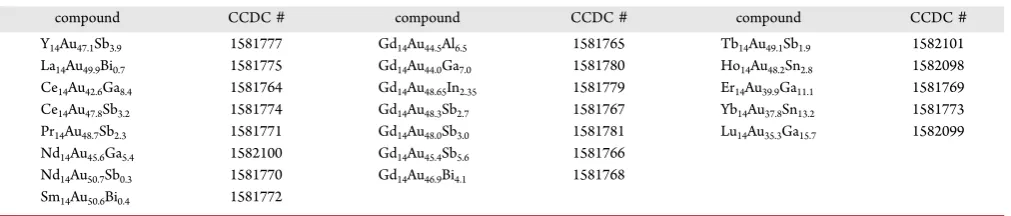
APPENDIXTable 4defines the CCDC numbers associated with the supple-mentary crystallographic data for the compounds described in this paper.
■
ASSOCIATED CONTENT*
S Supporting InformationThe Supporting Information is available free of charge on the
ACS Publications websiteat DOI:10.1021/acs.cgd.7b01469. EM/EDS data for eight samples; a representative single-phase powder X-ray diffraction pattern for Gd−Au−In; an alternate perspective of the R14Au51 structure (PDF)
Accession Codes
CCDC1581764−1581775, 1581777, 1581779−1581781, and
1582098−1582101contain the supplementary crystallographic data for this paper. These data can be obtained free of charge via www.ccdc.cam.ac.uk/data_request/cif, or by emailing
[email protected], or by contacting The Cambridge Crystallographic Data Centre, 12 Union Road, Cambridge CB2 1EZ, UK; fax: +44 1223 336033.
■
AUTHOR INFORMATIONCorresponding Author
*E-mail: [email protected].
ORCID
Volodymyr Smetana: 0000-0003-0763-1457
Alessia Provino:0000-0002-7577-6642 Anja-Verena Mudring:0000-0002-2800-1684
Notes
The authors declare no competingfinancial interest.
■
ACKNOWLEDGMENTSThe research was supported in part by the Office of the Basic Energy Sciences, Materials Sciences Division, U.S. DOE. Ames Laboratory is operated for DOE by Iowa State University under Contract DE-AC02-07CH11358 and Stockholm University, Sweden.
■
REFERENCES(1) Pitzer, K. S. Relativistic effects on chemical properties.Acc. Chem. Res.1979,12, 271−276.
(2) Pyykkö, P.; Desclaux, J. P. Relativity and the periodic system of elements.Acc. Chem. Res.1979,12, 276−281.
(3) Pyykkö, P. Relativistic Effects in Structural Chemistry.Chem. Rev.
1988,88, 563−594.
(4) Pyykkö, P.; Johnson, M.; Martinez, T. Relativistic effects in chemistry: more common than you thought.Annu. Rev. Phys. Chem.
2012,63, 45−64.
(5) Schwerdtfeger, P.; Bast, R.; Gerry, M.; Jacob, C.; Jansen, M.; Kello, V.; Mudring, A.-V.; Sadlej, A.; Saue, T.; Sohnel, T.; Wagner, F. The quadrupole moment of the 3/2(+) nuclear ground state of Au-197 from electric field gradient relativistic coupled cluster and density-functional theory of small molecules and the solid state.J. Chem. Phys.
2005,122, 124317.
(6) Mudring, A.-V.; Jansen, M.; Daniels, J.; Kramer, S.; Mehring, M.; Ramalho, J.; Romero, A.; Parrinello, M. Cesiumauride ammonia (1/1), CsAu·NH3: A crystalline analogue to alkali metals dissolved in ammonia?Angew. Chem., Int. Ed.2002,41, 120−124.
(7) Mudring, A.-V.; Jansen, M. Base-induced disproportionation of elemental gold.Angew. Chem., Int. Ed.2000,39, 3066−3067.
(8) Smetana, V.; Rhodehouse, M.; Meyer, G.; Mudring, A.-V. Gold polar intermetallics: structural versatility through exclusive bonding motifs.Acc. Chem. Res.2017,50, 2633−2641.
(9) Smetana, V.; Lin, Q.; Pratt, D. K.; Kreyssig, A.; Ramazanoglu, M.; Corbett, J. D.; Goldman, A. I.; Miller, G. J. A sodium-containing quasicrystal: using gold to enhance sodium’s covalency in intermetallic compounds.Angew. Chem., Int. Ed.2012,51, 12699−12702.
(10) Lin, Q.; Corbett, J. Development of the Ca-Au-In icosahedral quasicrystal and two crystalline approximants: Practice via pseudogap electronic tuning.J. Am. Chem. Soc.2007,129, 6789−6797.
(11) Lin, Q.; Corbett, J. Approximant phases and an icosahedral quasicrystal in the Ca-Au-Ga system: The influence of size of gallium versus indium.Inorg. Chem.2008,47, 7651−7659.
(12) Smetana, V.; Corbett, J. D.; Miller, G. J. Na8Au9.8(4)Ga7.2 and Na17Au15.87(2)Ga46.63: The diversity of pseudo 5-fold symmetries in the Na-Au-Ga system.J. Solid State Chem.2013,207, 21−28.
(13) Sinnen, H.-D.; Schuster, H.-U. Rb4Au7Sn2, eine intermetallische Phase mit siebenatomigen Goldclustern/ Rb4Au7Sn2, an Intermetallic Phase with Sevenatomic Gold-Clusters.Z. Naturforsch., B: J. Chem. Sci.
1981,36, 833.
Table 4
compound CCDC# compound CCDC# compound CCDC#
Y14Au47.1Sb3.9 1581777 Gd14Au44.5Al6.5 1581765 Tb14Au49.1Sb1.9 1582101 La14Au49.9Bi0.7 1581775 Gd14Au44.0Ga7.0 1581780 Ho14Au48.2Sn2.8 1582098 Ce14Au42.6Ga8.4 1581764 Gd14Au48.65In2.35 1581779 Er14Au39.9Ga11.1 1581769 Ce14Au47.8Sb3.2 1581774 Gd14Au48.3Sb2.7 1581767 Yb14Au37.8Sn13.2 1581773 Pr14Au48.7Sb2.3 1581771 Gd14Au48.0Sb3.0 1581781 Lu14Au35.3Ga15.7 1582099 Nd14Au45.6Ga5.4 1582100 Gd14Au45.4Sb5.6 1581766
Nd14Au50.7Sb0.3 1581770 Gd14Au46.9Bi4.1 1581768 Sm14Au50.6Bi0.4 1581772
Crystal Growth & Design Article
DOI:10.1021/acs.cgd.7b01469
Cryst. Growth Des.XXXX, XXX, XXX−XXX
(14) Zachwieja, U.; Wlodarski, J. Cs4Au7Sn2: a gold tin framework structure with Au7clusters and Sn2dumb-bells.Z. Anorg. Allg. Chem. 1998,624, 1443−1446.
(15) Muts, I.; Zaremba, V.; Rodewald, U.; Pottgen, R. Infinite gold zig-zag chains as structural motif in Ca3Au3In - A ternary ordered variant of the Ni4B3type.Z. Anorg. Allg. Chem.2008,634, 56−60.
(16) Kriegerbeck, P.; Brodbeck, A.; Strahle, J. Synthesis and structure of K2Au3, a new phase in the system potassium gold.Z. Naturforsch. B 1989,44, 237−239.
(17) Zachwieja, U. Single-crystal growth and strucrural refinement of KAu5and RbAu5.J. Alloys Compd.1993,196, 187−190.
(18) Palasyuk, A.; Grin, Y.; Miller, G. J. Turning gold into
“diamond”: a family of hexagonal diamond-type Au-frameworks interconnected by triangular clusters in the Sr−Al−Au system. J.
Am. Chem. Soc.2014,136, 3108−3117.
(19) Seidel, S.; Hoffmann, R.-D.; Pöttgen, R. SrAu4Ga3: a further example with Ga3 units and a Lonsdaleite-related gold substructure.
Monatsh. Chem.2014,145, 1043−1049.
(20) Smetana, V.; Steinberg, S.; Card, N.; Mudring, A.-V.; Miller, G. Crystal Structure and Bonding in BaAu5Ga2and AeAu4+xGa3‑x(Ae = Ba and Eu): Hexagonal Diamond-Type Au Frameworks and Remarkable Cation/Anion Partitioning in the Ae-Au-Ga Systems.
Inorg. Chem.2015,54, 1010−1018.
(21) Lin, Q.; Mishra, T.; Corbett, J. D. Hexagonal-diamond-like gold lattices, Ba and (Au,T)3 interstitials, and delocalized bonding in a family of intermetallic phases Ba2Au6(Au,T)3(T = Zn, Cd, Ga, In, or
Sn).J. Am. Chem. Soc.2013,135, 11023−11031.
(22) Gerke, B.; Hoffmann, R.-D.; Pöttgen, R. Zn3and Ga3triangles as building units in Sr2Au6Zn3 and Sr2Au6Ga3.Z. Anorg. Allg. Chem. 2013,639, 2444−2449.
(23) Gerke, B.; Pottgen, R. Sr2Au6Al3 and Eu2Au6Al3 - First Representatives of the Sr2Au6Zn3Type with Aluminum Triangles. Z.
Naturforsch. B2014,69, 121−124.
(24) Gerke, B.; Korthaus, A.; Niehaus, O.; Haarmann, F.; Pöttgen, R. Triangular Zn3 and Ga3units in Sr2Au6Zn3, Eu2Au6Zn3, Sr2Au6Ga3, and Eu2Au6Ga3−structure, magnetism,151Eu Mössbauer and69;71Ga solid state NMR spectroscopy.Z. Naturforsch. B2016,71, 567−577. (25) Zachwieja, U. A new compound in the rubidium gold system -synthesis and structure of Rb3Au7.J. Alloys Compd.1993,199, 115− 118.
(26) Fickenscher, T.; Rodewald, U.; Pottgen, R. Ternary stannides RE2Au5Sn2 (RE = Gd-Er)-i3 superstructures of the Fe2P type. Z.
Kristallogr. - Cryst. Mater.2015,230, 117−122.
(27) Provino, A.; Steinberg, S.; Smetana, V.; Kulkarni, R.; Dhar, S.; Manfrinetti, P.; Mudring, A.-V. Gold-rich R3Au7Sn3: establishing the interdependence between electronic features and physical properties.J.
Mater. Chem. C2015,3, 8311−8321.
(28) Provino, A.; Steinberg, S.; Smetana, V.; Paramanik, U.; Manfrinetti, P.; Dhar, S. K.; Mudring, A.-V. Gold in the layered structures of R3Au7Sn3: from relativity to versatility.Cryst. Growth Des. 2016,16, 5657−5668.
(29) Gebresenbut, G.; Tamura, R.; Eklöf, D.; Gomez, C. Syntheses optimization, structural and thermoelectric properties of 1/1 Tsai-type quasicrystal approximants in RE-Au-SM systems (RE = Yb, Gd and SM = Si, Ge).J. Phys.: Condens. Matter2013,25, 135402.
(30) Bigun, I.; Steinberg, S.; Smetana, V.; Mudryk, Y.; Kalychak, Y.; Havela, L.; Pecharsky, V.; Mudring, A.-V. Magnetocaloric Behavior in Ternary Europium Indides EuT5In: Probing the Design Capability of First-Principles-Based Methods on the Multifaceted Magnetic Materials.Chem. Mater.2017,29, 2599−2614.
(31) Smetana, V.; Steinberg, S.; Mudryk, Y.; Pecharsky, V.; Miller, G. J.; Mudring, A.-V. Cation-Poor Complex Metallic Alloys in Ba(Eu)− Au−Al(Ga) Systems: Identifying the Keys that Control Structural Arrangements and Atom Distributions at the Atomic Level. Inorg.
Chem.2015,54, 10296−10308.
(32) Tomes, P.; Himmelbauer, T.; Sidorenko, A.; Yan, X.; Prokofiev,̌ A.; Paschen, S. Physical properties of the type-I clathrate phase
Ba8−xEuxAuySi46−y.Acta Mater.2017,129, 521−531.
(33) Fornasini, M. L.; Mazzone, D.; Provino, A.; Michetti, M.; Paudyal, D.; Gschneidner, K. A., Jr; Manfrinetti, P. New structures formed by R3Au4Sn3, R5Au8Sn5and R3Au6Sn5compounds (R = rare earths).Intermetallics2014,53, 169−176.
(34) Fickenscher, T.; Rodewald, U. C.; Niehaus, O.; Gerke, B.; Haverkamp, S.; Eckert, H.; Pöttgen, R. The stannides RE3Au6Sn5(RE = La, Ce, Pr, Nd, Sm)−synthesis, structure, magnetic properties and 119Sn Mössbauer spectroscopy.Z. Naturforsch., B: J. Chem. Sci. 2015, 70, 425−434.
(35) Celania, C.; Smetana, V.; Provino, A.; Pecharsky, V.; Manfrinetti, P.; Mudring, A.-V. R3Au9Pn (R = Y, Gd−Tm; Pn = Sb, Bi): a link between Cu10Sn3 and Gd14Ag51.Inorg. Chem. 2017,56, 7247−7256.
(36) Steeb, S.; Godel, D.; Lohr, C. On Structure of Compounds Ag3RE (RE = Y La Ce Sm Gd Dy Ho Er).J. Less-Common Met.1968, 15, 137−141.
(37) Gschneidner, K.; McMasters, O.; Alexander, D.; Venteicher, R. Factors Influencing Formation of Silver-Rich Solid Solutions in Rare-Earth - Silver Alloy Systems.Metall. Trans. A1970,1, 1961−1971.
(38) Bsenko, L. Crystallographic data for intermediate phases in the copper-zirconium and copper-hafnium systems.J. Less-Common Met.
1975,40, 365−366.
(39) Bruzzone, G.; Merlo, F. The strontium-mercury system.J.
Less-Common Met.1974,35, 153−157.
(40) Tambornino, F.; Sappl, J.; Hoch, C. The Gd14Ag51 structure type and its relation to some complex amalgam structures. J. Alloys
Compd.2015,618, 326−335.
(41) Celania, C.; Smetana, V.; Mudring, A.-V. Crystal Structures and New Perspectives on Y3Au4and Y14Au51.Acta Crystallogr. C2017,73, 692−696.
(42) Canepa, F.; Palenzona, A.; Eggenhoffner, R. Effects of the Th-Substitution on the Antiferromagnetic Coupling and Kondo-like Behavior in the Heavy-Fermion System U14Au51.Phys. B 1992,176, 293−300.
(43) Eggenhoffner, R.; Canepa, F.; Palenzona, A. Electrical and Magnetic-Properties of the Pseudobinary System (U1‑XThX)14Au51.J.
Alloys Compd.1992,178, 125−129.
(44) Dommann, A.; Hulliger, F. On the Structure Types of UAu2and
U14Au51.J. Less-Common Met.1988,141, 261−273.
(45) Kanghou, Z.; Lili, C.; Chunxiao, H. Room-Temperature and 500°C Isothermal Sections of the Ag-Cu-Dy (0−33.3 at% Dy) Phase-Diagram.J. Alloys Compd.1993,194, 59−62.
(46) Gumenyuk, R.; Kuz’ma, Y. Crystal structure of Gd14Cu48Ga3 and Tb14Cu48Ga3.Inorg. Mater.2007,43, 135−137.
(47) Markiv, V.; Belyavina, N.; Gavrilenko, I. Crystal-Structure of Some Ternary Compounds in the System Sc-Cu-Ga. Russ. Metall.
1984, 227−230.
(48) Verbovytskyy, Y. New Ternary Phases from the R-Au-Ga Systems (R= Gd-Tm).Chem. Metals Alloys2014,7, 42−55.
(49) Mazzone, D.; Marazza, R.; Riani, P.; Zanicchi, G.; Cacciamani, G.; Fornasini, M.; Manfrinetti, P. The Isothermal Section at 600°C of the Ternary Pr-Au-Sn Phase Diagram.CALPHAD: Comput. Coupling
Phase Diagrams Thermochem.2009,33, 31−43.
(50) Lin, Q.; Corbett, J. Ca14Au46Sn5: a ″Colored″Gd14Ag51-Type Structure Containing Columns of Well-Differentiated Hexagonal Gold Stars.Inorg. Chem.2011,50, 1808−1815.
(51) Belgacem, B.; Pasturel, M.; Tougait, O.; Potel, M.; Roisnel, T.; Ben Hassen, R.; Noel, H. Crystal structure and magnetic properties of novel intermetallic compounds in the Er-Cu-Ga system. J. Alloys
Compd.2009,478, 89−95.
(52) Stoe & Cie GmbH Darmstadt, Germany, 2004.
(53) Blessing, R. H. An empirical correction for absorption anisotropy. Acta Crystallogr., Sect. A: Found. Crystallogr. 1995, 51, 33−38.
(54) Bruker AXS, I: Madison, WI, 1996.
(55) Sheldrick, G. M. A short history of SHELX. Acta Crystallogr.,
Sect. A: Found. Crystallogr.2008,64, 112−122.
(56) Tambornino, F.; Hoch, C. The Mercury-richest Europium Amalgam Eu10Hg55.Z. Anorg. Allg. Chem.2015,641, 537−542.
Crystal Growth & Design Article
DOI:10.1021/acs.cgd.7b01469
Cryst. Growth Des.XXXX, XXX, XXX−XXX
(57) Tkachuk, A. V.; Mar, A. Alkaline-Earth Metal Mercury Intermetallics A11−xHg54+x (A = Ca, Sr). Inorg. Chem. 2008, 47, 1313−1318.
(58) Hoch, C.; Simon, A. Na11Hg52: Complexity in a Polar Metal.
Angew. Chem., Int. Ed.2012,51, 3262−3265.
(59) Cordero, B.; Gomez, V.; Platero-Prats, A.; Reves, M.; Echeverria, J.; Cremades, E.; Barragan, F.; Alvarez, S. Covalent radii revisited.Dalton Trans.2008, 2832−2838.
(60) Krompholz, K.; Weiss, A. CaF2-Type Intermetallic Phases AuCdYSnYIn2−2Y(0< Y < 1).Z. Metallkd.1976,67, 400−403.
(61) Grin, Y.; Rogl, P.; Hiebl, K. Structural Chemistry and Magnetic-Behavior of Ternary Gallides REAuXGa4‑X(RE = La, Ce, Pr, Nd, Sm).
J. Less-Common Met.1988,136, 329−338.
(62) Lin, Q.; Corbett, J. The low-temperature form of calcium gold stannide, CaAuSn.Acta Crystallogr., Sect. C: Struct. Chem. 2014,70, 773−775.
(63) Salamakha, L.; Sologub, O.; Goncalves, A.; Mudryi, S.; Almeida, M. R(Au∼0.75Sb∼0.25)2 (R = La, Ce, Pr) with UHg2 Structure Type, New Members of the AlB2Family.J. Alloys Compd.2007,429, 140− 142.
(64) Wang, F.; Miller, G. J. Revisiting the Zintl−Klemm Concept: A2AuBi (A = Li or Na).Eur. J. Inorg. Chem.2011,2011, 3989−3998. (65) Markiv, V.; Shevchenko, I.; Belyavina, N.; Kuzmenko, P. Crystal-Structure of Phases in the Sm-Cu-Ga System. Dopovidi Akademii Nauk Ukrainskoi Rsr Seriya a-Fiziko-Matematichni Ta
Technichni Nauki1986, 78−81.
(66) Berns, V. M.; Fredrickson, D. C. Structural Plasticity: How Intermetallics Deform Themselves in Response to Chemical Pressure, and the Complex Structures That Result. Inorg. Chem. 2014, 53, 10762−10771.
Crystal Growth & Design Article
DOI:10.1021/acs.cgd.7b01469
Cryst. Growth Des.XXXX, XXX, XXX−XXX