Effect of roofing material type on microclimate in the sheep
buildings
M. H. Hatem
*, E. Mostafa, N. Hussein
(Agriculture EngineeringDepartment, Faculty of Agric., Cairo UniversityGiza, Egypt)
Abstract: A study was conducted on description of the sheep houses (materials, location, orientation etc) and its effect on microenvironment in two housing (concrete roofing material, Iron sheet roofing material) in Giza, Egypt.In order to select the appropriate type of housing that provides the best inside climate throughout making adjustment in housing.
During the experimental period, maximum temperature was recorded under Iron sheet and lowest temperature as in Concrete. The maximumprotection from high temperature was given in concrete than in Iron sheet. Adjustment of temperature and relative humidity through the day wassuccessful underconcrete than Iron sheet.
Keywords:sheep housing, roofing material, microclimate, building in hot climate, temperature – humidity index (THI)
Citation: M. H. Hatem, E. Abdel-Moniem, A. N. Hussein. 2015. Effect of roofing material type on microclimate in the sheep buildings.Agric Eng Int: CIGR Journal, Special issue 2015: 18th World Congress of CIGR: 52-56.
1 Introduction
1Housing system is considered as an important factor
affecting animal performance and behavior. It mitigates
the climatic stress, saves labor, controls disease vectors,
and harvests the products. It increases the efficiency of
breeding and milk production. In addition, allows better
control of feed intake and its quality (Wagner et al.,
2003).
Housing and management practices can be a source of
stress for sheep and domestic animals. Climatic
conditions have direct and indirect effects on production
and reproduction of livestock. The high environmental
temperature and lack of feed may restrict sexual activity
months of the year in the tropics, Hafez (2000) and
El-Sayed (2003).
The number of Sheep in Egypt was estimated in 2011
to be 55.9 million head (FAO, 2012).There are three
Received date: 2014-12-02 Accepted date: 2015-04-01 * Corresponding author: M. H. Hatem, Ph.D., Professor of Agric. Eng. Dept., Faculty of Agric., Cairo Univ., Giza, EGYPT.Tel:+20235738000, Fax:+20235717355.Email: [email protected]., [email protected]
breeds in Egypt: Rahmani, Osseimi and Barki. Rahmani is
the largest breed and then followed by Osseimi and
Barki.Recently, Marai et al. (2006) reported that the
common sheep-breeding season in Egypt is at May–June,
during which the climate is hot with rapid and sudden
fluctuations. During this breeding season, temperature
rises, this difficult weather effect on reducing the
productive and reproductive performance of sheep. This
condition let us to care of searching about the proper
housing system. Selecting a building for the
livestock farm should include all the personal
needs of the breeder in addition to the
livestock needs. This should be done at a
minimal cost to the farm enterprise. Selecting an
appropriate site for a new animal facility is
one of the most important steps in the animal
design process, Martin (1998).Animal production is
based on the inter play of animal and environment. The
farmer can manipulate both factors in order to
reach an optimal result. In any micro climate,
individual cattle should ideally be able to select for
May, 2015 Agric Eng Int: CIGR Journal Open access at http://www.cigrjournal.org Special issue 2015 53
the thermal comfort or least comfort. Microclimate
refers to the natural physical environmental factors
affecting livestock are: air temperature, relative humidity,
radiant heat, precipitation, atmospheric pressure,
ultraviolet light, wind velocity and dust (Hahn, 1981).
In animal housing the roof plays a primary role in the
determination of the thermal exchanges of the animals
(Liberati and Zappavigna, 2004). In particular, in the hot
climate, a high thermal resistancein daily hours can be
helpful in order to reduce the effect of the solar radiation.
But by increasing the thermal resistance the possibility to
the animals of discharging heat through the roof in the
night hours is to reduce the diurnal negative effect of the
radioactive heat load onto the animals the use of insulation
materials is often recommended. But this is an expensive
solution, the usefulness of which is not ascertained,
depending on various factors: climate, latitude, building
geometry and orientation, constructive solutions, animal
physical and spatial parameters (Zappavigna and Liberati,
2007).The main objective of this research is studying the
microclimate for common Egyptian sheep housing under
two different roof materials in order to recommend the
optimal roof material suitable for Egyptian conditions.
2 Materials and method
The present study was conducted at the sheep farm,
Agricultural Research Station, Giza, Egypt. Thirty Sheep
(3 months to 2years of age) were housed under each
treatment. Different roofing materials were used for
covered area under each treatment in following manner.
A: Concrete shading roof: Layer of concrete of 20 cm
thickness, B: Iron sheet shading roof: Layer of Iron sheet
of 0.2 cm thickness fixed to Iron Frame. The study was
undertaken both in summer and winter seasons.
2.1 Sheep rearing facilities:
As shown in Figure 1 House (A) is roofed by concrete
material with 20cm thickness and it is flat. The walls
height was 1.20 m and was made of 12cm common brick
and 2cm plaster inside and outside of the wall. The
houses have no windows, but there are openings for
ventilation (2.3 m high) at all sides. The house has one
iron door made of 1.23 cm thickness.(1.2 m high x 1.5 m
width).The dimensions of the house are 4.30 m, 7.0 m,
3.5m, width, length and height, respectively. House (B) is
roofed by flat Iron Sheet 0.2 cm thickness. The
dimensions of walls, windows and door are similar to that
of house A, and the floor is normal soil. The experiment
houses were north south oriented.
House (A)
House (B)
Figure1Sheep rearing facilities in Giza, Egypt
2.2 Experimental procedures
Meteorological data were measuredeach2
intervals using Tri-sense device and hygrometer
on the 1.5m height from the floor of buildings at
8:00,10:00,12:00,14:00,16:00 O’clock, each three
consecutive days every week for each experiment. Daily
air temperature (dry and wet bulb) and relative
humidity of inside and outside the two buildings
were recorded at8:00, 10:00, 12:00, 14:00,16:00
The instrument was hangedat equal heights by thread in
covered area under each treatment roof and at equal height
in the outside (open area) for outside conditions records.
Appropriate equations of heat transfer were applied to
calculate rates of heat gain and loss from buildings every
day during experimental period.
2.3 Statistical analysis
A randomize complete design with two factors was
used for analysis all data with five replications. The
treatment means were compared by least significant
difference (L.S.D.) test as given by Snedecor and
Cochran (1976)by using ASSISTATprogram.
3 Results and discussion
Studying the effect of roof material type on
the air temperature (AT, °C) and relative humidity
(RH%) inside sheep buildings has been done in both
winter and summer seasons.
3.1 Air temperature distribution during summer
season within sheep houses
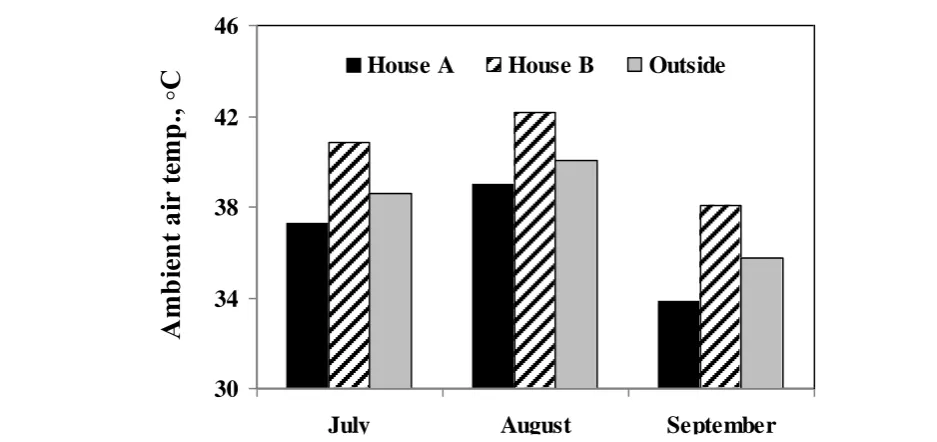
In summer season, the experiment has been conduct
from July to September. Maximum and minimum air
temperatures during the experimental period were 41.3°C
and 30°C for house A and 44.5°C and 32°C for house B
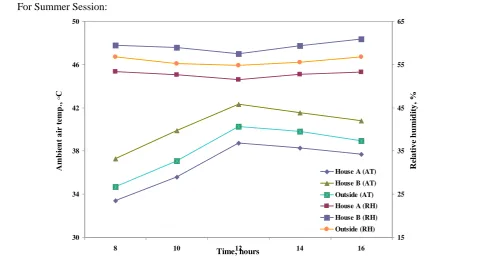
respectively. The maximum and minimum relative
humidity values were 64.4% and 47.25% for house A and
67.5% and 53.7% for house B respectively. The lowest
air temperature has been observed in the house roofed by
concrete in September. While the highest air temperature
was in August within the sheep house roofed by steel
sheet, Figure 2. Increasing of ambient air temperature
within the house roofed by steel sheet is over the outside
air temperature. Where the steel sheet has high ability to
absorb the solar radiation and accumulate the heat in the
rearing zone for period. With concrete roof, gaining and
loosing heat is performing slowly in comparison to steel
roof. It may returns to their thermal conductivity.
By considering the calculated temperature – humidity
index (THI) (Esmay 1969), heat stress was severe in the
months of July and August whereas moderate in
September for house B. In case of house A, THI was
below 75 units. It means, there was safe and almost no
stress on the animal.
3.2Air temperature distribution during winter season
within sheep houses
Figure 2 Average air temperature during summer season within different sheep houses in comparison with outside air temperature
30
34
38
42
46
July
August
September
A
m
b
ie
n
t
ai
r
te
m
p
.,
May, 2015 Agric Eng Int: CIGR Journal Open access at http://www.cigrjournal.org Special issue 2015 55
In winter season, the variety of inside air temperature
is very low for both houses in comparison to outside
temperature. The lowest temperature occurs in December,
Figure 3. The ambient air temperature inside house A is
quite higher than house B. This is due to the concrete
material ability for keeping the heat for a while before
losing it as mentioned previously. In winter season,
there is no heat stress has been observed according to THI.
3.3 Relative humidity and air temperature
distribution within different sheep houses
Air temperature and humidity are important property
of the climate that has implications in areas related to
animal comfort. They are essential components of a
comfortable environment. From the study it has been
statistically proved that the moisture holding capacity of
air depends on the air’s temperature. It increases with
increase in temperature. As the moisture holding capacity
increases the relative humidity decreases.
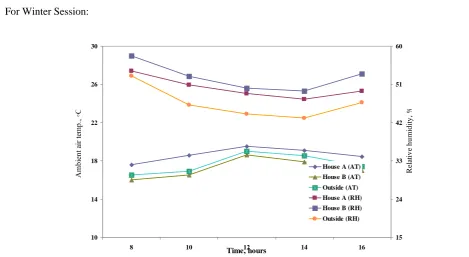
In winter season, non-significant difference in relative
humidity has been observed where the variance in air
temperature in minimized. See Figure 4 please. Figure3 Average air temperature during winter season within different sheep houses in comparison with
outside air temperature
0
5
10
15
20
25
DEC
JAN
FEB
A
m
b
ie
n
t
ai
r
te
m
p
.,
◦C
House A
House B
Outside
For Summer Session:
30 34 38 42 46 50
8 10 Time, hours12 14 16
A
m
b
ie
n
t
ai
r
te
m
p
.,
◦C
15 25 35 45 55 65
R
el
a
ti
v
e
h
u
m
id
it
y
,
%
House A (AT)
House B (AT)
Outside (AT) House A (RH)
House B (RH)
4 Conclusions
The high thermal conductivity of Iron sheet does not
enable the roof to reduce both temperature and relative
humidity during the day compared to concrete material
which significantly reduced the negative effect of
environmental variables and can prove to be effective in
warding off the hot and humid environmental condition
than Iron sheet.
References
El-Sayed, Y. M. S.2003. Studies of physiological and reproductive performance of goats under different housing systems in newly reclaimed areas. Ph.D. Thesis, Facultyof Agriculture, Cairo University, Giza, Egypt.
Esmay, M.L.1969. Principles of animal environment.The AVI publishing company, INC.
FAO.2012. Food and agriculture organization of the united nations,Rome.
Hafez, E.S. 2000.Reproduction cycles.In Reproduction in Farm Animal.7thed.Lippincott Williams and Wilkins, Philadelphia, USA.
Hahn, G.I. 1981. Housing and management to reduce climatic
impacts on livestock.Journal
ofAnimalScience,52:175-186.
Liberati, P. and P. Zappavigna.2004. “Performance of ventilated roofs in hot climate”, International symposium of the CIGR 2nd Technical Section, Evora, Portogallo, May 2-6, pp. 1-8.
Marai, I. F. M., A. A. El-Darawany, E. A. F. Ismail, and M. A. M. Abd El-Hafez.2006. Tunica dartos index as a parameter for measurement of adaptability of rams to subtropical conditions of Egypt. Animal Science Journal, 77(5): 487-494.
Martin, J.G.1998.Sitting large dairy facilities.Proceedings of Fourth International Dairy Housing Conference, January 28-30.chastain, J.P. (Ed.), the American Society of Agricultural Engineers. St. Louis, Missouri, USA. Snedecor, G. W.andW. G. Cochran. 1976.Statistical Methods.Pp.
593, 6th Edition.Iowa State University Press.
Wagner, A.M.; R.W. Palmer, and D.W. Kammel.2003.Factors affecting stall use for different free stall bases. Journalof Dairy Science, 86(6):2253-2266.
Zappavigna, P. and P. Liberati.2007. Analysis of the effects of the roofing design on heat stress in dairy cow housing, CIGR Workshop “Animal Housing in Hot Climate”, Cairo, Egypt, April 1-4.
For Winter Session:
Figure 4 Average of inside-outside air temperature and relative humidity for the two types of Sheep houses on the experimental during measured period
10 14 18 22 26 30
8 10 12 14 16
Time, hours
A
m
bi
en
t a
ir
te
m
p.
, ◦
C
15 24 33 42 51 60
R
el
at
iv
e
h
u
m
id
it
y
,
%