44
Volume 5 • Issue 2 • July 2019
ISSN 2206-4451
www.ajbssit.net.au
Critically Analyzing Information Technology Strategy
Framework: A Concept Perspective
Badar Mohammed Al Mughairi1, Mohammad Shahadat Hossain2, Asif Mahbub Karim3
11Binary Graduate School, Binary University, Malaysia, 2Department of CSE, University of Chittagong, Bangladesh, 3Binary University, Malaysia
1. Introduction
According to Rockart and Morton, in 1984, the information system (IS) is playing a significant role on improving the efficiency within the organization and productivity performance in addition to having a healthy and competitive position of the firm. The utilization of information technology (IT)/IS can improve the organization performance by affecting the management process, personal, and organization structure. The alignment framework between IT/IS strategy and E-government strategy plays the crucial role in the successful implementation of IT/IS strategy and achieving business objectives by considering the IT infrastructure as a base to making the target and running the government business. The proposed model will focus on the interaction between the two strategies to efficiently run business and get customer satisfaction.
2. Literature Review
2.1. IT deployment and organizational performance
The performance of organization considered as indicators to the success of meeting organization aims and objectives that set within the vision and mission. According to numerous researches done the IT, deployment shows a positive impact to the organization performance. The implementation of IT within the organization it affects the business operation, business process, and the managerial level of the framework which result in the following:
• Enable suitably and on time decision-making. • Take or propose faster action.
• Provide tracking of processes. Abstract
Nowadays, information technology (IT) is playing a major role in the success of achieving business goals. That supported by the continues innovation of information systems and communication technologies. Internet and cloud computing are the powerful examples which attract target business and attract the investors to utilize such technology. Therefore, including the information technology strategy as a part of business strategy become essential to reduce the cost and increase the gaining profits. This article is thoroughly analyzing the strategies of IS/IT frameworks that the successful firms undertake and consider focusing on the alignment of IT and business strategy, IT strategy, implementation, and management, IS outsourcing strategies, the use of IT in product development, and the electronic marketplace. Furthermore, it includes the proposed framework/mode for aligning IT strategy and E-government strategy.
• Enhanced insight into prices. • Shorter delivery times. • Higher consumer satisfaction.
The below model illustrates the relationship between the IT deployment and organization performance moderated by the quality of data in the organization IS (Figure 1).
Based on the finding above and the developed model/framework, the magnitude of IT deployment and quality of organization data positively related to the organization performance.
2.2. IT strategy, implementation, and management
IT strategy becomes a key factor for successful business needs by utilizing IT capabilities that reflect the support of business goals and setting the required action/tools associated with IS, and IT required infrastructure. The strategy of IT consists of three components, which are technology scope, distinctive competencies, and governance structure aligning with organization business strategy.
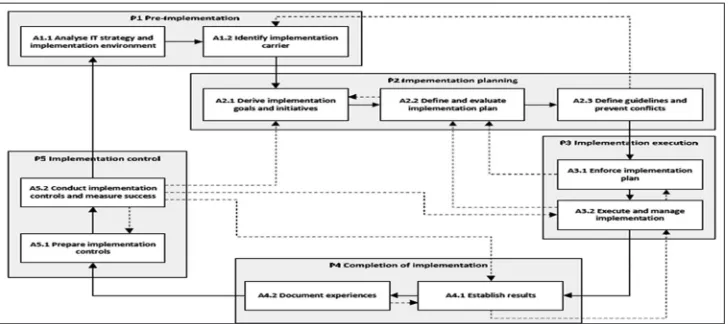
The below developed diagram shows the process model of implementing IT strategy which shows the clear and easy way to be used to get success during implementation and to avoid the common issues that may occur within the implementation planning, organization, human resources, communication, and IT. This method enables the implementer to get a good understanding of the implementation of the IT strategy aligning with business strategy ensuring the control and monitor implementation activities (Figure 2).
Figure 1: Information technology deployment and organizational performance model
46
2.3. IS outsourcing strategies
The implementation of outsourcing strategy will achieve a sustainable competitive advantage for the organization as long-term approach. The outsourcing strategies can be taken as a solution to increase the efficiency and innovation. Furthermore, it used to achieve the cost saving and to enable the organization to get access to advance technology. There are many motivations; the organization can be benefit from outsourcing IT according to many types of research listed in Table 1.
2.4. The use of IT in product development
The process of dealing with design creates, and market of a new product known as a product development strategy, which involves IT as a key player of the all product development phases. Recently, the usage of this technology for product development has enlarged mainly between the atmosphere and automotive productions, due to the existence of advanced computer-aided design, computer-aided engineering, computer-aided manufacturing systems, and improved automotive features. A virtual reality technology enhances digital manufactures. Therefore, simulated prototyping and simulated usage are increased before actual production. Furthermore, the vast availability of IT and fastest growing sector of reverse engineering and virtual/augmented reality is transfiguring the developmental product.
2.5. Electronic marketplace
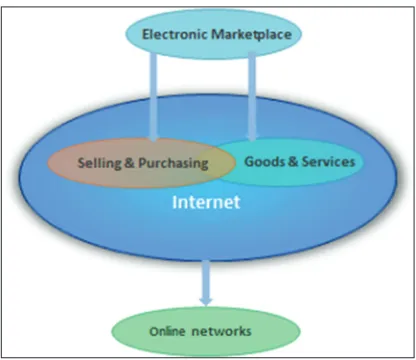
The electronic marketplace considered as a useful marketplace which enables consumers and dealers to meet and exchange information about the offered products/services negotiating about the prices/ deals and carry out the business transactions. Furthermore, the online IS allows multiple dealers and consumers to do a business transaction through the internet.
3. Research Methodology
The adoptive and clear strategy for electronic marketplace is a success factor in entering the electronic marketplace. This strategy will define the goals of doing business in the electronic market by having a
Table 1: Outsourcing motivatio
Motivation for outsourcing Description
Cost subtraction A consumer organization’s required to use outsourcing to decrease or control information system cost
Focus on main competences A consumer organization’s needed to use outsourcing to focus on leading capabilities
Access to proficiency/capabilities A consumer organization’s required to use outsourcing to access the supplier’s competence and capabilities Develop business and process A consumer organization is necessary to use outsourcing
to involve the suppliers to help to enhance the consumer’s business and operation.
Technical purpose A consumer organization’s required to use outsourcing to access and get up-to-date technology
Flexibility The capability to espouse the change
Scalabilities A consumer organization’s needed to use outsourcing to be able to measure the volume of an information system based on needs
Access to worldwide market A consumer organization is necessary to use outsourcing to gain access to the global market.
Alignment of information system and
clear vision and scope. The perceived net benefit of consumers and providers is the essential component of the electronic marketplace success. As per Clemons et al., 1993, they state that the IT helps to minimize the cost of the transaction, threats, and coordinating costs of electronic marketplaces (Figure 3).
3.1. Alignment of IT and business strategy
Many organization succeeds when integrating and match IT and business strategy which leads to creating essential business revenues. Involvement of IT has become the leading factor, which enables the organization business strategy to have high expectations of the IT investment in many areas within
the organization such as business improvement in the quality, process, and automation (Bruce, 1998),
the organization achieves the effectiveness and efficiency by getting help through IT. The following are the benefits the organization gain from aligning IT with business strategy.
• Decrease costs. • Regulate processes.
• Improve efficiency and productivity.
• Improve communications and business workflow. • Sustain with a reasonable service levels.
• Improve risk control mechanisms.
• Improve the relationship between the customer and buyer/supplier. • Facilitate organic and acquisition-driven growth.
• Help to create a new product and service/solution. • Exploit a new technology to get a competitive advantage.
The organization which has aligned IT and business strategy successfully saves an average of 17% compared with the other organizations who fail to align.
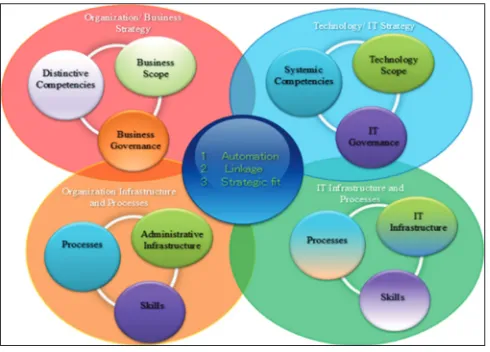
According to the listed above advantages of aligning the IT and business strategy, I modified Daft’s model and came up with the following framework (Figure 4).
3.2. Alignment of IT with E-government
Nowadays, the electronic government has been implemented almost in every country to provide online services for the nationalities and citizens in the world through adopting IS/IT. The alignment among the IT strategy and the government business strategy will lead to achieving a better implementation and functioning in the e-government. The mismatch between the two strategies will lead to failure in
48
the running business and will not accomplish the organization aim considering IT as a backbone of the e-service utilizing the IT infrastructure such as web services, databases, connectivity, and others to ensure availability and integrity. With that said, the organization has to have a framework/model to ensure the integrity of the business and IT strategy to have successful e-government.
4. Discussions and Results
4.1. Proposed model for the alignment of IT strategy with E-government strategy
The following alignment model is ensuring the integration of business strategy and IT strategy aiming to achieve the following:
1. Organization and business strategy drive the IT requirement, infrastructure, and its strategy. 2. Confirm the efficiency and effectiveness of the implemented technology to support the IT strategy. 3. Utilize the IT to produce new products and services.
4. Building a relationship between the management which will help to do change in the organization process and workflow ensuring the integration between function, successful atomization of ser-vices, and the link between IT strategy and organization processes (Figure 5).
Figure 4: Information technology/information system and business alignment
The E-government is facilitating the IT/IS to enhance government services through the aligning of IT strategy with government using IT capability and its infrastructure. This alignment leads to deliver a broader range of government services to constituencies any time anywhere with a minimum cost utilizing electronic channels and thus leverage the existing infrastructure and services. The below picture represents the result for successful alignment of IT strategy with E-government strategy by transferring all government services according to the above-proposed framework (Figure 6).
4.2. E-government and IT architecture model
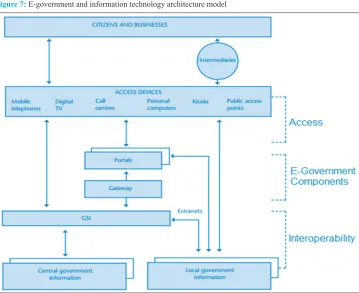
The IT is playing a significant role in government and considered as the backbone of the E-government. Therefore, it is enable the government to publish the service and makes it accessible online using the capability of IT service (servers, databases, connectives, and online services such as portals) as shown in the following architecture model (Figure 7).
4.3. The value added from the alignment between IT strategy and E-government
strategy
Based on the alignment framework and the architecture model proposed, the government will expedite the aim of e-government and has a return on investment in the long-term plan because of alignment.
Figure 6: E-government services
50
Furthermore, it is enhancing the relationship between the organization and their consumers and other business partners in addition to improve the internal operation. In addition to that, the use of IT and alignment of the IT strategy and business strategy assessing the effectiveness of the organization by saving time, employee, and efforts offering a competitive and quality service meet the customer need and organization objectives.
5. Conclusion
This article based on many types of research and published articles on IT and business strategy in addition to other related topics that have mentioned in the above abstract. Many models and frameworks have been developed based on the topics requirement and understanding aligned with standard models. The IT and its strategy are playing a significant role in the business profit and return on investment if its aligning with business strategy. Furthermore, the successful approach considering business needs and objectives supporting electronic marketplace to increase the profitability through the open new channel for market utilizing the new IS and technology to promote productivity and innovation.
In addition to the mentioned above, I try to apply the alignment between the IT and E-government and propose the suitable method based on the understanding of business activities and IT requirement which will eliminate the conflict between both strategies and increase the efficiency and productivity to get customer satisfaction. Furthermore, the proposed model will consider the customer intimacy and product/service innovation that is aimed to target service beneficiary through aligned the IT strategy with business and organization strategy that improves the service provided and get customer satisfaction. Finally, we conclude that the IS/IT and its strategy utilized to automate the business process/services aiming to improve the productivity and efficiency of the business activities aligning with business and organization strategy.
References
Bruce, K. (1998), Can you align IT with business strategy? Chicago: Strategy and Leadership.
Clemons, E.K., Reddi, P.S., Row, M.C. (1993), The impact of information technology on the organization of economic
activity: The “move to the middle” hypothesis. Journal of Management Information Systems, 10(2), 9-36. Rockart, J.F., Scott, M.S. (1984), Implications of changes in information technology for corporate strategy.