E-Logic Trainer Kit: Development of an Electronic
Educational Simulator and Quiz Kit for Logic Gate
Combinational Circuit by Using Arduino as Application
https://doi.org/10.3991/ijoe.v15i14.11410
Mohammad Zulkarnain O., Amar Faiz Z.A. (), Syahrul Hisham M.
Universiti Teknikal Malaysia Melaka, Melaka, Malaysia
[email protected] Nur Dalila K.A
Universiti Teknologi MARA, Johor, Malaysia
N. Ismail
Universiti Teknologi MARA, Selangor, Malaysia
Abstract—To supplement conventional teaching methods, use of new
tech-nology have recently being adapted in the current education system. Such exam-ples are implementing simulators and quiz kits in a classroom session to assist teachers in providing standardized evaluation or practical and more direct exam-ples of concepts that are being taught. Additionally, the well-known issue of at-tracting student interest in a so-called uninteresting conventional lecture may be solved by using this technological method. The objective of this works to provide methods on developing a prototype training kit (named as e-Logic trainer kit or e-LTK) which comprises of an electronic simulator and quiz assessment module to evaluate subject knowledge on logic gates. The e-LTK is developed by using Arduino Mega 2560 as the base microcontroller, equipped with keypad and dis-play module as the user input/output interface. The quiz assessment module con-tained in the prototype also allows conversion of inputs by combinatorial logic circuits into output in the form of timing diagram. This equipment enables elec-trical engineering students to simulate several combinations of logic circuit, re-inforcing the understanding of logic circuit operation. The effectiveness of using this prototype in educational settings have been evaluated through a survey on students and instructors at Faculty of Technology in Engineering (FTK) in Uni-versiti Teknikal Malaysia Melaka (UTeM). Response has been positive, with 60% of the correspondence has shown positive feedbacks, indicating the useful-ness of the prototype kit.
1
Introduction
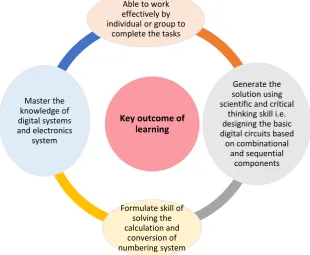
Electronic industry has played a significant role in the global market due to its wide applications in variety of sectors. Rapid advancement in the electronic technology have been made to meet the demands and challenges of other sectors. Naturally, knowledge and understanding of the electronic will have an emphasis in the education system. In relation to this, the university has included the Digital Electronics (DE) as a core subject in electrical engineering course. Typically, this subject is perceived as difficult and its application to real world is not obvious in practice [1, 2]. This may be due to the tradi-tional approach of teaching where student passively received the information from the instructor or lecturer in classroom setting. Consider the expected key outcome of the DE subject as shown in Figure 1.
Fig. 1. Learning outcome of the proposed course
It is well-known that by applying learned concepts to real-world scenarios increases student interest and motivation for learning. Therefore, there is a need for the develop-ment of educational kit as suppledevelop-mentary aid system to link from concept to practical example [3, 4]. For example, simulators to show output formed when a digital circuit design was implemented by a student based on the combinational and sequential com-ponents learned in the course. Additional feature can be added on the kit to also help
Key outcome of learning Able to work effectively by individual or group to
complete the tasks
Generate the solution using scientific and critical
thinking skill i.e. designing the basic digital circuits based
on combinational and sequential
components
Formulate skill of solving the calculation and
conversion of numbering system Master the
knowledge of digital systems and electronics
teacher and student to perform assessments through a quiz module, and in combination with simulator, can be implemented as a part of game-based learning system. This struc-ture of learning [5] has an added advantage in terms of influencing the efficiency, self-learnability, memorability and satisfaction towards the course structure.
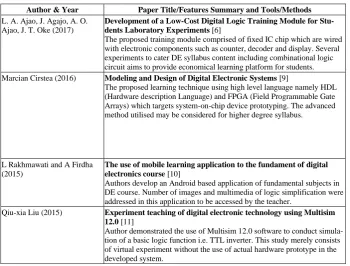
For the past ten years, researchers have demonstrated several innovations in teaching the DE course. To cater for different type of curriculum with similar basic DE knowledge such as computer science (CS) and electrical/computer engineering (ECE), the use of the simulator or hardware-based product may improve the teaching technique and student experience. Typically, the traditional method involves translating lecture content into calculations in paper-based design exercise, which involved doing truth table calculations or Karnaugh mapping for circuitry connection, for example. To sup-port this teaching method, encouraging “learning while doing” approach in system de-sign projects can help students to connect their learned concept from lectures to practi-cal development [6-8]. In this case, educational tools can be implemented to improve student understanding. The summary of current educational tools developed for DE course are shown in Table 1. The existing literatures have demonstrated that various methodologies can be employed to improve learning experience with the use of hard-ware prototype, with simulator. However, several disadvantages need to be addressed such as fixed wired/not “plug and play”, cost effectiveness and difficult development platform.
Table 1. Analysis of the literature for implemented innovations in DE course
Author & Year Paper Title/Features Summary and Tools/Methods
L. A. Ajao, J. Agajo, A. O. Ajao, J. T. Oke (2017)
Development of a Low-Cost Digital Logic Training Module for
Stu-dents Laboratory Experiments [6]
The proposed training module comprised of fixed IC chip which are wired with electronic components such as counter, decoder and display. Several experiments to cater DE syllabus content including combinational logic circuit aims to provide economical learning platform for students. Marcian Cirstea (2016) Modeling and Design of Digital Electronic Systems [9]
The proposed learning technique using high level language namely HDL (Hardware description Language) and FPGA (Field Programmable Gate Arrays) which targets system-on-chip device prototyping. The advanced method utilised may be considered for higher degree syllabus.
L Rakhmawati and A Firdha (2015)
The use of mobile learning application to the fundament of digital
electronics course [10]
Authors develop an Android based application of fundamental subjects in DE course. Number of images and multimedia of logic simplification were addressed in this application to be accessed by the teacher.
Qiu-xia Liu (2015) Experiment teaching of digital electronic technology using Multisim 12.0 [11]
Author & Year Paper Title/Features Summary and Tools/Methods David Baneres (2015) Towards an Analytical Framework to Enhance Teaching Support in
Digital Systems Design Course [12]
Author develop a simulator via VerilUOC which contains a self-study ma-terial to support teaching process. A web-based platform that has been de-velop assist students to design digital circuit and further verify the out-comes. Moreover, the support system for instructor allow them to analyti-cally asses the students design submission in terms of quality and checks for plagiarism.
Eduardo Garcia Breijo, Luis Gil Sánchez, Javier Ibáñez Civera (2014)
Charles Hacker (2009)
Using Hardware Description Languages in a Basic Subject of Digital
Electronic [13]
Author adopted an integrated circuit as HDL as validation tool to under-stand the concept of digital systems.
A Low Cost Student Constructed Digital Trainer [14]
A system developed to name as PortBuffer to replicate the function of dig-ital trainer. It consists of interfacing board connected to the computer com-plemented with PortDevice software to emulate the combinational con-structed circuitry.
Juan P. Oliver and Fiorella Haim (2009)
Lab at Home: Hardware Kits for a Digital Design Lab [15]Author
pro-pose the use of the take home kit consists of PLD (Altera) microprocessor and electronic kits to learn basic digital design. Students are familiarized to the kit, and taught the required precautions that should be taken to preserve it in good condition. Due to the low cost of the kit components, students can afford to pay for replacements in the event they break or lose them.
The motivation of pursuing this project is due to the confronted issues by students in electrical and electronic engineering to integrate the theoretical concept and practice in laboratory session. The traditional lecture-based type of teaching combines the theoret-ical class session followed by short quiz assessment and hands on laboratory session. The weakness that was observed is that the difference in student comprehension will affect the outcome of the laboratory session. The success of the lab activity will depend on the understanding of the students gained during the lecture. Therefore, it is crucial to gain student interest during the lecture session for better knowledge retainment. In line with this, the modern game-based teaching method has gained better support in modern education to retain student’s focus.
In line with this view, the main novelty of the work presented in this paper is to support more interactive game-based teaching by proposing a low-cost trainer kit as a proof of concept to support the current teaching and learning process. Aims to be achieved in this paper as following:
• To propose an educational kit comprising of Multisim simulator and combinational arrangement of logic gates
• To convert the constructed logic gate into timing diagram
• To reflect and verify the effectiveness of implementation for classroom usage.
bination on top of the trainer kit surface board. Once the connection has been com-pleted, the microcontroller will process the received input and then produce the output in the form of high (1) or low (0) timing diagram. Using the trainer kit, student can quickly cross-evaluate the logic circuit design with the manual calculation, or even stu-dent can test themselves with variety of combination to check their understanding. Also, user can simulate the output of their own custom combination circuit design to check whether their circuit design is meeting the requirement.
2
Methodology
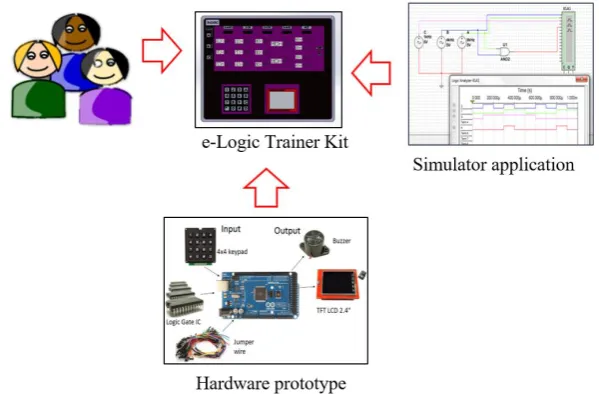
The block diagram of the proposed e-LTK consists of a microcontroller, inputs and outputs as illustrated in Fig.2. Specified criteria have been implemented by limiting the number of displayed input and output in the timing diagram into three and one respec-tively. For this purpose, a TFT LCD 2.4 is used to display the input and output of the timing diagram. Keypad 4x4 enables the user to choose the option from the selection menu such as simulation mode and assessment mode. Meanwhile the available logic gate for combination circuit comprises of five different types namely two-input AND, two-input OR, two-input XOR, three-input AND gate and a NOT gate. The functional modes that can be selected by user of the e-LTK can be described as following:
• Learning mode is enabled on LCD as default display menu selection. The user needs to press another button to select the other function. For simulation, user need to press “1” and the TFT LCD will display input timing diagram. So, user can do equivalent circuit connection on E-Logic Trainer Kit. The output of connection can be checked by pressing button “4”. When user had completed the simulation, user can press button “*” to returnto main menu.
Fig. 2. Block diagram of the e-LTK
3
Result and Discussion
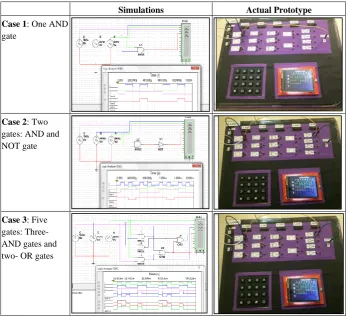
Table 2. Comparison of results between Multisim simulator and hardware ptototype
Simulations Actual Prototype Case 1: One AND
gate
Case 2: Two gates: AND and NOT gate
Case 3: Five gates: Three- AND gates and two- OR gates
4
Reflection and Evaluation of e-Logic Kit Implementation
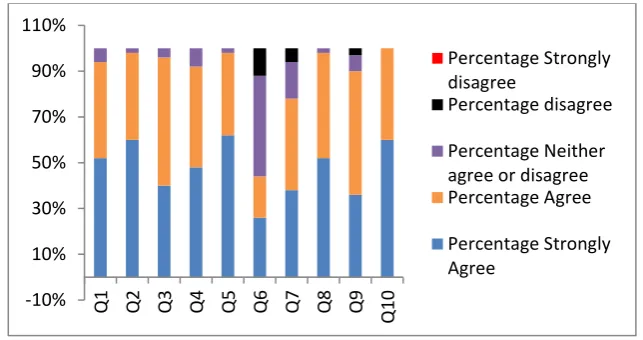
Table 3. List of Questionaire
Q1 During Simulation, is it E-Logic Trainer Kit can give true answer to connection? Q2 The question asked by E-Logic Trainer Kit is suitable for test student knowledge? Q3 E-Logic Trainer Kit can be highly interactive activity during class session?
Q4 Student gained better understanding after answering the entire questions in E-Logic Trainer Kit? Q5 E-Logic Trainer Kit can help student to improve their hands-on skill?
Q6 E-Logic Trainer Kit can be applied during lab session for subject Digital Electronic?
Q7 Student prefer to learn Digital Electronic subject by using E-Logic Trainer Kit rather than in theo-retically way.
Q8 This educational kit can help lecturer to teach easily student about logic gate response Q9 Student can operate the quiz kit without any guidance of educator/teacher?
Q10 Do you think this E-Logic Trainer Kit can marketable in industry?
Fig. 3. Tabulation of data demonstrated the agreement/disagreement towards the use of the e-LTK
Fig. 4. Survey on the usage of the kit as interactive medium of teaching
Fig. 4 represents the overall data that has been collected from the respondent. 60% from respondents strongly agree and 38% agree that this kit can be used as an interactive medium of teaching. However, this is to be used as a supplementary material and rec-ommended to be used during tutorial session. The 2% undetermined results derive from the respondent that prefers the traditional method of teaching using a white board.
5
Conclusion
This article has successfully proposed an innovative supplementary teaching method in Digital Electronic course. To meet this, the study had completed the development of
-10% 10% 30% 50% 70% 90% 110%
Q1 Q2 Q3 Q4 Q5 Q6 Q7 Q8 Q9 Q10
Percentage Strongly disagree
Percentage disagree
Percentage Neither agree or disagree Percentage Agree
Percentage Strongly Agree
60%
2% 38%
a toolkit support the teaching of logic gate circuits in DE course. The developed proto-type named as e-LTK comprises of the microcontroller that equipped with display mod-ule and several logic gate IC for enabling hardware connectivity. This tool enables stu-dents to verify the design of combinational logic gate comparable as traditional design method of using POS, SOP and Karnaugh-map for circuit simplification process. Feed-back from survey has shown positive results from students using this toolkit. As a rec-ommendation, this tool is to be used as supplementary material, preferably in a tutorial setting.
6
Acknowledgement
The authors would like to acknowledge and thank CRIM Universiti Teknikal Ma-laysia Melaka, and Universiti Teknologi MARA for collaborating and sponsoring this work.
7
References
[1]A., Alsadoon, P. W. C., Prasad, and A., Beg. "Using software simulators to enhance the learning of digital logic design for the information technology students", European Journal of Engineering Education, vol. 42, no. 5, pp. 533-546, 2017. https://doi.org/10.1080/030 43797.2016.1196344
[2]P.C., Prasad, A., Alsadoon, A., Beg, and A. Chan. "Incorporating simulation tools in the teaching of digital logic design", In IEEE International Conference on Control System, Com-puting and Engineering (ICCSCE 2014), 2014 Conference on IEEE, 2014, pp. 18-22.
https://doi.org/10.1109/iccsce.2014.7072682
[3]M., Esteves, A., Pereira, N., Veiga, R., Vasco, and A. Veiga. "The use of new learning tech-nologies in higher education classroom: a case study", in International Conference on Inter-active Collaborative Learning, 2017 Conference on. Springer, pp. 499-506. https:// doi.org/10.3991/ijep.v8i2.8146
[4]M., Cornejo and B., O'Hara, "Moray: Bridging an Ancient Culture of Innovation with Emerging Pedagogies in Engineering", International Journal of Engineering Pedagogy, 2018, vol. 8, no. 4, pp 43-55. https://doi.org/10.3991/ijep.v8i4.8139
[5]M., Boeker, P., Andel, W., Vach, and A.,Frankenschmidt. "Game-based e-learning is more effective than a conventional instructional method: a randomized controlled trial with third-year medical students", PloS one, vol. 8, no. 12, p. e82328, 2013. https://doi.org/ 10.1371/journal.pone.0082328
[6]L.A, Ajao, J., Agajo, A.O., Ajao, J.T., Oke. "Development of a Low-Cost Digital Logic Training Module for Students Laboratory Experiments", Journal of Engineering and Tech-nology, 2017, vol. 8, no. 1, pp 30-44.
[7]P., Bychkov, I., Zabrodina, M., Netesova, and C., Mapelli. "Game-Based Learning while Research Activities of Engineering Students", International Journal of Engineering Peda-gogy,2018, vol. 8, no. 4, pp 153-161. https://doi.org/10.3991/ijep.v8i4.8126
[9]M., Cirstea. "Modeling and design of digital electronic systems", In International Confer-ence on Development and Application Systems (DAS), 2016 ConferConfer-ence on. IEEE,2016,pp.189-194. https://doi.org/10.1109/daas.2016.7492596
[10]L., Rakhmawati and A., Firdha. "The use of mobile learning application to the fundament of digital electronics course", In IOP Conference Series: Materials Science and Engineering, 2018, vol. 296, no. 1, p. 012015. https://doi.org/10.1088/1757-899x/296/1/012015
[11]Qiu-xia, Liu. "Experiment teaching of digital electronic technology using Multisim 12.0", World Transactions on Engineering and Technology Education, 2014, vol. 12, no. 1, pp. 37-42.
[12]D. Baneres, "Towards an analytical framework to enhance teaching support in digital sys-tems design course", In 2015 Ninth International Conference on Complex, Intelligent, and Software Intensive Systems, 2015 Conference on. IEEE,2015, pp.148-155.
https://doi.org/10.1109/CISIS.2015.20
[13]E.G., Breijo, L.G., Sánchez, and J.I., Civera. "Using hardware description languages in a basic subject of digital electronic: Adaptation to high academic performance group", In 2014 XI Tecnologias Aplicadas a la Ensenanza de la Electronica (Technologies Applied to Elec-tronics Teaching) (TAEE), 2014 Conference on IEEE,2014, pp. 1-6. https://doi.org/10.11 09/TAEE.2014.6900163
[14]C., Hacker, "A low cost student constructed digital trainer", In 20th Annual Conference for the Australasian Association for Engineering Education, 2009, p. 369.
https://doi.org/10.1109/TAEE.2014.6900163
[15]J. P., Oliver and F., Haim, "Lab at home: Hardware kits for a digital design lab", IEEE Transactions on Education, 2008, vol. 52, no. 1, pp. 46-51. https://doi.org/10.11 09/TE.2008.917191
8
Authors
Mohammad Zulkarnain O. is with the Faculty of Electrical and Electronics Engi-neering Technology, Universiti Teknikal Malaysia, Melaka, 76100 Durian Tunggal, Melaka, Malaysia ([email protected])
Amar Faiz Z. A. is with the Faculty of Engineering Technology, Universiti Teknikal Malaysia, Melaka, 76100 Durian Tunggal, Melaka, Malaysia ([email protected])
Syahrul Hisham M. is with the Faculty of Electrical and Electronics Engineering Technology, Universiti Teknikal Malaysia, Melaka, 76100 Durian Tunggal, Melaka, Malaysia ([email protected])
Nur Dalila K.A. is with the Department of System, Faculty of Electrical Engineer-ing, Universiti Teknologi MARA, Johor, 81750 Masai, Malaysia ([email protected])
N. Ismail. is with the Department of System, Faculty of Electrical Engineering, Uni-versiti Teknologi MARA, Shah Alam, 40450 Shah Alam, Malaysia ([email protected])