A NATURE INSPIRED META-HEURISTIC OPTIMIZATION ALGORITHM
FOR A PACKET-SWITCHED NETWORK ROUTING
Hakeem Babalola Akande
1, Adegoke Ojeniyi
2,
Oladiran Martin Agboola
3, Taofeeq Doyinsola Yusuf
41
University of Ilorin, Ilorin, Nigeria, Department of Computer Science
2
KolaDaisi University, Ibadan, Oyo, Nigeria, Department of Mathematical and Computing Sciences
3
Kwara State Polytechnic, Kwara, Nigeria, Department of Computer Science
4
University of Greenwich, Old Royal Naval College, Park Row, London
Corresponding Author: Hakeem Babalola Akande, [email protected]
ABSTRACT: The increase in growth of communication
networks such as internet or intranet over large computer network requires a solution of network routing problem to be addressed in a packet-switched network. In the recent years, researchers have introduced several approaches to solve routing problem in other to maintain continuous network transmission without any loss of packets. Until now a number of studies revealed that the most routing devices get distorted when new nodes are added, shortest path and new direction need to be determined when connections go down in between the network nodes, congestion control and delay factor must be put in mind when finding solution to the problem so as to ensure effective network transmission. This paper applied a natured inspired optimization algorithm called Ant colony optimization (ACO) algorithm to reduce some of the problems encounter during routing process.The experimental results showed the robustness of the enhanced routing system when compared with the existing techniques of routing in a packet-switch network.
KEYWORD: Ant Colony Optimizatio, Meta-heuristic
Algorithm, Routing, Packet Switched Network.
1.
INTRODUCTIONThe network routing is very important in data communication network, and it is usually common in wide area network WAN, most especially it occurs during transmission of internet or intranet over a large network computers in an environment, metropolis, city or particular region ([TE14]). The brain behind the network routing also deals with the principle that send data from source to destination or end users ([SM16]). The major path it follows and medium is what is determined by the routing processes ([SSN18]). In packet switching networks, routing directs packet forwarding (the transit of logically addressed network packets from their source toward their ultimate destination) through intermediate
nodes. Intermediate nodes are typically network hardware devices such as routers, bridges, gateways, firewalls, or switches ([SSN18]). General-purpose
computers can also forward packets and perform routing, though they are not specialized hardware and may suffer from limited performance ([GA17]). The routing process usually directs the forwarding ratio on the basis of routing tables which maintain a record of the routes to various network destinations ([ARM12]). In packet switching networks, routing directs packet forwarding (the transit of logically addressed network packets from their source toward their ultimate destination) through intermediate nodes ([Z+14]). Most routing algorithms use only one network path at a time because of its ambiguity and error generation ([WZY17]).
Multipath routing techniques enable the use of multiple alternative paths is best for solving multiple problems ([DC10]). The process involves analyzing a routing tableto determine the best path which the packet will pass through ([Sum14]). The process of routing starts with bridging and braking down of network into several multiple simpler networks, the principal difference between the two is that bridging occurs at a lower level and is therefore more of a hardware function whereas, routing occurs at a higher level where the software component is more important ([SGS13]). And because routing occurs at a higher level, it can perform more complex analysis to determine the optimal path for the packet.
as a result; structure of a network will change when old nodes are removed and new nodes are added thus making it almost impossible to find a combination of constant parameters to route the network optimally.
Meta-heuristics forms an efficient general purpose approach that includes a wide range of application area ranging from finance to engineering and networking. Meta-heuristics have been increasingly applied to handle hard combinatorial problems that cannot be solved by any deterministic (exact) approach within a reasonable time. Most of these algorithms are nature-inspired, from Simulated Annealing (SA) to Genetic Algorithms (GA), and from Ant Colony Optimization (ACO) to Whale Optimization Algorithm (WOA). Modern optimization algorithms like Bat Optimization, Artificial Bee Colony Optimization, Particle Swarm Optimization, Cuckoo Optimization, Ant Colony Optimization are often nature-inspired, typically based on swarm intelligence. The ways for inspiration are diverse and consequently algorithms can be many different types. However, all these algorithms tend to use some specific characteristics for formulating the key updating formulae.
In recent years, ant-based algorithms were used to solve classical routing problems such as traveling salesman problem, vehicle routing problem, quadratic assignment problem, connection-oriented/ connectionless routing, sequential ordering, graph colouring and shortest common super sequence ([DS09]). Ant colony optimization (ACO) is an algorithm based on the behaviour of the real ants in finding a shortest path from a source to the food ([AK13]). This algorithm utilizes the behaviour of the real ants while searching for the food. It has been observed that the ants deposit a certain amount of pheromone in its path while traveling from its nest to the food ([KEA13]). A group of ants indirectly communicate with each other by just modifying the environment. There is no direct communication that exists between them. All the ants work towards global objective of collecting food. The common goal is more important than any individual goals. They optimize their social behaviour to achieve the set common goal.
This paper applied a nature inspired algorithm to reduce the routing problem that normally occurs in packet switched networks. Ant colony optimization algorithm was introduced to locate the shortest and optimal path for packets transmission within the network system.
2. RELATED WORK
([AY18]) presented a hybrid algorithm based on
algorithm and a Tabu search meta-heuristics algorithm for efficient network route optimization. This hybrid search process combines particle swarm optimization (PSO) for iteratively computing a population of better solutions and Tabu search method for diversifying the local search scheme to solve this problem. A priority based indirect encoding and decoding scheme based on heuristics was used for representing the shortest path problem parameters as a particle in PSO. Tabu search based meta-heuristics have been integrated in order to enhance the overall search efficiency. Simulation results in several networks with random topologies are used to illustrate the efficiency of the proposed hybrid algorithm for the optimal route computation. The simulation result showed that the proposed algorithm outperforms than the comparison algorithms used on result analysis.
([WZY17]) developed a routing algorithm based on Ant Colony Optimization for mobile social network. The work proposed an entire new MSN routing algorithm COMSN based on ant colony optimization. The algorithm applied the method of processing the node information on the transmission path to get the information list between the node pairs, so as to select the appropriate relay node to provide effective information when forwarding data to other nodes. In addition, the ACOMSN designed methodologies for pheromone updating and data forwarding. The simulation experiments on real data sets showed that comparing typical MSN routing algorithms, ACOMSN can effectively improve the critical performance of data transmission with considerable overhead in MSN.
([SK17]) came up with a study on ACO-based wireless sensor network routing for energy saving. The study employed optimization techniques such as Weighted Compressive Data Aggregation (WCDA), Cluster-based Weighted Compressive Data Aggregation (WCDA) & Ant Colony Optimization (ACO). WCDA & CWCDA are analyzed and discussed. WCDA & CWCDA algorithm was used for reducing energy consumption in WSN model. The simulation results of WCDA & CWCDA algorithms were illustrated in terms of sum of energy, percentage of dead nodes and packets send to base station nodes. Issues of WCDA & CWCDA algorithms were mentioned and a required solution was proposed. Final simulation results of WCDA & CWCDA showed consumption of energy was minimized as compared to other methods.
module throughout the section scenario of routing. A setup using NS2 was performed with traditional BAT and also proposed BAT algorithm. Experimental result obtained with parameters such as PDR, End to end delay, showed that the enhancement of BAT provide better result as compared to traditional mechanism.
([MDB16]) designed a model to find the optimized path on the basis of distance between source and destination and the residual energy of the node. The system implemented nature inspired algorithm known as Bat Algorithm to control congestion in Wireless Sensor Networks at transport layer. The Algorithm has been applied on the fitness function to obtain an optimum solution. Simulation results have shown improvement in parameters like network lifetime and throughput as compared with CODA (Congestion Detection and Avoidance), PSO (Particle Swarm Optimization) algorithm and ACO (Ant Colony Optimization).
3. METHODOLOGY
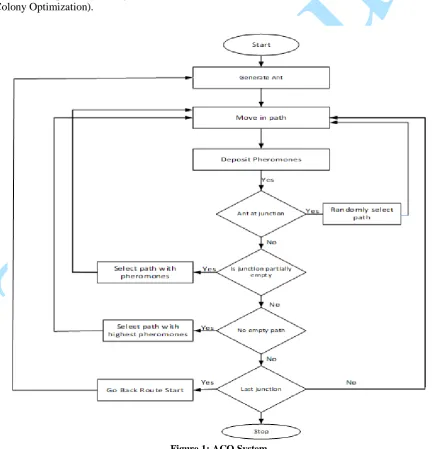
The developed routing system employed a computational artificial intelligence algorithm in solving static network routing problems. The study identified the problems associated with the current system of routing in computer network. An improved Ant colony Algorithm (ACO) was used for dynamically constructing routing tables automatically to guide traffic on the network. The implementation of the proposed Ant Colony Optimization algorithm for enhanced routing system was done through the use of computer simulation software. The algorithm solved the existing problem by finding the smallest path, best network route and also eliminate the static route error around the nodes in a network. The framework of developed ant colony optimization system is shown in Figure 1.
As it has been shown in Figure 1, when ants are leaving their colony, which describe the source of the network they continue to move on the path, as they are moving they will continue to drop pheromone trail until they get to a junction. When they discover the junction is empty they will move to the randomly selected path which they are meant to follow initially, they will continue to move until they get to a junction the is not totally empty, by that time they will change their route and move on the path that is not empty when they get to the next junction they will select the path that has the pheromone deposit, but if the junction is not partially empty it means there is no empty path then the ant will follow the path that has the highest pheromone deposit but if there is an empty path then the ant proceed to the last junction, once it get to the point the ant will definitely return to its colony irrespective of the condition met in the last junction which replicate the starting route.
3.1 Routing Path Calculation for the Enhanced Routing System
The calculation of the shortest/routing path is done as follows:
Step 1: Generate Ants/Packets at starting point A Step 2: Check the value of the pheromone for the adjacent points
Step 3: Go to the point that has the highest pheromone value
Step 4: If no point has the highest value then randomly select point
Step 5: Increase the pheromone value of that point by 1
Step 6: Decrease the pheromone value of the based on the formula
Pv(Point) = Pv(Point) - 1 * (currenttimenow - currenttime2millisecsago)
Where Pv is an integer array and point is the index of the point. From the formula above the value of the Pv(Point) will be decreased by every 2 milliseconds Step 7: Repeat Steps 2 to 6 until the last node is reached
Step 8: Generate the next generation of ants/packet and repeat step 1 to 8
3.2 Performance Evaluation Test
The Ant Optimization Algorithm will be used to demonstrate dynamic routing in a packer circuit network. The testing scenario is shown in Table 1, the test was carried out on a network system of 20 nodes. Five tests were performed.
Table 1: Testing Scenario
Test ID Description
Test1 Test for the algorithm to find the shortest path along the network of 20 nodes.
i. Where the nodes represent the pheromone in the network.
ii. Total path length of the 20 nodes is 48733m.
Test2 Test for the algorithm to find the shortest path along the network with 2 nodes removed (Total 18 nodes).
i. Where the nodes represent the pheromone in the network.
ii. Total path length of the 18 nodes is 33289m.
Test3 Test for the algorithm to find the shortest path along the network with 2 more nodes removed (Total 16 nodes),
i. Where the nodes represent the pheromone in the network.
ii. Total path length of the 18 nodes is 20015m.
Test4 Test for the algorithm to find the shortest path along the network with 2 more nodes removed (Total 14 nodes).
i. Where the nodes represent the pheromone in the network.
ii. Total path length of the 18 nodes is 14094m.
Test5 Test for the algorithm to find the shortest path along the network with 2 more nodes removed (Total 12 nodes).
i. Where the nodes represent the pheromone in the network.
ii. Total path length of the 18 nodes is 10827m.
3.3 Testing Snap Shot
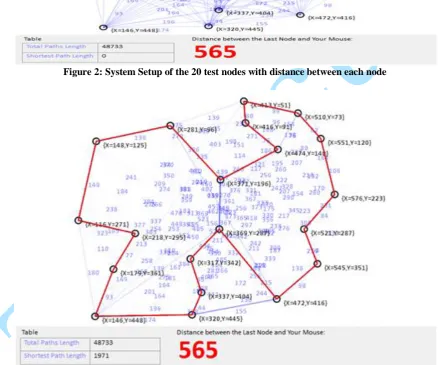
The simulation window of the program is set up with twenty node represented by the black circles as shown in Figure 2. The interfaces for five simulation tests for Ant Colony Optimization interfaces are displayed using the following figures:
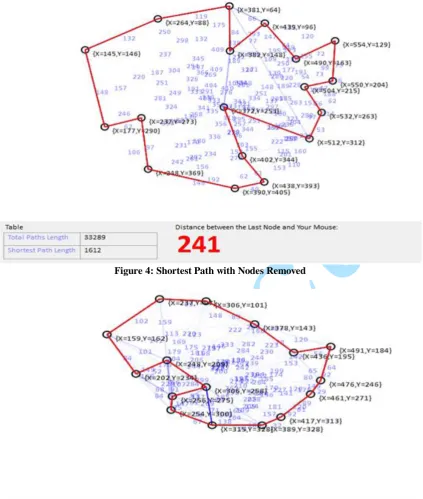
Test 1: Test for the algorithm to find the shortest path along the network. The best path is shown in red (Figure 3):-
Test 2: Test for the algorithm to find the shortest path along the network with 2 nodes removed (Total 18 nodes). The best path is shown in red (Figure 4):-
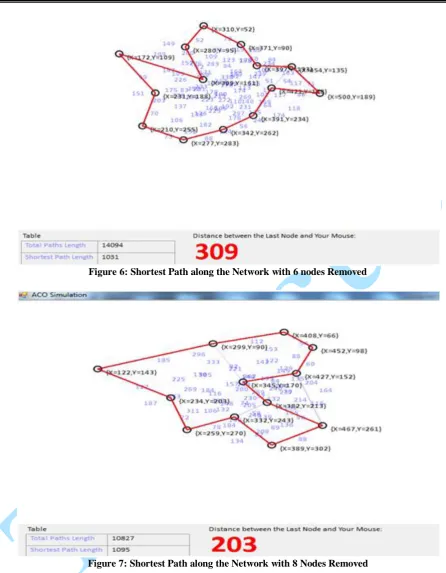
Test 4: Test for the algorithm to find the shortest path along the network with 6 nodes removed (Total 14 nodes). The best path is shown in red (Figure 6):-
Test 5: Test for the algorithm to find the shortest path along the network with 8 nodes removed (Total 12 nodes). The best path is shown in red (Figure 7).
Figure 2: System Setup of the 20 test nodes with distance between each node
Figure 4: Shortest Path with Nodes Removed
Figure 6: Shortest Path along the Network with 6 nodes Removed
Figure 7: Shortest Path along the Network with 8 Nodes Removed
4. RESULTS AND DISCUSSION
From the test interfaces, it can be seen that in all the cases of reduction of the size of the network, the system was able to find the path which the network was routed. This showed that the algorithm made the network:
(i) Highly Adaptive: Accommodate any amount of nodes that is being test on it.
(ii) Efficient: This applied algorithm is available and active at all time, it also saves time, reduce
stress and save cost. Making it easy to solve the problem at any giving time without any delay. (iii)Scalable: enables the network to provide an
acceptable level of service even in the presence of a large number of nodes supplies for this improved algorithm.
route was activated to send the packet to its destination without any form of manual command or prompting in the real world. (v) In the test snap shot there is a blue thick line
which indicated the redundancy of the network, if the network node of the next point is out of service or in the case where there is deadlock, it will send a traffic to the next node, if this node has the capacity to take the traffic and it is shorter to its destination, it will then re - route the packet sent to the new network path
detected so as to ensure the packet gets to its destination in which when related to the ant operation they can easily change their route once the pheromone is evaporated and there seem to be no visible path to follow.
(vi)It became easier and shorter to route packets on the network with the use of this algorithm without having to think of which route or problem which can be accoutre along the path The Table 2 shows the summary result for all the tests conducted.
Table 2. Summary of the Findings for all Tests
Tests Total routing path lenght (meters) New routing path length (meters) Description
Test 1 48733 1971 New shorter route is determined
Test 2 33289 1612 New shorter route is determined
Test 3 20015 1005 New shorter route is determined
Test 4 14094 1031 New shorter route is determined
Test 5 10827 1095 New shorter route is determined
5. CONCLUSION
The paper employed the use of Ant colony Optimization (IACO) for the determination of the routing paths in a network, and best route in case of congestion. As Packet Switching networks require dynamic routing schemes to ensure that the changes to the network are updated on the routing table, there is a need to use an algorithm that will know the best shortest path to take based on the availability of node on the network at the time. Thus this research sought to use the Ant Colony Optimisation technique which is based on the food finding behaviour of ants. In order to demonstrate the effect of the algorithm, a simulator program was used by the researcher using the Visual Basic.Net to demonstrate the working of the algorithm.
REFERENCES
[AK13] Anjali, N. Kaur – Routing Based Ant Colony Optimization in Wireless Sensor Networks, Glob. J. Comput. Scien e Technol., vol. 13, no. 4, pp. 35-40, 2013.
[AY18] L. B. Abdissa, Z. X. Yan – Network Route Optimization Using Particle Swarm Intelligence Algorithm, Int. J. Sci. Res., vol. 7, no. 3, pp. 1086-1093, 2018.
[ARM12] I. Abdullah, M. M. Rahman, Z. Mahmud – Performance of Conferencing over MANET Routing Protocols, ARPN J. Syst. Softw., vol. 2,
[A+17] G. K. Ahirwar, S. Goyal, N. Mishra, R. Agrawal – An Enhancement of BAT Algorithm using Diversity function for Routing optimization in WSN, Int. J. Control Theory Appl., vol. 10, no. 13, pp. 255-264, 2017.
[DC10] N. Dominguez-Medina, C. Cruz-Cortes – Routing Algorithms for Wireless Sensor Neworks Using Ant
Colony Optimization, Mexican
International Conference on Artificial Intelligence, pp. 337-348, 2010.
[DS09] M. Dorigo, T. Stützle – Ant colony optimization: overview and recent advances, in Gendreau M., Potvin J. Y. (eds): Handbook of Metaheuristics, pp. 311-351, Springer, Cham, 2009.
[GA17] V. Goyal, G. Arora – Implementation of Enhanced Interior Gateway Routing Protocol (EIGRP) in IPv6 Network, Int. Res. J. Adv. Eng. Sci., vol. 2, no. 1, pp. 90-95, 2017.
[KEA13] A. Kanan, T. Eldos, M. Al-kahtani –
Mobile Ad Hoc Networks Routing Using Ant Colony Optimization, World Comput. Sci. Inf. Technol. J., vol. 3, no. 6, pp. 105-109, 2013.
[LWL11] Y. Li, N. Wang, S. Li – A hybrid Approach of Genetic Algorithm and Ant
Colony Optimization for Vehicle
[MDB16] M. S. Manshahia, M. Dave, S. B. Singh – Improved Bat Algorithm Based Energy Efficient Congestion Control Scheme for Wireless Sensor Networks, Wirel. Sens. Netw., vol. 08, no. 11, pp. 229-241, 2016.
[Sum14] J. Sumitha – Routing Algorithms in Networks, Res. J. Recent Sci., vol. 3, pp. 1-3, 2014.
[SK17] S. Sharma, R. S. Kushwah – Energy Saving, International Conference on Inventive Communication and Computational Technologies, pp. 150-154, 2017.
[SM16] S. Sirika, S. Mahajan – Survey on Dynamic Routing Protocols, Int. J. Eng. Res. Technol., vol. 5, no. 01, pp. 10-14, 2016.
[SGS13] K. P. Singh, P. K. Gupta, G. Singh –
Performance Evaluation of Enhanced Interior Gateway Routing Protocol in
IPv6 Network, Int. J. Comput.
Applications, vol. 70, no. 5, pp. 42-47, 2013.
[SSN18] P. Sarao, P. Sindhu, V. Navakishor –
Analysis of Routing Protocols based on Network parameters in WANET, Int. J. Comput. Sci. Eng., vol. 6, no. 6, pp. 8-13, 2018.
[TE14] A. Taraka, N. Emani – Routing in Ad Hoc Networks Using Ant Colony Optimization, International Conference on Intelligence Systems, Modelling and Simulation, pp. 546-550, 2014.
[WZY17] Y. Wu, Y. Zhu, Z. Yang – Routing Algorithm Based on Ant Colony
Optimization for Mobile Social
Network, IEEE Computer Society, pp. 297-302, 2017.
[Z+14] B. Zhao, J. Huang, B. Zhang, S. Xia –