Volume 5, Issue 2, 2018, pp. 148-155 Available online at www.jallr.com ISSN: 2376-760X
* Correspondence: Zohre Dehghan, Email: zohreh.dehghan65 gmail.com © 2018 Journal of Applied Linguistics and Language Research
The Effect of Audio-Visual vs. Written Contexts on Idiom
Learning of Iranian Intermediate EFL Learners
Esmail Zare Behtash
Associate Professor, Chabahar Maritime University, Iran
Amin Saed
M.A. in TEFL, Chabahar Maritime University, Iran
Zohreh Dehghan *
M.A. in TEFL, Chabahar Maritime University, Iran
Abstract
Due to the significant role of idioms in second language learning and the difficulties EFL learners experience in learning them, finding ways to improve the learning process of idioms is of high importance. The present study investigated the effect of audio-visual vs. written contexts on idiom learning of Iranian Intermediate EFL learners. It was also an attempt to identify which context would lead to the language learners’ enhanced idiom comprehension. Particularly, the study explored the effect of audio-visual context on learners’ idiom learning, the effect of written-context on learners’ idiom learning, and finally the difference between idiom improvements of learners who were exposed to audio-visual compared to their counterparts in the written group. The participants were English language learners (L2) at Language Academy in Isfahan, Iran. They were all female, Persian native speakers. Their age range was between 19 and 26. Initially, a total of 80 EFL students were selected to participate in this study. Oxford Quick Placement Test (OQPT) was implemented to ensure homogeneity of learners in proficiency. According to the results of the test, 60 intermediate learners were selected. Then, they were randomly divided into two groups of 30. In the first group, they were taught the idioms through written contexts and in second group they were taught idioms through audio visual technique. After twelve sessions, a post-test administered to the learners in order to evaluate their improvement in learning idioms. In order to analyze data, descriptive statistics including mean and standard deviation and inferential statistics including paired and independent-samples t-tests were run. The results of the study showed that students exposed to the audio-visual context significantly outperformed in the post-test (p<0.01). Moreover, they significantly scored better compared to the written-group (p<0.01). Findings pinpoint important implications for idiom teaching and learning.
INTRODUCTION
Language is frequently changing. However, it is full of fixed language use, particularly established idioms that are metaphorical expressions. The English language permanently enriches its vocabulary with words invented by language speakers, especially with new idiomatic expressions. Idioms as inevitable part of speech are vital for EFL learners to be learning in order to master English well. Cooper (1998) “Since idiomatic expressions are so frequently encountered in both spoken and written discourse, they require special attention in language programs and should not be relegated to a position of secondary importance in the curriculum" (Cited in Martirosyan, 2013). Learning idioms has always been problematic for second-language learners. There are several reasons for this fact that idioms are so difficult to learn in a second language. First, Idioms are non-literal; their meaning cannot be determined based on the individual parts. Moreover, most of the idioms have literal counterparts that make their learning so harder. Second, idioms are commonly omitted in the speech addressed to second-language learners. Native speakers avoid using idioms when they address second-language learners and they tend to use everyday vocabulary. Third, learning how to use idioms correctly is usually difficult even when learners do master the meanings of idioms. The last reason of the difficulties in learning idioms can be related to the lack of suitable materials for teaching them (Irujo, 1986). Since idioms are considered as one of the most important areas of foreign language learning for both teachers and learners, it would be sufficient to look for strategies to facilitate its learning and teaching. This study attempts to find out whether there is a difference in learning idioms when Iranian L2 learners of English are faced with them in either a written context or in an audio-visual context.
REVIEW OF LITERATURE
In English, it is not easy to write or speak without using idioms (Seidl & McMordie, 1978). Therefore, language learners are recommended developing their idiom knowledge in order to reduce foreign-sounding (Watson, 1998). Idiomatic expressions make our sentences rich, colorful, charming, and precious (Adkins, 1968). According to Bergh (2016), there is a metal trigger point called idiomatic key which helps us comprehend idioms. Idiomatic key or Configuration hypothesis claimed that idiom meaning can be retrieved only when a certain amount of the string is heard.
knowledge of the world, our awareness of the co-text and our relevant linguistic knowledge (Haastrup, 1991).
Mayer (1997) proposed that the design of multimedia instructions can affect learners' cognitive processes for a meaningful learning. Mayer (1997) believed that in order to learn a vocabulary, learners can use visual and verbal cues to retrieve information which was already stored in their memory. Al-Seghayer (2001) mentioned that learners' exposure to the presentation of multiple modalities such as printed text, sound, picture, or video, can create a language-learning environment really influential for learning because in such cases learners' working memory can be affected by the relationship which is made between the verbal and visual system specially when long-term memory is desired.
Irujo (1986) listed some reasons which make idioms difficult for nonnative language learners: a) the non-literalness meaning of idioms or the existence of literal meaning counterparts for them, b) very limited exposure to idioms, and c) insufficient idiom teaching materials. Sornig (1988) stated that even native speakers make mistakes while using idioms let alone nonnative speakers. Therefore, it is clear that teaching them to nonnative speakers is troublesome. Sornig (1988) believed that the teaching of idioms should be based on the ways that native speakers learn and understand them. As idioms are impressive and communicatively effective, Sornig (1988) emphasized on categorizing and teaching idioms according to their communicative functions and interaction. Irujo (1986) believed that despite all these difficulties teaching of idioms should start even at the beginning levels of language learning. He stated that idiom should be selected according to their level of frequency of use, transparency, familiarity, appropriateness, simplicity of form and vocabulary, and then taught. Irujo (1986) mentioned that selection of good strategies for idiom teaching may help learners get rid of idiom-phobia.
METHODOLOGY
RESULTS
The present study intended to investigate the effect of audio-visual vs. written content on the idiom learning of Iranian intermediate EFL learners. In other words, the researcher attempted to have a deep look at how context can improve learners’ idiom comprehension. In this respect, after homogenizing learners, they were randomly divided into two groups: experimental 1 and 2. For the first group the researcher wrote an idiom on the board and asked the students to guess its meaning. Then, she presented synonyms, antonyms, definition and explanation for new words. And finally she told the real meaning (correct equivalents for every idiom) in target language. For the second group, the researcher wrote the idiom on the board and asked students to guess its meaning. Then she presented a PowerPoint of films or videos related to idioms to help students to guess the meaning of the idiom better. After that she told the real meaning (correct equivalents for every idiom) in target language. Pre- and post-tests were administrated before and after the intervention. The data were collected for further analysis.
According to Table 1, the mean scores of experimental 1 is at M=15.75 (SD=7.00). As it seems, learners were at similar level of listening proficiency before the intervention. Table 4.1 also shows learners’ mean scores after the intervention: M=19.40 and SD=2.41. According to the results, there are differences between learners’ idiom learning after the intervention.
Table 1. Descriptive statistics of pre- and post-tests of audio-visual group
N Mean Std. Deviation Std. Error Mean
Audio-visual
(pre-test) 30 15.7560 7.00806 1.40161
Audio-visual
(post-test) 30 19.4000 2.41523 .48305
To find out whether the use of audio-visual context affect learners’ idiom learning, a paired sample t-test was run to check any possible improvement before and after the intervention among experimental learners.
According to Table 4.2, there is a statistically significant difference between experimental learners’ pre- and post-tests (p=0.00≤0.01, t=2.99). It denotes that the use of pedagogical films meaningfully improved learners’ listening skills. Accordingly, based on the present findings, it is indicated that the first null hypothesis of the study is rejected and it is concluded that audio-visual context has significant effect on idiom learning.
Table 2. Paired sample t-test between pre- and post-tests of audio-visual group
Paired Differences
t df Sig. (2-tailed)
Mean Deviation Std.
Std. Error Mean
95% Confidence Interval of the
Difference
Lower Upper
Pre-Post Test -3.64 6.09 1.218 -6.158 -1.129 -2.99 29 .006
According to the results, there are differences between learners’ idiom learning after the intervention.
Table 3. Descriptive statistics of pre- and post-tests of written group
N Mean Std. Deviation Std. Error Mean
Written Group (pre-test) 30 14.6720 6.76173 1.35235
Written Group (post-test) 30 16.1200 3.51568 .70314
To further have evidence on learners’ performances, paired sample t-tests was run between pre- and post-tests of this group.
According to Table 4, there is no statistical significant difference between pre and post-tests administration of listening test among control groups (p=0.07≥0.05, t=1.88). Findings denote that the learners did not benefit from written context of idiom learning. Accordingly, based on the present findings, it is indicated that the second null hypothesis of the study is accepted and it is concluded that written context does not have any significant effect on idiom learning.
Table 4. Paired sample t-test between pre- and post-test of written group
Paired Differences
t df Sig. (2-tailed)
Mean Deviation Std. Std. Error Mean
95% Confidence Interval of the Difference
Lower Upper
Pre-Post
test -1.44 3.84 .769 -3.03 .140
-1.88 29 .072
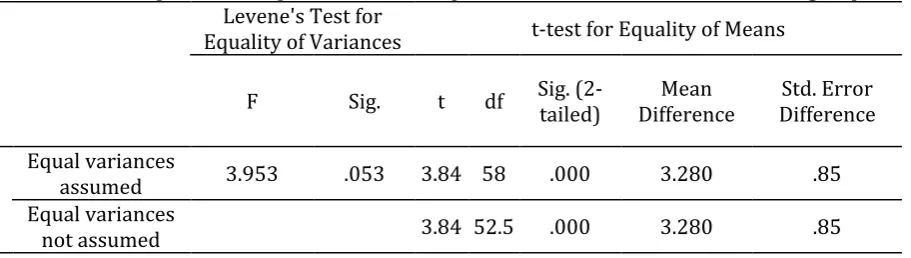
According to the Table 5, audio-visual learners significantly outperformed compared to their counterparts in written groups (p=0.00≤0.01, t=3.84).
Table 5. Independent sample t-test between post-tests of audio-visual and written groups
Levene's Test for
Equality of Variances t-test for Equality of Means
F Sig. t df Sig. (2-tailed) Difference Mean Difference Std. Error
Equal variances
assumed 3.953 .053 3.84 58 .000 3.280 .85
Equal variances
not assumed 3.84 52.5 .000 3.280 .85
The findings of the study revealed that employing audio-visual context in class instruction effectively promote learners’ idiom learning. Accordingly, based on the present findings, it is indicated that the third null hypothesis of the study is rejected and it is concluded that there is significant difference between the effects of audio-visual vs. written contexts on the EFL learners’ idiom learning.
DISCUSSION
pre and post-test were compared with each other and the findings indicated that watching English animation movies significantly improved Iranian EFL intermediate learners' idiom learning.
be justified according to dual coding theory which emphasizes on the effect of images on better retention.
CONCLUSION
Idioms are used in many aspects of daily lives, speeches, and conversations but unfortunately, it can be claimed that the acquisition of idiomatic expressions is one of the most outstanding challenges in TEFL. Presenting idioms through contexts especially audio-visual and written contexts have been known as two effective ways for improving L2 language learning particularly idiom learning by L2 learners. The researcher believed the effect of these two methods on idiom learning of Iranian EFL learners needed more investigation. Therefore, this study aimed to ascertain the effect of audio-visual and written contexts on idiom learning of Iranian intermediate EFL learners. The results of the study in the post tests indicated that audio-visual context was effective for learning L2 idioms, and audio-visual context was more beneficial than written context. In other words, audio-visual presentation improved idiomatic learning of the participants but not idiom presentation in written context. Therefore, only audio-visual context was found significantly influential on idiom learning and two of our three hypotheses were safely rejected. The present study adds to the previous literature on idiom learning in two important ways: first, visual context is beneficial for idiom learning; second audio-visual context is more effective than written context. Some of the findings of the present study are in accordance with the finding of previous studies and some are in contrast.
REFERENCES
Adkins, P.G., (1968). Teaching Idioms and Figures of Speech to Non-Native Speakers of English. Modern Language Journal, 52(3),148-152.
Al-Seghayer, K., (2001). The Effect of Multimedia Annotation Modes on L2 Vocabulary Acquisition: A Comparative Study. Language Learning & Technology, 5, 202-232, Available on: http://llt.msu.edu/vol5num1/alseghayer/default.html
Asschier, E., (2014). Comprhension of L2 Idioms-Audio-Visual versus Written Context.
Available on:
https://www.diva-portal.org/smash/get/diva2:726350/FULLTEXT01.pdf
Azar, S. & Talebinezhad, M., (2013). The Effect of Exposing Upper-Intermediate EFL Learners to Idiomatic Expressions through Poetry on Improving Their Metaphorical Competence. ELT Voices, 3(2), 16-30.
Bergh, V.N., (2016) A study of young Norwegians in English Idiom Processing. Available on:
https://www.ntnu.edu/documents/1535402/35615794/Uformatert.Samlet.Utka st.pd
Cain, K., Oakhill, J., & Lemmon, K., (2005). The Relation between Children’s Reading Comprehension Level and Their Comprehension of Idioms. Journal of Experimental Child Psychology, 90, 65-87.
Haastrup, K., (1991). Lexical Inferencing Procedures or Talking about Words. Tübingen: Narr
Irujo, S., (1986). Don’t Put Your Leg in Your Mouth: Transfer in the Acquisition of Idioms in a Second Language. TESOL Quarterly, 20, 287–304.
Mahmoodi-Shahrebabaki, M., (2014). An Investigation on the Effectiveness of Using Movie Clips in Teaching English Language Idioms. Enjoy Teaching Journal, 2(4), 26-35.
Martirosyan, A. (2013). The importance of idioms for English Language Learners.Available on: http:// publications.ysu.am/wp-content/uploads/2014/02/MarA.pdf
Mayer, R. E., (1997). Multimedia Learning: Are We Asking the Right Questions?.
Educational Psychologist, 32(1), 1-19
Mohamadi-Asl, F., (2013). The Impact of Context on Learning Idioms in EFL Classes. Available on: http://mextesol.net/
Sanaeifar, S. H., (2017) The Effect Of Watching English Language Animation Movies On Learning Idioms: A Case Of Iranian EFL Learners. European Journal of English
Language Teaching 2(3). Available on: www.oapub.org/edu
Seidl, J. & McMordie, W., (1978). English Idioms and How To Use Them. 4th ed. Oxford: Oxford University Press.
Sornig, K. (1988). Idioms in language teaching. Understanding the lexicon: Meaning, sense and world knowledge in lexical semantics, 280-290.