Volume 4, Issue 7, 2017, pp. 247-259 Available online at www.jallr.com ISSN: 2376-760X
* Correspondence: Marzieh Mehri, Email: mehr.sepid yahoo.com © 2017 Journal of Applied Linguistics and Language Research
The Effect of the Implementation of Task Based Language
Teaching on Iranian EFL Learners' Reading Comprehension
Performance
Omid Rezaei
Ph.D., University of Isfahan, Iran
Marzieh Mehri *
Ph.D. Candidate, University of Isfahan, Iran
Pouya Shakerian
M.A., Kashan University, Iran
Abstract
The present study investigates the impact of Task-Based Language Teaching (TBLT) on Iranian EFL learners’ reading comprehension performance. Seventy participants were assigned randomly to the experimental and control groups. Having instructed the two groups with the same texts but different task types and activities (i.e. tasks in 4 types) during 20 sessions, the learners’ reading performance results were compared through utilizing a reading post–test to both groups. The obtained data was analyzed using t-test to examine the effects of independent variable, namely, the method of teaching reading (task-based activities vs. classical reading comprehension) on learners’ reading performance as the dependent variable. Also, the performance of the experimental group in four task types was analyzed in order to investigate possible differences among four reading sets of scores obtained on four task types. A follow up TUKEY test was also conducted to locate the exact areas of difference. Results showed that TBLT had a significantly more positive effect on learners’ reading performance compared to traditional reading instruction. Also, the second task type investigated in this study, namely read, note and discuss, found to be more useful in increasing learners’ reading skill.
Keywords: task-based language teaching (TBLT), reading comprehension performance, EFL learners, task-based activities
INTRODUCTION
Task based language teaching
second language acquisition. Far less empirical research has been carried out where tasks have been used as the basic units for the organization of educational activities in intact language classrooms (van den Branden, 2006). Prabhu (1987) designed task-based teaching and learning tasks task-based on the concept that effective learning occurs when students are fully engaged in a language task, rather than just learning about language. Willis (1996) defined task as a goal-oriented activity which can have a clear purpose and which involves achieving an outcome through creating a final product that might be appreciated by others.
In addition, Breen (1987) suggested that language tasks can be viewed as a range of work plans, from simple to complex, with the overall purpose of facilitating language learning. He saw all materials for language teaching as compendia of tasks. Such Task-based Language Teaching (TBLT) is seen to enhance language acquisition by providing learners with the chance of receiving more comprehensible input, furnishing contexts in which learners need to produce output which others can understand, and finally, simulating classrooms to a real-life context.
Task based language teaching action
Regarding the varying claims of TBLT related to classroom practice, recent studies consider three recurrent features: TBLT is in accordance with a learner-oriented education (Ellis, 2003; Richards & Rodgers, 2001); it has particular components such as goal, procedure, a specific outcome (Skehan, 1998), and it focuses on meaning driven activities rather than form focused ones (Breen, 1987). Given the fact that language acquisition is influenced by the complex interactions of a number of variables including materials, activities, and evaluative feedback, TBLT seems to have a dramatic positive impact on these variables (Ellis, 2003). This means that TBLT can provide learners with natural sources of meaningful materials which in turn create ideal situations for real-life communicative activities. Specifically, in EFL (English as a Foreign Language) environments where learners are constrained on their accessibility to use the target language in daily communication, it is needed for language learners to be given real opportunities to be in touch with language use in the classroom (Rashtchi & Keyvanfar, 2007).
Skehan (1998) has probed the possibility that tasks may be selected and implemented so that particular pedagogic outcomes are gained. It can be said that any pre-designed task will be changed by the way the learner interacts with it. As a result, the outcome may not be consistent with the objectives intended by the task designer, who may be also the course book writer or the teacher. Similarly, Breen (1987) distinguishes between ‘task-as-work plan’ and the actual ‘task in process and suggests that the two may diverge. Kumaravadivelu (1991) argues that in the context of task-based language teaching, learning outcome is the result of a fairly unpredictable interaction between the learner, the task, and the task context. Thus, being successful in task-based teaching depends largely on the extent to which teacher’s intention and learners’ interpretations of a given task converge. Building on these insights from SLA and form-focused approaches, TBLT aims to ensure that learners are given plentiful opportunities for two things: (1) receiving meaningful input, or exposure to L2, and (2) having output or experiencing language use. The former is elaborated on by Krashen (1987) under comprehensible input while the latter is called by Swain (1985, cited in Ellis, 2003) as ‘pushed output’, which enables learners to pick up or acquire those skills and elements of language they are developmentally ready for.
Task based language teaching and reading instruction
In recent years, a growing interest in the application of TBLT in different realms of second and foreign language teaching has been observed. Among different tasks, the reading-based ones as more integral tasks seem to be more promising since they can involve EFL learners perhaps at the most basic yet essential activity of their academic life. Reading comprehension is a cognitive activity, almost the miraculous one, and like other skills it is a long learning process. Teaching reading is a considerably complex matter. Like other skills, reading is also considered to have different levels. The following features seem to be closely related to the areas which need to be considered in a reading task.
Reading comprehension
shown that there is a great deal of transfer from learning to read in one language to learning to read in a second language (Grabe, 2004).
Despite the great need for reading, this skill is not often fully acquired during school time and even during later educational stages. Learning to read is a type of problem solving, and has often been ignored (Pressley et al, 1992). As a matter of fact, most students fail to comprehend the foreign language texts for their failure in acquiring the reading skill. They seem to read with less understanding than one might expect them to have and slower than they reportedly read in their first language. When we talk about reading and reading instruction, we do so with the basic assumption that reading fundamentally involves comprehending what we read. This idea has been referred to as the finding, or creating, of meaning. The creation of this meaning (the ability to comprehend what we read) depends heavily on having automatic word-level skills and appropriate background knowledge plus a range of comprehension strategies which were mentioned previously. These factors need a lot of attention not only in academic settings but also in early stages of students’ acquiring the reading skill (Pressley, 2000). From the view point of both language learning and communicating in real language situations, reading comprehension occupies a position of pre-requisite importance (Cook, 1991).
Allen, Hendler, Tate (1990) note that comprehension is a process by which new or incoming information is related to the information that is already stored in memory. Cook (1991) maintains that comprehension wholly depends on the storing and processing of information by our minds, therefore, comprehension is something mentalistic. In simpler terms, Richard and Rodgers (2001) point out that comprehension is the process by which a person understands the meaning of written or spoken language.
Teaching reading in TBLT framework
During the last decades, there have been a plethora of studies and reports on reading purposefully. In one study, Astika (2004) states that keeping engaged in the process of reading in an interactive fashion is effective in providing the students with the skill to tackle the reading problems encountered during their EAP courses. Development of ESP in Iran can best be considered in terms of various EAP programs for all academic fields at university. Ataei (2000) conducted a large-scale study considering the effectiveness of the programs as implemented in the target settings or even the theoretical issues concerning ESP instruction. In relation to reading ability and reading skills, he acknowledged the need for getting EAP readers involved in extensive reading as a highly recurrent criterion task in college-courses (Carrell & Carson 1997, as cited in Ataei 2000, p.125).
In a most relevant study conducted by Hokmi (2005), the effects of teaching reading comprehension in ESP courses within the framework of task-based language teaching (TBLT) were investigated. The results of this study suggest that reading for message has a positive effect on students reading ability. Continuing the studies on the effectiveness of reading skills, Tahririan and Basiri (2005) worked on the effectiveness of reading abilities in Internet reading. The results of the study further indicated that reading skills, such as skimming and scanning, are fundamental to Internet reading. The Internet readers mainly favored quick glances from top to bottom of the page. Their eyes moved from one item to the other in search of relevant information. They did not read every word or every line of the page.
reflects the type of language that learners would need in their real-world situation (p160).
Contrary to the above-mentioned findings, Widdowson (2003) declares that real-world activities will not guarantee any effective contribution to the process of learning for “it is possible for learners to get their messages across” even if the language that is used is minimal (p.125). On the other hand, Ellis (2003, p.9) referred to some critical features of tasks such as a primary focus on meaning, cognitive engagement and clearly defined communicative outcomes as the features which guarantee, to some extent, students’ success in second/foreign language learning.
Reading purposefully is more interesting and text information is understood and recalled better when reading is purpose driven. But how narrowly should the concept of purpose be defined? Evans and Green (2007) conducted a large-scale multifaceted investigation and showed that students find the processing of information at the micro-level (skimming, scanning) more demanding than that carried out at the macro-micro-level (listening, speaking). They also mentioned that reading is a skill that comes from experience and needs to be continuously improved through different types of materials but that efficient reading involves many skills that need to be fostered in a classroom whether in an academic or non-academic context.
A great deal of research has been done in the area of TBLT and reading comprehension. Many researchers have investigated the effect of TBLT on different language skills including reading comprehension, however, the results do not agree in all cases. The present study is an attempt to investigate the effects of different TBLT tasks on reading comprehension of intermediate Iranian EFL learners and aims to answer the following questions:
1. Does implementing TBLT in reading classes have any significant effect on intermediate Iranian EFL learners 'reading comprehension performance?
2. Which task type has more significant effect on intermediate Iranian EFL learners’ reading comprehension performance?
METHOD
Participants
Materials
Instructional Materials
Four tasks were designed based on the students’ book in a way that motivated them to follow the text eagerly and enabled them to guess the answers from the text easily. In other words, the texts were available in the students’ books and the researchers just had to design the tasks based on the text that was going to be taught during the term. It should be mentioned that the texts were the same for both groups, and just the kind of activities that were based on the texts differed. All told, four task types were used in this study. Following is a brief description of what happened during each task:
Task 1: Read and think
Students read a text, studied an accompanying visual and decided whether or not the visual aid facilitates comprehension of the text.
Task 2: Read, note and discuss
Students read a text and carried out several activities including creating a visual to accompany a text.
Task 3: Read and discuss
Students read a short text and studied an accompany visual. Then, they discussed with their partner the extent to which the visual facilitates comprehension of the text.
Task 4: Read and write
Students read a text and provided a summary of the main points of the text. Testing materials
There are two main instruments utilized in this study:
1. A test of the teacher’s book of Passages series book 2 was administered to both groups of this study as the reading pre-test. It contained a series of texts which were based on students’ pre-learned vocabularies during the semester. At the end, there were some meaning based questions. In other words, the students were not able to answer the questions unless they understood the meaning of the texts. The questions were in different formats. At the end of the study, a similar test was used as reading posttest to measure the participants’ progress.
Procedure
After randomly assigning the two groups to the experimental and control one, the treatment started and lasted for forty hours of teaching (20 sessions each lasting for two hours). If we divide the whole period of instruction, i.e. 20 sessions, into 20 two-hour parts, then it can be said that in the control group, students worked on some short conversations, a grammar lesson, and some new vocabularies in the first part of each session. In the second part, they read a text and answered some comprehension questions of open-ended, true/false and/or matching types.
In the experimental group, new vocabularies were taught to the learners during the first part of each session. Then, a simple grammar was taught and different examples were written on the board. In making sentences, they were asked to use the new vocabularies. In the second part of each session, the task papers were brought to the class. Half an hour of the second part of each session was used for reviewing the new words of the previous session and answering the questions. Then, the topic was introduced to the learners and they were given clear instructions on what they had to do to perform the task. In addition, the teacher helped the students recall some language that could be useful for the task. Also, the pre-task stage often included performing a similar task to give students a clear model of what was expected of them. The rest of the time was used for doing the task. The students completed the task individually or in pairs using the language resources available for them while the researcher was monitoring and offering encouragement.
It is worth mentioning that in all the stages of performing the research, the researchers tried to keep the time in both classes the same. After doing the tasks and at the planning stage, the students were asked to prepare a short oral or written report to tell the class what had happened during their task, or simply put, what they had done. Then, they practiced what they were going to say in class. Meanwhile, the instructor was available for the students to ask questions to clear up any language problems they might have had. After the students accomplished each task, the instructor evaluated their work based on a general guideline he had prepared before and scored their performance. The scores obtained on each task type were to be used in the second phase of the study to investigate the possible impact of task type on the participants’ reading performance. Furthermore, the students in the experimental group were unaware of this implicit evaluation, and were given only some general feedback and guidelines for the betterment of their work.
After the final session of the instruction, a reading post-test was given to the learners and the scores of both groups were compared with those of pre-test to see if the groups performed differently.
RESULTS
procedure used in the study was a series of t-tests which compared the averages of the two groups in the reading pre-test and post-test. The second part of the research, which was concerned with the performance of the experimental group in four task types, required the calculation of ANOVA to investigate possible differences among four reading sets of scores obtained for four task types. A follow up TUKEY test was also conducted to locate the exact areas of difference.
Phase I: estimated reliability index for the pre-test and post-test was 0.756. Table 1 shows the descriptive statistics and the t-test results of the two groups’ reading post-test, respectively.
Table 1. T-test results for the experimental and control group for reading post-test
Leven’s test for equality
of variance t-test for equality of means
F Sig t df. Sig. (2-tailed) Mean dif. Std. Error of Differences
95% Confidence Interval of Difference
Lower Upper
Equal Variances
Assumed 13.793 .001 5.9 48 .000 4.7000 .7913 3.11 6.2910
Equal Variances not
Assumed 5.9 37 .000 4.7000 .7913 3.11 6.2910
T-test results make it clear that experimental group got higher mean scores than the control group, which indicates a statistically significant difference between the two groups. It implies that using TBLT is superior to the traditional method in reading classes.
Phase II: as it was mentioned earlier, in this project, four types of tasks were used for the treatment of the experimental group. Each session, after doing the tasks, the students’ performance was scored. The scores were recorded to be used for a later comparison of task types. In other words, the researchers aimed to use these scores to see in which task(s) the students had done better. It was mentioned earlier that there were twenty tasks in four types, which were given to the students in forty sessions (one task in every session). The average score in each task type was estimated for each student. To investigate in which task type they showed a better reading performance, the students’ scores on four types of tasks were compared through ANOVA. Table 2 shows the ANOVA results of four sets of scores.
Table 2. ANOVA results of final scores for four task types for the experimental group
Sum of
Squares df. Mean Square F Sig.
Between
groups 80.072 3 26.691 27.532 .000
Total 173.137 99
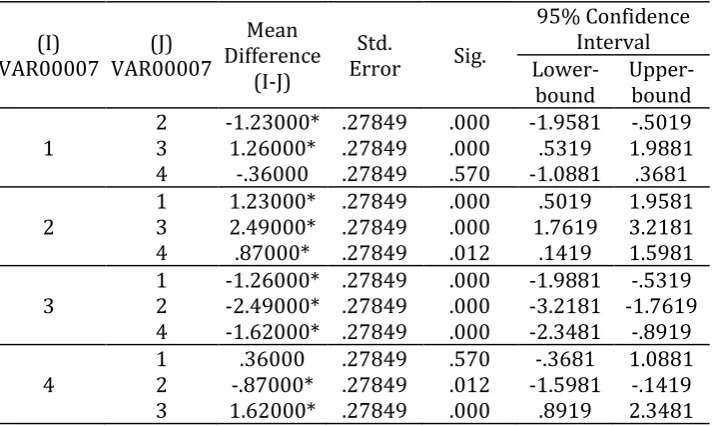
In Table 2, the significance level of .000 and the F obtained (27.53) which was higher than the critical value of 2.76 indicate that there was a significant difference among four sets of scores obtained for each task type for the experimental group. A follow-up TUKEY test located the areas of difference (Table 3).
Table 3. TUKEY test results for four task types
(I) VAR00007 (J) VAR00007 Mean Difference (I-J) Std.
Error Sig.
95% Confidence Interval Lower-bound Upper-bound
1 2 3
4 -1.23000* 1.26000* -.36000 .27849 .27849 .27849 .000 .000 .570 -1.9581 .5319 -1.0881 -.5019 1.9881 .3681 2 1 3 4 1.23000* 2.49000* .87000* .27849 .27849 .27849 .000 .000 .012 .5019 1.7619 .1419 1.9581 3.2181 1.5981 3 1 2 4 -1.26000* -2.49000* -1.62000* .27849 .27849 .27849 .000 .000 .000 -1.9881 -3.2181 -2.3481 -.5319 -1.7619 -.8919 4 1 2 3 .36000 -.87000* 1.62000* .27849 .27849 .27849 .570 .012 .000 -.3681 -1.5981 .8919 1.0881 -.1419 2.3481
Based on the results of the TUKEY test, four task types investigated in this study can be ranked as following:
Task 2 Task 3
Task 1 = Task 4
This means that task type 2 had the highest impact on reading performance of the experimental group. Next is task type 3. Task types 1 and 4 had almost equal impacts on student’s performance.
To recap, it can be said that a statistically significant difference was found between the reading performances of the experimental group and the control group when comparing their mean scores on reading post-test. That is, the treatment (the application of task-based reading activities) significantly affected the dependent variable (L2 reading comprehension) in Iranian advanced EFL learners. Also, the results of ANOVA and follow-up TTUKEY tests indicated that the students were more successful in the task type of Creative Product.
DISCUSSION
instruction who not only were exposed to language, but also acquired elements of language that learners were developmentally ready for. Forming hypotheses and making learners aware of language forms have been endeavors made to make L2 learning similar to L1 acquisition process. TBLT considers tasks as a necessary and sufficient incentive for language development and close enough to some aspects of the first language acquisition which makes it appropriate for foreign or second language learning context (Ellis, 2003).
The corollary of this research documents TBLT as an efficacious, practical and innovative teaching method, at least in teaching reading to EFL learners at intermediate levels. This research embodied steps such as ‘ready to go’ (warming-up), reading, and doing some real life tasks. To keep abreast of what’s been through during the application of TBLT, students relished the task-based texts as well as welcoming it; their involvement in class activities as well as communicative abilities and skills soared considerably owing to the fact that they hankered after the topics, and finally their propensity to take part in English conversations has set a seal on it. In this research, Task-based reading activities provided the learners with the chance of observing their own progress. The findings and analyses above substantiate task-based learning to be quite applicable and cornucopian with intermediate learners. The research findings may also contribute to the idea that TBLT may easily prevail in countries in which the evaluation system is quite traditional, and the exams are knowledge-oriented.
To round out, TBLT is considered to be a more effective way for teaching reading comprehension to intermediate learners. Teachers provide their students with a better learning context through implementing tasks in their lesson plans. Last and foremost, TBLT seems to make it a lot easier for teachers to manipulate the factors facilitating the reading comprehension. It can also accentuate the language input to which learners are exposed and give the teachers a chance to provide learners with the required language to do the tasks.
CONCLUSION AND IMPLICATIONS
based on methods designed to produce walking encyclopedias, but rather should promote learning in the broader sense, by starting out from various forms of contact with the concrete and proceeding to its abstract and intellectual representation. The aim of modern teaching is consequently to make teaching adapted to the learners, instead of adapting the learners to its own ends.
All tasks and materials should be utilized with the proviso that they are a source of initiative of teachers seeking to devise methods and a language of learning that, after all, will come most naturally to the learners. From the teacher’s point of view, the only criterion affecting their choice of tasks and equipment should be their educational potential and their capacity to convey an accessible image of the multiple and complex reality to be taught to learners. Teachers must not lose sight of the fact that it is partly or entirely through tasks, coupled with a learner’s particular perception of the world around them and their behavior upon it that a developing personality emerges and asserts itself, and that world is made up of both their experience and their hopes.
REFERENCES
Alderson, J. C. (1993). The relationship between grammar and reading in an English for academic purposes: selected papers from the 1990 language testing research Colloquium. In D. Douglas, & C. Chapelle (Ed.), VA: TESOL. Assessing reading (pp. 203-219). NY: Cambridge University Press.
Allen, J. F., Hendler, J. (1990). Reading in Planning. (A. Tate, Ed.) San Maneo, CA: Morgan Kaufmann Pub.
Astika, G. (2004). Task-based approach to reading English for specialized purposes. EA Journal, 22(2), 22-35.
Ataei, M. R. (2004). ESP revisited: a reappraisal study of discipline-based EAP programs in Iran. Unpublished Ph.D. dissertation, University of Isfahan, Isfahan, Iran.
Best, J. W., & Kahn, J. V. (2006). Research in Education (10th ed.). NJ: Prentice Hall.
Breen, M. P. (1987). Contemporary paradigms in syllabus design, part I. Language Teaching, 20(2), 81-91.
Brown, H. D. (2001). Language assessment principles and classroom practice. San Francisco: Pearson University.
Cook, V. (1991). Second language learning and language teaching. London: Edward Arnold.
Ellis, R. (2000). Task-based research and language pedagogy. Language Teaching Research, 4, 193-220.
Ellis, R. (2003). Task-based language learning and teaching. Oxford: Oxford University Press.
Evans, S., & Green, C. (2007). Why EAP is necessary: A survey of Hung Kong tertiary students. English for Academic Purposes, 6(1), 193-206.
Haberlandt, H., & Bringham, M. (1990). Reflections about minority language in the European community. New York: Mouton de Gruyter.
Hokmi, M. (2005). Iranian ESP Students’ Reading Comprehension in Task-based Language Teaching Approach. Roshd FLT, 19, 64-58.
Klapper, J. (2003). Taking communication to task? A critical review of recent trends in language teaching. Language Learning Journal, 27, 33-42.
Kumaravadivelu, B. (1991). Language learning tasks: teacher intention and learner interpretation. ELT Journal, 45, 98-107.
Nicholson, J. (1998). The Role of Formal Schemata on the Identification & Comprehension of Genre-Based Texts. Retrieved May 22, 2003, from http://www.surrey.ac.uk/AL-RG/dissertations/Nicholson_J_1998.html
Nunan, D. (1989). Designing tasks for the communicative classroom. Cambridge: Cambridge University Press.
Prabhu, N. S. (1987). Second language pedagogy. A perspective. Oxford: Oxford University Press.
Richards, J. C., & Rodgers, T. (2001). Approaches and methods in language teaching (2nd ed.). Cambridge: Cambridge University Press.
Richards, J. C., & Schmidt, R. (2002). Dictionary of language teaching and applied linguistics. Harlow: Pearson Education Limited.
Skehan, P. (1998). A cognitive approach to language learning. Oxford: Oxford University Press.
Skehan, P. (2001). Tasks and language performance assessment. In P. S. M. Bygate (Ed.), Researching pedagogic tasks: Second language learning, Teaching and testing (pp. 167-85). Harlow: Longman.
Tahririan, M. H., & Basiri, F. (2005). Reading internet documents: Appraising ESP reading from a new perspective. In G. Kiany, & M. Khayamdar (Ed.), Proceedings of the first national ESP/EAP conference (pp. 134-156). Iran: SAMT Publications. Taylor, I., & Taylor, M. M. (1990). Psycholinguistics: Learning and using language.
Englewood Cliffs: N.J. Prentice-Hall.
Widdowson, H. G. (2003). Defining issues in English language teaching. Oxford: Oxford University Press.
Willis, D. (1996). A framework for task-based learning. London: Longman.