This is anearly accessversion of
Fusco, Melissa.2019. Sluicing on free choice.Semantics and Pragmatics12(20). 1–20.https://doi.org/10.3765/sp.12.20.
This version will be replaced with the final typeset version in due course. Note that page numbers will change, so cite with caution.
Sluicing on free choice
*Melissa Fusco
Columbia University
Abstract I explore the implications of the Tense Phrase deletion operation known
assluicing(Ross 1969) for the semantic and pragmatic literature on the Free Choice
effect (Kamp 1973,von Wright 1969). I argue that the time-honored ‘I don’t know which’-riders on Free Choice sentences, traditionally taken to show that the effect is pragmatic, are sensitive to scope. Careful attention to such riders suggests that these sluices do not show cancellation on Free Choice antecedents in which disjunction scopes narrower than the modal.
1 Introduction
My purpose in this note is to explore the implications of the Tense Phrase ellipsis operation known assluicing(Ross 1969) for the semantic and pragmatic literature on the so-called Free Choice effect (Kamp 1973, von Wright 1969) — or “FC” for short. FC is the phenomenon whereby a modalized sentence like
(1) You may have coffee or tea.
♢(you have coffee or you have tea)
is interpreted as entailing (or otherwise communicating)
(2) You may have coffee and you may have tea. (♢you have coffee)∧(♢you have tea)
. . . a transition which is surprising because it is not valid in any normal modal logic. Note that, in setting out FC in this way, I assume that ‘or’ scopes below ‘may’ on the Free Choice interpretation of (1). While there is no consensus on this in the literature, it is a mainstream assumption.
Since Kamp’s time, semanticists have argued that the felt entailment of (2) by (1) is cancellable — thus prima facie a pragmatic, rather than semantic, phe-nomenon.1One such argument is made by appeal to constructions like (3):
* Warm thanks to Maria Aloni, Chris Barker, Matt Barros, Jennifer Carr, Hans Kamp, Josh Dever, Mario Guenther, Peter Jenks, Line Mikkelsen, Rachel Rudolph, Mandy Simons, Will Starr, Gary Thoms, Katja Vogt, Malte Willer, and to the editors and two anonymous referees atSemantics and Pragmatics.
early
access
(3) a. You may have coffee or tea. . . b. but I don’t know which.
The discourse in (3) is clearly not felt to communicate (2).2The claim that both cof-fee and tea are permitted is, on the contrary, in clear Moorean tension with (3), since (3b) features the speaker’s subsequent declaration of ignorance regarding what is permitted. Call thisthe cancellation argument. The cancellation argument appears to show that FC is pragmatic, rather than semantic.
(3b) is a sluice: a deleted Tense Phrase under thewh-word ‘which’, comparable to thewh-word ‘who(m)’ in (4) and thewh-phrase ‘which cat’ in (5):
(4) a. She needed to talk to someone,
b. but they couldn’t figure out [[who(m)]1[she needed to talk tot1]].
(5) a. Lola adopted a cat at the shelter,
b. but I don’t know [[which cat]1[Lola adoptedt1]].3
Moreover, (3b) is a certainkindof sluice: what I will call anignorance sluice. Other types of sluices, such as theindifference sluice(under ‘doesn’t matter’ in (6a)) and theencouragement sluice(under ‘free to choose’ in (6b)), do not appear to cancel FC.
(6) You may have coffee or tea. . . a. It doesn’t matter which. b. Feel free to choose which.
How does the nature of sluicing bear on the cancellation argument, resting as it does on (3b)? The position on FC I think is best supported by the literature is one I will call the No-Cancel-Narrow (or “NCN”) thesis:
(NCN): If the Free Choice interpretation of ‘You may ϕ or ψ’ de-pends on ‘may’ scoping over ‘or’, then the apparent cancellation
due to an influential discussion of such an example byGrice(1978: 45)). For more recent uses of “cancellation”, seeSimons(2005) andZimmermann(2000).
2 Alocus classicusof this observation, as well as the hypothesis that it is due to scope, isKamp
(1978: 271-274).
early
access
induced by the sluice continuation ‘But I don’t know which’ is not a pragmatic cancellation but a structural reinterpretation. This is be-cause the sluice continuation ‘I don’t know which’ is only compat-ible with ‘or’ scoping over ‘may’. Hence, the scopally ambiguous antecedent ⌜Smayϕ orψ⌝is being reinterpreted in the presence of the sluice as ⌜(Smayϕ) or (Smayψ)⌝.
In the context of Free Choice, the NCN has been suggested in previous work bySimons(2005) andAloni(2007). If it is correct, then the cancellation argument does not go through.
I will sketch the case for the NCN as follows. InSection 2, I present two prelim-inary arguments. The first is a comparison between English disjunctive Free Choice sentences, like (1), and disjunctive Free Choice sentences in Tiwa (Tibeto-Burman), a language which appears to lexicalize disjunction scope. The second is a compar-ison between disjunctive ignorance sluices like (3b) and ignorance sluices licensed by indefinites in English and Italian. Neither of these preliminary arguments relies on a hypothesis about the internal structure of deleted tense phrases; rather, they show that where there is a lexical way to disambiguate scope, an analogue of the NCN appears to hold.
InSection 3, I do turn to claims about the internal structure of (3b). The NCN’s reinterpretation claim depends on the hypothesis that ‘may’ is at-least-semantically present in the deleted material in (3b). I sketch the case for this — explaining what ‘at-least-semantically present’ means in the context of deletion — with the help of a naive argument from completion inAloni(2019) and observations about parallelism of logical form between sluices and their antecedents inChung et al.(1995).
Section 4adds an argument for the overall picture — narrow-scope Free Choice ‘or’, wide-scope structural reinterpretation in (3b), and LF parallelism for
igno-rance sluices — on the basis of sluices with conjunctively interpreted antecedents. This combination of elements is situated to explain a novel observation about just
whichignorance sluices are felt to trigger cancellation.
early
access
2015, 2016, Starr 2016, Willer 2017).4 Since the NCN holds that the LF targeted by the sluice cancellation isnotthe LF that gives rise to Free Choice, both types of position are in tension with the arguments to be put forth here.
2 Free choice and the NCN: Preliminary evidence
We begin with some cross-linguistic data from a language which lexicalizes dis-junction scope. Tiwa (Tibeto-Burman), has two words,baandkhí, for disjunction. Dawson(2019) reports that it is only the narrow-scope-takingbaand not the wide-scope-takingkhíwhich gives rise to FC. Dawson explicitly rules out a semantically very similar rider to (3b) — viz., ‘we can’t remember which one it is’ — onbarather thankhí. I report Dawson’s data below.
(7) Saldi can drink tea or coffee. a. Saldi Saldi [sa tea khí or coffee] coffee -go -ACC nung-a drink-INF phon-o can-NEUT
3Saldi is allowed to drink tea, but not coffee, (but we can’t remember which one it is)
7Saldi is allowed to drink tea and she’s allowed to drink coffee; it’s her choice which. b. Saldi Saldi [sa tea ba or coffee] coffee -go -ACC nung-a drink-INF phon-o can-NEUT
7Saldi is allowed to drink tea, but not coffee, (but we can’t remember which one it is)
3Saldi is allowed to drink tea and she’s allowed to drink coffee; it’s her choice which.
(fromDawson 2019: 5, example (7))
Unlike Tiwa, English does not lexicalize the difference between wide- and narrow-scope disjunction. Hence an English sentence like
(8) Saldi may have coffee or tea.
4 It should be noted that Hawke & Steinert-Threlkeld’s papers focus on the case ofepistemicmodals, which may have special features w.r.t. cancellability: to wit, ‘I don’t know which’-sluices do not
early
access
a. ♢(Saldi has coffee or Saldi has tea)
b. ♢(Saldi has coffee) or♢(Saldi has tea)
is ambiguous as between a narrow-scope-for-disjunction reading, (8a), and a wide-scope-for-disjunction reading, (8b). Note that if (8) receives the interpretation (8b), then even though the modal ‘may’ appears only once at surface form, the modal diamond,♢, appears twice — on either side of the disjunction — at LF.
According to the cancellation argument, the FC pattern ♢(Saldi has coffee or Saldi has tea)⊨ ♢(Saldi has coffee) ∧♢(Saldi has tea)is not semantic, because it can be cancelled by ignorance continuations like ‘I don’t know which’. But Daw-son’s data suggests that it is only (8b) that accepts such a continuation, while it is (8a) that gives rise to Free Choice in the first place. If this is correct, and the analogy between English and Tiwa holds, the cancellation argument misses its target. The interpreted LF of (3) (repeated):
(3) a. You may have coffee or tea. . . b. but I don’t know which.
is the analogue of (7a) withkhí:
(9) a. ♢(you have coffee) or♢(you have tea)
b. but I don’t know which.
The interpreted LF of (3a), (9a), is thus of a kind with sluices where the only sig-nificant scope-taking element is disjunction, as in
(10) a. It’s raining or it’s snowing. . . b. I don’t know which.
The next argument relies on Free Choice sentences with indefinites. In combi-nation with an ignorance sluice, these produce a pattern parallel to (3):
(11) a. You may sit in a chair. b. (But) I don’t know which.
When the ‘a’ in (11a) is replaced by the scope-sensitive English ‘any’ — indicating the indefinite takes narrow scope with respect to the modal — the discourse be-comes noticeably degraded.
early
access
This is noted, for example, in the widely-cited analysis of indefinite sluicing by Chung, Ladusaw, and McCloskey (1995; henceforth “CLM”). The suggestivea/any
contrast in (11)-(12) recurs with scope-sensitive pronominal expressions in other languages, such as the Italianqualsiasitreated at length inChierchia(2006) (I use Chierchia’s suggested translation “whatever” forqualsiasi(op. cit., p. 540)):
(13) a. ∅ ∅.2SG
Puoi may sederti sit in in una a sedia. chair. You may sit in a chair.
b. Ma but
∅ ∅.1SG
non not so know.1SG quale. which. but I don’t know which.
(14) a. ∅ ∅.2SG
Puoi may sederti sit in in qualsiasi whatever sedia. chair. You may sit in whatever chair.
b. ? ?
Ma but
∅ ∅.1SG
non not so know.1SG quale. which. ? but I don’t know which.
Pairs like (11)-(12) and (13)-(14) motivate a single theoretical commitment, according to which the combination (narrow-scope indefinite + ignorance sluice) puts conflicting constraints on the scopal interpretation of ∃ and ♢ in discourses like (12) and (14). This commitment can be framed in two ways: the first,SCOPE FACT(SF), is couched just in terms of the FC effect.
SCOPE FACT (SF). Indefinite Free Choice effects are most apparent in sentences where natural language indefinites scope under (rather than over) a modal diamond.
The second,IGNORANCE SLUICE OBSERVATION(ISO), highlights the consequences for the interpretation of ‘but I don’t know which’:
IGNORANCE SLUICE OBSERVATION(ISO). Narrow-scope-taking in-definite FC sentences resist ignorance sluice cancellation.
early
access
It should be noted that this second argument-by-analogy assumes — following much, but not all, of the literature on ‘any’ in the wake of Kadmon & Landman (1993) — that the so-called FCI ‘any’ (simply put, theanythat gives rise to a Free Choice reading of (12a)) has the same narrow-scope-taking profile as the negative polarity ‘any’ in, for example, ‘She didn’t take any coffee’.5 However this claim has not gone unchallenged in the literature: for the case that FCI ‘any’, unlike NPI ‘any’, can outscope the modal operator, seeSæbø(2004) andDayal(2004).
3 Sluicing and structural interpretation
In this section I argue ‘may’ is at-least-semantically present in the sluice (3b). This claim is important for establishing the NCN’s thesis about the sluice’s antecedent, the Free Choice sentence (3a).
A pair of sentences from Aloni (2019), which feature continuations more ex-plicit than those under full sluicing, illustrate the importance of the claim. Aloni considers the pair (15)-(16):
(15) You may either eat the cake or the ice cream, I don’t know which youmay eat.
(16) You may either eat the cake or the ice cream, I don’t care which youeat. (fromAloni 2019: 16, emphasis added)
An example from Meyer(t.a.) makes a comparable suggestion. Meyer consid-ers the ignorance sluice (17b), to which she adds an explicit continuation with ‘is allowed to’:
(17) a. John may eat an apple or a pear.. . . b. I don’t know which.
= I don’t know which one he isallowed to eat. (Meyer t.a.p. 9; “=” notation in the original)
The ‘don’t know’ continuations in (15) and (17), which appear to cancel the free choice effect, both feature a modal construction — ‘may’/‘is allowed to’ — below the negated attitude verb. By contrast, the ‘don’t care’ continuation in (16) doesnot
5 Indeed, given a view like CLM’s, the oddity of the continuation (12b) provides evidence for this. Hence the point in (12) is parallel to the oddity of
(1) a. She didn’t take any of the books. b. ? (But) I don’t know which.
early
access
feature the modal ‘may’. This is important because the speaker seems to be saying, in the first case, that she doesn’t know which of cake or ice cream the addresseemay
eat — her ignorance, in other words, concerns modality — but seems to be saying, in the second case, that she doesn’t care which of cake or ice cream the addressee
doeseat — her indifference, in other words, concerns the actual world. The fact that ‘which’ takes different complements in the different sentences makes explicit that disjunction is interpreted above the world-shifting modal in (15) and (17), but below it in (16).
The NCN seeks to broaden this contrast between ignorance and indifference sluices to free choice antecedents like (18), where there is no verb like ‘eat’ in common between the two disjuncts:
(18) You may [[drink tea] or [eat cake]]. . . a. I don’t know which.
b. I don’t care which.
These antecedents preclude continuations like Aloni’s ‘don’t know which you may
eat’ and Meyer’s ‘don’t know which one he is allowed to eat’. Instead, we find only disjunctive sluices. (18a) is, of course, an ignorance sluice on a Free Choice antecedent, just like (3b), and so falls under the scope of the pattern sketched by Aloni, Dawson, and Meyer.
The claim that ‘may’ is at-least-semantically present in ignorance sluices on free choice antecedents is the claim that an explicit version of (18a) — if such a thing were grammatically possible — would reveal an occurrence of the permis-sion modal under ‘don’t know’, just as Aloni’s (15) features ‘may’ and Meyer’s (17b) features ‘is allowed to’. The corollary claim about compatible and FC-encouraging sluices, like (6a)-(6b) and (18b), is that the explicit version of these
sentences would reveal theabsenceof a permission modal under ‘don’t care’ and ‘free to choose’, just as Aloni’s (16) does.
3.1 Structure and isomorphy
To begin making the argument that ‘may’ is at-least-semantically present in (3b) and (18a), we return to look at (5) (repeated as (19), below) in more detail. In (19b), thewh-wordwhichoccurs in isolation in a question-embedding environment (viz., under the attitude verb ‘know’). Sluices like (19b) are clearly related to the full interrogative in (19c):
(19) a. Lola adopted a cat at the shelter. . . b. but I don’t know which.
early
access
in which the embedded question under ‘know’ is overt. This is elided in the sluice:
(20) but I don’t know [[which cat]1[Lola adoptedt1]]
Accepting that NP ellipsis is separately responsible for the deletion of ‘cat’, the standard analysis of (20) is (21):
(21) don’t know. . . CP
DP1
D0 which
cat
C′
C TP
Lola2 T′
T VP
t2 V′
V adopted
t1
This tree shows the hallmark ofwh-movement: awh-element which originates as a complement of the verb in the sluice’s antecedent — viz., the verb ‘adopted’ — is raised to spec-CP, leaving behind a coindexed trace.
The sluice’s antecedent — (19a) — contains a correlate (here, the indefinite a cat) which corresponds to thewh-phrase in (21):
(22) CP
DP1
D0 a
cat
CP
C TP
Lola2 T′
T VP
t2 V′
V adopted
early
access
On the assumption thata cat also undergoes quantifier movement to a similar position, the structure of the antecedent TP in (22) matches the structure of (21). El-lipsis — that is, non-pronunciation of the TP — is held to be licensed by this match, or isomorphism, of material. The “dangling” wh-phrase, which survives deletion where a full constituent question would otherwise be expected, is sometimes re-ferred to as theremnant.
It is widely, though not universally, accepted that ellipsis is the non-pronunciation of fully realized syntactic structure (Ross 1969, Merchant 2001). To see why, con-sider Ross’s argument that it would be wrong for syntactic as well as semantic reasons to take a parsimonious view of the object of the verb ‘knows’ in a sentence like (4), on which the direct object of the attitude verb is simply thewh-phrase. Ross argued for this by showing, for example, thatwh-elements in sluicing show variable case inflection:
(23) Er He
will wants
jemandem someone.DAT
schmeicheln, flatter.INF,
aber but
sie they
wissen know
nicht not
wem whom.DAT
/ / *wen.
*who.ACC.
He wants to flatter somebody, but they don’t know whom.
(Ross 1969: p. 253)
For English speakers sensitive to thewho-whomalteration, the same point can be made by (24)-(26):
(24) John met someone, but I don’t know whom/*who.
(25) Someone met John, but I don’t know who/*whom.
(26) That’s someone’s prize possession, but I don’t know whose/*who.
For philosophers and logicians primarily interested in discourses like (3), the ramifications of the argument from case-marking are worth emphasizing. Without dative case-marking on thewh-element in the German (23), for example, the sluice is not grammatical. But case marking is a local phenomenon, and the verb schme-icheln in (23) appears explicitly only in the antecedent clause—too far away to assign case to the object of wissen (‘know’). Ross drew the conclusion that there is a silent token of schmeicheln, deleted under isomorphy, which assigns case to the remnant.6Because of phenomena like case-matching, few contemporary views
early
access
hold that semantics or pragmatics alone can account for the acceptability and inter-pretation of sluices.
On the other hand, Ross’s view, which requires not only fully realized syntax to be in the ellipsis site, but anexact match between this material and the syntax of the antecedent, has been challenged on the basis of other grammatical instances of sluicing where syntactic isomorphy does not appear to hold.7 The following well-known example comes fromMerchant(2001): in the antecedent, the verb is in the gerund form, but in any grammatical explicit continuation of the sentence, the verb must be in the infinitive.
(27) a. [Decorating for the holidays is easy]. . . b. if you know how.
c. * if you know how [decoratingfor the holidays]. d. if you know how [to decoratefor the holidays].
(Merchant 2001: 22, example (30))
The right generalization seems to be thatsomepurely syntactic features (like case) are required to match between ellipsis site and antecedent for deletion to be li-censed. For others — like whether the verb is in the infinitive or gerund form — exact matching is not required. This observation makes explicit continuations less of a guide to deleted structure than they would be under an exact match view.
Importantly for our purposes, disjunction seems to present a clear stumbling block for exact matching: the key datum is thatthere is no syntactically isomorphic pre-sluice structurefor disjunctive antecedents (Barros 2014,AnderBois 2010). To see the point, contrast the ungrammatical (28) and (30) with the grammatical (29) and (31):
(28) a. It’s raining or it’s snowing. . .
b. * I don’t know which [[it’s raining] or [it’s snowing]].
(29) a. It’s raining or it’s snowing. . . b. I don’t know which.
(1) Er He
will wants
jemandem someone.DAT
schmeicheln, flatter.INF,
aber but
sie they
wissen know
nicht not
[[wem1] [[whom1.DAT] [ert1schmeicheln will]].
[het1flatter.INFwants]].
He wants to flatter somebody, but they don’t know whom.
early
access
(30) a. Either there’s no bathroom here or it’s well-hidden . . .
b. * I don’t know which [[there’s no bathroom] or [it’s well-hidden]].
(31) a. Either there’s no bathroom here or it’s well-hidden . . . b. I don’t know which.
This is why the NCN’s generalization of the pattern in Aloni’s (15) was stated above in such cautious terms — in terms, that is, of what explicit versions of e.g. (18a) would revealif it be made explicit. Because it is not generally the case that a syntactically explicit, isomorphic pre-sluice structure can be offered for disjunctive sluices, (18a) cannot be given an uncontroversial “struck-through” form, as (20) can be given for (19b). Nonetheless, we can step back from purely grammatical features and ask about thelogical formof (3b) and (18a), showing that there is evidence for the presence of ‘may’ at LF in each. This we do in the next subsection.
3.2 Logical form
As emphasized by Chung, Ladusaw, and McCloskey, when a sentence with multi-ple quantifiers is followed up by an indefinite sluice, the licensing indefinite must be interpreted—sometimes, interpreted—as having wide semantic scope with re-spect to the other quantifiers. CLM make the argument on the basis of examples like (32):
(32) a. She always reads a book at dinnertime. . . we can’t figure out which one.
b. Each student wrote a paper on a Mayan language. . . but I don’t remember which one.
(Chung et al. 1995: 255)
If the isomorphy conditions for ellipsis were purely syntactic — “blind to seman-tics”, in the helpful phrasing ofJacobson(2018) — then surface-ambiguous strings like
(33) a. She always reads a book at dinnertime (Always<∃) / (∃<Always)
b. Each student wrote a paper on a Mayan language (∀<∃) / (∃<∀)
early
access
object into the ellipsis site, rather than the reproduction of asyntactic copy of the relevant Tense Phrase.8
For assessing the full case for the NCN, it is worth being precise about the limits of CLM’s claim. While it is common to say that sluices on indefinites require the licensing operator to takewidestLF-scope in the antecedent, this is not quite right, because multiple landing sites for both the indefinite and the wh-phrase may be available. CLM’s thesis merely requires that the two are interpreted in tandem (op. cit., 256): the licensing indefinite must be interpreted as having wide scope with respect to the logical form under the remnant.
An example will be helpful in making the point. Suppose that, after hearing (34):
(34) Reginald wants to marry a millionaire. (want<∃) / (∃< want)
we are unsure whether a de re or a de dicto desire is being ascribed to Reginald. Two different sluices—the ignorance sluice (35) and the indifference sluice (36)—on an antecedent with the surface form of (34) can push scope interpretation in one way or the other.
(35) Reginald wants to marry a millionaire. . . guess which. (De Re desire)
(36) Reginald wants to marry a millionaire. . . he doesn’t care which. (De Dicto desire)
In (37c) and (38c), I sketch the “struck-through” completions of these matching reinterpretations of (34):
(37) a. Reginald wants to marry a millionaire . . . b. Guess which.
c. Sluice:Guess [which millionaire]1 [Reginald wants PRO to marryt1] (Re)interpreted antecedent: [[∃x millionaire x]1 Reginald wants PRO
to marryt1] Indefinite has wide scope in the antecedent
(38) a. Reginald wants to marry a millionaire . . . b. He doesn’t care which.
c. Sluice:He doesn’t care [which millionaire]1[PRO to marryt1]
(Re)interpreted antecedent: [Reginald wants [[∃xmillionairex]1 PRO
to marryt1]] Indefinite has narrow scope in the antecedent
early
access
In the contrast between (38c) and (37c), we see CLM’s qualified wide-scope thesis at work. (38) is not interpreted as a statement of Reginald’s indifference about which millionaire hewantsto marry.9 Hence, the existential correlate ⌜∃xmillionairex⌝
is not (re-)interpreted as taking widestscope in the antecedent. It is, however, (re-)interpreted as taking scopeover the material that is recycled in the sluice(which is subsentential and does not include the scope-bearing operator ‘want’). To put the point more neutrally — in a way that does not literally read the struck-through ma-terial in (37c) and (38c) as syntactically present — themeaningof the deleted tense phrases are interpreted as if the wh-phrase took scope parallel to the interpreted scope of the existential.10 In each case, structural disambiguation of the antecedent is being driven by the meaning of the verb (‘guess’ vs. ‘(don’t) care’). The absence of ‘want’ in (38c), as well as its presence in (37c), is analogous to the absence of ‘may’ in Aloni’s (16), and its presence in her (15).
3.3 Free choice antecedents
We now return to Free Choice antecedents, including the contrasting sluices (3b) and (39b):
(3) a. You may have coffee or tea . . . b. I don’t know which.
(39) a. You may have coffee or tea . . . b. I don’t care which.
What we wanted to investigate was whether ‘may’ is present in these sluices; a clue was provided by the observation that while the ignorance sluice (3b) apparently cancels the free choice effect, the indifference sluice (39b) does not. My suggestion is that we apply CLM’s hypothesis about parallel scope. Recall the contrast between
9 While not impossible, this would be a bizarre, second-order mental state to be in. For example: Reginald can swallow one ofnpills, each of which will induce in him a different de re desire to marry millionairexifor 1≤i≤n. If, even though Reginald wants to swallow a pill — since he cares to be in a de re state of wanting to marry some particular millionaire — he is indifferent to which such state he cares to be in, and hence which such pill he will take, then he might be in the state corresponding to ⌜∃xmillionairex⌝taking widest scope in the antecedent of (38).
10 The careful reader will note that like (28b) and (30b), (38c) in factcannotbe read grammatically as written without the strikethrough: it would be
(38) d. Sluice:* He doesn’t care which millionaire to marry.
early
access
(37) and (38): these sluices trigger incompatible reinterpretations of their shared an-tecedent. Moreover, while a sluice-licensing existential need not takewidestscope in the antecedent to be interpretable, it must take wide scope with respect to the the material present in the sluice. We can apply the same pattern to (3b) and (39b). Disjunction will take wide scope with respect to the modal just in case the “ma-terial” — whether syntactic or merely interpreted — beneath ‘which’ in the sluice (39b) includes the modal ‘may’. In the style of (38), the deleted material in (39b) is:
(40) I don’t care [which one]1[youhavet1]
(FC-compatible sluice)
while, in the style of (37), the deleted material in (3b) is:
(41) I don’t know [which one]1[youmay havet1]
(FC-incompatible sluice)
The pattern we find again parallels the contrast between Aloni’s (15)-(16). In (40), the speaker expressesindifferenceconcerningworldlyfacts. But in (41), the speaker expresses ignorance concerning modal facts. The latter, and not the former, is in Moorean tension with a free choice reading of the antecedent. This offers an expla-nation for why the latter, but not the former, would be parsed in a way which does not give rise to Free Choice in the first place.
As noted in Section 2, the NCN extends this analysis to the general case, in-cluding Free Choice antecedents like (18) (repeated):
(18) You may [[drink tea] or [eat cake]]. . . a. I don’t know which.
b. I don’t care which.
early
access
4 Conjunctive sluices
In this section I present some additional data, from non-existential sluice construc-tions, for the picture of Free Choice sketched above. ‘else’-sluices, such as (42), can take conjunctions as antecedents (Merchant 2001: Section 4.2.2):
(42) a. WilliamandTom came to the bar. . . b. But I don’t know who else/*who.
While it would be Moore-paradoxical for a speaker to say that William came to the bar and that Tom came to the bar and that she (the speaker) does not know who came to the bar, the addition of ‘else’ renders (42) semantically and pragmatically acceptable.
The additional datum I want to consider is that Free Choice sentences license
both‘else’- and ‘else’-free ignorance sluices.
(43) You may have coffee or tea, but I don’t know which.
(44) You may have coffee or tea, and I don’t know what else.
Strikingly, although it is an ignorance sluice, the sluice in (44) does not cancel Free Choice; in fact, like the indifference and encouragement sluices in (6a) and (6b), it appears topresupposechoice. The question is whether the overall picture of FC sluices sketched above — narrow-scope Free Choice ‘or’, wide-scope structural reinterpretation in (3b), and LF parallelism — can shed light on this.
It seems that it can. The key is that the addition of ‘else’ ameliorates, as it does in (42), the threat of Moorean tension with a second available parse of the Free Choice antecedent. Hence that second interpretation again becomes available when ‘else’ is added.
For a comparison, consider (46)-(47), which share a scopally ambiguous an-tecedent (‘Pontius Pilate refused to pardon Christ or Barabbas’) with disjunction and negation. Like free choice antecedents, this antecedent supports both ‘else’-and ‘else’-free ignorance sluices.
(45) Pontius Pilate refused to pardon Christ or Barabbas. (¬<∃) / (∃<¬)
(46) Pontius Pilate refused to pardon Christ or Barabbas; I don’t remember which.
(47) Pontius Pilate refused to pardon Christ or Barabbas, and I don’t know who else.11
early
access
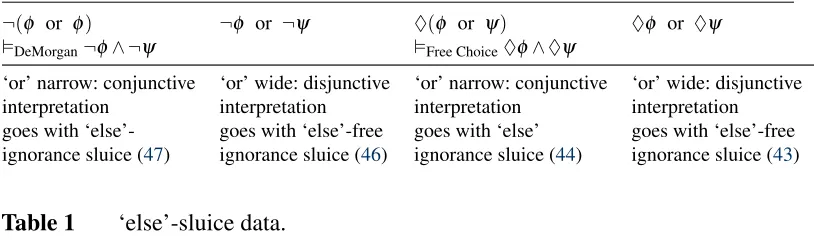
While both types of ignorance sluice are supported, however, the ‘else’-sluice, (47), favors a different parse of the antecedent than the ‘else’-free (46) favors. In particu-lar, it favors the interpretation¬(c or b)≡ ¬c∧ ¬b, on which (47) and the conjunc-tiveantecedent in (48) are equivalent:
(48) Pontius Pilate refused to pardon ChristandPontius Pilate refused to pardon Barabbas, and I don’t know who else [Pontius Pilate refused to pardont].
As in the case of (18), the syntactic structure of (42) and (48) is controversial. Since ‘and’ does not undergo quantifier movement, it is mysterious how there would come to be a trace in the struck-through material in (48) for thewh-element ‘who else’ to bind.
Nonetheless, the interpretive facts are clear: even thoughboththe ‘else’-sluice (47) and the ‘else’-free (46) are ignorance sluices, they differ with respect to the structural interpretations they favor for their shared antecedent. The ‘else’-sluice (47) favors the parse (¬(ϕ orψ)), because this is semantically equivalent to the conjunction (¬ϕ ∧ ¬ψ). By contrast, the ‘else’-free sluice (46) favors the parse (¬ϕ or¬ψ), in which disjunction takes wide scope. Returning to free choice: on the picture offered here, the ‘else’-sluice (44), unlike the ‘else’-free sluice (43), favors the parse (♢(ϕ orψ)) because this is the parse which semantically entails — via free choice — the conjunction (♢ϕ∧♢ψ). This is why the subsequent sluice can presuppose, rather than be felt to cancel, FC.
¬(ϕ or ϕ) ¬ϕ or ¬ψ ♢(ϕ or ψ) ♢ϕ or ♢ψ
⊨DeMorgan¬ϕ∧ ¬ψ ⊨Free Choice♢ϕ∧♢ψ
‘or’ narrow: conjunctive ‘or’ wide: disjunctive ‘or’ narrow: conjunctive ‘or’ wide: disjunctive interpretation interpretation interpretation interpretation goes with ‘else’- goes with ‘else’-free goes with ‘else’ goes with ‘else’-free ignorance sluice (47) ignorance sluice (46) ignorance sluice (44) ignorance sluice (43)
Table 1 ‘else’-sluice data.
The data from (43)-(47), summarized in Table 1, add to our understanding of the conditions under which the apparent cancellation effect obtains for FC. It was al-ready widely known that not all sluices on Free Choice antecedents give rise to apparent cancellation; only ignorance ones do. To this, we can add that not even
all ignorance sluices on FC antecedents give rise to apparent cancellation. Only
early
access
disjunction is naturally interpreted as the locus of ignorance — therefore, disjunc-tion scopes wide in the antecedents of such sluices. Without anything like ‘else’ to change the relevant pragmatic context, this precludes structural interpretations of the antecedent which are in Moorean tension with such ignorance.
5 Conclusion
I’ve explored the implications of Tense Phrase ellipsis — that is, sluicing — for the Free Choice effect. In particular, I argued that the time-honored ‘I don’t know which’-riders on Free Choice sentences, traditionally taken to confine the effect to the farther side of the semantics-pragmatics divide, do not in fact show any such thing. Indeed, the view from sluicing suggests that, when the scope of ‘or’ is nar-rower than the scope of the modal, Free Choice is not cancellable, and hence pat-terns semantically with indefinite “free choice items” (FCIs) like the Englishany.
Beyond the lexical considerations advanced inSection 2, I made the argument by appealing to two highlights from the indefinite-focused sluicing literature. The first, following Ross and Merchant, was simply that sluicingisconstrained by form. The second, following CLM, drilled down into the (at least partially) semantic na-ture of that constraint: to wit, that the licensing operator outscopes anything seman-tically present in the sluice. Finally, I discussed ‘else’-sluices and their ability to target conjunctive interpretations of antecedents featuring ‘or’.
References
Aloni, Maria. 2007. Free choice, modals, and imperatives. Natural Language Se-mantics15. 65–94. https://doi.org/10.1007/s11050-007-9010-2.
Aloni, Maria. 2019. FC disjunction in state-based semantics. Ms., ILLC, University of Amsterdam. maloni.humanities.uva.nl/resources/draft-nyu(revised).pdf. AnderBois, Scott. 2010. Sluicing as anaphora to issues. InProceedings of SALT
20,https://doi.org/10.3765/salt.v20i0.2574.
Barros, Matthew. 2014. Sluicing and identity in ellipsis: Rutgers University disser-tation.
Chierchia, Gennaro. 2006. Broaden your views: Implicatures of domain widening and the ‘logicality’ of language. Linguistic Inquiry 37(4). https://doi.org/10. 1162/ling.2006.37.4.535.
early
access
Dawson, Virginia. 2019. Lexicalizing disjunction scope. In Proceedings of the linguistics society of America, vol. 4, 1–13. https://doi.org/10.3765/plsa.v4i1. 4520.
Dayal, Veneeta. 2004. The universal force of free choiceAny. Linguistic Variation Yearbook4. 5–40. https://doi.org/10.1075/livy.4.02day.
Grice, H. Paul. 1978. Further notes on logic & conversation. In Grice (1991), Harvard University Press.
Grice, H. Paul. 1991. Studies in the way of words. Harvard University Press. Hawke, Peter & Shane Steinert-Threlkeld. 2015. Informational dynamics of ‘might’
assertions. In W. vander Hoek, W. Holliday & W. Wang (eds.),Logic, rational-ity, and interaction, 143–155.
Hawke, Peter & Shane Steinert-Threlkeld. 2016. Informational dynamics of epis-temic possibility modals. Synthese 195(10). 4309–4342. https://doi.org/10. 1007/s1122.
Jacobson, Pauline. 2018. The (persistent) myth of silent linguistic material. Hand-out from talk at PhLiP Conference, Tarrytown, NY, November 2018. Based in part on joint work with Scott AnderBois.
Kadmon, Nirit & Fred Landman. 1993. Any. Linguistics and Philosophy 16(4). 353–422. https://doi.org/10.1007/BF00985272.
Kamp, Hans. 1973. Free choice permission.Proceedings of the Aristotelian Society, New Series74. 57–74.
Kamp, Hans. 1978. Semantics versus pragmatics. In F. Guenthner & S.J. Schmidt (eds.), Formal semantics and pragmatics for natural languages, Reidel, Dor-drecht.
Merchant, Jason. 2001. The syntax of silence. Oxford University Press.
Meyer, Marie-Christine. t.a. An apple or a pear: Free choice disjunction. To appear in Companion to Semantics (Wiley). semanticsarchive.net/Archive/ TNjNDM2M/meyer_fc_2015.pdf.
Ross, John Robert. 1969. Guess who? In R. Binnick, A. Davidson, G.M. Green & J. L. Morgan (eds.),The sixth annual meeting of the northeastern linguistics society, 252–286.
Sæbø, Kjell Johan. 2004. Natural language corpus semantics: The free choice con-troversy.Nordic Journal of Linguistics27(2). 197–218. https://doi.org/10.1017/ S0332586504001210.
Simons, Mandy. 2005. Dividing things up: The semantics ofOrand the modal/Or
interaction. Natural Language Semantics13. 271–316. https://doi.org/10.1007/ s11050-004-2900-7.
early
access
Willer, Malte. 2017. Widening free choice. In A. Cremers, T. van Gessel & F. Roelofsen (eds.),Proceedings of the 21st Amsterdam Colloquium, 511–520. von Wright, G. H. 1969. An essay on deontic logic and the general theory of action.
North Holland: Amsterdam.
Zimmermann, Thomas Ede. 2000. Free choice disjunction and epistemic possi-bility. Natural Language Semantics 8. 255–290. https://doi.org/10.1023/A: 101125581.
Melissa Fusco