ISSN 2324-805X E-ISSN 2324-8068 Published by Redfame Publishing URL: http://jets.redfame.com
The Effect of Group Work on Misconceptions of 9
thGrade Students about
Newton's Laws
Serap Ergin
Correspondence: Serap Ergin, Ahi Evran Mesleki ve Teknik Anadolu Lisesi, Ankara, Turkey
Received: February 19, 2016 Accepted: March 14, 2016 Online Published: March 25, 2016
doi:10.11114/jets.v4i6.1390 URL: http://dx.doi.org/10.11114/jets.v4i6.1390
Abstract
In this study, the effect of group work and traditional method on 9th grade students’ misconceptions about Newton Laws was investigated. The study was conducted in three classes in an Anatolian Vocational High School in Ankara/Turkey in the second term of the 2014-2015 academic year. Two of these classes were chosen as the experimental group and one as the control group. The groups in the experimental group were formed on a voluntary basis with two students in each of them. These experimental groups were given activities which included methods such as concept maps, worksheets, concept cartoons, doing experiments, preparing a project homework and doing case studies. In the control group, the activities which were done in the experimental groups were converted into questions and solved by the students and the teacher. As the assessment tool, ‘Force Motion Misconception Test’ was used, whose validity and reliability studies had been performed by carrying out pilot studies. This test was administered to both the experimental groups and the control group as pre-test before the teaching and post-test after the teaching. The data obtained showed that there was no significant difference in post-tests between the experimental and control group students in terms of misconceptions (p>,05). However, according to the averages, the students in the experimental groups were observed to have fewer misconceptions than those in the control group.
Keywords: Newton’s Laws, group work, misconception
1. Introduction
In 2007, the physics education program in Turkey was modernized for all grades, and huge changes were made. Misconceptions about physics in the scientific literature were also given a place in the program, besides general objectives, basic skills aimed to be achieved, attainments, affective features, assessment and evaluation approaches. The fact that teachers’ attention is drawn to these misconceptions is a positive development. However, it is not enough because it is also necessary to form learning environments aimed at removing the misconceptions that students have, to supply teachers with materials and equipment aimed at application (Çepni, Akdeniz & Keser, 2000; Kurt, 2002) and to arrange curriculum workload and class hours as well.
Educational studies on misconceptions started to increase during 1980s and they are still continuing. When analyzed, it seems that studies on misconceptions are grouped under three topics. The first topic includes studies which aim to determine students’ misconceptions. Studies conducted in this topic suggest that students have misconceptions about almost all the subjects in physics. The most common misconceptions found in physics are about subjects related to energy, motion, impulse, electricity, heat and temperature and force (Aydın, 2007; Ergin & Atasoy, 2013; Goldring & Osborne, 1994; Hestenes, Wells & Swackhamer, 1992; Kurt & Akdeniz, 2004; Kuru & Güneş, 2005). These studies have also shown that not only students at primary, secondary, high school and university levels have such misconceptions but also pre-service and even in-service teachers hold similar misconceptions (Çepni, Akdeniz & Keser, 2000; Genç, 2008; Gürel & Gürdal, 2002; Hestenes, Wells & Swackhamer, 1992; Kurt & Akdeniz, 2004). Considering the results of these studies, the fact that similar misconceptions are held at every level of education may be regarded as a proof of that misconceptions are hard to remove.
change. Students’ misconceptions become permanent and persistent if students can solve problems they face with the concept they already have, if they do not face any problems or cases they can not solve, and if teaching is superficial (Güneş, 2005).
Studies under the third topic consist of using various methods and techniques to replace misconceptions students have with scientifically correct information or reduce them. Concept cartoons (Hand & Treagust, 1991), worksheets (Atasoy, 2008), concept maps (Aydın, 2007), conceptual change texts (Gülçiçek, 2004; Yılmaz, 2010), teaching based on learning styles (Ergin & Atasoy, 2013), usage of analogies (Uğur, 2009), teaching based on 5E model (Yıldız, 2010) and computer-aided teaching (Köse, Ayas & Taş, 2003) aimed at removing students’ misconceptions may be given as examples of such studies. Results from these studies suggest that these methods and techniques have a positive effect. Replacing misconceptions that students have with scientifically correct information requires a process. During this process, students, first of all, have to face their misconceptions. In other words, students need to be made feel that they fall short in explaining events with the help of their current knowledge. After that, the new concept which is scientifically correct has to be presented to the student. In this way, a contradiction will occur in the student’s mind. The fact that the new concept presented to the student is comprehensible, easy, clear, reasonable and convincing will make it easy for the student to adopt. Also, when the student notices that the new concept given helps him/her solve other problems, conceptual change will take place as a result (Hewson & Hewson, 1984; Posner, Strike, Hewson & Gertzog, 1982).
According to Riche (2000), instead of using a single method, keeping students' differences in mind, it will be more effective to use various methods to remove misconceptions. In this study, several different methods and techniques were carried out by forming groups of two so that students could work with their peers. As far as group work is concerned, several different methods can be found in the literature. Most of the studies conducted in this area focus on students' achievement and attitude (Akay, 2011; Bilgin & Geban, 2001; Savaş, 2011; Şekercioğlu, 2011; Tokatlı, 2010). The number of studies conducted on the effect of group work on students' misconceptions is quite small (Snyder & Sullivan, 1995; Tarhan & Sesen, 2012; Ünlüsoy, 2006). That is why, in this study, the effect of group work method on misconceptions about Newton's laws of motion was investigated in comparison with individual work.
2. Method
2.1 Model and the Sample of the Study
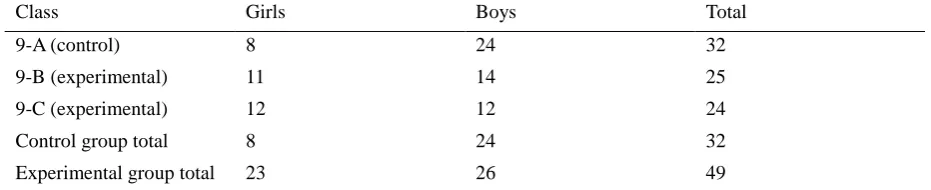
The sample of the study consisted of students attending three 9th grade classes in an Anatolian Vocational High School in Ankara in the second term of the 2014-2015 academic year. Two of these classes were selected as the experimental group and the other one as the control group. Students' ages range from 15 to 17. The numbers of students belonging to the experimental group and the control group are summarized in Table 1.
Table 1. Student numbers of experimental and control groups
Class Girls Boys Total
9-A (control) 8 24 32
9-B (experimental) 11 14 25
9-C (experimental) 12 12 24
Control group total 8 24 32
Experimental group total 23 26 49
As seen in Table 1, the experimental groups consisted of 49 students and the control group consisted of 32 students in total.
2.2 Data Collecting Tools and Data Analysis
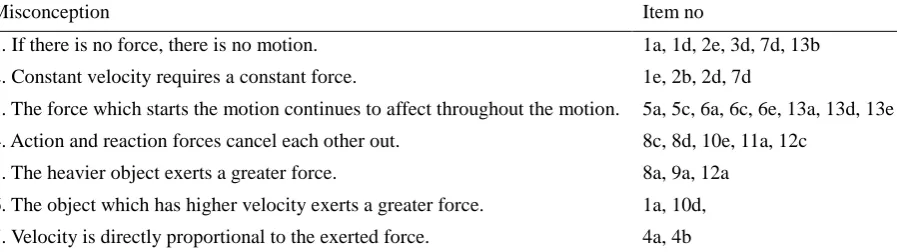
according to Cronbach α, and as 0,65 for the first two steps. This reliability value can be accepted as good for a misconceptions test (DeVellis, 1991). The misconceptions which were aimed to be identified in the test and their item numbers are summarized in Table 2.
Table 2.Misconceptions and item no
Misconception Item no
1. If there is no force, there is no motion. 1a, 1d, 2e, 3d, 7d, 13b
2. Constant velocity requires a constant force. 1e, 2b, 2d, 7d
3. The force which starts the motion continues to affect throughout the motion. 5a, 5c, 6a, 6c, 6e, 13a, 13d, 13e
4. Action and reaction forces cancel each other out. 8c, 8d, 10e, 11a, 12c
5. The heavier object exerts a greater force. 8a, 9a, 12a
6. The object which has higher velocity exerts a greater force. 1a, 10d,
7. Velocity is directly proportional to the exerted force. 4a, 4b
As seen in Table 2, seven misconceptions were measured with 30 choices in 13 questions. Because the numbers of students in the experimental groups and the control group were not equal, the comparison was made by giving the percentage of students who have a misconception instead of the number of students. The test was administered to the experimental groups and the control group as pre-test before the teaching, and as post-test after the teaching.
2.3 Teaching the Lesson in the Groups
In this study, the teaching was carried out in the experimental groups and the control group by the writer of the paper during the 2014-2015 academic year. At the time the study was performed, the writer had a teaching experience of 13 years, and was teaching physics at the school where the study was conducted. Also, the classes in the sample group were the classes the writer taught routinely. That is why there was no need to make additional explanations to the students about the study. In the experimental groups and the control group, the units of '' nature of physics'', ''waves'', ''matter and its qualities'', ''force and motion'' were taught respectively. The first three units were taught with the traditional methods including lectures, question-answer, problem-solving and in-class discussion. In the control group, teaching of the unit ''force and motion'' continued with the traditional method. In the experimental groups, group work was done in this unit. In the group work, which was aimed at enabling students to work with their peers and learn from each other, the groups were presented with various activities and given time to accomplish them. The group work in this study was planned in the way that the students worked in groups of two. The students in the experimental groups were given information about the method before the start of the teaching with the group work method. Also, the belief was expressed to the students that the group work method would contribute to their success. In addition, it was emphasized that each student might be more successful in other lessons. Achievement tests were applied after the first three units had been taught to the experimental groups. These achievement tests were developed by Ergin, Şen & Atasoy (2015) and their validity and realiability studies were conducted. Students' answers were converted into points on a 100-point grading scale, and their arithmetic mean was calculated. For each class in the experimental groups, the students were put in order according to their average scores starting from the highest. Those calasses were divided into two as successful and less successful according to the average scores they got in the previous 3 units. The students were then asked to form groups of two one from the successful group and the other from less successful group on a voluntary basis. Except for a few ones, the students chose their groups on their own.
3. Findings
In this part, analyses of the data obtained through ''Force and Motion Misconception Test'' are given. Because the number of students in the experimental groups and the control group were not equal, instead of the numbers of students who had misconceptions about force and motion, the percentages of students for the first step and the first two steps are summarized in the graphs below. In Graph 1, the data obtained for the misconception ''If there is no force, there is no motion'' is shown.
Graph 1. The percentage of students who have the misconception ''If there is no force, there is no motion''
As seen in Graph 1, the percentages of the experimental and the control group students having the misconception in the pre-tests and post-tests, according to only the first step, are higher than their percentages according to the first two steps. According to the pre-tests, the percentage of the experimental group students having this misconception (26.59%) is higher than that of the control group students (18.57%). According to the first two steps, when the post-tests are analyzed, the percentage of the experimental group students having the misconception for the pre-tests decreases to 26.17% and the control group students increases to 19.28% .The percentages of students who have the misconception ''Constant velocity requires a constant force'' are given in Graph 2.
Graph 2. The percentage of students who have the misconception ''Constant velocity requires a constant force''
As seen in Graph 2, according to the pre-tests, the percentage of students who have this misconception is higher in the control group. According to the first two steps, from the pre-test to the post-test, the percentage of students who have this misconception decreases from 18.92% to 17.85% in the control group while it increases from 14.89% to 17.02% in the experimental group.
Graph 3. The percentage of students who have the misconception ''The force which starts the motion continues to affect throughout the motion''
When Graph 3 is analyzed, it becomes conspicuous that the percentage of experimental group students who have this misconception only in the first step is very high 77%, according to the pre-test. This percentage is reduced almost by half and falls to 47% when it is estimated for the first two steps. According to the pre-test, the percentage of having this misconception among control group students is 51% for the first step, and 41% for the first two steps. In the post-tests, the percentage of having this misconception for the first two steps is 34% in the experimental group and 36% in the control group.
The data for the misconception ''Action and reaction forces cancel each other out'' is summarized in Graph 4.
Graph 4. The percentage of students who have the misconception ''Action and reaction forces cancel each other out''.
According to the Graph 4, the percentage of having this misconception is higher for the first two steps in the control group (17.85%) than in the experimental group (10.63%) in the pre-tests. In the post-tests, the percentage of the control group is 16.07% while that of the experimental group is 7.04%.
The percentages of having the misconception '' The heavier object exerts a greater force'' for interacting objects are summarized for the groups in Graph 5.
According to Graph 5, the percentage of students who have this misconception in the pre-tests for the first two steps is 40.42% for the experimental group, and 30.35% for the control group. The percentage of students who have this misconception is quite high in both groups. According to the post-tests, for the first two steps, the number of students having the misconception increases in the experimental group and becomes 41.48% while it decreases in the control group and becomes 27.14%.
The data for the misconception '' The object which has higher velocity exerts a greater force'' for interacting objects is summarized in Graph 6.
Graph 6. The percentage of students who have the misconception ''The object which has higher velocity exerts a greater force''.
According to Graph 6, for the pre-tests first two steps, the percentage of having this misconception is 58.08% for the experimental group, and 60.71% for the control group. These percentages indicate that students in both groups have this misconception to a very large extent. According to the post-tests, this rate does not change in the control group. However, in the experimental group, it falls to 45.32%.
The data about the last misconception ''Velocity is directly proportional to the exerted force'' is summarized in Graph 7.
Graph 7. The percentage of students who have the misconception ''Velocity is directly proportional to the exerted force''.
In Graph 7, for the first two steps, the percentage of having this misconception for the pre-tests is 51.06% for the experimental group, and 28.57% for the control group. The percentage of the experimental group students having this misconception is almost double the percentage of the control group students. According to the post-tests, the rate of the experimental group students having this misconception falls to 42.55%. However, the same rate rises to 53.57% for the control group. It is remarkable that the rate for this misconception almost doubles in the control group while it decreases in the experimental group.
Table3. The results of the independent samples t-test of the pre-test data of the experimental and the control group
Group N Mean S sd t p
Experimental 32 7,41 1,65 80 0,638 0,526
Control 49 7,14 1,71
According to Table 3, there is no significant difference between the pre-test scores of the experimental group students and the control group students (p>,05). The correlation between the experimental group students' pre-test and post-test scores for misconceptions was assessed using the paired sample t-test and it is summarized in Table 4.
Table 4. The results of the paired sample t-test of the experimental group students' pre-test and post-test scores
Test N Mean S sd t p
Pre-test 32 7,14 1,71 31 22,037 0,000
Post-test 32 5,30 2,37
According to Table 4, there is a significant difference between the experimental group students' pre-test and post-test scores when the data is analyzed (p<,05). When the means are examined, it can be observed that the difference is in favor of the pre-test. So, the experimental group students have more misconceptions in the pre-test. The correlation between the control group students' pre-test and post-test scores for misconceptions was assessed using the paired sample t-test and it is summarized in Table 5.
Table 5. The results of the paired sample t-test of the control group students' pre-test and post-test scores
Test N Mean S sd t p
Pre-test 49 7,41 1,47 48 36,291 0,000
Post-test 49 6,36 2,44
According to Table 5, the data obtained regarding the control group students' misconception indicates that there is a significant difference between the pre-test and post-test scores (p<,000). When the means are examined, the difference is in favor of the pre-test. So, the misconceptions students have in the post-test are fewer than the misconceptions they have in the pre-test.
The scores from the experimental and the control group students' answers for misconceptions were compared according to the independent samples t-test and the results are summarized in Table 6.
Table 6. The results of the independent samples t-test of the experimental group and the control group students' post-test scores
Group N Mean S sd t p
Experimental 49 5,30 2,20 80 1,97 0,052
Control 32 6,36 2,37
According to Table 6, there is no significant difference between the post-test scores of the experimental group and the control group students regarding their answers with misconceptions (p>,05). When the means are examined, it can be observed that the control group students' scores are higher. So, the experimental group students' answers with misconceptions are fewer than those of the control group students while there is not a significant difference between them.
4. Conclusion and Discussion
pre-tests. However, there is no change in the misconception ''The object which has higher velocity exerts a greater force'' in the post-test, in comparison with the pre-tests. Not many studies have been reported on the effects of group work methods, which have various applications, on removing misconceptions. Different results have been obtained from the studies that have been carried out. While Tarhan and Sesen (2012), Ünlüsoy (2006) found that group work had a significant effect on removing misconceptions, Snyder and Sullivan (1995) found that it had no significant effect.
According to the data obtained, it is apparent that the lowest rate in the post-tests for both groups belongs to the misconception ''Action and reaction forces cancel each other out''. However, the high rate of the misconceptions ''The heavier object exerts a greater force'' and ''The object which has higher velocity exerts a greater force'' for interacting objects, which are connected to the aforementioned misconception, in both groups indicates that this misconception is, in fact, not removed and it shows up through different questions. According to Stinner (1994), the misconceptions that students have about Newton's laws occur because students explain events in their daily lives intuitively.The interpretations that students make based on their limited observations are in parallel with the history of science and mostly in conflict with Newton's laws. The same situation was observed during the teaching. For example, it was seen that the students had difficulty in explaining the relation between the fact that the action and reaction forces are equal during a collision for two cars that crash and the fact that the smaller car suffers greater damage. A similar situation was also observed in collisions between fast and slower objects. Another observation was that the students considered ''force'' directly connected with motion because ''force'' is an abstract concept which can be perceived through the effect it exerts.
According to Table 3, there is no difference between the experimental group and the control group students' pre-test scores. According to Table 4 and Table 5, a significant difference in favor of the pre-tests is observed between the experimental group and the control group students' post-tests and pre-tests. In parallel with these results, it can be stated that the teaching was effective, for both groups, in removing the misconceptions the students had at the beginning. When the post-test results of the experimental group and the control group students were compared, it was found that there was not a significant difference according to Table 6 (p>.05). When the average scores of the groups are examined, it is observed that the experimental group students have a lower average of having misconceptions. In other words, the group work method, in comparison with the traditional method, brought about a reduction in misconceptions although this reduction is not significant. While the teaching was being performed in the experimental group, conceptual teaching was tried to be carried out through giving the groups activities including conceptual cartoons, worksheets, case studies, doing experiments, asking open ended questions, and preparing/presenting performance homework. As regards the control group, these activities were converted into questions, and solved in the class with the teacher and in the way that the students were given the opportunity to study individually without group work. It is thought that some of the decrease in the misconceptions in the control group is due to the fact that the questions containing misconceptions about Newton's laws were answered by the teacher clearly and briefly, and the students accepted these explanations without much questioning. In addition, the questions given on the basis of conceptual teaching may have reduced students' misconceptions. As regards the experimental group, the same misconceptions were studied with different activities, and by enabling students to have discussions with their peer in the same group. According to Lucas (2009), although group work ensures that passive students participate in the lesson, it is disadvantageous while solving detailed questions due to time limitations. So, it is possible that the students in the experimental group did not have the chance to discuss and analyze adequately because they had to finish the activities within a certain amount of time. After the time given for the activities finished, the answers were taken from the groups, and if the majority's answer was correct, the students were allowed to solve the activity. If the answer from more than half of the class was incorrect, necessary explanations were made by the teacher. During the teaching in the experimental group, the successful students were observed to be more active while the groups were doing the activities. It is possible that if the successful student had a misconception about the concept, he/she may have explained the case accordingly. If the other student in the group found that explanation plausible or both students had the same misconception and they explained the case with it and they were convinced, this may have caused the misconception to become permanent. Even though the answers to the activities were given later, the explanations students made to each other in their groups may have remained better in students' minds and they may have held onto their ideas because misconceptions are quite resistant to changes (Güneş, 2005).
References
Akay, G. (2011). The effect of peer instruction method on the 8th grade students’ mathematics achievement in transformation geometry and attitudes towards mathematics (Unpublished master’s thesis). The Middle East Technical University, Ankara, Turkey.
Atasoy, Ş. (2008). Öğretmen adaylarının Newton’un hareket kanunları konusundaki kavram yanılgılarının giderilmesine yönelik geliştirilen çalışma yapraklarının etkililiğinin araştırılması (Unpublished doctoral dissertation). Karadeniz Technical University, Trabzon, Turkey.
Aydın, Z. (2007). Isı ve sıcaklık konusunda rastlanan kavram yanılgıları ve bu kavram yanılgılarının giderilmesinde kavram haritalarının kullanılması (Unpublished master’s thesis). Yüzüncü Yıl University, Van, Turkey.
Bilgin, İ., & Geban, Ö. (2001). Benzeşim (Analoji) yöntemi kullanarak lise 2. sınıf öğrencilerinin kimyasal denge konusundaki kavram yanılgılarının giderilmesi. Hacettepe Üniversitesi Eğitim Fakültesi Dergisi, 20, 26-32. Çepni, S., Akdeniz, A. R., & Keser, Ö. F. (2000). Fen Bilimleri Öğretiminde Bütünleştirici Öğrenme Kuramına Uygun
Örnek Rehber Materyallerin Geliştirilmesi. 19. TFD Fizik Kongresi, Fırat University, Elazığ,Turkey.
Demircioğlu, H. (2003). Sınıf öğretmen adaylarının kimya kavramlarını anlama düzeyleri ve karşılaşılan yanılgılar (Unpublished master’s thesis). Karadeniz Technical University, Trabzon, Turkey.
DeVellis, R. F. (1991). Scale development. London: Sage Publications.
Duit, R., & Treagust, D. F. (1995). Students’ Conceptions And Constructivist Teaching Approaches, In Improving Science Education. University Of Chicago Pres, Illinois Chicago.
Ergin, S., & Atasoy, Ş. (2013). Comparative analysis of the effectiveness of 4MAT teaching method in removing pupils’ physics misconceptions of electicity. Journal of Baltic Science Education, 12(6), 730-746.
Ergin, S., Şen A. I., & Atasoy, Ş. (2015). The Impact of Peer Instruction on the Level of the Continuous Physics Achievement of Grade 9 Students. 6th World Conference, On Learning, Teaching and Educational Leadership. 29-31 October 2015, Paris, France.
Geban, Ö., Ertepınar, H., Yayla, N., & Işık, A. (1999). Elektro Kimya Konusu Kavram Yanılgıları. III. Ulusal Fen Bilimleri Egitimi Sempozyumu, 23–25 Eylül 1999, Karadeniz Technical University, Trabzon, Turkey.
Genç, G. (2008). İlköğretim 6. sınıf öğrencilerinin kuvvet ve hareket konusunu anlama düzeyleri ve kavram yanılgıları (Unpublished master’s thesis). Atatürk University, Erzurum, Turkey.
Goldring, H., & Osborne, J. (1994). Students’ difficulties with energy and related concepts. Physics Education, 28, 26– 31. http://dx.doi.org/10.1088/0031-9120/29/1/006
Gülçiçek, N. (2004). Kavramsal değişim metinlerinin öğrencilerin manyetizma konusunu anlamalarına ve fizik tutumlarına etkisi (Unpublished master’s thesis). Gazi University, Ankara, Turkey.
Güneş, B. (2005). Konu Alanı Ders Kitabı İnnceleme Kılavuzu: IV. Bölüm, Bilimsel Hatalar ve Kavram Yanılgıları. Gazi Kitabevi: Ankara.
Gürel, Z., & Gürdal, A. (2002). 7–11. sınıf öğrencilerinin yerçekimi konusundaki kavram yanılgıları. Burdur Eğitim Fakültesi Dergisi, 3, 42–55.
Hand, B. & Treagust, D. F. (1991). Student achievement and science curriculum development using a constructivist
framework. School Science and Mathematics, 91(4), 172-176.
http://dx.doi.org/10.1111/j.1949-8594.1991.tb12073.x
Hestenes, D., Wells, M., & Swackhamer, G. (1992). Force concept inventory. The Physics Teacher, 30, 141-158. http://dx.doi.org/10.1119/1.2343497
Hewson, P. W., & Hewson, M. G. (1984). The role conceptual conflict in conceptual change and the design of science instruction. Instructional Science, 13(1), 13. http://dx.doi.org/10.1007/BF00051837
Köse, S., Ayas, A., & Taş, E. (2003). Bilgisayar destekli öğretimin kavram yanılgıları üzerine etkisi: “Fotosentez”. Pamukkale Üniversitesi Eğitim Fakültesi Dergisi, 2(14), 106- 112.
Kurt, Ş. (2002). Fizik öğretiminde bütünleştirici öğrenme kuramına uygun çalışma yapraklarının geliştirilmesi (Unpublished master’s thesis). Karadeniz Technical University, Trabzon, Turkey.
Kurt, Ş., & Akdeniz, A. R. (2004). Farklı Düzeylerdeki Öğrencilerde Kuvvet Kavramı ile İlgili Yanılgılar. XII. Eğitim Bilimleri Kongresi, Bildiriler Kitabı, Cilt III, 1931–1950, Ankara, Turkey.
Eğitim Fakültesi Dergisi, 25(2), 1-17.
Lucas, A. (2009). Using Peer Instruction and I- Clickers to Enhance Students Participation in Calculus, PRIMUS, 19(3), 219- 231. http://dx.doi.org/10.1080/10511970701643970
Naylor, S., & Keogh, B. (1999). Constructivism in classroom: Theory into practice. Journal of Science Teacher Education, 10 (2), 93-106. http://dx.doi.org/10.1023/A:1009419914289
Posner, G. J., Strike, K. A., Hewson, P. W., & Gertzog, W. A. (1982). Accommodation of a scientific conception: Toward a theory of conceptual change. Science Education, 66, 211-227. http://dx.doi.org/10.1002/sce.3730660207
Riche, R. D. (2000). Strategies for assisting students overcome their misconceptions in high school physics. Memorial University of Newfoundland Education. 6390.
Savaş, E. (2011). Akran öğretimi destekli bilimsel süreç becerileri laboratuvar yaklaşımının öğretmen adaylarının bilimsel süreç becerilerine etkisi (Unpublished master’s thesis). Balıkesir University, Balıkesir, Turkey.
Şekercioğlu, A. (2011). Akran öğretimi yönteminin öğretmen adaylarının elektrostatik konusundaki kavramsal anlamalarına ve tutumlarına etkisi (Unpublished doctoral dissertation). Balıkesir University, Balkesir, Turkey. Snyder, T., & Sullivan, H. (1995). Cooperative and individual learning and student misconceptions in science.
Contemporary Educational Psychology, 20, 230-235. http://dx.doi.org/10.1006/ceps.1995.1015
Stinner, A. (1994). The story of force: From Aristotle to Einstein. Physics Education, 28, 77-85. http://dx.doi.org/10.1088/0031-9120/29/2/005
Tarhan, L., & Sesen, B. (2012). Jigsaw cooperative learning: Acid-base theories. Chemistry Education Research and Practice, 13, 307-313. http://dx.doi.org/10.1039/C2RP90004A
Tokatlı, F. R. (2010). Kavramsal değişim yaklaşımı, işbirlikli öğrenme ve bilgisayar destekli öğretimin öğrencilerin fen başarısına etkisi (Unpublished master’s thesis). Sakarya University, Sakarya, Turkey.
Uğur, G. (2009). Doğru akım devreleri ile ilgili olarak, 11. sınıf öğrencilerinde oluşmuş kavram yanılgılarının giderilmesine ve öğrencilerin fizik dersine karşı tutumlarına analoji kullanımının etkisinin araştırılması. (Unpublished maters’ thesis). Atatürk University, Erzurum, Turkey.
Ünlüsoy, M. (2006). Orta öğretim fizik müfredat konularından “İmpuls ve Momentum” konularındaki kavram yanılgılarının tespiti ve düzeltilmesinde işbirlikli yaklaşımın etkisi (Unpublished master’s thesis). Gazi University, Ankara, Turkey.
Yıldız, E. (2010). 5E modelinin kullanıldığı kavramsal değişime dayalı öğretimde üst bilişin etkileri: 7. sınıf kuvvet ve hareket ünitesine yönelik bir uygulama (Unpublished doctoral dissertation). Dokuz Eylül University, İzmir, Turkey. Yılmaz, Z. A. (2010). Kavramsal değişim metinlerinin üniversite öğrencilerinin geometrik optik konusundaki kavram yanılgılarının düzeltilmesi ve fizik dersine karşı tutumlarına etkisinin incelenmesi (Unpublished doctoral dissertation). Atatürk University, Erzurum, Turkey.