© 2015, IJRLS All Rights Reserved www.ijrls.in Page 42
RESEARCH TRENDS IN FORENSIC
SCIENCE: A STUDY OF SCIENTOMETRIC
ANALYSIS
Kumbar, Prakash
1; Biradar, Nirmala
2Librarian, Karnataka Institute of Leather Technology, Bangalore-560011
1;
Guest Assistant Librarian, Prof. S. S. Basavanal Library, Karnatak University,
Dharwad-580003
2[email protected]
1;
[email protected]
2ABSTRACT
The study explores and analyses the various bibliometric components of the research articles published on-line version of Web of Science in the field of forensic sciences during 2001-2015. The various bibliometric components of the 2108 research records published in the study period were studied. The study reveals the various aspects of forensic sciences literature. Such as year wise distribution, geographical wise, organization wise, Language wise, form wise, most prolific authors and funding agency etc. The highest number of articles was published in the year of 2015, while lowest numbers of research articles were reported in the year 2002. Most of the research publications are published in English language and most of the publications published in the form of research articles.
Keywords: Bibliometrics, Forensic sciences, Authorship Productivity, Web of Science.
1.
INTRODUCTION
Scientometrics is the study dealing with the quantification of written communications, which helps, in the measurement of the published knowledge. It throws light on the pattern of growth literature, Inter relationship among different branches of knowledge, productivity, authorship patter, and degree of collaboration, pattern of collection building, and their use. It helps in formulating need-based collection building policy and provides authentic data to inform managers to take judicious decisions in the process of documents' selection. It offers a set of measures for studying the structure and process of scholarly communication. Bibliometrics is defined as the
study and measurement of publication pattern of all forms of written communication and their authorship in a given area of research (Sengupta, 1985). Bibliometrics deals with some of the literature on the history of the three metric fields (which are Scientometrics, Informatics and Librametrics), beginning with earliest Bibliometrics. Cole and Eales (1917) did the first Bibliometric study on the history of 'Comparative Anatomy'. Hulme (1923) first used the expression 'Statistical Bibliography'. Gross and Gross's (1923) study was the third study in the field of bibliometrics. Henkle (1938) used the term 'Statistical Bibliography' in his article in the year 1938. Fussier (1948), Raising (1962) and Barker (1966) used the term 'Statistical Bibliography' in their works. Pritchard (1969) used the term ‘Statistical Bibliography' in his works in preference to 'Bibliometrics'.
The Present study is a bibliometric analysis of Forensic sciences subject. An attempt has been made in this study to find out various characteristics of Forensic sciences literature such as average different types of institutions, Language wise Distribution, Funding Agency wise and Country wise distribution of publications.
2. ABOUT FORENSIC SCIENCE
system.” Thus forensic science is related to the police agencies and to the judiciary. Forensic sciences include, but are not limited to pathology, psychiatry, psychology, odontology, toxicology, molecular biology, entomology. A forensic scientist must be skilled in applying the principles and techniques of the physical and natural science to the analysis of the many types of evidence that may be recovered during crime investigation. Due to the interdisciplinary nature of the field, forensic literature are not limited to core forensic science journal but also can be found in interrelated disciplines of anthropology, chemistry, engineering, entomology, dentistry and physics, among others.
3. WEB OF SCIENCE
The Web of Science is a part of Web of Knowledge; it was launched by Thomson Reuters, and focuses on research published in journals, conferences and books on science, medicine, arts, humanities and social sciences. The Web of Science was created as an awareness and information retrieval tool, but it has acquired an important secondary use as a tool for research evaluation, using citation analysis and bibliometrics. Data coverage is both current and retrospective in the sciences, social sciences, arts and humanities, in some cases back to 1900. Within the research community this data source is often referred by the acronym ‗ISI‘. Unlike other databases, the Web of Science and underlying databases are selective, that is the journals abstracted are selected using rigorous editorial and quality criteria.
4. REVIEW OF LITERATURE
Jones (2003) reviewed the impact factors of forensic science and toxicology journals and opined that the impact factors of these journals are low because the visibility and size of the circulation of these journals are low. During 2005, Jones identified with the help of Web of Science (WOS) the most highly cited papers published in the Journal of Forensic Sciences between 1956 and 2005. The most highly cited paper was by Kasai, Nakamura and White concerning DNA Profiling. Again Jones (2007) analyzed the forensic science journals, their development and distribution and their current status as reflected in the journal impact factor. He concluded that the relatively low impact factors of forensic science journals are due to the small size of the field, fewer active researchers and less pressure to publish. Sauvageau, Desnoyers and Godin (2009) studied the evolution of forensic science literature in two North American journals from 1980 to 2005 and found that forensic science literature in anthropology and DNA have increased
significantly, while the contribution of questioned documents and ballistics have decreased. They also found out that the number of articles per year and the average numbers of authors per article have both increased almost two fold. Jeyasekar and Saravanan (2012) conducted a scientometric study of forensic science to analyze the growth in literature, authorship productivity, the high ranking institution and country. It was found that the forensic science literature doubled between 2001 and 2011. In the same year, Jeyasekar and Saravanan carried out a scientometric analysis of the Indian forensic science literature for the period 2004 to 2011 using the Indian Citation Index (ICI) database. The study revealed that the forensic science publications are found not only in the core journals but also found scattered among journals of allied fields. The All India Institute of Medical Sciences (AIIMS) is the top contributor of Indian forensic science literature. Jeyasekar and Saravanan (2013) carried out a bibliometric study of the Journal of Forensic Sciences and found that there is an increase in publications on digital and multimedia aspects of forensic science and the literature related to application of DNA technology in forensic science is also increasing. The mean degree of authorship collaboration is 0.91.
5. NEED FOR THE STUDY
The present study has been undertaken in an attempt to recognize certain characteristics in the field of Forensic sciences which is covered in Web of Science database, using bibliometrics techniques and identify the trends in various aspects of the literature over a study period of 15 years (2001-2015).
6. OBJECTIVES OF THE RESEARCH
STUDY
The primary objective of the study is to know the research trends and their research output in the field of Forensic sciences during the study period of 2001-2015. The specific objectives of the study are as fallows.
1. To study the growth of forensic science research literature study period 2001-2015.
2. To study the Bibliographical form wise distribution of articles.
3. To study the Language wise distribution of the Articles
5. To know the funding agencies in the field of crystallography
6. To study the global wise distribution of research articles.
7. METHODOLOGY
The records published during 2001-2015 in the field of covered in Web of Science on-line version database was searched and bibliography details like number of records year wise, authors, title, language, country of publications, form wise distribution, Funding agency, etc. were collected and analyzed, which forms sources of data for the present study. The retrieved records were loaded in Ms-Excel and SPSS for the purpose of analysis. The data was analyzed in terms of forensic science literature have been calculated. Further, descriptive statistics was calculated, Language wise, bibliographic form wise, Geographic and funding agency wise are analyzed as per the objectives of the study.
8. ANALYSIS AND INTERPRETATION
Data on the bibliographical records were collected from the on-line version of web of science database pertaining to forensic science subject for the period of 2001-2015. A total of 2108 articles, bibliographical records were collected, which formed the sources for the study. The data was entered in the excel sheet and was coded, tabulated and analyzed with the help of frequency, percentage and meaningful conclusions were drawn.
8.1 Contribution of research publications by
Year wise
Table-1 shows the growth of research publications published in web of science on-line database during the study period of 2001-2015. Altogether there are 2108 publications were published. The highest number of articles 302 (14.32%) was published in the year of 2015, while lowest numbers of research articles was published 66 (3.14%) in the year 2002. The second highest number of articles was published in the year of 2014 (234, 11.10%)
Table-1 Contribution of research
publications by Year wise
8.2 Language wise distribution of the articles
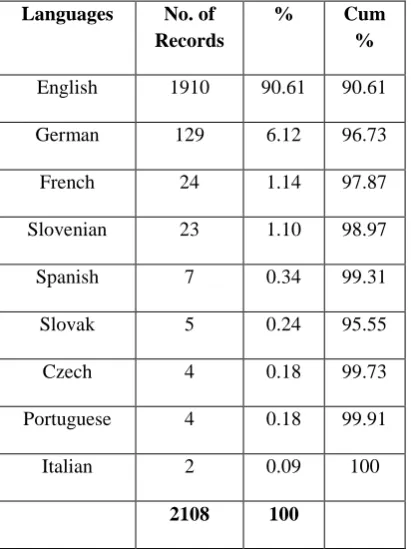
Table-2 shows the Language wise distribution of research articles. It is found that most of the research articles (1910-90.61%) in the field of Forensic sciences were published in English language, it is because of the fact that English is an international language and more over, majority of Science and Technology literature is being (70%) published in English language only. Hence, it articles are reported to be more in English language. Further, meager amount of article are also being published in other language like, German (129-6.12%), French (24-1.14%), Slovenian (23-1.10%), Spanish (7-0.34%), Slovak (5-0.24%), Czech, Portuguese (4-0.18%) and Italian (2-0.09%).
Pub Year
No. of Records
% Cumulative
Growth
%
2001 69 3.28 69 3.28
2002 66 3.14 135 6.42
2003 72 3.42 207 9.84
2004 85 4.04 292 13.88
2005 86 4.07 378 17.95
2006 86 4.07 464 22.02
2007 93 4.44 557 26.46
2008 114 5.40 671 31.86
2009 142 6.73 813 38.59
2010 187 8.87 1000 47.46
2011 167 7.92 1167 55.38
2012 190 9.01 1357 64.39
2013 215 10.19 1572 74.58
2014 234 11.10 1806 85.68
2015 302 14.32 2108 100
Table 2: Language wise distribution of the
articles
8.3
Bibliographical form wise of Research
Publications
Table-3 reveals the Global publication research output published in different bibliographical formats in the field of Forensic sciences during the period of 2001-2015. A total of 2108 records were published, out of which, most of the records in Forensic sciences are published in the form of Research Articles (1594-75.62%). The remaining records are published in other forms like Book Review (223-10.58%), Review (92-4.37%), Editorial Material (88-4.18), Proceedings Paper (74-3.52%), Book Chapter (22-1.05), Biographical Item, Correction (4-0.19%), Letter, Meeting Abstract (2-0.09%), Bibliography, Database Review and Software Review (1-0.04%). It can be concluded from the above analysis that research findings in the field of Forensic sciences are major communicated through research articles as mode transmission of scholarly communication.
Table 3: Bibliographical form wise of
Research Publications
8.4
Geographical
Distribution
of
Contribution of Research output
The geographical distribution of contribution is presented in Table-4, which gives the country wise distribution of contributions of research output. There are about 2108 research contributions made by 50 countries of the world in the field of Forensic sciences during the study period. Out of total 2108 research articles, USA including England contributed highest number of research articles constituting 58.26% of the total contribution. Australia is found to be the next highest country that contributed 144 (6.84%) and Canada (131-6.22%) research articles. However, none of the countries, other than Germany (71-3.37%) and Netherland (57-2.71%) have not contributed more than five percent to the total publications in the field of Forensic sciences during the study period. The overall
Bibliographical wise
No. of Records
% Cum %
Research Article 1594 75.62 75.62
Book Review 223 10.58 86.2
Review 92 4.37 90.57
Editorial Material 88 4.18 94.75
Proceedings Paper 74 3.52 98.27
Book Chapter 22 1.05 99.32
Biographical Item 4 0.19 99.51
Correction 4 0.19 99.7
Letter 2 0.09 99.79
Meeting Abstract 2 0.09 99.88
Bibliography 1 0.04 99.92
Database Review 1 0.04 99.96
Software Review 1 0.04 100
2108 100
Languages No. of
Records
% Cum
%
English 1910 90.61 90.61
German 129 6.12 96.73
French 24 1.14 97.87
Slovenian 23 1.10 98.97
Spanish 7 0.34 99.31
Slovak 5 0.24 95.55
Czech 4 0.18 99.73
Portuguese 4 0.18 99.91
Italian 2 0.09 100
analysis indicates that 50 percent of the research in the field of Forensic sciences is only reported from the top four countries in the world namely USA, England, Australia and Canada.
Table 4: Geographical Distribution of
Contribution of Research output
Country No. of
records
Cum no of records
% Cum
%
USA 881 881 41.80 41.79
England 347 1228 16.47 58.26
Australia 144 1372 6.84 65.1
Canada 131 1503 6.22 71.32
Germany 71 1574 3.37 74.69
Netherlands 57 1631 2.71 77.4
Israel 27 1658 1.29 78.69
Scotland 25 1683 1.18 79.87
Slovenia 21 1704 0.99 8086
France 20 1724 0.94 81.8
Wales 20 1744 0.94 82.74
Norway 19 1763 0.90 83.64
Italy 18 1781 0.85 84.49
Sweden 17 1798 0.80 85.29
Finland 16 1814 0.75 86.04
Other (35
countries) 294 2108 13.96 100
2108 100
8.5 Topmost Ten funding agency in the field
of Forensic sciences
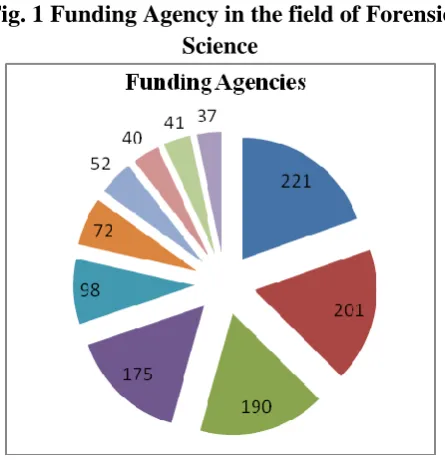
Table-5 Shows the top ten funding agencies who are financially assisting research activities in the field of Forensic sciences, it is evident from the above table that Economic and Social Research Council ESRC 221 is emerging as top funding agency in the world in the field of Forensic sciences, followed by National Institute on Alcohol Abuse and Alcoholism funded for 201 research activities, NSF 190 and Afosr Nuri 175 respectively. Furthermore, ARO assisted 98 research programs, ARO Muri 72, Atlantic Philanthropies USA 52. Bias II a Node of the ESRC S National Center for Research Methods 40, Canadian Institute for Health Research 41 and Clarendon Fund Green Templeton College Annual Fund Scholarship 37 respectively. It can be concluded with above analysis that ESRC is highly supporting research activities in the field of Forensic sciences (Fig-1).
Table 5: Topmost Ten funding agency in the
field of Forensic sciences
Funding Agencies Recor
ds
Rank
Economic and Social Research Council ESRC
221
1
National Institute on Alcohol Abuse and Alcoholism
201 2
NSF 190 3
Afosr Nuri 175 4
ARO 98 5
ARO Muri 72 6
Atlantic Philanthropies USA 52 7
Bias II a Node of the ESRC S National Center for Research
Methods
40 8
Canadian Institute for Health Research
41 9
Clarendon Fund Green Templeton College Annual
Fund Scholarship
Fig. 1 Funding Agency in the field of Forensic
Science
8.6 Most Prolific Authors in the field of
Forensic sciences
Table-6 shows the most prolific authors in the field of Forensic sciences, it is evident that the highest number of articles are contributed by Piquero, A R (Rank-1) followed by Delisi, M (2) the third highest contribution is contributed by Cullen, F T (3). While Farrington, D P (4) research articles, followed Beaver, K M (5), Brame, R (6) and Rafter, N (7). The least no. of articles is contributed by Barnes, J C (Rank-9) and Laub, J H (Rank-10) respectively. It can be summarized from the above discussion that Piquero, A R and Delisi, M are emerging as most prolific authors in the field of Forensic sciences.
Table 6: Most Prolific Authors in the field of
Forensic sciences
Rank Author Contribution
1 Piquero A R 69
2 Delisi M 52
3 Cullen F T 45
4 Farrington D P 39
5 Beaver K M 31
6 Brame R 28
7 Rafter N 19
8 Weisburd D 15
9 Barnes J C 12
10 Laub J H 10
9. FINDING OF THE STUDY
The major findings of the study
1. The year-wise Distribution of 2108 articles published from 2001-2015 Web of Science was seen.
2. The highest number of articles published in the year of 2015 (302, 14.32%).
3. The lowest number of research articles was reported in the year 2002 (66, 3.28%).
4. The highest articles are published in English Language only (1910 - 99.61%) and less than 2 (0.09% records are in Italian language.
5. Most of the Research output is being published in the form of research articles.
6. USA and England are the highest Contributors to the field of Forensic sciences
7. Economic and Social Research Council ESRC and National Institute on Alcohol Abuse and Alcoholism are the major funding agencies in the field of Forensic sciences.
8. Piquero, A R and Delisi, M were contributed highest number of research articles.
10. CONCLUSION
REFERENCE
[1]. Sengupta, I. N Bibliometrics: A Bird Eye View, vol.30, IASLIC Bulletin, 1985, pp.167-174.
[2]. Gross, P. L. K. and Gross, E. M College libraries and chemical education Science, vol. 66, 1923, pp.385-389.
[3]. Henkle, N. H The periodical literature of Bio-Chemistry. vol.27, Bulletin of the Medical library Association, 1938, pp.139-147.
[4]. Pritchard, Alan Statistical bibliography or Bibliometrics. vol.25, Journal of Documentation, 1969, pp.348-349.
[5]. Saferstein, R Criminalistics: An Introduction to Forensic Science. 7th ed., vol.2, New Jersey: Prentice-Hall, 2001, 12-18.
[6]. Jones, A.W Impact factors of forensic science and toxicology journals: What do the numbers really mean? Vol.133, Forensic Science International, 2003, pp.1-8.
[7]. Jones, A.W The distribution of forensic science journals, reflections on authorship practices, vol.165,
peer-review and the role of the impact factor. Forensic Science International, 2007, pp.115-128. [8]. Sauvageau, A., Desnoyers, S and Godin, A. 2009.
Mapping the Literature in Forensic science: A Bibliometric Study of North-American Journals from 1980 to 2005. Vol.2, The Open Forensic Science Journal, 2009, pp.41-46.
[9]. Jeyasekar, J. J. and Saravanan, P Scientometric analysis of forensic science publications: A study based on SCOPUS database. Proceedings of the UGC-SAP National Seminar on Scientometrics and Informetrics. Vol.3 Annamalai Nagar, India: Annamalai University: 2012, pp.75-78.
[10]. Jeyasekar, J. J. and Saravanan, P Scientometric analysis of Indian forensic science literature based on ICI database. Vol.2, Journal of Library Advancements, 2012, pp.1-4.