Available online at http://ijpdr.com ISSN: 2347-6346
Review Article
MICROEMULSION: A NOVEL DRUG DELIVERY SYSTEM
Parth Gandhi*, Jimit Shah, Khalid Mohammad, Ronak Gandhi, Dilip Agrawal. Department of Pharmaceutics, Kota College of Pharmacy, Kota (Rajasthan)
Corresponding Author’s Email: [email protected]
Received 22 July 2013; Revised 04 Aug 2013; Accepted 17 Aug 2013
ABSTRACT
Microemulsions are a thermodynamically stable isotropically clear dispersion of two immiscible liquids, such as oil and water, stabilized by an interfacial film of surfactant molecules. A microemulsion is considered to be a thermodynamically or kinetically stable liquid dispersion of an oil phase and a water phase, in combination with a surfactant. The dispersed phase typically comprises small particles or droplets, with a size range of 5 nm-200 nm, and has very low oil/water interfacial tension. Microemulsions are clear, transparent, thermodynamically stable dispersions of oil and water, stabilized by an interfacial film of surfactant frequently in combination with a co-surfactant. Recently, there has been a considerable interest for the microemulsion formulation, for the delivery of hydrophilic as well as lipophilic drug as drug carriers because of its improved drug solubilisation capacity, long shelf life, easy of preparation and improvement of bioavailability. In this present review, we discuss about the various advantages of microemulsion in pharmaceuticals, along with its preparation, evaluation and research work carried out on microemulsions. Microemulsions are optically isotropic and thermodynamically stable liquid solutions of oil, water and amphiphile. Microemulsions are readily distinguished from normal emulsions by their transparency, low viscosity and more fundamentally their thermodynamic stability. Drug delivery through microemulsions is a promising area for continued research with the aim of achieving controlled release with enhanced bioavailability and for drug targeting to various sites in the body.
INTRODUCTION
The term "microemulsion" refers to a
thermodynamically stable isotropically clear
dispersion of two immiscible liquids, such as oil
and water, stabilized by an interfacial film of
surfactant molecules. A microemulsion is
considered to be a thermodynamically or
kinetically stable liquid dispersion of an oil phase
and a water phase, in combination with a
surfactant. The dispersed phase typically
comprises small particles or droplets, with a size
range of 5 nm-200 nm, and has very low oil/water
interfacial tension. Because the droplet size is less
than 25% of the wavelength of visible light,
microemulsions are transparent. The
microemulsion is formed readily and sometimes
spontaneously, generally without high-energy
input. In many cases a cosurfactant or cosolvent is
used in addition to the surfactant, the oil phase and
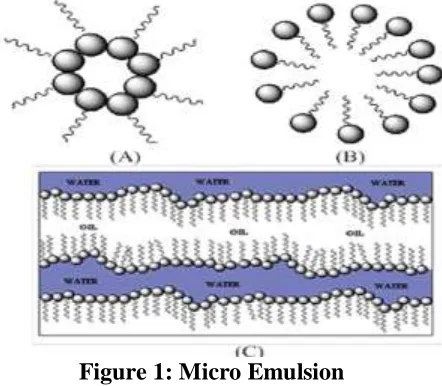
the water phase. Three types of microemulsions
are most likely to be formed depending on the
composition:
Oil in water microemulsions wherein oil droplets
are dispersed in the continuous aqueous phase
Water in oil microemulsions wherein water
droplets are dispersed in the continuous oil phase;
Bi-continuous microemulsions wherein micro
domains of oil and water are inter dispersed within
the system.
In all three types of microemulsions, the interface
is stabilized by an appropriate combination of
surfactants and/or co-surfactants. The key
difference between emulsions and
microemulsions are that the former, whilst they
may exhibit excellent kinetic stability, are
fundamentally thermodynamically unstable and
will eventually phase separate (Shinoda and
Lindman, 1987)
Microemulsions are colloidal dispersions
composed of an oil phase, aqueous phase,
surfactant and co-surfactant at appropriate ratios.
Unlike coarse emulsions micronized with external
energy microemulsions are based on low
interfacial tension. This is achieved by adding a
cosurfactant, which leads to spontaneous
formation of a thermodynamically stable
microemulsion. The droplet size in the dispersed
phase is very small, usually below 140 nm in
diameter, which makes the microemulsions
transparent liquids (Tenjarla, 1999).
In principle, microemulsions can be used to
deliver drugs to the patients via several routes, but
the topical application of microemulsions has
gained increasing interest. The three main factors
determining the transdermal permeation of drugs
are the mobility of drug in the vehicle, release of
drug from the vehicle, and permeation of drug into
the skin (Ktistis and Niopas, 1998). These factors
affect either the thermodynamic activity that
drives the drug into the skin or the permeability of
drug in the skin, particularly stratum corneum.
Microemulsions improve the transdermal delivery
of several drugs over the conventional topical
preparations such as emulsions (Kreilgaard,
2000) and gels (Gasco et al, 1991). Mobility of
drugs in microemulsions is more facile (Kriwet,
Müller-Goymann, 1995), as compared to the
microemulsion with gel former which will
increase its viscosity and further decrease the
permeation in the skin (Trotta, 1999). The
superior transdermal flux from microemulsions
has been shown to be mainly due to their high
solubilization potential for lipophilic and
hydrophilic drugs. This generates an increased
thermodynamic activity towards the skin
(Alvarez-Figueroa and Blanco-Méndez, 2001).
Microemulsions may affect the permeability of
drug in the skin. In this case, the components of
microemulsions serve as permeation enhancers.
Several compounds used in microemulsions have
been reported to improve the transdermal
permeation by altering the structure of the stratum
corneum. For example, short chain alkanols are
widely used as permeation enhancers (Pershing et
al, 1990; Liu et al., 1991; Kim et al., 1992). It is
known that oleic acid, a fatty acid with one double
bond in the chain structure, perturbs the lipid
barrier in the stratum corneum by forming
separate domains which interfere with the
continuity of the multilamellar stratum corneum
and may induce highly permeable pathways in the
stratum corneum (Pershing et al., 1994, Tanojo et
al., 1997, Hadgraft, 2001). Isopropyl myristate
(IPM) is used as a permeation enhancer in
transdermal formulations, but the mechanism of
its action is poorly understood (Goldberg-Cettina,
1995). Nonionic surfactants are widely used in
topical formulations as solubilizing agents but
some recent results indicate that they may affect
also the skin barrier function (Fang, 2001). It is of
interest to explore the effects of these components
in the organized microemulsion structures. The
aim of the present study was to investigate the
potential of several microemulsion formulations
in transdermal delivery of lipophilic drugs.
A unique attempt was made (Acharya et al., 2002)
to emulsify coconut oil with the help of
polyoxyethylene 2-cetyl ether (Brij 52) and
isopropanol or ethanol, forming stable isotropic
dispersion thus paving way for use of plant and
vegetable oil to be used as oil phase in
The surfactants used to stabilise such systems may
be:
Non-ionic,
Zwitterionic,
Cationic, Anionic surfactants
A combination of these, particularly ionic and
non-ionic, can be very effective at increasing the
extent of the microemulsion region. Examples
of non-ionics include polyoxyethylene surfactants
such as Brij 35 (C12E35 ) or a sugar esters such as
sorbitan monooleate (Span 80). Phospholipids are
a notable example of zwitterionic surfactants and
exhibit excellent biocompatibility. Lecithin
preparations from a variety of sources including
soybean and egg are available commercially and
contain diacylphosphatidylcholine as its major
constituent (Attwood et al. 1992, Aboofazeli et
al., 1994, Aboofazeli and Lawrence, 1993,
Shinoda et al., 1991). Quaternary ammonium
alkyl salts form one of the best known classes
of cationic surfactants, with hexadecyltrimethyl
ammonium bromide (CTAB), and the twin-tailed
surfactant didodcecylammonium bromide
(DDAB) are amongst the most well known. The
most widely studied anionic surfactant is
probably sodium bis-2-ethylhexylsulphosuccinate
(AOT) which is twin-tailed and is a particularly
effective stabiliser of w/o microemulsions
(Angelo et al. 1996).
Attempts have been made to rationalise surfactant
behaviour in terms of the hydrophile–lipophile
balance (HLB) (Carlfors et al., 1991), as well as
the critical packing parameter (CPP) (Israel
achvilli et al., 1976, Mitchell and Ninham, 1981).
Both approaches are fairly empirical but can be a
useful guide to surfactant selection. The HLB
takes into account the relative contribution of
hydrophilic and hydrophobic fragments of the
surfactant molecule. It is generally accepted that
low HLB (3–6) surfactants are favoured for the
formation of w/o microemulsions whereas
surfactants with high HLBs (8–18) are preferred
for the formation of o/w microemulsion systems.
Ionic surfactants such as sodium dodecyl sulphate
which have HLBs greater than 20, often require
the presence of a cosurfactant to reduce their
effective HLB to a value within the range required
for microemulsion formation. In contrast, the CPP
relates the ability of surfactant to form particular
aggregates to the geometry of the molecule itself.
In most cases, single-chain surfactants alone are
unable to reduce the oil /water interfacial tension
sufficiently to enable a microemulsion to form, a
point made in a number of pertinent
microemulsions reviews (Bhargava et al.,1987,
Attwood, 1994, Eccleston, 1994, Lawrence, 1994,
Lawrence, 1996). Medium chain length alcohols
which are commonly added as cosurfactants, have
the effect of further reducing the interfacial
interface thereby increasing the entropy of the
system (Attwood, 1994, Eccleston, 1994). Medium chain length alcohols also increase the
mobility of the hydrocarbon tail and also allow
greater penetration of the oil into this region.
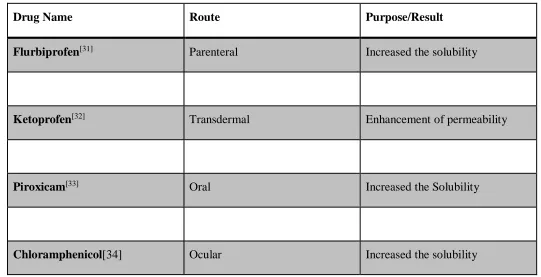
Table 1: Research Work carried out on Microemulsions
Drug Name Route Purpose/Result
Flurbiprofen[31] Parenteral Increased the solubility
Ketoprofen[32] Transdermal Enhancement of permeability
Piroxicam[33] Oral Increased the Solubility
Chloramphenicol[34] Ocular Increased the solubility
PREPARATION OF M ICROEMULSION
The drug is be dissolved in the lipophilic part
of the microemulsion i.e Oil and the water
phases can be combined with surfactant and
a cosurfactant is then added at slow rate with
RESEARCH WORK CARRIED OUT ON
MICROEMULSIONS
gradual stirring until the system is
transparent. The amount of surfactant and
cosurfactant to be added and the percent of
oil phase that can be incorporated shall be
determined with the help of pseudo-ternary
phase diagram. Ultrasonicator can finally be
used so to achieve the desired size range for
dispersed globules. It is then be allowed to
equilibrate.
Gel may be prepared by adding a gelling
agent to the above microemulsion.
Carbomers (crosslinked polyacrylic acid
polymers) are the most widely used gelling
CONSTRUCTION OF PHASE DIAGRAM
Pseudo-ternary phase diagrams of oil, water,
and co-surfactant/surfactants mixtures are
constructed at fixed cosurfactant/surfactant
weight ratios. Phase diagrams are obtained by
mixing of the ingredients, which shall be
pre-weighed into glass vials and titrated with
water and stirred well at room temperature.
Formation of monophasic/ biphasic system is
confirmed by visual inspection. In case
turbidity appears followed by a phase
separation, the samples shall be considered as
biphasic. In case monophasic, clear and
transparent mixtures are visualized after
stirring, the samples shall be marked as
points in the phase diagram. The area covered
by these points is considered as the
microemulsion region of existence.
CHARACTERIZATION OF MICROEMULSION
The droplet size, viscosity, density, turbidity,
refractive index, phase separation and pH
measurements shall be performed to
characterize the microemulsion.
The droplet size distribution of
microemulsion vesicles can be determined by
either light scattering technique or electron
microscopy. This technique has been
advocated as the best method for predicting
microemulsion stability.
Dynamic light-scattering measurements.
The DLS measurements are taken at 90° in a
dynamic light-scattering spectrophotometer
which uses a neon laser of wavelength 632
nm. The data processing is done in the
built-in computer with the built-instrument.
Polydispersity
Studied using Abbe refractometer.
Phase analysis
To determine the type if microemulsion that
has formed the phase system (o/w or w/o) of
the microemulsions is determined by
measuring the electrical conductivity using a
conductometer.
Viscosity measurement
The viscosity of microemulsions of several
compositions can be measured at different
shear rates at different temperatures using
Brookfield type rotary viscometer. The
sample room of the instrument must be
maintained at 37 ± 0.2°C by a thermobath,
and the samples for the measurement are to
be immersed in it before testing.
In Vitro Drug Permeation Studies
Determination of permeability coefficient and flux
Excised human cadaver skin from the
have undergone postmortem not more than 5
days ago in the hospital. The skin is stored at
4C and the epidermis separated. The skin is
first immersed in purified water at 60C for 2
min and the epidermis then peeled off. Dried
skin samples can be kept at -20C for later use.
Alternatively the full thickness dorsal skin of
male hairless mice may be used. The skin
shall be excised, washed with normal saline
and used.
The passive permeability of lipophilic drug
through the skin is investigated using Franz
diffusion cells with known effective
diffusional area. The hydrated skin samples
are used. The receiver compartment may
contain a complexing agent like cyclodextrin
in the receiver phase, which shall increase the
solubility and allows the maintenance of sink
conditions in the experiments. Samples are
withdrawn at regular interval and analyzed
for amount of drug released.
In Vivo Studies
Bioavailability studies: Skin bioavailability of topical applied microemulsion on rats
Male Sprague–Dawley rats (400–500 g),
need to be anesthetized (15 mg/kg
pentobarbital sodium i.p.) and placed on their
back. The hair on abdominal skin shall be
trimmed off and then bathed gently with
distilled water. Anesthesia should be
maintained with 0.1-ml pentobarbital (15
mg/ml) along the experiment.
Microemulsions must be applied on the skin
surface (1.8 cm2) and glued to the skin by a
silicon rubber. After 10, 30 and 60 min of in
vivo study, the rats shall be killed by
aspiration of ethyl ether. The drug exposed
skin areas shall be swabbed three to four
times with three layers of gauze pads, then
bathed for 30 s with running water, wiped
carefully, tape-stripped (X10 strips) and
harvested from the animals.
Determination of residual drug remaining in the skin on tropical administration.
The skin in the above permeation studies can
be used to determine the amount of drug in
the skin. The skin cleaned with gauze soaked
in 0.05% solution of sodium lauryl sulfate
and shall bathed with distilled water. The
permeation area shall be cut and weighed and
drug content can be determined in the clear
solution obtained after extracting with a
suitable solvent and centrifuging.
Pharmacological Studies
Therapeutic effectiveness can be evaluated
for the specific pharmacological action that
the drug purports to show as per stated
guidelines.
As the formulation is intended for dermal
application skin irritancy should be tested.
The dorsal area of the trunk is shaved with
clippers 24 hours before the experiment. The
skin shall be scarred with a lancet. 0.5 ml of
product is applied and then covered with
gauze and a polyethylene film and fixed with
hypoallergenic adhesive bandage. The test be
removed after 24 hours and the exposed skin
is graded for formation of edema and
erythema. Scoring is repeated a72 hours later.
Based on the scoring the formulation shall be
graded as ‘non-irritant’, ‘irritant’ and ‘highly irritant’.
Stability Studies
The physical stability of the microemulsion
must be determined under different storage
conditions (4, 25 and 40 °C) during 12
months. Fresh preparations as well as those
that have been kept under various stress
conditions for extended period of time is
subjected to droplet size distribution analysis.
Effect of surfactant and their concentration
on size of droplet is also be studied
(Aboofazeli and Lawrence, 1993, Lawrence,
1991, Lawrence, 1994)
REFERENCES
Aboofazeli, R., Lawrence, C.B., Wicks, S.R.,
Lawrence, M.J., (1994). Investigations into
the formation and characterisation of
phospholipid microemulsions. III.
Pseudo-ternary phase diagrams of systems containing
water–lecithin–isopropyl myristate and
either an alkanoic acid, amine, alkanediol,
polyethylene glycol alkyl ether or alcohol as
cosurfactant, Int. J. Pharm. 111: 63–72.
Aboofazeli, R. and Lawrence, M.J. (1993).
Investigations into the formation and
characterization of phospholipid
microemulsions: I Pseudo-ternary phase
diagrams of systems containing water–
lecithin–alcohol–isopropyl myristate. Int. J.
Pharm. 93: 161–175.
Acharya, S. P., Moulik, S. K.
Sanyal,Mishra,B. K. and Puri, P. M.,
(2002). Physicochemical investigations of
Microemulsification of Coconut Oil and
Water Using Polyoxyethylene 2-Cetyl Ether
(Brij 52) and Isopropanol or Ethanol. Journal
of Colloid and Interface Science, 245: 163–
170.
Alvarez-Figueroa, M.J. and Blanco-Méndez,
J. (2001). Transdermal delivery of
methotrexate: iontophoretic delivery from
hydrogels and passive delivery from
microemulsions. Int. J. Pharm. 215, 57–65.
Angelo, M.D., Fioretto, D., Onori, G.,
Palmieri, L. and Santucvelocity, A. (1996).
Dynamics of water-containing sodium
micelles: a high-frequency dielectric study.
Phys. Rev. E. 54: 993–996.
Attwood, D., Mallon, C. and Taylor, C.J.
(1992). Phase studies of oil-in water
phospholipid microemulsions, Int. J. Pharm.
84: R5–R8.
Attwood (1994). Microemulsions, in: J.
Kreuter (Ed.), Colloidal Drug Delivery
Systems, Dekker, New York, 31–71.
Bhargava, H.N., Narurkar, A. and Lieb, L.M.
(1987). Using microemulsions for drug
delivery. Pharm. Tech. 11: 46–52.
Carlfors, J., Blute, I. and Schmidt, V. (1991).
Lidocaine in microemulsion - a dermal
delivery system, J. Disp. Sci. Technol. 12:
467–482.
Eccleston, J. (1994). Microemulsions, in: J.
Swarbrick, J.C. Boylan (Eds.), Encyclopedia
of Pharmaceutical Technology, Marcel
Dekker, New York, 375–421.
Fang, J.Y., Yu, S.Y., Wu, P.C., Huang, Y.B.
and Tsai, Y.H., (2001). In vitro skin
permeation of estradiol from various
proniosome formulations. Int. J. Pharm. 215,
91–99.
Gasco, M.R., Gallarate, M. and Pattarino, F.
(1991). In vitro permeation of azelaic acid
from viscosized microemulsions. Int. J.
Pharm. 69: 193–196.
Goldberg-Cettina, M., Liu, P., Nightingale, J.
and Kurihara-Bergstrom, T. (1995).
Enhanced transdermal delivery of estradiol in
vitro using binary vehicles of isopropyl
myristate and short-chain alkanols. Int. J.
Pharm. 114: 237–245.
Hadgraft, J. (2001). Skin, the final frontier.
Int. J. Pharm. 224, 1–18.
Israelachvilli, J.N., Mitchell, D.J. and
Ninham, B.W. (1976). Theory of self
assembly of hydrocarbon amphiphiles into
micelles and bilayers, J. Chem. Soc. Faraday
Trans. 72: 1525–1567.
Kim, Y.H., Ghanem, A.H., Mahmoud, H. and
Higuchi, W.I. (1992). Short chain alkanols as
transport enhancers for lipophilic and
polar/ionic permeants in hairless mouse skin:
mechanism(s) of action. Int. J. Pharm. 80:
17–31.
Kreilgaard, M., Pedersen, E.J. and
Jaroszewski, J.W. (2000). NMR
characterization and transdermal drug
delivery potential of microemulsion systems.
J. Control. Release 69: 421–433.
Kriwet, K. and Müller-Goymann, C.C.
(1995). Diclofenac release from phospholipid
drug systems and permeation through excised
human stratum corneum. Int. J. Pharm. 125:
231–242.
Ktistis, G. and Niopas, I., 1998. A study on
the in-vitro percutaneous absorption of
propranolol from disperse systems. J. Pharm.
Lawrence, M.J. (1994). Surfactant systems:
microemulsions and vesicles as vehicles for
drug delivery. Eur. J. Drug Metab.
Pharmacokinet. 3: 257-269.
Lawrence, M.J. (1996). Microemulsions as
drug delivery vehicles. Curr. Opin. Colloid
Interface Sci. 1: 826–832.
Liu, P., Kurihara-Bergstrom, T. and Good,
W.R. (1991). Cotransport of estradiol and
ethanol through human skin in vitro:
understanding the permeant/enhancer flux
relationship. Pharm. Res. 8: 938–944.
Mitchell, D.J. and Ninham, B.W. (1981).
Micelles, vesicles and microemulsions, J.
Chem. Soc. 77: 601–629.
Pershing, L.K., Parry, G.E. and Lambert,
L.D. (1993). Disparity of in vitro and in vivo
oleic acid-enhanced b-estradiol percutaneous
absorption across human skin. Pharm. Res.
10: 1745– 1750.
Pershing, L.K., Lambert, L.D. and Knutson,
K., (1990). Mechanism of ethanol-enhaced
estradiol permeation across human skin in
vivo. Pharm. Res. 7: 170–175.
Shinoda, K. and Lindman, B. (1987).
Organised surfactant systems:
microemulsions. Langmuir. 3: 135–149.
Shinoda, K., Araki, M., Sadaghiani, A.,
Khan, A. and Lindman, B. (1991).
Lecithin-Based Microemulsions: Phase Behaviour and
Micro-Structure. J. Phys. Chem. 95: 989–93.
Tenjarla SN. (1999). Microemulsions: An
overview and pharmaceutical applications.
Critical Reviews TM in Therapeutic Drug Carrier Systems 16: 461–521.
Trotta, M. (1999). Influence of phase
transformation on indomethacin release from
microemulsions. J. Control. Release 60:
399–405.
Tanojo, H., Junginger, H.E. and Boddé, H.E.,
1997. In vivo human skin permeability
enhancement by oleic acid: transepidermal
water loss and Fourier-transform infrared
spectroscopy studies. J. Control. Release. 47,