Correlations of Biomechanical Characteristics with Ball Speed in Penalty Corner Push-In
Effect of Partial substitution of Ag on the Structural and Electrical Properties of High
Temperature HgBa
2Ca
2Cu
3O
8+δSuperconductor
Noor S. Abed1, Sabah J. Fathi2 & Kareem A. Jassim3
1Department of Physics, College of Sciences, Kirkuk University, Kirkuk, Iraq. 2Department of Physics, College of Sciences, Kirkuk University, Kirkuk, Iraq. 3
Department of Physics, College of Education for Pure Science (Ibn-AL-Haitham), Baghdad University, Iraq.
Received 14th May 2017, Accepted 15th June 2017
Abstract
The effect of the Ag partial substitution at Hg site in HgOδ layer on the structure ,Tc and oxygen content for
Hg-1223 have been studied .High temperature superconductor composition Hg1-xAgxBa2Ca2Cu3O8+δ, with x=(0.0, 0.05, 0.1,
0.15, 0.2, 0.25 and 0.3) have been prepared using solid state reaction method. Annealing temperature 850 C0 for (24) hours with a rate of 5C˚/min and under a pressure of 7 ton/cm2. XRD analysis showed a tetragonal polycrystalline structure with high ratio of Hg-1223 phase and increase of c-axis lattice parameter with increase Ag rate. The surface morphology has been studied by using atomic force microscopes (AFM) in 3D. The results showed that all specimens have good crystalline and homogeneous surface. Also give a best Nano size value is 77.52 nm at x=0.3. Four probe technique is used to measured Tc . The highest Tc was found to be Tc=144 K for x=0.3, and oxygen contend was observed increase with increase
Ag content.
Keywords: HgBa2Ca2Cu3O8+δ, Superconductor, Solid state reaction metho , Structural Properties.
© Copy Right, IJRRAS, 2017. All Rights Reserved.
1. Introduction
Superconductivity is a phenomenon, which was observed by Kamerlingh Onnes in 1911. When temperature decreases to below a critical value, electric resistance of a superconductor disappeared and the magnetic field is expelled [1]. The first member of HgBa2Can-1CunO2n+2+δ series, was HgBa2CuO4+δ,
fabricated by Putilin et. al. in 1993 [2]. In 1993 Schlling et. al. [3,4] concluded that the critical temperature was equal to 133 K for a compound HgBa2Ca2Cu3O8. This
has achieved a significant jump in the critical temperature of superconducting compounds at high temperatures. The highest values of Tc which were
calculated for HgBa2Can-1CunO2n+2+δ series were 97K [5]
, 123K [6] 127K [7], and 135K [8], for 1201, Hg-1234 phases, Hg-1212, and Hg-1223 respectively. The Tc value of Hg-1223 raise up to 164 K under high
pressures of 30 GPa [9,10]. HBCCO superconductor phases most important series of all HTSC cuprates because of the high Tc and the extra oxygen existence
appear by this series [11]. There are difficulties in preparation of Hg-based superconductors, because of the toxic mercury steam and the low decomposition temperatures of the compounds containing mercury and the relative instability of these materials.All cuprates are
Correspondence Noor S.Abed
E-mail: [email protected]
very sentient to carries doping and, it was found that the most efficient way to enhance the stabilization of the Hg-1223 phase is by partial substitution with cations having oxidation states higher than +2 i.e. higher than Hg+2 (e.g. Tl+3, Re+4 etc) [12,13,14].
M. M. Abbas [15] reported that substitution of Cu (0≤x≤0.5) at Hg site in HgOδ layer in the Hg-1223
lead to enhanced Tc . The Tc HgBa2Ca2Cu3O8+δ was
118K .
While best value of Tc=153K and lattice
parameters a=b= 3.841969, c= 15.79734 for sample with (x=0.3).
O. Babych et. al. [16] prepared 15% Pb, 5% Fe and 5% Cd doped mercury HgBa2Ca2Cu3O8+δ using
Hg-free precursor Ba2Ca2Cu3O8+δ which obtained by sol-gel
method. They noticed the superconducting plate grains size is (10–20) μm and there are non-superconducting phases of doped Hg-1223 ceramics surface. The Fe doped samples of HgBa2Ca2Cu3O8+δ exhibit decreasing
Tc, with increase in the critical current in grain to 6800
A/cm2.
M. Abdul-Nebi et. al. [17] studied Hg0.5Pb 0.5-xSbxBa2Ca2Cu3O8+δ HTSC (x= 0, 0.10 and 0.15)
prepared by solid state reaction method. They founded that the behavior of the composition which has no Sb is semiconductor. whereas the substitution of Sb content in the Hg0.5Pb0.5-xSbxBa2Ca2Cu3O8+δ convert from normal
state (x=0.1) to superconducting state (x=0.15) with (Tc=
126K).
F. H. S. Eleuterio et. al. [18] analyzed granular
International
Noor et al. 2017 ISSN: 2349 – 4891
composition and measure magnetic response of Hg0.82Re0.18Ba2Ca2Cu3O8.76 composition. The AC
magnetic susceptibility of a powder sample have Tc=133
K with a particle size of 20 μm. The AC magnetic sample susceptibility shows two Tc at 133 and 98 K after
crushed powder and sieved.
K. A. Jassim et.al. [19] prepared Hg
0.6Tl0.4Ba2Ca2(Cu1-xAgx)3O8+δ samples using solid state
reaction for x=(0-0.7).XRD analysis exhibit a tetragonal structure for all specimens. Lattice constant and Tc are
reduced with addition Ag.
In this paper we studied the effect of partial substitution of Ag on the oxygen content, structural
properties and transition temperature of
HgBa2Ca2Cu3O8+δ HTSC compounds.
2. Experimental methods:
The Hg1-xAgxBa2Ca2Cu3O8+δ samples with
different Ag (x=0.0, 0.05, 0.1, 0.15, 0.2, 0.25, 0.3) were prepared by using solid state reaction method using mixed oxides powder of HgO, AgO, BaO, CaO and CuO with a purity of 99.99%. The starting materials were mixed and ground in a gate mortar.Isopropanol is added during the grinding process to avoid the loss of parts of the powder during the grinding process. Then it is placed inside an electric oven at a temperature of 100 C0 to remove the isopropanol alcohol. The powder was pressed into disc shaped pellets (1.5 cm) in diameter and (0.3) cm thickness, using hydraulic press under a pressure of (7 ton/cm2) .The pellets were sintered in air at (850) C0 for (24) hours with a rate of 5C˚/min then cooled to room temperature by same rate of heating. Four probe method at temperature range (77-300)K was used to measure the resistivity(ρ) [20].Critical temperature (Tc)
calculated using the relation:
𝜌 = (𝑅 ∗ 𝐴)/𝐿………(1)
Where R is electric resistance, A is area of specimens and L is length of specimens. The structure properties of the 1223-phase was checked using X-ray diffraction technique using (Shimadzu XRD-6000) diffractometer with source Cu-Kα (1.5406 Å) radiation. The lattice parameters a, b and c were calculated by using d-values and (hkl) reflection of the observed XRD using standard card of Hg-1223 (ICDD-045-0615). The oxygen content determined using a chemical method called iodometric titration was described elsewhere [21]. The volume fraction for any phase determined by using the relation:
𝑉𝑝ℎ = 𝐼 𝐼ᵒ
ᵒ+ 𝐼1+ 𝐼2+ 𝐼𝑛 *100%………(2)
Where I˚is the XRD peak intensity of the phase which were determined, I1,I2,…In are the peaks intensity of all XRD. The mass density (dm) calculated using the relation [22]:
𝑑𝑚 𝑔𝑚 𝑐𝑚3 =
𝑀𝑤𝑡
𝑁𝐴×𝑉………(3)
Where 𝑁𝐴is Avogadro number (6.022*1023 mol
-1
), 𝑀𝑤𝑡is molecular weight, V is volume of unit cell
which equal (a2*c) for tetragonal system. Atomic Force Microscopy (AFM) micrographs were recorded by using scanning probe microscope type (SPM- AA3000), Contact mode, supplied by Angstrom Advanced Inc.
3. Results and discussion :
3.1. X-Ray Diffraction Results : The structures of Hg 1-xAgxBa2Ca2Cu3O8+δ, with x=(0.0, 0.05, 0.1, 0.15, 0.2,
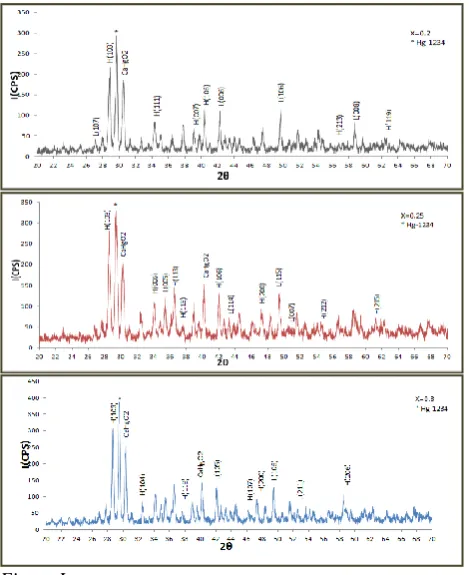
0.25, 0.3) were well established by X-ray diffraction analyses. Figure-I shows the X-ray diffraction patterns for samples which were prepared using solid state reaction. The positions and intensities of the diffraction peaks appear that samples mainly consist of a major 1223 phase and a small amount of a minor (1212 and 1234) phase and a small amount of impurity (CaHgO2 )
which are agreement with reference [23]. The appearance of more than two phases could be related to the stacking faults along the c-axis. High-Tc phase
Figure I
XRD pattern of Hg1-xAgxBa2Ca2Cu3O8+δ, superconductor
compounds with x=(0.0, 0.05, 0.1, 0.15, 0.2, 0.25, 0.3)
The lattice parameters a, b, c which presented in the Table-1 shows tetragonal symmetry structure for all our samples. The c-axis lattice constant increase with increase of Ag ratio. These results were almost identical to those reported in reference [24] and a-lattice parameter changes little. This result may be, because of the larger ionic radius of Ag+2 (1.26 A0) than that of Hg+2 (1.02 A0).This will be a driving force to the pairing generation of superconductor holes forming bosons which arethe current carriers in our superconductor.
Table 1
Lattice parameters of Hg1-xAgxBa2Ca2Cu3O8+δ
compounds
3.2. Tc and Oxygen Content Results : The change of Tc
is related with δ. Oxygen content increase with increase Ag concentration as presented in the Table-2. Since the
substitution of Ag in Hg site leads to produce chemical pressure in HgOδ layer. generally increase the pressure
mean increases the hole which lead to disorders in structure, and this disorder is found reflected the Tc (δ)
behavior. At x=0.3, the oxygen content (δ) and Tc gets a
maximum value. These results were almost identical to those reported in references [15].
Table 2
Oxygen content and critical temperature (Tc) for
Hg1-xAgxBa2Ca2Cu3O8+δ compounds
Figure II shows the electrical resistivity as function of temperature for Hg1-xAgxBa2Ca2Cu3O8+δ,
HTSC with (0≤x≤0.3). Samples shows a metallic behavior, followed by a superconductivity transition with Tc =120, 126, 128, 133, 138, 140, 144K respectively.
ThisDue to firstly, the Ag partial substitution may lead to change in the carrier density of states indicating unlike magnetic moments, secondly, the positive contribution of the Ag element to the coupling process in the CuO layer which responsible for the superconductivity, leads to an increase in the c-lattice parameter, which leads to raise in Tc values.
Figure II
The electrical resistivity vs. temperature behavior of Hg 1-xAgxBa2Ca2Cu3O8+δ, for (0≤x≤0.3)
Figure III show Tc as a function of Ag content
from 0.0 to 0.3. It is found that, with increasing of Ag contents, the Tc will increase.
x a=b (A˚) c(A˚) v(A˚)³ dm
(gm/cm³)
V- ph(1223)
0 3.8383 15.7817 232.5652 6.2397 70.54
0.05 3.8385 15.7919 232.6185 6.2052 75.12
0.1 3.8384 15.7934 232.8632 6.1656 76.65
0.15 3.8381 15.7954 232.6528 6.1381 76.55
0.2 3.8388 15.7981 232.8202 6.1007 77.27
0.25 3.8379 15.7990 232.6580 6.0718 77.47
0.3 3.8380 15.8011 232.7099 6.0374 78.84
x Tc(K) δ
0 120 0.2931
0.05 126 0.3046
0.1 128 0.3078
0.15 133 0.3143
0.2 138 0.3189
0.25 140 0.4056
Noor et al. 2017 ISSN: 2349 – 4891
Figure III
The Tc vs. Ag concentration for (0≤x≤0.3).
3.3. AFM Results : After the preparation of the samples by solid state interaction method. Using a nanometer agate mortar, the elements were converted to small dimensions and imaged by an atomic force microscope.
Figure-IV represent 3-D AFM images of Hg
1-xAgxBa2Ca2Cu3O8+δ, superconductor compounds for
(0≤x≤0.3). It was noted that there are tortuosity, areas of high and low density with nano scale dimensions different from one site to another location within the sample .The Surface roughness and average diameter of Hg1-xAgxBa2Ca2Cu3O8+δ compoundsfor (0≤x≤0.3) which
presented in the Table-3 shows that all specimens have good crystalline and homogeneous surface give a best nano size value is 77.52 nm at x=0.3
Table 3
Surface roughness and average diameter for Hg
1-xAgxBa2Ca2Cu3O8+δ compounds
(a)
(b)
(c)
(d)
(e)
(f)
(g)
Figure IV
3D AFM images of Hg1-xAgxBa2Ca2Cu3O8+δ,
superconductor compounds for (a) x=0, (b) x=0.05, (c) x=0.1,(d) x=0.15, (e) x=0.2, (f) x=0.25, (g) x=0.3.
X Surface
roughness average diameter
0 0.522 nm 131.63 nm
0.05 0.202 nm 112.46 nm
0.1 0.418 nm 112.06 nm
0.15 0.84 nm 101.29 nm
0.2 0.266 nm 96.32 nm
0.25 0.62 nm 76.93 nm
Conclusions
In the present paper, we have investigated Hg 1-xAgxBa2Ca2Cu3O8+δ, superconductor compounds for
(0≤x≤0.3) which prepared by solid state reaction method. XRD pattern analyses have showed tetragonal structure with high ratio of Hg-1223 superconductor phase, and, increase of the c-axis lattice constant for the samples doped with Ag as compared with this has no Ag content. The best value for x is that the best substitution ratio for Ag in the compound Hg1-xAgxBa2Ca2Cu3O8+δ, is at x =
0.3 where a high percentage of phase Hg-1223 appears. The Tc of un-doped Hg-1223 was (120K). The
substitution of Ag in Hg for the compounds Hg 1-xAgxBa2Ca2Cu3O8+δ, has exhibited a maximum value of
Tc (144 K) at x=0.3 in addition, oxygen content δ have
been found increases with increasing Ag concentration since the substitution produced of local pressure, hole carrier concentration, variation electronic state and its distribution. AFM results showed that the values of the surface roughness and average diameter that samples have good crystalline and homogeneous surface and give a best Nano size value is 77.52 nm at x=0.3
References
[1] M. Monteverde, M. Nunez-Regueiro, C. Acha, D. A. Pavlov, K. A. Lokshin, S. N. Putilin, E. V. Antipov, Physica C: Superconductivity, 408-410 (2004) 23-24.
[2] N. Putilin, E. V. Antipov, O. Chmaissem and M. Marezio, Nature, 362 pp.226, (1993).
[3] Schilling A., Jeandupeux O., Guo J. D., et al. Magnetization and resistivity study on the 130 K superconductor in the Hg–Ba–Ca–Cu–O system. Physica C, 216: pp. 6–11,(1993).
[4] A. Schilling, M. Cantoni, J. D. Guo, and H. R. Ott, “Superconductivity above 130 K in the Hg-Ba-Ca-Cu-O system,” Nature 363, 56 (1993).
[5] Fukuoka, A. Tokiwa – Yamamoto et. al., Physics C, Vol. 13, No. 265, (1996).
[6] R. Usami, S. Adachi, M. Itoh, et. al. Physica C, 262 (1996) 21.
[7] Tokiwa - Yamamoto, S. Adachi, K. Isawa et.al., Advances in Superconductivity, VI /Proc.ISS' 93 (Oct 26 - 29, 1993 Hiroshima, Japan) eds. T. Fujita, Y. Shiohara ,Springer – Verlag Tokyo, P. 247, (1994).
[8] K. Isawa, A. Tokiwa - Yamamoto, M. Itoh et. al. Physica C, 222 (1994) 33.
[9] C. W. Chu, L. Gao, F. Chen, Z. J. Huang, R. L. Meng, and Y. Y. Xue, “Superconductivity above 150 K in HgBa2Ca2Cu3O8+δ δ at high pressures,” Nature
365, 323 (1993).
[10]H. Takahashi, A. Tokiwa-Yamamoto, N. Môri, S. Adachi, H. Yamauchi, and S. Tanaka, “Large enhancement of Tc in the 134 K superconductor
HgBa2Ca2Cu3O under high pressure,” Physica C
218, 1 (1993).
[11]R. Giri, H. K. Singh, R. S. Tiwari and O. N. S. rivastava Mater. Sci., Vol. 24, No. 5, pp. 523–528, (2001).
[12] N.H. Hur, N.H. Kim, K.W. Lee, K.H. Yoo, Y.K. Park and J.C. Park "PhysicaC" V234, p.19, 1994.
[13] Lin C. T., Yan Y., Peters K., et. al. “Flux growth
Hg1-xRexBa2Can-1CunO2n+2+δ single crystals by
self-atmosphere”. Physica C ,pp. 300: 141–150 ,(1998).
[14] Sin A., Cunha A.G., Calleja A., et. al. “Formation
and stability of HgCaO2, a competing phase in the
synthesis of Hg1-xRexBa2Ca2Cu3O8+δ
superconductor”. Physica C, 306, pp. 34–46, (1998).
[15] M. M. Abbas “Influences of the Cu Substitution at
Hg Site in Hg1-xCuxBa2Ca2Cu3O8+δ
Superconductors” Iraqi Journal of Physics, Vol. 5, No. 1, PP 1-6, (2008).
[16] O. Babych, Ya. Boyko, I. Gabriel, R. Lutciv, M. Matviyiv and M. Vasyuk “Preparation and Properties of Doped Hg-Based Superconducting
Copper Oxides” ACTA PHYSICA POLONICA ,
No. 1, Vol. 117, (2010).
[17] K. A. Jasim, M. Abdul-Nebi and M. M. Ali
“Synthesis and Study Structural and Electrical
Properties ofHg0.5Pb0.5-xSbxBa2Ca2Cu3O8+δ
Superconductors” IBN AL- HAITHAM J. FOR PURE & APPL. SCI., VOL.24, NO.2, (2011).
[18] F. H. S. Eleuterio, L. S. Amorim .H. Belich, M. T. D. Orlando, C. A. C. Passos , J. S. Espinoza Ortiz “Two Mixed Superconducting Phases in (Hg, Re)-1223 Ceramics” Journal of Superconductivity
and Novel Magnetism December, Volume
27, Issue 12, pp 2679–2684 , (2014).
[19] K. A. Jasim , Raghad S. Al-Khafaji, “The study of
the properties of Hg0.6Tl0.4Ba2Ca2(Cu1-xAgx)3O8+δ
compound” Journal of Applied and Physical
Sciences JAPS, 3(1): 26-31, 2017.
[20] M. M. Abbas "Effect of the Electron Beam and Laser Radiation on TC of Y1-x(Gd,Pr)xBa 2-ySryCu3O7-δ compounds". Ph.D. Thesis, Baghdad
University College of Science, (2003).
[21] Sabah Jalal Fathi, “isovalent substitution for Y and Ba in high temperature YBa2Cu3O7-δ ”, Thesis,
college of science, university of Baghdad, (1993). [22]L.H.Van Vlack, “Elements of materials science and
engineering”,6th edition. Addition-Wesley
Publishing Company, Inc. (1989)
[23]T. Akao, S. R. Lee, K. Mizogami, H. Suematsu and H. Yamauchi “Physica C" V338,pp.76-83,2000. [24]K. A. Jassim “Influence of Simultaneous Doping of
Tl on the Transition Temperature Tc and the Lattice
Parameters of HgBa2Ca2Cu3O8+δ Superconductors”
IBN AL- HAITHAM J. FOR PURE & APPL. SCI,VOL.22 , NO.(3), (2009).