J
The Undergraduate Research Journal of James Madison UniversityMUR
J
James Madison
Volume One 2013-2014
James Madison Undergraduate Research Journal
JMURJ’s
mission is to promote, publish, and share the
excellent scholarly research by undergraduate students across
James Madison University.
JMURJ
seeks to connect James
Madison University’s undergraduate students in all fields of
study with their peers, their school, and their community.
C
ontents
James Madison Undergraduate Research Journal
Volume One | 2013-2014
From the Editors
JMURJ Editorial and Review Boards
High Energy Battery Team:
Capstone Project Report
Evan Bowen, Brandon Cash, John Edinger, Matt Muller
“The Woman” and the Women of Sherlock Holmes
Cassandra Poole
Where to Park?:
The East Campus Dilemma
Matthew Lewis
Meet the Contributors
Acknowledgements and Call for Papers
http://jmu.edu/jmurj
4
5
6
16
24
32
Welcome to the
James Madison Undergraduate Research Journal.
JMURJ
has three primary functions: to review, to publish, and to connect.
The
JMURJ
Editorial Board, with help from faculty across campus, actively
reviews
—reviews, responds to, and helps students to revise—undergraduate
research. For undergraduate students, participating in an academic journal’s
review process reinforces the collaborative, ongoing nature of scholarly work.
JMURJ
publishes
research grounded in the conventions and methodologies
of JMU’s many disciplines. The journal affirms our university’s enduring
commitment to undergraduate research in all its forms and offers JMU
students a forum for their excellent scholarship. Finally,
JMURJ
connects
students and faculty by featuring multidisciplinary content in each issue. As a
university publication, the journal offers undergraduate researchers an entrée
to engaged conversations with other scholars in their fields.
We are indebted to the many JMU faculty members who have volunteered to
review manuscripts, and to the many others who have offered their insight and
support since Spring 2013. We would also like to pay tribute to Casey Boutwell
and Laurence Lewis, JMU alumni who created
JMURJ
in 2007. For more than
a year now, we have been building on the foundation they established. This first
new issue of
JMURJ
in over five years is a step toward realizing their vision.
From the beginning, one of our main objectives has been to represent the
range of scholarly research that James Madison University’s undergraduates
pursue in their disciplines. We have invited—and have been very pleased to
receive—submissions from Bluestone to East Campus, Showker to Memorial.
We hope that promoting, publishing, and sharing interesting, fundamentally
useful undergraduate research in all its many forms will inspire other JMU
undergraduate researchers across the university to consider what
they
can do.
If you want valuable publication experience, we invite you to submit your own
research to
JMURJ
.
The
JMURJ
Editorial Board
James Madison Undergraduate Research Journal
Volume One | 2013 - 2014
Editorial Board
Zachary Buchin
Stephanie Chung
Christopher Deitrick
Olivia Deputy
Morgan Foran
Frank Galante
Anna Hull
Carly Isakowitz
Jacqueline Jessop
Estelle Mitchell
Luis Parada
Meghan Parker
Rachel Petty
J.P. Riley
Nathan Saxman
Alexa Senio
Chris Sheehy
Courtney Stout
Katie Utne
Lindy Westenhoff
Kevin Jefferson
Scott Lunsford
Advisers
Political Science
History
ISAT
Education
History
Nursing
History
English
English
Media Arts and Design
Biology
Psychology
College of Arts and Letters
Political Science
Political Science
WRTC
WRTC
General Education
Nursing
Political Science
CISE
WRTC
Dr. Jessica Adolino
Dr. Chris Arndt
Dr. James Barnes
Dr. Ed Brantmeier
Dr. John Butt
Dr. Maria deValpine
Dr. Michael Galgano
Dr. Richard Gaughran
Dr. Dawn Goode
Prof. Mike Grundmann
Dr. Carol Hurney
Dr. Jessica Irons
Dr. David Jeffrey
Dr. Bernd Kaussler
Dr. Hak-Seon Lee
Dr. Seán McCarthy
Dr. Cathryn Molloy
Dr. Georgia Polacek
Dr. Julie Sanford
Dr. John Scherpereel
Dr. Jeffrey Tang
Dr. Jim Zimmerman
Faculty Review Board
J
The Undergraduate Research Journal of James Madison UniversityCapstone Project Report
High Energy Battery Team
James Madison University’s High Energy Battery Team was commissioned in Fall 2011 to conceptualize, design, prototype, test, and construct a high voltage, high amperage battery pack capable of powering an all-electric motorcycle at a speed of 70 miles per hour for a minimum of 150 miles. Key design goals were to minimize volume and weight and to maximize power output, reliability, and serviceability. This project re-port details the Team’s work to develop a battery “sub-pack” using 18650-type lithium ion cells which could be used (in a full-size battery pack) to power a future version of the motorcycle. The ultimate project goal is to supply an all-electric commuter motorcycle to a new market segment, reducing dependency on fossil fuels and eliminating vehicle emissions.
Evan Bowen
Brandon Cash
1 Introduction
This report highlights the processes, analyses, concepts, and experiments used by the High Energy Battery Team (the “Team”) to develop a battery “sub-pack” that, as part of a full-size battery pack, could power an all-electric, street-legal touring motorcycle. Based on the preliminary data presented in this report, the Team concluded that a full-size battery pack constructed from thirty-two of the Team’s battery sub-packs would exceed the energy density of the battery pack now installed on a prototype motorcycle, and could possibly outperform most of the batteries currently available for electric vehicles and other energy storage applications.
1.1 Problem Statement
In Fall 2011, Dr. John Lowitz, the project client and stakeholder, commissioned the Team and a second Engineering Capstone team—the Vehicle Integration Team—to build an electric motorcycle able to travel 150 miles at 70 miles per hour on a single charge. While the client’s vision is to create the first electric “touring” motorcycle, the Team’s goal over the next two years was to design a battery pack that will allow him to realize his vision. The Team produced a single battery sub-pack by the end of the project. Thirty-two sub-sub-packs compose a full-size battery pack, and the client may choose to build and integrate a full-size battery pack into the motorcycle at a later date.
1.2 Broader Impacts
The key objective of this project, from the outset, was to create a battery pack using existing technology—18650-type lithium ion cells—that could power a commercially viable electric touring motorcycle. By manufacturing vehicles using the Team’s design, Dr. Lowitz hopes to increase the demand for electric and hybrid vehicles, to reduce pollution, and to reduce the nation’s dependency on foreign oil.
A focus on lithium ion batteries and in particular on 18650 lithium ion batteries in electric/hybrid vehicles will necessitate advancements in their internal construction and composition. The proliferation of 18650 batteries should reduce their cost and increase their availability. Similarly, the increasing popularity and presence of electric/hybrid vehicles will increase public curiosity and, eventually, raise public awareness. Vehicles using the Team’s design would respond to the public’s demand for increased fuel efficiency. Range is one of the largest concerns associated with battery-powered vehicles, and the appeal of electric/hybrid vehicles will increase as the range per charge increases.
2 Life Cycle Analysis
Currently, all-electric vehicles have three limitations compared to their gasoline-powered counterparts: lower range, the paucity of electric charging stations compared to the ubiquity of gas stations, and the time required to recharge an electric vehicle compared to the time required to refuel a gas vehicle.
Most charging stations require 6–8 hours to recharge a vehicle battery, although existing battery chemistries allow for much faster recharges (about 2 hours) (1). These limitations make it easy to see why all-electric vehicles have not gained a larger market share.
However, a comparison of the total environmental impact of electric and gas powered vehicles (measured by their relative effects on Overall Human Health, Ecosystem Quality, Climate Change, and Resources Used) highlights the benefits of using an all-electric vehicle over the life of the vehicle. To make this comparison (known as a Life Cycle Analysis), the Team used SimaPro, popular LCA software “chosen by industry, research institutes, and consultants in more than 80 countries” (2).
SimaPro required several metrics and assumptions to perform its analysis. The first input variable was the average miles a typical vehicle is driven each year by all age groups in the United States (13,476 miles) (3). The Team compared the total impact of producing and consuming the gasoline required to travel this distance to the total impact of producing the Team’s sub-pack design and charging the sub-pack to travel the same distance. In 2011, the average age of light vehicles in the United States was 10.8 years (4). The Team used this age for the life cycle comparison, as a 10.8 year lifespan is feasible for electric vehicles; some manufacturers currently offer 8-year/125,000-mile factory warranties on electric vehicle batteries (5).The Team’s life cycle analysis does not include the impacts of manufacturing any of the vehicles or their components, nor does it include the cost of properly disposing of the vehicles and their subcomponents at the end of their usable lives.
Figure 2. 1 is the life cycle analysis comparison of three of the best-selling gas-powered vehicles in the United States against a typical electric vehicle powered by a 60 kilowatt hour (kWh) battery pack (chosen to approximate vehicles such as the Tesla Model S, which uses a 60 kWh battery pack). The mpg rating for each vehicle is from www.fueleconomy.gov. The SimaPro value of electricity used for recharging the battery pack is the value given by the program for average electricity of the electrical infrastructure of the United States, imported into the electric grid.
Figure 2. 1 shows that the impact of using the battery pack as an energy source for vehicles is less than the impact of using gasoline for similar vehicles. In particular, the battery pack most dramatically reduces CO2 emissions and total resources used.
Figure 2. 2is the life cycle analysis comparison of two gasoline powered touring motorcycles sold in the United States and a motorcycle powered by a 30 kWh battery pack. The mpg rating for each motorcycle is published by their respective manufacturers. The SimaPro value of electricity used for recharging the battery pack is the value given by the program for average electricity of the electrical infrastructure of the United States, imported into the electric grid.
Figure 2. 2 shows that the battery pack has a lower overall impact compared to the impact of using gasoline to power motorcycles. Figure 2. 2’s comparison is especially relevant because the Team designed the pack to fit a 2003 Honda Goldwing motorcycle frame.
3 Project Management
3.1 Team Organization
The Team operated with two leadership positions: team leader and treasurer. The team leader led meetings, assigned tasks, and ensured the project accomplished its intended goals. The position of team leader was filled by the person who worked as an intern on the project the previous summer. The knowledge the team leader gained in the internship gave him the perspective necessary to determine the project’s needs and direction. Evan Bowen led the team in the project’s first year, and John Edinger led the team in the second year. The treasurer’s duties included purchasing all the equipment and materials that team members requested and enforcing the $500 annual budget. Brandon Cash served as treasurer for both years of the project.
3.2 Budget
The James Madison University Department of Engineering provided the Team $500 each year. The Team used these funds to purchase items that fulfilled specific needs for research for the project. The client provided additional funds necessary to complete the project’s deliverables.
3.3 Project Progression and Timeframe
The Team’s Capstone Project spanned four semesters, from Fall 2011 through Spring 2013.
• Fall 2011: The Team did not begin work on the battery pack until October. Early in the semester, Dr. Lowitz challenged the Team and the Vehicle Integration Team to build an electric motorcycle for him to race in Maxton, North Carolina, on September 24, 2011. Through herculean labors, the two teams produced a motorcycle incorporating commercially designed and manufactured prismatic lithium ion batteries in time for the race. This effort did not significantly influence the Team’s later battery pack design. In October, the Team began the process of selecting a battery for the pack.
• Spring 2012: The Team continued its work to select a battery for the pack, which in turn influenced the pack’s design. The Team’s considerations in choosing the battery are detailed in Sections 4.1, 5.1, and 6.1. Concurrently, the Team began designing the battery pack.
• Fall 2012: The Team continued to design the battery pack. The Team’s work is detailed in Sections 4.2, 5.2, and 6.2. • Spring 2013: The Team finalized its battery pack design,
built a fully-functional sub-pack, and then designed a protocol to test the effectiveness of the design. Using real highway data gathered by the Vehicle Integration Team, the Team devised a “Road Test” to estimate the likely performance of a full-size battery pack. The test’s design, results, and conclusions are detailed in Sections 4.3, 5.3, and 6.3.
4 Approaches and Method
4.1 Battery Testing and Selection
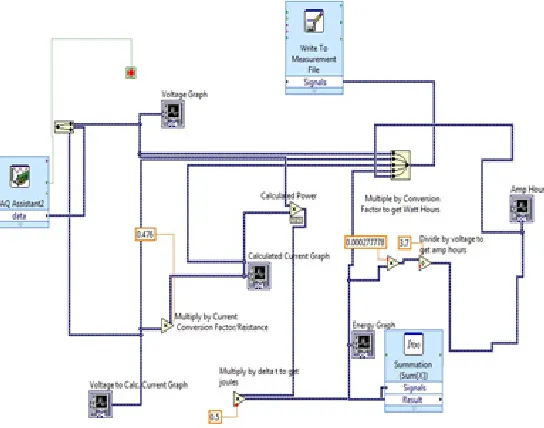
2.4 amps, 4.8 amps, or 7.2 amps. The Team did not use the 7.2 amp circuit because protective circuits in most of the batteries would not allow them to discharge at that quick a rate. During each test, the Team ran a LabView program to record the amount of energy discharged and exported the data to Excel. Each program was built off of the LabView program shown in Figure 4.1. 2.
The experiment discharged batteries at 2.1 amps and 3.1 amps. Circuit inefficiencies caused rates to be short of nominal rates of 2.4 amps and 4.8 amps. The Team therefore used tests done in Denmark (6) that discharged batteries at constant discharge rates of 2 and 5 amps to supplement its data. The Team used this data to compare different batteries’ weight, price, and volume per kWh.
4.2 Design Requirements and Preferred Solution
Strategies
To create a battery that met the client’s goals, the Team had to overcome several design obstacles. Using preliminary research from an independent 2010 study done for the client, the Team chose to create a pack comprised of thirty-two sub-packs. Each sub-pack has a nominal voltage of 3.7 volts and a rated capacity of 300 amp-hours. This decision required that each sub-pack use one hundred 18650 batteries in parallel, as the typical 18650 has a nominal voltage of 3.7 volts and a rated capacity of about 3 amp-hours.
Fig. 4.1. 1: Battery discharging circuit
Fig. 4.1. 2: Block diagram of a typical LabView circuit
After determining the requirements for the battery pack, the Team broke the design down into four specific components and brainstormed solutions for each using a design tool called a Morphological Matrix, shown in Figure 4.2. 1.
The first two components were electrical connections required in each sub-pack. The first electrical component, referred to in Figure 4.2. 1 as “Cell to Cell Electrical,” connects all the cells inside the sub-pack together in parallel. The second electrical component, referred to in the figure as “Flight to Flight Electrical,” connects the thirty-two sub-packs to each other in series. The remaining two components are the physical connections required by the design. The first physical connection, “Cell to Cell Physical,” prevents the cells from moving inside the sub-pack. The second physical connection, “Flight to Flight Physical,” secures the sub-pack inside the motorcycle’s body.
The blocks highlighted in green in Figure 4.2. 1 show which solutions would work best for each type of connection. After discussion, the Team determined that it should have placed a higher importance on the “Ease of Manufacture” category, and that it should therefore use the solution set highlighted in gold in Figure 4.2. 1.
Other design problems arose during the course of the project, including the need to explore heat mitigation techniques and the need to redesign the “Cell to Cell Electrical” connection. To solve these problems, the Team looked to Morphological Matrices as its preferred method of brainstorming, which the Team combined with results from its research and direct experimentation. To appreciate how the Team’s strategy worked, consider the following example concerning electrical connections.
The Team made a number of material and design choices in the project’s first three semesters, including to use a common bus
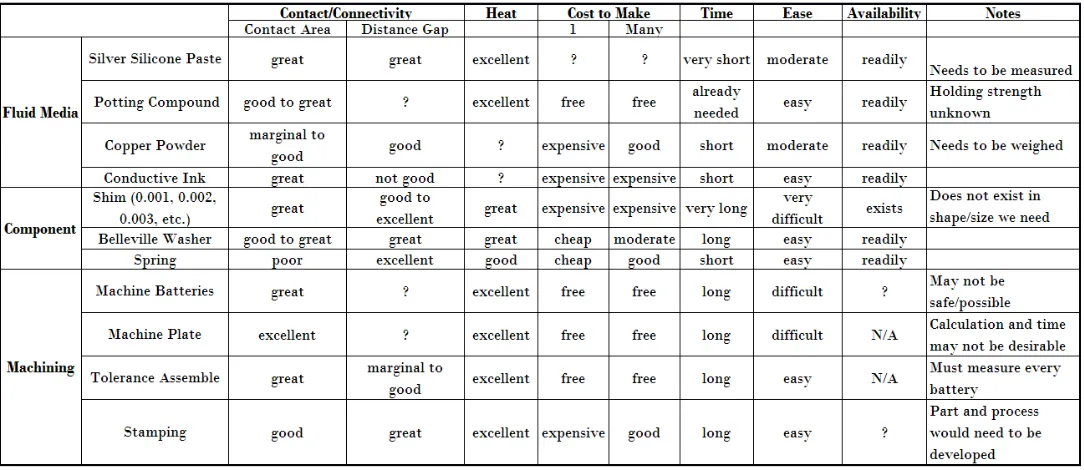
plate and to use the thickness of the bus plate to control heat generation). In turn, the rigidity of the bus plate necessitated an adjustable connection between the positive and negative terminals of the battery and the bus plates. The Team used a matrixto evaluate each possible solution based on several factors, including cost, availability, and the quality of the electrical contact. The matrix shown in Figure 4.2. 2 highlights three different connection types: fluid media, the addition of a physical component, and machining and assembling.
The Team conducted research on a championed selection from each category. Fluid media demonstrated excellent contact area and compliance but had unknown amperage capacity and a fluctuating cost. Team members contacted online distributors and Master Bond Inc. to identify several viable solutions, but limited resources, time, and capital led the Team to abandon a fluid media solution set.
Machining and assembling offered excellent contact area but reduced flexibility in the electrical connection. It also created a long wait time, with extensive labor required for assembly and measurement. All potential machining solutions involved physically measuring the 18650 batteries. The Team measured a sample of 25 batteries selected at random from 100 batteries on hand. The Team found a maximum height differential of 0.009”. The time required to machine both copper bus plates to match the individual tolerances of each battery would have equated to ten man-hours per sub-pack. The machining process would also have added complexity to the assembly process, as it emphasized the importance of each battery’s specific position in the sub-pack. The Team decided that adding such a large amount of complexity was unacceptable and ultimately determined that a physical connection component offered the best combination of cost, time, and functionality. The Team therefore concentrated on a physical component solution for the “Cell to Cell Electrical” connection.
The Team decided to champion an electrically conductive spring washer, selecting a type of disc spring washer readily available in a variety of material choices and spring stiffness that can span large distance gaps, up to 0.040”. Figure 4.2. 3 shows the profiles of a Belleville washer, a curved washer, and a wave washer.
Testing conducted on these different washers produced a clear choice. Theoretical analysis helped the Team to determine the spring stiffness. Equations from www.engineeringtoolbox. com led to a dynamic Microsoft Excel spreadsheet. The force that the Belleville and curved washer springs exert is dependent on the composition material, thickness, and inner-to-outer diameter ratio. Equation 4.2. 1 is the governing equation for the force.
The maximum forces exerted by the 0.006” and 0.008” wave washers were taken from their respective data sheets. The Team used an Instron 5966 10kN Mechanical Tester to measure the force exerted by the wave washers at the expected range of compliance needed for the team’s application. Figure 4.2. 4shows the average force exerted by each type of washer.
From the graph shown inFigure 4.2. 4, the feasible solutions were the curved washer and the 0.008” wave washer. The 0.006” wave washer displayed inconsistent force and the Belleville washer did not offer a large displacement. A comparison of each washer’s contact area aided the Team’s final decision between the two feasible options. A layer of blue indelible ink on small samples of beryllium copper highlighted the contact areas of the compressed washers.
As the contact “footprints” in Figure 4.2. 5 show, the Belleville washer possesses the largest contact area but does not offer the necessary compliance travel. The curved washer has two contact points on the concave side of the washer. The convex side of the washer has a much smaller contact area—barely visible lines at the washer’s edge—and could not be seen using the ink method. By design, the wave washer offers the same contact area between both surfaces. That fact, along with a beneficial force profile, led the Team to select the 0.008” wave
washer for the electrical contact between the bus plate and each of the 100 lithium ion cells.
4.3 Developing the Road Test
In order to determine whether the battery pack the team created could take the Vehicle Integration Team’s motorcycle 150 miles at 70 miles per hour, the Team had to follow one of two test paths. The first path meant building thirty-two sub-packs, installing them on the motorcycle, and conducting a real-world test by driving the bike down Interstate 81 until it ran out of energy. Building a full-size battery pack would have cost over $30,000 and over a decade of the James Madison University machine shop’s spare time. The second path meant building a single sub-pack, which could then be tested using a scaled Road Test to simulate a real-world ride. Time and monetary constraints helped the Team to choose the second path. While the Team would have liked to create a full-scale battery pack, a properly scaled test still yielded valuable relevant data for the Team to analyze and use to make a preliminary estimate of the battery pack’s range.
To run a simulated Road Test, the Team used a BK Precision 8514 DC Electronic Programmable Load device to draw various amperages in order to best mimic road conditions. The Team also used amperage and voltage data supplied by the Vehicle Integration Team; the amperage data provided changed on the basis of various speeds and terrain changes encountered by the motorcycle. The Team ran the Road Test on the individual prismatic batteries and on the Team’s battery sub-pack to directly compare the prismatic battery pack used in the real road test and the team’s full-size battery pack design. Equation 4.2. 1
Fig. 4.2. 3: Washer Profiles (from left: Belleville washer, curved washer, wave washer) *Images from www.mcmaster.com
Fig. 4.2. 4:Washer load testing
5 Detailed Design Review
5.1 Battery Testing Results
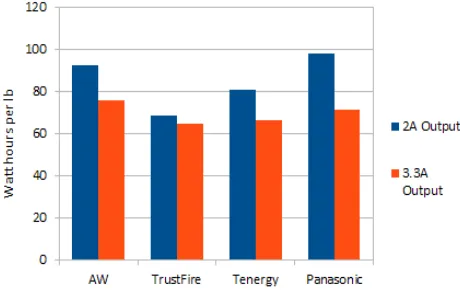
Using the research performed in Denmark as a basis, the Team selected four different brands of 18650 batteries to test: Panasonic, TrustFire, AW, and Tenergy. The Team used its discharge test circuit to test six batteries from each brand at two different current rates (2 and 3.3 amps). The calculated capacity in milliamp hours of each cell were recorded and averaged for each brand. Figure 5.1. 1 shows the results of the test. The Team also evaluated the energy density of each battery brand in terms of cost and weight. These comparisons are shown in Figure 5.1. 2 and Figure 5.1. 3.
5.2 Evolution of the Sub-Pack Design
As the Team built the sub-pack, moving from design concept to reality, it made several substantial changes to the original design. The first iteration of the design called for an enclosed container made of acrylic to protect the battery pack from inclement weather. Heat buildup and difficulties in manufacturing acrylic required this design concept to be eliminated. The material championed for the functional prototype is polycarbonate, chosen with the input of Casey Flanagan and Mark Starnes (JMU Engineering’s Machine Tech and Machine Shop Supervisor, respectively).
The current functional design uses a common bus plate to handle the current through the battery sub-pack. The Team performed calculations using a modified version of the resistivity equation, shown in Equation 5.2. 1 where ρ is the resistivity of the material, i is the current through the battery sub-pack, l is the length across the battery sub-pack, V is the voltage drop, and w is the width the current is expected to travel through. The Team used this formula to choose the material for the bus plate. Figure 5.2. 1 shows the analysis.
The Team also made many changes to the construction of the sub-pack’s casing, ranging from the materials used to the overall size and shape. The Team also modified the configuration of the battery placement within the sub-pack several times. Figure 5.2. 2 shows the initial placement of the batteries. This original design would have allowed future service monitoring of as few as ten individual batteries The Team abandoned the design due to possible heat issues and the battery management system’s inability to monitor each group of ten individually. The Team also rejected a second battery configuration, shown in Figure 5.2 3, due to possible heat issues and for better integration of forced convection. Fig. 5.1. 1: Average measured capacity of each battery brand
Fig. 5.1. 2: Energy density of batteries vs. weight
Fig. 5.1. 3: Energy density of batteries vs. cost
Fig. 5.2. 1: Sub-pack bus plate thickness Equation 5.2. 1
t=
pil
The Team anticipates taking greater advantage of forced convection with its current concept. The current battery configuration, shown in Figure 5.2. 4, was chosen to keep a minimum spacing between each battery to prevent heat transfer. The Team ultimately chose the design in Figure 5.2. 5 to induce turbulent air flow through the batteries to aid in cooling. The battery sub-pack design the Team developed into a functional prototype is shown in Figure 5.2. 5.
5.3 Road Test Results
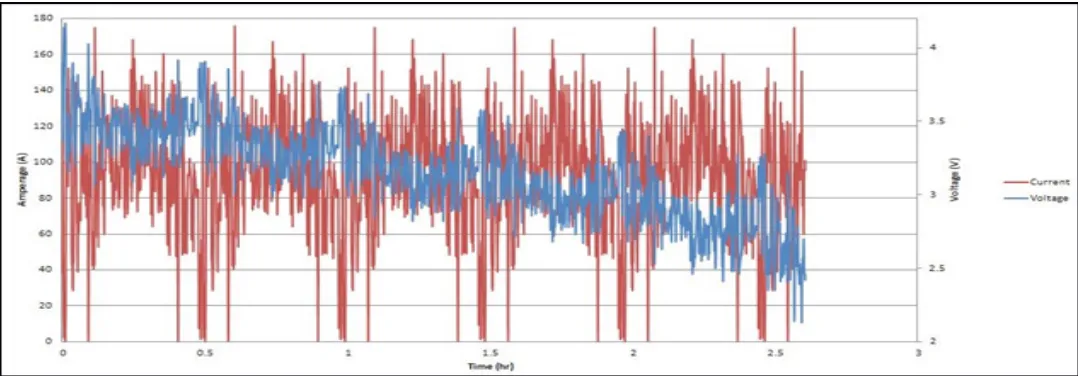
In order to ensure that its testing procedure was a valid approximation of real-world road conditions, the Team tested several of the Vehicle Integration Team’s prismatic cells to check for validity. The results from one of these tests are shown in Figure 5.3. 1.
Figure 5.3. 1 contains voltage and amperage versus time for the prismatic battery which the team had labeled “2D.” The red amperage line changes periodically over time, matching the data provided by the Vehicle Integration Team. The blue
voltage line steadily declines from a nominal value of 4.2 volts and ends at 2.75 volts. This particular prismatic battery, containing 8.4 kWh of energy, used 4.5 kWh of energy during the road test, defined by the beginning of the straight red line at about 1750 seconds. The programmable load was temporarily set at drawing constant 100 amp current after the road test was completed. This was done because 100 amps was the average draw throughout the test, and because the energy remaining in the battery could be easily calculated by subtracting the nominal energy of the pack and the energy used. Eight prismatic batteries were discharged, with the average total energy contained in each battery totaling to 8.26 kWh, and the average total energy used during each road test by a single battery totaling to 4.4 kWh. Dividing the second number by the first number results in the “percentage of energy remaining.” The calculation showed that there was 47 percent of energy remaining after the test.
After comparing these results against the real-world data that the Vehicle Integration Team collected, the Team concluded that the testing process it had created was a valid test for its battery Fig. 5.2. 2: Initial battery placement
Fig. 5.2. 3: Second battery configuration
Fig. 5.2. 4: Current battery configuration
pack. The Team then looped the coding for the test and used it to estimate the range of the Team’s sub-pack. The results of this test can be seen in Figure 5.3. 2.
Figure 5.3. 2 shows that the sub-pack completed over five loops of the road test before the battery was exhausted. An advantage of using the road test is that each complete iteration translates into 31 miles of real-world distance traveled. Based on the data provided by the Vehicle Integration Team and the number of loops the battery performed, the data suggests that the battery pack would travel a theoretical 168 miles, exceeding the initial goal of 150 miles.
6 Discussion
6.1 Selecting a Battery
After analyzing the data, the Team concluded that the 18650 battery best suited for the prototype sub-pack was the Panasonic NCR18650A. The Team chose the NCR18650A because it had both the highest rated and the highest actual capacity of all the 18650 batteries. The Team also chose the NCR18650A for its excellent performance at higher discharge rates. Inefficiencies
associated with discharging batteries at rates typically seen in electric vehicles affect the NCR18650A less than most of its competitors.
6.2 Implications of the Final Design Solution Set
Every redesign of each pack component changed the sub-pack’s properties and specifications. As a result of the evolving design process, the Team’s final sub-pack design resulted in several very exciting and impressive qualities. One of the sub-pack’s most important qualities is an extremely large capacity at a comparatively low voltage. The result of this design feature is that each individual 18650 battery experiences a smaller proportional current draw than most rival designs (most commercially available vehicles’ battery packs are designed as “High Voltage, (relatively) Low Current” packs, while the Team’s pack is designed to be a “Low Voltage, High Current” pack). This feature helps increase the energy efficiency of the system. Additionally, increased efficiency enabled the Team to calculate with a reasonable degree of certainty that no heat mitigation (other than the direct convection that the pack would experience while on the motorcycle) would be necessary to keep the battery pack within the optimal temperature range. Fig. 5.3. 1: Simulated road test performed on prismatic battery “2D”
Avoiding the need for heat mitigation measures eliminates an entire subsystem from the pack’s design, thus saving weight, money, and volume, and creating (as confirmed by the road test) an incredibly energy dense battery pack.
7.3 Interpreting the Road Test
Even given the data in reported in Section 5.3 and shown in Figure 5.3. 2, the Team hesitates to assert that its battery pack will take an electric motorcycle 168 miles at 70 mph. This hesitation exists for two reasons: the future design changes the Vehicle Integration Team plans on making to the motorcycle, and the inevitable differences between the current motorcycle and any future iteration’s road load. “Road load,” defined as the sum of all the forces that act on a vehicle as it propels itself down the road, can be drastically changed by an increase in weight and frontal area, both of which are expected to increase when the Team’s battery pack is attached to the motorcycle’s frame. While these factors will decrease the motorcycle’s range, the Vehicle Integration Team will attempt to offset possible range losses with new design features, such as improved gearing and the installation of a drag-reducing fairing. Calculating the motorcycle’s road load is the Vehicle Integration Team’s responsibility, and the Vehicle Integration Team currently does not have enough information about the aforementioned changes to make any accurate estimation of the bike’s future road load. Still, the sub-pack used 0.32 kWh of energy during the road test. Based on publically available test data on other lithium ion batteries, the team believes that at the time the Team’s battery pack was completed, it had one of the most energy-dense lithium ion battery pack designs (by volume) in the world.
7 Conclusion
After two years of work, the Team is glad to report that its project was a success. The Team constructed a fully functional sub-pack and proved (to the fullest extent possible without building a full battery pack and installing it on a motorcycle) that a full-size battery pack would have sufficient energy density to meet the client’s original design criteria. The Team also concluded that its design has sufficient energy density to meet the range requirement, an adequate heat dissipation system, and a design flexible enough that it can be adapted to function in a variety of layouts. Overall, client John Lowitz appears to be extremely pleased with the Team’s results.
The success of this project could lead to a number of benefits in the electric vehicle market. As the popularity of electric and alternative vehicles rises, the market will look for designs that contain more energy, recharge faster, and cost less. The Team’s design represents a data point on the continuum of battery technology, a snapshot of what lithium ion batteries are capable of at this time. While the Team is proud of what it has managed to accomplish with the state of the art, one of the most exciting aspects of the team’s design is that it can be applied to future versions of the 18650 battery, allowing the design to stay relevant as lithium batteries power more and more of the vehicles on our roads.
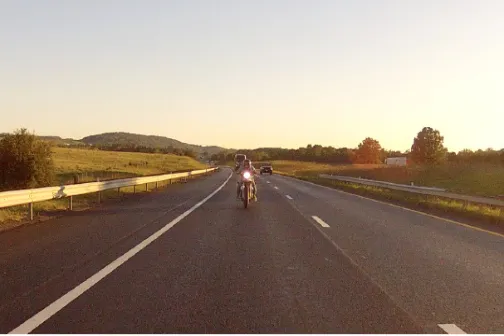
Fig. 7. 1: The Team’s electric motorcycle on Interstate 81
Acknowledgements
The High Energy Battery Team would like to acknowledge the following individuals, as without their help this project would not have been a success: Dr. John Lowitz, Dr. Robert Prins, John Wild, Scott Padgett, Mark Starnes, Samuel Osterhout, Travis Knight, Grant Haskins, Richard Arena.
References
1. Tesla Motors. Supercharging. www.teslamotors.com. [On-line] [Cited: April 30, 2013.] http://www.teslamotors.com/ supercharger.
2. About Sima Pro. PRé Sustainability. [Online] 2013. [Cited: November 16, 2013] http://www.pre-sustainability.com/ simapro-lca-software.
3. Federal Highway Administration. Average Annual Miles per Driver by Age Group. U.S. Department of Transportation. [Online] April 4, 2011. [Cited: April 29, 2013.] http://www.fhwa.dot.gov/ohim/onh00/bar8.htm. 4. Bureau of Transportation Statistics. Research and
Innovative Technology Administration. [Online] January 2013. [Cited: April 29, 2013.] http://www.rita.dot.gov/ bts/sites/rita.dot.gov.bts/files/publications/national_ transportation_statistics/html/table_01_26.html.
5. Valdes-Dapena, Peter. Tesla offers idiot-proof battery warranty. CNNMoney. [Online] April 26, 2013. [Cited: April 30, 2013.] http://money.cnn.com/2013/04/26/autos/ tesla-service-gaurantee/.
6. 18650 Battery Test. [Online] 2011. [Cited: April 26, 2012.] http://lygte-info.dk/info/Batteries18650-2011%20UK. html.
Cassandra Poole
Women appear in nearly every Sherlock Holmes novel and short story. The vast majority are victims. Against the recurring oppression of women and women’s sexuality in the Holmes canon, a few exceptional female characters escape their Victorian gender roles. One rises above all others. She is “the woman,” Irene Adler, whose strength, intelligence, and independence have made her a recurring star in extra-canonical books, television shows, film adaptations, and Sherlockian fan fiction. This essay focuses on women and women’s sexuality within and beyond the Holmes canon to explore our enduring fascination with “the only woman to ever best Sherlock Holmes.”
“T
o Sherlock Holmes she is always the woman. I have seldom heard him mention her by any other name. In his eyes, she eclipses and predominates the whole of her sex.” It is impossible for anyone acquainted with the Sherlock Holmes universe not to know to whom this description refers. She is Irene Adler, the only woman to ever beat Sherlock Holmes. But Irene is not the only woman in the canon. Women appear in nearly every Sherlock Holmes novel and short story. Some are Holmes’ clients, and others are wives, brides-to-be, or maids, but the vast majority are victims. Much of the oppression of women and women’s sexuality in the Sherlock Holmes stories has to do with the way sexuality was treated during the era in which Arthur Conan Doyle was writing. Still, a few women in the canon do stand to overthrow Victorian stereotypes, none so much as Irene Adler. As a result, Irene has become a staple of the Sherlockian universe, appearing in innumerable essays, pastiches, and parodies, as well as stage, television and film adaptations. To understand Irene Adler’s enduring popularity, it is necessary to look at Victorian attitudes toward women and sexuality, and at some of the women in the canon who conform to those attitudes, as well as two besides Irene who do not.Arthur Conan Doyle introduced Sherlock Holmes to the world in 1887. Modern portrayals of the Victorian era paint a picture of prudish, straight-laced people who feared the very idea of sex. In actuality, sex and sexuality were as present then as they are now. As Christopher Redmond notes in In
Bed with Sherlock Holmes, “The letters and diaries of many proper Victorians,” including “Queen Victoria herself,” make it clear that these people certainly felt the same passions we do today.1 But Victorians took a very different approach to sexuality. For them, a person’s sexuality was to be expressed “chiefly in private, loving marriages, or else in certain other socially tolerated contexts, as gentlemen did with London’s thousands of prostitutes,” observes Redmond.2 Indeed, the middle years of the Victorian era, when Holmes and Doyle were growing up, were a time when “prostitution was widespread and flagrant; when many London streets were like Oriental bazaars of flesh; when the luxurious West End night houses dispensed love and liquor until dawn.”3 Sexuality was just as present, but had to be pursued in a society that “maintained a strong segregation of the sexes.”4
Men and women had their own social spheres that were rarely breached by members of the opposite sex. This separation was
1 Christopher Redmond, In Bed with Sherlock Holmes: Sexual Elements in Arthur Conan Doyle’s Stories (Toronto, Simon & Pierre, 1984), 11.
2 Ibid.
3 Cyril Pearl, The Girl with the Swansdown Seat (Indianapolis, Bobbs-Mer-rill, 1955), 5, quoted in Christopher Redmond, In Bed with Sherlock Holmes: Sexual Elements in Arthur Conan Doyle’s Stories (Toronto, Simon & Pierre, 1984), 12.
4 Redmond, In Bed with Sherlock Holmes, 12.
due partly to the limited knowledge about what actually diff-erentiated the sexes. Until the early 1900s, very little was known about the exact nature of sexuality, sexual characteristics, and hormones. Theorists therefore treated the genders almost as two separate species, each with their own inherent, unique attributes.5 As Elizabeth Lee notes in “Victorian Theories of Sex and Sexuality,” men were seen as the “active agents, who expended energy while women were sedentary, storing and conserving energy.”6 In the sexual process, men were involved only in the fertilization stage, while women had to be concerned with “pregnancy, menstruation (considered a time of illness, debilitation, and temporary insanity) and child-rearing.”7 Women therefore had no energy to expend in other areas of life like men did. These reproductive differences led to Victorian beliefs in mental and emotional differences between the genders. Women were thought to be less intelligent and more emotional than men. They were thought to belong in the home, tending house and raising children, while the men were free to function in outside society. Women were seen as the weaker, gentler sex; they were innocent creatures with little sexual appetite, while men were seen as sinful and lustful.8
Toward the end of the Victorian period when Doyle began writing his Holmes stories, attitudes towards men and women’s
sexuality had started to change. Women were increasingly viewed as the sinful creatures, while men could not really be blamed. Increasingly, women were portrayed as “either frigid or else insatiable. A young lady was only worth as much as her chastity and appearance of complete innocence, for women were time bombs just waiting to be set off.”9 This perception that women are both innocent, naïve creatures and secretly lustful time bombs plays itself out in many of the Holmes stories. Women are frequently victims of controlling fathers or deceptive lovers, usually motivated by monetary gains, or of blackmail, usually by way of an “imprudent letter” written to a lover.10 In fact, twenty of the sixty stories revolve around a love affair, and fifteen of the sixty contain explicit or implied adultery.11
Women’s roles in society changed even more during the forty-year period that Doyle published the Holmes stories, and “‘[A new type of women] to whom competent work had given self-confidence and strength’ could no longer be ignored.”12 American author Henry James popularized the
5 Elizabeth Lee, “Victorian Theories of Sex and Sexuality,” The Victorian Web, 1996, http://www.victorianweb.org/gender/sextheory.html.
6 Ibid. 7 Ibid. 8 Ibid. 9 Ibid.
10 Arthur Conan Doyle, “Charles Augustus Milverton” in Sherlock Holmes: The Complete Novels and Stories (New York: Bantam Classic, 1986), 1:906. Unless otherwise noted, all references to Doyle’s Sherlock Holmes stories are to this edition.
11 Redmond, In Bed with Sherlock Holmes, 16.
12 Paul-Christoph Trüper, “Sherlock Holmes—Rooted in Reality: Gender Roles,” Sherlock Holmes: Background to a Phenomenon, last modified 2006,
Women are both
innocent, naïve
creatures
and secretly lustful
term “New Woman” to describe the increase in independent, career-minded women toward the end of the nineteenth century. The tensions and anxieties this shift in societal norms caused among the people of the late nineteenth and early twentieth centuries is readily apparent in the Holmes canon. As Rosemary Jan points out in “Sherlock Holmes Codes the Social Body,” many of Doyle’s stories have more to do with “challenges to the social and sexual conventions that insured order in his world” than they do with challenges to official law and order.13 By upholding Victorian gender conventions in his stories, Doyle gives his readers “an antidote for the threatening sexuality of the New Woman”; in its place, he offers “the reassuring spectacle of woman’s predicable unpredictability controlled by chivalric conventions, either composed from without for their own good or internalized by the women themselves.”14
Deducing the Plot
In one of the first short stories to display the characteristic oppression of women and women’s sexuality, “A Case of Identity,” published in 1891, Miss Mary Sutherland comes to Sherlock Holmes for help in finding her lost fiancé, Hosmer Angel. Mary is a typist with a small inheritance that she hands over every quarter to her mother and
stepfather. Her stepfather has refused Mary suitors before, often saying that “a woman should be happy in her own family circle.”15 Mary met Hosmer Angel at a gasfitter’s ball, became
engaged to him almost immediately, and saw him in secret when her stepfather was out of town on business. On the day they were to be married, Hosmer Angel disappeared.
After investigating, Holmes realizes that Hosmer Angel was in fact Mary’s stepfather, James Windibank. Windibank forbade Mary from seeing suitors to prevent her from marrying and taking her inheritance with her. When he recognized that his stepdaughter would not remain obedient forever, he began dressing up as Hosmer Angel to keep other lovers away. He became engaged to Mary, secured her heart to the fiction of Hosmer Angel, and then ran out on their supposed wedding day, confident that she would wait for her beloved to return.
Mary Sutherland’s story perfectly exemplifies the oppression of women as well as the struggle for equality which would culminate in the era of Henry James’ “New Woman.” It is clear from the story that women in the time of the Holmes canon were generally not allowed to make their own choices; it was the place of a man—her husband or her father—to do it for her. This is evident in Mary’s stepfather’s willingness to go to such lengths to prevent her marriage. If she marries, Mary’s husband will control her assets.16 Were Mary able to continue giving
http://www.text-traeger.info/SHolmes/32Gend.html.
13 Rosemary Jan, “Sherlock Holmes Codes the Social Body,” ELH 57, no. 3,
1990: 705, http://www.jstor.org/stable/2873238.
14 Ibid.
15 Doyle, “A Case of Identity,” 1:293.
16 Trüper, “Sherlock Holmes—Rooted in Reality.”
her money to her family after her marriage, there would be no need for such a sham. But because her husband will control her inheritance, it is necessary for her stepfather to prevent her marriage.
Mary is a typically obedient Victorian girl: she does not question the inferiority of her position in society, and she obeys her stepfather without question for most of her life. In an interesting irony, her one disobedient, purely independent action—going to the ball—only serves to further chain her down. Through her mother and stepfather’s wicked plot, Mary is forced back into the role of compliant daughter, prevented from evolving into the independent woman she could have become, free of her family’s machinations.
A similar situation occurs in “The Adventure of the Speckled Band,” published in 1892. Helen Stoner comes to Holmes against the wishes of her terribly unpleasant stepfather, Grimesby Roylott, with concerns about death of her sister Julia, who was engaged to be married before her untimely demise. Now, two years later, Helen is also engaged to be married and has begun hearing the same noises that Julia heard before her death. Holmes eventually surmises that Roylott murdered
Julia Stoner to prevent her marriage, upon which he would lose control of Julia’s late mother’s inheritance. Now that Helen is set to be married, he is attempting to murder her in the same way he killed Julia, using a poisonous speckled snake.
Again, similar circumstances repeat themselves in Doyle’s 1892 “The Adventure of the Copper Beeches,” in which Alice Rucastle is held prisoner by her father, Jephro Rucastle, to prevent her from marrying a man she met at a party. According to a maid in the story, “Miss Alice had rights of her own by will, but she was so quiet and patient that she never said a word about them, but just left everything in Mr. Rucastle’s hands.”17 Alice’s husband would not be so patient, and so Mr. Rucastle tried to get his daughter to sign over those rights and imprisoned her when she would not.
The Case of the Vanishing Sexuality
The repression of women and women’s sexuality in the Holmes canon does not always work through this same formulaic plot. Published in 1904, and set in 1899, “The Adventure of Charles Augustus Milverton” is an often-cited example of the oppression of female sexuality in the canon, played out through the narratives of three women. Charles Augustus Milverton, described by Holmes as “the worst man in London,” is a blackmailer extraordinaire who possesses countless letters which “compromise people of wealth and position,” including Holmes’ client, Lady Eva Blackwell.18 Today, such letters might cause a small scandal or a bit of
17 Doyle, “The Copper Beeches,” 1:516. 18 Doyle, “Charles Augustus Milverton,” 1:907.
“A woman should be
happy within her own
embarrassment, but in conservative Victorian times, they could bring about Armageddon if made public.19 Indeed, one of Milverton’s other victims has been utterly ruined by the exposure of her letters; her husband “broke his gallant heart and died.”20 Milverton’s leverage over these women stems from the very moral nature of Victorian times, when sexuality was to be enjoyed in private, but never discussed or written about publicly. The letters these women wrote to their lovers would ruin their reputations, and nothing was as important to a proper Victorian woman as her good reputation. At the end of the story, after Milverton has been murdered by the ruined woman, Holmes and Watson burn all of the letters Milverton possessed, thereby erasing all traces of the women’s sexuality.
The third woman in the story is a maid to whom Holmes becomes engaged under a false identity to acquire information. When Watson questions the morality of this duplicity, Holmes remarks, “You can’t help it, my dear Watson. You must play your cards as best you can when such a stake is on the table.”21 Catherine Belsey remarks on how “the sexuality of these three shadowy women motivates the narrative and yet is barely present in it.”22 Lady Eva never appears in person; the aggrieved widow is never named;
the housemaid, whose situation with Holmes parallels that of Miss Mary Sutherland and her fake fiancé in “A Case of Identity,” is mentioned only once and then never appears again. As Belsey observes, “the presentation of so many women
in the Sherlock Holmes stories as shadowy, mysterious and magical figures” is particularly interesting because it “precisely contradicts” the intended realism of the stories and Holmes’ often-repeated pleas for scientific explicitness.23
The Adventure of the Two Exceptional Women
Not all women in the Sherlock Holmes canon conform to the Victorian stereotype. In “The Adventure of the Copper Beeches,” there is Violet Hunter, who comes to consult with Holmes about whether she should take a job she has been offered as a governess. When she first enters the room, Watson describes her as “plain but neatly dressed, with a bright, quick face, and the brisk manner of a woman who has had her own way to make in the world,” and remarks that Holmes is clearly impressed with her manner and speech.24 Violet states that she has no family or friends, and that she is quickly running out of money since the last family she worked for has moved away; as Watson observes, she is a woman who has had to take care of herself. While Violet describes the meeting between herself and her potential future employer, Jephro Rucastle, it19 Trüper, “Sherlock Holmes—Rooted in Reality.”
20 Doyle, “Charles Augustus Milverton,” 1:920. 21 Ibid., 1:913.
22 Catherine Belsey, “Deconstructing the Text: Sherlock Holmes,” in Sherlock Holmes: Major Stories with Contemporary Critical Essays, ed. John A. Hodson (Boston: Bedford/St. Martin’s, 1984), 383.
23 Belsey, “Deconstructing the Text,” 383. 24 Doyle, “The Copper Beeches,” 1:494.
becomes apparent that she is an intelligent young woman; she even states at a later meeting with Holmes and Watson, “I am naturally observant, as you may have remarked, Mr. Holmes” (1:509). And it is true, for Violet is quick to recognize that her job as a governess for the Rucastles is not what it appears, and that something more sinister is going on.
When Holmes figures out the real state of affairs—that Rucastle has imprisoned his daughter Alice, and that Violet was meant to impersonate her to drive away Alice’s fiancée— he devises a plan to free Alice in which Violet plays a central role. “I should not ask it of you if I did not think you a quite exceptional woman,” he says when he asks her to trick the maid and lock her in the cellar (1:513). When she succeeds at the task, he commends her intelligence and competence, remarking, “You have done well indeed!” (1:514). Coming from Holmes, a man who often judges others and finds them wanting, Violet Hunter seems to have the Holmes seal of approval. Miss Hunter goes on to become “the head of a private school at Walsall, where she has met with considerable success” (1:518).
A second woman who stands out in the canon is Kitty Winter, from “The Adventure of the Illustrious Client,” published in 1924. This story is unique in that it does not contain a mystery for Holmes to solve, and it is also much more implicitly sexual than other Holmes stories. Holmes’ client has hired him to convince Miss Violet de Merville to break off her engagement to Baron Adelbert Gruner, who has already been accused of killing his first wife. Violet de Merville is described by the client as “young, rich, beautiful, accomplished, a wonder-woman in every way,”25 but it becomes clear that she is actually a hopelessly naïve, weak, and suggestible woman. When Holmes’ attempt to convince Gruner to let go of the marriage ends in a less than subtle threat against Holmes’ life, he turns to his contacts in the underworld to unearth evidence of Gruner’s real nature. One of those contacts finds Kitty Winter.
Watson’s description of Kitty is quite unlike any other woman in the canon:
It seems [Holmes’ contact] had dived down into what was peculiarly his kingdom and beside him on the settee was a brand which he had brought up in the shape of a slim, flame-like young woman with a pale, intense face, youthful, and yet so worn with sin and sorrow that one read the terrible years which had left their leprous mark upon her. (2:521)
When Kitty speaks of Gruner, Watson remarks that “there was an intensity of hatred in her white, set face and her blazing eyes such as woman seldom and man can never attain” (2:522).
25 Doyle, “The Illustrious Client,” 2:516.
Kitty Winter is Baron Gruner’s former mistress; although she does not go into detail about her past (“That’s neither here nor there, Mr. Holmes” [2:522]), she says that he used her and that she would like nothing more than to “pull him into the pit where he has pushed so many!” (2:522). She tells Holmes about a little book in which Gruner documents his collection of women that he has ruined in the past, as he ruined Kitty and as he would ruin Violet in the future.
Holmes takes Kitty with him when he goes to confront Violet, and the two women are like flame and ice, Kitty passionate in her hatred of Gruner and Violet chilly in her naïve love and devotion. She tells Violet who she is, that she is just “one of a hundred that he has tempted and used and ruined and thrown into the refuse heap” (2:526). When they fail to convince Violet to break her engagement, Holmes concocts a plan to steal Gruner’s book and use it to change Violet’s mind. While Watson distracts the Baron, Holmes and Kitty break into his study and steal the book. But when
they are almost caught, Kitty seizes the moment to have her revenge and flings acid in Gruner’s face, ruining him as he had ruined her and so many others. She later gets the lightest sentence possible for her actions, in light of the terrible nature of her victim,
Although it is never stated explicitly, it is clear that Kitty Winter is a prostitute. What makes her past with Gruner all the more sinister is that she could not have been a prostitute before she met him. Kitty would had to have been a woman of some standing for Gruner to take her as a mistress.26 If her ruination had simply been about him leaving her for another woman, it is unlikely she would have had to become a prostitute. She could simply have returned to whatever standing she had before, or taken her experience as Gruner’s mistress to become someone else’s. Critics have speculated that Kitty Winter and the other women in Gruner’s little book were sold into white slavery as prostitutes.27 White slavery was common throughout Europe during much of the nineteenth century, and would still have been in people’s memories in 1924.28 This explanation is not stated in the text and was never confirmed by Doyle, but it certainly explains Miss Winter’s hatred of Gruner, as well as her face “worn with sin and sorrow.”29 If accurate, this past only makes Miss Winter’s character more unusual in the canon, for it shows what a strong and resilient woman she must be to have not only survived such an ordeal, but to have succeeded at getting revenge upon her foe. In the end, Miss Winter can be seen as something of the hero of the story, for it is through her actions that the villain is repaid for his crimes and prevented from ever committing them again.
26 Redmond, In Bed with Sherlock Holmes, 17. 27 Ibid., 18.
28 Ibid., 19.
29 Doyle, “The Illustrious Client,” 2:521.
Meet
the
Woman
Violet Hunter and Kitty Winter are strong, competent, and intelligent women, but neither is as remarkable or memorable as the third exceptional woman in the Sherlock Holmes canon: the unforgettable adventuress Irene Adler. Irene appears in the first Sherlock Holmes short story, “A Scandal in Bohemia,” published in 1891. Watson begins the narrative by saying,
To Sherlock Holmes she is always the woman. I have seldom heard him mention her under any other name. In his eyes, she eclipses and predominates the whole of her sex…. [T]here was but one woman to him, and that woman was the late Irene Adler, of dubious and questionable memory.30
Even before Doyle tells anything of the actual story, he makes sure readers know that Irene Adler is the woman, the one woman who has earned Holmes’ utmost respect. Instantly, Doyle’s readers begin to wonder about what makes this mysterious woman so very important.
Irene Adler is a New Jersey-born actress and opera singer, the former prima donna of the Imperial Opera in Warsaw. In her youth, she had a love affair with the Crown Prince of Bohemia, now the King. She possesses a photo of him and herself which could ruin his impending marriage with a Scandinavian princess. The King is certain that Irene will go through with her threat to send the photo to the royal family: “I know that she will do it…. [S]he has a soul of steel. She has the face of the most beautiful of women, and the mind of the most resolute of men,” he says (2:248). He has come to Holmes to get the photo back, because though he has had Irene’s house robbed, ransacked her luggage, and even personally accosted her twice in attempts to recover it, Irene is too clever to be so easily overcome.
Holmes disguises himself and goes to Irene’s home, hoping to learn more about her. He discovers that “she is the daintiest thing under a bonnet on this planet,” according to the men on her street (1:250). That evening, Holmes manages to gain entrance. Watson, per Holmes’ plan, shouts fire in the street and tosses a smoke rocket into the house, tricking Irene into revealing the location of the photo. According to Holmes, “when a woman thinks her house is on fire, her instinct is at once to rush to the thing which she values most” (1:258). For Irene, this is the photograph. It seems as though Holmes has won. Holmes and Watson leave and return to Baker Street. As they are entering, a “slim youth” hurries past them down the street, saying, “Good-night, Mister Sherlock Holmes” (1:259).
When Holmes and Watson return to Irene’s home the next day to retrieve the photograph, they find that Irene has outwitted them. She saw through Holmes’ disguise, disguised herself as
30 Doyle, “A Scandal in Bohemia,” 1:239.
“She has the face of the
most beautiful of women,
a man,31 and followed him back to Baker Street, impulsively telling him goodnight before fleeing with her new husband and the photograph. All she leaves behind is a cheeky letter for Holmes, a new photograph of herself for the King—which Holmes requests as payment for services rendered, futile as they ultimately were—and an assurance that she will not use the photograph against the King, but keeps it as insurance.32
The great Sherlockian myth of Irene Adler is that she is the only woman to ever beat Sherlock Holmes. She outwitted him, foiled his attempts to recover the photograph, and escaped with her new husband, leaving naught but a picture of herself behind for Holmes to brood over. She is an intelligent, capable, spirited woman, a grand adventuress. What’s more, she is an honorable woman, as even the King himself is forced to admit: “I know that her word is inviolate. The photograph is now as safe as if it were in the fire.”33 Irene Adler is truly unique in the canon. Although she precedes them both, one can note aspects of both Violet Hunter and Kitty Winter in Irene’s character. She is almost a
mash-up of the two women, smart and confident like Violet, strong and fierce like Kitty. But unlike either woman, Irene Adler has one very unique trait: her overwhelming presence in the extended Holmes universe. Irene has captured the imaginations of
Sherlockians since the day she first graced the canon in 1891. In addition to her appearances over the years in numerous pastiches and parodies, she has featured prominently in stage, television, and film adaptations, and even stars in her own book series.
The Extra-Canonical Irene
The Sherlockian myth of Irene Adler is rarely upheld in the extra-canonical universe. Recent television and film adaptations of Irene in particular are guilty of the crime of not living up to her grand myth; one might even go so far as to say they intentionally demean her character, a fact which frustrates the many Sherlockians who love and admire her. One internet critic notes, “It is repeatedly disappointing that I have yet to see a film or television adaptation of Irene Adler that exhibits her full agency, her intelligence, her refusal to play by strict gender roles, and of course, her fierce independence.”34
Irene’s most recent appearance on the big screen is in Guy Ritchie’s 2009 and 2011 Sherlock Holmes films, where she is
31 In her letter Irene says, “I have been trained as an actress myself. Male costume is nothing new to me. I often take advantage of the freedom which it gives.” Ibid., 1:261.
32 “As to the photograph, your client may rest in peace. I love and am loved by a better man than he. The King may do what he will without hindrance from one whom he has cruelly wronged. I keep it only to safeguard myself, and to preserve a weapon which will always secure me from any steps which he might take in the future.” Ibid.
33 Ibid., 1:262.
34 Stephanie Cole, “Sherlock Goes Sexist: Arthur Conan Doyle Is Very Disappointed,” Spark Movement, last modified February 9, 2012, http://www. sparksummit.com/ 2012/02/09/sherlock-goes-sexist-arthur-conan-doyle-is-very-disapointed/.
played by actress Rachel McAdams. Early in the first film, Irene arrives in Holmes’ rooms at Baker Street while he is sleeping; upon realizing she is there, Holmes’ initial thought is to check his wall safe for tampering, and to check his tea for poison. He clearly doesn’t trust her.35 They are portrayed as having a history. Watson refers to her having beaten Holmes in the past, perhaps recalling the events of “A Scandal in Bohemia,” after which Holmes kept track of her movements. He has a file with her name on it, the contents of which Irene reads aloud while Holmes checks the safe: “Theft of Velazquez portrait from King of Spain…missing naval documents lead to resignation of Bulgarian prime minister…scandalous affair ends engagement of Hapsburg prince to Romanov princess.”36
Alhough there is little evidence of Irene being a criminal in the canon beyond her attempted blackmail of the King of Bohemia, she is often portrayed as such in extra-canonical material. The first film has her working with Holmes’ arch-enemy, Professor James Moriarty, attempting to use Holmes’
feelings for her (which canonically, are little more than fervent respect and wariness, and explicitly stated not to be love37) to get Holmes to unknowingly do Moriarty’s bidding. Though she does manage to momentarily outwit Holmes and acquire the item she was attempting to steal for Moriarty, she is tricked by the Professor in the end and used as a scapegoat while he escapes with the device he actually wanted. In the sequel film, Moriarty kills Irene because her feelings for Holmes have compromised her, and she is no longer useful to him.38
In some ways, Irene’s portrayal here lives up to the Sherlockian myth. She is intelligent, resourceful, and clever: she manages to follow Holmes without being seen; she disables the cyanide machine; she tricks Holmes into ingesting poisoned wine. She is an adventuress: she has traveled around the world and mentions having been in Syria. She is said to have beat Sherlock Holmes at some point in the past. However, she does have her shortcomings. She is not an independent woman; instead, she works for Moriarty. She has fallen in love with Sherlock Holmes—where in the canon, she certainly does not—and those feelings eventually get her killed. She falls victim to the “damsel in distress” stereotype when she is nearly killed in a slaughter house and has to be rescued by Holmes and Watson. She is just not quite the Irene Adler of Sherlockian myth.
35 She even asks him, “Why are you always so suspicious?” to which he replies, “Shall I answer alphabetically or chronologically?” Sherlock Holmes, directed by Guy Ritchie (Burbank, CA: Warner Bros. Pictures, 2009) DVD. 36 Ibid.
37 “It was not that he felt any emotion akin to love for Irene Adler. All emo-tions, and that one particularly, were abhorrent to his cold, precise but admira-bly balanced mind. He was, I take it, the most perfect reasoning and observing machine that the world has seen, but as a lover he would have placed himself in a false position.” Doyle, “A Scandal in Bohemia,” 1:239.
38 “It’s been apparent to me for some time that you had succumbed to you feelings for him….I no longer require your services.” Sherlock Holmes: A Game of Shadows, directed by Guy Ritchie Burbank, CA: Warner Brothers Pictures, 2011) DVD.