IJPAR |Vol.8 | Issue 3 | Jul - Sep - 2019
Journal Home page: www.ijpar.com
Research article Open Access
RP-HPLC method development and validation for estimation of Alectinib
in bulk and pharmaceutical dosage form
Pavani belide*
1, P.Mounica*
21
department of Pharmaceutical chemistry, Assistant Professor, CMR college of Pharmacy.
2department of pharmaceutical analysis, CMR college of pharmacy, medchal district
*Corresponding Author:
Email:[email protected]
ABSTRACT
A simple, Précised, Accurate method was developed for the estimation of Alectinib by RP-HPLC technique. Chromatographic conditions used are stationary phase Zodiasil 150mm x 4.6 mm, 5mm, Mobile phase Water;Acetonitrile (50:50) and flow rate was maintained at 1ml/min, detection wave length was 265nm, column temperature was set to 30oC and diluent was mobile phase Conditions were finalized as optimized method. System suitability parameters were studied by injecting the standard six times and results were well under the acceptance criteria. Linearity study was carried out between 25% to150 % levels, R2 value was found to be as 0.999.Precision was found to be 1.0 for repeatability and 0.5 for intermediate precision.LOD and LOQ are 0.62µg/ml and 1.88 µg/ml respectively. By using above method assay of marketed formulation was carried out 100.65% was present. Degradation studies of Alectinib were done, in all conditions purity threshold was more than purity angle and within the acceptable range. Full length method was not performed; if it is done this method can be used for routine analysis of Alectinib.
Keywords:
HPLC Alectinib, Method development. ICH Guidelines.INTRODUCTION
Alectinib is a kinase inhibitor indicated for the treatment of patients with anaplastic lymphoma kinase (ALK)-positive, metastatic non-small cell lung cancer (NSCLC) who have progressed on or are intolerant to crizotinib. This indication is approved under accelerated approval based on tumor response rate and duration of response. Continued approval for this indication may be
contingent upon verification and description of clinical benefit in confirmatory trials [1-5].
Alectinib is a second generation oral drug that selectively inhibits the activity of anaplastic lymphoma kinase (ALK) tyrosine kinase. It is specifically used in the treatment of non-small cell lung cancer (NSCLC) expressing the ALK-EML4 (echinoderm microtubule-associated protein-like 4) fusion protein that causes proliferation of NSCLC cells. Inhibition of ALK prevents phosphorylation
and subsequent downstream activation of STAT3 and AKT resulting in reduced tumour cell viability. Both alectinib and its major active metabolite M4 demonstrate similar in vivo and in vitro activity against multiple mutant forms of ALK [6-15].
Literature survey revealed that there were few analytical methods have been reported for Alectinib in LC MS/MS for Alectinib has been reported.
However, an extensive literature search didn’t reveal any estimation method for Alectinib in API and Pharmaceutical dosage form. Therefore an attempt has been made to develop and validate simple, precise, accurate economical RP-HPLC method as per ICH guidelines for estimation of Alectinib in API and Pharmaceutical dosage form.
MATERIAL AND METHODS
Chemicals and Reagents
Methanol HPLC Grade (RANKEM),
Acetonitrile HPLC Grade (RANKEM), HPLC grade Water (RANKEM), Glacial Acetic acid. All active pharmaceutical ingredients (API’s) of Alectinib as reference standards were procured from spectrum labs, Hyderabad, India [16-24].
Instruments and Chromatographic conditions
Sonicator (Ultrasonic sonicator), PH meter (Thermo scientific), Micro balance (Sartorius), Vacuum filter pump, HPLC instrument used was of WATERS HPLC 2965 SYSTEM with Auto Injector and PDA Detector. Software used is Empower 2. UV-VIS spectrophotometer PG Instruments T60 with special bandwidth of 2mm and 10mm and matched quartz was be used for measuring absorbance for Alectinib solutions. The mobile phase used was water: Acetonitrile (50:50) at a flow rate of 1 ml/min, samples were analysed at 265nm detector wavelength and at an injection volumes of 10µl using zodiasil 150mm x 4.6mm, 5µm with run time of 5mins.
METHODS
Buffer
500 ml of HPLC garde Acetonitrile was taken in a 1000ml of volumetric flask add about 500ml of milli-Q water added and degas to sonicate it for 10min.
Preparation of Standard stock solutions:
Accurately weighed 15mg of Alectinib transferred 25ml and volumetric flasks, 3/4 Th of diluents was added and sonicated for 10 minutes. Flasks were made up with diluents and labeled as Standard stock solution (600µg/ml of Alectinib).
Preparation of Standard working solutions (100% solution): 1ml of Alectinib from each stock solution was pipetted out and taken into a 10ml volumetric flask and made up with diluent. (60µg/ml of Alectinib).
Preparation of Sample stock solutions: 20 capsules were weighed and the average weight of each tablet was calculated, then the weight equivalent to 1 tablet was transferred into a 100 ml volumetric flask, 50ml of diluents was added and sonicated for 25 min, further the volume was made up with diluent and filtered by HPLC filters (600µg/ml of Alectinib). Preparation of Sample working solutions
(100% solution): 1ml of filtered sample stock solution was transferred to 10ml volumetric flask and made up with diluent. (60µg/ml of Alectinib)
METHOD VALIDATION
As per ICH guidelines the method was validated and the parameters like Linearity, Specificity, Accuracy, Precision, Limit of Detection (LOD) and Limit of Quantification (LOQ) were assessed.
Specificity
It is the ability of analytical method to measure the response of the analyte and have no interference from other extraneous components and well resolved peaks are obtained.
Linearity
Linearity solutions are prepared such that 0.25, 0.5, 0.75, 1, 1.25, 1.5ml from the Stock solutions of alectinib is taken in to 6 different volumetric flasks and diluted to 10ml with diluents to get 15ppm, 30ppm, 45ppm, 60ppm, 75ppm, 90ppm repectively.
ACCURACY
Preparation of Standard stock solutions:
transferred 25ml and volumetric flasks, 3/4th of diluents was added and sonicated for 10 minutes. Flasks were made up with diluents and labeled as Standard stock solution (1500µg/ml of Alectinib).
Preparation of 50% Spiked Solution: 0.5ml of sample stock solution was taken into a 10ml volumetric flask, to that 1.0ml from each standard stock solution was pipetted out, and made up to the mark with diluent.
Preparation of 100% Spiked Solution: 1.0ml of sample stock solution was taken into a 10ml volumetric flask, to that 1.0ml from each standard stock solution was pipetted out, and made up to the mark with diluent.
Preparation of 150% Spiked Solution: 1.5ml of sample stock solution was taken into a 10ml volumetric flask, to that 1.0ml from each standard stock solution was pipetted out, and made up to the mark with diluent.
Robustness: Small deliberate changes in method like Flow rate, mobile phase ratio, and temperature are made but there were no recognized change in the result and are within range as per ICH Guide lines.
Robustness conditions like Flow minus (0.9ml/min), Flow plus (1.1ml/min), mobile phase minus, mobile phase plus, temperature minus (25°C) and temperature plus (35°C) was maintained and samples were injected in duplicate manner. System suitability parameters were not much affected and all the parameters were passed. %RSD was within the limit.
LOD sample Preparation: 0.25ml each from two standard stock solutions was pipetted out and transferred to two separate 10ml volumetric flasks and made up with diluents. From the above solutions 0.1ml of alectinib solution was transferred to 10ml volumetric flask and made up with the same diluent.
LOQ sample Preparation: 0.25ml each from two standard stock solutions was pipetted out and transferred to two separate 10ml volumetric flask and made up with diluent. From the above solutions 0.3ml of alectinib solution was transferred to 10ml volumetric flask and made up with the same diluent.
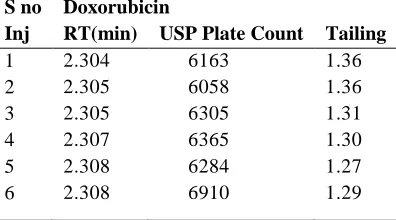
System suitability parameters
The system suitability parameters were determined by preparing standard solutions of alectinib (150ppm)
solution was injected six times and the parameters like peak tailing, resolution and USP plate count were determined to check whether the results complies with Recommended limits.
Assay of alectinib
An Accurately measured weight equivalent to (alecensa) 150mg of doxorubicin was used to perform assay by utilizing the method developed and under the optimized chromatographic conditions. Sample solutions were injected in to the HPLC system and scanned at 265 nm from which the % of drug was estimated.
RESULTS & DISCUSSIONS
Optimization of Chromatographic Conditions
To develop and establish a suitable RP-HPLC method for estimation of alectinib in bulk and tablet dosage forms, different preliminary tests were performed and different chromatographic conditions were tested and optimized chromatographic conditions were developed which were given in Table-1.The final analysis was performed by using 50% Water:50% Acetonitrile at a flow rate of 1ml/min. samples were analyzed at 265 nm detector wave length and at an injection volume of 10 μL using Zodiasil 150mm x 4.6 mm, 5mm. with run time of 5 min. The proposed method was optimized to give sharp peak and minimum tailing effect for alectinib, the optimized chromatogram was obtained as shown in (Figure-2).
Validation
calculated from the corresponding peaks obtained by injecting six times a known concentration of alectinib was obtained as 1.0% and the % RSD for intermediate Precision was obtained as 0.5%, Low % RSD values indicates that the method developed was precise as shown in (Table-3). The LOD and LOQ values were evaluated based on Relative standard deviation of response and slope of the calibration curve doxorubicin. The detection limit values were obtained as 0.62 and Quantitation limit were fund to be 1.88 as given in (Table-4).Robustness conditions like Flow minus (0.5 ml/min), Flow plus (0.6ml/min), mobile phase minus (55:45) mobile phase plus (45:50) temperature minus (25°C) and temperature plus (35°C) was maintained and samples were injected in duplicate manner Table -5). System suitability parameters were not much affected and all the parameters were passed. %RSD was within the limit (Table -6). alectinib pure drugs (API) was obtained from spectrum Pharma research solutions and Roche (Alecensa),bearing the label claim 150mg. Assay was performed with the above formulation. Average % Assay obtained was 100.65% the result was shown in (Table-7) and the chromatogram of standard drugs and
pharmaceutical dosage forms were shown in (Figure-4, 5) respectively.
Degradation Studies
Degradation studies were performed with the formulation and the degraded samples were injected. Assay of the injected samples was calculated and all the samples passed the limits of degradation (Table 8).
CONCLUSION
A simple, Accurate, precise method was developed for the estimation of the alectinib in injection dosage form. Retention time of alectinib was found to be 2.302min. %RSD was found to be 1.0. %Recover was obtained as 100.64%. LOD, LOQ values were obtained from regression equations of alectinib was 0.62µg/ml and 1.88µg/ml respectively. Regression equation of alectinib is y = 15456x + 2384. Retention times are decreased and that run time was decreased so the method developed was simple and economical that can be adopted in regular Quality control test in Industries.
Figure-2: Optimized Chromatogram of Alectinib
Figure-3: Linearity Curve of Alectinib
Figure-4: Standard Chromatogram of Doxorubicin
y = 34606x + 23587 R² = 0.9998
0 500000 1000000 1500000 2000000 2500000 3000000 3500000
Figure-5: A Sample Chromatogram of Alectinib in Pharmaceutical Dosage Form
Table-1: Optimized Chromatographic Conditions Parameter Condition
RP-HPLC WATERS HPLC SYSTEM equipped with quaternary pumps with PDA detector
Mobile phase 50% Water : 50% Acetonitrile
Flow rate 1ml/min
Column Zodiasil 150mm x 4.6 mm, 5m.
Detector wave length 265nm
Column temperature 30°C
Injection volume 10L
Run time 5 min
Diluent Buffer and methanol in the ratio of 50:50
Retention Time Alectinib 2.302 min
Theoretical Plates Alectinib 7041.0
Table-2: Accuracy results of Alectinib % Level Amount Spiked
(μg/mL)
Amount recovered (μg/mL)
% Recovery Mean %Recovery
50% 30 29.595012 98.65 99.56%
30 29.834942 99.45
30 29.788274 99.29
100% 60 60.368404 100.61
60 60.037537 100.06
60 59.761573 99.60
150% 90 89.214125 99.13
90 90.096717 100.11
90 89.217274 99.13
Table-3: Precision Result of Alectinib
S.No Peak Area(Intermediate) Peak Area(repeatability)
1 1945654 2152177
2 1949024 2149727
3 1966125 2128794
5 1960264 2181252
6 1961014 2145294
AVG 1958644 2156330
STDEV 9483.4 20773.0
%RSD 0.5 1.0
Table-4: LOD and LOQ values of Alectinib Molecule LOD LOQ
Doxorubicin 0.62 1.88
Table-5 Robustness Data of Alectinib Parameter %RSD
Flow Minus 0.5
Flow Plus 0.6
Mobile phase Minus 0.6 Mobile phase Plus 0.2 Temperature minus 0.2 Temperature plus 0.5
Table-6: System Suitability Parameters Result of Alectinib S no Doxorubicin
Inj RT(min) USP Plate Count Tailing
1 2.304 6163 1.36
2 2.305 6058 1.36
3 2.305 6305 1.31
4 2.307 6365 1.30
5 2.308 6284 1.27
6 2.308 6910 1.29
Table -7: Assay Results of Alectinib Sample No %Assay
1 100.45
2 100.34
3. 99.36
4. 101.79
5. 101.81
6. 100.13
AVG 100.65
STDEV 0.97
%RSD 1.0
Table 8. Degradation Data of Alectinib
S.NO Degradation Condition % Drug Degraded Purity Angle Purity Threshold
1 Acid 6.76 4.804 5.366
2 Alkali 7.67 0.207 0.267
3 Oxidation 3.33 0.190 0.272
4 Thermal 2.83 0.231 0.285
5 UV 1.56 0.208 0.284
REFERENCE
[1]. B.k Sharma, Instrumental methods of chemical analysis, Introduction to analytical chemistry, Goel publication , Meerut. 23, 2007.
[2]. Lindholm.J, Development and Validation of HPLC Method for Analytical and Preparative purpose. Acta Universitatis Upsaliensis, 2004, 13-14.
[3]. Rashmin, An introduction to analytical Method Development for Pharmaceutical formulations. Indoglobal Journal of Pharmaceutical Sciences, 2(2), 2012, 191-196.
[4]. Malvia R, Bansal V , Pal O.P and Sharma P.K. A Review of High Performance Liquid Chromatography. Journal of Global Pharma technology. 2010.
[5]. Douglas A Skoog, F. James Holler, Timothy A. Niemen, Principles of Instrumental Anal ysis 725-760. [6]. Dr.S. Ravi Shankar, Text book of Pharmaceutical analysis, Fourth edition, 13.1 -13.2
[7]. David G.Watson. Pharmaceutical Analysis, A text book for Pharmacy students and Pharmaceutical Chemists. Harcourt Publishers Limited; 2, 221-232.
[8]. Remingtonn’s The Sciences and Practise of Pharmacy, 20, 2000.
[9]. Connors Ka. A Textbook of Pharmaceutical Analysis, Wiley intersciences Inc; Delhi, 3, 373 -421, 1994. [10]. Gurdeep R.Chatwal , Sham K .Anand, Instrumental Methods of Chemical Analysis , 2007, 2.566 -2.638 [11]. Nasal.A, Siluk.D, and Kaliszan.R. Chromatographic Retention Parameters in Medicinal Chemistry and
Pharmacology, Pubmed, 10(5), 2003, 381-426.
[12]. Ashok Kumar, Lalith Kishore, navpreet Kaur, Anroop Nair. Method Development and Validation for Pharmaceutical Analysis. International Pharmaceutica Sciencia, 2(3), 2012.
[13]. Kaushal.C, Srivatsava.B, A Process of Method Development: A Chromatographic Approach. J Chem Pharm Res, Vol.2, Issue 2, 519-545, (2010)
[14]. Green JM. A Practicle guide to analytical method validation, Anal Chem 1996, 305A -309A
[15]. ICH, Validation of analytical procedures: Text and Methodology. International Conference on Harmonization, IFPMA , Geneva, 1996.
[16]. IUPAC. Compendium of Chemical Terminology, 2nd edn. (The Gold Book). PAC69, 1137 Glossary of terms used in computational drug design (IUPAC Recommendations 1997.
[17]. K. D. Tripathi, Essentials of Medical Pharmacology, 6th Edition, Jaypee brother’s medical publishers (P) LTD, 254-255.
[18]. Indian Pharmacopoeia, Indian Pharmacopoeial Commission, Controller of Publication, Government of India, Ministry of health and Family Welfare, Ghaziabad, India, 2, 2010, 1657 -1658.
[19]. British Pharmacopoeia, The British Pharmacopoeial Commission, the stationary office, UK, London, 2, 2011, 1408-1409.
[20]. https://www.drugbank.ca/drugs/DB11363. [21]. https://en.wikipedia.org/wiki/Alectinib
[22]. https://www.accessdata.fda.gov/drugsatfda_docs/label
[23]. Heinig K1, Herzog D et,al. LC-MS/MS determination of alectinib and its major human metabolite M4 in human urine: prevention of nonspecific binding, Bioanalysis. 9(5), 2017, 459 -468.