88
INTERNATIONAL JOURNAL OF ADVANCES IN ENGINEERING RESEARCH
PRIORITIZING AND HANDLING CONGESTION IN
VOIP FLOWS USING DIFFSERV MODEL
M.V.Sreeraj, T.Satya Savithri
Electronics and Communication Engineering Department Jawaharlal Nehru Technological University Anantapur
Andhra Pradesh, India.
ABSTRACT
The VoIP traffic flow is emerging out as one of the commonly used day to day technology. This is a very effective technology but at the same time is susceptible to various threats. This is due to several features of the wireless networks, with some being congestion, attacks, etc. So in this paper, we propose to develop a technique for Prioritizing and Handling Congestion in VoIP Flows Using DiffServ Model. In this technique, the VoIP traffic flow is mapped into the DiffServ network, for traffic protection and prioritization. Then to handle the unpredictable congestion in the VoIP network, a dynamic token bucket traffic shaper is employed, which adaptively manages the congested packets based on its dynamic token generation rate.
1. INTRODUCTION
1.1 Voice over Internet Protocol (VoIP)
In Voice over IP (VoIP), the telephonic conversation is passed through a packet switched IP network. The range of the IP network can vary from a single subnet private LAN to a huge public internet [1]. The VoIP transmission indicates the flow of the VoIP based network data such as the signaling as well as the streaming protocols and also codecs [2]. Basically, VoIP is a process of transmitting the voice through internet protocol within the packet oriented network [3].
1.2 Issues in VoIP
Transmission of VoIP faces similar issues as faced by other types of transmissions over internet. Some of the common issues are:
1.Delay : As VoIP is a highly sensitive traffic, the transmission of VoIP is very susceptible
to network variations causing unpredictable delay [4].
2.Jitter : Wireless environment poses disturbance in the traffic flow, thus causing jitter.
3.Packet Loss: During congestion in the network, the VoIP flow gets accumulated and
89
INTERNATIONAL JOURNAL OF ADVANCES IN ENGINEERING RESEARCH
In order to overcome these issues in the VoIP network, different layers have taken up some measures. The Application layer performs techniques such as encoding, echo cancellation, packetization, packet loss concealment (PLC), and dynamic de-jitter buffering. The IEEE 802.11e protocol in the network layer handles the voice flow by separately analyzing the channel access probability of each traffic flow within the channel [5].
1.3 Threats in VoIP transmission
1.Spam over internet telephony (SPIT): Numerous unsolicitated calls from telemarketers
consume huge amount of storage space which is allocated for useful network operations.
2.Spoofing: In VoIP transmission, it is possible for attackers to pose as a trusted caller and
subsequently retrieve confidential user information.
3.Security threats: When the VoIP transmission is performed unencrypted, then it allows the
attackers to retrieve the transmitted data by using high end softwares [6].
2. RELATED WORKS
Abdelbasset Trad et al [7] have proposed a TFMC: a TCP-Friendly Multiplexing Control Scheme for VoIP Flow Transmission. TFMC scheme is a dynamic voice flow multiplexing scheme. This scheme maintains the overhead of the transmission protocol at an optimal rate and also ensures a firm voice data throughput. The TFMC scheme is designed by combining the RTP voice flow multiplexing technique with the TCP friendly congestion control technique. In TFMC scheme, alterations need not be done at the routers as well as the number of control messages used is lesser. The deployment and the usage of the TFMC scheme is simpler since no variation is needed in the RTP packet. Based on the simulation results, it is observed that the TFMC scheme utilizes the network proficiently and deals with the VoIP flow in a fair manner.
Jeonggyun Yu et al [8] have proposed Enhancement of VoIP over IEEE 802.11 WLAN via Dual Queue Strategy. In the proposed technique, two queues are designed in the device driver of IEEE 802.11 MAC controller for the purpose of prioritizing the VoIP packets. This prioritization is attained by scheduling the packets in accordance with stringent priority queue method at the driver. This technique is very efficient because in WLAN, the TCP flow control behaviour is being controlled at the downlink. The simulation results show that when considering the conventional single queue mechanism with the proposed mechanism, the VoIP performance of the proposed technique is more effective even in the coexistence of VoIP nad TCP traffic flow.
90
INTERNATIONAL JOURNAL OF ADVANCES IN ENGINEERING RESEARCH
packets are determined and resent. Due to this differentiation in the design level, the QoS needs are defined at the source. On the basis of various network technologies, it is feasible to determine the QoS need of each packet.
Edmundo Zuchowski Filho [10] et al have proposed a technique for Performance Monitoring of individual VoIP flows on DiffServ Networks. In this technique, the performance of the QoS requiring applications is analyzed by considering the data under transmission as a part of the DiffServ class. Since the carrier performance is a representation of the aggregate flow, there is a requirement to determine the flow performance of each single flow within the aggregate flow. Thus, a control flow is selected based on strict factors and then its features are analyzed by noting its performance factors while traversing the network.
Sheikh Aqeel Abbas et al [11] have proposed a VOIP Congestion Control technique with Adaptable Token Generation Rate. The proposed technique is a dynamic scheme where the token is generated at a dynamic rate according to the networtk requirement. The proposed technique is compared w.r.t the conventional token bucket technique, where the token generation rate is static. The proposed technique achieves lower packet loss as well as maximizes the throughput. This technique efficiently handles congestion by managing the voice packets. Based on the simulation results, it is seen that the proposed technique works more efficiently than the conventional token bucket scheme.
3. PRIORITIZING AND HANDLING CONGESTION IN VOIP FLOWS
USING DIFFSERV MODEL
3.1 Overview
91
INTERNATIONAL JOURNAL OF ADVANCES IN ENGINEERING RESEARCH
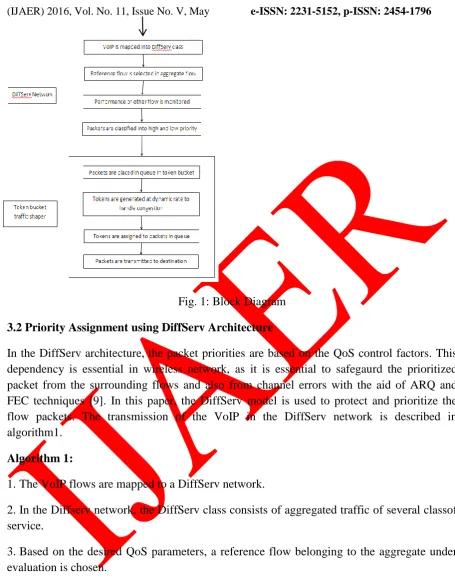
Fig. 1: Block Diagram
3.2 Priority Assignment using DiffServ Architecture
In the DiffServ architecture, the packet priorities are based on the QoS control factors. This dependency is essential in wireless network, as it is essential to safegaurd the prioritized packet from the surrounding flows and also from channel errors with the aid of ARQ and FEC techniques [9]. In this paper, the DiffServ model is used to protect and prioritize the flow packets. The transmission of the VoIP in the DiffServ network is described in algorithm1.
Algorithm 1:
1.The VoIP flows are mapped to a DiffServ network.
2.In the Diffserv network, the DiffServ class consists of aggregated traffic of several classof
service.
3.Based on the desired QoS parameters, a reference flow belonging to the aggregate under
evaluation is chosen.
4.The chosen reference flow has characteristics like flow nature, transmission delay, jitter,
packet loss, etc compatible with the aggregated traffic heterogenity.
5.Based on the variation in the reference flow, the useful information about the performance
92
INTERNATIONAL JOURNAL OF ADVANCES IN ENGINEERING RESEARCH
6.By comparing the variation with respect to the features of the reference flow, every
individual flow in the aggregate is classified as high priority packets and low priority packets.
Thus, the aggregated flow of packets in the DiffServ class is monitored specifically with respect to the refernce flow and classified according to the network requirement.
3.3 Token bucket traffic shaper
Once the packets are prioritized, then the next step is to transmit them through the outstream path on the basis of the priority. This transmission is performed at the token bucket traffic shaper where each packet is transmitted towards the destination only after the reception of a token. This process is described in algorithm 2.
Algorithm 2
1.The high and low priority packets classified in the DiffServ network are placed in a queue
in the token bucket traffic shaper.
2.If tokens are available in the token bucket, then initially the high priority packets are
assigned the token followed by the low priority packets.
3.If tokens are not available in the token bucket, then the Token Bucket starts generating
tokens at a specific rate x.
4.If the packets waiting in the queue exceeds a optimal wait level, w, then it indicates the
occurence of congestion in the network.
5.Then in consideration with the data burst in the network, the token bucket traffic shaper
predicts an appropriate token generation rate by increasing the current token generation rate x by integer multiple of x.
6. The newly generated tokens are assigned to the packets in the queue in the priority order.
7. After receiving the token, the packets are transmitted to the destination.
8. The high priority packets are protected and transmitted by the FEC and the packet
concealment technique (prev. Paper).
9. The low priority packets are transmitted using the Fast Decrease technique as discussed in
the previous paper.
93
INTERNATIONAL JOURNAL OF ADVANCES IN ENGINEERING RESEARCH
4. SIMULATION RESULTS
4.1 Simulation Parameters
We use NS2 to simulate our proposed Prioritizing and Handling Congestion in VoIP Flows Using DiffServ Model (PHC-Diffserv) protocol. It has the functionality to notify the network layer about link breakage. In our simulation, the rate is varied as 0.5,1,1.5 and 2Mb.The simulated traffic is Exponential(EXP).
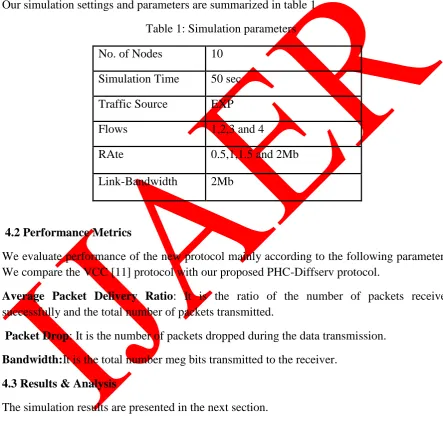
Our simulation settings and parameters are summarized in table 1
Table 1: Simulation parameters
No. of Nodes 10
Simulation Time 50 sec
Traffic Source EXP
Flows 1,2,3 and 4
RAte 0.5,1,1.5 and 2Mb
Link-Bandwidth 2Mb
4.2 Performance Metrics
We evaluate performance of the new protocol mainly according to the following parameters. We compare the VCC [11] protocol with our proposed PHC-Diffserv protocol.
Average Packet Delivery Ratio: It is the ratio of the number of packets received
successfully and the total number of packets transmitted.
Packet Drop: It is the number of packets dropped during the data transmission.
Bandwidth:It is the total number meg bits transmitted to the receiver.
4.3 Results & Analysis
The simulation results are presented in the next section.
A. Based on Rate
94
INTERNATIONAL JOURNAL OF ADVANCES IN ENGINEERING RESEARCH
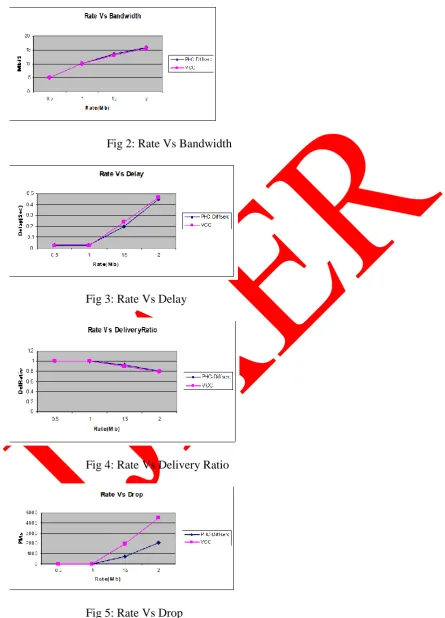
Fig 2: Rate Vs Bandwidth
Fig 3: Rate Vs Delay
Fig 4: Rate Vs Delivery Ratio
Fig 5: Rate Vs Drop
95
INTERNATIONAL JOURNAL OF ADVANCES IN ENGINEERING RESEARCH
protocols. When comparing the performance of the two protocols, we infer that PHC-Diffserv outperforms VCC by 1% in terms of bandwidth, 3% in terms of delay, 2% in terms of delivery ratio and 27% in terms of drop.
B. Based on Flows
In our second experiment we vary the number of flows as 1,2,3 and 4.
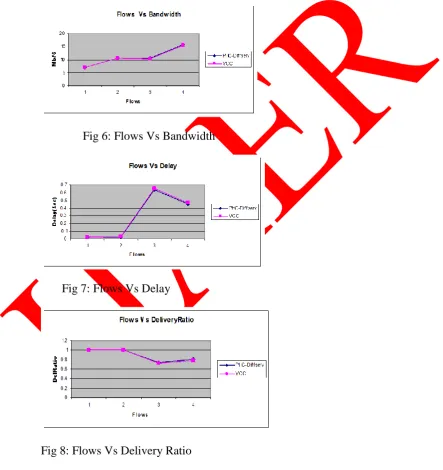
Fig 6: Flows Vs Bandwidth
Fig 7: Flows Vs Delay
96
INTERNATIONAL JOURNAL OF ADVANCES IN ENGINEERING RESEARCH
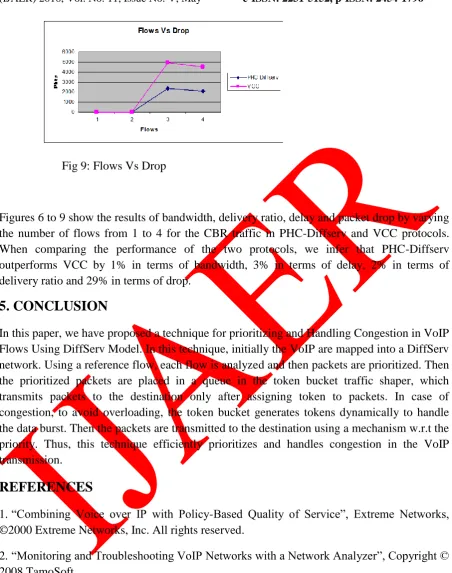
Fig 9: Flows Vs Drop
Figures 6 to 9 show the results of bandwidth, delivery ratio, delay and packet drop by varying the number of flows from 1 to 4 for the CBR traffic in PHC-Diffserv and VCC protocols. When comparing the performance of the two protocols, we infer that PHC-Diffserv outperforms VCC by 1% in terms of bandwidth, 3% in terms of delay, 2% in terms of delivery ratio and 29% in terms of drop.
5. CONCLUSION
In this paper, we have proposed a technique for prioritizing and Handling Congestion in VoIP Flows Using DiffServ Model. In this technique, initially the VoIP are mapped into a DiffServ network. Using a reference flow, each flow is analyzed and then packets are prioritized. Then the prioritized packets are placed in a queue in the token bucket traffic shaper, which transmits packets to the destination only after assigning token to packets. In case of congestion, to avoid overloading, the token bucket generates tokens dynamically to handle the data burst. Then the packets are transmitted to the destination using a mechanism w.r.t the priority. Thus, this technique efficiently prioritizes and handles congestion in the VoIP transmission.
REFERENCES
1.“Combining Voice over IP with Policy-Based Quality of Service”, Extreme Networks,
©2000 Extreme Networks, Inc. All rights reserved.
2.“Monitoring and Troubleshooting VoIP Networks with a Network Analyzer”, Copyright ©
2008 TamoSoft
3.Abdelbasset Trad, Qiang Ni, and Hossam Afifi, “Adaptive VoIP Transmission over
Heterogeneous Wired/Wireless Networks”, INRIA, Planete Project 2004
4.Miroslaw Narbutt and Mark Davis, “Experimental Tuning of AIFSN and CWmin
97
INTERNATIONAL JOURNAL OF ADVANCES IN ENGINEERING RESEARCH
IWCMC’07, August 12–16, 2007, Honolulu, Hawaii, USA. Copyright 2007 ACM 978-1-59593-695-0/07/0008.
5.MATTHEW DESANTIS, “Understanding Voice over Internet Protocol (VoIP)”, Produced
2006; updated 2008, by US-CERT, a government organization.
6.Abdelbasset Trad and Hossam Afifi, “TFMC: a TCP-Friendly Multiplexing
ControlScheme for V oIP Flow Transmission”,
7.Jeonggyun Yu, Sunghyun Choi, and Jaehwan Lee, “Enhancement of VoIP over IEEE
802.11 WLAN via Dual Queue Strategy”
8.Henning Sanneck, Nguyen T uong Long Le, Martin Haardt and Werner Mohr, “Selective
Packet Prioritization for Wireless V oice over IP”
9.Edmundo Zuchowski Filho and Keiko Verˆ onica Ono Fonseca, “Performance Monitoring
of individual VoIP flows on DiffServ Networks”, VI INTERNATIONAL
TELECOMMUNICATIONS SYMPOSIUM (ITS2006), SEPTEMBER 3-6, 2006,
FORTALEZA-CE, BRAZIL.
10.Sheikh Aqeel Abbas and Malik Sikandar Hayat Khiyal, “VOIP Congestion Control with
Adaptable Token Generation Rate”, Middle-East Journal of Scientific Research 22 (8):
1150-1156, 2014. ISSN 1990-9233. © IDOSI Publications, 2014. DOI: