A wavelet method for stochastic Volterra integral equations and its
application to general stock model
Saeed Vahdati
Department of Mathematics,
Khansar Faculty of Mathematics and Computer Science, Khansar, Iran.
E-mail: [email protected]
Abstract In this article, we present a wavelet method for solving stochastic Volterra integral equations based on Haar wavelets. First, we approximate all functions involved in the problem by Haar Wavelets then, by substituting the obtained approximations in the problem, using the Itˆo integral formula and collocating at points then, the main problem converts to a system of linear or nonlinear equation which can be solved by some numerical methods like Newton’s or Broyden’s methods. The capability of the simulation of Brownian motion with Schauder functions which are the integration of Haar functions enables us to find some reasonable approximate solutions. Two test examples and the application of the presented method for the general stock model are considered to demonstrate the efficiency, high accuracy and the simplicity of the presented method.
Keywords. Haar Function, Schauder Function, Haar Wavelet, Itˆo Integral, Brownian Motion. 2010 Mathematics Subject Classification. 65T60, 60H20, 60H35, 60J65.
1. Introduction
Linear, nonlinear Volterra integral equations and integro-differential equations have an important role in theoretical physics and other disciplines. Several numerical ap-proaches have been suggested for solving these equations, one can find an overview in the monograph. Beginning from 1991 onwards, some numerical methods based on wavelet theory has been applied for solving integral equations. A short investigation
on these papers can be found in [12]. The solutions by these methods are often quite
intricate and the merits of the wavelet method get lost, therefore, some researchers tried to find a simplified version of these methods. One way to do this, is to make use of the Haar wavelets, the most simple wavelets. An overview of the using of Haar wavelet method for solving linear integral equations related to a different and
nonlin-ear Fredholm integral equations can be found in [12] and [13] respectively. Operational
matrix of integration based on Haar wavelets and its application to analyse lumped
and distributed-parameters dynamic systems established and formulated in [6]. For
some other kind of wavelets such as Legendre multi-wavelets and their application
one can refer to [1,2, 8,12,13].
Received: 11 August 2016 ; Accepted: 14 December 2016.
Many problems in finance, mechanics, biology, medical, social sciences etc can be modeled by stochastic integral equations. The application of the stochastic integral equations for the modeling of such problems makes the study of these problems very useful and there is an increasing demand for studying the behavior of a number of sophisticated dynamical systems in physical, medical and social sciences, as well as in engineering and finance. The mentioned systems are usually dependent on a noise source, such as Gaussian white noise. For this reason, the modeling of such systems mostly requires the use of various stochastic functional equations. For stochastic
differential equation case one can refer to [9,10,11,14,15,16]. Some applications of
stochastic Volterra and Volterra-Fredholm integral equations and stochastic
integro-differential equations can be found in [7,24,25]. Finding an approximate solution for
such problems by using a numerical method is so important because many cases of
these problems cannot be solved analytically [7,9,10,11,14,15,16,24, 25].
Haar wavelet operational matrix method is utilized for fractional order nonlinear
oscillation equations by Saeed et. al [18]. They obtained the solutions of fractional
order force-free and forced Duffing-Van der Pol oscillator and higher order fractional Duffing equation on large intervals. The combination of signal denoising technology and Hankel transforms algorithm which were both based on Haar wavelet
decom-position is proposed in [23]. Zedan et. al [22] proposed a numerical solution based
on Haar wavelet method for Fredholm integral equations and the system of Volterra integral equations.
Wavelet constitutes a family of functions constructed from dilation and translation
of a single function called the mother wavelet. When the dilation parameteraand the
translation parameterbvary continuously, we have the following family of continuous
wavelets as [5],
Ψa,b(t) =|a|
−1
Ψ
t−b a
, a, b∈R, a6= 0,
where Ψ is the mother wavelet.
Letα >1, β >0 andl, andkare positive integers and restrict the parametersa
andbto the discrete values asa=α−k, b=lβα−k, so the following discrete wavelets
are obtained
Ψl,k(t) =|a|
k
2 Ψ αkt−lβ,
which form a wavelet basis forL2(
R). For the case, α= 2 and β = 1 then Ψl,k(t)
forms an orthonormal basis [5].
2. Haar wavelet and function approximation
The Haar wavelet family is
ψn(s) =
1, 2kj ≤s <
2k+1 2j+1, −1, 2k+1
2j+1 ≤s < k+1
2j ,
0, elsewhere,
Table 1. The calculation of indicesn, j, mand kforJ= 2.
J = 3, 2M = 2J+1= 8
n= 1· · ·2M 1 2 3 4 5 6 7 8
j=blog2(n−1)c - 0 1 1 2 2 2 2 m= 2j - 1 2 2 4 4 4 4 k=n−m−1 - 0 0 1 0 1 2 3
the integerm= 2j,j= 0,1, ..., J indicates the level of the wavelet;k= 0,1, ..., m−1
is the translation parameter, the integerJ determines the maximal level of resolution
and the index nis calculated by the formula n=m+k+ 1. The minimal value is
n= 2 (then m= 1, k= 0)and the maximal value is n= 2M where M = 2J. The
indexn= 1 corresponds to the scaling function
ψ1(s) =
1, 0≤s <1,
0, elsewhere. (2.2)
It easy to see from what we have defined the indices through this section that for a
fixed positive integern≥2, we have j=blog2(n−1)c,m= 2j andk=n−m−1.
As an example, whenJ = 3 remaining indices are listed in Table 1.
The function ψ2(s) is called the mother wavelet, and all the other Haar Wavelets
family except the scaling function are obtained from the mother wavelets by the operations of dilation and translation. This family of function are orthogonal to each
other, so any functionf(s) which is square integrable in (0,1) can be expressed as an
infinite sum of Haar Wavelets as follow
f(s) = ∞
X
n=1
fnψn(s). (2.3)
It is not difficult to see that the series (2.3) terminates at finite term iff(s) is piecewise
constant and the jumps are at points with a finite binary representation. In other cases, the truncation of the above series is given as an approximation of the function
f(s) for piecewise constant during each subinterval. The orthogonal property of Haar
Wavelet family leads us to find the values offn, n= 1,2,· · · as
f1 =
Z 1 0
f(s)ψ1(s)ds,
fn = 2j
Z 1 0
f(s)ψn(s)ds, n= 2· · ·2M, j=blog2(n−1)c. (2.4)
Imran Aziz [3] introduced a new algorithm to approximate the Haar wavelet
coeffi-cients. To do this, consider the following collocation points
sp= p−0.5
Let f(s) be a square integrable function which has been approximated by Haar wavelets as follow
f(s)'f2Mˆ (s) =
2M X
i=1
ˆ
fi,2Mψi(s), (2.6)
substituting the collocation points (2.5) into (2.6) and supposing f = ˆf2M at the
collocation points, we get the following linear system of equations
f(sp) = ˆf2M(sp) =
2M X
i=1
ˆ
fi,2Mψi(sp), (p= 1,2,· · ·,2M), (2.7)
which is a 2M ×2M linear system of equations. The following theorem is used to
find the solution of this system for the unknown coefficients ˆfi,2M. We will show that
ˆ
fi,2M, i= 1,· · ·,2M are the midpoint quadrature weights.
Theorem 2.1. The solution of system (2.7) is given as follows
ˆ
f1,2M = 1
2M
2M X
j=1
f(sj), (2.8)
ˆ
fi,2M = 1
ρi
βi
X
p=αi
f(sp)− γi
X
p=βi+1
f(sp)
, (2.9)
i = 2,3,· · · ,2M, where
αi = ρi(σi−1) + 1,
βi = ρi(σi−1) + ρi
2,
γi = ρiσi,
ρi = 2M
τi ,
σi = i−τi, τi = 2blog2(i−1)c.
Proof. See [3] and [21].
Now, consider a square integrable functionf(s, t) of two variabless andt. Using
the Haar wavelet basis, this function can be approximated as follows
ˆ
f2M(s, t) = 2M X
i=1
ˆ
fi,2M(t)ψi(s), (2.10)
with a similar argument to the equation (2.6) and the collocation points given in (2.5),
we have the following system of 2M×2M linear equations
f(sp, t) = 2M X
i=1
ˆ
The following corollary renders an algorithm for finding the unknown coefficients ˆ
fi,2M(t).
Corollary 2.2. The solution of the system (2.11) is given as follows
ˆ
f1,2M(t) =
1
2M
2M X
j=1
f(sj, t), (2.12)
ˆ
fi,2M(t) = 1
ρi βi X p=αi
f(sp, t)− γi
X
p=βi+1
f(sp, t)
,
i = 2,3,· · ·,2M, (2.13)
whereτi, σi, ρi, γi, βi andαi are defined in theorem (2.1).
Proof. See [20].
Lemma 2.3. Let f ∈ C2[0,1], kf00k
∞ ≤ M, {fn,2Mˆ }M be the sequence defined in
(2.8) and (2.9) andfnbe the Haar wavelet coefficient defined in (2.4) then lim M→∞
ˆ
fn,2M =
fn, in particular
ˆ
f1,2M −f1 ≤
M
96M2 and
ˆ
fn,2M −fn ≤
M
192M2, n≥2. Proof. For the case n= 1 we have
ˆ
f1,2M−f1 = 1 2M 2M X j=1
f(sj)− Z 1
0
f(t)ψ1(t)dt = Z 1 0
f(t)dt− 1
2M
2M X
j=1 f(sj)
≤ M
96M2, (2.14)
the last inequality holds due to the error-bound composite midpoint rule of the nu-merical integration.
Now, letn≥2 be a positive integer number. Simply put, in the rest of the article
we putn = 2kj, ζn =
2k+1
2j+1 and ηn = k+1
2j , where j and k are the integer number
regardingnas shown in Table1.
ˆ
fn,2M −fn = 1 ρn βn P p=αn
f(sp)− γn
P
p=βn+1
f(sp) !
−2jR1
0 f(t)ψn(t)dt ≤ 1 ρn βn P p=αn
f(sp)−2jRζn
n f(t)dt
+ 1 ρn γn P
p=βn+1
f(sp)−2jRηn
ζn f(t)dt
with some elementary calculations, we have
αn= 2M k2j + 1,
βn= 2M k2j +
M 2j,
γn= 2M k2j +
2M 2j ,
ρn= 2M2j ,
(2.16) and
βn−αn+ 1 = M2j,
γn−(βn+ 1) + 1 = M2j,
sp=n+4M1 , p=αn,
sp=ζn− 1
4M, p=βn, sp=ζn+4M1 , p=βn+ 1,
sp=ηn− 1
4M, p=γn,
(2.17)
by using the equations (2.16), (2.17) and the composite midpoint rule, we obtain
1 ρn βn X
p=αn
f(sp)−2j
Z ζn
n f(t)dt
≤ 2j(ζn−n)
3
24 M2j
2
= M
192M2, (2.18)
and similarly 1 ρn γn X
p=βn+1
f(sp)−2j
Z ηn
ζn f(t)dt
≤ 2j(ηn−ζn)
3
24 M 2j
2
= M
192M2. (2.19)
By considering equations (2.14), (2.18) and (2.19), we get
lim
M→∞ ˆ
fn,2M =fn.
Theorem 2.4. Let f ∈C2[0,1],kf00k
Proof. Haar wavelet family is dense inL2[0,1) which means lim M→∞ f− 2M X n=1 fnψn 2
= 0, (2.20)
further f− ˆ f2M 2 ≤ f − 2M X n=1 fnψn+
2M X
n=1
fnψn−f2Mˆ 2 ≤ f − 2M X n=1 fnψn 2 + 2M X n=1 fnψn− 2M X n=1 ˆ fn,2Mψn 2 ≤ f − 2M X n=1 fnψn 2 + 2M X n=1
fn−fn,2Mˆ ψn 2 ≤ f − 2M X n=1 fnψn 2 + M
48M, (2.21)
by using equations (2.20) and (2.21), we can get the desire result.
In the next theorem, we will extend the above idea for a bivariate function. Let
f(s, t) be a square integrable function, by using the Haar wavelet basis, we have
f(s, t) = ∞ X n=1 ∞ X k=1
ψn(s)fn,kψk(t),
where
fn,k = 2jn+jk Z 1
0 Z 1
0
f(s, t)ψn(s)ψk(t)dsdt, (2.22)
jn = blog2(n−1)c, jk = blog2(k−1)c.
On the other hand, we can approximate this function in another way by equation
(2.10)
f(s, t)' 2M X
k=1
ˆ
fn,2M(t)ψn(s),
where ˆfn,2M(t), n = 1,2,· · ·,2M are defined in equations (2.12) and (2.13). Each
function ˆfn,2M(t) also can be approximated as follows
ˆ
fn,2M(t)' 2M X
k=1
ˆ
where the coefficients ˆfn,k,2M are calculated by equations (2.8) and (2.9), so
f(s, t)' 2M X
k=1 2M X
k=1
ψn(s) ˆfn,k,2Mψk(t),
under some assumptions and the following collocation points, we will show
lim
M→∞ ˆ
fn,k,2M =fn,k,
tq =q−0.5
2M , q= 1,2,· · ·,2M. (2.23)
Lemma 2.5. Let Ω = [0,1]2, f ∈C2(Ω), I(f) :=R1 0
R1
0 f(s, t)dsdt and Q2M(f) := 1
4M2 2M P
n=1 2M P
k=1
f(sk, tn)wheresk andtk are defined in (2.5) and (2.23), then
|I(f)−Q2M(f)| ≤ 1
96M2
max
(s,t)∈Ω
∂2f ∂s2
+ max
(s,t)∈Ω
∂2f ∂t2 |
.
Proof. In a general case, let Ω = [a, b]×[c, d] and f(s, t) : Ω −→ R be a square
integrable function. Suppose wj and sj, j = 1,2,· · ·, mare the weights and nodes
regarding one dimension numerical integral insdirection andw0iandti, i= 1,2,· · · , n
are weights and nodes regarding one dimension numerical integral int direction. Let
F(s) =Rd
c f(s, t)dt, we have
I(f) :=
Z b
a Z d
c
f(s, t)dtds=
Z b
a
F(s)ds
=
m X
j=1
F(sj)wj+Es(F(s))
=
m X
j=1 " n
X
i=1
f(sj, ti)wi0+Et(f(sj, t)) #
+Es(F(s))
=
m X
j=1 n X
i=1
f(sj, ti)wi0wj+ m X
j=1
wjEt(f(sj, t)) +Es(F(s))
= Qm,n(f) +Em,n(f),
where,EsandEtare the errors of one dimension numerical integrations in direction
sandtrespectively and also
Qm,n(f) :=
m X
j=1 n X
i=1
f(sj, ti)w0iwj,
Em,n(f) := m X
j=1
are the double numerical integration formula and the error terms. Suppose that the one dimension numerical integration, we have
|Et(f(., t))| ≤E¯t, |Es(F(s))| ≤E¯s,
so
|I(f)−Qm,n(f)| ≤WEt¯ + ¯Es, (2.24)
whereW =
m P
j=1 |wj|.
Now, in our special case, we use the midpoint rule (Q2M(f) =Qn,m(f)) where a=
c= 0, b=d= 1, m=n= 2M, wj =wi0 = 2M1 , hs=ht= 2M1 wherehs andhtare
the distance between two subsequent points in directionsand t respectively. Using
the assumptionf ∈C2
Ω, it is clear that
¯
Es=
1
96M2(s,t)max∈Ω
∂2f ∂s2 ,
¯
Et= 1
96M2(s,t)max∈Ω
∂2f ∂t2 .
andW =
m P
j=1
|wj|= 1. Substituting the obtained results in (2.24) will complete the
proof.
Theorem 2.6. Under the above assumptions, including the assumption thatf(s, t)∈ C2
Ω, where Ω = [0,1]2. Suppose max (s,t)∈Ω
|∂2f
∂s2| ≤ M1, max (s,t)∈Ω
|∂2f
∂t2| ≤ M2, then for each
k, n= 1,2,· · ·,2M we have lim
M→∞ ˆ
fn,k,2M =fn,k, in particular
|fn,k,2Mˆ −fn,k| ≤ 1
96M2(M1+M2).
Proof. It is clear to see
ˆ
f1,1,2M = 1
2M
2M X
j=1
ˆ
f1,2M(tj) = 1
4M2
2M X
j=1 2M X
i=1
f(si, tj) =Q2M(f)
= Q2M(f ψ1) =Q2M(f ψ1ψ1), (2.25)
ˆ
f1,k,2M k=2,3,···,2M
= 1
ρk
βk
X
p=αk
ˆ
f1,2M(tp)− γk
X
p=βk+1
ˆ
f1,2M(tp)
= 1
2M ρk
2M X
n=1
βk
X
p=αk
f(sn, tp)− γk
X
p=βk+1
f(sn, tp)
Similarly, we have
ˆ
fn,1,2M n=2,3,···,2M
= 2jnQ
2M(f ψn) = 2jnQ2M(f ψ1ψn), (2.27)
and
ˆ
fn,k,2M n,k=2,3,···,2M
= 2jn+jkQ
2M(f ψnψk). (2.28)
By using equation (2.22), equations (2.25)-(2.28) and the lemma (2.5), we have
lim
M→∞ ˆ
fn,k,2M =fn,k, n, k= 1,2,· · ·,2M,
and
|fˆn,k,2M −fn,k| ≤
1
96M2(M1+M2).
Corollary 2.7. With the same argument discussed in (2.4), letΩ = [0,1]2, f(s, t)∈CΩ2, max
(s,t)∈Ω| ∂2f
∂s2| ≤ M1, max (s,t)∈Ω|
∂2k
∂t2| ≤ M2 and
ˆ
f2M(s, t) =
2M P
k=1 2M P
k=1
ψn(s) ˆfn,k,2Mψk(t)then lim
M→∞
f−
ˆ
f2M 2= 0.
3. Simulation of Brownian motion via series representations
Definition 3.1. Let (Ω,F,P) be a probability space and let {Ft} be a filtration,
B(t) =Bt=Bt(ω) is a one-dimensional Brownian motion with respect to{Ft}and
the probability measureP, started at 0, if [4]
(1) BtisFtmeasurable for eacht≥0.
(2) B0= 0, a.s.
(3) Bt−Bsis a normal random variable with mean 0 and variancet−swhenever
s < t.
(4) Bt−Bsis independent ofFswhenevers < t.
(5) Bthas continuous paths.
Since the Brownian sample paths are continuous functions, they can be expanded
in a Fourier series. However, the paths are random functions: for differentωdifferent
functions are obtained. This means that the coefficients of this Fourier series are random variables, and since the process is Gaussian, they must be Gaussian as well.
The representation of Brownian motion on the interval [0,2π] is called Paley-Wiener
representation, which is formulated as follows [17]
Bt(ω) = Z0(ω)√t
2π+
2
√ π
∞
X
n=1
Zn(ω)sin(
nt 2) n , t ∈ [0,2π],
where (Zn, n≥0) is a sequence of iid (independent and identically distributed)N(0,1)
Another such well-known representation is due to L´evy representation, since the sine functions are replaced by certain polygonal functions (the Schauder function).
Let’s define the Haar functionsHn on [0,1] as follows
H1(t) = 1,
H2m+1(t) =
2m2, if t∈1− 2
2m+1,1− 1 2m+1
,
−2m2, if t∈1− 1 2m+1,1
,
0, elsewhere,
H2m+k(t) =
2m2, if t∈k−1
2m ,
2k−1 2m+1
,
−2m2, if t∈2k−1 2m+1,
k 2m
,
0, elsewhere,
k= 1, . . . ,2m−1; m= 0,1, . . . .
From these functions, define the system of the Schauder functions on [0,1] by
inte-grating the Haar functions
e Hn(t) =
Z t
0
Hn(s)ds, n= 1,2, . . . .
Figure3 shows the graphs of Hn andHne for the first n. A series representation for
Figure 1. The graphs ofHn andHne for the first n.
0 0.2 0.4 0.6 0.8 1
Haar Functions
0 0.2 0.4 0.6 0.8 1
0 0.2 0.4 0.6 0.8 1 -1
-0.5 0 0.5 1
0 0.2 0.4 0.6 0.8 1 -1.5
-1 -0.5 0 0.5 1 1.5
0 0.2 0.4 0.6 0.8 1 -1.5
-1 -0.5 0 0.5 1 1.5
0 0.2 0.4 0.6 0.8 1
Schauder Functions
0 0.2 0.4 0.6 0.8 1
0 0.2 0.4 0.6 0.8 1 0
0.1 0.2 0.3 0.4 0.5
0 0.2 0.4 0.6 0.8 1 0
0.1 0.2 0.3 0.4
0 0.2 0.4 0.6 0.8 1 0
Brownian sample path on [0,1] is then given by
Bt(ω) = ∞
X
n=1
Zn(ω)Hne (t)t∈[0,1], (3.1)
where the convergence of this series is uniform fort∈[0,1] andZn(ω)s are realizations
of an iidN(0,1) sequence (Zn).Haar wavelet approximation of the involved functions
in the problem, simulation of the Brownian motion by Haar functions and the simi-larities between the Haar wavelet family and Haar functions enable us to reduce the computational costs in solution procedure.
4. Stochastic integration operational matrix
In this section, we have applied the Itˆo integral for functionsψn(s) as follows
Z t
0
ψn(s)dB(s) =
0,
B(t)−B(2kj),
2B(2k+1
2j )−B(
k
2j)−B(t),
2B(2k+12j+1)−B( k 2j)−B(
k+1 2j ),
(4.1)
for
0≤t < k
2j,
k
2j ≤t <
2k+ 1
2j+1 ,
2k+ 1
2j+1 ≤t < k+ 1
2j ,
k+ 1
2j ≤t <1,
respectively.
By substitutingtq= q−2M0.5, q= 1,2,· · · ,2M in (4.1) we have
ψBn(tq) =
Z tq
0
ψn(s)dB(s)
=
0, 0≤tq < 2kj,
B(tq)−B(2kj),
k
2j ≤tq <
2k+1 2j+1,
2B(2k+12j )−B(
k
2j)−B(tq),
2k+1 2j+1 ≤tq <
k+1 2j ,
2B(2k+12j+1)−B( k 2j)−B(
k+1 2j ),
k+1
2j ≤tq <1,
where it can be written in a matrix form, so called stochastic integration operational matrix
PHaarB =ψiB(tq)2M×2M, i, q= 1,2,· · · ,2M.
5. Solution procedure
In this section, we will describe the numerical method for stochastic Volterra inte-gral equations. We consider the following stochastic Volterra inteinte-gral equation
X(t) =f(t) +
Z t
0
k1(s, t, X(s))ds+ Z t
0
k2(s, t, X(s))dB(s), t∈[0,1), (5.1)
where X, f, k1 and k2 are the stochastic processes defined on the probability space
(Ω,F,P), andXis unknown. Also,B(t) is a Brownian motion andRt
0k2(s, t, X(s))dB(s)
is the Itˆo integral. Using equation (2.11), we approximate the functionsk1(s, t, X(s))
andk2(s, t, X(s)) as follow
kl(s, t, X(s)) =
2M X
i=1
ˆ
kl,i(t)ψi(s), l= 1,2,
where
ˆ
kl,1(t) =
1
2M
2M X
j=1
kl(sj, t, X(sj)), l= 1,2, (5.2)
and
ˆ
kl,i(t) = 1
ρi
βi
X
p=αi
kl(sp, t, X(sp))− γi
X
p=βi+1
kl(sp, t, X(sp))
i = 2,3,· · ·,2M, l= 1,2, (5.3)
by substituting the above approximations in equation (5.1), we obtain the following
equation
X(t) =f(t) +
Z t
0 2M X
i=1
ˆ
k1,i(t)ψi(s)ds+ Z t
0 2M X
i=1
ˆ
After simplifying and substituting the collocation points (2.23), we have
X(tq) = f(tq) + 1
2M
2M X
p=1
k1(sp, tq, X(sp))ψ1(tq)
+ 1
2M
2M X
p=1
k2(sp, tq, X(sp))ψB1(tq)
+
2M X
i=2
1
ρi βi
X
p=αi
k1(sp, tq, X(sp))
− γi
X
p=βi+1
k1(sp, t, X(sp))
ψi(tq)
+
2M X
i=2
1
ρi βi
X
p=αi
k2(sp, tq, X(sp))
− γi
X
p=βi+1
k2(sp, t, X(sp))
ψ B
i (tq). (5.4)
Having Solved the above system of equations and used the equations (2.6)-(2.9), we
can find the Haar wavelet approximation for the stochastic processX(t) as follows
X(s)'Xˆ2M = 2M X
i=1
ˆ
Xi,2Mψi(s). (5.5)
6. Numerical results
In order to demonstrate the method presented in the previous section, the following examples are considered.
Example 1. Consider the following linear stochastic Volterra integral equation,
X(t) = 1 +
Z t
0
s2X(s)ds+
Z t
0
sX(s)dB(s), s, t∈[0,1). (6.1)
with the exact solutionX(t) = et63+
Rt
0sdB(s) where X(t) is an unknown stochastic
process defined on the probability space (Ω, z,P), and B(t) is a Brownian motion
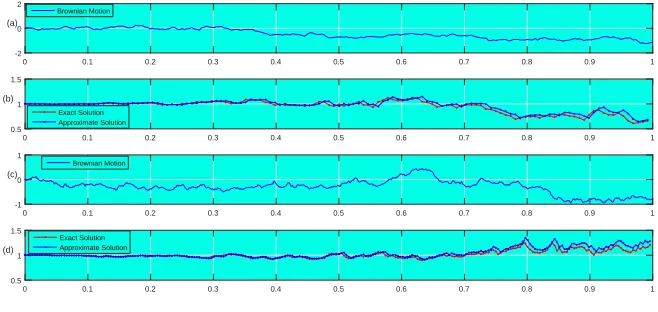
process.The curves in Figure 1 represents a trajectory of the approximate solution computed by the presented method with a trajectory of exact solution.
Example 2. Consider the following linear stochastic Volterra integral equation,
X(t) = 1
12+
Z t
0
cos(s)X(s)ds+
Z t
0
Figure 2. Simulation of Brownian motion are shown in graphs (a)
with J = 6 and (c) with J = 7. Graphs (b) and (d) show the
proposed analytical approximate and exact solutions of equation (6.1)
corresponding to the simulation of Brownian motion shown in (b) and (d) respectively.
0 0.1 0.2 0.3 0.4 0.5 0.6 0.7 0.8 0.9 1
(a)
-2 0 2
Brownian Motion
0 0.1 0.2 0.3 0.4 0.5 0.6 0.7 0.8 0.9 1
(b)
0.5 1 1.5
Exact Solution Approximate Solution
0 0.1 0.2 0.3 0.4 0.5 0.6 0.7 0.8 0.9 1
(c)
-1 0 1
Brownian Motion
0 0.1 0.2 0.3 0.4 0.5 0.6 0.7 0.8 0.9 1
(d)
0.5 1 1.5
Exact Solution Approximate Solution
with the exact solution X(t) = 1
12e
−t
4+sin(t)+ sin(2t)
8 + Rt
0sin(s)dB(s) where X(t) is an
unknown stochastic process defined on the probability space (Ω, z, P), and B(t) is
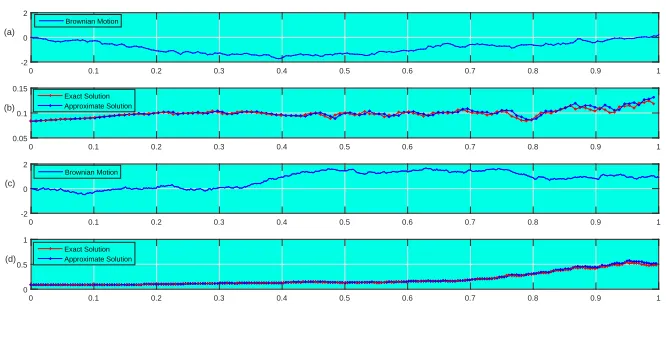
a Brownian motion process.The curves in Figure 2 represents a trajectory of the approximate solution computed by the presented method with a trajectory of exact solution.
6.1. Application to general stock model. The market consists of a riskless cash
bond,{A(t)}t≥0, and a single risky asset with price process {S(t)}t≥0 governed by
dAt=rtAtdt, A0= 1,
dSt=µtStdt+σtStdBt, (6.3)
where{W(t)}t≥0is aP-Brownian motion generating the filtration{F }t≥0and{r(t)}t≥0,
{µ(t)}t≥0and{σ(t)}t≥0are{F }t≥0-adapted processes. Evidently, a solution to these
equations should take the form
At=exp Z t
0 rudu
,
St=S0exp Z t
0
µu−
1
2σ
2 u
du+
Z t
0
σudBu
.
Figure 3. Simulation of Brownian motion are shown in graphs (a)
with J = 6 and (c) with J = 7. Graphs (b) and (d) show the
proposed analytical approximate and exact solutions of equation (6.2)
corresponding to the simulation of Brownian motion shown in (b) and (d) respectively.
0 0.1 0.2 0.3 0.4 0.5 0.6 0.7 0.8 0.9 1
(a)
-2 0 2
Brownian Motion
0 0.1 0.2 0.3 0.4 0.5 0.6 0.7 0.8 0.9 1
(b)
0.05 0.1 0.15
Exact Solution Approximate Solution
0 0.1 0.2 0.3 0.4 0.5 0.6 0.7 0.8 0.9 1
(c)
-2 0 2
Brownian Motion
0 0.1 0.2 0.3 0.4 0.5 0.6 0.7 0.8 0.9 1
(d)
0 0.5 1
Exact Solution Approximate Solution
For example, consider the following general stock model,
dAu= sin(u)Audu, B0= 1, u∈[0,1),
St= 1
10 +
Z t
0
ln(1 +u)Sudu+
Z t
0
uSudBu, u, t∈[0,1),
(6.5)
with the exact solution At = e1−cos(t) and St = 101e(1+t) ln(1+t)−t−t
3 6+
Rt
0udBu, for
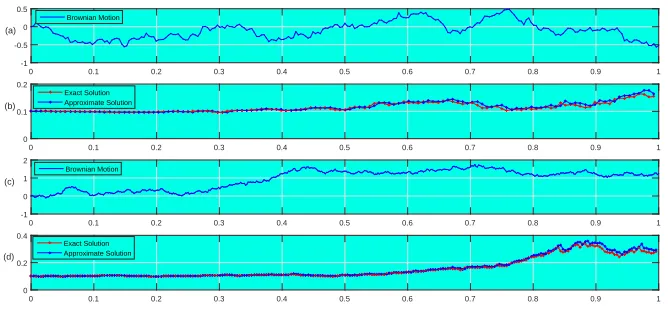
0 ≤ t < 1. Figure 4 shows two trajectory of the analytical approximate solution computed by the presented method with the trajectory of the exact solutions for
levelsJ= 6 and J = 7.
Theorem 6.1. Let Wt, t≥0 be a Brownian motion, and let ∆(t) be a nonrandom function of time. Define I(t) =Rt
0∆(u)dBu. For t≥0, the random variable I(t) is normally distributed with expected value zero and varianceRt
0∆ 2(u)du.
Proof. See [19].
Corollary 6.2. Theorem (6.1) implies that the random variables lnX(t) in exam-ples (6.1) and (6.2) and lnSt in example (6.5) are normally distributed. Therefore, confidence intervals for these random variables and thereafter forX(t)andStcan be obtained. As an special case, we have
lnSt∼ N
ln 1
10 + (1 +t) ln(1 +t)−t−
t3
6,
t2
2
Figure 4. Simulation of Brownian motion are shown in graphs (a)
with J = 6 and (c) with J = 7. Graphs (b) and (d) show the
proposed analytical approximate and exact solutions of equation (6.5)
corresponding to the simulation of Brownian motion shown in (b) and (d) respectively.
0 0.1 0.2 0.3 0.4 0.5 0.6 0.7 0.8 0.9 1
(a)
-1 -0.5 0 0.5
Brownian Motion
0 0.1 0.2 0.3 0.4 0.5 0.6 0.7 0.8 0.9 1
(b)
0 0.1 0.2
Exact Solution Approximate Solution
0 0.1 0.2 0.3 0.4 0.5 0.6 0.7 0.8 0.9 1
(c)
-1 0 1 2
Brownian Motion
0 0.1 0.2 0.3 0.4 0.5 0.6 0.7 0.8 0.9 1
(d)
0 0.2 0.4
Exact Solution Approximate Solution
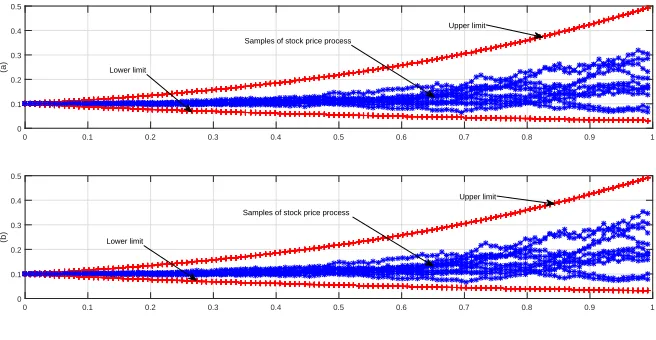
Figure5shows a 95% confidence region for the stock price process, in Figure5-(a)
100 sample paths for the exact solutionSt = 101e(1+t) ln(1+t)−t−t3
6+ Rt
0udBu with the
upper and lower limits corresponding to the 95% confidence region is shown where,
Figure5-(b) shows the approximate sample paths corresponding to 100 sample paths
of the exact solution and the 95% confidence region.
7. Conclusion
Mail goal of the presented work has been to construct an approximation to the solu-tion of stochastic Volterra integral equasolu-tions. In the above discussion, the collocasolu-tion points with Haar wavelets, which have the property of orthogonality, is employed to achieve this goal. Using the new method for finding the Haar wavelet coefficients enables us to reduce the computation costs. There is a good agreement between ob-tained results and exact values that demonstrate the validity of the present method for this type of problems and gives the method a wider applicability. The method also applied to general stock model and the obtained results showed the ability and the accuracy of the method.
Acknowledgment
Figure 5. The 95% confidence region for the general stock model;
Figure (a) shows the sample paths obtained from the exact solution where Figure (b) shows the sample paths obtained from the proposed method.
0 0.1 0.2 0.3 0.4 0.5 0.6 0.7 0.8 0.9 1
(a)
0 0.1 0.2 0.3 0.4 0.5
0 0.1 0.2 0.3 0.4 0.5 0.6 0.7 0.8 0.9 1
(b)
0 0.1 0.2 0.3 0.4 0.5
Lower limit
Upper limit
Samples of stock price process
Lower limit
Samples of stock price process
Upper limit
References
[1] Z. Abbas, S. Vahdati, K. A. Atan, and N. M. A. N. Long, Legendre
multi-wavelets direct method for linear integro-differential equations, Appl. Math. Sci.,
3(14)(2009), 693–700.
[2] Z. Abbas, S. Vahdati, and M. Ghasemi, Legendre multi-wavelets direct method
for solving fredholm integral equations of the second kind, Aust. J. Basic Appl.
Sci., 4(9)(2010), 4193–4199.
[3] I. Aziz and Siraj-ul-Islam,New algorithms for the numerical solution of nonlinear
fredholm and volterra integral equations using Haar wavelets, J. Comput. Appl.
Math.,239(2013), 333–345.
[4] R. F. Bass,Stochastic Processes, Cambridge University Press, 2011.
[5] A. Boggess and F. J. Narcowich,A First Course in Wavelets with Fourier
Anal-ysis, Prentice Hall, 2001.
[6] C. Chen and C. Hsiao,Haar wavelet method for solving lumped and
distributed-parameter systems, IEE Proc. Control Theory Appl.,144(1)(1997), 87–94.
[7] S. Jankovic and D. Ilic,One linear analytic approximation for stochastic
integro-differential equations, Acta, Math. Sci.,30 (2010), 1073–1085.
[8] Y. Khan, M. Ghasemi, S. Vahdati, and M. Fardi,Legendre multi-wavelets to solve
oscillating magnetic fields integro-differential equations, U.P.B. Sci. Bull., Series A, 76(1)(2014), 51–58.
[9] M. Khodabin, K. Maleknejad, M. Rostami, and M. Nouri, Numerical solution
Comput. Model., 53(9)(2011), 1910–1920.
[10] M. Khodabin, K. Maleknejad, M. Rostami, and M. Nouri, Interpolation
solu-tion in generalized stochastic exponential populasolu-tion growth model, Appl. Math.
Model.,36(3)(2012), 1023–1033.
[11] M. Khodabin, K. Maleknejad, M. Rostami, and M. Nouri,Numerical approach
for solving stochastic volterra-fredholm integral equations by stochastic opera-tional matrix, Comput. Math. Appl.,64(6) (2012), 1903–1913.
[12] U. Lepik and E. Tamme.Application of the Haar wavelets for solution of linear
integral equations, Dyn. Syst. Appl, Proc., (July, Antalya, Turkey), (2004), 494– 507.
[13] U .LepikandE.Tamme.Solution of nonlinear fredholm integral equations via the
haar wavelet method, Proc. Est. Acad. Scie. Phy. Math., (2017), 17–27.
[14] K. Maleknejad, M. Khodabin, and M. Rostami.A numerical method for solving
m-dimensional stochastic ito-volterra integral equations by sto- chastic opera-tional matrix, Comput. Math. Appl.,63(1) (2012), 133–143.
[15] K. Maleknejad, M. Khodabin, and M. Rostami.Numerical solution of stochastic
volterra integral equations by a stochastic operational matrix based on block pulse functions, Math. Compt. Model.,55(3) (2012), 791–800.
[16] K. Maleknejad and F. Mirzaee.Numerical solution of stochastic linear heat
con-duction problem by using new algorithms, Appl. Math. Comput., 163(1)(2005), 97–106.
[17] T. Mikosch.Elementary Stochastic Calculus with Finance in view, World
Scien-tific, 1998.
[18] U. Saeed and M. ur Rehman.Haar wavelet operational matrix method for
frac-tional oscillation equations, Int. J. of Math. Math. Sci., 2014(2014).
[19] E. Shreve Steven.Stochastic Calculus for Finance II: Continuous-Time Models,
Springer, 2004.
[20] Siraj-ul-Islam, Imran Aziz, A. S. Al–Fhaid,An improved method based on Haar
wavelets for numerical solution of nonlinear integral and integro- differential equations of first and higher orders, J. Comput. Appl. Math., 260(2014), 449– 469.
[21] Siraj-ul-Islam, I. Aziz, Fazal Haq,A comparative study of numerical integration
based on Haar wavelets and hybrid functions, Comput. Math. Appl.,59(6)(2010), 2026–2036.
[22] H. A. Zedan and E. Alaidarous,Haar wavelet method for the system of integral
equations, Abstr. Appl. Anal.,2014(2014).
[23] H. Zhang, C. Zhu, X. Su, and X. Nie,A stable hankel transforms algorithm based
on Haar wavelet decomposition for noisy data, Math. Prob. Eng.,2015(2015).
[24] X. Zhang, Euler schemes and large deviations for stochastic volterra equations
with singular kernels, J. Differ. Equ.,44(2008), 2226– 2250.
[25] X. Zhang, Stochastic volterra equations in banach spaces and stochastic partial