Stable Gaussian radial basis function method for solving Helmholtz
equations
Jalil Rashidinia∗
School of Mathematics, Iran University of Science and Technology, Tehran, Iran.
E-mail: [email protected]
Manoochehr Khasi
School of Mathematics, Iran University of Science and Technology, Tehran, Iran.
E-mail: m [email protected]
Abstract Radial basis functions (RBFs) are a powerful method for obtaining the numerical solution of high-dimensional problems. They are often referred to as a meshfree method and the spectrally accurate can be achieved by them. In this paper, we ana-lyze a new stable method for evaluating Gaussian radial basis function interpolants based on the eigenfunction expansion. We develop our approach in two-dimensional spaces for solving Helmholtz equations. In this paper, the eigenfunction expansions are rebuilt based on Chebyshev polynomials which are more suitable in numerical computations. Numerical examples are presented to demonstrate the effectiveness and robustness of the proposed method for solving two-dimensional Helmholtz equa-tions.
Keywords. Gaussian radial basis functions, Eigenfunction expansion, Helmholtz equations, Sylvester
sys-tem.
2010 Mathematics Subject Classification. 65M99, 65N99, 76R50.
1. Introduction
Helmholtz equation is very important in a variety of science and engineering prob-lems, for example, in physics, technology, geophysics and optical problems. There are several numerical methods for solving the Helmholtz equation. Among them we can mention the Finite element method in [2], the Finite volume method in [13,21], the Boundary element method in [22], spectral element methods in [17,19], radial basis function method in [15], or spectral methods in [1,16].
Radial basis functions (RBFs) have been used in many branches of science and engineering. Today there are many books related to the theory, applications and implementations of RBFs (see [3,6,23,25]). By using infinitely smooth basis functions such as Gaussians or Multiquadric , the exponential convergence rate can be achieved [9,25]. The best accuracy can usually be obtained when the shape parameter is small. But we should mention that as the shape parameter becomes small, the interpolant
Received: 17 September 2017 ; Accepted: 27 October 2018.
∗Corresponding author.
matrix becomes increasingly ill-conditioned. This fact has led to a growing number of stable approaches to overcome this problem, such as the Contour-Pad´e approach [8] or the RBF-QR method which in 2007 was introduced by Fornberg and Piret [10, 11] and later on by Larsson [14]. In [7], Fasshauer and McCourt developed a different type of the RBF-QR method by considering an eigenfunction expansion of the Gaussian RBF. They established a connection between the RBF-QR algorithm and Mercer’s theorem which states any positive definite kernel such as Gaussian has an eigenfunction expansion . In our previous work [20], we changed the eigenfunction expansion approach for evaluating Gaussian RBF interpolants by taking advantage of the orthogonality of the eigenfunctions which are based on Hermite polynomials.
In this article, we study numerical solution by a stable approach based on the eigenfunction expansions of Gaussian Radial basis functions which is an extension of our previous work [20]. The eigenfunction expansions are rebuilt based on Chebyshev polynomials, which are more suitable in numerical computations.
In this paper, we consider the following two-dimensional Helmholtz equation
∆u+k2u=f(x, y), in Ω, (1.1)
wheref is a smooth functions, ∆ = ∂x∂22 + ∂2
∂y2 is Laplacin operator, Ω is a bounded
domain inR2,k is the wavenumber defined as k:= 2πp/v withpand v stating fre-quency and speed, respectively, anduis the unknown solution representing a pressure field. The wavenumberkis a constant for the homogeneous medium, and varies for the heterogeneous medium. On the boundary ∂Ω, a Robin boundary condition is used:
αu(x, y) +β∂u
∂n(x, y) =h(x, y), on ∂Ω, (1.2)
where n is the outward unit normal vector to the boundary, h(x, y) is a smooth function, and α, β are non zero, simultaneously. If α 6= 0, β = 0, the boundary conditions can be imposed as Dirichlet boundary conditions and ifα= 0,β 6= 0, they can be imposed as Neumann boundary conditions.
The remaining part of this paper is organized as follows. Section 2 is devoted to some essential concepts about the stable method for Gaussian RBF interpolation based on eigenfunction expansions. In Section 3, the solution of two-dimensional Helmholtz equations are investigated. In Section 4, some numerical experiments that illustrate the accuracy, efficiency and stability of the proposed method are included.
2. A new stable method for 2d Gaussian RBF interpolation Before discussing the discretization of the equation (1.1), we present a brief sum-mary of the new stable method for Gaussian RBF interpolation. Based on Mercer’s theorem, every positive definite kernelK: Ω×Ω→Rwhere Ω⊂Rd, can be explained
in terms of the positive eigenvaluesλn →0 and normalized eigenfunctions ϕn of an
associated compact integral operator [24]. In fact
K(x,z) =
∞
X
n=1
Now supposeK is a native Hilbert space of functions on Ω, X={x1, . . . ,xN} ⊂ Ω
is the set of centers andKX = span{K(·,xj), xj ∈X} is the subspace spanned by
the basisK(·,xj), 1≤xj ≤N. We can write the interpolantsf ∈ KX off ∈ Kat
x1, . . . ,xN as
sf(x) = N
X
j=1
cjK(x,xj),
where the coefficients cj are determined by the interpolation conditions sf(xj) =
f(xj) : j = 1,· · · , N; i.e., they can be obtained by solving the following N ×N
linear system
Kc=f,
wheref = (f(x1),· · · , f(xN))T,c= (c1,· · ·, cN)T, and
K=
K(x1,x1) · · · K(x1,xN)
..
. ...
K(xN,x1) · · · K(xN,xN)
.
In applications, we have to truncate the series in (2.1). By choosingN terms of the series (2.1), and ignoring the truncation error, we can approximate the kernel as
K(x,xj) = N
X
n=1
λnϕn(x)ϕn(xj).
Therefore the interpolantsf becomes
sf(x) =
N
X
j=1
cj N
X
n=1
λnϕn(x)ϕn(xj) =VTΦ(x)ΛN ΦXc,
whereVT
Φ(x) = (ϕ1(x), . . . , ϕN(x)),
ΛN =
λ1 0
. ..
0 λN
, and ΦX=
ϕ1(x1) · · · ϕ1(xN)
..
. ...
ϕN(x1) · · · ϕN(xN)
.
In the same manner as in [4,20], we can show that
sf(x) =VTΦ(x)Φ−TX f. (2.2)
For small values of the Gaussian shape parameterε, the eigenvaluesλn decrease
to-ward zero [18] rapidly, and this causes the system to become ill-conditioned. So that
ΛN, which depends on eigenvalues, is eliminated. We can conclude that one of the
source of ill-conditioning is removed.
We consider the one-dimensional Gaussian RBF, which is a positive definite kernel. Based on Mercer’s theorem
e−ε2(x−z)2=
∞
X
n=1
where the ϕn are orthogonal functions with respect to the weight function ρ(x) = α
√ πe
−α2x2
,
ϕn(x) =
p
βe−δ2x2Hen−1(αβx), (2.3)
andHen(x) are normalized Hermite polynomials (see [7,20]). Also
β =
1 +4ε 2
α2 14
, δ2=α 2
2 (β 2−1),
and the eigenvaluesλn are given by
λn=
r
α2
α2+ε2+δ2
ε2
α2+ε2+δ2 n−1
, n= 1,2, . . . .
By using (2.3), the vector functionVΦ(x) and the matrixΦX can be decomposed as
VΦ(x) = p
β e−δ2x2 VH(x), (2.4)
and
ΦX=
p
β HX DX, (2.5)
where
VH(x) =
e
H0(αβx) .. .
e
HN−1(αβx)
, HX =
e
H0(αβx1) · · · He0(αβxN)
..
. ...
e
HN−1(αβx1) · · · HeN−1(αβxN)
,
and
DX =
e−δ2x21 0
. ..
0 e−δ2x2N
.
Since the Hermite polynomials values can grow dramatically, the algorithm for eval-uation of Gaussian RBFs can become unstable. Therefore in the following we show that the eigenfunctions can be rebuilt according to any other orthogonal polynomi-als, like Chebyshev polynomipolynomi-als, which are more stable for numerical computation. Let{pn(x)}∞n=0 be a family of polynomials, since {p0,· · ·, pn} is a basis forπn (the
space of all polynomials of degree at mostn), Hen(αβx) can be presented as a linear
combination of its members as follows:
e
Hn(αβx) = n
X
k=0
cn,kpk(x), (2.6)
so e
H0(αβx)
e
H1(αβx) .. .
e
HN−1(αβx) = c00
c10 c11 0 ..
. ... . ..
cN−1,0 cN−1,1 · · · cN−1,N−1
p0(x)
p1(x) .. .
The above formula can be written in matrix-vector form asVH(x) =C Vp(x) and
consequentlyHX=C PX where
PX=
p0(x1) · · · p0(xN)
..
. ...
pN−1(x1) · · · pN−1(xN)
,
is a polynomial Vandermonde-type matrix [5,12].
Therefore, from the relations (2.2), (2.4), and (2.5), we have
sf(x) = pβ e−δ2x2 VTH(x) √1 βH
−T
X D
−1
X f
= e−δ2x2 VpT(x)C T
C−T P−TX D−X1 f
= e−δ2x2 VpT(x)P−TX D−X1 f,
so we rebuild eigenfunctions according topn(x), consequently we rebuildϕn(x) as
ϕn(x) =
p
βe−δ2x2pn−1(x).
Now we can generalize the above discussion for two-dimensional interpolation for-mula forf : [a, b]×[c, d]→R. LetY ={y1,· · ·, yM}be a set of arbitrary grid points
on [c, d] and ¯Ω :=X×Y ={(xi, yj) : i= 1,2,· · ·, N, j= 1,2,· · · , M}be the tensor
product grid points on [a, b]×[c, d]. By using the tensor product form of the Gaussian kernel, we have
sf(x, y) = N
X
j=1
cj N
X
n=1
M
X
m=1
λmλnϕn(x)ϕn(xj)ϕm(y)ϕm(yj),
where
ϕm(y) =
p
β e−δ2y2pm−1(x), m= 1,· · ·, M, y∈[c, d].
Just as in [20], we can show that
sf(x, y) =VTΦ(x)Φ−TX F Φ −1
Y VΦ(y), (2.7)
where
F=
f(x1, y1) · · · f(x1, yM) ..
. ...
f(xN, y1) · · · f(xN, yM)
.
Similarly, by using (2.4) and (2.5), we can decomposeVΦ(y) andΦY as
VΦ(y) = p
β e−δ2y2VP(y),
and
ΦY =
p
By these decompositions, the formula (2.7) can be obtained as:
sf(x, y) = e−δ 2(x2+y2)
VTP(x)P−TX F P¯ −Y1 VP(y), (2.8)
whereF¯=D−X1 F D−Y1.
Remark 1. Up until now the polynomials pn were arbitrary. In particular we can, use Chebyshev polynomials (also shifted Chebyshev polynomials) instead of Hermite
polynomials. Therefore, in this paper, when we approximatef : [a, b]→Rby Gaussian
RBFs, theϕn(x)’s are modified as
ϕn(x) =
p
β e−δ2x2Tbn−1(α1x+α2), x∈[a, b],
where
b
Tn(x) =
2
√
N, n= 0,
q 2
NTn(x), n≥1,
and the parametersα1, α2, which control the Chebyshev polynomials, can be chosen
arbitrary. While if we choose α1 = b−a2 , α2 = −ab−a+b, then the shifted Chebyshev
polynomials become bounded such that|Tn(α1 x+α2)| ≤1 forx∈[a, b].
3. Implementation of the method
In this section, we want to solve two dimensional Helmholtz equation (1.1) on Ω = [a, b]×[c, d] by a collocation method based on Gaussian eigenfunctions. The boundary conditions (1.2) can be considered as
α1u(a, y) +β1ux(a, y) =h1(a, y),
α2u(b, y) +β2ux(b, y) =h2(b, y),
α3u(x, c) +β3uy(x, c) =h3(x, c),
α4u(x, d) +β4uy(x, d) =h4(x, d),
(3.1)
Suppose that the approximate solution of (1.1) is
U(x, y) =VTΦ(x)Φ−TX U Φ −1
Y VΦ(y), (3.2)
where [U]ij =U(xi, yj). For solving the equation and illustrating the algorithm, it is
necessary to decompose and rearrange the matrixUas
U=
u11 u1M u12 · · · u1,M−1
uN,1 uN,M uN2 · · · uN,M−1
u21 u2,M u22 · · · u2,M
..
. ... ... . .. ...
uN−1,1 uN−1,M uN−1,2 · · · uN−1,M−1
=
UcorB UrowB Ucol
B UI
In fact, we decomposeU to four matrices UcorB ,UBrow, UcolB ,UI which are the four
corners, the up and down boundaries, the left and right boundaries, and the interior entries ofU, respectively. We should mention that it is necessary to rearangement the other matrices in the formula (3.2) asU, to avoid deformation of that. For the Dirichlet boundary conditions, all of the entries along the boundary of the matrixU
are known, so it is necessary to obtain onlyUIby simplifying the equation with some
matrix algebraic operations. For the Neumann boundary conditions, the problem be-comes a little complicated.
Collocating the equation at the interior points and using the boundary data at the boundary points leads to the following system of equations
VΦ00T(xi) Φ−TX U Φ −1
Y VΦ(yj) +V
T
Φ(xi)Φ−TX U Φ −1
Y V
00
Φ(yj)
+ k2U=f(xi, yj), (3.3)
for 1< i < N, 1< j < M, associated with boundary conditions
α1u(x1, yj) +β1ux(x1, yj) =h1(x1, yj),
α2u(xN, yj) +β2ux(xN, yj) =h2(xN, yj), i= 2,· · ·, N−1,
α3u(xi, y1) +β3uy(xi, y1) =h3(xi, y1),
α4u(xi, yM) +β4uy(xi, yM) =h4(xi, yM), j= 1,· · ·, M.
(3.4)
By denoting the following
e
ΨTX =
VΦ00T(x2) .. .
V00ΦT(xN−1)
, ΦeY =
VΦ(y2) · · · VΦ(yM−1)
,
andA= [aij] =ΨeTX Φ−TX , we consider the first term on the left-hand side of (3.3). In the same manner as in [20] we can show that
e
ΨTX Φ−TX U Φ−Y1 ΦeY
=
a1,1 a1,N
a2,1 a2,N
..
. ...
aN−2,1 aN−2,N
| {z }
=AB
u1,2 u1,3 · · · u1,M−1
uN,2 uN,3 · · · uN,M−1
| {z }
+
a1,2 · · · a1,N−1
a2,2 · · · a2,N−1 ..
. ...
aN−2,2 · · · aN−2,N−1
| {z }
=AI
u2,2 u2,3 · · · u2,M−1 ..
. ... ...
uN−1,2 uN−1,3 · · · uN−1,M−1
| {z }
=UI
. (3.5)
Using the first two boundary conditions, we have
α1 0 0 α2
| {z }
=α12
Urow1
UrowN
+
β1 0 0 β2
| {z }
=β12
˜
A U=
h1(x1, y1) · · · h1(x1, yM)
h2(xN, y1) · · · h2(xN, yM) , where ˜ A=
V0ΦT(x1)
V0ΦT(xN)
Φ−TX .
therefore
α12 h
UcorB |UrowB i+β12 A U˜ = h
Hcor|Hrowi.
Now by decomposing ˜AandU, we want to obtain UrowB andUcorB , in fact
˜
A U = ˜
AB A˜I
Ucor
B U˜rowB
Ucol
B UI
= A˜B UcorB +AI UBcol A˜BUrowB + ˜AI UI.
Now by using two above equations
α12U cor
B +β12
h ˜
AB UcorB + ˜AI UcolB
i
=Hcor,
and
α12U row
B +β12
h ˜
AB UrowB + ˜AI UI
i
=Hrow.
So by denotingK1=α12+β12A˜B, we have
UcorB =K−11hHcor−β12 A˜I UcolB
i
, (3.6)
and
UrowB =K−11hHrow−β12 A˜I UI
i
. (3.7)
Now by denoting
e
ΦTX=
VT
Φ(x2) .. .
VT
Φ(xN−1)
, ΨeY =
V00Φ(y2) · · · VΦ00(yM−1)
andB= [bij] =Φ−Y1ΨeY, we can similarly obtained
e
ΦTX Φ−TX U Φ−Y1 ΨeY =
u2,1 u2,M
u3,1 u3,M
..
. ...
uN−1,1 uN−1,M
| {z }
=Ucol
B
b1,1 b1,2 · · · b1,M−2
bM,1 bM,2 · · · bM,M−2
| {z }
=BB
+
u2,2 u2,3 · · · u2,M−1 ..
. ... ...
uN−1,2 uN−1,3 · · · uN−1,M−1
| {z }
=UI
b2,1 b2,2 · · · b2,M−2 ..
. ... ...
bM−1,1 bM−1,2 · · · bM−1,M−2
| {z }
=BI
,(3.8)
and
UcolB =hHcol−UI B˜I β34 i
K−21, (3.9)
whereK2=α34+ ˜BB β34.
Now, by substituting (3.7) in (3.5), and (3.9) in (3.8), we obtain the following Sylvester system
A UI+UI B+C=0, (3.10)
where
A = AI+
k2 2 I,
B = BI+
k2
2 I,
C = AB GrowB +GcolB BB−Fe,
and [Fe]i,j=f(xi, yj), i= 2,· · ·, N, j= 2,· · · , M.
The equation (3.10) can be solved inMatlabby using the command sylvester, which first transforms theAandBmatrices to complex Schur form, then computes the solution of the resulting triangular system and finally transforms the solution back.
After solving (3.10),UI will be obtained (the solution in interior points), then by
using (3.7) and (3.9),Urow
B andUcolB will be obtained, and finally by using (3.6),UcorB
will be obtained. Also by using (3.2), we can obtain a closed form solution for the Helmholtz equation.
4. Numerical Results
Table 1. The local and global error for different values of grid points
for Example 1.
N×M Uniform points Chebyshev points
Local error Global error Local error Global error
11×11 3.79×10−02 4.02×10−01 3.09×10−04 1.42×10−02
13×13 1.97×10−03 1.72×10−02 5.84×10−06 2.99×10−05
15×15 5.14×10−05 3.85×10−04 6.20×10−08 3.41×10−06
17×17 3.72×10−07 2.45×10−06 2.12×10⁻¹⁰ 1.33×10−08
19×19 1.40×10−08 7.98×10−08 2.21×10⁻¹² 1.03×10⁻¹⁰
21×21 3.25×10−09 3.37×10−08 1.38×10⁻¹³ 1.37×10⁻¹²
23×23 1.78×10−07 7.22×10−07 1.43×10⁻¹³ 8.47×10⁻¹³
Intel(R) Core(TM) i5-4460 processor (3.20GHz CPU), a 64-bit Windows 7 operating system, and a 16 GB internal memory . In all examples, we usedε= 1,α= 1.9 and we used uniform grid points and Chebyshev collocation points.
The accuracy is measured by computing the local and global error of
ku−Uk
∞,Ω¯ = max|u(xi, yj)−Ui,j|
(xi,yj)∈Ω¯
,
and
ku−Uk
∞,Ω = max|u(x, y)−U(x, y)|
(x,y)∈Ω
,
where the second norm is approximated on 300×(b1−a1+b2−a2) evenly spaced points.
Example 1. Consider the following two-dimensional Helmholtz equation
∂2u(x,y) ∂x2 +
∂2u(x,y) ∂y2 + 9π
2u(x, y) =−9π2sin(3πx) sin(3πy), (x, y)∈Ω
u(x, y) = 0, (x, y)∈∂Ω
Figure 1. Error with the 17 ×17 uniform grid point (left) and
Chebyshev grid points (right) for Example 1.
0
0.5 1
0 0.5 1 0 0.2 0.4 0.6 0.8 1
x 10−6
absolute error
0
0.5
1
0 0.5 1 0 1 2 3 4
x 10−9
x y
absolute error
Example 2. Consider the following two-dimensional Helmholtz equation from [15]
∂2u(x,y) ∂x2 +
∂2u(x,y)
∂y2 + 2u(x, y) = 2x−4y, in Ω = [0,1]×[0,1]
uy(x, y) =h2(x, y), on Γ2= [0,1]× {0}
u(x, y) =h1(x, y), on Γ1=∂Ω\Γ2
where the exact solution is u(x, y) = sin(√3x) sinh(y) + cos(√2y) +x−2y, and
Table 2. The local and global error for different values of grid points
for Example 2.
N×M Uniform points Chebyshev points
Local error Global error Runtime Local error Global error Runtime
11×11 4.37×10−05 1.89×10−02 0.1824 1.34×10−04 1.74×10−03 0.1895
13×13 1.39×10−06 4.12×10−04 0.1813 1.79×10−06 1.76×10−05 0.1937
15×15 8.45×10−08 1.09×10−05 0.1776 2.96×10−08 1.75×10−07 0.1865
17×17 3.32×10−09 5.94×10−07 0.1779 4.94×10⁻¹⁰ 3.37×10−09 0.1910
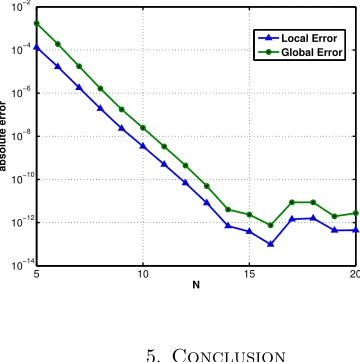
19×19 1.69×10−09 2.06×10−08 0.1804 8.10×10⁻¹² 4.94×10⁻¹¹ 0.1927
21×21 2.56×10−09 9.37×10−09 0.1795 3.81×10⁻¹³ 2.33×10⁻¹² 0.1953
23×23 6.71×10−08 1.38×10−08 0.1875 1.43×10⁻¹² 8.68×10⁻¹² 0.1905
Figure 2. Absolute errors as function of N for Chebyshev grid
points for Example 2.
5 10 15 20
10−14 10−12 10−10 10−8 10−6 10−4 10−2
N
absolute error
Local Error Global Error
5. Conclusion
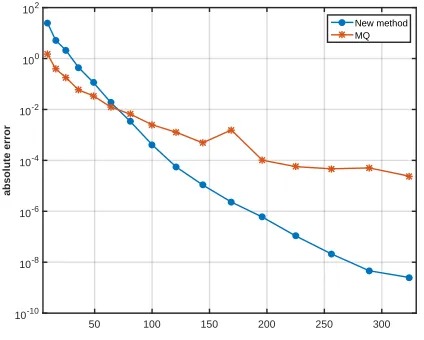
Figure 3. Absolute errors as function of N for Chebyshev grid
points for Example 2.
Number of grid points
50 100 150 200 250 300
absolute error
10-10 10-8 10-6 10-4 10-2 100 102
New method MQ
References
[1] K. Atkinson, O. Hansen, and D. Chien,A spectral method for elliptic equations: The Neumann problem, Adv. Comput. Math.,34(3) (2011), 295–317.
[2] I. Babuska, F. Ihlenburg, E. T. Paik, and S. A. Sauter, A generalized finite element method for solving the helmholtz equation in two dimensions with minimal pollution, Comput. Method. Appl. Mech. engg.,128(3-4) (1995), 325–359.
[3] M. D. Buhmann,Radial basis functions: theory and implementations, Cambridge university press,12(2003).
[4] R. Cavoretto, G. E. Fasshauer, and M. Mccourt,An introduction to the Hilbert-Schmidt SVD using iterated Brownian bridge kernels, Numer. Algor.,68(2) (2015), 393-422.
[5] J. Demmel and P. Koev,Accurate SVDs of polynomial Vandermonde matrices involving or-thonormal polynomials, Lin. Algeb. Applic.,417(2-3) (2006), 382–396.
[6] G. E. Fasshauer,Meshfree approximation methods with Matlab:(With CD-ROM), World Scien-tific Publishing Co Inc,6, (2007).
[7] G. E. Fasshauer and M. J. Mccourt,Gaussian radial basis function interpolants, SIAM J. Sc. Comput.,34(2) (2012), A737–A762.
[8] B. Fornberg and G. Wright,Stable computation of multiquadric interpolants for all values of the shape parameter, Comput. Math. Appli.,48(5) (2004), 853–867.
[10] B. Fornberg and C. Piret,A stable algorithm for flat radial basis functions on a sphere, SIAM J. Sc. Comput.,30(1) (2007), 60–80.
[11] B. Fornberg, E. Larsson, and N. Flyer,Stable computations with Gaussian radial basis functions, SIAM J. Sc. Comput.,33(2) (2011), 869–892.
[12] W. Gautschi,The condition of Vandermonde-like matrices involving orthogonal polynomials, Lin. Algeb. Appl.,52(1983), 293–300.
[13] A. Handloviˇcov´a and I. Rieˇcanov´a,Numerical solution to the complex 2D Helmholtz equation based on finite volume method with impedance boundary conditions, Open Phy.,14(1) (2016), 436–443.
[14] E. Larsson, E. Lehto, A. Heryudono, and B. Fornberg,Stable computation of differentiation matrices and scattered node stencils based on Gaussian radial basis functions, SIAM J. Sc. Comput.,35(4) (2013), A2096–A2119.
[15] , J. Lin, W. Chen, and K. Y. Sze,A new radial basis function for Helmholtz problems, Eng. Anal. Bound. Elem.,36(12) (2012), 1923–1930.
[16] P. Martinsson,A direct solver for variable coefficient elliptic PDEs discretized via a composite spectral collocation method, J. Comput. Phy.,242(2013), 460–479.
[17] A. T. Patera,A spectral element method for fluid dynamics: laminar flow in a channel expan-sion, J. Comput. Phy.,54(3) (1984), 468–488.
[18] M. Pazouki and R. Schaback,Bases for kernel-based spaces, J. Comput. Appl. Math.,236(4) (2011), 575–588.
[19] C. Pozrikidis,Introduction to finite and spectral element methods using MATLAB, CRC Press, 2005.
[20] J. Rashidinia, G. E. Fasshauer, and M. Khasi,A stable method for the evaluation of Gaussian radial basis function solutions of interpolation and collocation problems, Comput. Math. Appl.,
72(1) (2016), 178–193.
[21] I. Rieˇcanov´a,Finite volume method scheme for the solution of Helmholtz equation, Proceedings of Aplimat, 14-th Conference on Applied Mathematics, Institute of Mathematics and Physics, Faculty of Mechanical Engineering STU in Bratislava, 2015.
[22] S. A. Sauter and C. Schwab,Boundary element methods, Springer-Verlag, Berlin, 2010. [23] R. Schaback,A practical guide to radial basis functions,Electronic Resource,11, 2007. [24] E. Schmidt,Uber die Aufl¨¨ osung linearer Gleichungen mit unendlich vielen Unbekannten,