Cognitive-Behavioral Therapy in CPAP Adherence for Obstructive
Sleep Apnea a Follow -up study
Maryam Talebi
1, KazemRasoolzadehTabatabaye
2, EnsiyeVahedi
31PhD student of psychology, Department of Psychology, Faculty of Humanities, Tarbiat
Modares University, Tehran, Iran
2Associate professor, Tarbiat Modares University, Tehran, Iran
3Pulmonary disease specialist, School of Medical Sciences, Baqiyatallah University of Medical
Sciences, Tehran, Iran
Submitted: 14 July 2017 Accepted: 21 October 2017
Int J Behav Sci. 2017; 11(1): 30-37
Corresponding Author: Kazem RasoolzadehTabatabaye
Associate professor, Tarbiat Modares University, Tehran,
Iran
E-mail: [email protected]
Abstract
Introduction: Sleep apnea disorder brings about negative effects to the quality of life of the people involved. Debilitation of cognitive functioning is one of the consequences of this condition. However, scant researches have been carried out to explore the efficacy of cognitive therapy in mitigating the clinical symptoms and cognitive functions of the brain. By combining the cognitive method and medical treatment, this research aims at comparing the effectiveness of Continuous Positive Air Pressure (CPAP) therapy and Cognitive-Behavioral Treatment (CBT) in improving mental cognitive functions among patients with sleep apnea disorder.
Methods: The study population included all patients who referred to the sleep disorders clinic in Tehran. Our sample consisted of 45 subjects who were randomly allocated into three groups of 15 individuals (CPAP, combined treatment, and control). All three groups were psychologically assessed prior to the intervention. Next, individuals in the cognitive-behavioral group underwent CPAP and 12 sessions of cognitive training, progressive muscle relaxation, mental visualization, and sleep hygiene. The other group went through CPAP therapy and the third group was also assessed. After the intervention, all groups were again psychologically assessed. Data collection instruments included Wisconsin Cognitive Software, semantic and complex Stroop, continuous performance, and polysomnography and CPAP devices.
Results: The results indicated that both types of intervention can enhance cognitive functioning. However, a greater efficacy is obtained by combining the two methods compared with the exclusive application of medical treatment.
Keywords: Obstructive Sleep Apnea, CPAP Therapy, Cognitive-Behavioral Therapy, Cognitive Functions
Introduction
As one of the most important natural and biological cycles of human beings, sleep is featured by a complex pattern. One normally applies the concept of sleep to refer to the effects associated with two circadian (24 hours) and balancing processes such as the adequacy of nocturnal sleep, sleep quantity, and daytime sleepiness.
Investigating sleep-related problems gains relevance for two reasons: First, such complaints are very common among people; second, low sleep quality is considered as an indicator of many psychological diseases[1]. In contrast, good quality sleep is a sign of mental and physical regeneration of individuals since cellular repair and mental health are dependent on sleep.
brain problems; and mixed sleep apnea that combines the features of previous two types. The prevalence of sleep apnea in the general population is about 2-4%. CSA is mostly found in older people, individuals with heart diseases, or those with stroke-related illnesses. CSA, which is less common, occurs when the brain cannot give order to the breathing muscles to start respiration. On the other hand, OSA, which is more common, happens when the air does not flow into or out of the nose and mouth, despite the efforts of an individual or his/her breathing muscles for respiration. The main cause of OSA can be attributed to the fact that tissues around the throat relax during sleep, fall on one another, and cause obstruction. This obstruction takes place at a faster pace in people who are affected by OSA compared with normal individuals. Mixed sleep apnea is a combination of the previous two types of apnea. OSA occurs more frequently in obese and middle-aged people, but it can happen at any age as well.
Appearing between two apnea attacks, snoring is more often than not associated with sleep apnea. Possibly, 20 to 30 apnea attacks occur every one hour. In addition, patients may complain of choking during sleep, morning headaches and drowsiness, and daily dizziness. It is vital to diagnose and treat sleep apnea because the problem can lead to high blood pressure, stroke and heart attack, as well as heart and lung failure. If air does not enter or exit the lungs, one may be faced with an increase in the level of blood carbon dioxide and a decline in blood oxygen levels. These changes cause the person to wake up and as a result the throat muscle relaxation is reduced and the airway opens again allowing the air to flow. Even though such frequent awakenings perpetuate breathing, they deprive the patient from having a deep sleep. Sleep apnea is diagnosed in sleep laboratories with the help of polysomnogram, and can be treated using a variety of surgical and non-surgical procedures, depending on the severity and cause of the condition [2].
According to some researchers, the first damage caused by poor sleep emerges in the ability of brain to plan and organize cognitive functions[3]. Sleep apnea is a common disorder with far-reaching implications for health and it is one of the major consequences of cognitive impairment[4].Apnea leads to a negative effect on inductive and deductive reasoning, attention, alertness, learning[5], one’s performance in the revised version of Wechsler Adult Intelligence Scale[4],psychomotor vigilance task [6, 7], repetitive finger-tappingtest [8]as well as impaired concentration, problem-solving, and verbal and spatial short-term memory [9]. The prevalence of sleep apnea in adult men is about 3-7% and nearly 2-5% for adult women [10].
In addition to physical factors underlying sleep disorder, one can point to some psychological roots of this condition including emotional factors, dysfunctional beliefs and attitudes concerning sleep[11][12], as well as behavioral factors such as inadequate sleep hygiene.
People with sleep apnea, due to frequent waking, are unable to enter the phase of Rapid Eye Movement (REM), which is necessary for a good sleep[13]; therefore, they experience mental health problems such as anxiety and
memory complications. This is because dreams are an opportunity for processing everyday events and a means of memory retention [14]. They provide a ground for long-term goals, everyday interactions and discharge of anxious emotions.
Only a few studies have evaluated the behavioral interventions designed to improve CPAP use, with the findings somewhat equivocal. Cognitive behavioral approaches based on cognitive therapy have recently been applied to improve adherence to CPAP[15]. Cognitive theory relates to how humans think and choose. Perceptions and expectations derived from past experiences influence how a person acts.Similarly, provision of accurate information enhances new learning experiences and can correct irrational beliefs through exposure to positive stimuli[16].In this regard, recognizing the core beliefs is a key component that determines one’s ability to accomplish future behaviors. To achieve this, realistic goals are set and positive experiences are shared by patients (real CPAP users)[17]. Previous research with a small randomized intervention (n=12) based onself-efficacy and decisional balance found improved adherence to CPAP[18].
A cohort study on 4 million American soldiers revealed that 118 thousand individuals had gone through sleep apnea along with other disorders such as depression (21.8%), post-traumatic stress (11.9%) anxiety (16.7%), psychosis (5.1%), and bipolar disorder (3.3%)[19, 20].
Bardwell et al.(2003) reported that after controlling severe sleep apneas, the subjects showed symptoms of depression and fatigue. Hence, they suggested that in addition to controlling this disorder, one has to take psychological symptoms and mood complications into account as well [21]. It is worth noting that depression causes the most prevalent conditions in subjects with sleep apnea [22].
It is also shown that anxiety and depression decreases as a result of Continuous Positive Air Pressure (CPAP), but fatigue might be still there and the treatment may not improve it.In fact, intense apnea disorder is associated with the increase of anxiety and depression.
Aloia et al.(2003) in their research on the cognitive effects of apnea and treatment with continuous positive air pressure demonstrated that consciousness increases after treatment, but there still remains a weakness in terms of cognitive abilities and mental performance. In other words, many cognitive deficiencies cannot be compensated by medical care alone [23].
weakness (psychasthenia), evaluated by MMPI-2 test, remained unchanged [12].
In their samples who were treated with CPAP and were mentally trained, Golay et al.(2006) also observed a considerable progress in improved quality of life compared to the group without training[25]. The faith-based model to health, which emphasizes patients’ mental experience of health and their beliefs, produces more stable treatment effects[26].
Therefore, due to the severity of cognitive side effects and considering the important role of cognitive disabilities in the course of this condition, we employed, in addition to medical treatment, the cognitive-behavioral approach as a combination therapy to improve executive
functions of patients. The hypothesis of this research is “Can CPAP and CBT be used, as a long-term treatments to prevent the recurrence of impairment?”
Methods
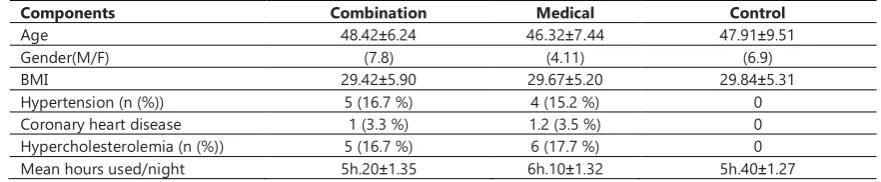
This case study is a quasi-experimental research with pretest and post-test design and a control group. Research population included 270 patients who referred to sleep disorders clinicsin Tehran in 2016.To conduct the study, 45 patients with sleep apnea were chosen using purposive sampling and were assigned to control and experimental groups. The participants’ demographic and clinical data are presented in Table 1.
Table 1.Demographic and clinical characteristics of study subjects with OSAD and controls
Components Combination Medical Control
Age 48.42±6.24 46.32±7.44 47.91±9.51
Gender(M/F) (7.8) (4.11) (6.9)
BMI 29.42±5.90 29.67±5.20 29.84±5.31
Hypertension (n (%)) 5 (16.7 %) 4 (15.2 %) 0
Coronary heart disease 1 (3.3 %) 1.2 (3.5 %) 0
Hypercholesterolemia (n (%)) 5 (16.7 %) 6 (17.7 %) 0 Mean hours used/night 5h.20±1.35 6h.10±1.32 5h.40±1.27
The criteria for inclusion were as follows: maximum age of 60 years, no psychotic and personality disorder, no substance abuse, lack of sleep medications, observing ethical principles, and willingness to cooperate. We implemented Wisconsin software, semantic stroke, emotional stroke and continuous performance.
The Wisconsin Card Classification Test is one of the most well-known neurological tests that measures abstract reasoning, cognitive flexibility, endurance, problem solving, and attention maintenance. This test was first developed by Berg (1948) and was revised by Heaton et al. (1993) [27].
The emotional stroop test's reliability was calculated at 0.92, and kappa coefficient was reported 0.83 [28]. The
reliability of semantic stroop was evaluated to be 83.5.[29]. The construct validity of CPT was assessed0.87 and
the reliability of the test was 0.89[30].
CBT-I was administered in a group setting with an experienced psychologist. The treatment lasted for seven sessions (90mins each) over 9 weeks, and in each session
we taught some psychological methods to our patients, including standard CBT-I and sleep hygiene, stimulus control, relaxation techniques, and sleep restriction.
In polysomnography, the following variables
were systematically monitored:
electroencephalogram (C3/A2, C4/A1, Fpz/ A1-A2, O1/A1), 2 electro-oculograms (right and left eye), chin and leg electromyograms, electrocardiogram (modified V2 lead), and a body position sensor. Respiration was monitored with a nasal cannula pressure transducer, an oral thermistor, a neck microphone, thoracic and abdominal piezoelectric belts, and finger pulse oximetry. The severity of OSA was determined through the results of the PSG.
CPAP is an accepted treatment that improves
neurocognitive performances and survival rates[31]. However,the treatment has high efficacy but low effectiveness, with refusalrates for adherence ranging from 5% to 50% in the first weekto 6 months[32]. Continued CPAP usage is best associated by reduced somnolence[33].
Results
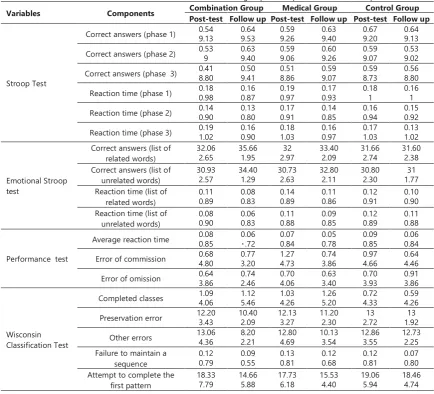
Table 2 provides the average pretest and post-test scores in the experimental and control groups. As can be seen, compared with the control group, the post-test scores of the experimental groups have been improved in all indices.
To examine the differences in the linear combination of dependent variables in the experimental and control groups, we drew on Wilks’ Lambda multivariate test (Table 3). The results of all four tests showed that after controlling the pretest factor, there was a significant difference in the linear combination of dependent variables; hence, the group factorwas seen to have a significant impact.
Table 4 illustrates the results of the intergroup effect test which can be used to examine the differences between each dependent variable. The results of Table 4 show that the mean scores of post-test have been significantly changed in all of the dependent variables except for the index of "correct responses (phase 2)".
Table 2. Mean and SD of research variables in three groups in the post-test and follow up
Variables Components Post-test Follow up Post-test Follow up Post-test Follow up Combination Group Medical Group Control Group
Stroop Test
Correct answers (phase 1) 0.54 9.13 0.64 9.53 0.59 9.26 0.63 9.40 0.67 9.20 0.64 9.13
Correct answers (phase 2) 0.539 0.63 9.40 0.59 9.06 0.60 9.26 0.59 9.07 0.539.02
Correct answers (phase 3) 0.41 8.80 0.50 9.41 0.51 8.86 0.59 9.07 0.59 8.73 0.56 8.80
Reaction time (phase 1) 0.18 0.98 0.16 0.87 0.19 0.97 0.17 0.93 0.18 1 0.16 1
Reaction time (phase 2) 0.14 0.90 0.13 0.80 0.17 0.91 0.14 0.85 0.16 0.94 0.15 0.92
Reaction time (phase 3) 0.19 1.02 0.16 0.90 0.18 1.03 0.16 0.97 0.17 1.03 0.13 1.02
Emotional Stroop test
Correct answers (list of related words)
32.06
2.65 35.661.95 2.9732 33.40 2.09 31.66 2.74 31.60 2.38 Correct answers (list of
unrelated words)
30.93
2.57 34.401.29 30.732.63 32.80 2.11 30.80 2.30 1.7731 Reaction time (list of
related words)
0.11
0.89 0.08 0.83 0.14 0.89 0.11 0.86 0.12 0.91 0.10 0.90 Reaction time (list of
unrelated words)
0.08
0.90 0.06 0.83 0.11 0.88 0.09 0.85 0.12 0.89 0.11 0.88
Performance test
Average reaction time 0.08 0.85 0.06 0.72 0.07 0.84 0.05 0.78 0.09 0.85 0.06 0.84
Error of commission 0.68 4.80 0.77 3.20 1.27 4.73 0.74 3.86 0.97 4.66 0.64 4.46
Error of omission 0.64 3.86 0.74 2.46 0.70 4.06 0.63 3.40 0.70 3.93 0.91 3.86
Wisconsin Classification Test
Completed classes 1.09 4.06 1.12 5.46 1.03 4.26 1.26 5.20 0.72 4.33 0.59 4.26
Preservation error 12.203.43 10.402.09 12.133.27 11.20 2.30 2.7213 1.9213
Other errors 13.064.36 8.202.21 12.804.69 10.13 3.54 12.86 3.55 12.73 2.25 Failure to maintain a
sequence 0.12 0.79 0.09 0.55 0.13 0.81 0.12 0.68 0.12 0.81 0.07 0.80 Attempt to complete the
first pattern
18.33
7.79 14.665.88 17.736.18 15.53 4.40 19.06 5.94 18.46 4.74
Table 3.Multivariate tests (Wilks’ Lambda statistics)
Test F Eta.
Stroop 8.996 .635
Emotional Stroop 18.210 .675
Performance 22.940 .650
WisconsinClassification 13.270 .668
Table 4.Intergroup effect test
Variables Dependent Variable F Sig. Eta
Stroop Test
Correct answers (phase 1) 3.586 .038 .166 Correct answers (phase 2) 2.745 .078 .132 Correct answers (phase 3) 4.963 .012 .216 Reaction time (phase 1) 21.672 .000 .546 Reaction time (phase 2) 27.528 .000 .605 Reaction time (phase 3) 52.080 .000 .743
Emotional Stroop test
Correct answers (list of related words) 54.602 .000 .742 Correct answers (list of unrelated words) 32.107 .000 .628 Reaction time (list of related words) 25.907 .000 .577 Reaction time (list of unrelated words) 28.547 .000 .600
Performance test
Average reaction time 74.160 .000 .792 Error of commission 23.476 .000 .546 Error of omission 11.719 .000 .375
Wisconsin Classification test
Completed classes 7.773 .000 .296 Preservation error 14.226 .000 .435
Other errors 57.396 .000 .756
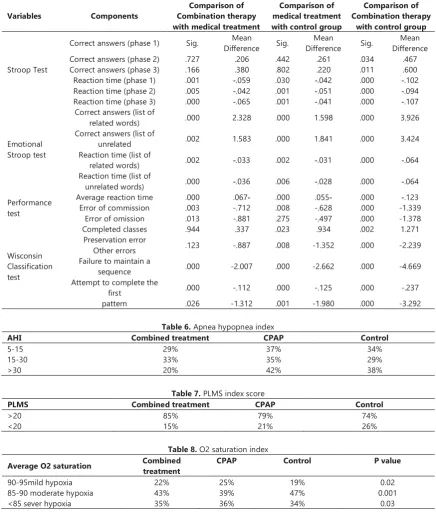
Apnea-hypopnea index in Combined treatment 29%, CPAP ABOUT 37% and in control group about 34% of people with 5-15, apnea-hypopnea index in Combined treatment 33%, CPAP ABOUT 35% and in control group about 29% of the apnea-hypopnea index were 15-30 and Apnea-apnea-hypopnea index in Combined treatment 20%, CPAP about 42% and in control group about 38% of people were over 30.
According to the results, 85% of Combined treatment the top 20 PLMS and 15 percent were under 20 PLMS. In the control group, 74% of the top 20 PLMS and 26% under 20 PLMS. In the CPAP group, 79% of the top 20 PLMS and 21% under 20 PLMS.
The tables in the attachment concern apneahypopnea index, PLMS index score, O2 saturation index, polysomnography results of the duration and quality of sleep, respiratory events, oximetry, snoring and arousal index, and PLMD in the case and control groups.
After ascertaining that the three groups had a normal distribution in terms of sleep efficacy (as shown by KS test), we used independent samples t-test to compare the results. It was revealed that the average sleep efficacy of the three groups have a significant difference (P < 0.05).
Since KS test did not provide a normal SOL distribution, the Mann-Whitney test was instead deployed to compare the results. Accordingly, no significant difference was seen in the average SOL of the three groups (p= 0.400).
Table 5.Bonferroni test comparing follow up mean of the indices studied in the three groups
Comparison of Combination therapy
with control group Comparison of
medical treatment with control group Comparison of
Combination therapy with medical treatment Components Variables Mean Difference Sig. Mean Difference Sig. Mean Difference Sig.
Correct answers (phase 1)
Stroop Test .467 .034 .261 .442 .206 .727
Correct answers (phase 2)
.600 .011 .220 .802 .380 .166
Correct answers (phase 3)
-.102 .000 -.042 .030 -.059 .001
Reaction time (phase 1)
-.094 .000 -.051 .001 -.042 .005
Reaction time (phase 2)
-.107 .000 -.041 .001 -.065 .000
Reaction time (phase 3)
3.926 .000 1.598 .000 2.328 .000
Correct answers (list of related words) Emotional Stroop test 3.424 .000 1.841 .000 1.583 .002
Correct answers (list of unrelated -.064 .000 -.031 .002 -.033 .002
Reaction time (list of related words) -.064 .000 -.028 .006 -.036 .000
Reaction time (list of unrelated words) -.123 .000 .055- .000 .067- .000
Average reaction time Performance
test Error of commissionError of omission .003.013 -.712-.881 .008.275 -.628-.497 .000.000 -1.339 -1.378 1.271 .002 .934 .023 .337 .944 Completed classes Wisconsin Classification test -2.239 .000 -1.352 .008 -.887 .123 Preservation error Other errors -4.669 .000 -2.662 .000 -2.007 .000
Failure to maintain a sequence -.237 .000 -.125 .000 -.112 .000
Attempt to complete the first -3.292 .000 -1.980 .001 -1.312 .026 pattern
Table 6. Apnea hypopnea index
AHI Combined treatment CPAP Control
5-15 29% 37% 34%
15-30 33% 35% 29%
>30 20% 42% 38%
Table 7. PLMS index score
PLMS Combined treatment CPAP Control
>20 85% 79% 74%
<20 15% 21% 26%
Table 8. O2 saturation index
Average O2 saturation Combined treatment CPAP Control P value
90-95mild hypoxia 22% 25% 19% 0.02
85-90 moderate hypoxia 43% 39% 47% 0.001
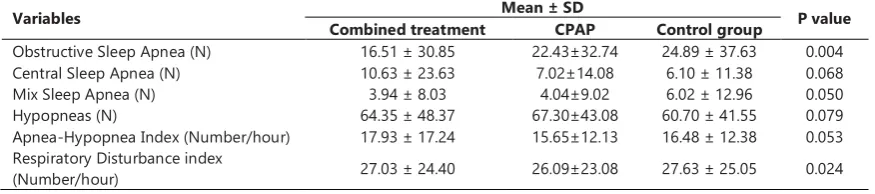
As the OSA of the three groups was normal on the basis of the KS test (p <0.05), T test was utilized to compare the three OSAs. The results suggest a significant difference in the average OSA of the groups (p> 0.05). Given that the CSA of the three groups was not normal as indicated by the KS test (p <0.05), we employed the Mann-Whitney test in order to compare the three CSAs. Based on the conducted tests, no significant difference was observed in the average CSA of the two groups (p>0.05).
Since MSA of the three groups was not normal as demonstrated by the KS test (p <0.05), Mann-Whitney test was chosen to compare the MSA of the two cases and control groups. The tests did not, however, show a significant difference in the average MSA of the two groups (p>0.05).
After it was indicated that the three groups had a normal hypopnea distribution (as shown by KS test), we used independent samples t-test to compare the results of the three groups, and it was proven that the average number of hypopneas of the three groups did not have a significant difference (p>0.05). Similarly, once the normal distribution of AHI of the three groups was observed (using KS test), independent samples t-test was employed to compare the results. Accordingly, a significant difference was noted in the average AHI of the three groups (p>0.05).
Since the RDI of the three groups was not normal (as shown by KS test) (p<0.05), Mann-Whitney test was used to compare the results. The tests did not, however, show a significant difference in the average RDI of the three groups (p>0.05).
Table 9. Polysomnography results of the duration and quality of Sleep in the case and control groups (Follow up)
Variables
Mean ± SD
P value Combined
treatment
CPAP Control group
Sleep onset latency (min.) 21.40 ± 19.91 19.20±13.62 13.29 ± 16.91 0.400 Sleep quality (%) 84.77 ±10.62 82.36±10.43 79.91 ±10.33 0.0561 S1 Phase (%) 15.96 ±17.73 17.65±16.42 23.85 ± 18.81 0.016* S2 Phase (%) 52.42 ± 16.87 53.17±13.81 55.15 ± 14.36 0.001 S3 Phase (%) 22.80 ± 14.62 17.94±13.02 14.87 ± 10.61 0.148 REM Phase (%) 11.15 ± 7.52 10.18±7.52 7.25 ± 7.52 0.003*
Number of REM 3.77 ± 1.62 4.4±1.96 3.21 ± 1.58 0.185
REM onset latency (min.) 121.67 ± 69.21 110.02±62.43 108.12 ± 58.40 0.974 Note. P < 0.05 values were considered significant.
Table 10.Polysomnography results of respiratory events in the case and control groups(Follow up) Variables Combined treatment Mean ± SDCPAP Control group P value Obstructive Sleep Apnea (N) 16.51 ± 30.85 22.43±32.74 24.89 ± 37.63 0.004 Central Sleep Apnea (N) 10.63 ± 23.63 7.02±14.08 6.10 ± 11.38 0.068 Mix Sleep Apnea (N) 3.94 ± 8.03 4.04±9.02 6.02 ± 12.96 0.050 Hypopneas (N) 64.35 ± 48.37 67.30±43.08 60.70 ± 41.55 0.079 Apnea-Hypopnea Index (Number/hour) 17.93 ± 17.24 15.65±12.13 16.48 ± 12.38 0.053 Respiratory Disturbance index
(Number/hour) 27.03 ± 24.40 26.09±23.08 27.63 ± 25.05 0.024 Note. P < 0.05 values were considered significant.
Since KS test did not show a normal average of O2 saturation for the two groups (p<0.05), Mann-Whitney test was used to compare the average O2 saturation. This time, however, the tests revealed a significant difference in the average O2 saturation of the three groups (p=0.047). Because KS test did not yield a normal average for the lowest O2 saturation of the groups (p<0.05), Mann-Whitney test was used to compare the average lowest O2 saturation in the three groups. Nevertheless, the tests displayed a significant difference in the average lowest O2 saturation of the three groups (p>0.05).
Discussion
The main purpose of this study was to investigate the effect of combination therapy in improving the cognitive skills of patients on follow up. Regarding the two indices of “correct answers (phase 1)” and “correct answers (phase 2),” it was found that the mean for combined treatment group was significantly higher than that of follow up
that both combined treatment and medical treatment displayed a significant effect, compared to the control group, and they clearly improved the subjects’ performance. Moreover, it was remarkable that combined treatment had a significantly better effect than medical treatment. Based on the indices of “average reaction time,” “commission error,” and “omission error,” subjects’ performance was better in both experimental groups than in the control group. Besides, combined treatment revealed a significantly greater performance than medical treatment.
This is in line with the results obtained byNejati et al.(2012) based on which meditation and mindfulness helps the regulation of emotional states and increases activity in the forehead while decreasingit in amygdala and insole areas. However, in Mohlman and Gorman’s study (2005),the amount of error and response time of the subjects decreased with increased cognitive functions.
Also, Hezareie et al.(2013)displayed the effectiveness of CBT treatment in improving the reaction time of the samples[34].
With respect to the indices of “completed classes” and “preservation error,” we found that subjects’ performance was significantly better in both experimental groups compared to the control group. Even so, although the performance of the combined treatment group was slightly better than the medical treatment group, this did not reveala significant difference. With regards to the three indices of “other errors,” “failure to maintain a sequence,” and “attempt to complete the first pattern,” it was demonstrated that both combined treatment and medical treatment had a significant effect, compared to the control group, in enhancingthe subjects’ performance. The combined treatmenthad a significantly better impact than medical treatment in this regard as well. The result of this part of the study is consistent with the research by Fazeli et al.(2015that confirmed the effect of cognitive-behavioral therapy on cognitive flexibility. In order to achieve cognitive flexibility, one must understand the complexity of the problem and frequently examine the problem, which requires a higher level of cognition, and mostly a patient with interruption is unable to solve these problems.
According to the results of this study, it seems that, in explaining the effectiveness of cognitive-behavioral therapy, training the skills of cognitive-behavioral therapy is helpful in terms of some executive functions such as attention, reaction time, problem-solving strategies, and control of impulsive behaviors; an objective that can be attained through improving cognitive functioning or increasing cognitive abilities of individuals involved.Given that cognitive functions can be seriously impaired due to apnea, one may compensate for the defects resulting from the disease by properly taking advantage of cognitive-behavioral treatment as a regular therapeutic activity built upon cognitive principles. This seems an important suggestion because frequent sleep apneas might damage the performance of central neural system and the implementation of many cognitive tasks.Thus, it is proposed that if one effectively learns cognitive control
skills and sleep hygiene strategies, his neural system and cognitive performance will improve accordingly. This is due to the fact that one of the goals of cognitive-behavioral treatment is to make life style interventions so as to enhance recovery and increase cognitive performance.
Shiri et al.(2016) demonstrated that cognitive-behavioral therapy improves the health and quality of sleep in patients. In the same vein, in Mothghi’sresearch(2016), cognitive-behavioral therapy improved the general quality of sleep in the elderly who showed signs of sleep disorder.Abdolahi et al.(2015)also proposed that CBT is effective in treating insomnia in patients.
Our research iscomparable withDastani et al.’s study (2011) which compared drug therapy and behavioral therapy in women with insomnia.Based on their findings, both psychological and medical interventions could improve sleep quality and insomnia. Comparisons between the two kinds of interventions showed that psychological interventions are more effective than medical intervention.
Although the CBT treatmentbasically focuses on changing the content of thought and cognitive processes. Practically the major emphasis in our treatment was on a number of central issues related to patients’ daily life such as sleep hygiene, emotional self-regulation, increasing cognitive flexibility, and controlling as well as coordinating behavior.
Conclusion
The study revealed that both medical approach and combined treatment are effective in treating apnea symptoms. However, upon comparison, it was observed that the efficacy of combined treatment was significantly greater than medical treatment in follow up.
Indeed, despite the benefits of cognitive-behavioral therapy in improving sleep quality, sleep disorders are often addressed by physicians, and psychologists only occasionally deal with them. Notwithstanding the psychological complications of this disorder, seldom are sleep medicine specialists familiar with the methods of treatment. Thus, it appears that increasing the knowledge of specialists with regard to the efficacy of cognitive-behavioral methods and encouraging psychologists to cooperate with physicians at sleep clinics will lead to obtaining better results in treating sleep disorders. Besides, one may use this method in sleep clinics as a complement to medical treatment.
References
1. Ağargün MY, Kara H, Anlar Ö. The validity and reliability of the Pittsburgh Sleep Quality Index. Turk Psikiyatri Derg. 1996;7(2):107-15.
2. Buysse DJ, Reynolds CF, Kupfer DJ, Thorpy MJ. Clinical diagnoses in 216 insomnia patients using the International Classification of Sleep Disorders (ICSD), DSM-IV and ICD-10 categories: a report from the APA/NIMH DSM-IV Field Trial. Sleep: Journal of Sleep Research & Sleep Medicine. 1994. 3. Alhola P, Polo-Kantola P. Sleep deprivation: Impact on
4. Lal C, Strange C, Bachman D. Neurocognitive impairment in obstructive sleep apnea. CHEST Journal. 2012;141(6):1601-10. 5. Incalzi RA, Marra C, Salvigni BL, Petrone A, Gemma A, Selvaggio D, et al. Does cognitive dysfunction conform to a distinctive pattern in obstructive sleep apnea syndrome? Journal of sleep research. 2004;13(1):79-86.
6. Dorrian J, Rogers NL, Dinges DF. Psychomotor vigilance performance: Neurocognitive assay sensitive to sleep loss: Marcel Dekker New York; 2005.
7. Gagnon K, Baril A-A, Gagnon J-F, Fortin M, Decary A, Lafond C, et al. Cognitive impairment in obstructive sleep apnea. Pathologie Biologie. 2014;62(5):233-40.
8. Lojander J, Kajaste S, Maasilta P, Partinen M. Cognitive function and treatment of obstructive sleep apnea syndrome. Journal of sleep research. 1999;8(1):71-6.
9. Findley LJ, Barth JT, Powers DC, Wilhoit SC, Boyd DG, Suratt PM. Cognitive impairment in patients with obstructive sleep apnea and associated hypoxemia. CHEST Journal. 1986;90(5):686-90.
10. Lindberg E. Epidemiology of OSA. 2010.
11. Morin C, Blais F, Savard J. Are changes in beliefs and attitudes about sleep related to sleep improvements in the treatment of insomnia? Behaviour research and therapy. 2002;40(7):741-52. 12. Saunamäki T, Jehkonen M. Depression and anxiety in
obstructive sleep apnea syndrome: a review. Acta Neurologica Scandinavica. 2007;116(5):277-88.
13. Iranzo A, Santamaria J. Severe obstructive sleep apnea/hypopnea mimicking REM sleep behavior disorder. Sleep. 2005;28(2):203-6.
14. Meyer JS, Sakai F, Karacan I, Derman S, Yamamoto M. Sleep apnea, narcolepsy, and dreaming: regional cerebral hemodynamics. Annals of neurology. 1980;7(5):479-85. 15. Bandura A. Human agency in social cognitive theory. American
psychologist. 1989;44(9):1175.
16. Bandura A, Walters RH. Social learning theory. 1977. 17. Espie CA, Inglis SJ, Harvey L. Predicting clinically significant
response to cognitive behavior therapy for chronic insomnia in general medical practice: Analyses of outcome data at 12 months posttreatment. Journal of Consulting and Clinical Psychology. 2001;69(1):58.
18. Richards D, Bartlett DJ, Wong K, Malouff J, Grunstein RR. Increased adherence to CPAP with a group cognitive behavioral treatment intervention: a randomized trial. SLEEP-NEW YORK THEN WESTCHESTER-. 2007;30(5):635.
19. Sharafkhaneh A, Richardson P, Hirshkowitz M. Sleep apnea in a high risk population: a study of Veterans Health Administration beneficiaries. Sleep medicine. 2004;5(4):345-50.
20. Sharafkhaneh A, Giray N, Richardson P, Young T, Hirshkowitz M. Association of psychiatric disorders and sleep apnea in a large cohort. SLEEP-NEW YORK THEN WESTCHESTER-. 2005;28(11):1405.
21. Bardwell WA, Moore P, Ancoli-Israel S, Dimsdale JE. Fatigue in obstructive sleep apnea: driven by depressive symptoms instead of apnea severity? American Journal of Psychiatry. 2003;160(2):350-5.
22. Baran AS, Richert AC. Obstructive sleep apnea and depression. CNS spectrums. 2003;8(02):128-34.
23. Aloia M, Arnedt J, Stepnowsky C, Hecht J, Borrelli B. Predicting treatment adherence in obstructive sleep apnea using principles of behavior change. Journal of clinical sleep medicine: JCSM: official publication of the American Academy of Sleep Medicine. 2005;1(4):346-53.
24. Bourke R, Anderson V, Yang JS, Jackman AR, Killedar A, Nixon GM, et al. Cognitive and academic functions are impaired in children with all severities of sleep-disordered breathing. Sleep medicine. 2011;12(5):489-96.
25. Golay A, Girard A, Grandin S, Métrailler J-C, Victorion M, Lebas P, et al. A new educational program for patients suffering from sleep apnea syndrome. Patient education and counseling. 2006;60(2):220-7.
26. Tyrrell J, Poulet C, Pe J-L, Veale D. A preliminary study of psychological factors affecting patients' acceptance of CPAP therapy for sleep apnoea syndrome. Sleep medicine. 2006;7(4):375-9.
27. Bowden SC, Fowler KS, Bell RC, Whelan G, Clifford CC, Ritter AJ, et al. The reliability and internal validity of the Wisconsin Card Sorting Test. Neuropsychological Rehabilitation. 1998;8(3):243-54.
28. Siegrist M. Test-retest reliability of different versions of the Stroop test. The Journal of Psychology. 1997;131(3):299-306. 29. Augustinova M, Ferrand L. Suggestion does not de-automatize
word reading: Evidence from the semantically based Stroop task. Psychonomic Bulletin & Review. 2012;19(3):521-7.
30. Rosvold HE, Mirsky AF, Sarason I, Bransome Jr ED, Beck LH. A continuous performance test of brain damage. Journal of consulting psychology. 1956;20(5):343.
31. McFadyen T, Espie C, McArdle N, Douglas N, Engleman H. Controlled, prospective trial of psychosocial function before and after continuous positive airway pressure therapy. European Respiratory Journal. 2001;18(6):996-1002.
32. Engleman HM, Wild MR. Improving CPAP use by patients with the sleep apnoea/hypopnoea syndrome (SAHS). Sleep medicine reviews. 2003;7(1):81-99.
33. Engleman HM, Asgari-Jirhandeh N, McLeod AL, Ramsay CF, Deary IJ, Douglas NJ. Self-reported use of CPAP and benefits of CPAP therapy: a patient survey. Chest. 1996;109(6):1470-6. 34. Hezareie D, Rasoolzade K, Moradi A, Ebrahimabad A.