Study on Bending Damage of Intra-Ply Basalt/Nylon
Hybrid Composites
Soheila Ahmadi-Vamakani, Hooshang Nosraty, and Majid Tehrani-Dehkordi
*Abstract- Basalt fiber offers an economic alternative to carbon fiber for the manufacture of composite parts. In this research, homogenous and intra-ply hybrid composites of basalt and nylon fibers have been produced in order to investigate the effects of bending speed and fiber volume ratio on the bending damage of composite structure. Five different types of woven fabric as reinforcement and different volume percentages of nylon including 0, 25, 33.33, 50 and 100% were used. All composites consisted of six-ply laminates were prepared using hand lay-up method. Three-point bending test was used in this research. The residual tensile strength values was employed in order to study the amount of bending damage of samples. The results demonstrated the highest residual tensile strength for the samples containing 33.33, 50 and 100% nylon fiber. Also, with increasing bending speed, the influence of the content of nylon and basalt on the residual tensile strength became more and more important.
Keywords: residual tensile strength, bending damage, intra-ply hybrid, basalt, nylon
I. INTRODUCTION
T
he development of composite materials and related manufacturing technologies is one of the most important advances in the history of materials. Composites are recognized as multifunctional materials with unique physical and mechanical properties that can be tailored for a particular application [1].Composites are multi-component structures comprised
of two or more constituent materials with significantly
different properties which results in better properties than the components individually [1-4]. In general, there are two main categories of constituent materials: matrix and reinforcement. The reinforced phase provides the
S. Ahmadi-Vamakani and H. Nosraty
Department of Textile Engineering, Amirkabir University of Technology, Tehran, 15914, Iran.
M. Tehrani-Dehkordi
Department of Art, Shahrekord University, Shahrekord, 56811-88617, Iran.
Correspondence should be addressed to M. Tehrani-Dehkordi e-mail: [email protected]
strength and stiffness of the composite. In most cases, the
reinforcement materials usually comprised of fibers or
particles are harder, stronger, and stiffer than the matrix. Matrix is a continuous phase in the composite structure which is a polymer, metal, or ceramic. This continuous phase performs several critical functions such as maintaining the
fibers in the proper orientation and protecting them from
abrasion and some other mechanical damages [4].
In the case of polymer composite design and manufacturing technologies, hybrid composites can
be found in numerous scientific research fields. For
producing hybrid composites, three different constructions are employed: 1. one kind of reinforcement material incorporated in a mixture of several matrices; 2. two or
more reinforcement and filling materials embedded in a
single matrix; and 3. also, it can be possible to produce a hybrid composite using the combination of the two previous instructions [5]. Physical and mechanical properties of hybrid composites depend on different
parameters including fibers length, fiber ratio in blends, fibers orientation and the extent of the fibers intermingling [6]. The problem of selecting the type of compatible fibers
and the level of their properties is of the prime importance for designing and producing hybrid composites [7].
Various researchers have tried blending of two different
fibers in order to achieve the best utilization of the positive attributes of one fiber in a composite [8]. As an inorganic fiber, basalt fiber has a good compressive strength, tensile
strength and modulus. Some investigators claimed that these properties are better than those of glass [9–11].
Besides good mechanical properties, basalt fibers have high
thermal stability, and good electrical and sound insulating
properties. Basalt fibers have much better chemical resistance than glass fibers, especially in strong alkalis [9]. Due to the mentioned properties, basalt fibers are more and
more widely studied and used in polymer composites area. It should be noted that in spite of these advantages, basalt
composites–like other brittle fiber composites–have low
resistance under impact loading [12].
low weight, high fatigue strength, chemical resistance and etc. But besides all these advantages, composite materials have low resistance under impact loading which can cause
several damages including matrix cracks or fiber breakage.
This in turn, results in structural stiffness reduction, leading
to growth of damages and reduces the composite efficiency
[13]. In many investigations, the impact properties of polymer composites with inorganic brittle reinforcements,
such as carbon, glass or basalt fibers, tried to be improved by mixing them with more ductile organic fibers, such as
aramid, polyester or nylon.
One of the most important purposes of using the hybrid composites is to combine the good mechanical property of
brittle fibers with the excellent bending resistance of ductile fibers [13-15]. Epoxy resin is commonly used as matrix
phase in hybrid composites. Srivastav and Cicala [16,17] studied the mechanical properties and behavior of hybrid composites under impact loading, also Rao [18] studied the bending and compressive properties of hybrid composites that epoxy resin was used as matrix in those composites.
Limited research has been performed on the hybrid
composites comprised of basalt and ductile fibers [12].
Szabo [19] investigated the mechanical properties of polypropylene-polyamide/basalt hybrid composites
comprised of different fiber blending ratios. Through their
researches, some parameters such as tensile properties, bending properties and the rigidity of composite were determined. Comparing the results of tensile, bending and
compressive properties of glass and basalt fibers obtained by Lopersto [20], revealed that the basalt fibers can be a promising alternative to the glass fibers as a reinforcing
material in composites. Todic [21] compared the properties
of particle polymer composites in order to produce a composite comprised of basalt and polymer matrix with better properties. Carmisciano [22] investigated the properties of reinforced composites using a basalt/glass woven fabrics and a vinyl-ester matrix.
In the composite manufacturing process, fibers
as reinforcement materials can be embedded in the composite structure in different forms. The most common multidirectional reinforcement form is woven fabric. The important characteristic of fabrics is their resistance to
micro-cracking (matrix splitting between fibers) which is very essential in composites application fields [23].
In the nineteenth century, natural formation of basalt
fibers known as Pele’s hair was described by the wind when it blows over molten volcanic lava [24]. Glass fiber, basalt
and silica products can be made to withstand temperatures from 1000-2000 °F [25]. In this research, ply-up woven
hybrid composite samples of basalt/nylon fibers have been
produced in order to investigate the effect of bending speed on the process of structural damaging of composite. Epoxy resin was used as matrix phase of composite samples.
Also, the effect of the amount of brittle fiber (basalt) on the
bending behavior of composite was studied.
II. EXPERIMENTAL
A. Materials and Sample Production
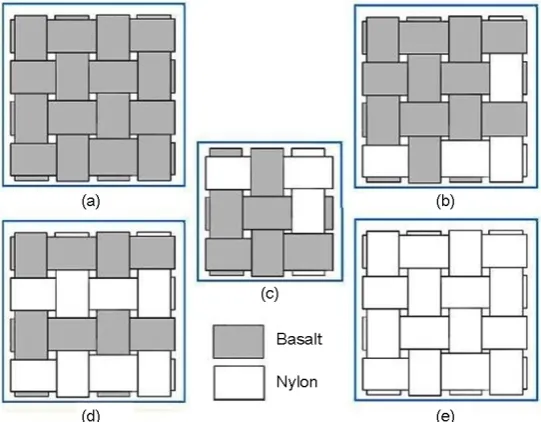
In this research, five homogeneous and hybrid fabric
samples comprised of different contents of basalt and nylon
fibers were produced using a rapier weaving machine. The volume fractions of basalt fiber in samples were chosen as
100, 75, 66.66, 50 and 0% based on the total amount of
fibers, as shown in Fig. 1. The fabric blend samples were
coded based on the percentage of basalt and nylon present in each sample blend. For example, the sample 66B33N consists of 66.66% basalt and 33.33% nylon in the warp and weft directions.
It should be noted that the prepared fabrics possess the same properties in both warp and weft directions. 800-tex basalt yarns and 372-tex nylon yarns were obtained from two different Chinese companies named Russia & Hengdian Group Shanghai Gold Basalt Fibers Co. and Junma Tyre
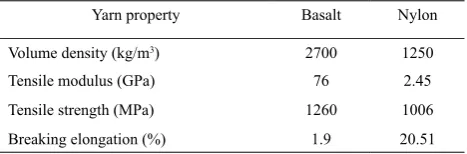
Cord Co., respectively. In Table I, some specifications of
basalt and nylon yarns are given.
Basalt/nylon homogenous and intra-ply hybrid composite samples were prepared in the Textile Research Center of Amirkabir University of Technology. Composites
consisting of six-ply laminates were prepared by hand lay-up method. As seen in Fig. 2, composites are coded according to their fabrics codes. Two types of laminates
were obtained: intra-ply hybrid laminates (A, B, C) and homogeneous laminates (M, N). Composite plates were laminated with the [(0,90)]3s stacking sequence. The
designation of (0/90) represents a single layer of woven fabric with the warp and weft fibers oriented in zero alignment. The ML-506 epoxy (about 28-36 wt%) was used as the resin matrix of composite. HA11 (about 5-7 wt%)
was added to the matrix resin as the hardener. Some properties of prepared composites are shown in Table II.
B. Mechanical Experiments
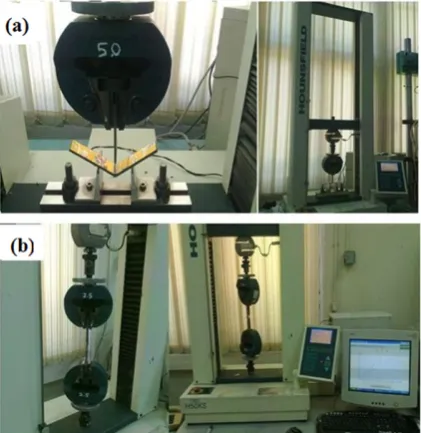
The samples were prepared according to ASTM D790-30 [26] before testing. An American bending test apparatus H25KS was used in this research. A view of the used bending test apparatus is shown in Fig. 3a.
Generally, two different bending tests methods are used to determine the bending properties of laminate composite structures known as 3-point and 4-point bending test. In this research, the 3-point bending method was chosen. It should be noted that the 3-point bending test method is commonly used for composites comprised of high modulus
TABLE I
BASALT AND NYLON YARNS SPECIFICATIONS USED IN SAMPLE PRODUCTION
Yarn property Basalt Nylon
Volume density (kg/m3) 2700 1250
Tensile modulus (GPa) 76 2.45
Tensile strength (MPa) 1260 1006
Breaking elongation (%) 1.9 20.51
fibers such as carbon and glass fibers [20]. Before the
bending test procedure, the distance between two clamps were adjusted at 50 mm. The bending experiments were conducted at different bending speeds (1.3, 50 and 100
mm/min) in order to analyze the effect of bending speed on
the structural damaging behavior of composites. After the bending test, all specimens were tensile tested to analyze how their strength was reduced by the bending damage. By using the tensile residual strength, the effects of nylon/
basalt fiber content on bending damage were studied in
detail. The residual tensile strength was calculated by the following expression:
(1) In the Eq. (1), R is the residual strength, T1 is the tensile
strength before bending and T2 is the tensile strength after
bending. An American tensile testing apparatus H50KS was used for performing tensile tests. The distance between the
fixed and movable clamps of tensile testing apparatus was
90 mm. The speed of the movable clamp was adjusted at
5 mm/min. A view of the used tensile test apparatus is shown in Fig. 3b.
C. Statistical Analysis
One-way analysis of variance (ANOVA) was used to compare the strength and residual strength between the five
homogenous and hybrid laminates. A P-value < 0.05 was
considered statistically significant.
III. RESULTS AND DISCUSSION
A. Bending Tests Results
Fig. 4 shows the bending stress vs. deflection curves for
the basalt/nylon hybrid composite samples at 1.3 mm/min bending speed which were bent 10 mm. In the sample
containing only basalt fibers, a linear increase in elongation
values can be observed with increasing bending stress. This trend is continued until the 60 percent of bending strength is reached and then the curve slope decreases. This indicates
that the elastic behavior of basalt fibers is in contrast to that of nylon fibers.
Nylon fibers have high breaking deflection, demons-
trating their viscoelastic behavior. This effect can be clearly observed in Fig. 4. As it is illustrated, the composite
samples containing only nylon fibers show high deflection
values even with a slight increase in applied loading. The properties of composite samples containing basalt/
nylon fibers blends are associated with the properties of
Fig. 3. (a) Bending test apparatus and (b) tensile testing apparatus.
TABLE II
SPECIFICATIONS OF COMPOSITES PREPARED IN THIS STUDY
Composite code Thickness (mm) Fibers volume ratio (%) Experimental density (kg/m3)
100B 3.90 54 1786
75B25N 4.39 62 1690
66B34N 4.42 66 1667
50B50N 5.35 53 1398
100N 4.67 61 1190
1 2 T R
T
=
Fig. 4. Bending strength-deflection curves of different composites at
both basalt and nylon fibers. In other word, the behavior of
basalt/nylon composites is resulted from the combination of the behaviors the composite samples containing pure basalt and pure nylon individually. It is understood from the results that after damaging the matrix (about 2 mm
deflection), by increasing basalt fiber content in all hybrids (except 50B50N sample) the composite strength increases. This in turn is because of the more strength of basalt fibers
compared to the nylon ones.
The stress-deflection behavior at 50 and 100 mm/min
bending speeds for the composite samples with different
basalt fiber loadings are illustrated in Figs. 5 and 6, respectively. As it is obvious in these figures, the results of
bending test performed at the speeds of 50 and 100 mm/min are as the same as those obtained from the previous experimental procedures.
Figs. 4-6 show that at different bending speeds, against our expectation, the 50B50N has the lowest bending strength which is smaller than 100N, due to the thicker
and lower fiber volume fraction of the 50B50N sample (Table II).
The bending strength values of several basalt/nylon hybrid composites at different bending speeds were compared and the obtained results are given in Fig. 7. The results of samples bending strength values were statistically analyzed.
The statistical investigations revealed that for 100B and
75B25N samples the bending strength values measured at 100 mm/min bending speed are higher than those measured at other speeds. It can be seen that, the differences between the values of bending strength of the 100B and 75B25N composite samples at two different bending speeds of 1.3
and 50 mm/min are not significant. In the samples containing 66% basalt fibers, the bending strengths measured at 50
and 100 mm/min bending speeds were the same; while the bending strength values of this sample measured at 1.3 mm/min are less than those measured at other speeds. This trend was observed for the samples 50B50N and 100N by
decreasing the basalt fibers loading.
The comparison of the values shown in Fig. 7 demonstrates that by increasing the loading speed from 1.3 to 100 mm/min, the bending strength increases considerably. It can be seen that, the ultimate bending strength values at 100 mm/min speed are 1.25, 1.10, 1.75, 1.62 and 2.62 times higher than those calculated at 1.3 mm/min for 100B, 75B25N, 66B33N, 50B50N and 100N samples, respectively. These observations are in agreement with the results of the investigation conducted by Sims [27] who investigated the effect of strain rate on the Fig. 5. Bending strength-deflection curves of different composites at
50 mm/min bending speed.
Fig. 6. Bending strength-deflection curves of different composites at
100 mm/min bending speed.
Fig. 7. Bending strength of basalt/nylon hybrid composites.
bending strength of glass mat/polyester laminates and reported increasing bending strengths over a wide range of displacement rates from 10-6 m/s to 10-1 m/s.
For the above observation, it is important to note that at high bending speed, the available time is very less for the failure to occur, thus the matrix may not properly be able to transfer the load which, leads to matrix cracking. However, at lower bending speed, more time is available for crack initiation and crack propagation to occur, which lead to ease of deterioration, causing the reduction in value of ultimate strength [28].
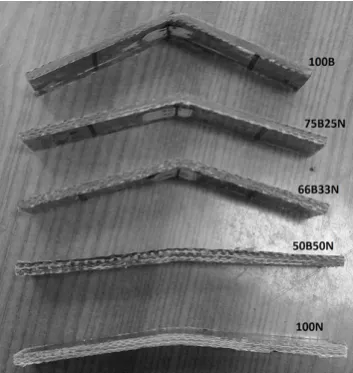
In Fig. 8, the effect of bending stress on the failure behavior of different composite samples tested at 100 mm/min bending speed is illustrated. The fracture strength of the
hybrid composites is lowered by increasing basalt fiber
content.
B. Tensile and Residual Tensile Strength Results
Fig. 9 shows the stress-strain behaviors of basalt/nylon hybrid composite samples. It can be seen that the
stress-strain curves of samples have two different stages: the first stage is related to the brittle behavior of basalt fibers which
indicates a low elongation through the tensile loading, and
the second stage is happened due to the flexible behavior of nylon fibers. A linear relation between the stress and
strain of 100% basalt composites is observed which, at the end of the curves the stress has dropped suddenly to zero.
This is because of elastic behavior of basalt fibers. Against, nylon fibers show viscoelastic behavior during the tensile
testing. The behavior of hybrid composites comprised
of basal/nylon fibers blend is a combination of the two previous cases. When the basalt fiber content in the blends
increases, the behavior of composite samples coming close
to the behavior of those containing only basalt fiber. For
example in Fig. 9, the behavior of 75B25N composites
is similar to that of samples containing only basalt fiber,
especially at low strain region. The low slope observed in
the stress-strain curve of 66B33N composite is because of
the viscoelastic behavior of nylon fibers. The results also
showed that the behavior of 50B50N composite is more similar to that of 100% nylon composite.
In Fig. 10, the results of tensile strength of composite samples measured at 100 mm/min bending speed are
illustrated. The results show a significant decrease in the
failure tensile strength of composites. By increasing the
nylon fiber content in the hybrid composites, the residual
tensile strength of samples has been improved.
The results from tensile testing shown in Fig. 11 reveal that by increasing the bending speed and basalt/nylon
fiber ratio, the composite samples are more damaged. The samples containing 100% basalt fibers experienced more damage compared to those containing 75% basalt fibers.
At higher bending speeds, more damage was observed in the composite samples, indicating the decrease in the residual tensile stress. The results of residual tensile stress at different bending speeds for other basalt/nylon hybrid
composite samples were not statistically significant.
As it is obvious in Fig. 11, for samples containing 100%
nylon fibers, the residual tensile stress values obtained
at different bending speeds are the same, which can be
attributed to the viscoelastic behavior of nylon fibers. With
increasing the content of nylon, the laminates became less
Fig. 10. Tensile stress-strain behavior of basalt/nylon hybrid composites after bending.
Fig. 9. Tensile stress-strain behavior of basalt/nylon hybrid composites
stiff and behaved as a ductile material. Also, in the high content of nylon, the nylon yarns prevent to damage the basalt yarns, and the specimens returned to their original
shape after bending (Fig. 8). Therefore, the integrity of
these composite samples could be maintained after bending.
IV. CONCLUSIONS
In this research, ply-up woven hybrid composite samples
of basalt/nylon fibers were produced in order to investigate
the effect of bending speed on composite structural
damaging. Also, the effect of basalt/nylon fiber ratio on
the bending behavior of the composites was studied. The results indicated that among different basalt/nylon hybrid composite samples, the samples containing only basalt
fibers showed the highest bending strength. The results of
tensile testing showed that the samples containing 33.33,
50 and 100% nylon fibers had the highest residual tensile
strength. With increasing bending speed, the effect of the content of nylon and basalt on the residual tensile strength became more and more important. It could be concluded
that the hybrid systems had positive and significant effects
on residual tensile strength of the brittle composite samples.
REFERENCES
[1] M. Kutz, Mechanical Engineers Handbook, vol. 1,
John Wiley & Sons, 2015.
[2] B. Harris, Engineering Composite Materials, The Institute of Materials, London, 1990.
[3] F.P. Gerstle, “Composites”, in Encyclopedia of Polymer Science and Engineering, New York: Wiley, 1991.
[4] F.C. Campbell, Structural Composite Materials: Introduction to Composite Materials, ASM International, 2010.
[5] M. Jawaid and H.P. Abdul-Khalil, “Cellulosic/
synthetic fiber reinforced polymer hybrid composites”,
Carbohydr. Polym., vol. 86, pp. 11–18, 2011.
[6] M.S. Sreekala, J. George, M.G. Kumaran, and S. Thomas, “The mechanical performance of hybrid phenol-formaldehyde-based composites reinforced
with glass and oil palm fibers”, Compos. Sci. Technol.,
vol. 62, no. 3, pp. 339-353, 2002.
[7] M.J. John and S. Thomas, “Bio-fibers and
bio-composites”, Sci. Direct Carbohydr. Polym., vol. 71, no. 3, pp. 343–364, 2008.
[8] G. Basu and A.N. Roy, “Blending of jute with different
natural fibers”, J. Nat. Fibre, vol. 4, no. 4, pp. 13-29, 2007.
[9] Q. Liu, H.S. Giffard, and M.T. Shaw, “Preliminary
investigation of basalt fiber composite properties for
applications in transportation”, Official Newslett. Inter. Inst. FRP Const., vol. 2, pp. 6–8, 2005.
[10] D. Pavlovski, B. Mislavsky, and A. Antonov, “CNG
cylinder manufacturers test basalt fiber”, J. Reinf. Plast. Compos., vol. 51, no. 4, pp. 36-37, 2007. [11] S.E. Artemenko, “Polymer composites materials made
from carbon, basalt and glass fibers, structures and
properties”, Fibre Chem., vol. 35, no. 3, pp. 226-229, 2003.
[12] X. Wang, “Low velocity impact properties of 3D-woven basalt/aramid hybrid composites”,
Compos. Sci. Technol., vol. 68, no. 2, pp. 444-450, 2008.
[13] M. Tehrani-Dehkordi, H. Nosraty, M.M. Shokrieh, G.
Minak, and D. Gelli, “The influence of hybridization
on impact damages behavior and residual compression strength of intra-ply basalt/nylon composites”, Mater. Des., nol. 43, pp. 283-290, 2013.
[14] R. Park and J. Jang, “The effect of hybridization on the mechanical performance of aramid/polyethylene intra-ply fabric composites”, Compos. Sci. Technol., vol. 58, pp. 1621-1628, 1995.
[15] M. Tehrani-Dehkordi, H. Nosraty, M.M. Shokrieh, G. Minak, and D. Gelli, “Low velocity impact properties of intra-ply hybrid composites based on basalt and nylon woven fabrics”, Mater. Des., vol. 31, no. 8, pp. 3835-3844, 2010.
[16] A.K. Srivastav, M.K. Behera, and B.C. Ray, “Loading rate sensitivity of jute/glass hybrid reinforced epoxy
composites effect of surface modifications”, J. Reinf. Plast. Compos., vol. 26, no. 9, pp. 851–860, 2007. [17] G. Cicala, G. Cristaldi, G. Recca, G. Zeigmann,
A. El-Sabbagh, and M. Dickert, “Properties and
performances of various hybrid glass/natural fiber
composites for curved pipes”, Mater. Des., vol. 30, no. 7, pp. 2538–2542, 2009.
[18] H.R. Rao, A.V. Rajulu, and G.R. Reddy, “Flexural and
compressive properties of bamboo and glass
fiber-reinforced epoxy hybrid composites”, J. Reinf. Plast. Compos., vol. 10, pp. 1446–1450, 2010.
[19] J.S. Szabo, Z. Kocsis, and T. Czigany, “Mechanical
properties of basalt fiber reinforced PP/PA blends”,
Period. Polytech. Chem., vol. 48, pp. 119–132, 2004. [20] V. Lopresto, C. Leone, and I. De-Iorio, “Mechanical
characterization of basalt fiber reinforced plastic”,
Compos. Part B-Eng., vol. 42, no. 4, pp. 717–723, 2011.
[22] S. Carmisciano, I.M. De Rosa, F. Sarasini, A.
Tamburrano, and M. Valente, “Basalt woven fiber reinforced vinyl-ester composites flexural and
electrical properties”, Mater. Des., vol. 32, no. 1, pp. 337-342, 2011.
[23] Z. Hashin, Theory of Composite Materials, NASA CR, 1972.
[24] N. Tucker, J. Stanger, and M.P. Staiger, “The history of the science and technology of electro spinning from 1600 to 1995”, J. Eng. Fibre Fab., vol. 7, pp. 63-73, 2012.
[25] Anon, “Engineered non-woven fabrics in automotive”,
Int. Non-woven J., vol. 11, no. 4, pp. 24-26, 2002.
[26] Standard test methods for flexural properties of
un-reinforced and un-reinforced plastics and electrical insulation, Annual Book of ASTM Standard, ASTM D790-03, 2003.
[27] G.D. Sims, “Understanding charpy impact testing of composite laminates”, In: Proceeding of 6th International Conference on Composite Materials,
Imperial College, London, UK; pp. 3494-3507, 1988. [28] I. Okoli, “The effects of strain rate and failure modes
on the failure energy of fibre reinforced composites”,